
the Creative Commons Attribution 4.0 License.
the Creative Commons Attribution 4.0 License.
 | 12 Dec 2025
Seasonal Variability and Cloud-Type Effects on Secondary Organic Aerosol Formation During Cloud Events at a Mountainous Site in Southeastern China
Abstract. Aerosol-cloud interactions exert substantial influences on atmospheric chemistry and regional climate, yet real-time characterization of chemical and microphysical evolution within cloud droplets remain limited. Here, two intensive campaigns were conducted at the high-altitude Shanghuang station in southeastern China during autumn 2023 and spring 2024, capturing distinct nocturnal orographic and long-persistence stratiform cloud events. Using a ground-based counterflow virtual impactor and an aerosol-cloud sampling inlet system along with integrated aerosol chemical speciation and cloud microphysical measurements, we resolved the composition of interstitial (INT), and residual (RES) particles during cloud events and ambient particles (AMB) under cloud-free conditions. Organic aerosols (OA) dominated particle mass across both seasons, while inorganic species (nitrate, sulfate, ammonium) exhibited high scavenging efficiencies (≥ 65–70 %) and strong enrichment in RES particles. Organic components showed seasonally contrasting partitioning patterns. Organics in INT particles exhibited a lower degree of oxidation during orographic clouds in 2023, whereas those in RES particles were more oxidized. In contrast, persistent clouds in 2024 displayed the opposite behaviour, reflecting shifts in aqueous-phase oxidation. Air-mass analysis further revealed pronounced source-dependent variability, with polluted westerly inflow leading to the highest particle loadings and most aged organic signatures. By linking chemistry with microphysics, we found that secondary organic aerosol formation preferentially occurs in smaller droplets, while OA from primary emissions is more efficiently incorporated into larger droplets through collision-coalescence. These results provide a quantitative, process-level understanding of seasonal and cloud-type controls on in-cloud chemical evolution, offering new constraints for representing aqueous-phase processing in atmospheric models.
Competing interests: At least one of the (co-)authors is a member of the editorial board of Atmospheric Chemistry and Physics.
Publisher's note: Copernicus Publications remains neutral with regard to jurisdictional claims made in the text, published maps, institutional affiliations, or any other geographical representation in this paper. While Copernicus Publications makes every effort to include appropriate place names, the final responsibility lies with the authors. Views expressed in the text are those of the authors and do not necessarily reflect the views of the publisher.-
Notice on discussion status
The requested preprint has a corresponding peer-reviewed final revised paper. You are encouraged to refer to the final revised version.
-
Preprint
(2820 KB)
-
Supplement
(2324 KB)
-
The requested preprint has a corresponding peer-reviewed final revised paper. You are encouraged to refer to the final revised version.
- Preprint
(2820 KB) - Metadata XML
-
Supplement
(2324 KB) - BibTeX
- EndNote
- Final revised paper


Journal article(s) based on this preprint
Interactive discussion
Status: closed
- RC1: 'Comment on egusphere-2025-5835', Anonymous Referee #1, 09 Feb 2026
-
RC2: 'Comment on egusphere-2025-5835', Anonymous Referee #2, 27 Feb 2026
This manuscript presents two cloud campaigns at a high-altitude site in southeastern China, combining cloud droplet separation with real-time ACSM and microphysical measurements. The dataset is clearly valuable, particularly the INT/RES separation across contrasting cloud regimes. Such measurements remain relatively limited, especially in this region.
The measurements themselves are strong. The discussion of scavenging efficiency and seasonal contrasts in OA composition is interesting. I tend to agree with Reviewer 1 that the manuscript would be more fit “Measurement Report”. At the same time, two aspects of the analysis would benefit from further clarification and strengthening before publication in ACP.
Q1. The analysis compares pre-cloud, formation, in-cloud, and dissipation stages, but mostly through averaged periods. However, the analysis remains largely based on averaged “formation” and “dissipation” stages rather than resolving the continuous chemical–microphysical evolution throughout the cloud lifecycle.
Given the availability of high time-resolution ACSM and other measurements, a process-resolved analysis would substantially strengthen the interpretation. For example: (1) How do OA factors evolve progressively with increasing LWC and droplet size? (2) Is there evidence of gradual in-cloud oxidation within RES particles? (3) Do chemical changes exhibit hysteresis between cloud formation and dissipation? (4) Is the reported enhancement of LO-OOA during dissipation progressive or abrupt?
Stage-averaged contrasts may obscure transient processes and potentially conflate chemical transformation with air mass variability. A time-resolved co-evolution analysis of LWC, droplet size, INT and RES composition, and OA factor dynamics for representative cases would considerably enhance the process-level insight of the study.
Q2. The manuscript attributes many differences between 2023 and 2024 to cloud-type contrasts. However, the two campaigns also differ in season, background aerosol composition, air mass patterns, and sampling systems. It therefore remains unclear whether the reported contrasts reflect intrinsic cloud-type controls or broader seasonal variability. A clearer separation between cloud-type effects and background differences would strengthen the attribution.
Citation: https://doi.org/10.5194/egusphere-2025-5835-RC2 -
AC1: 'Comment on egusphere-2025-5835', Yele Sun, 03 Apr 2026
The comment was uploaded in the form of a supplement: https://egusphere.copernicus.org/preprints/2025/egusphere-2025-5835/egusphere-2025-5835-AC1-supplement.pdf
Peer review completion


Interactive discussion
Status: closed
-
RC1: 'Comment on egusphere-2025-5835', Anonymous Referee #1, 09 Feb 2026
Overview
The study from Zhang et al presents results from measurement campaigns conducted in 2023 and 2024 in southeastern China in which they studied aerosol-cloud interactions. They measured both interstitial and residual particles during cloud events and compared those to ambient cloud-free conditions. They studied both aerosol size distributions and chemical composition. In addition to the detailed measurements, the novelty of the work lies in the location of the measurements (mountainous site in China).
General comments
The manuscript is very well written, and the methods and results are presented with all necessary details. My main concern is related to the interpretation of the results, or rather to the lack of final conclusions (your conclusions at the moment are more like a summary) and implications. Now, the manuscript reads more like a measurement report, and for example, the abstract does not mention anything related to the question of “what do these results imply” in a larger context. ACP accepts different manuscript types (ACP - Manuscript types), and measurement report is one of them. At the present form, therefore, I would recommend adjusting the manuscript into a proper measurement report i.e. adding it also to the manuscript title. This would require sharing the data fully online via DOI, not just upon request. Another option would be to adjust the abstract and conclusions sections to include more discussion on the importance and significance of these results for future research and whether the observations made in these campaigns have larger implications (and reflect on whether these observations agree/disagree with other similar measurements and why).
For example, lines 90-91 in the introduction are very general and cloud be added to many other manuscripts too presenting such measurements. I think more practical insights are necessary here (how is the understanding advanced, how can these results be used to constrain models and so on) unless going with the Measurement Report. The manuscript title also reads very report-like, and does not reveal anything about the actual results or implications.
Detailed comments
Line 42-43: The reference for the IPCC is from 2021, which was already 5 years ago. I would suggest deleting the word “recent” or adjust otherwise (i.e. change reference) to reflect this.
Line 106: Where do these limits (3km, 95%) come from /are based on when defining cloud events? Absence of precipitation is also mentioned, so I assume only non-precipitating clouds are studied, however later in lines 195 and onwards, you do mention precipitating cloud events too? Can you reflect on any of the differences regarding size distribution or composition for activated or interstitial aerosols for precipitating clouds? Can we expect those to be different from those arising from non-precipitating clouds?
Line 127: I have difficulties understanding this sentence. What do you mean by that the size range for every bin varies for different sizes? Do you mean the width of the size bin varies?
Line 130: How well does ERA5 correspond to the measured values at the site? I would assume large differences exist considering your site is located on a mountainous environment, thus having (potentially) large variation in the WD depending on where you measure. ERA5 does represent an average over larger gridbox, so might not be always representable.
Line 162: You mention orographic cloud events in few places. Consider explaining this out when mentioned first time for readers who are not familiar with this type of clouds / formation process. Later on (Line 165) you also bring up the persistent cloud events, please consider giving brief explanation on the differences and similarities of these.
Line 170: Wet scavenging process is rather abstract term, especially when you discuss about wet scavenging efficiency. Could you be a bit more specific on what wet scavenging process do your numbers you calculate reflect on? Is this now in-cloud removal via activation, below cloud removal or what?
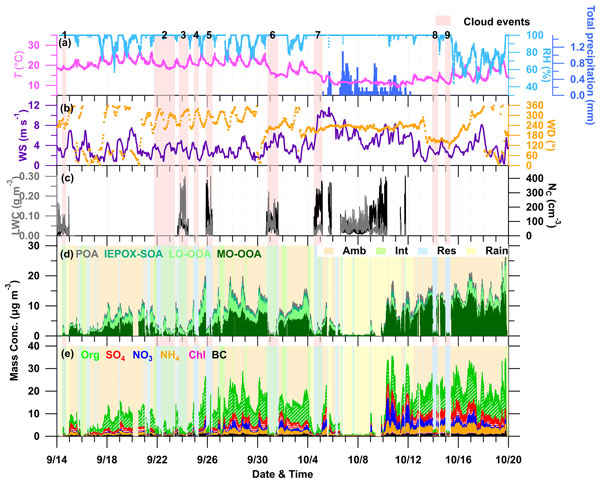
Figures 1-3 and others where you show bulk composition from AMS: I understand that the red-green-blue-orange-black colors are the ones traditionally used to present AMS data. However, the red-green combination is not very accommodating for the most common varieties of color vision deficiencies. ACP submission guidelines enforce this (ACP - Submission) and therefore I strongly recommend the authors to test their figures and select other color schemes or add perhaps line overlays to make the different colors distinguishable also for people with color vision deficiencies.
Line 228: What are the potential reasons for the more aged particles for 2024? Is this due to the different cloud events/types (orographic versus persistent)? You do mention the lifetime of the clouds later on in the paragraph, but could the reason be different origin of the aerosols between these two years?
Sect. 3.2: Ah I do see now that you have made some airmass comparisons here. So overall, just to confirm, your conclusion is that the air masses came from similar directions in the 2024 and 2023 campaign, and thus the differences I mentioned above are unlikely due to different airmasses/source regions?
Lines 285-294: Could you give numeric values for the scavenging efficiencies also here, at least for the species you explicitly mention? Maybe just reporting the averages you later show in Fig. 7? This way the reader does not have to go back and forth between the figure and text.
Figure 7 and Figure 8: You use different colors for 2023 and 2024, highlighting the comparison between those years. Is that your goal or is the main idea to compare the different cloud events (persistent versus orographic) which just happened to take place in different years? I would consider adding these cloud types to the figure alongside the observation years to mark this. After all, its not really the different years alone you are interested in but the very different clouds taking place those years. If it were the years, I would be expecting similar values which is not the case here.
Line 351: Results partly align, a little ambiguous. Where do they agree and where do they not?
Sect. 4: The conclusions are more like a summary of the results. I don’t oppose a summary, however, if aiming for something else than a measurement report, this would need to be expanded. Please see my general comment.
Citation: https://doi.org/10.5194/egusphere-2025-5835-RC1 -
RC2: 'Comment on egusphere-2025-5835', Anonymous Referee #2, 27 Feb 2026
This manuscript presents two cloud campaigns at a high-altitude site in southeastern China, combining cloud droplet separation with real-time ACSM and microphysical measurements. The dataset is clearly valuable, particularly the INT/RES separation across contrasting cloud regimes. Such measurements remain relatively limited, especially in this region.
The measurements themselves are strong. The discussion of scavenging efficiency and seasonal contrasts in OA composition is interesting. I tend to agree with Reviewer 1 that the manuscript would be more fit “Measurement Report”. At the same time, two aspects of the analysis would benefit from further clarification and strengthening before publication in ACP.
Q1. The analysis compares pre-cloud, formation, in-cloud, and dissipation stages, but mostly through averaged periods. However, the analysis remains largely based on averaged “formation” and “dissipation” stages rather than resolving the continuous chemical–microphysical evolution throughout the cloud lifecycle.
Given the availability of high time-resolution ACSM and other measurements, a process-resolved analysis would substantially strengthen the interpretation. For example: (1) How do OA factors evolve progressively with increasing LWC and droplet size? (2) Is there evidence of gradual in-cloud oxidation within RES particles? (3) Do chemical changes exhibit hysteresis between cloud formation and dissipation? (4) Is the reported enhancement of LO-OOA during dissipation progressive or abrupt?
Stage-averaged contrasts may obscure transient processes and potentially conflate chemical transformation with air mass variability. A time-resolved co-evolution analysis of LWC, droplet size, INT and RES composition, and OA factor dynamics for representative cases would considerably enhance the process-level insight of the study.
Q2. The manuscript attributes many differences between 2023 and 2024 to cloud-type contrasts. However, the two campaigns also differ in season, background aerosol composition, air mass patterns, and sampling systems. It therefore remains unclear whether the reported contrasts reflect intrinsic cloud-type controls or broader seasonal variability. A clearer separation between cloud-type effects and background differences would strengthen the attribution.
Citation: https://doi.org/10.5194/egusphere-2025-5835-RC2 -
AC1: 'Comment on egusphere-2025-5835', Yele Sun, 03 Apr 2026
The comment was uploaded in the form of a supplement: https://egusphere.copernicus.org/preprints/2025/egusphere-2025-5835/egusphere-2025-5835-AC1-supplement.pdf
Peer review completion
Journal article(s) based on this preprint
Viewed
| HTML | XML | Total | Supplement | BibTeX | EndNote | |
|---|---|---|---|---|---|---|
| 1,141 | 481 | 112 | 1,734 | 290 | 114 | 143 |
- HTML: 1,141
- PDF: 481
- XML: 112
- Total: 1,734
- Supplement: 290
- BibTeX: 114
- EndNote: 143
Viewed (geographical distribution)
| Country | # | Views | % |
|---|
| Total: | 0 |
| HTML: | 0 |
| PDF: | 0 |
| XML: | 0 |
- 1
Weiqi Xu

Yan Li
Guohua Zhang
Dantong Liu
Yu Zhang
Xiaocong Peng
Bojiang Su
Weihong Huang
Zijun Zhang
Liu Yang
Yangzhou Wu
Siyuan Li
Shitong Zhao
Lanzhong Liu
Xiaole Pan
Zifa Wang
Xinhui Bi
Mikael Ehn
Douglas R. Worsnop
The requested preprint has a corresponding peer-reviewed final revised paper. You are encouraged to refer to the final revised version.
- Preprint
(2820 KB) - Metadata XML
-
Supplement
(2324 KB) - BibTeX
- EndNote
- Final revised paper
Overview
The study from Zhang et al presents results from measurement campaigns conducted in 2023 and 2024 in southeastern China in which they studied aerosol-cloud interactions. They measured both interstitial and residual particles during cloud events and compared those to ambient cloud-free conditions. They studied both aerosol size distributions and chemical composition. In addition to the detailed measurements, the novelty of the work lies in the location of the measurements (mountainous site in China).
General comments
The manuscript is very well written, and the methods and results are presented with all necessary details. My main concern is related to the interpretation of the results, or rather to the lack of final conclusions (your conclusions at the moment are more like a summary) and implications. Now, the manuscript reads more like a measurement report, and for example, the abstract does not mention anything related to the question of “what do these results imply” in a larger context. ACP accepts different manuscript types (ACP - Manuscript types), and measurement report is one of them. At the present form, therefore, I would recommend adjusting the manuscript into a proper measurement report i.e. adding it also to the manuscript title. This would require sharing the data fully online via DOI, not just upon request. Another option would be to adjust the abstract and conclusions sections to include more discussion on the importance and significance of these results for future research and whether the observations made in these campaigns have larger implications (and reflect on whether these observations agree/disagree with other similar measurements and why).
For example, lines 90-91 in the introduction are very general and cloud be added to many other manuscripts too presenting such measurements. I think more practical insights are necessary here (how is the understanding advanced, how can these results be used to constrain models and so on) unless going with the Measurement Report. The manuscript title also reads very report-like, and does not reveal anything about the actual results or implications.
Detailed comments
Line 42-43: The reference for the IPCC is from 2021, which was already 5 years ago. I would suggest deleting the word “recent” or adjust otherwise (i.e. change reference) to reflect this.
Line 106: Where do these limits (3km, 95%) come from /are based on when defining cloud events? Absence of precipitation is also mentioned, so I assume only non-precipitating clouds are studied, however later in lines 195 and onwards, you do mention precipitating cloud events too? Can you reflect on any of the differences regarding size distribution or composition for activated or interstitial aerosols for precipitating clouds? Can we expect those to be different from those arising from non-precipitating clouds?
Line 127: I have difficulties understanding this sentence. What do you mean by that the size range for every bin varies for different sizes? Do you mean the width of the size bin varies?
Line 130: How well does ERA5 correspond to the measured values at the site? I would assume large differences exist considering your site is located on a mountainous environment, thus having (potentially) large variation in the WD depending on where you measure. ERA5 does represent an average over larger gridbox, so might not be always representable.
Line 162: You mention orographic cloud events in few places. Consider explaining this out when mentioned first time for readers who are not familiar with this type of clouds / formation process. Later on (Line 165) you also bring up the persistent cloud events, please consider giving brief explanation on the differences and similarities of these.
Line 170: Wet scavenging process is rather abstract term, especially when you discuss about wet scavenging efficiency. Could you be a bit more specific on what wet scavenging process do your numbers you calculate reflect on? Is this now in-cloud removal via activation, below cloud removal or what?
Figures 1-3 and others where you show bulk composition from AMS: I understand that the red-green-blue-orange-black colors are the ones traditionally used to present AMS data. However, the red-green combination is not very accommodating for the most common varieties of color vision deficiencies. ACP submission guidelines enforce this (ACP - Submission) and therefore I strongly recommend the authors to test their figures and select other color schemes or add perhaps line overlays to make the different colors distinguishable also for people with color vision deficiencies.
Line 228: What are the potential reasons for the more aged particles for 2024? Is this due to the different cloud events/types (orographic versus persistent)? You do mention the lifetime of the clouds later on in the paragraph, but could the reason be different origin of the aerosols between these two years?
Sect. 3.2: Ah I do see now that you have made some airmass comparisons here. So overall, just to confirm, your conclusion is that the air masses came from similar directions in the 2024 and 2023 campaign, and thus the differences I mentioned above are unlikely due to different airmasses/source regions?
Lines 285-294: Could you give numeric values for the scavenging efficiencies also here, at least for the species you explicitly mention? Maybe just reporting the averages you later show in Fig. 7? This way the reader does not have to go back and forth between the figure and text.
Figure 7 and Figure 8: You use different colors for 2023 and 2024, highlighting the comparison between those years. Is that your goal or is the main idea to compare the different cloud events (persistent versus orographic) which just happened to take place in different years? I would consider adding these cloud types to the figure alongside the observation years to mark this. After all, its not really the different years alone you are interested in but the very different clouds taking place those years. If it were the years, I would be expecting similar values which is not the case here.
Line 351: Results partly align, a little ambiguous. Where do they agree and where do they not?
Sect. 4: The conclusions are more like a summary of the results. I don’t oppose a summary, however, if aiming for something else than a measurement report, this would need to be expanded. Please see my general comment.