
the Creative Commons Attribution 4.0 License.
the Creative Commons Attribution 4.0 License.
 | 19 Nov 2025
Are ghost forests a substantial source of methane from reservoirs?
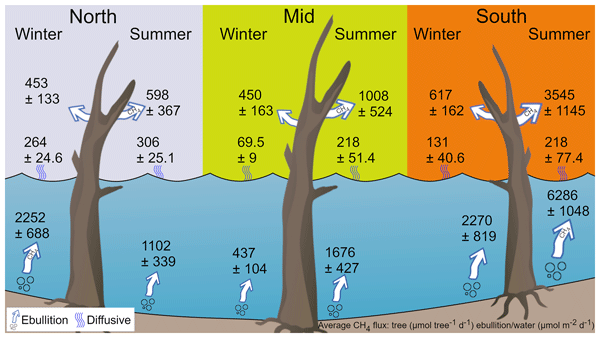
Abstract. Methane (CH4) is a potent greenhouse gas that is increasing in the atmosphere, being a major driver of climate change. Tree stem CH4 emissions are a rapidly advancing research field however emissions from dead trees remain poorly studied. This is of particular concern in reservoir "ghost forests", where large areas of standing dead trees can form, and remain submerged in CH4-enriched waters, providing a potential CH4-flux pathway along the soil-tree-atmosphere continuum, for many decades. This study quantified the drivers of seasonal CH4 and carbon dioxide (CO2) emissions from a ghost forest within a subtropical reservoir alongside diffusive and ebullition fluxes, across two seasons. We compared the influence of sediment organic carbon, water level and temperature fluctuations on ghost forest stem CH4 emissions, to the diffusive and ebullition flux pathways, at three within reservoir sites (North, Mid and South). The highest average ghost forest CH4 fluxes occurred near the reservoir inflow site (South) during summer (1173 ± 338 µmol m-2 stem d-1). At the same location the average CH4 fluxes from ghost forest trees and ebullition were significantly higher, 5.8 and 2.7 respectfully, during summer, compared to winter. Ghost forest CH4 fluxes contributed an additional ~15 % to the overall reservoir greenhouse gas budget, beyond conventional methods which generally only consider ebullition and diffusive flux pathways. Our findings reveal the need to recognise ghost forest CH4 emissions from reservoirs and encourage management strategies to balance CH4 mitigation with other ecological benefits of standing ghost forests.
-
Notice on discussion status
The requested preprint has a corresponding peer-reviewed final revised paper. You are encouraged to refer to the final revised version.
-
Preprint
(1592 KB)
-
Supplement
(349 KB)
-
The requested preprint has a corresponding peer-reviewed final revised paper. You are encouraged to refer to the final revised version.
- Preprint
(1592 KB) - Metadata XML
-
Supplement
(349 KB) - BibTeX
- EndNote
- Final revised paper


Journal article(s) based on this preprint
Interactive discussion
Status: closed
-
RC1: 'Comment on egusphere-2025-5594', Anonymous Referee #1, 30 Dec 2025
- AC1: 'Reply on RC1', Johannes Dittmann, 12 Mar 2026
-
RC2: 'Comment on egusphere-2025-5594', Anonymous Referee #2, 13 Feb 2026
Dittmann et al ask whether ghost forests are source of methane from reservoir. This is an important question considering the role of natural wetlands in the global methane budget and its implication in the rise of atmospheric methane
The quality of the manuscript can be improved. There is a difference between a student thesis, even an excellent one, and a scientific article, and guidance is needed to transform the former into the latter.
- The introduction does not present any clear research questions or hypotheses, which would be useful for structuring the discussion and writing the conclusion, as well as highlighting the originality of this research. The section “4.4 Comparison with other studies” would benefit from better integration by using these elements to discuss the results of the present study.
- CO2 is a “ghost” in the manuscript. It appears neither in the title nor in the state-of-the-art review, only once in the abstract but without any results, and in the first and last paragraphs of the introduction but without justification.It is found in several places in the "Methods" section, except for the subsection titles, and almost everywhere in the "Results" section, but only in certain parts of the discussion, which focuses primarily on CH4.Just because an analyzer can measure the concentrations of two gases does not mean that both gases must necessarily be mentioned.If the CO2 flux is significant, it should be introduced and discussed more thoroughly.Otherwise, it can simply be omitted.
- δ13C was measured but the results are missing, while they seem to be discussed. Or is the discussion based on published data (Martinez et al., 2022)? Clarification is needed.
- It is unclear how diffusive and ebullitive fluxes were separated. Ebullition can occur in the floating chambers that were used for measuring diffusive fluxes. In this case, the ebullitive fluxes are underestimated and the diffusive fluxes are overestimated. This is a critical point as ebullitive flux is the dominant CH4 source.
- Missing information in the Methods sections are listed as minor comments below. Overall, provide references for each method and each formula.
- It seems to be implied that the word "forest" is being used as a synonym for "tree," which is imprecise. Why not systematically replace "ghost forests" with "ghost forest trees" and "ghost forest stems " with "ghost forest tree stems "throughout the text, including the title?
Additional minor comments:
lines 86-87: This sentence is unnecessary, somewhat irrelevant.
lines 102-103: do not discuss the results in the method section
line 119: what means “phosphorus samples”. Is it soil samples for phosphorus determination
line 126: What is the function of "Hach, LDO101" in addition to its commercial reference?
line 137: δ13C in what?
line 140: provide details regarding the calculation of dissolved concentration from headspace concentration
line 142: The floating bubble traps should be described (dimension, geometry …)
line 176: the unit nmol/s is better than µmol/h for CH4 flux
line 189: a line break is needed
line 198: a line break is needed
lines 192-212: rewrite with a better structure to avoid duplication
line 226: The Shapiro-Wilk normality test is used to reject the null hypothesis of normality when P<0.05. The way this is written can be confusing. Furthermore, it is important to note that, like any other statistical test, it is designed to reject the null hypothesis, not to accept it. In other words, when the p value is below the threshold (e.g., 0.05, a commonly used value), the null hypothesis (here, normality) can be rejected. Conversely, when it is above this threshold, it is statistically incorrect to conclude that the null hypothesis is confirmed. This could just as easily mean that the test lacks power to reject it, and a few more repetitions would suffice. It is better to visually examine the data distribution rather than using a normality test. Also note that heteroscedasticity is probably more problematic than non-normality.
line 335: Do you mean “All trees at all stem heights”?
lines 432-433: Add references on the influence of orientation and bathymetry and explain how orientation and bathymetry account for the accumulation of organic carbon. Delete the sentence unless the link between this sentence and the following can be clarified.
line 466: affects?
line 479: BOD in full at first use
lines 486-487: I agree that your “summer results do not necessarily point to a wood source”, but I would expect a less wordy explanation that it “rather show the complexity of tree stem fluxes in such a dynamic system”.
line 566: 15% is maybe not so crucial, but still substantial (line 551)
All figure and table captions: add the number of replicates when it is missing and explain what the plus/minus is referring to.
Citation: https://doi.org/10.5194/egusphere-2025-5594-RC2 - AC2: 'Reply on RC2', Johannes Dittmann, 12 Mar 2026
Peer review completion


Interactive discussion
Status: closed
-
RC1: 'Comment on egusphere-2025-5594', Anonymous Referee #1, 30 Dec 2025
This paper addresses a relatively un-explored greenhouse gas flux pathways from reservoirs—specifically the role of dead standing trees, which the authors term “ghost forests”, as a conduit (and/or source) of methane. The authors study a subtropical reservoir whose dam wall height was raised in 2011, resulting in the death of trees around the reservoir perimeter (estimated to affect 20% of the reservoir surface area). The authors measured methane diffusion, ebullition, and dead tree flux in 3 regions of the reservoir (close to the inflow, mid-reservoir, and far from the inflow) during 2 seasons. They then estimate that ghost forests contribute about 15% of the total methane emissions. The study is a nice follow-up to a more qualitative discussion started by Abril et al. 2013 (Journal of South American Earth Sciences, https://www.sciencedirect.com/science/article/abs/pii/S0895981112001642), which could be discussed in the introduction. The authors borrow methods from studies of live and dead tree fluxes in other ecosystem types, but to my knowledge this is the first study specifically addressing flooded dead forests caused by dam impoundment. While the authors don’t mention it, the removal of trees and other vegetation prior to impoundment has been implemented prior to the closure of some dams, for a variety of purposes including to harvest usable timber before flooding or to reduce debris and hazards in the reservoir itself. This emphasizes the management relevance of the question.
Overall, this is a well thought out study with findings that will be of interest to the readership of Biogeosciences. I do not find any fatal flaws or have any major concerns, but list some suggestions and questions that I hope can improve the paper. From a writing clarity perspective, the paper could benefit from some editing, particularly in the discussion. I suggest opening the discussion with the most novel findings from this study (e.g. pertaining to ghost forest emissions). The discussion regarding the potential control of temperature on emission seems tangential to the questions you were asking in this study (and awkward to place at the very beginning of the discussion section).
While the title of the paper and upscaling exercise focus on methane, the authors also measured carbon dioxide fluxes. Is there a reason why the same upscaling exercise was not conducted for carbon dioxide (e.g. in Table 4)?
The upscaling of dead tree fluxes is tricky for a number of reasons that the authors discuss. One decision the authors made was to only consider the first 2.5 meters of exposed trunk above the reservoir surface as the emissive surface area. Do the authors have a reference to cite for this decision? Can they present a back of the envelope estimate considering a larger emission height to help the reader understand the impact of this decision?
A recent study also found that degassing flux may be a globally significant component of reservoir methane emissions (Harrison et al. 2021), but this pathway is not discussed here. Do the authors have a sense for whether the degassing from this reservoir may be significant?
Line by Line:
Line 10: change “being a major driver” to “driving”
Line 40: Could add lake littoral zones here as well. See: Desrosiers, K., T. DelSontro, and P. A. del Giorgio. 2022. Disproportionate Contribution of Vegetated Habitats to the CH4 and CO2 Budgets of a Boreal Lake. Ecosystems 25: 1522-1541, doi:10.1007/s10021-021-00730-9.
Line 85: I’m unfamiliar with the term “supply volume”, is this the reservoir capacity?
Line 184: The subtraction of diffusive flux seems unusual here. In my group, we don’t typically do this since the ebullition trap consists of a funnel with a very small surface area at the air-water interface. Please explain. Also, you may want to use a different term than “v” in equation 2 since it is referring to the volume of bubbles captured in the trap (rather than the headspace volume in the floating chamber).
Line 204 and throughout: The use of the term “aquatic flux” to refer to diffusive flux is confusing to me since I think of both ebullition and diffusion as types of aquatic fluxes. I encourage the authors to stick to the term “diffusive flux” throughout the paper.
Line 298: What do you mean by “between, within, and across”? It seems like you measured variability within a site as well as across sites. Not sure how the “between” and “across” are different from each other?
Figure 2: It is hard to see the ebullition trap in panel E very well, do you have a better photo?
Figure 6: I suggest considering a correction for tree flux that would allow you to compare the flux per m-2 of inundated surface area that the tree occupies. This was done in Amaral et al 2025 to facilitate easier comparison to diffusive and aquatic fluxes (Inland Waters: https://www.tandfonline.com/doi/full/10.1080/20442041.2024.2432804). In other parts of the paper when the authors report a m-2 flux for dead trees I think they are reporting per surface area of tree trunk, but I’m a bit unclear on that.
Line 337: Check this 8614 number, it looks like it is reported as 8613 in Table 3
Figure 8: I suggest keeping the color scale the same across the two panels so that the reader can more easily compare the magnitude of methane concentrations across the two seasons.
Line 404: change “resulting” to “resulted”
Line 424: Avoid switching the topic to methane mid paragraph. The topic sentence of the paragraph suggests that the paragraph should be focusing on carbon dioxide.
Line 451: Did you present your SOD results in the results section?
Table 5: Can you add the age of the forest to this table? And perhaps a description of the ecosystem?
Line 512: “One tree” not “On tree”
Line 547: add “and it” before “therefore”
Line 591: “We” not “I”
Citation: https://doi.org/10.5194/egusphere-2025-5594-RC1 - AC1: 'Reply on RC1', Johannes Dittmann, 12 Mar 2026
-
RC2: 'Comment on egusphere-2025-5594', Anonymous Referee #2, 13 Feb 2026
Dittmann et al ask whether ghost forests are source of methane from reservoir. This is an important question considering the role of natural wetlands in the global methane budget and its implication in the rise of atmospheric methane
The quality of the manuscript can be improved. There is a difference between a student thesis, even an excellent one, and a scientific article, and guidance is needed to transform the former into the latter.
- The introduction does not present any clear research questions or hypotheses, which would be useful for structuring the discussion and writing the conclusion, as well as highlighting the originality of this research. The section “4.4 Comparison with other studies” would benefit from better integration by using these elements to discuss the results of the present study.
- CO2 is a “ghost” in the manuscript. It appears neither in the title nor in the state-of-the-art review, only once in the abstract but without any results, and in the first and last paragraphs of the introduction but without justification.It is found in several places in the "Methods" section, except for the subsection titles, and almost everywhere in the "Results" section, but only in certain parts of the discussion, which focuses primarily on CH4.Just because an analyzer can measure the concentrations of two gases does not mean that both gases must necessarily be mentioned.If the CO2 flux is significant, it should be introduced and discussed more thoroughly.Otherwise, it can simply be omitted.
- δ13C was measured but the results are missing, while they seem to be discussed. Or is the discussion based on published data (Martinez et al., 2022)? Clarification is needed.
- It is unclear how diffusive and ebullitive fluxes were separated. Ebullition can occur in the floating chambers that were used for measuring diffusive fluxes. In this case, the ebullitive fluxes are underestimated and the diffusive fluxes are overestimated. This is a critical point as ebullitive flux is the dominant CH4 source.
- Missing information in the Methods sections are listed as minor comments below. Overall, provide references for each method and each formula.
- It seems to be implied that the word "forest" is being used as a synonym for "tree," which is imprecise. Why not systematically replace "ghost forests" with "ghost forest trees" and "ghost forest stems " with "ghost forest tree stems "throughout the text, including the title?
Additional minor comments:
lines 86-87: This sentence is unnecessary, somewhat irrelevant.
lines 102-103: do not discuss the results in the method section
line 119: what means “phosphorus samples”. Is it soil samples for phosphorus determination
line 126: What is the function of "Hach, LDO101" in addition to its commercial reference?
line 137: δ13C in what?
line 140: provide details regarding the calculation of dissolved concentration from headspace concentration
line 142: The floating bubble traps should be described (dimension, geometry …)
line 176: the unit nmol/s is better than µmol/h for CH4 flux
line 189: a line break is needed
line 198: a line break is needed
lines 192-212: rewrite with a better structure to avoid duplication
line 226: The Shapiro-Wilk normality test is used to reject the null hypothesis of normality when P<0.05. The way this is written can be confusing. Furthermore, it is important to note that, like any other statistical test, it is designed to reject the null hypothesis, not to accept it. In other words, when the p value is below the threshold (e.g., 0.05, a commonly used value), the null hypothesis (here, normality) can be rejected. Conversely, when it is above this threshold, it is statistically incorrect to conclude that the null hypothesis is confirmed. This could just as easily mean that the test lacks power to reject it, and a few more repetitions would suffice. It is better to visually examine the data distribution rather than using a normality test. Also note that heteroscedasticity is probably more problematic than non-normality.
line 335: Do you mean “All trees at all stem heights”?
lines 432-433: Add references on the influence of orientation and bathymetry and explain how orientation and bathymetry account for the accumulation of organic carbon. Delete the sentence unless the link between this sentence and the following can be clarified.
line 466: affects?
line 479: BOD in full at first use
lines 486-487: I agree that your “summer results do not necessarily point to a wood source”, but I would expect a less wordy explanation that it “rather show the complexity of tree stem fluxes in such a dynamic system”.
line 566: 15% is maybe not so crucial, but still substantial (line 551)
All figure and table captions: add the number of replicates when it is missing and explain what the plus/minus is referring to.
Citation: https://doi.org/10.5194/egusphere-2025-5594-RC2 - AC2: 'Reply on RC2', Johannes Dittmann, 12 Mar 2026
Peer review completion
Journal article(s) based on this preprint
Viewed
| HTML | XML | Total | Supplement | BibTeX | EndNote | |
|---|---|---|---|---|---|---|
| 2,177 | 949 | 210 | 3,336 | 257 | 157 | 238 |
- HTML: 2,177
- PDF: 949
- XML: 210
- Total: 3,336
- Supplement: 257
- BibTeX: 157
- EndNote: 238
Viewed (geographical distribution)
| Country | # | Views | % |
|---|
| Total: | 0 |
| HTML: | 0 |
| PDF: | 0 |
| XML: | 0 |
- 1
Johannes Dittmann

Damien T. Maher
Scott G. Johnston
Douglas R. Tait
Paula Gomez Alvarez
Alistar Grinham
Katrin Sturm
Luke C. Jeffrey
The requested preprint has a corresponding peer-reviewed final revised paper. You are encouraged to refer to the final revised version.
- Preprint
(1592 KB) - Metadata XML
-
Supplement
(349 KB) - BibTeX
- EndNote
- Final revised paper
This paper addresses a relatively un-explored greenhouse gas flux pathways from reservoirs—specifically the role of dead standing trees, which the authors term “ghost forests”, as a conduit (and/or source) of methane. The authors study a subtropical reservoir whose dam wall height was raised in 2011, resulting in the death of trees around the reservoir perimeter (estimated to affect 20% of the reservoir surface area). The authors measured methane diffusion, ebullition, and dead tree flux in 3 regions of the reservoir (close to the inflow, mid-reservoir, and far from the inflow) during 2 seasons. They then estimate that ghost forests contribute about 15% of the total methane emissions. The study is a nice follow-up to a more qualitative discussion started by Abril et al. 2013 (Journal of South American Earth Sciences, https://www.sciencedirect.com/science/article/abs/pii/S0895981112001642), which could be discussed in the introduction. The authors borrow methods from studies of live and dead tree fluxes in other ecosystem types, but to my knowledge this is the first study specifically addressing flooded dead forests caused by dam impoundment. While the authors don’t mention it, the removal of trees and other vegetation prior to impoundment has been implemented prior to the closure of some dams, for a variety of purposes including to harvest usable timber before flooding or to reduce debris and hazards in the reservoir itself. This emphasizes the management relevance of the question.
Overall, this is a well thought out study with findings that will be of interest to the readership of Biogeosciences. I do not find any fatal flaws or have any major concerns, but list some suggestions and questions that I hope can improve the paper. From a writing clarity perspective, the paper could benefit from some editing, particularly in the discussion. I suggest opening the discussion with the most novel findings from this study (e.g. pertaining to ghost forest emissions). The discussion regarding the potential control of temperature on emission seems tangential to the questions you were asking in this study (and awkward to place at the very beginning of the discussion section).
While the title of the paper and upscaling exercise focus on methane, the authors also measured carbon dioxide fluxes. Is there a reason why the same upscaling exercise was not conducted for carbon dioxide (e.g. in Table 4)?
The upscaling of dead tree fluxes is tricky for a number of reasons that the authors discuss. One decision the authors made was to only consider the first 2.5 meters of exposed trunk above the reservoir surface as the emissive surface area. Do the authors have a reference to cite for this decision? Can they present a back of the envelope estimate considering a larger emission height to help the reader understand the impact of this decision?
A recent study also found that degassing flux may be a globally significant component of reservoir methane emissions (Harrison et al. 2021), but this pathway is not discussed here. Do the authors have a sense for whether the degassing from this reservoir may be significant?
Line by Line:
Line 10: change “being a major driver” to “driving”
Line 40: Could add lake littoral zones here as well. See: Desrosiers, K., T. DelSontro, and P. A. del Giorgio. 2022. Disproportionate Contribution of Vegetated Habitats to the CH4 and CO2 Budgets of a Boreal Lake. Ecosystems 25: 1522-1541, doi:10.1007/s10021-021-00730-9.
Line 85: I’m unfamiliar with the term “supply volume”, is this the reservoir capacity?
Line 184: The subtraction of diffusive flux seems unusual here. In my group, we don’t typically do this since the ebullition trap consists of a funnel with a very small surface area at the air-water interface. Please explain. Also, you may want to use a different term than “v” in equation 2 since it is referring to the volume of bubbles captured in the trap (rather than the headspace volume in the floating chamber).
Line 204 and throughout: The use of the term “aquatic flux” to refer to diffusive flux is confusing to me since I think of both ebullition and diffusion as types of aquatic fluxes. I encourage the authors to stick to the term “diffusive flux” throughout the paper.
Line 298: What do you mean by “between, within, and across”? It seems like you measured variability within a site as well as across sites. Not sure how the “between” and “across” are different from each other?
Figure 2: It is hard to see the ebullition trap in panel E very well, do you have a better photo?
Figure 6: I suggest considering a correction for tree flux that would allow you to compare the flux per m-2 of inundated surface area that the tree occupies. This was done in Amaral et al 2025 to facilitate easier comparison to diffusive and aquatic fluxes (Inland Waters: https://www.tandfonline.com/doi/full/10.1080/20442041.2024.2432804). In other parts of the paper when the authors report a m-2 flux for dead trees I think they are reporting per surface area of tree trunk, but I’m a bit unclear on that.
Line 337: Check this 8614 number, it looks like it is reported as 8613 in Table 3
Figure 8: I suggest keeping the color scale the same across the two panels so that the reader can more easily compare the magnitude of methane concentrations across the two seasons.
Line 404: change “resulting” to “resulted”
Line 424: Avoid switching the topic to methane mid paragraph. The topic sentence of the paragraph suggests that the paragraph should be focusing on carbon dioxide.
Line 451: Did you present your SOD results in the results section?
Table 5: Can you add the age of the forest to this table? And perhaps a description of the ecosystem?
Line 512: “One tree” not “On tree”
Line 547: add “and it” before “therefore”
Line 591: “We” not “I”