
the Creative Commons Attribution 4.0 License.
the Creative Commons Attribution 4.0 License.
 | 24 Nov 2025
Unexpected quasi-independence of colored dissolved organic matter absorption from chlorophyll-a concentration in the Southern Ocean
Abstract. The absorption coefficient of colored dissolved organic matter (CDOM), ay, plays a critical role in driving ocean optical properties and so light attenuation and light-dependent biogeochemical cycles. In the Southern Ocean (SO), however, ay remains poorly documented because of the scarcity of in situ measurements and the absence of suitable bio-optical models. To address this gap, we derived ay in surface waters from the diffuse attenuation coefficient (Kd) derived from radiometric measurements performed by Biogeochemical-Argo floats. Sensitivity analyses indicated that the uncertainty of our estimates is mainly driven by Kd, with an overall ∼ 18 % uncertainty of ay at 380 and 412 nm based on a Monte Carlo approach. The relationships we obtained between ay and Chl in low-latitude waters are consistent with previous studies but diverge in the SO, with a much weaker dependence on Chl and a larger relative contribution to the absorption budget for clear waters. Possible reasons for this different contribution include CDOM release by sea ice melting, CDOM enrichment of surface layers through deep winter mixing, adaptation of phytoplankton physiology to cold waters and reduced photo degradation during the polar winter.
-
Notice on discussion status
The requested preprint has a corresponding peer-reviewed final revised paper. You are encouraged to refer to the final revised version.
-
Preprint
(5257 KB)
-
Supplement
(2164 KB)
-
The requested preprint has a corresponding peer-reviewed final revised paper. You are encouraged to refer to the final revised version.
- Preprint
(5257 KB) - Metadata XML
-
Supplement
(2164 KB) - BibTeX
- EndNote
- Final revised paper


Journal article(s) based on this preprint
Interactive discussion
Status: closed
-
RC1: 'Comment on egusphere-2025-5495', Emmanuel Boss, 30 Nov 2025
-
AC3: 'Reply on RC1', Juan Li, 27 Feb 2026
The comment was uploaded in the form of a supplement: https://egusphere.copernicus.org/preprints/2025/egusphere-2025-5495/egusphere-2025-5495-AC3-supplement.zip
-
AC3: 'Reply on RC1', Juan Li, 27 Feb 2026
-
CC1: 'Comment on egusphere-2025-5495', Simon Bélanger, 10 Jan 2026
General Comments:
This manuscript addresses the absorption of light by colored dissolved organic matter (CDOM, a_y) in Southern Ocean (SO) waters, a region characterized by strong turbulence, deep surface mixed layer and challenging sampling conditions. The topic is interesting and relevant, as it highlights a distinctive feature of the SO. By analyzing ARGO float data, the authors convincingly show that CDOM concentrations are significantly lower for low chlorophyll-a (Chla) concentrations in the SO compared to other oceanic regions. Below a Chla concentration of 0.1 mg m⁻³, the correlation between a_y and Chla becomes very weak. This finding may appear counterintuitive given that photobleaching processes are relatively inefficient in this region, where light levels are low and the mixed layer is very deep.
I appreciate the efforts of the authors relative to the method developed to estimate CDOM absorption from ARGO floats and the accuracy assessment they provided. This is a strong point.
The authors correctly point out the implications of this feature for the use of global empirical bio-optical relationships applied to satellite ocean color data, which could bias Chla estimates in the SO. The manuscript is generally well written, although there are numerous errors in the notation of symbols such as a_y and the mean cosine (μ_d), particularly in Section 2.
Specific Comments
- Introduction (lines 38–44): The introduction provides extensive details on OCRS algorithms for CDOM estimation, citing several approaches. At this stage, I expected the manuscript to focus on algorithm development, which is not the case. These details seem unnecessary if the main objective is not algorithm design. The key point is simply that if the SO has distinct CDOM levels, applying empirical algorithms developed for the global ocean is risky. Later (lines 51–53), the manuscript mentions the a_NAP versus b_bp relationship, which is not well known in the SO, but this is not directly related to CDOM and appears off-topic.
Moreover, given the inefficiency of photobleaching processes in the SO, one might expect CDOM accumulation in the absence of effective degradation mechanisms. In other words, the introduction is overly focused on OCRS algorithms and does not sufficiently emphasize the unique characteristics of the SO that could explain anomalies in the CDOM–Chla relationship ,which is the main topic of the current paper. I recommend citing relevant studies (such as Reynolds et al 2001; Siegel et al. JGR, 2005 – Independence and interdependencies among global ocean color properties: Reassessing the bio-optical assumption (see their Figure 7)), in the introduction that points toward different CDOM background in the SO relative to the global ocean. - Spatial Analysis: the manuscript would benefit from a more detailed spatial analysis of anomalies in the CDOM–Chla relationship. While a global relationship exists (Fig. 6), it is relatively weak, with substantial variability in a_y for a given Chla. Could the authors map anomalies (i.e., CDOM predicted by the global relationship versus CDOM observed by floats) to identify coherent spatial patterns? For example, regions with positive anomalies (+ CDOM per unit Chla) and others with negative anomalies (– CDOM per unit Chla, such as the SO). Figure 8 is a good starting point, but further spatial analysis (i.e. CDOM-anomaly maps) would provide valuable insights into CDOM dynamics.
- Discussion (Section 4.2): The discussion lacks depth regarding the interpretation of CDOM dynamics. The authors should explore potential mechanisms explaining the weak CDOM–Chla relationship and the low CDOM background in the SO compared to the global ocean. The absence of any reference to photobleaching processes, which play a key role in CDOM degradation at global scale, is a major gap. Previous studies (e.g., Fichot et al., 2023, Earth-Science Reviews, Fig. 14; Zhu PhD thesis, 2023; figures 3.5 and 3.6) have quantified photobleaching rates. Given that photobleaching is inefficient in the SO, microbial degradation likely plays a dominant CDOM removal role. In addition, the thickness of the mixed layer may also be critical. As Reynolds et al. (2001) noted: “The deep winter mixing is likely to limit the accumulation of a long-lived CDOM pool in the SO.” Long residence time of CDOM in the MLD likely favor long-term degradation of CDOM by microbes. Finaly, absence of terrigenous CDOM in the SO should also be clearly mentioned.
I strongly encourage the authors to expand Section 4.2 to address these points.
I attached the PDF with a few additional comments.
-
AC2: 'Reply on CC1', Juan Li, 27 Feb 2026
The comment was uploaded in the form of a supplement: https://egusphere.copernicus.org/preprints/2025/egusphere-2025-5495/egusphere-2025-5495-AC2-supplement.pdf
- Introduction (lines 38–44): The introduction provides extensive details on OCRS algorithms for CDOM estimation, citing several approaches. At this stage, I expected the manuscript to focus on algorithm development, which is not the case. These details seem unnecessary if the main objective is not algorithm design. The key point is simply that if the SO has distinct CDOM levels, applying empirical algorithms developed for the global ocean is risky. Later (lines 51–53), the manuscript mentions the a_NAP versus b_bp relationship, which is not well known in the SO, but this is not directly related to CDOM and appears off-topic.
-
RC2: 'Comment on egusphere-2025-5495', Anonymous Referee #2, 14 Jan 2026
Authors present analysis of differences in bio-optical properties between the low-latitude ocean and the Southern Ocean (SO) using many 1000's of BioARGO float profiles which include multispectral radiometers. Their focus is on relationships between colored dissolved organic matter (CDOM or a_y) and chlorophyll retrievals and show a rough independence between these two properties. From what I can tell, the analysis of deriving a_y spectra seems valid as supported by the sensitivity analyses presented. There is a lack of statistical rigor in the analyses presented and the discussion presented is neither insightful nor useful. I think that the paper could be a fine contribution to the literature once a couple of issues are resolved. These issues are delineated in the text that follows.
I found section 3.1 very confusing. First, I think the description of figure 2 is incorrect. The text and caption both state that what is plotted is the relative contributions of optical properties to equation 4, including a_y. But, the right hand side of equation 4 is a_y. So, this does not make any sense. I think what is plotted in figure 2 are the relative contributions that the various optical properties make to K_d.
Figure 3 is fine, showing invariance of several of the approaches to the retrieved a_y value. However, I do not understand what Table 2 is trying to communicate. Line 230 states that "K_d is the main contributor to differences in a_y" and cites Table 2, but I do not see how the "dispersion of the mean a_y" from the sensitivity analysis shown in Table 2 demonstrates that.
Section 3.2 shows differences in the K_d vs. Chl relationships from the low-latitude ocean and the Southern Ocean. The analysis presented is completely qualitative and needs to be more quantitative. I suggest that the authors assess whether there are statistically significant differences among the various relationships presented. The colors selected in figure 5 are very difficult to see (especially the yellow and white text).
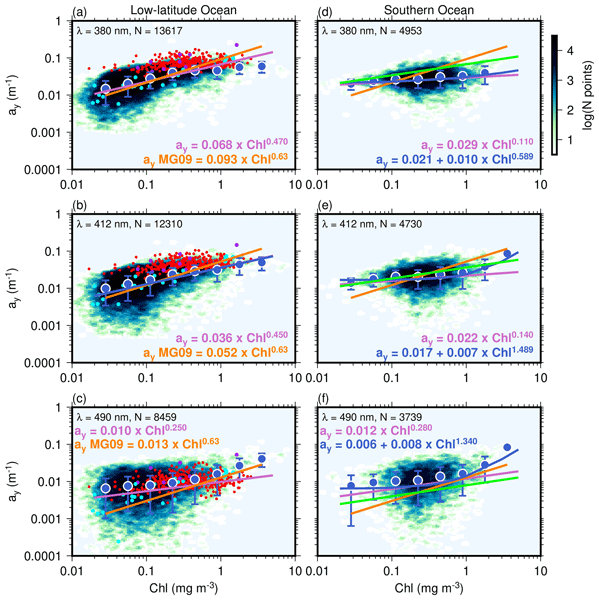
Section 3.3 (Figure 6) gets to differences in the relationships between a_y spectra and Chl concentrations. As in the last section, there is a lack of statistical rigor and the colors selected for the figure needs changing. The authors need to show that the differences commented upon are actually statistically significant. Most importantly, a test of independence between a_y and Chl would be that the derived power-law slope is not statistically different than zero. This result would prove the author's hypothesis in a compelling way.
As mentioned above, the discussion is very weak and does not get anywhere useful. The existing sections need to be further elaborated upon and expanded new points to be introduced. One suggestion would be to address previous work on why the SO bio-optical properties differ and satellite Chl values are underestimated compared with lower latitudes. Some researchers thought it was unusually low pigment normalized phytoplankton absorption spectra (Mitchell and others) or glacial flour changing particle backscattering (Dierssen) or differences in photochemical processes. This would help round out section 4.2. Also, you should read through Yamamoto et al. JGR (2024) which does a global analysis of CDOM sources and sinks that would help think about the processes that are creating and destroying CDOM and why the SO might be different.
Last, this is not the first time that Southern Ocean CDOM patterns have been addressed (see Ortega-Retuerta et al. 2010, there are likely others).
Citation: https://doi.org/10.5194/egusphere-2025-5495-RC2 -
AC1: 'Reply on RC2', Juan Li, 27 Feb 2026
The comment was uploaded in the form of a supplement: https://egusphere.copernicus.org/preprints/2025/egusphere-2025-5495/egusphere-2025-5495-AC1-supplement.pdf
-
AC1: 'Reply on RC2', Juan Li, 27 Feb 2026
Peer review completion


Interactive discussion
Status: closed
-
RC1: 'Comment on egusphere-2025-5495', Emmanuel Boss, 30 Nov 2025
Review of: ‘Unexpected quasi-independence of colored dissolved organic matter
absorption from chlorophyll-! concentration in the Southern Ocean’ by Li et al.
Reviewer: Emmanuel Boss, UMaine.
This paper investigates the relationship between CDOM (the absorbing part of DOM) and chlorophyll using BGC-Argo data. A simple bio-optical model to decompose the contributions to the diffuse attenuation of the measured irradiance is used with additional inputs from the chlorophyll fluorometer and backscattering sensors on the float. For each wavelength a CDOM estimate is computed and compared to chlorophyll to investigate how they relate both in the SO as well as further north.
The subject of the paper is very interesting and pertinent as there is currently a debate regarding the skill of remote sensing retrievals in the SO. Understanding why they may not work, such as if assumption in them are wrong, would help advance the science we can do from remote sensing in the SO by removing biases.
The paper is relatively clearly written though the notation/formatting could be significantly improved to avoid confusion and make it easier to read (for example CDOM, the subject of the paper, is written as a_y, ay and a_y, see attached pdf). Such sloppiness in the notation of the subject of the paper does not reflect well on the author (two of which I know well and are excellent and careful scientists).
I have some significant comments that I feel, if addressed, will significantly improve this manuscript. I am also returning an annotated PDF.
- I feel like there is no real closure in this paper. This could be done, for example by showing the degree of agreement between the different wavelengths when computing an a_y spectra. Since each radiometer is an independent sensor, it provides you an opportunity to test the quality of your retrieval for each profile. You only provide us the one estimate of the spectral slope of a_y for each region. It would be very informative to see it for each profile. It could be used by you as an independent quality check as CDOM slopes are well constraint in the literature. You could, for example, provide a histogram of a_y(380)/a_y(412), a_y(380)/a_y(490), and a_y(412)/a_y(490) (or their reciprocal), and compare to what is expected. You are making so many assumption (e.g. a_p to chl relationship, chl to Fchl relationship etc’) that it is hard to evaluate if your uncertainties are indeed as small as you think they are. This closure exercise will help determine it.
- Alternatively, you could use kd(490) and Fchl to constrain better chlorophyll (using a Xing like method) and then see if a_y(380) and a_y(412) are better related.
- The adjustment done to the chlorophyll and bbp is not well justified. It is hand waved. In addition, at low chl, Fchl could be significantly affected by CDOM (see another Xing paper) biasing your adjustment.
- Table 1 – not clear if you assume no uncertainties at 412 and 490 when they are not provided.
- You mix Discussion (or interpretation) into your Result while you provide two separate sections. I suggest, in particular because of the high uncertainties of your assumptions, that you clearly separate the two. Have the Result section be an objective description of what you found and use only the Discussion for speculation about the cause for your observation. Also, you may want to add a Summary section where you summarize the most important implication of what you found and suggest future work.
- It is not clear what Fig. 2 represent and how it is linked to Eq. 4. I suspect it is the relative contribution of different terms to (a+bb), but this is not what is written.
- The discussion relating Fig. 8 to DOC in the upper ocean is wrong. There is actually more DOC in low latitude compared to high latitudes (see Hansel, 2009, Oceanography). And, generally, CDOM and DOC do not correlate in the open ocean.
- The discussion regarding case 1 and case 2 could be more nuanced. Bricaud and Morel have a paper from 1981 showing decorrelation between chl and a_y. When I asked Morel he told me that locally one may see a lack of correlation but when one uses a large dynamic range from many contrasting oceanic environment, a general relationship may emerge. When looking at your data I see a huge spread around your best fit lines, with the lines being a poor representation of most of the data (e.g. if I had to predict a_y from [chl], even not in the SO, the likely error could be very large, to the point of being useless for many applications. Maybe if you used a heat map for your regression plot (with color being the concentration of datapoint of a given value one could see better how the relationship derived relate to the statistical distribution of the points and appreciate that the fits are much better than I claim here).
Dear authors: I am often wrong. If you feel that my comments are off the mark, please contact me and I would be happy to change them if convinced.
-
AC3: 'Reply on RC1', Juan Li, 27 Feb 2026
The comment was uploaded in the form of a supplement: https://egusphere.copernicus.org/preprints/2025/egusphere-2025-5495/egusphere-2025-5495-AC3-supplement.zip
-
CC1: 'Comment on egusphere-2025-5495', Simon Bélanger, 10 Jan 2026
General Comments:
This manuscript addresses the absorption of light by colored dissolved organic matter (CDOM, a_y) in Southern Ocean (SO) waters, a region characterized by strong turbulence, deep surface mixed layer and challenging sampling conditions. The topic is interesting and relevant, as it highlights a distinctive feature of the SO. By analyzing ARGO float data, the authors convincingly show that CDOM concentrations are significantly lower for low chlorophyll-a (Chla) concentrations in the SO compared to other oceanic regions. Below a Chla concentration of 0.1 mg m⁻³, the correlation between a_y and Chla becomes very weak. This finding may appear counterintuitive given that photobleaching processes are relatively inefficient in this region, where light levels are low and the mixed layer is very deep.
I appreciate the efforts of the authors relative to the method developed to estimate CDOM absorption from ARGO floats and the accuracy assessment they provided. This is a strong point.
The authors correctly point out the implications of this feature for the use of global empirical bio-optical relationships applied to satellite ocean color data, which could bias Chla estimates in the SO. The manuscript is generally well written, although there are numerous errors in the notation of symbols such as a_y and the mean cosine (μ_d), particularly in Section 2.
Specific Comments
- Introduction (lines 38–44): The introduction provides extensive details on OCRS algorithms for CDOM estimation, citing several approaches. At this stage, I expected the manuscript to focus on algorithm development, which is not the case. These details seem unnecessary if the main objective is not algorithm design. The key point is simply that if the SO has distinct CDOM levels, applying empirical algorithms developed for the global ocean is risky. Later (lines 51–53), the manuscript mentions the a_NAP versus b_bp relationship, which is not well known in the SO, but this is not directly related to CDOM and appears off-topic.
Moreover, given the inefficiency of photobleaching processes in the SO, one might expect CDOM accumulation in the absence of effective degradation mechanisms. In other words, the introduction is overly focused on OCRS algorithms and does not sufficiently emphasize the unique characteristics of the SO that could explain anomalies in the CDOM–Chla relationship ,which is the main topic of the current paper. I recommend citing relevant studies (such as Reynolds et al 2001; Siegel et al. JGR, 2005 – Independence and interdependencies among global ocean color properties: Reassessing the bio-optical assumption (see their Figure 7)), in the introduction that points toward different CDOM background in the SO relative to the global ocean. - Spatial Analysis: the manuscript would benefit from a more detailed spatial analysis of anomalies in the CDOM–Chla relationship. While a global relationship exists (Fig. 6), it is relatively weak, with substantial variability in a_y for a given Chla. Could the authors map anomalies (i.e., CDOM predicted by the global relationship versus CDOM observed by floats) to identify coherent spatial patterns? For example, regions with positive anomalies (+ CDOM per unit Chla) and others with negative anomalies (– CDOM per unit Chla, such as the SO). Figure 8 is a good starting point, but further spatial analysis (i.e. CDOM-anomaly maps) would provide valuable insights into CDOM dynamics.
- Discussion (Section 4.2): The discussion lacks depth regarding the interpretation of CDOM dynamics. The authors should explore potential mechanisms explaining the weak CDOM–Chla relationship and the low CDOM background in the SO compared to the global ocean. The absence of any reference to photobleaching processes, which play a key role in CDOM degradation at global scale, is a major gap. Previous studies (e.g., Fichot et al., 2023, Earth-Science Reviews, Fig. 14; Zhu PhD thesis, 2023; figures 3.5 and 3.6) have quantified photobleaching rates. Given that photobleaching is inefficient in the SO, microbial degradation likely plays a dominant CDOM removal role. In addition, the thickness of the mixed layer may also be critical. As Reynolds et al. (2001) noted: “The deep winter mixing is likely to limit the accumulation of a long-lived CDOM pool in the SO.” Long residence time of CDOM in the MLD likely favor long-term degradation of CDOM by microbes. Finaly, absence of terrigenous CDOM in the SO should also be clearly mentioned.
I strongly encourage the authors to expand Section 4.2 to address these points.
I attached the PDF with a few additional comments.
-
AC2: 'Reply on CC1', Juan Li, 27 Feb 2026
The comment was uploaded in the form of a supplement: https://egusphere.copernicus.org/preprints/2025/egusphere-2025-5495/egusphere-2025-5495-AC2-supplement.pdf
- Introduction (lines 38–44): The introduction provides extensive details on OCRS algorithms for CDOM estimation, citing several approaches. At this stage, I expected the manuscript to focus on algorithm development, which is not the case. These details seem unnecessary if the main objective is not algorithm design. The key point is simply that if the SO has distinct CDOM levels, applying empirical algorithms developed for the global ocean is risky. Later (lines 51–53), the manuscript mentions the a_NAP versus b_bp relationship, which is not well known in the SO, but this is not directly related to CDOM and appears off-topic.
-
RC2: 'Comment on egusphere-2025-5495', Anonymous Referee #2, 14 Jan 2026
Authors present analysis of differences in bio-optical properties between the low-latitude ocean and the Southern Ocean (SO) using many 1000's of BioARGO float profiles which include multispectral radiometers. Their focus is on relationships between colored dissolved organic matter (CDOM or a_y) and chlorophyll retrievals and show a rough independence between these two properties. From what I can tell, the analysis of deriving a_y spectra seems valid as supported by the sensitivity analyses presented. There is a lack of statistical rigor in the analyses presented and the discussion presented is neither insightful nor useful. I think that the paper could be a fine contribution to the literature once a couple of issues are resolved. These issues are delineated in the text that follows.
I found section 3.1 very confusing. First, I think the description of figure 2 is incorrect. The text and caption both state that what is plotted is the relative contributions of optical properties to equation 4, including a_y. But, the right hand side of equation 4 is a_y. So, this does not make any sense. I think what is plotted in figure 2 are the relative contributions that the various optical properties make to K_d.
Figure 3 is fine, showing invariance of several of the approaches to the retrieved a_y value. However, I do not understand what Table 2 is trying to communicate. Line 230 states that "K_d is the main contributor to differences in a_y" and cites Table 2, but I do not see how the "dispersion of the mean a_y" from the sensitivity analysis shown in Table 2 demonstrates that.
Section 3.2 shows differences in the K_d vs. Chl relationships from the low-latitude ocean and the Southern Ocean. The analysis presented is completely qualitative and needs to be more quantitative. I suggest that the authors assess whether there are statistically significant differences among the various relationships presented. The colors selected in figure 5 are very difficult to see (especially the yellow and white text).
Section 3.3 (Figure 6) gets to differences in the relationships between a_y spectra and Chl concentrations. As in the last section, there is a lack of statistical rigor and the colors selected for the figure needs changing. The authors need to show that the differences commented upon are actually statistically significant. Most importantly, a test of independence between a_y and Chl would be that the derived power-law slope is not statistically different than zero. This result would prove the author's hypothesis in a compelling way.
As mentioned above, the discussion is very weak and does not get anywhere useful. The existing sections need to be further elaborated upon and expanded new points to be introduced. One suggestion would be to address previous work on why the SO bio-optical properties differ and satellite Chl values are underestimated compared with lower latitudes. Some researchers thought it was unusually low pigment normalized phytoplankton absorption spectra (Mitchell and others) or glacial flour changing particle backscattering (Dierssen) or differences in photochemical processes. This would help round out section 4.2. Also, you should read through Yamamoto et al. JGR (2024) which does a global analysis of CDOM sources and sinks that would help think about the processes that are creating and destroying CDOM and why the SO might be different.
Last, this is not the first time that Southern Ocean CDOM patterns have been addressed (see Ortega-Retuerta et al. 2010, there are likely others).
Citation: https://doi.org/10.5194/egusphere-2025-5495-RC2 -
AC1: 'Reply on RC2', Juan Li, 27 Feb 2026
The comment was uploaded in the form of a supplement: https://egusphere.copernicus.org/preprints/2025/egusphere-2025-5495/egusphere-2025-5495-AC1-supplement.pdf
-
AC1: 'Reply on RC2', Juan Li, 27 Feb 2026
Peer review completion
Journal article(s) based on this preprint
Viewed
| HTML | XML | Total | Supplement | BibTeX | EndNote | |
|---|---|---|---|---|---|---|
| 1,852 | 748 | 188 | 2,788 | 358 | 101 | 106 |
- HTML: 1,852
- PDF: 748
- XML: 188
- Total: 2,788
- Supplement: 358
- BibTeX: 101
- EndNote: 106
Viewed (geographical distribution)
| Country | # | Views | % |
|---|
| Total: | 0 |
| HTML: | 0 |
| PDF: | 0 |
| XML: | 0 |
- 1
Juan Li

David Antoine
Yannick Huot
The requested preprint has a corresponding peer-reviewed final revised paper. You are encouraged to refer to the final revised version.
- Preprint
(5257 KB) - Metadata XML
-
Supplement
(2164 KB) - BibTeX
- EndNote
- Final revised paper
Review of: ‘Unexpected quasi-independence of colored dissolved organic matter
absorption from chlorophyll-! concentration in the Southern Ocean’ by Li et al.
Reviewer: Emmanuel Boss, UMaine.
This paper investigates the relationship between CDOM (the absorbing part of DOM) and chlorophyll using BGC-Argo data. A simple bio-optical model to decompose the contributions to the diffuse attenuation of the measured irradiance is used with additional inputs from the chlorophyll fluorometer and backscattering sensors on the float. For each wavelength a CDOM estimate is computed and compared to chlorophyll to investigate how they relate both in the SO as well as further north.
The subject of the paper is very interesting and pertinent as there is currently a debate regarding the skill of remote sensing retrievals in the SO. Understanding why they may not work, such as if assumption in them are wrong, would help advance the science we can do from remote sensing in the SO by removing biases.
The paper is relatively clearly written though the notation/formatting could be significantly improved to avoid confusion and make it easier to read (for example CDOM, the subject of the paper, is written as a_y, ay and a_y, see attached pdf). Such sloppiness in the notation of the subject of the paper does not reflect well on the author (two of which I know well and are excellent and careful scientists).
I have some significant comments that I feel, if addressed, will significantly improve this manuscript. I am also returning an annotated PDF.
Dear authors: I am often wrong. If you feel that my comments are off the mark, please contact me and I would be happy to change them if convinced.