
the Creative Commons Attribution 4.0 License.
the Creative Commons Attribution 4.0 License.
 | 27 Nov 2025
Atmospheric vertical structure variations during severe aerosol pollution events based on lidar observations
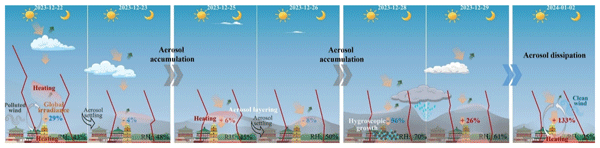
Abstract. During severe haze events, the boundary layer exhibits a complex vertical structure, while high aerosol loadings hinder high-resolution temperature and humidity measurements. To address this, a Raman-Mie lidar and retrieval algorithms for temperature, humidity, and aerosol optical properties were developed at Xi’an University of Technology, enabling high-resolution profiling of haze vertical structures. A 12-day haze episode was continuously monitored from formation to dissipation, providing detailed spatiotemporal variations of temperature, relative humidity, and aerosols. The boundaries of temperature inversion (TI) and aerosol layers were identified using a threshold method. The results revealed a strong coupling between aerosols and temperature during pollution evolution. Dome and stove effects were observed, with possible coexistence and interaction. Three dome-shaped TIs were identified. The top of a decreasing-type aerosol layer formed a stratified dome structure that constrained vertical diffusion, with the temperature gradient of the elevated TI varying inversely with its depth. Both TI strength and humidity were strongly correlated with surface PM2.5 concentrations. Surface-based TI exhibited a clear diurnal variation, with TI peaks preceding aerosol peaks. The results indicated that strong elevated TI and weak turbulence in the lower layer favored aerosol accumulation. Clouds and virga not only suppressed radiative heating but also enhanced humidity, further driving the rapid increase in surface PM2.5 concentrations. During the dissipation stage, the rapid breakdown of TI and enhanced solar heating were critical for pollutant removal, while efficient horizontal transport facilitated the complete clearance of aerosols within the boundary layer.
-
Notice on discussion status
The requested preprint has a corresponding peer-reviewed final revised paper. You are encouraged to refer to the final revised version.
-
Preprint
(10941 KB)
-
The requested preprint has a corresponding peer-reviewed final revised paper. You are encouraged to refer to the final revised version.
- Preprint
(10941 KB) - Metadata XML
- BibTeX
- EndNote
- Final revised paper


Journal article(s) based on this preprint
Interactive discussion
Status: closed
-
RC1: 'Comment on egusphere-2025-5393', Anonymous Referee #1, 02 Jan 2026
-
AC1: 'Reply on RC1', Li Qimeng, 22 Jan 2026
We sincerely thank the reviewer for the constructive and insightful comments, which have helped to improve the clarity and quality of the manuscript. We have carefully reviewed the manuscript in its entirety and have implemented the necessary revisions in accordance with the reviewer’s suggestions. A detailed, point-by-point response and the corresponding modifications to the manuscript are provided in the attached document.
-
AC1: 'Reply on RC1', Li Qimeng, 22 Jan 2026
-
RC2: 'Comment on egusphere-2025-5393', Anonymous Referee #2, 27 Feb 2026
ACP REVIEW
https://doi.org/10.5194/egusphere-2025-5393
Preprint. Discussion started: 27 November 2025
Atmospheric vertical structure variations during severe aerosol pollution events based on lidar observations
Qimeng Li1,2, Huige Di1, Ning Chen1, Xiao Cheng1, Jiaying Yang1, Yun Yuan1, Qing Yan1, and Dengxin Hua1
GENERAL COMMENT
The paper deals with impact of weather conditions on severe aerosol pollution events. Multiple datasets were used for aerosol pollution analysis. Special attention is paid to the atmospheric vertical structure that is monitored with lidar systems that have been designed at Xi'an University of Technology. The use of previously developed tools for the retrieval of vertical profiles of temperature and relative humidity allows the monitoring of these variables close to the surface. Aerosol layer boundaries and thermal inversion, TI, features were identified using gradient-based methods. During a extreme pollution event that last 12-day dome and stove effects were observed, with three dome-shaped TIs identified. Several stages are identified during the contamination event. The vertical distributions of aerosols and temperature during the stage of contamination development were analyzed. Thermal inversion played a crucial role in the accumulation of aerosols during the pollution episode. The contamination dissipation stage was characterized by an increase in vertical aerosol mixing. The study evidence that aerosol dome and hygroscopic growth phenomena were identified that intensified contamination. The coexistence of elevated and shallow thermal inversion layers was a dominant meteorological feature during these events of extreme pollution. A statistical analysis was performed that revealed correlations between relative humidity and PM2.5 concentrations.
This work is appropriate to the scope of Atmospheric Chemistry and Physic. Presenting a comprehensive analysis of a valuable dataset gathered with state-of-the-art instrumentation and methodology for monitoring the atmosphere. This work presents a relevant contribution to scientific progress in the atmospheric research field. The scientific approach and applied methods are valid, although some clarifications are suggested in the following section. In this sense, some comments for improving the discussion of results are included in the following section, where comments on the number and quality of figures are also included. Once these comments were solved the paper is suitable for publication in ACP.
PARTICULAR COMMENTS
- The authors use multiple datasets and discuss different variables, in the manuscript some of the instrumentation, methodology and uncertainties are described, but there is a lack of information on others, like PM2.5, PM10 and meteorological and radiometric measurements at the surface level. This is worthy information to be included, bearing in mind some of the correlation analyses included in the manuscript.
- Section 2.2 must be improved with the inclusion of some graphical information on the study area.
- Given the relevance of the temperature and relative humidity profiling and the accessibility of the reference Li et al. 2025, additional details on the associated methodology must be included in the manuscript for helping the reader understand better the pros and cons of these retrievals. I realized that the authors provided yet an answer to this question through the answer they gave to the Reviewer#1 review. But concerning the new figure 1, and the explanation offered in the answer to the Reviewer #1, I do not understand the small size of the shaded area associated to the corrected temperature profile in red, having in mind the uncertainty associated to the cross talk correction method, evidenced in the new figure 1g, where it is necessary to include information on the regression coefficient and the standard error of the modelled cross-talk.
- The discussion on figure 7 is not easy to follow, the redesign of this figure could help to solve this problem. In general, the sizes of figures could be larger to clearly detect the significant features of the situation. Likely shortening the number of time slots presented and improving the visibility of the most relevant periods. Identifications of the upper aerosol layer and the top of the TI in the profiles of figure 7 could improve the discussion.
- Even with the information gathered with the comprehensive set of observations use in this study some statements are a little bit speculative. For example, in line 221, the authors write:” A brief removal of pollutants occurred in the afternoon of 30 December, followed by a rapid re-accumulation during the night.”. In fact what you can state is that: “A brief reduction of pollutants occurred in the afternoon of 30 December, followed by a rapid re-accumulation during the night.” The origin of the “reduction” could be associated to different causes like the removal, the spreading of these pollutants in a high volume of atmosphere and the advection of these pollutants due to horizontal wind, but the authors do not present evidence for a choice.
- In their answers to the Reviewer#1, the authors try to improve the discussion on the stove effect starting in line 305: “... At noon on 24 December, aerosols were primarily concentrated near the surface, potentially favoring the onset of the stove effect. However, the surface-based TI restricted vertical diffusion, resulting in negligible changes in surface PM2.5 concentrations.” and in this sense they propose the inclusion of a new statement : “However, the warming of the lower layer must overcome the surface inversion formed by nocturnal radiative cooling, which delays the development of near-surface turbulence and may be the primary reason for the relatively modest changes in surface PM2.5 concentrations.” My concern with this justification is that I can see in the figures a clear effect of surface inversion, that supports this statement. Even with the answer on the overlap effects on temperature offered by the authors, determining the presence of near surface temperature inversion is not easy, having in mind the uncertainties in the temperature profiles in the lower part and the fact that you missed the first 120 m, according to the estimation of the overlap.
- Having in mind the relevance of the stove effect in the discussion of results, does the author measurements of the absorption component of the aerosol, for example with an aethalometer, that can support the development of the stove effect near the surface-
- In the manuscript the authors mention the extinction coefficient as a product of their measurements, but they do not use this variable. In fact, the lidar ratio that can be derived from the backscatter and extinction profiles could provide confirmation of the absorption component of the aerosol relevant for the development of the dome effect.
Citation: https://doi.org/10.5194/egusphere-2025-5393-RC2 -
AC2: 'Reply on RC2', Li Qimeng, 17 Mar 2026
We gratefully acknowledge the reviewer 2 for the careful review of our manuscript and for providing detailed and valuable comments. We believe that these comments have significantly contributed to improving the scientific quality and presentation of the manuscript. We have addressed all comments point by point, and the corresponding revisions have been incorporated into the revised version. A detailed, point-by-point response and the corresponding modifications to the manuscript are provided in the attached document.


Interactive discussion
Status: closed
-
RC1: 'Comment on egusphere-2025-5393', Anonymous Referee #1, 02 Jan 2026
This manuscript “Atmospheric vertical structure variations during severe aerosol pollution events based on lidar observations” presents an observation-driven investigation of boundary-layer thermodynamic structure during a severe winter haze episode. This manuscript presents continuous Raman–Mie lidar observations of a severe winter haze episode in Xi’an, focusing on the coupled evolution of aerosol vertical structure, temperature inversions (TIs), humidity, and boundary-layer dynamics. By applying correction algorithms to mitigate elastic scattering cross-talk and geometric overlap effects, the authors retrieve high-resolution thermodynamic profiles under heavy aerosol loading and analyze aerosol–radiation–boundary-layer feedbacks, including the coexistence of dome and stove effects.
The topic is highly relevant to the atmospheric and aerosol science community, and the dataset is valuable and rare, particularly the continuous temperature and humidity profiling during severe haze. The manuscript demonstrates substantial observational effort and methodological development. However, the scientific narrative occasionally moves beyond what can be uniquely inferred from the observations, lacks sufficient uncertainty assessment, and requires clearer separation between observation, inference, and mechanism. Significant revisions are needed before the manuscript can be considered for publication. The dataset is impressive and addresses a significant gap in our understanding of fine-scale thermodynamic evolution during haze development. However, the manuscript’s transition from observation to mechanistic interpretation is sometimes speculative.
- The authors calculate buoyancy acceleration (Eq. 9) using lidar-derived virtual potential temperature. While they state temperature uncertainties are <1 K and water vapor <0.5 g/kg (Table 1), they do not discuss how these errors propagate into the buoyancy and stability metrics. Given that the study relies heavily on small changes in stability to explain the "dome effect," a formal error propagation analysis is necessary to ensure the observed trends exceed the instrument’s noise floor.
- The manuscript frequently employs strong causal language that may not be fully supported by the observational evidence. For instance, the authors state that clouds and virga "drove" suppressing radiative heating and the rapid increase in PM2.5. While the temporal correlation is evident, the study does not sufficiently account for confounding factors such as variations in local primary emissions or regional advection during these specific windows. Furthermore, the discussion of the "stove effect" is somewhat contradictory; it is described as "favoring" pollution alleviation, yet the authors simultaneously conclude that surface-based TIs rendered this effect "negligible". A more rigorous analysis, perhaps involving a mass-balance approach or sensitivity tests, is required to disentangle these competing meteorological and chemical mechanisms.
- The study places heavy emphasis on the "stove effect" and "surface-based temperature inversions (TIs)," both of which occur in the lowest few hundred meters of the atmosphere. However, most Raman-Mie lidar systems suffer from a "blind zone" or "overlap effect" in the first 200–500 meters. While the authors mention a "geometric overlap factor correction" (referencing Li et al., 2025), they do not show the overlap function or discuss the minimum height at which the temperature and humidity retrievals become stable. What is the full-overlap height of the system? If the overlap correction is significant below 500m, how can the authors ensure that the "stove effect" observations (often very close to the surface) are not artifacts of the correction algorithm?
- Does the system provide depolarization measurements? If so, these should be included to confirm the presence of virga and characterize the aerosol type. If not, the authors must clarify how they distinguish between high-extinction "heavy haze" and "cloud base" or "virga" using only backscatter and Raman signals, as these features can look very similar in elastic channels.
- The paper identifies three specific "dome-type TIs". The criteria for classifying an inversion as "dome-type" versus a standard elevated inversion should be more explicitly defined. Is this based purely on the geometric shape of the PM5 stratification, or on a specific threshold of radiative heating/cooling rates?
- To truly claim an "Aerosol-Radiation-Boundary Layer" feedback, could the authors provide a simple estimation of the heating rate induced by the aerosol layer? This would support the "dome effect" hypothesis by showing that the aerosol-induced warming at the top of the layer is sufficient to maintain the observed temperature inversion.
- The Raman ratio correction and geometric overlap factor correction are central to the paper’s novelty. While the authors refer to Li et al. (2025) for details, a brief but more comprehensive summary of how the "theoretical rotational Raman ratio" is derived from radiosondes and applied to the "haze layer" retrievals would improve the manuscript's readability and transparency.
- The study is conducted in Xi’an, located in the Guanzhong Plain, a narrow basin bordered by the Qinling Mountains to the south. Local phenomena like "dome effects" and "stove effects" are driven by urban-scale (1–5 km) or valley-scale thermodynamics. A 31 km grid cell is far too coarse to "see" the specific vertical air currents or temperature variations created by the interaction between the city’s heat and the nearby mountain slopes. The authors explicitly state that they derive vertical velocity from the "vertical pressure tendency provided by ERA5".Vertical velocity is one of the most difficult variables for reanalysis models to get right at a local level. In a complex basin, the actual vertical motion measured by the lidar (which has a resolution of 3.75 m) might be completely different from the average vertical motion of a 31 km x 31 km block in ERA5. Using a coarse, model-averaged vertical velocity to explain fine-scale aerosol stratification observed by a lidar can be misleading. Specifically, how do the authors justify using a 31 km grid-averaged vertical velocity to interpret aerosol stratification changes observed at a local station? A discussion on the representativeness of ERA5 vertical motion for these specific local events is required.
- Are UABL and PBLH herein different? Kindly ensure if "UABL" (Upper Boundary of Aerosol Layer) is defined at its first mention in the main text and used consistently. Currently, the text occasionally switches between discussing "PBLH" and "UABL".
Citation: https://doi.org/10.5194/egusphere-2025-5393-RC1 -
AC1: 'Reply on RC1', Li Qimeng, 22 Jan 2026
We sincerely thank the reviewer for the constructive and insightful comments, which have helped to improve the clarity and quality of the manuscript. We have carefully reviewed the manuscript in its entirety and have implemented the necessary revisions in accordance with the reviewer’s suggestions. A detailed, point-by-point response and the corresponding modifications to the manuscript are provided in the attached document.
-
RC2: 'Comment on egusphere-2025-5393', Anonymous Referee #2, 27 Feb 2026
ACP REVIEW
https://doi.org/10.5194/egusphere-2025-5393
Preprint. Discussion started: 27 November 2025
Atmospheric vertical structure variations during severe aerosol pollution events based on lidar observations
Qimeng Li1,2, Huige Di1, Ning Chen1, Xiao Cheng1, Jiaying Yang1, Yun Yuan1, Qing Yan1, and Dengxin Hua1
GENERAL COMMENT
The paper deals with impact of weather conditions on severe aerosol pollution events. Multiple datasets were used for aerosol pollution analysis. Special attention is paid to the atmospheric vertical structure that is monitored with lidar systems that have been designed at Xi'an University of Technology. The use of previously developed tools for the retrieval of vertical profiles of temperature and relative humidity allows the monitoring of these variables close to the surface. Aerosol layer boundaries and thermal inversion, TI, features were identified using gradient-based methods. During a extreme pollution event that last 12-day dome and stove effects were observed, with three dome-shaped TIs identified. Several stages are identified during the contamination event. The vertical distributions of aerosols and temperature during the stage of contamination development were analyzed. Thermal inversion played a crucial role in the accumulation of aerosols during the pollution episode. The contamination dissipation stage was characterized by an increase in vertical aerosol mixing. The study evidence that aerosol dome and hygroscopic growth phenomena were identified that intensified contamination. The coexistence of elevated and shallow thermal inversion layers was a dominant meteorological feature during these events of extreme pollution. A statistical analysis was performed that revealed correlations between relative humidity and PM2.5 concentrations.
This work is appropriate to the scope of Atmospheric Chemistry and Physic. Presenting a comprehensive analysis of a valuable dataset gathered with state-of-the-art instrumentation and methodology for monitoring the atmosphere. This work presents a relevant contribution to scientific progress in the atmospheric research field. The scientific approach and applied methods are valid, although some clarifications are suggested in the following section. In this sense, some comments for improving the discussion of results are included in the following section, where comments on the number and quality of figures are also included. Once these comments were solved the paper is suitable for publication in ACP.
PARTICULAR COMMENTS
- The authors use multiple datasets and discuss different variables, in the manuscript some of the instrumentation, methodology and uncertainties are described, but there is a lack of information on others, like PM2.5, PM10 and meteorological and radiometric measurements at the surface level. This is worthy information to be included, bearing in mind some of the correlation analyses included in the manuscript.
- Section 2.2 must be improved with the inclusion of some graphical information on the study area.
- Given the relevance of the temperature and relative humidity profiling and the accessibility of the reference Li et al. 2025, additional details on the associated methodology must be included in the manuscript for helping the reader understand better the pros and cons of these retrievals. I realized that the authors provided yet an answer to this question through the answer they gave to the Reviewer#1 review. But concerning the new figure 1, and the explanation offered in the answer to the Reviewer #1, I do not understand the small size of the shaded area associated to the corrected temperature profile in red, having in mind the uncertainty associated to the cross talk correction method, evidenced in the new figure 1g, where it is necessary to include information on the regression coefficient and the standard error of the modelled cross-talk.
- The discussion on figure 7 is not easy to follow, the redesign of this figure could help to solve this problem. In general, the sizes of figures could be larger to clearly detect the significant features of the situation. Likely shortening the number of time slots presented and improving the visibility of the most relevant periods. Identifications of the upper aerosol layer and the top of the TI in the profiles of figure 7 could improve the discussion.
- Even with the information gathered with the comprehensive set of observations use in this study some statements are a little bit speculative. For example, in line 221, the authors write:” A brief removal of pollutants occurred in the afternoon of 30 December, followed by a rapid re-accumulation during the night.”. In fact what you can state is that: “A brief reduction of pollutants occurred in the afternoon of 30 December, followed by a rapid re-accumulation during the night.” The origin of the “reduction” could be associated to different causes like the removal, the spreading of these pollutants in a high volume of atmosphere and the advection of these pollutants due to horizontal wind, but the authors do not present evidence for a choice.
- In their answers to the Reviewer#1, the authors try to improve the discussion on the stove effect starting in line 305: “... At noon on 24 December, aerosols were primarily concentrated near the surface, potentially favoring the onset of the stove effect. However, the surface-based TI restricted vertical diffusion, resulting in negligible changes in surface PM2.5 concentrations.” and in this sense they propose the inclusion of a new statement : “However, the warming of the lower layer must overcome the surface inversion formed by nocturnal radiative cooling, which delays the development of near-surface turbulence and may be the primary reason for the relatively modest changes in surface PM2.5 concentrations.” My concern with this justification is that I can see in the figures a clear effect of surface inversion, that supports this statement. Even with the answer on the overlap effects on temperature offered by the authors, determining the presence of near surface temperature inversion is not easy, having in mind the uncertainties in the temperature profiles in the lower part and the fact that you missed the first 120 m, according to the estimation of the overlap.
- Having in mind the relevance of the stove effect in the discussion of results, does the author measurements of the absorption component of the aerosol, for example with an aethalometer, that can support the development of the stove effect near the surface-
- In the manuscript the authors mention the extinction coefficient as a product of their measurements, but they do not use this variable. In fact, the lidar ratio that can be derived from the backscatter and extinction profiles could provide confirmation of the absorption component of the aerosol relevant for the development of the dome effect.
Citation: https://doi.org/10.5194/egusphere-2025-5393-RC2 -
AC2: 'Reply on RC2', Li Qimeng, 17 Mar 2026
We gratefully acknowledge the reviewer 2 for the careful review of our manuscript and for providing detailed and valuable comments. We believe that these comments have significantly contributed to improving the scientific quality and presentation of the manuscript. We have addressed all comments point by point, and the corresponding revisions have been incorporated into the revised version. A detailed, point-by-point response and the corresponding modifications to the manuscript are provided in the attached document.
Peer review completion


Journal article(s) based on this preprint
Viewed
| HTML | XML | Total | BibTeX | EndNote | |
|---|---|---|---|---|---|
| 849 | 552 | 78 | 1,479 | 89 | 94 |
- HTML: 849
- PDF: 552
- XML: 78
- Total: 1,479
- BibTeX: 89
- EndNote: 94
Viewed (geographical distribution)
| Country | # | Views | % |
|---|
| Total: | 0 |
| HTML: | 0 |
| PDF: | 0 |
| XML: | 0 |
- 1
Qimeng Li
Huige Di
Ning Chen
Xiao Cheng
Jiaying Yang
Yun Yuan
Qing Yan
Dengxin Hua
The requested preprint has a corresponding peer-reviewed final revised paper. You are encouraged to refer to the final revised version.
- Preprint
(10941 KB) - Metadata XML
This manuscript “Atmospheric vertical structure variations during severe aerosol pollution events based on lidar observations” presents an observation-driven investigation of boundary-layer thermodynamic structure during a severe winter haze episode. This manuscript presents continuous Raman–Mie lidar observations of a severe winter haze episode in Xi’an, focusing on the coupled evolution of aerosol vertical structure, temperature inversions (TIs), humidity, and boundary-layer dynamics. By applying correction algorithms to mitigate elastic scattering cross-talk and geometric overlap effects, the authors retrieve high-resolution thermodynamic profiles under heavy aerosol loading and analyze aerosol–radiation–boundary-layer feedbacks, including the coexistence of dome and stove effects.
The topic is highly relevant to the atmospheric and aerosol science community, and the dataset is valuable and rare, particularly the continuous temperature and humidity profiling during severe haze. The manuscript demonstrates substantial observational effort and methodological development. However, the scientific narrative occasionally moves beyond what can be uniquely inferred from the observations, lacks sufficient uncertainty assessment, and requires clearer separation between observation, inference, and mechanism. Significant revisions are needed before the manuscript can be considered for publication. The dataset is impressive and addresses a significant gap in our understanding of fine-scale thermodynamic evolution during haze development. However, the manuscript’s transition from observation to mechanistic interpretation is sometimes speculative.