
the Creative Commons Attribution 4.0 License.
the Creative Commons Attribution 4.0 License.
 | 07 Nov 2025
Wind-induced collapse of the biopolymeric surface microlayer induces sudden changes in sea surface roughness
Abstract. All exchange between the ocean and atmosphere has to cross the sea surface microlayer (SML), yet the SML impact on modulating air-sea exchange rates remains poorly understood. Surfactants, including biopolymers, can influence exchange rates by altering the rheological properties of the SML, damping surface turbulence, and capillary wave formations. We investigated the impact of wind speed on SML biopolymer enrichment, surface roughness and interfacial surfactant coverage at the Heidelberg ‘Aeolotron,’ a large annular wind-wave facility filled with 18.000 L seawater. Our results show that biopolymer enrichment, specifically the enrichment of polypeptides and polysaccharides, in the SML declined sharply at wind speeds above 6 m/s, coinciding with a sudden increase in the Mean Square Slope (MSS) of waves by 2–3 orders of magnitude. At wind speed <6m s-1, biopolymer enrichment in the SML reduced MSS values by up to two orders of magnitude compared to non-enriched or clean, i.e. freshwater, surfaces, indicating a substantial impact of biopolymers in the SML for air-sea exchange at lower wind speed. Selective SML enrichment was observed, particularly for the amino acids arginine and glutamic acid and the amino sugar galactosamine. Amino acid and carbohydrate monomers in the SML also exhibited significant and compound-specific wind-induced variability. Our findings suggest that biopolymers, particularly those derived from bacterial production accumulate in the SML act as powerful biosurfactants. Unlike artificial surfactant films, natural SML components were more susceptible to wind-induced disruption and to microbial production and decomposition. Our findings reveal that ecological processes actively regulate the chemical and physical properties of the SML, thereby potentially modulating air–sea heat and mass exchange.
-
Notice on discussion status
The requested preprint has a corresponding peer-reviewed final revised paper. You are encouraged to refer to the final revised version.
-
Preprint
(1106 KB)
-
The requested preprint has a corresponding peer-reviewed final revised paper. You are encouraged to refer to the final revised version.
- Preprint
(1106 KB) - Metadata XML
- BibTeX
- EndNote
- Final revised paper


Journal article(s) based on this preprint
Interactive discussion
Status: closed
-
RC1: 'Comment on egusphere-2025-5375', Simon Hauser, 08 Dec 2025
Title: Wind-induced collapse of the biopolymeric surface microlayer induces sudden changes in sea surface roughness
Author(s): Anja Engel et al.
MS No.: egusphere-2025-5375
MS type: Research article
Special issue: Biogeochemical processes and Air–sea exchange in the Sea-Surface microlayer (BG/OS inter-journal SI)General comments:
Thank you for presenting this interesting study on the collapse of the SML at wind speeds above 6 m/s. The writing style and the figures are generally clear. Some of the figures need a bit more work (see specific comments).
One could think about moving details in the sections 2.4.1-2.4.3 into the supplementary material.
The results are sufficient to support the conclusions.Following an extensive discussion, the conclusion is very short. It could be expanded by adding a summary of the main points from the discussion, to highlight the substantial and novel conclusions from this work.
I recommend for publication after minor revisions.
Specific comments:
l. 3 “sea surface roughness“: As this term occurs in the title, it should be explained in a bit more detail in the text (eg. l. 365-366).
l. 27 “2–3 orders of magnitude“: This claim should also be formulated somewhere in the main text.
l. 35-36 “Our findings reveal that ecological processes actively regulate the chemical and physical properties of the SML, thereby potentially modulating air–sea heat and mass exchange.“ If you want to make this claim, I think you should discuss potential effects on the physical properties of the SML more.
l. 59/60 Do they really reduce turbulent energy dissipation or do they shift where the dissipation occurs?
l. 73/74 But the variability of surfactants in the SML is not the only reason for inaccuracies in wind-speed only based parameterizations (see e.g. Wanninkhof 2009). You probably do not want to state that, but your phrasing sounds a bit like it.
l.76-78 e.g. Pereira (2018) analysed water samples in an automated, closed air–water gas exchange tank. Was this effect also measured in the field (although challenging, as you mention later)?
l. 91 I think there are also some measurements reported using different Triton surfactant concentrations in Krall (2013).
l.114: Are there publications to cite here about the advantages of the Aelotron?
l.122-123: “The key mechanisms governing air-sea gas exchange“: What about wave breaking, stokes drift and Langmuir turbulence (see e.g. Belcher (2012))? I think I understand what you are trying to say, but perhaps you could phrase it more carefully.
l. 154-155: How accurate is this conversion? Can you estimate uncertainties, maybe based on Edson (2013)?
l. 325 Figure 2A: If I understand the color scheme correctly, GABA is listed in the legend, but not shown in the plot. If sc or c*/c_max cannot exceed 1, the scale should reflect it.
l. 361 Figure 3: Figure 3 and Figure 4 could be combined into one, or maybe Figure 3 could be dropped.
l. 373 Figure 4: Nice result. You should come up with a way to estimate uncertainties on MSS values or comment why you do not estimate such uncertainties.
l. 392-393 “likely due to enhanced mixing and rising of film-covered bubbles after wave-breaking (Figure 5I)“. Did you observe enhanced mixing or film-covered bubbles after wave-breaking?
l. 416 Figure 6: Why not choose a similar plotstyle in Figures 2 and 6 for sc and c*/c_max?
l. 454 Figure 6: The image quality seems to be low. Maybe use logarithmic axes to e.g. make the structures for EF_TCHO < 2 more visible.
l. 492-494 “and is referred to as the Marangoni effect (McKenna and Bock, 2006)“: This should be explained in more detail in the introduction.
l. 503 “wind-wave tank experiments with natural seawater and, hence, natural surfactants and surface films remain scarce.“ This sentence should be placed as close as possible to the sentences citing these other studies (eg. l. 511-513).
l. 611 I think a sentence similar to this one “However, the damping effect largely vanished at >6 m s-1 when the biopolymeric SML collapsed“ (l. 496-497) should make it into the conclusion, as it is a very nice main result.
Technical corrections:
l. 54. Dot missing.
l.100 18000\,L
l.112 1.4\,m. You should probably check all the physical units for correct spacing.
l.134: Do the black and white rectangles indicate no light source/light source? If so, they do not exactly match the time periods in the text.
l.173 U10 subscript missing.
l. 190-191 ULW sampling is not marked in Figure 1C.
l. 270 Dot missing.
l. 287 If it contains only the definition of the enrichment factor, there should not be an extra subchapter “2.5 Data Analysis“.
l. 306-307 This probably should not be two sentences.
l. 322 In, particular
l. 325 Figure 2: You should either use a,b or A,B.
l. 353 mu is missing, same for the following lines.
l. 403 Figure 5: Please increase the size of the axis tick labels, particularly those on the x-axis. Perhaps try rearranging the subplots in an upright orientation (e.g. 3x5 instead of 5x3). It looks like ULW are white rectangles (grey rectangles in the caption).
l. 423-424 According to the table, ISO has p<0.005.
l. 479 Different citation style.
l. 495 Space missing.
Citation: https://doi.org/10.5194/egusphere-2025-5375-RC1 -
AC1: 'Reply on RC1', Anja Engel, 14 Jan 2026
Please find below a point-by-point response:
RC1: General comments:
Thank you for presenting this interesting study on the collapse of the SML at wind speeds above 6 m/s. The writing style and the figures are generally clear. Some of the figures need a bit more work (see specific comments).
One could think about moving details in the sections 2.4.1-2.4.3 into the supplementary material.
The results are sufficient to support the conclusions.
Following an extensive discussion, the conclusion is very short. It could be expanded by adding a summary of the main points from the discussion, to highlight the substantial and novel conclusions from this work.
I recommend for publication after minor revisions.
Response: We thank Referee 1 for the positive feedback and the constructive suggestions on how to further improve the clarity of the paper. As outlined below in our answers to the specific comments, we took up most of the suggestions. We will also extend the conclusion section.
RC1: Specific comments:
- 3 “sea surface roughness“: As this term occurs in the title, it should be explained in a bit more detail in the text (eg. l. 365-366)
Response: The term “surface roughness” is a widely used technical term and means more or less exactly what the words says. Nevertheless, we will include a short explanation of this term to improve the clarity of the manuscript.
“The surface roughness, a measure of the small- to medium-scale structure of the wave field that controls how the sea interacts with wind and light, has been determined by means of the MSS value, a parameter directly correlated with air-sea exchange of gases and heat.”
RC1: l. 27 “2–3 orders of magnitude“: This claim should also be formulated somewhere in the main text.
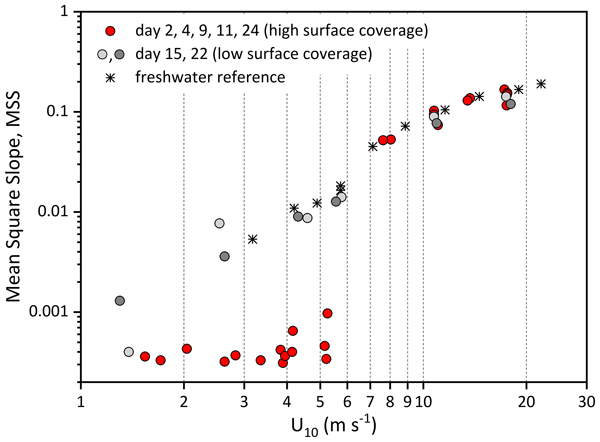
Response: We agree with the referee that the magnitude of the effect should be consistently denoted throughout the manuscript. The mentioned “2-3 orders of magnitude” refer to the overall effect seen for all wind speeds shown in Fig.3. However, seeing this comment by the reviewer, it probably makes more sense to refer to the step-like feature in MSS observed for a wind speed around 6 m/s. The step corresponds to a factor of 10-30 change in MSS, hence one and a half orders of magnitude.
We will update the abstract and the Results section “Sea surface properties and biochemical SML composition at increasing wind speed” accordingly.
RC1: l. 35-36 “Our findings reveal that ecological processes actively regulate the chemical and physical properties of the SML, thereby potentially modulating air–sea heat and mass exchange.“ If you want to make this claim, I think you should discuss potential effects on the physical properties of the SML more.
Response: We do not think that a more thorough discussion of the surfactant-related effects on the physical properties needs to be discussed in length in this paper, as the paper clearly sets a focus on the biogeochemistry and compositional change of the biopolymers. However, to clarify this point, we will slightly reword the sentence:
“Our findings reveal that ecological processes actively regulate the chemical and physical properties of the SML, including surfactant surface coverage, and thereby potentially modulate air–sea heat and mass exchange.”
RC1: 59/60 Do they really reduce turbulent energy dissipation or do they shift where the dissipation occurs?
and
RC1: l. 492-494 “and is referred to as the Marangoni effect (McKenna and Bock, 2006)“: This should be explained in more detail in the introduction.
Response: Well, this is a subtle but important point. We will reword:” Specifically, surfactants increase the surface elasticity and effective surface viscosity of water. As a result, Marangoni stresses arise from surface-tension gradients. This damps the formation of capillary waves, which reduces small-scale roughness, and leads to a stronger turbulent energy dissipation near the surface.”
RC1: l. 73/74 But the variability of surfactants in the SML is not the only reason for inaccuracies in wind-speed only based parameterizations (see e.g. Wanninkhof 2009). You probably do not want to state that, but your phrasing sounds a bit like it.
Response: Yes, but the presence/absence of SML surfactants are a key factor for the high variability of measured gas transfer rates. But the reviewer is of course right that the story of gas-exchange is more complicated in detail. We will rephrase to:
“Variability of surfactants in the SML is likely one of the main reasons why parameterizations based...”
RC1: l.76-78 e.g. Pereira (2018) analysed water samples in an automated, closed air–water gas exchange tank. Was this effect also measured in the field (although challenging, as you mention later)?
Response: The Pereira experiment, although conducted in an on-board air–water gas exchange tank, was very close to real world conditions. The authors note that “there is no practical procedure for collecting a large volume sample of surface seawater that preserves the integrity of the SML. However, we have shown (1) that following its disturbance by vigorous mixing in a laboratory tank the SML becomes re-established on a timescale of seconds with respect to surfactants and other SML components (2) that a new SML is similarly established when sub-surface coastal waters are pumped into large mesocosm tanks.”
In order to avoid that the reader gets the impression that the Pereira data are based on “perfect” open-sea gas-transfer measurements, we will reword the sentence as follows: “For example, a substantial reduction of air-sea fluxes of CO2 has been documented under high accumulation of natural surfactants using surface seawater of the Atlantic in an on-board air-sea gas exchange tank experiment (Pereira et al., 2018)”.
RC1: l. 91 I think there are also some measurements reported using different Triton surfactant concentrations in Krall (2013).
Response: We have already cited this reference (the dissertation of Kerstin Krall who is co-author of this study) later in the text.
RC1: l.114: Are there publications to cite here about the advantages of the Aelotron?
and
RC1: l.122-123: “The key mechanisms governing air-sea gas exchange“: What about wave breaking, stokes drift and Langmuir turbulence (see e.g. Belcher (2012))? I think I understand what you are trying to say, but perhaps you could phrase it more carefully.
Response: Thanks for these comments. We actually missed to add a reference to an older publication discussing the advantages and disadvantages of annular wind-wave tanks compared to the more prevalent linear ones.
In the revised version we will add the following reference:
Schmundt, D. / Münsterer, Th. / Lauer, H. / Jähne, B. The circular wind wave facilities at the University of Heidelberg, 1995, in Jähne, B. / Monahan, E. C. (Eds.) Air-Water Gas Transfer - Selected papers from the Third International Symposium on Air-Water Gas Transfer, AEON, Hanau, p. 505-516
RC1: l. 154-155: How accurate is this conversion? Can you estimate uncertainties, maybe based on Edson (2013)?
Response: Unfortunately, Edson et. a 2013 don’t go into detail about the uncertainties of their published drag coefficients, which we used for the conversion. However, it is likely that they depend significantly on the sea state (wave age). In our study, we measured under infinite fetch conditions, which are very similar to open ocean conditions with high wave ages.
RC1: l. 325 Figure 2A: If I understand the color scheme correctly, GABA is listed in the legend, but not shown in the plot. If sc or c*/c_max cannot exceed 1, the scale should reflect it.
Response: GABA is included in the plot but has too low values to show up clearly in the chart. As written in the text:’ GABA, an indicator for bacterial degradation, was highest on day 15 with 0.41 Mol%. ‘. We agree with the referee that the plot would look more consistent if the labeling of the right axis is only up to 1.0 and will change the graph accordingly in the revised version..
RC1: l. 361 Figure 3: Figure 3 and Figure 4 could be combined into one, or maybe Figure 3 could be dropped.
Response: Figure 3 and 4 show two conceptually different things (apparent SML thickness and MSS against wind speed) that are also discussed separately in the text. In our opinion, presenting the two corresponding findings in two separate plots makes sense and should stay that way.
RC1: l. 373 Figure 4: Nice result. You should come up with a way to estimate uncertainties on MSS values or comment why you do not estimate such uncertainties.
Response: We will add the following sentence to the figure caption:
“For MSS values above 0.002, the uncertainties are below 10%, while close to the detection limit, the uncertainties are in the order of the measured value.”
RC1: l. 392-393 “likely due to enhanced mixing and rising of film-covered bubbles after wave-breaking (Figure 5I)“. Did you observe enhanced mixing or film-covered bubbles after wave-breaking?
Response: We did not directly determine film-covered bubble, but inferred this from earlier studies. We will change the sentence to:
“...likely due to enhanced mixing and rising of film-covered bubbles after wave-breaking, which is an established mechanism discussed in literature (Blanchard (1975), Stefan (1999), Sabbaghzadeh (2017)) (Figure 5I).”
RC1: l. 416 Figure 6: Why not choose a similar plotstyle in Figures 2 and 6 for sc and c*/c_max?
Response: We agree and will update the plot styles accordingly.
RC1: l. 454 Figure 6: The image quality seems to be low. Maybe use logarithmic axes to e.g. make the structures for EF_TCHO < 2 more visible.
Response: We assume that this comment refers to Figure 7. We will assure that the final figures’ quality is high.
RC1: l. 503 “wind-wave tank experiments with natural seawater and, hence, natural surfactants and surface films remain scarce.“ This sentence should be placed as close as possible to the sentences citing these other studies (eg. l. 511-513).
Response: The studies cited (511-513) have not been conducted in wind-wave channels. We therefore think that the order of text is appropriate.
RC1: l. 611 I think a sentence similar to this one “However, the damping effect largely vanished at >6 m s-1 when the biopolymeric SML collapsed“ (l. 496-497) should make it into the conclusion, as it is a very nice main result.
Response: We agree with the reviewer that this important and nice results should also highlighted in the Conclusion section. We will add the following information: “Natural surfactants that accumulated in the SML during this study exhibited a significant damping effect on wave formation up to wind speeds of U10 6 m s^-1. However, at even higher wind speed and going along with the collaps of the biopolymeric SML, the damping effect largely vanished.”
RC1: Technical Corrections
Response: We thank the reviewer for the very careful check of the formatting of the manuscript. We will adopt the suggested corrections.
Citation: https://doi.org/10.5194/egusphere-2025-5375-AC1
-
AC1: 'Reply on RC1', Anja Engel, 14 Jan 2026
-
RC2: 'Comment on egusphere-2025-5375', Anonymous Referee #2, 10 Dec 2025
Engel et al. have conducted a series of experiments designed to investigate how biopolymers present in the sea surface microlayer (SML) influence capillary wave damping and mean-square-slope suppression under increasing wind speed in an annular wave tank. This is an important topic given that the SML modulates air–sea gas exchange, which is an important part of the global carbon cycle, the understanding of which is critical if we are to understand the extent of future climate change.
Laboratory studies, such as those conducted in wind/wave tanks, are useful because natural surfactants are chemically complex and difficult to characterise in situ, and their impacts on gas exchange are difficult to constrain due to the numerous parameters that may influence gas exchange (e.g. wind, wave action, rain, biological activity, etc.). As such, the use of the large annular wind-wave tank provides the opportunity to examine ocean-like wind–wave conditions with natural seawater, enabling controlled study of turbulent mixing, SML formation, and surface damping, with the ultimate goal of the field being improved understanding of biological contributions to air–sea exchange and improved gas-transfer parameterisations.
To this end, the authors have done a convincing job of describing how the biopolymers behave as a function of wind speed and that at low wind speeds they observe a substantial reduction of mean-square-slope relative to a clean freshwater reference. In addition, they identify what appears to be a solid wind-speed threshold at which biopolymer enrichment in the sea surface microlayer appears to collapse, at which point surfactant coverage declines and mean-square-slope returns to clean-water values. So far, so good, and all very compelling.
However, this is where my major criticism of the study falls. The authors, in their introduction, motivate their work with reference to air–sea exchange, and this would be a natural progression of this work, especially given that this same experiment already appears to have produced gas-exchange data (Ribas-Ribas et al., 2018). In that study, the authors showed that natural surfactants reduced CO2 gas transfer by up to 54% and that a transition wind speed of 5.5–8 m s-1 existed where surfactant influence decreased. I wonder whether this is not the same transition in surfactant surface coverage and mean-square-slope that the authors observe here?
Given that this dataset has already been published, I would expect at least some reference to it (as well as potentially some of the other parameters measured in this study, such as total surfactant activity, etc.). Instead, what we get is a terse reference to this paper in the introduction that feels insufficient, to say the least: “Only a limited number of wind-channel experiments have been conducted using natural surface films and seawater (Tang and Wu, 1992; Ribas-Ribas et al., 2018).” In my view, this is very much a missed opportunity for mechanistic synthesis and a major weakness in the interpretation of the results.
Given that I feel this is a dataset clearly worthy of publication, and accounting for what I feel is a major gap in the interpretation of the data, my recommendation is major revisions. I outline my major points below, followed by more suggested corrections of a more technical nature.
Major points
1. As outlined above, I would like to see explicit acknowledgement of all the studies that have been published based on these experiments in the methods section. If they were not comparable for whatever reason, then make this clear to the reader. If this study and that by Ribas-Ribas et al. (2018) were conducted together, I would like to see substantial discussion of how the biopolymer and surfactant dynamics presented here relate to the previously published gas-exchange suppression in the same system (wind-speed transition, mechanistic drivers, etc.). In addition, the authors should clearly describe how the present results improve mechanistic understanding of natural surfactant effects on air–sea exchange, in order to complete the conceptual chain that the reader is led to expect based on the motivation for the work. In addition, it would be interesting to see some interpretation of the measured VSFG surfactant coverage in the context of the electrochemical surfactant activity measured by Ribas-Ribas et al. (2018) (even if only qualitatively).
2. In my view the manuscript would benefit from improvements in language clarity and figure presentation. Several sentences are awkwardly phrased or ambiguous (as noted in the technical comments below) leading to potential confusion about the meaning of the results. There are also a few examples of inconsistent terminology and unclear definitions (e.g., the use of “surfactant concentration,” “biochemical concentrations,” or the criteria for grouping specific experimental days). In addition, I think that the quality and readability of several figures are below the standard expected for a paper of this scope. For example, some figures lack adequate legends or explanatory elements (e.g., Fig. 4), and some panels are too small or dense to allow easy interpretation (e.g., Fig. 5). Given that the manuscripts conclusions are heavily reliant on patterns presented in the figures, e.g. the identification of transition wind speeds and changes in surfactant coverage, I think a little more time spent on figure design would improve the work.Technical comments
Line 23: “wave formations” should be corrected to “wave formation.”
Line 29: The term “freshwater” is used here as a reference condition, but this may not be immediately clear to readers. I suggest clarifying that this refers to the clean-water reference experiment.
Line 61: The sentence beginning with “Hereby” reads awkwardly. I would go with something like: "In this context, the overall effect of surfactants arises from complex, dynamic competitive adsorption..."
Line 71: The sentence beginning with “Besides,” is awkward. I would replace it with something like: “In addition, surfactants in seawater have also been linked to anthropogenic and terrestrial sources..."
Lines 129–132: How long was the sample stored in the dark for (I assume around two months?). Was any analysis conducted to determine if its composition changed during this period?
Lines 141–143: It is not clear how the “biogenic microlayer” from the previous phytoplankton mesocosm experiment was sampled. Please specify.
Line 147: It is unclear why the lower limit is described as “about 1 m/s,” whereas the upper limit is given with high precision (18.7 m/s). If only the lower limit is approximate, please clarify this explicitly. Otherwise, I suggest using consistent levels of precision for both limits (e.g., “1–18.7 m/s” or “~1–~19 m/s”).
Lines 156–157: The authors state that water velocities were at or below the “resolution limit of the velocimeter,” but the actual resolution limit is not specified. Since this determines the wind-speed conditions under which U* and U_10 could not be obtained, please provide the specific resolution limit of the instrument.
Line 174: The phrase “sampled at 12 days” is unclear. If the SML was sampled on twelve days, the text should read “sampled on 12 days.” Please clarify the intended meaning.
Line 255: This is the first mention of surfactant coverage, so the abbreviation (sc) should be introduced here rather than later (line 263).
Line 306: I am not completely sure what is meant by the term “biochemical concentrations” here. Please elaborate.
Line 349: The implication of this sentence is unclear. It is not specified what is meant by “surfactant concentration,” since no direct concentration metric for surfactants is defined earlier in the manuscript (VSFG-derived surfactant coverage is not a concentration). Please clarify (i) what variable THAA and TCHO were correlated with, and (ii) what the reader should conclude from the slightly higher correlation with THAA.
Lines 366–370: The manuscript refers to “freshwater” MSS values as a reference, but it may not be compltely clear to the reader why freshwater is being used for comparison. Since the rationale is that the freshwater reference is relatively surfactant-free, I suggest adding a brief clarification along these lines (e.g., “reference freshwater MSS values, representing relatively surfactant-free conditions..."). This would help readers understand the purpose of the comparison.
Lines 380–387: The rationale for grouping days 2 and 4 together, and days 9 and 11 together, is not clearly explained. It is stated that days 15, 22, and 24 “showed different patterns,” but it is not evident what specific criteria were used to form these groups. Was it similar initial SML biopolymer concentrations, similar wind-speed responses, comparable experimental conditions, something else? Please specify why these particular days were grouped and what distinguishes them from the days shown individually.
Lines 390–393: The manuscript mentions “wave-breaking” as a mechanism contributing to enhanced mixing and bubble-mediated transport of organic matter, but it is unclear whether wave-breaking was directly observed, measured, or inferred, and what operational definition was used in the context of the Aeolotron. Since wave-breaking can have different definitions (e.g., whitecapping, crest overturning, bubble entrainment), please clarify how wave-breaking was identified or determined, and whether any measurements support its occurrence at the reported wind speeds.
Line 411: "Therewith" is awkward and I would recommend a more natural alternative such as “Consequently,” “As a result,” or “In line with this,” etc.
Line 422: This is a stylistic suggestion but I feel that this section could do with a sentence to orient the reader. Something like: "In addition to concentration changes, wind speed may also alter the molecular composition of biopolymers in the SML..."
Line 508: Here the authors state that the impact of natural surface films “may differ… when stronger surfactants are included that resist higher wind speeds.” I understand the general point they are trying to make, but I do not fully see how it applies in the context of the experiment conducted here. This phrasing could imply that the seawater used in this study lacked such surfactants or was not representative of natural conditions. If the authors intend instead to highlight the natural variability in surfactant strength and composition, and that some surfactant classes can persist to higher wind speeds than the biopolymer-rich films observed here, this should be stated more explicitly to avoid misunderstanding. What specifically about their experiments do the authors think was not representative of natural conditions? Which, if any, classes of surfactants do they believe were absent?
Line 534: There is an issue with the phrasing here: "DOC concentration in the SML may be simply be high because of diffusive exchange with high background concentration of organic substances do not have surfactant properties”. Please rephrase for clarity.
Lines 542–547: Here the text refers repeatedly to “slicks” (e.g., “slicks showed THAA accumulation…”), yet so far as I can see, the methods section does not describe how slicks were identified, distinguished from non-slick SML, or sampled. Was slick material collected using the same glass-plate SML technique, and did sampling deliberately target visually identified slick patches? Or perhaps the authors are just implying that slicks were just the natural SML state during low-wind conditions, meaning all SML samples from early experiment days represented slicks? Clarification is certainly needed here, especially given that the discussion interprets compositional differences (e.g., P/C ratios) in terms of slick-specific processes.
Figure 4: This figure would benefit from the addition of legend. At present, the use of multiple colours (red, light grey, grey, open circles) without a corresponding legend makes it difficult for the reader to quickly understand which points belong to which experiment day or grouping. In addition, I wonder whether clearly highlighting the transition wind speed (~5-6 m s-1) that is central to the paper’s interpretation might be a useful addition to the figure.
Figure 5: The figure is very difficult to read in its current form because the panels are so small and dense. I would reorganise the layout (e.g., from the current 3 × 5 grid to a 5 × 3 grid) or otherwise increase the panel size to improve readability. If possible I would also include a legend to aid interpretation.
Citation: https://doi.org/10.5194/egusphere-2025-5375-RC2 -
AC2: 'Reply on RC2', Anja Engel, 14 Jan 2026
Please find below a point-by-point response:
RC2: General Feedback:
Engel et al. have conducted a series of experiments designed to investigate how biopolymers present in the sea surface microlayer (SML) influence capillary wave damping and mean-square-slope suppression under increasing wind speed in an annular wave tank. This is an important topic given that the SML modulates air–sea gas exchange, which is an important part of the global carbon cycle, the understanding of which is critical if we are to understand the extent of future climate change.
Laboratory studies, such as those conducted in wind/wave tanks, are useful because natural surfactants are chemically complex and difficult to characterise in situ, and their impacts on gas exchange are difficult to constrain due to the numerous parameters that may influence gas exchange (e.g. wind, wave action, rain, biological activity, etc.). As such, the use of the large annular wind-wave tank provides the opportunity to examine ocean-like wind–wave conditions with natural seawater, enabling controlled study of turbulent mixing, SML formation, and surface damping, with the ultimate goal of the field being improved understanding of biological contributions to air–sea exchange and improved gas-transfer parameterisations.
To this end, the authors have done a convincing job of describing how the biopolymers behave as a function of wind speed and that at low wind speeds they observe a substantial reduction of mean-square-slope relative to a clean freshwater reference. In addition, they identify what appears to be a solid wind-speed threshold at which biopolymer enrichment in the sea surface microlayer appears to collapse, at which point surfactant coverage declines and mean-square-slope returns to clean-water values. So far, so good, and all very compelling.
Response: We thank the referee for the positive feedback and for outlining the relevance of our work.
RC2: However, this is where my major criticism of the study falls. The authors, in their introduction, motivate their work with reference to air–sea exchange, and this would be a natural progression of this work, especially given that this same experiment already appears to have produced gas-exchange data (Ribas-Ribas et al., 2018). In that study, the authors showed that natural surfactants reduced CO2 gas transfer by up to 54% and that a transition wind speed of 5.5–8 m s-1 existed where surfactant influence decreased. I wonder whether this is not the same transition in surfactant surface coverage and mean-square-slope that the authors observe here?
Given that this dataset has already been published, I would expect at least some reference to it (as well as potentially some of the other parameters measured in this study, such as total surfactant activity, etc.). Instead, what we get is a terse reference to this paper in the introduction that feels insufficient, to say the least: “Only a limited number of wind-channel experiments have been conducted using natural surface films and seawater (Tang and Wu, 1992; Ribas-Ribas et al., 2018).” In my view, this is very much a missed opportunity for mechanistic synthesis and a major weakness in the interpretation of the results.
General comment 1.
Given that I feel this is a dataset clearly worthy of publication, and accounting for what I feel is a major gap in the interpretation of the data, my recommendation is major revisions. I outline my major points below, followed by more suggested corrections of a more technical nature.
As outlined above, I would like to see explicit acknowledgement of all the studies that have been published based on these experiments in the methods section. If they were not comparable for whatever reason, then make this clear to the reader. If this study and that by Ribas-Ribas et al. (2018) were conducted together, I would like to see substantial discussion of how the biopolymer and surfactant dynamics presented here relate to the previously published gas-exchange suppression in the same system (wind-speed transition, mechanistic drivers, etc.). In addition, the authors should clearly describe how the present results improve mechanistic understanding of natural surfactant effects on air–sea exchange, in order to complete the conceptual chain that the reader is led to expect based on the motivation for the work. In addition, it would be interesting to see some interpretation of the measured VSFG surfactant coverage in the context of the electrochemical surfactant activity measured by Ribas-Ribas et al. (2018) (even if only qualitatively).
Response: Our paper is intended to place a specific focus on the role of wind in controlling the enrichment and composition of biopolymers in the SML, which presumably act as biosurfactants, as well as on the integrity of the SML under different wind-speed regimes. Our primary objective is therefore not to quantify air–sea gas transfer directly. Nevertheless, we motivate our study by previous findings showing that changes in air–sea gas exchange are closely linked to sea-surface roughness often measured as MSS.
Our results demonstrate that a pronounced change in MSS coincides with a strong decline in the enrichment of biopolymers in the SML. This suggests a direct impact on air–sea gas exchange via wind-driven modifications of SML properties. In this context, the study by Ribas-Ribas et al. (2018), which reported a decrease in N₂O gas transfer velocities at wind speeds of approximately U₁₀ = 5.5–8 m s⁻¹ along with a reduction in surfactants is highly consistent with our observations. We agree with the referee that this agreement should be more clearly emphasized, and we will discuss the Ribas-Ribas findings and highlight this connection more explicitly in the revised manuscript.
A more extensive comparison with Ribas-Ribas et al. (2018) is, however, beyond the scope of the present study and not straightforward, as the datasets are not directly comparable. In particular, most samples were obtained on different days and relate to different wind experiments. These methodological differences limit the extent to which a detailed quantitative comparison can be meaningfully performed.
Another study related to this particular Aeolotron study with natural seawater is Sun et al. (2018).
1.) Sun, C.-C., Sperling, M., & Engel, A. (2018). Effect of wind speed on the size distribution of gel particles in the sea surface microlayer: insights from a wind–wave channel experiment. Biogeosciences, 15(11), 3577–3589. https://doi.org/10.5194/bg-15-3577-2018
We have already referenced this study in the context of discussing the enrichment of uronic acids gel particle enrichment
‘Uronic acids are building blocks of complex gel-like colloidal and particulate material suggested to form the SML (Sieburth, 1983; Cunliffe and Murrell, 2009), and accumulation of carbohydrate-rich gel-like transparent exopolymer particles (TEP) was also observed during this study (Sun et al., 2018).’
RC2: General Comment 2. In my view the manuscript would benefit from improvements in language clarity and figure presentation. Several sentences are awkwardly phrased or ambiguous (as noted in the technical comments below) leading to potential confusion about the meaning of the results. There are also a few examples of inconsistent terminology and unclear definitions (e.g., the use of “surfactant concentration,” “biochemical concentrations,” or the criteria for grouping specific experimental days). In addition, I think that the quality and readability of several figures are below the standard expected for a paper of this scope. For example, some figures lack adequate legends or explanatory elements (e.g., Fig. 4), and some panels are too small or dense to allow easy interpretation (e.g., Fig. 5). Given that the manuscripts conclusions are heavily reliant on patterns presented in the figures, e.g. the identification of transition wind speeds and changes in surfactant coverage, I think a little more time spent on figure design would improve the work.
Response: We thank the reviewer for the suggestions on how to further improve the clarity of the manuscript. As it is outlined in the following list of point-by-point answer, we can incorporate nearly all technical/editorial changes, including the revision of some Figures during the revision of the manuscript.
RC2: Line 23: “wave formations” should be corrected to “wave formation.”
Response: OK
RC2: Line 29: The term “freshwater” is used here as a reference condition, but this may not be immediately clear to readers. I suggest clarifying that this refers to the clean-water reference experiment.
Response: We hope that the following reworded sentence helps to avoid any misinterpretation: “At wind speed < 6m s-1, biopolymer enrichment in the SML strongly reduced MSS values compared to non-enriched as well as essentially surfactant-free clean freshwater surfaces, indicating a substantial impact of biopolymer enrichment in the SML for air-sea exchange at lower wind speed.”
RC2: Line 61: The sentence beginning with “Hereby” reads awkwardly. I would go with something like: "In this context, the overall effect of surfactants arises from complex, dynamic competitive adsorption..."
Response: Will be reworded to: “In this context, the overall effect of surfactants arises from complex and dynamic competitive adsorption”
RC2: Line 71: The sentence beginning with “Besides,” is awkward. I would replace it with something like: “In addition, surfactants in seawater have also been linked to anthropogenic and terrestrial sources..."
Response: Will be reworded to: “In addition, surfactants present in seawater have been associated with human-related and terrestrial sources, such as riverine runoff.”
RC2: Lines 129–132: How long was the sample stored in the dark for (I assume around two months?). Was any analysis conducted to determine if its composition changed during this period?
Response: The water was stored in the dark for about one month; it was shipped to the experimental facility on September 22nd and the first sampling day in the Aeolotron experiment was November 3rd as described in Engel et al. (2018).
RC2: Lines 141–143: It is not clear how the “biogenic microlayer” from the previous phytoplankton mesocosm experiment was sampled. Please specify.
Response: The SML was sampled with a glass plate; we will add this information in the revised version.
RC2: Line 147: It is unclear why the lower limit is described as “about 1 m/s,” whereas the upper limit is given with high precision (18.7 m/s). If only the lower limit is approximate, please clarify this explicitly. Otherwise, I suggest using consistent levels of precision for both limits (e.g., “1–18.7 m/s” or “~1–~19 m/s”).
Response: Will be replaced by “1.3 m/s to 21.9 m/s”
RC2: Lines 156–157: The authors state that water velocities were at or below the “resolution limit of the velocimeter,” but the actual resolution limit is not specified. Since this determines the wind-speed conditions under which U* and U_10 could not be obtained, please provide the specific resolution limit of the instrument.
Response: That was indeed a misleading statement. We will change the sentence to:
“At the lowest wind speeds studied, the drift and electronic noise (mainly induced into the system by the wind generating fans) in the measured water velocities made the determination of the friction velocity impossible. Thus, no wind speed U10 could be obtained. “
RC2: Line 174: The phrase “sampled at 12 days” is unclear. If the SML was sampled on twelve days, the text should read “sampled on 12 days.” Please clarify the intended meaning
Response: As it becomes clear from Figure 1, the SML was sampled 12 times on 12 days, so “on” is correct.
RC2: Line 255: This is the first mention of surfactant coverage, so the abbreviation (sc) should be introduced here rather than later (line 263).
Response: We will introduce the abbreviation (sc) here.
RC2: Line 306: I am not completely sure what is meant by the term “biochemical concentrations” here. Please elaborate.
Response: This is actually specified in the following sentence in the same paragraph. However, to make it more clear, we can reword the sentence to: “.. we here report total concentrations of the biochemicals, where THAA ranged from 0.83 to 1.67 µmol L-1 and TCHO from 0.66 to 1.28 µmol L-1.”
RC2: Line 349: The implication of this sentence is unclear. It is not specified what is meant by “surfactant concentration,” since no direct concentration metric for surfactants is defined earlier in the manuscript (VSFG-derived surfactant coverage is not a concentration). Please clarify (i) what variable THAA and TCHO were correlated with, and (ii) what the reader should conclude from the slightly higher correlation with THAA.
Response: Here, the reviewer raises an important point – namely how to link surfactant concentration in the “bulk” SML with our measure of surfactant surface coverage. This has been actually already explained in some detail in section “2.4.3 Surfactant Coverage and Enrichment”, together with the limitations and assumptions behind our operationally defined “reduced concentration c*“ as an effective concentration measure for “wet” surfactants. Of course, as c* is reduced with respect to the (not further specified) c1/2 concentration, it represents a unitless concentration measure. Depending to the surface activity of the surfactants present in the samples, c1/2 may largely vary.
The outlined correlation of the THAA and TCHO concentration with the (normalized) reduced surfactant concentration c* can actually help to identify the biochemical compound class that is mainly responsible for the measured surfactant surface coverage. In this sense, the somewhat better correlation with THAA may indicate that THAA is actually a better suited predictor for surfactant surface coverage than TCHO. Actually, in our SML samples, THAA was much more abundant than TCHO. Therefore - together with the expected higher surface activity of polypeptides compared to polycarbohydrates – this is a reasonable finding.
Although we have already outlined this important conclusion in the Discussion section of the manuscript, we will include an additional short comment already in the Results section as follows: “The correlation between the normalized reduced surfactant concentration c*/cmax and THAA was slightly higher (r = 0.84; n = 7; p = 0.019) than for TCHO (r = 0.79; n = 7, p = 0.034). Together with the higher abundance of THAA and the higher surface activity of polypeptides compared to polysaccharides (Burrows et al. 2014 ), another indication that in particular protein-rich material was important for the formation of the highly surfactant-covered air-water interface.”
RC2: Lines 366–370: The manuscript refers to “freshwater” MSS values as a reference, but it may not be completely clear to the reader why freshwater is being used for comparison. Since the rationale is that the freshwater reference is relatively surfactant-free, I suggest adding a brief clarification along these lines (e.g., “reference freshwater MSS values, representing relatively surfactant-free conditions..."). This would help readers understand the purpose of the comparison.
Response: The same issue has been raised by reviewer 1. We will update the sentence as follows: “At wind speed < 6m s-1, biopolymer enrichment in the SML strongly reduced MSS values compared to non-enriched as well as essentially surfactant-free clean freshwater surfaces, indicating a substantial impact of biopolymer enrichment in the SML for air-sea exchange at lower wind speed.”
RC2: Lines 380–387: The rationale for grouping days 2 and 4 together, and days 9 and 11 together, is not clearly explained. It is stated that days 15, 22, and 24 “showed different patterns,” but it is not evident what specific criteria were used to form these groups. Was it similar initial SML biopolymer concentrations, similar wind-speed responses, comparable experimental conditions, something else? Please specify why these particular days were grouped and what distinguishes them from the days shown individually.
Response: The intention behind grouping days in Figure 5 was to improve the visualization of the data across the applied wind-speed regimes. Days 2 and 4, as well as days 9 and 11, were close in terms of sampling time, exhibited similar biopolymer concentrations in the SML, particularly with respect to amino acids, and showed comparable surfactant coverage (Figure 2A, B). In contrast, although days 22 and 24 were similar in terms of overall biopolymer concentrations, they differed markedly in surfactant coverage. We therefore chose to present these days separately in Figure 5. We will clarify in the revised manuscript that the grouping shown in Figure 5 is based on similarities in SML biopolymer concentrations and surface (surfactant) coverage.
RC2: Lines 390–393: The manuscript mentions “wave-breaking” as a mechanism contributing to enhanced mixing and bubble-mediated transport of organic matter, but it is unclear whether wave-breaking was directly observed, measured, or inferred, and what operational definition was used in the context of the Aeolotron. Since wave-breaking can have different definitions (e.g., whitecapping, crest overturning, bubble entrainment), please clarify how wave-breaking was identified or determined, and whether any measurements support its occurrence at the reported wind speeds.
Response: The focus of this paper was not on wave breaking, but how the surface roughness is modified by the SML. Breaking waves and bubble entrainment were observed visually at the highest wind speeds measured, but not quantified.
RC2: Line 411: "Therewith" is awkward and I would recommend a more natural alternative such as “Consequently,” “As a result,” or “In line with this,” etc.
Response: Will be changed to “Consequently”.
RC2: Line 422: This is a stylistic suggestion but I feel that this section could do with a sentence to orient the reader. Something like: "In addition to concentration changes, wind speed may also alter the molecular composition of biopolymers in the SML..."
Response: We thank the reviewer for this stylistic comment, which we will adopt in the revised manuscript.
RC2: Line 508: Here the authors state that the impact of natural surface films “may differ… when stronger surfactants are included that resist higher wind speeds.” I understand the general point they are trying to make, but I do not fully see how it applies in the context of the experiment conducted here. This phrasing could imply that the seawater used in this study lacked such surfactants or was not representative of natural conditions. If the authors intend instead to highlight the natural variability in surfactant strength and composition, and that some surfactant classes can persist to higher wind speeds than the biopolymer-rich films observed here, this should be stated more explicitly to avoid misunderstanding. What specifically about their experiments do the authors think was not representative of natural conditions? Which, if any, classes of surfactants do they believe were absent?
Response: We did not want to say that there were missing surfactants in our experiments but only that the natural surfactant pool may be more variable than seen from our single experiment. We will rephrase the sentence to avoid this possible misinterpretation to: “Due to natural chemical heterogeneity and variability, the impact of natural surface film on air-sea gas exchange, however, may differ from our observations. In particular in situations where stronger surfactants are present, also natural SML films may resist higher wind speeds”.
RC2: Line 534: There is an issue with the phrasing here: "DOC concentration in the SML may be simply be high because of diffusive exchange with high background concentration of organic substances do not have surfactant properties”. Please rephrase for clarity.
Response: Our study shows that high DOC concentration does not necessarily link to high enrichment as we would expect it from amphihilic substances. High DOC concentration in the SML might simply be because of high background concentration of DOC that is transported to the SML by diffusion.
RC2: Lines 542–547: Here the text refers repeatedly to “slicks” (e.g., “slicks showed THAA accumulation…”), yet so far as I can see, the methods section does not describe how slicks were identified, distinguished from non-slick SML, or sampled. Was slick material collected using the same glass-plate SML technique, and did sampling deliberately target visually identified slick patches? Or perhaps the authors are just implying that slicks were just the natural SML state during low-wind conditions, meaning all SML samples from early experiment days represented slicks? Clarification is certainly needed here, especially given that the discussion interprets compositional differences (e.g., P/C ratios) in terms of slick-specific processes.
Response: We will rephrase the definition of slick given in the introduction to: ‘Under low wind conditions, the accumulation of organic material and surfactants in the SML dampens capillary waves and reduces light reflection, making the SML visible as a smooth surface often referred to as slick. In the ocean, slicks appear shiny, calm, or darker than surrounding water because they reflect sunlight differently.’
RC2: Figure 4: This figure would benefit from the addition of legend. At present, the use of multiple colours (red, light grey, grey, open circles) without a corresponding legend makes it difficult for the reader to quickly understand which points belong to which experiment day or grouping. In addition, I wonder whether clearly highlighting the transition wind speed (~5-6 m s-1) that is central to the paper’s interpretation might be a useful addition to the figure.
Response: We agree with the referee and will modify the figure to add a legend into the figure and highlight the transition wind speed.
Citation: https://doi.org/10.5194/egusphere-2025-5375-AC2
-
AC2: 'Reply on RC2', Anja Engel, 14 Jan 2026
Peer review completion


Interactive discussion
Status: closed
-
RC1: 'Comment on egusphere-2025-5375', Simon Hauser, 08 Dec 2025
Title: Wind-induced collapse of the biopolymeric surface microlayer induces sudden changes in sea surface roughness
Author(s): Anja Engel et al.
MS No.: egusphere-2025-5375
MS type: Research article
Special issue: Biogeochemical processes and Air–sea exchange in the Sea-Surface microlayer (BG/OS inter-journal SI)General comments:
Thank you for presenting this interesting study on the collapse of the SML at wind speeds above 6 m/s. The writing style and the figures are generally clear. Some of the figures need a bit more work (see specific comments).
One could think about moving details in the sections 2.4.1-2.4.3 into the supplementary material.
The results are sufficient to support the conclusions.Following an extensive discussion, the conclusion is very short. It could be expanded by adding a summary of the main points from the discussion, to highlight the substantial and novel conclusions from this work.
I recommend for publication after minor revisions.
Specific comments:
l. 3 “sea surface roughness“: As this term occurs in the title, it should be explained in a bit more detail in the text (eg. l. 365-366).
l. 27 “2–3 orders of magnitude“: This claim should also be formulated somewhere in the main text.
l. 35-36 “Our findings reveal that ecological processes actively regulate the chemical and physical properties of the SML, thereby potentially modulating air–sea heat and mass exchange.“ If you want to make this claim, I think you should discuss potential effects on the physical properties of the SML more.
l. 59/60 Do they really reduce turbulent energy dissipation or do they shift where the dissipation occurs?
l. 73/74 But the variability of surfactants in the SML is not the only reason for inaccuracies in wind-speed only based parameterizations (see e.g. Wanninkhof 2009). You probably do not want to state that, but your phrasing sounds a bit like it.
l.76-78 e.g. Pereira (2018) analysed water samples in an automated, closed air–water gas exchange tank. Was this effect also measured in the field (although challenging, as you mention later)?
l. 91 I think there are also some measurements reported using different Triton surfactant concentrations in Krall (2013).
l.114: Are there publications to cite here about the advantages of the Aelotron?
l.122-123: “The key mechanisms governing air-sea gas exchange“: What about wave breaking, stokes drift and Langmuir turbulence (see e.g. Belcher (2012))? I think I understand what you are trying to say, but perhaps you could phrase it more carefully.
l. 154-155: How accurate is this conversion? Can you estimate uncertainties, maybe based on Edson (2013)?
l. 325 Figure 2A: If I understand the color scheme correctly, GABA is listed in the legend, but not shown in the plot. If sc or c*/c_max cannot exceed 1, the scale should reflect it.
l. 361 Figure 3: Figure 3 and Figure 4 could be combined into one, or maybe Figure 3 could be dropped.
l. 373 Figure 4: Nice result. You should come up with a way to estimate uncertainties on MSS values or comment why you do not estimate such uncertainties.
l. 392-393 “likely due to enhanced mixing and rising of film-covered bubbles after wave-breaking (Figure 5I)“. Did you observe enhanced mixing or film-covered bubbles after wave-breaking?
l. 416 Figure 6: Why not choose a similar plotstyle in Figures 2 and 6 for sc and c*/c_max?
l. 454 Figure 6: The image quality seems to be low. Maybe use logarithmic axes to e.g. make the structures for EF_TCHO < 2 more visible.
l. 492-494 “and is referred to as the Marangoni effect (McKenna and Bock, 2006)“: This should be explained in more detail in the introduction.
l. 503 “wind-wave tank experiments with natural seawater and, hence, natural surfactants and surface films remain scarce.“ This sentence should be placed as close as possible to the sentences citing these other studies (eg. l. 511-513).
l. 611 I think a sentence similar to this one “However, the damping effect largely vanished at >6 m s-1 when the biopolymeric SML collapsed“ (l. 496-497) should make it into the conclusion, as it is a very nice main result.
Technical corrections:
l. 54. Dot missing.
l.100 18000\,L
l.112 1.4\,m. You should probably check all the physical units for correct spacing.
l.134: Do the black and white rectangles indicate no light source/light source? If so, they do not exactly match the time periods in the text.
l.173 U10 subscript missing.
l. 190-191 ULW sampling is not marked in Figure 1C.
l. 270 Dot missing.
l. 287 If it contains only the definition of the enrichment factor, there should not be an extra subchapter “2.5 Data Analysis“.
l. 306-307 This probably should not be two sentences.
l. 322 In, particular
l. 325 Figure 2: You should either use a,b or A,B.
l. 353 mu is missing, same for the following lines.
l. 403 Figure 5: Please increase the size of the axis tick labels, particularly those on the x-axis. Perhaps try rearranging the subplots in an upright orientation (e.g. 3x5 instead of 5x3). It looks like ULW are white rectangles (grey rectangles in the caption).
l. 423-424 According to the table, ISO has p<0.005.
l. 479 Different citation style.
l. 495 Space missing.
Citation: https://doi.org/10.5194/egusphere-2025-5375-RC1 -
AC1: 'Reply on RC1', Anja Engel, 14 Jan 2026
Please find below a point-by-point response:
RC1: General comments:
Thank you for presenting this interesting study on the collapse of the SML at wind speeds above 6 m/s. The writing style and the figures are generally clear. Some of the figures need a bit more work (see specific comments).
One could think about moving details in the sections 2.4.1-2.4.3 into the supplementary material.
The results are sufficient to support the conclusions.
Following an extensive discussion, the conclusion is very short. It could be expanded by adding a summary of the main points from the discussion, to highlight the substantial and novel conclusions from this work.
I recommend for publication after minor revisions.
Response: We thank Referee 1 for the positive feedback and the constructive suggestions on how to further improve the clarity of the paper. As outlined below in our answers to the specific comments, we took up most of the suggestions. We will also extend the conclusion section.
RC1: Specific comments:
- 3 “sea surface roughness“: As this term occurs in the title, it should be explained in a bit more detail in the text (eg. l. 365-366)
Response: The term “surface roughness” is a widely used technical term and means more or less exactly what the words says. Nevertheless, we will include a short explanation of this term to improve the clarity of the manuscript.
“The surface roughness, a measure of the small- to medium-scale structure of the wave field that controls how the sea interacts with wind and light, has been determined by means of the MSS value, a parameter directly correlated with air-sea exchange of gases and heat.”
RC1: l. 27 “2–3 orders of magnitude“: This claim should also be formulated somewhere in the main text.
Response: We agree with the referee that the magnitude of the effect should be consistently denoted throughout the manuscript. The mentioned “2-3 orders of magnitude” refer to the overall effect seen for all wind speeds shown in Fig.3. However, seeing this comment by the reviewer, it probably makes more sense to refer to the step-like feature in MSS observed for a wind speed around 6 m/s. The step corresponds to a factor of 10-30 change in MSS, hence one and a half orders of magnitude.
We will update the abstract and the Results section “Sea surface properties and biochemical SML composition at increasing wind speed” accordingly.
RC1: l. 35-36 “Our findings reveal that ecological processes actively regulate the chemical and physical properties of the SML, thereby potentially modulating air–sea heat and mass exchange.“ If you want to make this claim, I think you should discuss potential effects on the physical properties of the SML more.
Response: We do not think that a more thorough discussion of the surfactant-related effects on the physical properties needs to be discussed in length in this paper, as the paper clearly sets a focus on the biogeochemistry and compositional change of the biopolymers. However, to clarify this point, we will slightly reword the sentence:
“Our findings reveal that ecological processes actively regulate the chemical and physical properties of the SML, including surfactant surface coverage, and thereby potentially modulate air–sea heat and mass exchange.”
RC1: 59/60 Do they really reduce turbulent energy dissipation or do they shift where the dissipation occurs?
and
RC1: l. 492-494 “and is referred to as the Marangoni effect (McKenna and Bock, 2006)“: This should be explained in more detail in the introduction.
Response: Well, this is a subtle but important point. We will reword:” Specifically, surfactants increase the surface elasticity and effective surface viscosity of water. As a result, Marangoni stresses arise from surface-tension gradients. This damps the formation of capillary waves, which reduces small-scale roughness, and leads to a stronger turbulent energy dissipation near the surface.”
RC1: l. 73/74 But the variability of surfactants in the SML is not the only reason for inaccuracies in wind-speed only based parameterizations (see e.g. Wanninkhof 2009). You probably do not want to state that, but your phrasing sounds a bit like it.
Response: Yes, but the presence/absence of SML surfactants are a key factor for the high variability of measured gas transfer rates. But the reviewer is of course right that the story of gas-exchange is more complicated in detail. We will rephrase to:
“Variability of surfactants in the SML is likely one of the main reasons why parameterizations based...”
RC1: l.76-78 e.g. Pereira (2018) analysed water samples in an automated, closed air–water gas exchange tank. Was this effect also measured in the field (although challenging, as you mention later)?
Response: The Pereira experiment, although conducted in an on-board air–water gas exchange tank, was very close to real world conditions. The authors note that “there is no practical procedure for collecting a large volume sample of surface seawater that preserves the integrity of the SML. However, we have shown (1) that following its disturbance by vigorous mixing in a laboratory tank the SML becomes re-established on a timescale of seconds with respect to surfactants and other SML components (2) that a new SML is similarly established when sub-surface coastal waters are pumped into large mesocosm tanks.”
In order to avoid that the reader gets the impression that the Pereira data are based on “perfect” open-sea gas-transfer measurements, we will reword the sentence as follows: “For example, a substantial reduction of air-sea fluxes of CO2 has been documented under high accumulation of natural surfactants using surface seawater of the Atlantic in an on-board air-sea gas exchange tank experiment (Pereira et al., 2018)”.
RC1: l. 91 I think there are also some measurements reported using different Triton surfactant concentrations in Krall (2013).
Response: We have already cited this reference (the dissertation of Kerstin Krall who is co-author of this study) later in the text.
RC1: l.114: Are there publications to cite here about the advantages of the Aelotron?
and
RC1: l.122-123: “The key mechanisms governing air-sea gas exchange“: What about wave breaking, stokes drift and Langmuir turbulence (see e.g. Belcher (2012))? I think I understand what you are trying to say, but perhaps you could phrase it more carefully.
Response: Thanks for these comments. We actually missed to add a reference to an older publication discussing the advantages and disadvantages of annular wind-wave tanks compared to the more prevalent linear ones.
In the revised version we will add the following reference:
Schmundt, D. / Münsterer, Th. / Lauer, H. / Jähne, B. The circular wind wave facilities at the University of Heidelberg, 1995, in Jähne, B. / Monahan, E. C. (Eds.) Air-Water Gas Transfer - Selected papers from the Third International Symposium on Air-Water Gas Transfer, AEON, Hanau, p. 505-516
RC1: l. 154-155: How accurate is this conversion? Can you estimate uncertainties, maybe based on Edson (2013)?
Response: Unfortunately, Edson et. a 2013 don’t go into detail about the uncertainties of their published drag coefficients, which we used for the conversion. However, it is likely that they depend significantly on the sea state (wave age). In our study, we measured under infinite fetch conditions, which are very similar to open ocean conditions with high wave ages.
RC1: l. 325 Figure 2A: If I understand the color scheme correctly, GABA is listed in the legend, but not shown in the plot. If sc or c*/c_max cannot exceed 1, the scale should reflect it.
Response: GABA is included in the plot but has too low values to show up clearly in the chart. As written in the text:’ GABA, an indicator for bacterial degradation, was highest on day 15 with 0.41 Mol%. ‘. We agree with the referee that the plot would look more consistent if the labeling of the right axis is only up to 1.0 and will change the graph accordingly in the revised version..
RC1: l. 361 Figure 3: Figure 3 and Figure 4 could be combined into one, or maybe Figure 3 could be dropped.
Response: Figure 3 and 4 show two conceptually different things (apparent SML thickness and MSS against wind speed) that are also discussed separately in the text. In our opinion, presenting the two corresponding findings in two separate plots makes sense and should stay that way.
RC1: l. 373 Figure 4: Nice result. You should come up with a way to estimate uncertainties on MSS values or comment why you do not estimate such uncertainties.
Response: We will add the following sentence to the figure caption:
“For MSS values above 0.002, the uncertainties are below 10%, while close to the detection limit, the uncertainties are in the order of the measured value.”
RC1: l. 392-393 “likely due to enhanced mixing and rising of film-covered bubbles after wave-breaking (Figure 5I)“. Did you observe enhanced mixing or film-covered bubbles after wave-breaking?
Response: We did not directly determine film-covered bubble, but inferred this from earlier studies. We will change the sentence to:
“...likely due to enhanced mixing and rising of film-covered bubbles after wave-breaking, which is an established mechanism discussed in literature (Blanchard (1975), Stefan (1999), Sabbaghzadeh (2017)) (Figure 5I).”
RC1: l. 416 Figure 6: Why not choose a similar plotstyle in Figures 2 and 6 for sc and c*/c_max?
Response: We agree and will update the plot styles accordingly.
RC1: l. 454 Figure 6: The image quality seems to be low. Maybe use logarithmic axes to e.g. make the structures for EF_TCHO < 2 more visible.
Response: We assume that this comment refers to Figure 7. We will assure that the final figures’ quality is high.
RC1: l. 503 “wind-wave tank experiments with natural seawater and, hence, natural surfactants and surface films remain scarce.“ This sentence should be placed as close as possible to the sentences citing these other studies (eg. l. 511-513).
Response: The studies cited (511-513) have not been conducted in wind-wave channels. We therefore think that the order of text is appropriate.
RC1: l. 611 I think a sentence similar to this one “However, the damping effect largely vanished at >6 m s-1 when the biopolymeric SML collapsed“ (l. 496-497) should make it into the conclusion, as it is a very nice main result.
Response: We agree with the reviewer that this important and nice results should also highlighted in the Conclusion section. We will add the following information: “Natural surfactants that accumulated in the SML during this study exhibited a significant damping effect on wave formation up to wind speeds of U10 6 m s^-1. However, at even higher wind speed and going along with the collaps of the biopolymeric SML, the damping effect largely vanished.”
RC1: Technical Corrections
Response: We thank the reviewer for the very careful check of the formatting of the manuscript. We will adopt the suggested corrections.
Citation: https://doi.org/10.5194/egusphere-2025-5375-AC1
-
AC1: 'Reply on RC1', Anja Engel, 14 Jan 2026
-
RC2: 'Comment on egusphere-2025-5375', Anonymous Referee #2, 10 Dec 2025
Engel et al. have conducted a series of experiments designed to investigate how biopolymers present in the sea surface microlayer (SML) influence capillary wave damping and mean-square-slope suppression under increasing wind speed in an annular wave tank. This is an important topic given that the SML modulates air–sea gas exchange, which is an important part of the global carbon cycle, the understanding of which is critical if we are to understand the extent of future climate change.
Laboratory studies, such as those conducted in wind/wave tanks, are useful because natural surfactants are chemically complex and difficult to characterise in situ, and their impacts on gas exchange are difficult to constrain due to the numerous parameters that may influence gas exchange (e.g. wind, wave action, rain, biological activity, etc.). As such, the use of the large annular wind-wave tank provides the opportunity to examine ocean-like wind–wave conditions with natural seawater, enabling controlled study of turbulent mixing, SML formation, and surface damping, with the ultimate goal of the field being improved understanding of biological contributions to air–sea exchange and improved gas-transfer parameterisations.
To this end, the authors have done a convincing job of describing how the biopolymers behave as a function of wind speed and that at low wind speeds they observe a substantial reduction of mean-square-slope relative to a clean freshwater reference. In addition, they identify what appears to be a solid wind-speed threshold at which biopolymer enrichment in the sea surface microlayer appears to collapse, at which point surfactant coverage declines and mean-square-slope returns to clean-water values. So far, so good, and all very compelling.
However, this is where my major criticism of the study falls. The authors, in their introduction, motivate their work with reference to air–sea exchange, and this would be a natural progression of this work, especially given that this same experiment already appears to have produced gas-exchange data (Ribas-Ribas et al., 2018). In that study, the authors showed that natural surfactants reduced CO2 gas transfer by up to 54% and that a transition wind speed of 5.5–8 m s-1 existed where surfactant influence decreased. I wonder whether this is not the same transition in surfactant surface coverage and mean-square-slope that the authors observe here?
Given that this dataset has already been published, I would expect at least some reference to it (as well as potentially some of the other parameters measured in this study, such as total surfactant activity, etc.). Instead, what we get is a terse reference to this paper in the introduction that feels insufficient, to say the least: “Only a limited number of wind-channel experiments have been conducted using natural surface films and seawater (Tang and Wu, 1992; Ribas-Ribas et al., 2018).” In my view, this is very much a missed opportunity for mechanistic synthesis and a major weakness in the interpretation of the results.
Given that I feel this is a dataset clearly worthy of publication, and accounting for what I feel is a major gap in the interpretation of the data, my recommendation is major revisions. I outline my major points below, followed by more suggested corrections of a more technical nature.
Major points
1. As outlined above, I would like to see explicit acknowledgement of all the studies that have been published based on these experiments in the methods section. If they were not comparable for whatever reason, then make this clear to the reader. If this study and that by Ribas-Ribas et al. (2018) were conducted together, I would like to see substantial discussion of how the biopolymer and surfactant dynamics presented here relate to the previously published gas-exchange suppression in the same system (wind-speed transition, mechanistic drivers, etc.). In addition, the authors should clearly describe how the present results improve mechanistic understanding of natural surfactant effects on air–sea exchange, in order to complete the conceptual chain that the reader is led to expect based on the motivation for the work. In addition, it would be interesting to see some interpretation of the measured VSFG surfactant coverage in the context of the electrochemical surfactant activity measured by Ribas-Ribas et al. (2018) (even if only qualitatively).
2. In my view the manuscript would benefit from improvements in language clarity and figure presentation. Several sentences are awkwardly phrased or ambiguous (as noted in the technical comments below) leading to potential confusion about the meaning of the results. There are also a few examples of inconsistent terminology and unclear definitions (e.g., the use of “surfactant concentration,” “biochemical concentrations,” or the criteria for grouping specific experimental days). In addition, I think that the quality and readability of several figures are below the standard expected for a paper of this scope. For example, some figures lack adequate legends or explanatory elements (e.g., Fig. 4), and some panels are too small or dense to allow easy interpretation (e.g., Fig. 5). Given that the manuscripts conclusions are heavily reliant on patterns presented in the figures, e.g. the identification of transition wind speeds and changes in surfactant coverage, I think a little more time spent on figure design would improve the work.Technical comments
Line 23: “wave formations” should be corrected to “wave formation.”
Line 29: The term “freshwater” is used here as a reference condition, but this may not be immediately clear to readers. I suggest clarifying that this refers to the clean-water reference experiment.
Line 61: The sentence beginning with “Hereby” reads awkwardly. I would go with something like: "In this context, the overall effect of surfactants arises from complex, dynamic competitive adsorption..."
Line 71: The sentence beginning with “Besides,” is awkward. I would replace it with something like: “In addition, surfactants in seawater have also been linked to anthropogenic and terrestrial sources..."
Lines 129–132: How long was the sample stored in the dark for (I assume around two months?). Was any analysis conducted to determine if its composition changed during this period?
Lines 141–143: It is not clear how the “biogenic microlayer” from the previous phytoplankton mesocosm experiment was sampled. Please specify.
Line 147: It is unclear why the lower limit is described as “about 1 m/s,” whereas the upper limit is given with high precision (18.7 m/s). If only the lower limit is approximate, please clarify this explicitly. Otherwise, I suggest using consistent levels of precision for both limits (e.g., “1–18.7 m/s” or “~1–~19 m/s”).
Lines 156–157: The authors state that water velocities were at or below the “resolution limit of the velocimeter,” but the actual resolution limit is not specified. Since this determines the wind-speed conditions under which U* and U_10 could not be obtained, please provide the specific resolution limit of the instrument.
Line 174: The phrase “sampled at 12 days” is unclear. If the SML was sampled on twelve days, the text should read “sampled on 12 days.” Please clarify the intended meaning.
Line 255: This is the first mention of surfactant coverage, so the abbreviation (sc) should be introduced here rather than later (line 263).
Line 306: I am not completely sure what is meant by the term “biochemical concentrations” here. Please elaborate.
Line 349: The implication of this sentence is unclear. It is not specified what is meant by “surfactant concentration,” since no direct concentration metric for surfactants is defined earlier in the manuscript (VSFG-derived surfactant coverage is not a concentration). Please clarify (i) what variable THAA and TCHO were correlated with, and (ii) what the reader should conclude from the slightly higher correlation with THAA.
Lines 366–370: The manuscript refers to “freshwater” MSS values as a reference, but it may not be compltely clear to the reader why freshwater is being used for comparison. Since the rationale is that the freshwater reference is relatively surfactant-free, I suggest adding a brief clarification along these lines (e.g., “reference freshwater MSS values, representing relatively surfactant-free conditions..."). This would help readers understand the purpose of the comparison.
Lines 380–387: The rationale for grouping days 2 and 4 together, and days 9 and 11 together, is not clearly explained. It is stated that days 15, 22, and 24 “showed different patterns,” but it is not evident what specific criteria were used to form these groups. Was it similar initial SML biopolymer concentrations, similar wind-speed responses, comparable experimental conditions, something else? Please specify why these particular days were grouped and what distinguishes them from the days shown individually.
Lines 390–393: The manuscript mentions “wave-breaking” as a mechanism contributing to enhanced mixing and bubble-mediated transport of organic matter, but it is unclear whether wave-breaking was directly observed, measured, or inferred, and what operational definition was used in the context of the Aeolotron. Since wave-breaking can have different definitions (e.g., whitecapping, crest overturning, bubble entrainment), please clarify how wave-breaking was identified or determined, and whether any measurements support its occurrence at the reported wind speeds.
Line 411: "Therewith" is awkward and I would recommend a more natural alternative such as “Consequently,” “As a result,” or “In line with this,” etc.
Line 422: This is a stylistic suggestion but I feel that this section could do with a sentence to orient the reader. Something like: "In addition to concentration changes, wind speed may also alter the molecular composition of biopolymers in the SML..."
Line 508: Here the authors state that the impact of natural surface films “may differ… when stronger surfactants are included that resist higher wind speeds.” I understand the general point they are trying to make, but I do not fully see how it applies in the context of the experiment conducted here. This phrasing could imply that the seawater used in this study lacked such surfactants or was not representative of natural conditions. If the authors intend instead to highlight the natural variability in surfactant strength and composition, and that some surfactant classes can persist to higher wind speeds than the biopolymer-rich films observed here, this should be stated more explicitly to avoid misunderstanding. What specifically about their experiments do the authors think was not representative of natural conditions? Which, if any, classes of surfactants do they believe were absent?
Line 534: There is an issue with the phrasing here: "DOC concentration in the SML may be simply be high because of diffusive exchange with high background concentration of organic substances do not have surfactant properties”. Please rephrase for clarity.
Lines 542–547: Here the text refers repeatedly to “slicks” (e.g., “slicks showed THAA accumulation…”), yet so far as I can see, the methods section does not describe how slicks were identified, distinguished from non-slick SML, or sampled. Was slick material collected using the same glass-plate SML technique, and did sampling deliberately target visually identified slick patches? Or perhaps the authors are just implying that slicks were just the natural SML state during low-wind conditions, meaning all SML samples from early experiment days represented slicks? Clarification is certainly needed here, especially given that the discussion interprets compositional differences (e.g., P/C ratios) in terms of slick-specific processes.
Figure 4: This figure would benefit from the addition of legend. At present, the use of multiple colours (red, light grey, grey, open circles) without a corresponding legend makes it difficult for the reader to quickly understand which points belong to which experiment day or grouping. In addition, I wonder whether clearly highlighting the transition wind speed (~5-6 m s-1) that is central to the paper’s interpretation might be a useful addition to the figure.
Figure 5: The figure is very difficult to read in its current form because the panels are so small and dense. I would reorganise the layout (e.g., from the current 3 × 5 grid to a 5 × 3 grid) or otherwise increase the panel size to improve readability. If possible I would also include a legend to aid interpretation.
Citation: https://doi.org/10.5194/egusphere-2025-5375-RC2 -
AC2: 'Reply on RC2', Anja Engel, 14 Jan 2026
Please find below a point-by-point response:
RC2: General Feedback:
Engel et al. have conducted a series of experiments designed to investigate how biopolymers present in the sea surface microlayer (SML) influence capillary wave damping and mean-square-slope suppression under increasing wind speed in an annular wave tank. This is an important topic given that the SML modulates air–sea gas exchange, which is an important part of the global carbon cycle, the understanding of which is critical if we are to understand the extent of future climate change.
Laboratory studies, such as those conducted in wind/wave tanks, are useful because natural surfactants are chemically complex and difficult to characterise in situ, and their impacts on gas exchange are difficult to constrain due to the numerous parameters that may influence gas exchange (e.g. wind, wave action, rain, biological activity, etc.). As such, the use of the large annular wind-wave tank provides the opportunity to examine ocean-like wind–wave conditions with natural seawater, enabling controlled study of turbulent mixing, SML formation, and surface damping, with the ultimate goal of the field being improved understanding of biological contributions to air–sea exchange and improved gas-transfer parameterisations.
To this end, the authors have done a convincing job of describing how the biopolymers behave as a function of wind speed and that at low wind speeds they observe a substantial reduction of mean-square-slope relative to a clean freshwater reference. In addition, they identify what appears to be a solid wind-speed threshold at which biopolymer enrichment in the sea surface microlayer appears to collapse, at which point surfactant coverage declines and mean-square-slope returns to clean-water values. So far, so good, and all very compelling.
Response: We thank the referee for the positive feedback and for outlining the relevance of our work.
RC2: However, this is where my major criticism of the study falls. The authors, in their introduction, motivate their work with reference to air–sea exchange, and this would be a natural progression of this work, especially given that this same experiment already appears to have produced gas-exchange data (Ribas-Ribas et al., 2018). In that study, the authors showed that natural surfactants reduced CO2 gas transfer by up to 54% and that a transition wind speed of 5.5–8 m s-1 existed where surfactant influence decreased. I wonder whether this is not the same transition in surfactant surface coverage and mean-square-slope that the authors observe here?
Given that this dataset has already been published, I would expect at least some reference to it (as well as potentially some of the other parameters measured in this study, such as total surfactant activity, etc.). Instead, what we get is a terse reference to this paper in the introduction that feels insufficient, to say the least: “Only a limited number of wind-channel experiments have been conducted using natural surface films and seawater (Tang and Wu, 1992; Ribas-Ribas et al., 2018).” In my view, this is very much a missed opportunity for mechanistic synthesis and a major weakness in the interpretation of the results.
General comment 1.
Given that I feel this is a dataset clearly worthy of publication, and accounting for what I feel is a major gap in the interpretation of the data, my recommendation is major revisions. I outline my major points below, followed by more suggested corrections of a more technical nature.
As outlined above, I would like to see explicit acknowledgement of all the studies that have been published based on these experiments in the methods section. If they were not comparable for whatever reason, then make this clear to the reader. If this study and that by Ribas-Ribas et al. (2018) were conducted together, I would like to see substantial discussion of how the biopolymer and surfactant dynamics presented here relate to the previously published gas-exchange suppression in the same system (wind-speed transition, mechanistic drivers, etc.). In addition, the authors should clearly describe how the present results improve mechanistic understanding of natural surfactant effects on air–sea exchange, in order to complete the conceptual chain that the reader is led to expect based on the motivation for the work. In addition, it would be interesting to see some interpretation of the measured VSFG surfactant coverage in the context of the electrochemical surfactant activity measured by Ribas-Ribas et al. (2018) (even if only qualitatively).
Response: Our paper is intended to place a specific focus on the role of wind in controlling the enrichment and composition of biopolymers in the SML, which presumably act as biosurfactants, as well as on the integrity of the SML under different wind-speed regimes. Our primary objective is therefore not to quantify air–sea gas transfer directly. Nevertheless, we motivate our study by previous findings showing that changes in air–sea gas exchange are closely linked to sea-surface roughness often measured as MSS.
Our results demonstrate that a pronounced change in MSS coincides with a strong decline in the enrichment of biopolymers in the SML. This suggests a direct impact on air–sea gas exchange via wind-driven modifications of SML properties. In this context, the study by Ribas-Ribas et al. (2018), which reported a decrease in N₂O gas transfer velocities at wind speeds of approximately U₁₀ = 5.5–8 m s⁻¹ along with a reduction in surfactants is highly consistent with our observations. We agree with the referee that this agreement should be more clearly emphasized, and we will discuss the Ribas-Ribas findings and highlight this connection more explicitly in the revised manuscript.
A more extensive comparison with Ribas-Ribas et al. (2018) is, however, beyond the scope of the present study and not straightforward, as the datasets are not directly comparable. In particular, most samples were obtained on different days and relate to different wind experiments. These methodological differences limit the extent to which a detailed quantitative comparison can be meaningfully performed.
Another study related to this particular Aeolotron study with natural seawater is Sun et al. (2018).
1.) Sun, C.-C., Sperling, M., & Engel, A. (2018). Effect of wind speed on the size distribution of gel particles in the sea surface microlayer: insights from a wind–wave channel experiment. Biogeosciences, 15(11), 3577–3589. https://doi.org/10.5194/bg-15-3577-2018
We have already referenced this study in the context of discussing the enrichment of uronic acids gel particle enrichment
‘Uronic acids are building blocks of complex gel-like colloidal and particulate material suggested to form the SML (Sieburth, 1983; Cunliffe and Murrell, 2009), and accumulation of carbohydrate-rich gel-like transparent exopolymer particles (TEP) was also observed during this study (Sun et al., 2018).’
RC2: General Comment 2. In my view the manuscript would benefit from improvements in language clarity and figure presentation. Several sentences are awkwardly phrased or ambiguous (as noted in the technical comments below) leading to potential confusion about the meaning of the results. There are also a few examples of inconsistent terminology and unclear definitions (e.g., the use of “surfactant concentration,” “biochemical concentrations,” or the criteria for grouping specific experimental days). In addition, I think that the quality and readability of several figures are below the standard expected for a paper of this scope. For example, some figures lack adequate legends or explanatory elements (e.g., Fig. 4), and some panels are too small or dense to allow easy interpretation (e.g., Fig. 5). Given that the manuscripts conclusions are heavily reliant on patterns presented in the figures, e.g. the identification of transition wind speeds and changes in surfactant coverage, I think a little more time spent on figure design would improve the work.
Response: We thank the reviewer for the suggestions on how to further improve the clarity of the manuscript. As it is outlined in the following list of point-by-point answer, we can incorporate nearly all technical/editorial changes, including the revision of some Figures during the revision of the manuscript.
RC2: Line 23: “wave formations” should be corrected to “wave formation.”
Response: OK
RC2: Line 29: The term “freshwater” is used here as a reference condition, but this may not be immediately clear to readers. I suggest clarifying that this refers to the clean-water reference experiment.
Response: We hope that the following reworded sentence helps to avoid any misinterpretation: “At wind speed < 6m s-1, biopolymer enrichment in the SML strongly reduced MSS values compared to non-enriched as well as essentially surfactant-free clean freshwater surfaces, indicating a substantial impact of biopolymer enrichment in the SML for air-sea exchange at lower wind speed.”
RC2: Line 61: The sentence beginning with “Hereby” reads awkwardly. I would go with something like: "In this context, the overall effect of surfactants arises from complex, dynamic competitive adsorption..."
Response: Will be reworded to: “In this context, the overall effect of surfactants arises from complex and dynamic competitive adsorption”
RC2: Line 71: The sentence beginning with “Besides,” is awkward. I would replace it with something like: “In addition, surfactants in seawater have also been linked to anthropogenic and terrestrial sources..."
Response: Will be reworded to: “In addition, surfactants present in seawater have been associated with human-related and terrestrial sources, such as riverine runoff.”
RC2: Lines 129–132: How long was the sample stored in the dark for (I assume around two months?). Was any analysis conducted to determine if its composition changed during this period?
Response: The water was stored in the dark for about one month; it was shipped to the experimental facility on September 22nd and the first sampling day in the Aeolotron experiment was November 3rd as described in Engel et al. (2018).
RC2: Lines 141–143: It is not clear how the “biogenic microlayer” from the previous phytoplankton mesocosm experiment was sampled. Please specify.
Response: The SML was sampled with a glass plate; we will add this information in the revised version.
RC2: Line 147: It is unclear why the lower limit is described as “about 1 m/s,” whereas the upper limit is given with high precision (18.7 m/s). If only the lower limit is approximate, please clarify this explicitly. Otherwise, I suggest using consistent levels of precision for both limits (e.g., “1–18.7 m/s” or “~1–~19 m/s”).
Response: Will be replaced by “1.3 m/s to 21.9 m/s”
RC2: Lines 156–157: The authors state that water velocities were at or below the “resolution limit of the velocimeter,” but the actual resolution limit is not specified. Since this determines the wind-speed conditions under which U* and U_10 could not be obtained, please provide the specific resolution limit of the instrument.
Response: That was indeed a misleading statement. We will change the sentence to:
“At the lowest wind speeds studied, the drift and electronic noise (mainly induced into the system by the wind generating fans) in the measured water velocities made the determination of the friction velocity impossible. Thus, no wind speed U10 could be obtained. “
RC2: Line 174: The phrase “sampled at 12 days” is unclear. If the SML was sampled on twelve days, the text should read “sampled on 12 days.” Please clarify the intended meaning
Response: As it becomes clear from Figure 1, the SML was sampled 12 times on 12 days, so “on” is correct.
RC2: Line 255: This is the first mention of surfactant coverage, so the abbreviation (sc) should be introduced here rather than later (line 263).
Response: We will introduce the abbreviation (sc) here.
RC2: Line 306: I am not completely sure what is meant by the term “biochemical concentrations” here. Please elaborate.
Response: This is actually specified in the following sentence in the same paragraph. However, to make it more clear, we can reword the sentence to: “.. we here report total concentrations of the biochemicals, where THAA ranged from 0.83 to 1.67 µmol L-1 and TCHO from 0.66 to 1.28 µmol L-1.”
RC2: Line 349: The implication of this sentence is unclear. It is not specified what is meant by “surfactant concentration,” since no direct concentration metric for surfactants is defined earlier in the manuscript (VSFG-derived surfactant coverage is not a concentration). Please clarify (i) what variable THAA and TCHO were correlated with, and (ii) what the reader should conclude from the slightly higher correlation with THAA.
Response: Here, the reviewer raises an important point – namely how to link surfactant concentration in the “bulk” SML with our measure of surfactant surface coverage. This has been actually already explained in some detail in section “2.4.3 Surfactant Coverage and Enrichment”, together with the limitations and assumptions behind our operationally defined “reduced concentration c*“ as an effective concentration measure for “wet” surfactants. Of course, as c* is reduced with respect to the (not further specified) c1/2 concentration, it represents a unitless concentration measure. Depending to the surface activity of the surfactants present in the samples, c1/2 may largely vary.
The outlined correlation of the THAA and TCHO concentration with the (normalized) reduced surfactant concentration c* can actually help to identify the biochemical compound class that is mainly responsible for the measured surfactant surface coverage. In this sense, the somewhat better correlation with THAA may indicate that THAA is actually a better suited predictor for surfactant surface coverage than TCHO. Actually, in our SML samples, THAA was much more abundant than TCHO. Therefore - together with the expected higher surface activity of polypeptides compared to polycarbohydrates – this is a reasonable finding.
Although we have already outlined this important conclusion in the Discussion section of the manuscript, we will include an additional short comment already in the Results section as follows: “The correlation between the normalized reduced surfactant concentration c*/cmax and THAA was slightly higher (r = 0.84; n = 7; p = 0.019) than for TCHO (r = 0.79; n = 7, p = 0.034). Together with the higher abundance of THAA and the higher surface activity of polypeptides compared to polysaccharides (Burrows et al. 2014 ), another indication that in particular protein-rich material was important for the formation of the highly surfactant-covered air-water interface.”
RC2: Lines 366–370: The manuscript refers to “freshwater” MSS values as a reference, but it may not be completely clear to the reader why freshwater is being used for comparison. Since the rationale is that the freshwater reference is relatively surfactant-free, I suggest adding a brief clarification along these lines (e.g., “reference freshwater MSS values, representing relatively surfactant-free conditions..."). This would help readers understand the purpose of the comparison.
Response: The same issue has been raised by reviewer 1. We will update the sentence as follows: “At wind speed < 6m s-1, biopolymer enrichment in the SML strongly reduced MSS values compared to non-enriched as well as essentially surfactant-free clean freshwater surfaces, indicating a substantial impact of biopolymer enrichment in the SML for air-sea exchange at lower wind speed.”
RC2: Lines 380–387: The rationale for grouping days 2 and 4 together, and days 9 and 11 together, is not clearly explained. It is stated that days 15, 22, and 24 “showed different patterns,” but it is not evident what specific criteria were used to form these groups. Was it similar initial SML biopolymer concentrations, similar wind-speed responses, comparable experimental conditions, something else? Please specify why these particular days were grouped and what distinguishes them from the days shown individually.
Response: The intention behind grouping days in Figure 5 was to improve the visualization of the data across the applied wind-speed regimes. Days 2 and 4, as well as days 9 and 11, were close in terms of sampling time, exhibited similar biopolymer concentrations in the SML, particularly with respect to amino acids, and showed comparable surfactant coverage (Figure 2A, B). In contrast, although days 22 and 24 were similar in terms of overall biopolymer concentrations, they differed markedly in surfactant coverage. We therefore chose to present these days separately in Figure 5. We will clarify in the revised manuscript that the grouping shown in Figure 5 is based on similarities in SML biopolymer concentrations and surface (surfactant) coverage.
RC2: Lines 390–393: The manuscript mentions “wave-breaking” as a mechanism contributing to enhanced mixing and bubble-mediated transport of organic matter, but it is unclear whether wave-breaking was directly observed, measured, or inferred, and what operational definition was used in the context of the Aeolotron. Since wave-breaking can have different definitions (e.g., whitecapping, crest overturning, bubble entrainment), please clarify how wave-breaking was identified or determined, and whether any measurements support its occurrence at the reported wind speeds.
Response: The focus of this paper was not on wave breaking, but how the surface roughness is modified by the SML. Breaking waves and bubble entrainment were observed visually at the highest wind speeds measured, but not quantified.
RC2: Line 411: "Therewith" is awkward and I would recommend a more natural alternative such as “Consequently,” “As a result,” or “In line with this,” etc.
Response: Will be changed to “Consequently”.
RC2: Line 422: This is a stylistic suggestion but I feel that this section could do with a sentence to orient the reader. Something like: "In addition to concentration changes, wind speed may also alter the molecular composition of biopolymers in the SML..."
Response: We thank the reviewer for this stylistic comment, which we will adopt in the revised manuscript.
RC2: Line 508: Here the authors state that the impact of natural surface films “may differ… when stronger surfactants are included that resist higher wind speeds.” I understand the general point they are trying to make, but I do not fully see how it applies in the context of the experiment conducted here. This phrasing could imply that the seawater used in this study lacked such surfactants or was not representative of natural conditions. If the authors intend instead to highlight the natural variability in surfactant strength and composition, and that some surfactant classes can persist to higher wind speeds than the biopolymer-rich films observed here, this should be stated more explicitly to avoid misunderstanding. What specifically about their experiments do the authors think was not representative of natural conditions? Which, if any, classes of surfactants do they believe were absent?
Response: We did not want to say that there were missing surfactants in our experiments but only that the natural surfactant pool may be more variable than seen from our single experiment. We will rephrase the sentence to avoid this possible misinterpretation to: “Due to natural chemical heterogeneity and variability, the impact of natural surface film on air-sea gas exchange, however, may differ from our observations. In particular in situations where stronger surfactants are present, also natural SML films may resist higher wind speeds”.
RC2: Line 534: There is an issue with the phrasing here: "DOC concentration in the SML may be simply be high because of diffusive exchange with high background concentration of organic substances do not have surfactant properties”. Please rephrase for clarity.
Response: Our study shows that high DOC concentration does not necessarily link to high enrichment as we would expect it from amphihilic substances. High DOC concentration in the SML might simply be because of high background concentration of DOC that is transported to the SML by diffusion.
RC2: Lines 542–547: Here the text refers repeatedly to “slicks” (e.g., “slicks showed THAA accumulation…”), yet so far as I can see, the methods section does not describe how slicks were identified, distinguished from non-slick SML, or sampled. Was slick material collected using the same glass-plate SML technique, and did sampling deliberately target visually identified slick patches? Or perhaps the authors are just implying that slicks were just the natural SML state during low-wind conditions, meaning all SML samples from early experiment days represented slicks? Clarification is certainly needed here, especially given that the discussion interprets compositional differences (e.g., P/C ratios) in terms of slick-specific processes.
Response: We will rephrase the definition of slick given in the introduction to: ‘Under low wind conditions, the accumulation of organic material and surfactants in the SML dampens capillary waves and reduces light reflection, making the SML visible as a smooth surface often referred to as slick. In the ocean, slicks appear shiny, calm, or darker than surrounding water because they reflect sunlight differently.’
RC2: Figure 4: This figure would benefit from the addition of legend. At present, the use of multiple colours (red, light grey, grey, open circles) without a corresponding legend makes it difficult for the reader to quickly understand which points belong to which experiment day or grouping. In addition, I wonder whether clearly highlighting the transition wind speed (~5-6 m s-1) that is central to the paper’s interpretation might be a useful addition to the figure.
Response: We agree with the referee and will modify the figure to add a legend into the figure and highlight the transition wind speed.
Citation: https://doi.org/10.5194/egusphere-2025-5375-AC2
-
AC2: 'Reply on RC2', Anja Engel, 14 Jan 2026
Peer review completion
Journal article(s) based on this preprint
Viewed
| HTML | XML | Total | BibTeX | EndNote | |
|---|---|---|---|---|---|
| 1,054 | 294 | 121 | 1,469 | 78 | 99 |
- HTML: 1,054
- PDF: 294
- XML: 121
- Total: 1,469
- BibTeX: 78
- EndNote: 99
Viewed (geographical distribution)
| Country | # | Views | % |
|---|
| Total: | 0 |
| HTML: | 0 |
| PDF: | 0 |
| XML: | 0 |
- 1

Gernot Friedrichs
Kerstin Krall
Bernd Jähne
The requested preprint has a corresponding peer-reviewed final revised paper. You are encouraged to refer to the final revised version.
- Preprint
(1106 KB) - Metadata XML