
the Creative Commons Attribution 4.0 License.
the Creative Commons Attribution 4.0 License.
 | 01 Dec 2025
Isotopic apportionment of sulfate aerosols between natural and anthropogenic sources in the outflow of South Asia
Abstract. Sulfate aerosols cool the climate and thus temporarily mask climate warming, but at a cost to air quality. Their short atmospheric lifetime leads to heterogeneous global coverage, with sulfate concentrations over South Asia being especially elevated and continuing to increase. It remains challenging to constrain the relative importance of different emission sources due to poor observational coverage and uncertainties in bottom-up technology-based emission estimates. The stable sulfur isotope composition (δ34S-SO42-) quantitatively distinguishes natural and anthropogenic sources. This study aimed to constrain the sources of sulfate arriving at the Maldives Climate Observatory Hanimaadhoo (MCOH), which is ideally situated for intercepting the outflow from airsheds over the Indian subcontinent. The results show that anthropogenic sources of sulfate contributed 94 ± 11 %, 88 ± 9 %, and 67 ± 13 % in winter (post-monsoon), spring (pre-monsoon), and summer (monsoon), respectively. There was also a moderate to strong correlation (r2 = 0.79, p << 0.05, n = 7) between continental anthropogenic (winter and spring) sulfate (δ34S) and black carbon aerosols from fossil fuel combustion (pinpointed by Δ14C). This study provides improved constraints on sulfate sources for South Asia – a key region for aerosol pollution and aerosol masking of climate warming.
-
Notice on discussion status
The requested preprint has a corresponding peer-reviewed final revised paper. You are encouraged to refer to the final revised version.
-
Preprint
(848 KB)
-
Supplement
(572 KB)
-
The requested preprint has a corresponding peer-reviewed final revised paper. You are encouraged to refer to the final revised version.
- Preprint
(848 KB) - Metadata XML
-
Supplement
(572 KB) - BibTeX
- EndNote
- Final revised paper


Journal article(s) based on this preprint
Interactive discussion
Status: closed
-
RC1: 'Comment on egusphere-2025-5334', Anonymous Referee #1, 19 Dec 2025
-
AC2: 'Reply on RC1', Sean Clarke, 20 Feb 2026
The comment was uploaded in the form of a supplement: https://egusphere.copernicus.org/preprints/2025/egusphere-2025-5334/egusphere-2025-5334-AC2-supplement.pdf
-
AC2: 'Reply on RC1', Sean Clarke, 20 Feb 2026
-
RC2: 'Comment on egusphere-2025-5334', Anonymous Referee #2, 12 Jan 2026
The presented work provides a valuable dataset of sulfur isotopic compositions of aerosol sulfate in South Asia. This region experiences heavy aerosol loading, and it is therefore important to observationally constrain emission inventories in order to better quantify their impacts on effective radiative forcing.
The analytical procedure appears sound, and the interpretations are generally well supported. I recommend publication after the authors address the following concerns.Major comments:
Lines 170–176 and Section 3.1: The discussion regarding the choice of δ³⁴S end-member values for both biogenic and anthropogenic sources should be expanded, as these choices directly affect the subsequent source apportionment.
- Biogenic sources: Several previous studies have reported δ³⁴S values for biogenic sulfur sources ranging from approximately 17.4 to 19.7 ‰ (e.g., Seguin et al., 2011; Jongebloed et al., 2023, and references therein). The use of lower δ³⁴S values could potentially reduce the inferred contribution of anthropogenic sources in the present analysis. Please provide clearer justification for the selected biogenic end-member values and discuss the potential sensitivity of the results to this choice.
- Anthropogenic sources: A ship emission end-member of 3 ± 3 ‰ is introduced; however, in the final source apportionment it appears that a value of 2.3 ± 1.7 ‰ was used as the anthropogenic end-member without explicitly accounting for the ship contribution. Please clarify how this value was derived and explain how ship emissions were considered (or excluded) in determining the anthropogenic end-member.
Lines 296–311: The discrepancy between the observed BC/SO₄ ratios (0.075 ± 0.03) and the inventory-based BC/SO₂ ratio (0.097) warrants further discussion, particularly because a stated goal of this study is to provide guidance for future mitigation strategies in South Asia.
How might atmospheric processes following emission (such as SO₂ oxidation to sulfate, differential deposition of BC and sulfate, or other removal mechanisms) affect the BC/SO₄ ratio? After accounting for these processes, is the difference between observed and inventory-based ratios still significant? In addition, could emissions of H₂S from mangrove ecosystems influence the observed ratios? If possible, the authors are encouraged to provide suggestions on how emission inventories for this region could be improved based on these findings.
Finally, as noted above, uncertainties associated with the choice of δ³⁴S end-member values may further propagate into the estimated BC/SO₄ ratios and should be acknowledged.Specific comments:
Line 113: Please provide information on the IC column used for ion quantification.
Line 118: Please explicitly state whether the sulfate-to-sodium ratio refers to a mass ratio or a molar ratio.
Lines 130–132: Please specify the chemical forms of the solutions used for adding Si and Na. For example, were these added in acidic (e.g., H₃SiO₄) and alkaline (e.g., NaOH) forms, respectively? Although readers can consult Rodiouchkina (2018) for methodological details such as solution concentrations, the simplified procedure presented here is difficult to follow from an analytical chemistry perspective without this clarification.
Line 159: Replacing “%nssSO₄” with “F_nssSO₄” would improve readability and maintain consistency with other equations in the manuscript (e.g., F_biomass in Eq. (3) and F_DMS-SO₄ in Eq. (5)).
Citation: https://doi.org/10.5194/egusphere-2025-5334-RC2 -
AC1: 'Reply on RC2', Sean Clarke, 20 Feb 2026
The comment was uploaded in the form of a supplement: https://egusphere.copernicus.org/preprints/2025/egusphere-2025-5334/egusphere-2025-5334-AC1-supplement.pdf


Interactive discussion
Status: closed
-
RC1: 'Comment on egusphere-2025-5334', Anonymous Referee #1, 19 Dec 2025
Clarke et al. present new measurements of d34S(SO4) from the Maldives in South Asia, a region that is severely impacted by anthropogenic pollution. These measurements are very valuable and can help quantify the sources of sulfate in this region. Clarke et al. present a solid interpretation of their measurements. I have written some suggestions below to improve their analysis.
Major comments:
- I assume that methanesulfonic acid (MSA) is not separated through the anion-retaining mesh method described in 2.4.1. Please describe how much you expect MSA contamination to alter measured d34S(SO4).
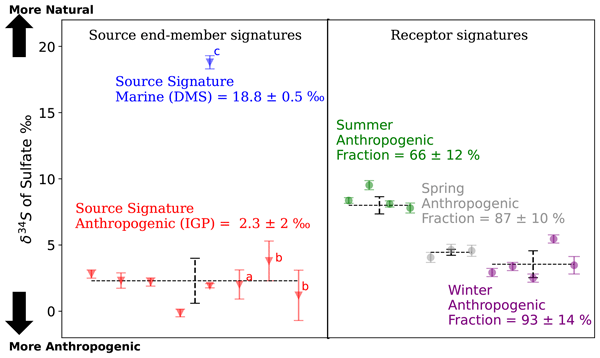
- Figure 2 is confusing. I recommend splitting the source signatures and the d34S measurements into two subplots in figure 2.
- Jongebloed et al. (2023) also compiled DMS-derived sulfurous compounds, including the measurements from Amrani et al. (2013) and other studies, to estimate d34S(SO4)DMS = 18.8 permille, which is slightly lower than the 19.7 used here. Justify why you use 19.7 – are you sure 18.8 is not a more accurate value?
- Harris et al. (2013) and others have shown that d34S(SO4) is different from d34S(SO2) due to fractionation during oxidation of SO2. Why is it justifiable to create a mixing model here that ignores this fractionation? Is it because all your source signatures are determined based on sulfate that has already been oxidized? I think this is briefly mentioned in Text S1, but should be mentioned in 1-2 sentences in the main text.
- The way that the anthropogenic source signature was determined is not clearly explained. This is an important and uncertain aspect of your analysis, so it should be addressed more explicitly in the main text. I assume it is determined by just taking the d34S(SO4) measurements from IGP and BCOB based on this sentence: “Samples from BCOB, which were used to represent the anthropogenic end-member of sulfate, were assumed to be predominantly anthropogenic in origin (~100 %)”
- Even in a highly polluted region, is it realistic that 100% of sulfate is anthropogenic? I wonder if this assumption results in an anthropogenic signature that is too high or too low. It would be good to test this assumption by seeing how your results would change if you assumed that the sulfate in BCOB is only 90% anthropogenic, for example.
- Another way to examine this would be to create a Keeling Plot (plot 1/nssSO4 vs. d34S(nssSO4)) of the data in Table S1. If anthropogenic sulfate is the more variable sulfate source, the y-intercept will represent the anthropogenic source signature. A Keeling Plot might not be appropriate if the other sources are too variable (see Pataki et al., 2003). I leave the decision of whether to evaluate a Keeling Plot to the authors of this study.
Minor comments:
- Figure 1: the labels of the seasons (winter, autumn, summer) don’t align with the caption (winter, spring, summer), unless if I’m missing something.
- This sentence needs a citation at the end: The ship end-member had a δ34S of 3 ± 3 ‰ taken from studies that measured δ34-SO4 and δ34-SO2 in the North Atlantic, which is thought to be representative of remote air masses with strong ship emissions from heavy fuel oil. Perhaps (Seguin et al., 2010, 2011; Wadleigh, 2004)?
Citation: https://doi.org/10.5194/egusphere-2025-5334-RC1 -
AC2: 'Reply on RC1', Sean Clarke, 20 Feb 2026
The comment was uploaded in the form of a supplement: https://egusphere.copernicus.org/preprints/2025/egusphere-2025-5334/egusphere-2025-5334-AC2-supplement.pdf
-
RC2: 'Comment on egusphere-2025-5334', Anonymous Referee #2, 12 Jan 2026
The presented work provides a valuable dataset of sulfur isotopic compositions of aerosol sulfate in South Asia. This region experiences heavy aerosol loading, and it is therefore important to observationally constrain emission inventories in order to better quantify their impacts on effective radiative forcing.
The analytical procedure appears sound, and the interpretations are generally well supported. I recommend publication after the authors address the following concerns.Major comments:
Lines 170–176 and Section 3.1: The discussion regarding the choice of δ³⁴S end-member values for both biogenic and anthropogenic sources should be expanded, as these choices directly affect the subsequent source apportionment.
- Biogenic sources: Several previous studies have reported δ³⁴S values for biogenic sulfur sources ranging from approximately 17.4 to 19.7 ‰ (e.g., Seguin et al., 2011; Jongebloed et al., 2023, and references therein). The use of lower δ³⁴S values could potentially reduce the inferred contribution of anthropogenic sources in the present analysis. Please provide clearer justification for the selected biogenic end-member values and discuss the potential sensitivity of the results to this choice.
- Anthropogenic sources: A ship emission end-member of 3 ± 3 ‰ is introduced; however, in the final source apportionment it appears that a value of 2.3 ± 1.7 ‰ was used as the anthropogenic end-member without explicitly accounting for the ship contribution. Please clarify how this value was derived and explain how ship emissions were considered (or excluded) in determining the anthropogenic end-member.
Lines 296–311: The discrepancy between the observed BC/SO₄ ratios (0.075 ± 0.03) and the inventory-based BC/SO₂ ratio (0.097) warrants further discussion, particularly because a stated goal of this study is to provide guidance for future mitigation strategies in South Asia.
How might atmospheric processes following emission (such as SO₂ oxidation to sulfate, differential deposition of BC and sulfate, or other removal mechanisms) affect the BC/SO₄ ratio? After accounting for these processes, is the difference between observed and inventory-based ratios still significant? In addition, could emissions of H₂S from mangrove ecosystems influence the observed ratios? If possible, the authors are encouraged to provide suggestions on how emission inventories for this region could be improved based on these findings.
Finally, as noted above, uncertainties associated with the choice of δ³⁴S end-member values may further propagate into the estimated BC/SO₄ ratios and should be acknowledged.Specific comments:
Line 113: Please provide information on the IC column used for ion quantification.
Line 118: Please explicitly state whether the sulfate-to-sodium ratio refers to a mass ratio or a molar ratio.
Lines 130–132: Please specify the chemical forms of the solutions used for adding Si and Na. For example, were these added in acidic (e.g., H₃SiO₄) and alkaline (e.g., NaOH) forms, respectively? Although readers can consult Rodiouchkina (2018) for methodological details such as solution concentrations, the simplified procedure presented here is difficult to follow from an analytical chemistry perspective without this clarification.
Line 159: Replacing “%nssSO₄” with “F_nssSO₄” would improve readability and maintain consistency with other equations in the manuscript (e.g., F_biomass in Eq. (3) and F_DMS-SO₄ in Eq. (5)).
Citation: https://doi.org/10.5194/egusphere-2025-5334-RC2 -
AC1: 'Reply on RC2', Sean Clarke, 20 Feb 2026
The comment was uploaded in the form of a supplement: https://egusphere.copernicus.org/preprints/2025/egusphere-2025-5334/egusphere-2025-5334-AC1-supplement.pdf
Peer review completion
Journal article(s) based on this preprint
Viewed
| HTML | XML | Total | Supplement | BibTeX | EndNote | |
|---|---|---|---|---|---|---|
| 783 | 345 | 68 | 1,196 | 151 | 78 | 89 |
- HTML: 783
- PDF: 345
- XML: 68
- Total: 1,196
- Supplement: 151
- BibTeX: 78
- EndNote: 89
Viewed (geographical distribution)
| Country | # | Views | % |
|---|
| Total: | 0 |
| HTML: | 0 |
| PDF: | 0 |
| XML: | 0 |
- 1
Henry Holmstrand
Krishnakant Budhavant
Manoj Remani
Sophie Haslett
Katerina Rodiouchkina
Ellen Kooijman
Örjan Gustafsson
The requested preprint has a corresponding peer-reviewed final revised paper. You are encouraged to refer to the final revised version.
- Preprint
(848 KB) - Metadata XML
-
Supplement
(572 KB) - BibTeX
- EndNote
- Final revised paper
Clarke et al. present new measurements of d34S(SO4) from the Maldives in South Asia, a region that is severely impacted by anthropogenic pollution. These measurements are very valuable and can help quantify the sources of sulfate in this region. Clarke et al. present a solid interpretation of their measurements. I have written some suggestions below to improve their analysis.
Major comments:
Minor comments: