
the Creative Commons Attribution 4.0 License.
the Creative Commons Attribution 4.0 License.
 | 23 Dec 2025
Untangling the effects of vertical mixing schemes and convective adjustment in the Mediterranean Sea
Abstract. The Mediterranean Sea provides a natural laboratory for investigating ocean circulation processes of global relevance due to its complex dynamics, active deep and intermediate water formation, and sensitivity to climate variability. Regional ocean circulation models skill strongly depends on the parameterization of subgrid-scale processes, among which turbulent vertical mixing and convection play a major role. To evaluate their impact in the context of the Mediterranean Sea two-year-long simulations were conducted using three vertical closure schemes – Richardson-number dependent parameterisation, Turbulent Kinetic Energy (TKE) scheme, and Generalised Length Scale (GLS) scheme – combined with a convective adjustment approach with the aim to study their interaction. Model results are evaluated against all available Argo floats data, both at the basin scale and in key deep and intermediate water formation regions. The simulations show that adding a convective adjustment is crucial to accurately reproduce observations with the Richardson-number dependent parameterization, where it improves all key variables, while for the TKE scheme it is particularly important for representing the mixed layer depth across the basin and in deep water formation areas. For more physics-based vertical schemes, like the GLS closure, the convective adjustment is mostly redundant and can occasionally degrade results. Overall, the GLS scheme without any convective adjustment provides the most accurate representation of the mixed layer depth as well as the vertical structure and variability both at basin scale and in key regions of deep and intermediate water formation.
-
Notice on discussion status
The requested preprint has a corresponding peer-reviewed final revised paper. You are encouraged to refer to the final revised version.
-
Preprint
(21400 KB)
-
The requested preprint has a corresponding peer-reviewed final revised paper. You are encouraged to refer to the final revised version.
- Preprint
(21400 KB) - Metadata XML
- BibTeX
- EndNote
- Final revised paper


Journal article(s) based on this preprint
Interactive discussion
Status: closed
-
RC1: 'Comment on egusphere-2025-5327', Anonymous Referee #1, 03 Mar 2026
- AC1: 'Reply on RC1', Lucia Gualtieri, 16 Apr 2026
-
RC2: 'Comment on egusphere-2025-5327', Anonymous Referee #2, 10 Mar 2026
The comment was uploaded in the form of a supplement: https://egusphere.copernicus.org/preprints/2025/egusphere-2025-5327/egusphere-2025-5327-RC2-supplement.pdf
- AC2: 'Reply on RC2', Lucia Gualtieri, 16 Apr 2026
Peer review completion


Interactive discussion
Status: closed
-
RC1: 'Comment on egusphere-2025-5327', Anonymous Referee #1, 03 Mar 2026
This study provides valuable insight by demonstrating, through various experiments in the Mediterranean Sea, that the choice of vertical mixing scheme is an important factor in reproducing oceanic physical variables. In this regard, the manuscript has sufficient merit and relevance for readers.
However, several aspects require more thorough discussion. If these points are adequately addressed, the study could serve as a useful reference for ocean numerical modeling.
[Major Comments]
- This study compares differences in the vertical structure of the Mediterranean Sea associated with different vertical mixing schemes and convective adjustment, primarily focusing on basin-averaged scales. However, the current discussion remains somewhat superficial, and a more in-depth analysis is needed.
- In particular, more detailed explanations are required regarding how the schemes and EVD operate in key regions where major water masses are formed, such as deep water and intermediate water formation areas in each experiment. It would also be valuable to describe the physical processes through which these differences develop over time.
- Rather than simply describing differences among experimental results, the discussion should further address the physical mechanisms responsible for these differences and elaborate on their scientific implications.
- In Section 3.1, before discussing the differences between the Control experiment and observations (OBS), it would be necessary to first present the differences between the initial conditions used in this study and the observations. This information would provide an important basis for interpreting how the model results shown in Figs. 4 and 5 are actually influenced by the vertical mixing schemes.
For example, it should be clarified whether the statistical metrics presented in Figs. 4 and 5 primarily reflect characteristics of the initial conditions, or whether they result from physical processes associated with the vertical mixing schemes that amplify or reduce model errors. - In addition to Argo data, incorporating ship-based observational datasets (e.g., repeated hydrographic sections or long-term monitoring stations), if available, could provide a more comprehensive observational basis and allow for a more detailed discussion of experiment-specific characteristics across different regions of the Mediterranean.
[Specific Comments]
- (line 84) Although statistical differences in deep water and intermediate water formation regions are compared across experiments, it is unclear whether a two-year model integration is sufficient to evaluate these differences. In particular, it should be examined whether spin-up effects may still influence the results.
- (line 94) The phrase “our model domain” in the description of Argo float data sounds somewhat awkward.
- (Fig. 1) It would be helpful to label major sub-basins of the Mediterranean on the map and include a schematic of major currents and regions where convection frequently occurs. In particular, key regions repeatedly mentioned in the manuscript should be clearly indicated to help readers better understand the regional characteristics.
- (Section 2.1) The study presents basin-averaged vertical profiles of temperature and salinity using Argo float data. However, presenting seasonal vertical profile characteristics specifically in deep and intermediate water formation regions would more clearly illustrate the effects of different vertical mixing schemes and convective adjustment.
- (line 130) The longitude and latitude ranges should be clearly specified.
- (line 156) In the sentence “The latter rely on ~~,” it should be clarified what “the latter” refers to.
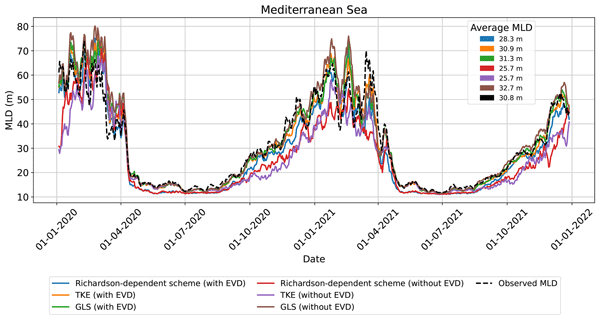
- (Fig. 4) Would it be possible to present basin-averaged mixed layer depth by showing both model results and observations together for comparison?
- (line 341) Clarification is needed regarding the meaning of negative RMSE values. How can RMSE take negative values?
- (line 351–353) A more detailed explanation is needed regarding why the result described in “The Richardson-dependent scheme without EVD ~~~” was expected.
- The location of the Rhodes Gyre region should be indicated in Fig. 1.
- The Rhodes Gyre region should be defined and its location presented when it is first mentioned in the manuscript.
- (Figure 11) The manuscript states that the largest errors occur between 200–500 m depth across all experiments. However, the figure appears to show that intermediate-depth errors increase at specific times after model integration begins. A discussion is needed to explain the physical processes responsible for the formation of these errors. For example, it should be considered whether differences in intermediate water formation associated with different schemes lead to the development of these errors during periods of water mass formation.
- It would also be beneficial to extend the discussion to regions with characteristics similar to the Mediterranean, and to elaborate on how the findings of this study could be considered or applied in a broader regional context.
Citation: https://doi.org/10.5194/egusphere-2025-5327-RC1 - AC1: 'Reply on RC1', Lucia Gualtieri, 16 Apr 2026
-
RC2: 'Comment on egusphere-2025-5327', Anonymous Referee #2, 10 Mar 2026
The comment was uploaded in the form of a supplement: https://egusphere.copernicus.org/preprints/2025/egusphere-2025-5327/egusphere-2025-5327-RC2-supplement.pdf
- AC2: 'Reply on RC2', Lucia Gualtieri, 16 Apr 2026
Peer review completion
Journal article(s) based on this preprint
Viewed
| HTML | XML | Total | BibTeX | EndNote | |
|---|---|---|---|---|---|
| 1,685 | 1,768 | 195 | 3,648 | 303 | 283 |
- HTML: 1,685
- PDF: 1,768
- XML: 195
- Total: 3,648
- BibTeX: 303
- EndNote: 283
Viewed (geographical distribution)
| Country | # | Views | % |
|---|
| Total: | 0 |
| HTML: | 0 |
| PDF: | 0 |
| XML: | 0 |
- 1

Paolo Oddo
Hans Burchard
Federica Borile
Aimie Moulin
Pietro Miraglio
Francesco Maicu
Emanuela Clementi
The requested preprint has a corresponding peer-reviewed final revised paper. You are encouraged to refer to the final revised version.
- Preprint
(21400 KB) - Metadata XML
This study provides valuable insight by demonstrating, through various experiments in the Mediterranean Sea, that the choice of vertical mixing scheme is an important factor in reproducing oceanic physical variables. In this regard, the manuscript has sufficient merit and relevance for readers.
However, several aspects require more thorough discussion. If these points are adequately addressed, the study could serve as a useful reference for ocean numerical modeling.
[Major Comments]
For example, it should be clarified whether the statistical metrics presented in Figs. 4 and 5 primarily reflect characteristics of the initial conditions, or whether they result from physical processes associated with the vertical mixing schemes that amplify or reduce model errors.
[Specific Comments]