
the Creative Commons Attribution 4.0 License.
the Creative Commons Attribution 4.0 License.
 | 18 Nov 2025
Contrasting Impacts of Dust Ice-Nucleating Particles on the Evolution and Radiative Effects of Mixed-Phase and Ice Clouds
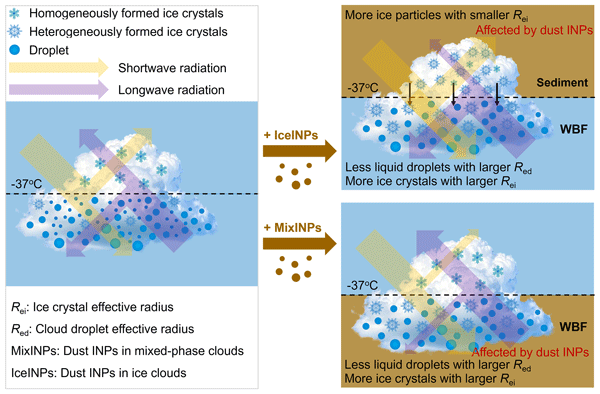
Abstract. The effect of aerosols acting as ice-nucleating particles (INPs) remains one of the least understood processes in aerosol–cloud–climate interactions. Mineral dust can serve as INPs in both mixed-phase and ice clouds, yet few studies have simultaneously considered dust INPs in both cloud types, limiting our understanding of their impacts on clouds and radiation. Here, we develop an improved INP parameterization in WRF-Chem that explicitly represents dust INPs in both cloud types, incorporating both non-size-resolved and size-resolved INP parameterizations. Model evaluation against ground-based and satellite observations shows good agreement with the observed spatiotemporal variations of surface PM10, dust INPs, liquid water path (LWP), and ice water path (IWP) over East Asia. Simulations for spring 2018 reveal that dust INPs in mixed-phase clouds accelerate the Wegener–Bergeron–Findeisen (WBF) process, increasing IWP by 2.3 % and decreasing LWP by 3.3 %, thereby reducing cloud albedo and producing a warming of 0.20 W m−2. In ice clouds, dust INPs enhance heterogeneous nucleation, increase ice crystal number concentrations, and reduce their effective radius. Sedimenting ice crystals from ice clouds further intensify the WBF process in mixed-phase clouds, ultimately yielding a stronger warming of 3.56 W m−2. Differences among INP parameterizations are comparable to those between simulations with and without INPs, whereas the size-resolved scheme may more reasonably represent the spatial variability of dust INP effects. This study highlights the distinct roles of dust INPs in mixed-phase and ice clouds from the microphysical perspective and advances our understanding of aerosol–cloud–climate interactions.
Competing interests: At least one of the (co-)authors is a member of the editorial board of Atmospheric Chemistry and Physics. The peer-review process was guided by an independent editor, and the authors also have no other competing interests to declare.
Publisher's note: Copernicus Publications remains neutral with regard to jurisdictional claims made in the text, published maps, institutional affiliations, or any other geographical representation in this paper. While Copernicus Publications makes every effort to include appropriate place names, the final responsibility lies with the authors. Views expressed in the text are those of the authors and do not necessarily reflect the views of the publisher.-
Notice on discussion status
The requested preprint has a corresponding peer-reviewed final revised paper. You are encouraged to refer to the final revised version.
-
Preprint
(5870 KB)
-
Supplement
(2672 KB)
-
The requested preprint has a corresponding peer-reviewed final revised paper. You are encouraged to refer to the final revised version.
- Preprint
(5870 KB) - Metadata XML
-
Supplement
(2672 KB) - BibTeX
- EndNote
- Final revised paper


Journal article(s) based on this preprint
Interactive discussion
Status: closed
-
RC1: 'Comment on egusphere-2025-5277', Anonymous Referee #1, 18 Jan 2026
- AC1: 'Response to the Comments from Anonymous Referee #1', Hua Zhang, 14 Apr 2026
-
RC2: 'Comment on egusphere-2025-5277', Anonymous Referee #2, 06 Feb 2026
In this work, the authors introduce two new parameterizations for ice-nucleating particles (INPs) in WRF-Chem to investigate the impacts of dust INPs on mixed-phase and ice clouds and their radiative effects. Given the large uncertainties surrounding the role of dust emissions in ice formation and cloud evolution, this study is relevant to the community. The methods and results are described in detail, the manuscript is generally well written, and the inclusion of model validation is commendable.
However, I find the paper largely descriptive, with few overarching conclusions that advance the state of the field, and I question whether it is a good fit for the journal. Several mechanisms are proposed to explain the results, but these remain mostly speculative. In addition, there may be fundamental flaws in the implementation of the ice nucleation parameterizations that warrant major revisions. These issues must be addressed before the paper can be considered for publication.
General comments
Overall, the manuscript is clearly written, detailed, and the simulation experiments are well designed. At the same time, the discussion often falls back on straightforward descriptions of figures without deeper analysis. When mechanistic explanations are proposed (for example involving sedimentation or the WBF process) they are not supported by evidence. It should be possible to output the relevant microphysical rates from the model to demonstrate that the proposed mechanisms are actually operating. As written, these explanations are often lost in the text and do not appear central to the paper’s conclusions. I encourage the authors to include a dedicated discussion section where these mechanisms can be addressed in more depth, and where Figure 10 and the hypotheses raised in the conclusions can be more fully developed.
More fundamentally, there may be a major flaw in the implementation of the ice formation parameterizations for ice clouds. It is never clear what subgrid-scale vertical velocity is used. At the model resolution employed (27 km), the dynamics of individual parcels are not resolved; using grid-scale vertical velocities would significantly underestimate peak supersaturation and ice formation rates, particularly for homogeneous ice nucleation. This issue would strongly affect, and likely alter, the conclusions of the study. The authors should provide more detailed information on the implementation of the ice nucleation parameterizations and clearly state the assumptions made regarding subgrid-scale dynamics.
Minor comments
- Line 69: Remove “simple.”
- Lines 92–94: Please clarify this sentence. Parameterizations derived for cirrus should be applicable wherever cirrus clouds occur.
- Line 159: Consider “the latter mechanism remains…”
- Section 2.2.1: Whether immersion freezing is restricted to the presence of liquid water has a significant impact on simulated cloud properties (see, e.g., Tan and Barahona, 2022).
- Lines 215–217: Any droplet reaching −40 °C would freeze; it is unclear why heterogeneous ice nucleation would be more likely.
- Line 224: “Before” is ambiguous here.
- Line 316: Please specify whether, in the NoINPs experiment, INPs are represented by the default parameterization or removed entirely.
- Line 348: Consider “homogeneous and heterogeneous ice nucleation in ice clouds followed…”
- Line 393: This is a large number of sites. Please describe how samples are collected.
- Figure 2: How is supersaturation diagnosed? What assumptions are made regarding subgrid-scale variability?
- Lines 524–526: Low ice crystal concentrations from homogeneous ice nucleation may indicate overly weak vertical velocities.
- Line 538: Is dust transported with cloud droplets in the convective parameterization?
- Lines 600–602: Again, please ensure this result is not driven by weak subgrid-scale vertical velocities.
- Figure 10: The proposed mechanisms are largely speculative and should be supported by diagnosed WBF rates. The figure also seems misplaced in the conclusions.
- Code and data availability: At minimum, the source data for the figures should be made available. Please also indicate the sources of the model code and parameterizations, even if they were modified by the authors.
Reference
Tan, I., and D. Barahona, 2022: The impacts of immersion ice nucleation parameterizations on Arctic mixed-phase stratiform cloud properties and the Arctic radiation budget in GEOS-5. J. Climate, 35, 4049–4070.
Citation: https://doi.org/10.5194/egusphere-2025-5277-RC2 - AC2: 'Response to the Comments from Anonymous Referee #2', Hua Zhang, 14 Apr 2026
Peer review completion


Interactive discussion
Status: closed
-
RC1: 'Comment on egusphere-2025-5277', Anonymous Referee #1, 18 Jan 2026
This review concerns the ACP manuscript of Hua Zhang et al. entitled “Contrasting Impacts of Dust Ice-Nucleating Particles on the Evolution and Radiative Effects of Mixed-Phase and Ice Clouds”.
The authors use a customized version of WRF-Chem to investigate the impact of variable INP setups on the cloud evolution and radiation budget over China and associated regions of Asia. The conclusions which the authors draw from their study are generally sound and of certain relevance to the community. Nevertheless, one has to consider that the study is kind of a synthesis report which deploys a range of existing methods and techniques to investigate the subject of dust impacts on the evolution of the tropospheric ice phase and the radiation budget. This was, however, done before by others, which is also acknowledged by the authors in the manuscript.
Given that the study is not a big leap forward for fundamental research (while it is certainly of some interest and impact for the community), there is no new technique that would require careful evaluation. After having read the study in the framework of this review I thus only identified mostly minor issues. The identification of these minor issues was happily possible rather easy as the quality of the English text is already in the current state pretty advanced.
Find below the listing of the comments. Only general minor (or rather semi-major) comments are listed here. I’m strongly in favor for a second round of reviews, as the implementation of some of my comments might have some impact on the study.
General comments:
- Title: The title is misleading. I was only triggered to accept the review because I was hoping for an observational study. I kindly ask the authors to modify the title of the study in such a way that it is clear to everybody that simulations are used. Suggestion: Simulations of the impacts of contrasts in dust ice-nucleating particles on the evolution and radiative effects of mixed-phase and ice clouds
- Fundamentals of the statistical analysis: The authors provide a lot of statistical analyses, including many mean values. But the theory behind the acquisition of these statistics is not outlined in the manuscript. The output of any model, especially with respect to aerosol and cloud microphysics yields usually output values in every grid box. The evaluation of statistics thus requires a custom decision of the authors about the applied thresholds, below which values are neglected and set to zero. Thus, which thresholds did the authors apply to define the ‘background’ or zero values? This of course addresses all parameters the authors analysed statistically.
- I kindly ask the authors to elaborate a bit how the selected minimum realistic data values affected the derived statistics. How do mean and median values behave and which conclusions can be drawn from this comparison?
- If there was no threshold applied to filter out the background/simulation noise, the authors must explain/describe what the impact of the background/simulation noise is on the mean/median values.
- I see need that the authors add a new section to the manuscript where they describe the statistical approach and where they discuss the decisions for the thresholds and how the impact mean/median values. Perhaps that can be done by means of a table and a new section 2.5: Statistical methods.
- Limitation to only dust INP: Meanwhile it is widely accepted that ice formation at temperatures above -15°C is mostly determined by biological particles (Cornwell et al., 2023). This was not discussed at all by the authors. There should be some information about this important INP type provided in the introduction and in the conclusions section. Another important INP type, especially at Cirrus level is smoke (Ansmann et al., 2025), which might also deserve some discussion in the introduction and conclusions.
- Lack of referencing to observational studies of INP/ICNC relationships under ambient conditions: There are meanwhile plenty of observational studies discussing relationships between INP concentration and cloud properties. It would be nice if the authors would add some to their study (introduction). Here some examples (e.g., Zhang et al., 2018; Ansmann et al., 2019; He et al., 2025, Villanueva et al., 2025). There are also nice detailes spectral-bin simulations of the impact of perturbations in INP on mixed-phase cloud properties (Lee et al., 2024)
- Impact for future studies: I suggest to the authors to extend their conclusions a bit by means of an outlook. Their study has the potential to evaluate how projected changes in landuse and surface type will probably effect the regional climate in China and surrounding parts of Asia. It would be an easy task to just modify the dust immersion scheme in order to investigate how clouds and radiation would change with changing emissions (and a certainly warmer climate). Such a future study would be a really nice follow-up to the presented one.
- All figures: I kindly request that the authors aim on increasing the size of fonts and legends in all of their figures to the maximum. The figures are very hard to read. I was hardly able to read any number in the printed version of the manuscript. Especially Figs. 5 and 6.
References:
- Cornwell et al., 2023: https://doi.org/10.1126/sciadv.adg3715
- Ansmann et al., 2025: https://doi.org/10.5194/acp-25-4867-2025
- Zhang et al., 2018: https://doi.org/10.5194/acp-18-4317-2018
- Ansmann et al., 2019: https://doi.org/10.5194/acp-19-15087-2019
- He et al., 2025: https://doi.org/10.1029/2024JD043157
- Lee et al., 2024: https://doi.org/10.5194/acp-24-5737-2024
- Villanueva et al., 2025: https://doi.org/10.1126/science.adt5354
Citation: https://doi.org/10.5194/egusphere-2025-5277-RC1 - AC1: 'Response to the Comments from Anonymous Referee #1', Hua Zhang, 14 Apr 2026
-
RC2: 'Comment on egusphere-2025-5277', Anonymous Referee #2, 06 Feb 2026
In this work, the authors introduce two new parameterizations for ice-nucleating particles (INPs) in WRF-Chem to investigate the impacts of dust INPs on mixed-phase and ice clouds and their radiative effects. Given the large uncertainties surrounding the role of dust emissions in ice formation and cloud evolution, this study is relevant to the community. The methods and results are described in detail, the manuscript is generally well written, and the inclusion of model validation is commendable.
However, I find the paper largely descriptive, with few overarching conclusions that advance the state of the field, and I question whether it is a good fit for the journal. Several mechanisms are proposed to explain the results, but these remain mostly speculative. In addition, there may be fundamental flaws in the implementation of the ice nucleation parameterizations that warrant major revisions. These issues must be addressed before the paper can be considered for publication.
General comments
Overall, the manuscript is clearly written, detailed, and the simulation experiments are well designed. At the same time, the discussion often falls back on straightforward descriptions of figures without deeper analysis. When mechanistic explanations are proposed (for example involving sedimentation or the WBF process) they are not supported by evidence. It should be possible to output the relevant microphysical rates from the model to demonstrate that the proposed mechanisms are actually operating. As written, these explanations are often lost in the text and do not appear central to the paper’s conclusions. I encourage the authors to include a dedicated discussion section where these mechanisms can be addressed in more depth, and where Figure 10 and the hypotheses raised in the conclusions can be more fully developed.
More fundamentally, there may be a major flaw in the implementation of the ice formation parameterizations for ice clouds. It is never clear what subgrid-scale vertical velocity is used. At the model resolution employed (27 km), the dynamics of individual parcels are not resolved; using grid-scale vertical velocities would significantly underestimate peak supersaturation and ice formation rates, particularly for homogeneous ice nucleation. This issue would strongly affect, and likely alter, the conclusions of the study. The authors should provide more detailed information on the implementation of the ice nucleation parameterizations and clearly state the assumptions made regarding subgrid-scale dynamics.
Minor comments
- Line 69: Remove “simple.”
- Lines 92–94: Please clarify this sentence. Parameterizations derived for cirrus should be applicable wherever cirrus clouds occur.
- Line 159: Consider “the latter mechanism remains…”
- Section 2.2.1: Whether immersion freezing is restricted to the presence of liquid water has a significant impact on simulated cloud properties (see, e.g., Tan and Barahona, 2022).
- Lines 215–217: Any droplet reaching −40 °C would freeze; it is unclear why heterogeneous ice nucleation would be more likely.
- Line 224: “Before” is ambiguous here.
- Line 316: Please specify whether, in the NoINPs experiment, INPs are represented by the default parameterization or removed entirely.
- Line 348: Consider “homogeneous and heterogeneous ice nucleation in ice clouds followed…”
- Line 393: This is a large number of sites. Please describe how samples are collected.
- Figure 2: How is supersaturation diagnosed? What assumptions are made regarding subgrid-scale variability?
- Lines 524–526: Low ice crystal concentrations from homogeneous ice nucleation may indicate overly weak vertical velocities.
- Line 538: Is dust transported with cloud droplets in the convective parameterization?
- Lines 600–602: Again, please ensure this result is not driven by weak subgrid-scale vertical velocities.
- Figure 10: The proposed mechanisms are largely speculative and should be supported by diagnosed WBF rates. The figure also seems misplaced in the conclusions.
- Code and data availability: At minimum, the source data for the figures should be made available. Please also indicate the sources of the model code and parameterizations, even if they were modified by the authors.
Reference
Tan, I., and D. Barahona, 2022: The impacts of immersion ice nucleation parameterizations on Arctic mixed-phase stratiform cloud properties and the Arctic radiation budget in GEOS-5. J. Climate, 35, 4049–4070.
Citation: https://doi.org/10.5194/egusphere-2025-5277-RC2 - AC2: 'Response to the Comments from Anonymous Referee #2', Hua Zhang, 14 Apr 2026
Peer review completion
Journal article(s) based on this preprint
Viewed
| HTML | XML | Total | Supplement | BibTeX | EndNote | |
|---|---|---|---|---|---|---|
| 2,414 | 919 | 208 | 3,541 | 406 | 162 | 167 |
- HTML: 2,414
- PDF: 919
- XML: 208
- Total: 3,541
- Supplement: 406
- BibTeX: 162
- EndNote: 167
Viewed (geographical distribution)
| Country | # | Views | % |
|---|
| Total: | 0 |
| HTML: | 0 |
| PDF: | 0 |
| XML: | 0 |
- 1
Hua Zhang
Shuxiao Wang
Xi Zhao
Zhijun Wu
Siyu Chen
Dantong Liu
Jingchuan Chen
Hui Jiang
Jiewen Shen
Da Gao
Dejia Yin
Yicong He
Shengyue Li
Zhaoxin Dong
Manish Shrivastava

The requested preprint has a corresponding peer-reviewed final revised paper. You are encouraged to refer to the final revised version.
- Preprint
(5870 KB) - Metadata XML
-
Supplement
(2672 KB) - BibTeX
- EndNote
- Final revised paper
This review concerns the ACP manuscript of Hua Zhang et al. entitled “Contrasting Impacts of Dust Ice-Nucleating Particles on the Evolution and Radiative Effects of Mixed-Phase and Ice Clouds”.
The authors use a customized version of WRF-Chem to investigate the impact of variable INP setups on the cloud evolution and radiation budget over China and associated regions of Asia. The conclusions which the authors draw from their study are generally sound and of certain relevance to the community. Nevertheless, one has to consider that the study is kind of a synthesis report which deploys a range of existing methods and techniques to investigate the subject of dust impacts on the evolution of the tropospheric ice phase and the radiation budget. This was, however, done before by others, which is also acknowledged by the authors in the manuscript.
Given that the study is not a big leap forward for fundamental research (while it is certainly of some interest and impact for the community), there is no new technique that would require careful evaluation. After having read the study in the framework of this review I thus only identified mostly minor issues. The identification of these minor issues was happily possible rather easy as the quality of the English text is already in the current state pretty advanced.
Find below the listing of the comments. Only general minor (or rather semi-major) comments are listed here. I’m strongly in favor for a second round of reviews, as the implementation of some of my comments might have some impact on the study.
General comments:
References: