
the Creative Commons Attribution 4.0 License.
the Creative Commons Attribution 4.0 License.
 | 27 Nov 2025
Sphagnum and Herbaceous Net Ecosystem Exchanges in a Pyrenean Peatland: A Long-Term Study Using the ISBA Model
Abstract. Peatlands play a crucial role in the global carbon cycle, acting as long-term carbon sinks. However, their stability is increasingly threatened by climate change, particularly through rising temperatures and the intensification of droughts. This study focuses on the Bernadouze peatland in the Pyrenees Mountains and aims to validate a newly implemented Sphagnum Plant Functional Type (PFT) in the ISBA land surface model, assess the temporal evolution of carbon fluxes over the past 70 years, and investigate the factors influencing carbon accumulation, with a particular emphasis on drought events.
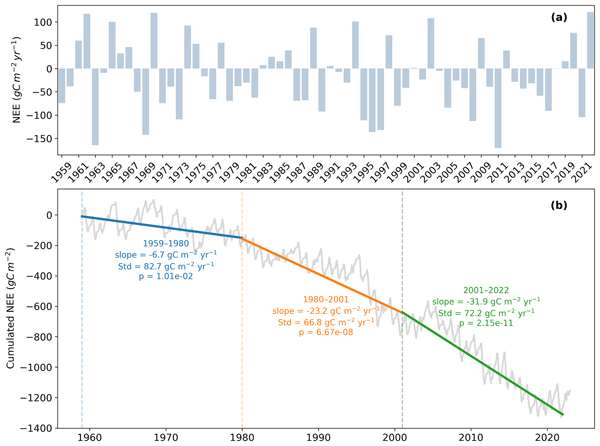
The model was validated using in situ data, demonstrating reliable carbon flux estimations. Using this validated model, we reconstructed the net ecosystem exchange (NEE) dynamics of the Bernadouze peatland from 1959 to 2022. The results reveal significant interannual variability in NEE, largely driven by air temperature and water table depth. While the peatland has remained a carbon sink, extreme droughts such as those in 1989, 1994, 2003, and most recently 2022 have led to substantial CO2 emissions.
Our findings suggest that although increasing temperatures have extended the growing season and enhanced gross primary productivity (GPP), the rising frequency and intensity of droughts pose a long-term risk to peatland carbon storage. The dryness index developed in this study appears to be a strong predictor of summer and annual NEE, offering a potential tool for estimating carbon fluxes in peatlands lacking direct measurements.
-
Notice on discussion status
The requested preprint has a corresponding peer-reviewed final revised paper. You are encouraged to refer to the final revised version.
-
Preprint
(13777 KB)
-
The requested preprint has a corresponding peer-reviewed final revised paper. You are encouraged to refer to the final revised version.
- Preprint
(13777 KB) - Metadata XML
- BibTeX
- EndNote
- Final revised paper


Journal article(s) based on this preprint
Interactive discussion
Status: closed
-
RC1: 'Comment on egusphere-2025-5248', Katharina Jentzsch, 02 Jan 2026
The comment was uploaded in the form of a supplement: https://egusphere.copernicus.org/preprints/2025/egusphere-2025-5248/egusphere-2025-5248-RC1-supplement.pdfCitation: https://doi.org/
10.5194/egusphere-2025-5248-RC1 -
AC2: 'Reply on RC1', Raphael Garisoain, 29 Jan 2026
Dear Reviewer,
Please find attached a document containing our responses to the reviewers’ comments. The document is organized as follows: first, the detailed responses to the comments, then the updated bibliography, and finally the figures that have been modified.
Best regards,
-
AC2: 'Reply on RC1', Raphael Garisoain, 29 Jan 2026
-
RC2: 'Comment on egusphere-2025-5248', Anonymous Referee #2, 09 Jan 2026
The comment was uploaded in the form of a supplement: https://egusphere.copernicus.org/preprints/2025/egusphere-2025-5248/egusphere-2025-5248-RC2-supplement.pdf
-
AC1: 'Reply on RC2', Raphael Garisoain, 29 Jan 2026
Dear Reviewer,
Please find attached a document containing our responses to the reviewers’ comments. The document is organized as follows: first, the detailed responses to the comments, then the updated bibliography, and finally the figures that have been modified.
Best regards.
-
AC1: 'Reply on RC2', Raphael Garisoain, 29 Jan 2026
Peer review completion


Interactive discussion
Status: closed
-
RC1: 'Comment on egusphere-2025-5248', Katharina Jentzsch, 02 Jan 2026
The comment was uploaded in the form of a supplement: https://egusphere.copernicus.org/preprints/2025/egusphere-2025-5248/egusphere-2025-5248-RC1-supplement.pdf
-
AC2: 'Reply on RC1', Raphael Garisoain, 29 Jan 2026
Dear Reviewer,
Please find attached a document containing our responses to the reviewers’ comments. The document is organized as follows: first, the detailed responses to the comments, then the updated bibliography, and finally the figures that have been modified.
Best regards,
-
AC2: 'Reply on RC1', Raphael Garisoain, 29 Jan 2026
-
RC2: 'Comment on egusphere-2025-5248', Anonymous Referee #2, 09 Jan 2026
The comment was uploaded in the form of a supplement: https://egusphere.copernicus.org/preprints/2025/egusphere-2025-5248/egusphere-2025-5248-RC2-supplement.pdf
-
AC1: 'Reply on RC2', Raphael Garisoain, 29 Jan 2026
Dear Reviewer,
Please find attached a document containing our responses to the reviewers’ comments. The document is organized as follows: first, the detailed responses to the comments, then the updated bibliography, and finally the figures that have been modified.
Best regards.
-
AC1: 'Reply on RC2', Raphael Garisoain, 29 Jan 2026
Peer review completion
Journal article(s) based on this preprint
Data sets
Sphagnum and Herbaceous Net Ecosystem Exchanges in a Pyrenean Peatland: A Long-Term Study Using the ISBA Model [Data set] R. Garisoain et al. https://doi.org/10.5281/zenodo.16984992
Viewed
| HTML | XML | Total | BibTeX | EndNote | |
|---|---|---|---|---|---|
| 1,780 | 899 | 206 | 2,885 | 138 | 142 |
- HTML: 1,780
- PDF: 899
- XML: 206
- Total: 2,885
- BibTeX: 138
- EndNote: 142
Viewed (geographical distribution)
| Country | # | Views | % |
|---|
| Total: | 0 |
| HTML: | 0 |
| PDF: | 0 |
| XML: | 0 |
- 1
Raphael Garisoain

Christine Delire
Bertrand Decharme
Laure Gandois
The requested preprint has a corresponding peer-reviewed final revised paper. You are encouraged to refer to the final revised version.
- Preprint
(13777 KB) - Metadata XML