
the Creative Commons Attribution 4.0 License.
the Creative Commons Attribution 4.0 License.
 | 06 Nov 2025
Sub-kilometer Scale Snow Depth Distribution on Sea Ice of Different Ages and Thickness
Abstract. Accurately representing the snow depth (SND) distribution on sea ice is essential for sea ice thickness (SIT) retrievals, ecological studies, and climate modeling. Using co-located SND and SIT measurements from multiple Arctic and Antarctic campaigns, this study examines sub-kilometer-scale SND variability, considering both ice type and SIT, and identifies the most suitable statistical distributions to represent SND across different ice ages and thicknesses. First, we examine the statistical properties of SND and their dependence on SIT, finding a linear increase of SND with SIT for new and first-year ice, reflecting concurrent seasonal growth. The ratio between the standard deviation and the mean SND is referred to as the coefficient of variation (CV). A consistent CV ≈ 0.50 is observed to be independent of SIT, allowing variability to be estimated directly from the mean SND. Notably, flooded snow exhibits a lower CV. Furthermore, we investigate four probability density functions (Normal, Log-normal, Gamma, and Skew) and find that the best-fit distribution depends on ice ages, SIT, deformation, and meteorological events such as snow fall and drift. Finally, SND correlation lengths derived from semi-variograms show a positive relation with SIT and are enhanced by snow drift events. The results reveal substantial differences in SND distributions across ice types and SIT during winter and summer, underscoring the importance of ice-condition-dependent parameterizations for representing sub-kilometer SND variability. These findings support improved parameterizations of SND variability at sub-grid scale in remote sensing and climate models.
-
Notice on discussion status
The requested preprint has a corresponding peer-reviewed final revised paper. You are encouraged to refer to the final revised version.
-
Preprint
(11830 KB)
-
Supplement
(407 KB)
-
The requested preprint has a corresponding peer-reviewed final revised paper. You are encouraged to refer to the final revised version.
- Preprint
(11830 KB) - Metadata XML
-
Supplement
(407 KB) - BibTeX
- EndNote
- Final revised paper


Journal article(s) based on this preprint
Interactive discussion
Status: closed
-
RC1: 'Comment on egusphere-2025-5158', Anonymous Referee #1, 05 Dec 2025
- AC1: 'Reply on RC1', Lanqing Huang, 05 Mar 2026
-
RC2: 'Comment on egusphere-2025-5158', Anonymous Referee #2, 08 Dec 2025
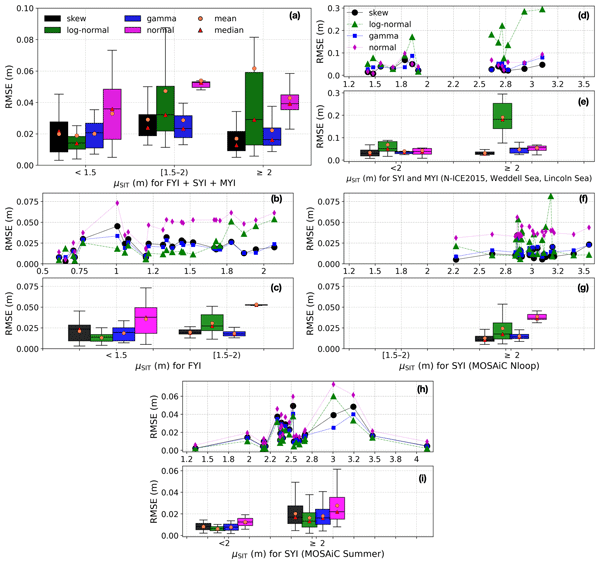
This paper analyzes snow depth and sea ice thickness relationships from in situ observations obtained during MOSAiC, the Lincoln Sea, N-ICE2015, Resolute Bay, and the Weddell Sea field campaigns. This collection of analyses span various ice types, conditions, and seasons. Snow depth distributions are fit to Normal, Log-Normal, Gamma, and Skew distributions and compared accordingly across ice thickness bins. Lastly, the authors examine snow depth correlation lengths against sea ice thickness to test these relationships at various distances. Key findings show snow depth varies considerably across ice types/thicknesses. The Log-Normal distribution tends to perform best for snow atop thinner ice conditions (newly formed ice, first-year ice and thinner multi-year ice) and under thicker ice conditions (>1.5 m), the Skew distribution is optimal. They also note that thicker ice is associated with longer correlation lengths (between depth and thickness) as a result of the common presence surface features such as hummocks and ridges.
The paper is very detailed, well-written, and illustrated. The authors’ concluding remarks calling for SIT-dependent model parameterizations is supported by their findings. Just a couple of minor comments are offered below by line number of the submitted manuscript.
Line (L) 6-7: Leave this definition of the coefficient of variation (CV) for the methods section, though I think it is fine to report the CV as needed here in the context of key findings.
L85-90: Magnaprobe accuracy could be noted somewhere in this section.
L112: Since “drifting” mentioned earlier in the sentence, “drifting with the ice” can be omitted here.
Figure 9: Some brief description of each of the meteorological “events” could be offered in the methods or folded into results. It is unclear, for example, what how “storm” is characterized.
Figure 17: Blue bars in panels a) and b) indicating storm presence appear to have different coloring.
L467: Change to “Future work should involve…”
Citation: https://doi.org/10.5194/egusphere-2025-5158-RC2 - AC2: 'Reply on RC2', Lanqing Huang, 05 Mar 2026
-
CC1: 'Comment on egusphere-2025-5158', Torbjörn Kagel, 15 Dec 2025
Hey all, find a few comments of mine regarding your geo-statistical analysis in the attached PDF.
-
EC1: 'Reply on CC1', John Yackel, 26 Dec 2025
Thank you very much Torbjörn for these insightful comments on the manuscript. I will be sure to pass them along to the authors !
Best regards,
John Yackel
Citation: https://doi.org/10.5194/egusphere-2025-5158-EC1 - AC4: 'Reply on CC1', Lanqing Huang, 05 Mar 2026
-
EC1: 'Reply on CC1', John Yackel, 26 Dec 2025
-
RC3: 'Comment on egusphere-2025-5158', Anonymous Referee #3, 15 Dec 2025
The authors use datasets of snow and ice thickness distributions from both Arctic as well as Antarctica sea ice to describe and investigate the relationships between snow and ice thickness distributions, to investigate the temporal evolution, and describe the spatial distributions, on small scales (under a km). The manuscript definitely fits within the scope of the Cryosphere, and provides several novel results, which is of interest to the sea ice community, in my opinion. My major concerns are the relatively poor discussion with existing literature, as well as the seemingly somewhat ad-hoc data selection and data treatment, as I will point out below.
Major concerns
- My biggest concern with the current manuscript is that it is not strongly connected to existing literature. For example, Mallett et al. (2022) [10.1017/jog.2022.18] has published a manuscript with the title: "Sub-kilometre scale distribution of snow depth on Arctic sea ice from Soviet drifting stations”. Note the similarity between the title of this manuscript: “Sub-kilometer Scale Snow Depth Distribution on Sea Ice of Different Ages and Thickness”. However, Mallett et al. (2022) is only referenced twice in the Introduction. Similarly, violin plots from the Weddell Sea data were published in Wever et al. (2021) [10.1017/jog.2021.54]. Violin plots are reproduced here, without relating them to the already published work from 2021. In its current form, the manuscript does not have a Discussion section. However, I think that such a section is really needed, to make connections with the existing literature: to what extent are previous results confirmed, or improved upon? It also needs to be discussed how the results relate to existing snow depth and ice thickness retrievals using satellites.
- I also did not understand the particular dataset selection. Is there really only one suitable dataset from Antarctic sea ice? Why is the other data from Mallett et al. (2022) not additionally included? Why are none of the remote sensing products included? At first I thought that the criterion was the availability of both concurrent sea ice thickness and snow depth data. But then according to Section 2.3.5, this is also not the case for the Resolute Bay data. I strongly recommend starting Section 2 with listing the criteria that have been used to include datasets in the analysis. I found for example also this dataset: 10.1002/2017GL075434, and there must be quite a few more out there. I think that AWI collects snow and sea ice thickness distributions during most of the Polarstern campaigns, for example.
Also regarding this point, are the data from representative floes for the region? How do average snow depth and ice thickness compare to regional statistics? Given that the selection of data seems to have been quite restrictive, it is important to provide the reader with information about the representativeness of this data compared to overall climatology of sea ice in the region.
- For the Antarctic sea ice data, were station 503 and 506 combined? It sounds like this from the sentence (L105/106): "For the FYI floes (503 and 506), the mean SIT and SND were 0.69 m and 0.19 m, respectively." Does it make sense to combine both datasets? In Table 2, there is only one entry for Weddell Sea FYI (even though there are 2 floes, from different locations and time periods), whereas in Fig. 13d, the floes are analyzed separately. In Wever et al. (2021), the distributions are already shown, and it is clear that 503 and 506 have different underlying sea ice thickness distributions (as also shown in Fig. 13d). Similarly for the N-ICE2015 campaign. In Fig. 4, it looks like all 4 transects are combined in a single violin plot, even though they were captured over the course of a few months, from different locations. I don't think it is justified to combine them like this. In contrast, the MOSAiC data seems to not have been combined. Why are the MOSAiC datasets then analyzed separately?
- L248-249: I’m not really sure I follow this proposed mechanism. Regarding the first physical mechanism, there is indeed something like enhanced compaction of wet snow, particularly upon first wetting. I found this conference proceeding which describes this: https://scispace.com/pdf/the-first-wetting-of-snow-micro-structural-hardness-2islaa1vn8.pdf But maybe the authors can find some peer-reviewed literature in support of this. Regarding the second mechanism, I’m not sure that it works like that in reality. Why would refreezing of the flooded layer be faster with higher overburden pressure? The only thing I can think of is the higher the overburden pressure, the higher the density at the base, the smaller the capillaries, the higher the capillary suction. Please provide more robust explanation, possibly with a citation, of what is meant here. I think the phrasing: “can turn into snow-ice more easily” is unclear. “More easily” is not a clear expression to describe a process.
Some minor comments:
- Fig. 11, 13, etc.: when data is from the same location, but only differs in time, it makes sense to draw lines between data points. However, for N-ICE2015 and the Weddell Sea data, they are from different dates and locations, and even from different types of ice. This should then not be shown with a line graph.
- Caption Fig. 5: “The histogram were generated with a bin width of 5cm for display.” This sentence has a grammatical error, and I don’t understand what “for display” means in this context.
- Abstract, L9-10: Instead of (or in addition to) writing what you did: “We investigate …”, (also) write the conclusions of what you found with this analysis.
- Note that a “snow drift” is a bedform that forms when snow deposits during drifting snow conditions. The event itself is called “drifting snow”. This term is mixed up in the manuscript (see for example L11-12 vs L43). Please make the terminology consistent throughout the manuscript.
- L245: “eaten away”: to avoid any conclusion, please explain in a more process-based way what happens here. “Eaten away” sounds like something disappears, but is it not rather the conversion into snowice that forms after refreezing of the flooded layer?
- L281-282, L454-455: This sentence, arguing that drifting snow leads to a more evenly redistributed snow layer, is not logical and stated too generalized. In the absence of drifting snow, a 10cm snowfall would simply deposit an even layer of 10cm of snow. Only if the initial snow depth distribution would not be homogeneous, because of differential melt, or previous drifting snow events, or different ice ages in close proximity, or the presence of ridges, then drifting snow could make the snow depth distribution more homogeneous.
- L371-372 / Fig. 15: Even though Log-normal may perform well in some cases, it also exposes one to the risk of having some of the largest RSME when it doesn’t match, as displayed in Fig. 9, 13a,b… Something to be aware of. One can argue that other distributions behave more stably, and are less prone to large discrepancies with the actual snow depth distributions. So they might be considered the best option, given this issue.
- L445-447: Given the already provided explanation in L245-249, I’m not understanding here in which direction this additional research is supposed to go. I suggest writing this in a more specific research direction, or to remove it from the manuscript.
Citation: https://doi.org/10.5194/egusphere-2025-5158-RC3 - AC3: 'Reply on RC3', Lanqing Huang, 05 Mar 2026
Peer review completion


Interactive discussion
Status: closed
-
RC1: 'Comment on egusphere-2025-5158', Anonymous Referee #1, 05 Dec 2025
Review of the manuscript egusphere-2025-5158 titled “Sub-kilometer Scale Snow Depth Distribution on Sea Ice of Different Ages and Thickness” by Huang et al.
General comments
This manuscript investigates snow depth distributions on sea ice at sub-kilometer scale using ground-based snow depth and sea-ice thickness measurements collected at specific test sites from several polar field campaigns and four different probability density functions. The authors find that the best-fitting function differs based on sea-ice type and thickness as well as meteorological events, which could have impacts on parameterizations in modelling and remote sensing.
The manuscript fits the scope of The Cryosphere well. The underlying science appears relevant, yet the clarity of the manuscript must be significantly improved for the results to be properly understood and evaluated. For example, the manuscript falls short in several aspects, including language (both quality and terminology), figures, chosen data, and conclusions. These are detailed below. In its current form, I recommend the manuscript to be reviewed again after major revision.
Specific comments
(1) Sharpening the terminology. The term “drift” appears in many meanings throughout the text. “Drift” is problematic in a sea-ice and snow setting. It could refer to drifting sea ice. It also can mean a snow dune. In some context I think you also use it for the phenomenon of wind-induced drifting snow. With the latter there is also a difference between how high the snow reaches, at least in a meteorological sense: if only low, below eye level, it’s called drifting snow; if higher than that, then it’s blowing snow. Please review the terminology carefully throughout the manuscript and keep to selected expressions consistently to avoid confusing the reader. Suggestion: sea-ice drift, snow dune, and drifting/blowing snow.
(2) Limited data. Why were exactly these data chosen? Having only one Antarctic field campaign seems odd. Would there be more data available, e.g. Beaufort Sea, Chuckhi Sea, Antarctic? Data repositories such as Arctic Data Center and PANGAEA provide most likely many more campaigns where Magnaprobe snow depths and ground-based EM measurements of total thickness follow the same transect. Combining measurements from those two instruments is a rather standard procedure in recent times.
If the authors want to focus on specific test sites, as they call them in the text, then it should be reflected more in the title and abstract that this is a collection of case studies. If snow depth distributions are to be generalized, more structured and comprehensive investigation should be conducted across hemispheres, regions, seasons, various meteorological conditions, and ice types (age and degree of deformation).
(3) Figures. There are a lot of them, and they need to be revised for clarity. See technical comments for further details.
(4) English language. To my understanding, The Cryosphere no longer provides professional copy-editing as part of their publishing process, i.e. no English language changes will be made. In its current form, the manuscript needs thorough editing, which is evident from the sheer number of technical corrections that caught my eye (see below). There are e.g. unnecessary plurals, some incomplete sentences, and inconsistencies with the journal’s guidelines regarding e.g. date and table formats, some of which I will highlight below in the technical comments. The manuscript text should be carefully reviewed by a native speaker, and there are many of those among the author list, or a professional copyeditor, and special care should be taken to follow the journal guidelines.
(5) Discussion. There is no specific dedicated section for discussing the results. I assume that discussion has been combined with the results section. If so, it should be reflected in the section heading. One thing that I find lacking from the discussion is related to the performance of different distribution functions based on RMSE values and different sea-ice thickness classes (Fig. 14). What is the significance of say 0.001 m difference in RMSE between probability density functions and how might measurement accuracy affect that? Furthermore, big global climate models usually apply various sea-ice thickness classes in their simulations, so I would welcome additional discussion on reflecting the sea-ice thickness classes of this study to those used in global climate models and how would different snow depth distributions in different sea-ice thickness classes potentially affect the simulations.
(6) Conclusions. In its current form, the conclusions section is a summary about the different parts of the study, which is the task of the abstract, but in extended form. The conclusions should be completely rewritten with a special focus on summarizing how this study has advanced the scientific knowledge of the topic and how it ties to the overall objective of the study. What is the main take-home message from this study? At the moment, this is not clear.
Technical corrections
Title: According to journal guidelines, only first words and proper nouns are capitalized. Furthermore, why is “ages” plural and “thickness” not? I’m not a native speaker, but singular “age” sounds better to me.
Line 2ff: there’s only one Antarctic campaign included in your data. Therefore “multiple Arctic and Antarctic campaigns” is probably not warranted. Suggestion: “multiple polar in-situ sea-ice campaigns”
L8: “the flooded site” is not defined yet here.
L9: the names of the distributions are not usually proper nouns (excluding the ones based on names e.g. Gaussian, Rayleigh, …); thus they should not be written with a capital first letter unless in the beginning of a sentence: normal, log-normal, skew-normal, gamma. Please correct throughout the manuscript.
L10: snowfall and drifting snow? I will not note future occurrences of “drift*”, e.g. the very next line, see specific comment (1).
L18: ice age
L33: Veyssière et al. (2022) seems a bit odd reference here, or is it just an example of such case where uniform SND distribution is assumed?
L47: coefficient of variation (CV). All abbreviations need to be defined again in the main text.
L49: depend on the ice type
L50: ice age
L53: how does SND and ice dynamics equal snow water equivalent?
L66: sea ice age and deformation are key factors affecting
L67: NP not defined
L69: how can it be “between” three things? Suggestion: among
L73ff: Specifically mention also Section 3, like the other sections.
L82: N-ICE and MOSAiC undefined
L85: automated SND probes (Magnaprobes)
L86ff: what are the measurement accuracies for both Magnaprobe SND and ground-based EM total thickness? How are they taken into account in this study?
L89: total thickness
L91ff: More information about methods is needed! How was the drift correction done? Was it included in the data products or did you carry out the correction? What data were used to do it? How was co-location done, closest neighboring value or some interpolation? If the correction and co-location methods differ between datasets, how do they affect the results?
Fig. 1: Undefined jargon/abbreviations: Nloop, Sloop, PS81/503 etc. In caption, the date format should follow the journal guidelines 31 July 2013.
Fig. 2 & 3: The figure panels should be equal aspect to avoid distortion, so that a meter on both axes is equal length. Why are x labels tilted for panel f)? The total length and number of measurements for each transect would be a nice addition to the figure panels.
Fig. 4: N-ICE floes were SYI, so they should be red? Is the blue for SIT lighter than for SND, or is it just my printer?
Table 1: According to journal guidelines, horizontal lines should be placed only above and below the table and separate the header from the rest of the table. Vertical lines are not used. Moreover, earlier on L96, standard deviation was abbreviated with capital letters (STD). Or, as you later in the manuscript use symbols \mu and \sigma for the mean and standard deviation, why not use these? With the corresponding subscripts SIT and SND.
L94ff: Please make sure that the same information is provided for each test location, maybe even in the same order, e.g. location, time period, covered area, number of measurements, flooding (if present), etc., so that this information is easy to find for the reader.
L100ff: How many measurements were there in total/per transect? Should flooding be mentioned here, too?
L113: no commas separating year in dates
L124: examined
L125ff: 12 April (2017), 17 April. I suggest always adding the year, too, since your datasets originate from different campaigns.
L129: wrong citation format, (Haas et al., 2017).
L130: the expression “areas ranging from x-y m by x-y m” does not make sense. Replace with a range of actual areas m^2 and the expression “ranging from … to …”.
L139: space missing before the unit: 18 kHz
L140ff: date format should be DD Month YYYY
L145: an area of 400 m^2 is simply false, that would mean an area of 20 m by 20 m!
L152: MOSAiC summer transect includes parts of Nloop, see e.g. Fig.2 in Webster et al. (2022) https://doi.org/10.1525/elementa.2021.000072.
L157: on 4–6 April 2025
L160: either 300 m x 500 m or 300 x 500 m^2
L168ff: what does the subscript l stand for, and why does it disappear from Eq. (2)?
L181: 14 November 2019. I’ll stop marking these now. Please make sure all dates adhere to journal guidelines.
Fig. 5: In panel a), shouldn’t the vertical axis have a unit of m^-1, because the area under the PDF equals 1? In panels b)-e), quantiles shouldn’t have units of meter, right? Furthermore, I would suggest using the same colors for different distributions as in panel a), i.e. points in panel b) in green, red in d), etc. In fact, it would be very useful to use the same colors for the distributions in all figures throughout the manuscript! Here, the 1:1 line could be then e.g. gray or black. In caption, the space before the unit is missing: 5 cm.
L201: remove full stop before citation
L206: a reference would be good here. What is a Matheron estimator?
L212: Beyond the effective range
L224: This can be explained by younger and thinner ice forming and evolving…
L225: and their snow cover
L226: what do you mean by minimal wind redistribution? With little surface roughness, even a little wind can redistribute snow.
L231: CV already defined earlier
Fig. 8: In panel a), is the color scale capped at the min/max values presented there, or should the color bar be extended by triangle-like markers at one/both ends? In panel b), is the y axis intercept point set at 0? What is the confidence interval of the linear fit?
L243: remove “likely”. How else can flooding happen?
L244: remove unnecessary commas between the values and the units
L245: replace “eaten away” with “turned into slush and, if refrozen, into snow ice”
L246: something is missing in this sentence
L250: wrong citation format
L260ff: split infinitive. “…to interpret the fitting performance further.”
L267: remove plural: (green line). There is only one green line in Fig. 9a.
L273ff: an indent is missing at the beginning of the paragraph. Remove plurals from “lines”. Please rewrite this sentence, because “performance of Gamma and Skew … become comparable RMSE values” does not make sense.
L274ff: Remove sentence “To better understand…”, it’s unnecessary repetition from three paragraphs ago.
Fig. 9: This and many subsequent figures need quite some work to make them clearer. Due to multiple vertical axes, the background grid is very messy. Please choose the tick spacing so that the grids overlap. E.g. RMSE should range from 0 to 0.1 m, \mu_SIT from 0 to 5 m, and \Delta_SIT from 0 to 10 m all in five steps. In figures, where the horizontal axis is date, it must be a proper time axis. Now here the measurements are equally spaced even though the time period between them varies. For example, the April snowfall events have different width in Fig. 9a) and b). I further suggest that the time axis of Fig. 9a) and b), and others if applicable, is shared, i.e. the meteorological events line up with each other. It is of course great that the exact transect measurement days are noted, but this could be done e.g. in a table in the appendix. Later on, you often refer to the respective kurtosis and skewness plots together with the distributions, which is why I suggest that you rearrange the figures by campaign/location and add Fig. 11a) in a panel above/below Fig. 9a) in the same figure. To keep the number of figures in control, perhaps combine MOSAiC plots into one figure. In addition, in the caption of Fig. 9, the citation and date formats are wrong. Regarding the changes in Sloop geolocation, the shape of the transect loops in Fig. B1 look very similar, just shifted laterally. Is this due to ice deformation i.e. lead formation, and the sampled ice and snow is still mostly the same?
L279: indent missing?
L281: remove “from”
L285ff: was any of the authors on the MOSAiC expedition to confirm this?
Fig. 10: weather events are missing (at least panel a). Fix background grid by adjusting vertical axes ticks. Use a proper time axis.
L290: split infinitive, “To capture the deformation levels better”
L292: 6.79 m before 30 January to 4.13 m after 30 January
L295: SIT -> \mu_SIT ? I suggest adding “seasonal thermodynamic growth”
Fig. 11: Wrong citation format in the caption. Also here, where applicable, use a proper time axis. Then also the green bar indicating log-normal distribution superiority should be continuous, e.g. panel d).
Fig. 12: Shouldn’t the vertical axes unit be m^-1? The red histograms are not dashed as the legend suggests. Also the date format is wrong.
L313: be consistent with subscripts, why is it \sigma_snow and not \sigma_SND? Check throughout the manuscript.
Table 2: According to journal guidelines, horizontal lines should be placed only above and below the table and separate the header from the rest of the table. Vertical lines are not used. Later in the manuscript you use symbols \mu and \Delta for the mean and range, why not use these? With the corresponding subscripts SIT and SND. In addition, the date format is wrong.
L320: or does it work better just after 30 Jan when most deformed/thickest ice was sampled less?
L323: perhaps replace “level” with “values” to avoid confusion with level ice thickness
L329: remove “heavy”, thickness alone does not imply heaviness
L333: replace “heavy” with “a thick”
L341: I suggest moving the reference to the supplement earlier, when you first mention Churchill
L347: contradicts Table 2, Gamma has the lowest RMSE, not skew (albeit by very little)
Fig. 13: Fix background grid by adjusting vertical axes ticks. Use a proper time axis. Why is there no markers for \Delta_SIT anymore?
L350: split infinitive, “To generalize the dependence of fitting performance on SIT further”
L355: is 0.001 m difference in RMSE significant enough to draw the result “most accurate fit”? Gamma and skew are not far behind. How does measurement accuracy affect the RMSE values?
L368: the term skew-normal hasn’t been used since the methods section. If you refer to skew-normal distributions with just skew, it should be clearly mentioned in the very beginning and used consistently throughout the manuscript. Please double-check.
L371ff: This sentence needs rewriting, e.g. “we considered the impacts of ice age, SIT, SIT range, and meteorological conditions on the best PDF…”
L373: SIT -> \mu_SIT, like on the next line
L374: be consistent with subscripts, why is it \Delta_ice and not \Delta_SIT? Check throughout the manuscript. In addition, “as well as FYI that grows thicker…”
L379: wrong date format
Fig. 14: What do the colors mean? Could this information be condensed into one figure panel, where boxplots are grouped by SIT class and the box colors follow the same color scale of different distributions, e.g. all skew boxplots green, log-normal blue, etc. Then the vertical axes could be extended so the smallest boxplots could be better readable. In the caption, the definition of whiskers is wrong, it should be Q3 + 1.5 * (Q3 – Q1) and Q1 – 1.5 * (Q3 – Q1), the whiskers are not centered at Q3. Is the line in the box the median value?
L386ff: why did they fail to reach constant semi-variance value?
L392ff: are the values average +/- STD?
Fig. 15: Panels a) and b) are not explicitly introduced. It also seems that they don’t include the same points?
L407: wrong citation format
Fig. 16: Fix background grid by adjusting vertical axes ticks. What are the red and blue (hidden in the legend) dots? Is the horizontal line in the box the median? Definition for the whiskers is wrong in the caption, see earlier comment on Fig. 14.
L421: split infinitive, “To investigate the temporal changes of the spatial heterogeneity of snow cover further”
L424: Fig. 17a
L427: an example where you use “drift” for “dune”
Fig. 17: Fix background grid by adjusting vertical axes ticks. Use proper and common/shared time axis for panels a) and b). Could this information, essentially just one curve more, be added to revised Fig. 9? There are a lot of figures in this manuscript.
L437: SIT -> \mu_SIT
L443ff: (ii) Coefficient of variation remains independent of (\mu_?)SIT and ice type with an approximately constant value of 0.50,
L449: ice age
L470ff: why do all the subsequent section contents start with a full stop?
L487ff: wrong citation formats, both of them
L491: spell out names instead of initials
References: nearly all dois are missing
L520: fix author name
L525: journal name, volume, page, doi missing
L533: provide date
L597: pages/article number missing
L607: pages/article number missing
Fig. A1 & A2: Use proper time axis. What do the whiskers indicate? Some violin plots seem to have two horizontal lines, what do they represent? The caption mentions black line, but I cannot see any. Fixed vertical axes makes some panels unreadable.
Fig. B1: Date format is wrong in the figure annotations and in the caption. Panel b) has a random “-500” floating around at approximately (-800,100). Why is the transect route partially outside the background image? What is the source of the airborne laser scanner data in the background? Add the citation. What is the meaning of the color scale?
Fig. C1: The unit for the probability density axes should be m^-1, right? The date format is wrong. One legend is enough for the figure, no need to repeat it in each panel. I recommend using the same colors for the distributions as in the main manuscript figures. What is the bin size for the histogram?
Supplement, L2: date format
Supplement, Fig. 1: The unit for the probability density axes should be m^-1, right? The date format is wrong. One legend is enough for the figure, no need to repeat it in each panel. I recommend using the same colors for the distributions as in the main manuscript figures. What is the bin size for the histogram? Why is 6 Dec so much thicker than all the others? Are these not data from a repeated transect, but a different route each time?
Citation: https://doi.org/10.5194/egusphere-2025-5158-RC1 - AC1: 'Reply on RC1', Lanqing Huang, 05 Mar 2026
-
RC2: 'Comment on egusphere-2025-5158', Anonymous Referee #2, 08 Dec 2025
This paper analyzes snow depth and sea ice thickness relationships from in situ observations obtained during MOSAiC, the Lincoln Sea, N-ICE2015, Resolute Bay, and the Weddell Sea field campaigns. This collection of analyses span various ice types, conditions, and seasons. Snow depth distributions are fit to Normal, Log-Normal, Gamma, and Skew distributions and compared accordingly across ice thickness bins. Lastly, the authors examine snow depth correlation lengths against sea ice thickness to test these relationships at various distances. Key findings show snow depth varies considerably across ice types/thicknesses. The Log-Normal distribution tends to perform best for snow atop thinner ice conditions (newly formed ice, first-year ice and thinner multi-year ice) and under thicker ice conditions (>1.5 m), the Skew distribution is optimal. They also note that thicker ice is associated with longer correlation lengths (between depth and thickness) as a result of the common presence surface features such as hummocks and ridges.
The paper is very detailed, well-written, and illustrated. The authors’ concluding remarks calling for SIT-dependent model parameterizations is supported by their findings. Just a couple of minor comments are offered below by line number of the submitted manuscript.
Line (L) 6-7: Leave this definition of the coefficient of variation (CV) for the methods section, though I think it is fine to report the CV as needed here in the context of key findings.
L85-90: Magnaprobe accuracy could be noted somewhere in this section.
L112: Since “drifting” mentioned earlier in the sentence, “drifting with the ice” can be omitted here.
Figure 9: Some brief description of each of the meteorological “events” could be offered in the methods or folded into results. It is unclear, for example, what how “storm” is characterized.
Figure 17: Blue bars in panels a) and b) indicating storm presence appear to have different coloring.
L467: Change to “Future work should involve…”
Citation: https://doi.org/10.5194/egusphere-2025-5158-RC2 - AC2: 'Reply on RC2', Lanqing Huang, 05 Mar 2026
-
CC1: 'Comment on egusphere-2025-5158', Torbjörn Kagel, 15 Dec 2025
Hey all, find a few comments of mine regarding your geo-statistical analysis in the attached PDF.
-
EC1: 'Reply on CC1', John Yackel, 26 Dec 2025
Thank you very much Torbjörn for these insightful comments on the manuscript. I will be sure to pass them along to the authors !
Best regards,
John Yackel
Citation: https://doi.org/10.5194/egusphere-2025-5158-EC1 - AC4: 'Reply on CC1', Lanqing Huang, 05 Mar 2026
-
EC1: 'Reply on CC1', John Yackel, 26 Dec 2025
-
RC3: 'Comment on egusphere-2025-5158', Anonymous Referee #3, 15 Dec 2025
The authors use datasets of snow and ice thickness distributions from both Arctic as well as Antarctica sea ice to describe and investigate the relationships between snow and ice thickness distributions, to investigate the temporal evolution, and describe the spatial distributions, on small scales (under a km). The manuscript definitely fits within the scope of the Cryosphere, and provides several novel results, which is of interest to the sea ice community, in my opinion. My major concerns are the relatively poor discussion with existing literature, as well as the seemingly somewhat ad-hoc data selection and data treatment, as I will point out below.
Major concerns
- My biggest concern with the current manuscript is that it is not strongly connected to existing literature. For example, Mallett et al. (2022) [10.1017/jog.2022.18] has published a manuscript with the title: "Sub-kilometre scale distribution of snow depth on Arctic sea ice from Soviet drifting stations”. Note the similarity between the title of this manuscript: “Sub-kilometer Scale Snow Depth Distribution on Sea Ice of Different Ages and Thickness”. However, Mallett et al. (2022) is only referenced twice in the Introduction. Similarly, violin plots from the Weddell Sea data were published in Wever et al. (2021) [10.1017/jog.2021.54]. Violin plots are reproduced here, without relating them to the already published work from 2021. In its current form, the manuscript does not have a Discussion section. However, I think that such a section is really needed, to make connections with the existing literature: to what extent are previous results confirmed, or improved upon? It also needs to be discussed how the results relate to existing snow depth and ice thickness retrievals using satellites.
- I also did not understand the particular dataset selection. Is there really only one suitable dataset from Antarctic sea ice? Why is the other data from Mallett et al. (2022) not additionally included? Why are none of the remote sensing products included? At first I thought that the criterion was the availability of both concurrent sea ice thickness and snow depth data. But then according to Section 2.3.5, this is also not the case for the Resolute Bay data. I strongly recommend starting Section 2 with listing the criteria that have been used to include datasets in the analysis. I found for example also this dataset: 10.1002/2017GL075434, and there must be quite a few more out there. I think that AWI collects snow and sea ice thickness distributions during most of the Polarstern campaigns, for example.
Also regarding this point, are the data from representative floes for the region? How do average snow depth and ice thickness compare to regional statistics? Given that the selection of data seems to have been quite restrictive, it is important to provide the reader with information about the representativeness of this data compared to overall climatology of sea ice in the region.
- For the Antarctic sea ice data, were station 503 and 506 combined? It sounds like this from the sentence (L105/106): "For the FYI floes (503 and 506), the mean SIT and SND were 0.69 m and 0.19 m, respectively." Does it make sense to combine both datasets? In Table 2, there is only one entry for Weddell Sea FYI (even though there are 2 floes, from different locations and time periods), whereas in Fig. 13d, the floes are analyzed separately. In Wever et al. (2021), the distributions are already shown, and it is clear that 503 and 506 have different underlying sea ice thickness distributions (as also shown in Fig. 13d). Similarly for the N-ICE2015 campaign. In Fig. 4, it looks like all 4 transects are combined in a single violin plot, even though they were captured over the course of a few months, from different locations. I don't think it is justified to combine them like this. In contrast, the MOSAiC data seems to not have been combined. Why are the MOSAiC datasets then analyzed separately?
- L248-249: I’m not really sure I follow this proposed mechanism. Regarding the first physical mechanism, there is indeed something like enhanced compaction of wet snow, particularly upon first wetting. I found this conference proceeding which describes this: https://scispace.com/pdf/the-first-wetting-of-snow-micro-structural-hardness-2islaa1vn8.pdf But maybe the authors can find some peer-reviewed literature in support of this. Regarding the second mechanism, I’m not sure that it works like that in reality. Why would refreezing of the flooded layer be faster with higher overburden pressure? The only thing I can think of is the higher the overburden pressure, the higher the density at the base, the smaller the capillaries, the higher the capillary suction. Please provide more robust explanation, possibly with a citation, of what is meant here. I think the phrasing: “can turn into snow-ice more easily” is unclear. “More easily” is not a clear expression to describe a process.
Some minor comments:
- Fig. 11, 13, etc.: when data is from the same location, but only differs in time, it makes sense to draw lines between data points. However, for N-ICE2015 and the Weddell Sea data, they are from different dates and locations, and even from different types of ice. This should then not be shown with a line graph.
- Caption Fig. 5: “The histogram were generated with a bin width of 5cm for display.” This sentence has a grammatical error, and I don’t understand what “for display” means in this context.
- Abstract, L9-10: Instead of (or in addition to) writing what you did: “We investigate …”, (also) write the conclusions of what you found with this analysis.
- Note that a “snow drift” is a bedform that forms when snow deposits during drifting snow conditions. The event itself is called “drifting snow”. This term is mixed up in the manuscript (see for example L11-12 vs L43). Please make the terminology consistent throughout the manuscript.
- L245: “eaten away”: to avoid any conclusion, please explain in a more process-based way what happens here. “Eaten away” sounds like something disappears, but is it not rather the conversion into snowice that forms after refreezing of the flooded layer?
- L281-282, L454-455: This sentence, arguing that drifting snow leads to a more evenly redistributed snow layer, is not logical and stated too generalized. In the absence of drifting snow, a 10cm snowfall would simply deposit an even layer of 10cm of snow. Only if the initial snow depth distribution would not be homogeneous, because of differential melt, or previous drifting snow events, or different ice ages in close proximity, or the presence of ridges, then drifting snow could make the snow depth distribution more homogeneous.
- L371-372 / Fig. 15: Even though Log-normal may perform well in some cases, it also exposes one to the risk of having some of the largest RSME when it doesn’t match, as displayed in Fig. 9, 13a,b… Something to be aware of. One can argue that other distributions behave more stably, and are less prone to large discrepancies with the actual snow depth distributions. So they might be considered the best option, given this issue.
- L445-447: Given the already provided explanation in L245-249, I’m not understanding here in which direction this additional research is supposed to go. I suggest writing this in a more specific research direction, or to remove it from the manuscript.
Citation: https://doi.org/10.5194/egusphere-2025-5158-RC3 - AC3: 'Reply on RC3', Lanqing Huang, 05 Mar 2026
Peer review completion
Journal article(s) based on this preprint
Viewed
| HTML | XML | Total | Supplement | BibTeX | EndNote | |
|---|---|---|---|---|---|---|
| 2,606 | 1,370 | 283 | 4,259 | 375 | 186 | 175 |
- HTML: 2,606
- PDF: 1,370
- XML: 283
- Total: 4,259
- Supplement: 375
- BibTeX: 186
- EndNote: 175
Viewed (geographical distribution)
| Country | # | Views | % |
|---|
| Total: | 0 |
| HTML: | 0 |
| PDF: | 0 |
| XML: | 0 |
- 1
Lanqing Huang

Julienne Stroeve
Thomas Newman
Robbie Mallett
Rosemary Willatt
Malin Johansson
Carmen Nab
Alicia Fallows
The requested preprint has a corresponding peer-reviewed final revised paper. You are encouraged to refer to the final revised version.
- Preprint
(11830 KB) - Metadata XML
-
Supplement
(407 KB) - BibTeX
- EndNote
- Final revised paper
Review of the manuscript egusphere-2025-5158 titled “Sub-kilometer Scale Snow Depth Distribution on Sea Ice of Different Ages and Thickness” by Huang et al.
General comments
This manuscript investigates snow depth distributions on sea ice at sub-kilometer scale using ground-based snow depth and sea-ice thickness measurements collected at specific test sites from several polar field campaigns and four different probability density functions. The authors find that the best-fitting function differs based on sea-ice type and thickness as well as meteorological events, which could have impacts on parameterizations in modelling and remote sensing.
The manuscript fits the scope of The Cryosphere well. The underlying science appears relevant, yet the clarity of the manuscript must be significantly improved for the results to be properly understood and evaluated. For example, the manuscript falls short in several aspects, including language (both quality and terminology), figures, chosen data, and conclusions. These are detailed below. In its current form, I recommend the manuscript to be reviewed again after major revision.
Specific comments
(1) Sharpening the terminology. The term “drift” appears in many meanings throughout the text. “Drift” is problematic in a sea-ice and snow setting. It could refer to drifting sea ice. It also can mean a snow dune. In some context I think you also use it for the phenomenon of wind-induced drifting snow. With the latter there is also a difference between how high the snow reaches, at least in a meteorological sense: if only low, below eye level, it’s called drifting snow; if higher than that, then it’s blowing snow. Please review the terminology carefully throughout the manuscript and keep to selected expressions consistently to avoid confusing the reader. Suggestion: sea-ice drift, snow dune, and drifting/blowing snow.
(2) Limited data. Why were exactly these data chosen? Having only one Antarctic field campaign seems odd. Would there be more data available, e.g. Beaufort Sea, Chuckhi Sea, Antarctic? Data repositories such as Arctic Data Center and PANGAEA provide most likely many more campaigns where Magnaprobe snow depths and ground-based EM measurements of total thickness follow the same transect. Combining measurements from those two instruments is a rather standard procedure in recent times.
If the authors want to focus on specific test sites, as they call them in the text, then it should be reflected more in the title and abstract that this is a collection of case studies. If snow depth distributions are to be generalized, more structured and comprehensive investigation should be conducted across hemispheres, regions, seasons, various meteorological conditions, and ice types (age and degree of deformation).
(3) Figures. There are a lot of them, and they need to be revised for clarity. See technical comments for further details.
(4) English language. To my understanding, The Cryosphere no longer provides professional copy-editing as part of their publishing process, i.e. no English language changes will be made. In its current form, the manuscript needs thorough editing, which is evident from the sheer number of technical corrections that caught my eye (see below). There are e.g. unnecessary plurals, some incomplete sentences, and inconsistencies with the journal’s guidelines regarding e.g. date and table formats, some of which I will highlight below in the technical comments. The manuscript text should be carefully reviewed by a native speaker, and there are many of those among the author list, or a professional copyeditor, and special care should be taken to follow the journal guidelines.
(5) Discussion. There is no specific dedicated section for discussing the results. I assume that discussion has been combined with the results section. If so, it should be reflected in the section heading. One thing that I find lacking from the discussion is related to the performance of different distribution functions based on RMSE values and different sea-ice thickness classes (Fig. 14). What is the significance of say 0.001 m difference in RMSE between probability density functions and how might measurement accuracy affect that? Furthermore, big global climate models usually apply various sea-ice thickness classes in their simulations, so I would welcome additional discussion on reflecting the sea-ice thickness classes of this study to those used in global climate models and how would different snow depth distributions in different sea-ice thickness classes potentially affect the simulations.
(6) Conclusions. In its current form, the conclusions section is a summary about the different parts of the study, which is the task of the abstract, but in extended form. The conclusions should be completely rewritten with a special focus on summarizing how this study has advanced the scientific knowledge of the topic and how it ties to the overall objective of the study. What is the main take-home message from this study? At the moment, this is not clear.
Technical corrections
Title: According to journal guidelines, only first words and proper nouns are capitalized. Furthermore, why is “ages” plural and “thickness” not? I’m not a native speaker, but singular “age” sounds better to me.
Line 2ff: there’s only one Antarctic campaign included in your data. Therefore “multiple Arctic and Antarctic campaigns” is probably not warranted. Suggestion: “multiple polar in-situ sea-ice campaigns”
L8: “the flooded site” is not defined yet here.
L9: the names of the distributions are not usually proper nouns (excluding the ones based on names e.g. Gaussian, Rayleigh, …); thus they should not be written with a capital first letter unless in the beginning of a sentence: normal, log-normal, skew-normal, gamma. Please correct throughout the manuscript.
L10: snowfall and drifting snow? I will not note future occurrences of “drift*”, e.g. the very next line, see specific comment (1).
L18: ice age
L33: Veyssière et al. (2022) seems a bit odd reference here, or is it just an example of such case where uniform SND distribution is assumed?
L47: coefficient of variation (CV). All abbreviations need to be defined again in the main text.
L49: depend on the ice type
L50: ice age
L53: how does SND and ice dynamics equal snow water equivalent?
L66: sea ice age and deformation are key factors affecting
L67: NP not defined
L69: how can it be “between” three things? Suggestion: among
L73ff: Specifically mention also Section 3, like the other sections.
L82: N-ICE and MOSAiC undefined
L85: automated SND probes (Magnaprobes)
L86ff: what are the measurement accuracies for both Magnaprobe SND and ground-based EM total thickness? How are they taken into account in this study?
L89: total thickness
L91ff: More information about methods is needed! How was the drift correction done? Was it included in the data products or did you carry out the correction? What data were used to do it? How was co-location done, closest neighboring value or some interpolation? If the correction and co-location methods differ between datasets, how do they affect the results?
Fig. 1: Undefined jargon/abbreviations: Nloop, Sloop, PS81/503 etc. In caption, the date format should follow the journal guidelines 31 July 2013.
Fig. 2 & 3: The figure panels should be equal aspect to avoid distortion, so that a meter on both axes is equal length. Why are x labels tilted for panel f)? The total length and number of measurements for each transect would be a nice addition to the figure panels.
Fig. 4: N-ICE floes were SYI, so they should be red? Is the blue for SIT lighter than for SND, or is it just my printer?
Table 1: According to journal guidelines, horizontal lines should be placed only above and below the table and separate the header from the rest of the table. Vertical lines are not used. Moreover, earlier on L96, standard deviation was abbreviated with capital letters (STD). Or, as you later in the manuscript use symbols \mu and \sigma for the mean and standard deviation, why not use these? With the corresponding subscripts SIT and SND.
L94ff: Please make sure that the same information is provided for each test location, maybe even in the same order, e.g. location, time period, covered area, number of measurements, flooding (if present), etc., so that this information is easy to find for the reader.
L100ff: How many measurements were there in total/per transect? Should flooding be mentioned here, too?
L113: no commas separating year in dates
L124: examined
L125ff: 12 April (2017), 17 April. I suggest always adding the year, too, since your datasets originate from different campaigns.
L129: wrong citation format, (Haas et al., 2017).
L130: the expression “areas ranging from x-y m by x-y m” does not make sense. Replace with a range of actual areas m^2 and the expression “ranging from … to …”.
L139: space missing before the unit: 18 kHz
L140ff: date format should be DD Month YYYY
L145: an area of 400 m^2 is simply false, that would mean an area of 20 m by 20 m!
L152: MOSAiC summer transect includes parts of Nloop, see e.g. Fig.2 in Webster et al. (2022) https://doi.org/10.1525/elementa.2021.000072.
L157: on 4–6 April 2025
L160: either 300 m x 500 m or 300 x 500 m^2
L168ff: what does the subscript l stand for, and why does it disappear from Eq. (2)?
L181: 14 November 2019. I’ll stop marking these now. Please make sure all dates adhere to journal guidelines.
Fig. 5: In panel a), shouldn’t the vertical axis have a unit of m^-1, because the area under the PDF equals 1? In panels b)-e), quantiles shouldn’t have units of meter, right? Furthermore, I would suggest using the same colors for different distributions as in panel a), i.e. points in panel b) in green, red in d), etc. In fact, it would be very useful to use the same colors for the distributions in all figures throughout the manuscript! Here, the 1:1 line could be then e.g. gray or black. In caption, the space before the unit is missing: 5 cm.
L201: remove full stop before citation
L206: a reference would be good here. What is a Matheron estimator?
L212: Beyond the effective range
L224: This can be explained by younger and thinner ice forming and evolving…
L225: and their snow cover
L226: what do you mean by minimal wind redistribution? With little surface roughness, even a little wind can redistribute snow.
L231: CV already defined earlier
Fig. 8: In panel a), is the color scale capped at the min/max values presented there, or should the color bar be extended by triangle-like markers at one/both ends? In panel b), is the y axis intercept point set at 0? What is the confidence interval of the linear fit?
L243: remove “likely”. How else can flooding happen?
L244: remove unnecessary commas between the values and the units
L245: replace “eaten away” with “turned into slush and, if refrozen, into snow ice”
L246: something is missing in this sentence
L250: wrong citation format
L260ff: split infinitive. “…to interpret the fitting performance further.”
L267: remove plural: (green line). There is only one green line in Fig. 9a.
L273ff: an indent is missing at the beginning of the paragraph. Remove plurals from “lines”. Please rewrite this sentence, because “performance of Gamma and Skew … become comparable RMSE values” does not make sense.
L274ff: Remove sentence “To better understand…”, it’s unnecessary repetition from three paragraphs ago.
Fig. 9: This and many subsequent figures need quite some work to make them clearer. Due to multiple vertical axes, the background grid is very messy. Please choose the tick spacing so that the grids overlap. E.g. RMSE should range from 0 to 0.1 m, \mu_SIT from 0 to 5 m, and \Delta_SIT from 0 to 10 m all in five steps. In figures, where the horizontal axis is date, it must be a proper time axis. Now here the measurements are equally spaced even though the time period between them varies. For example, the April snowfall events have different width in Fig. 9a) and b). I further suggest that the time axis of Fig. 9a) and b), and others if applicable, is shared, i.e. the meteorological events line up with each other. It is of course great that the exact transect measurement days are noted, but this could be done e.g. in a table in the appendix. Later on, you often refer to the respective kurtosis and skewness plots together with the distributions, which is why I suggest that you rearrange the figures by campaign/location and add Fig. 11a) in a panel above/below Fig. 9a) in the same figure. To keep the number of figures in control, perhaps combine MOSAiC plots into one figure. In addition, in the caption of Fig. 9, the citation and date formats are wrong. Regarding the changes in Sloop geolocation, the shape of the transect loops in Fig. B1 look very similar, just shifted laterally. Is this due to ice deformation i.e. lead formation, and the sampled ice and snow is still mostly the same?
L279: indent missing?
L281: remove “from”
L285ff: was any of the authors on the MOSAiC expedition to confirm this?
Fig. 10: weather events are missing (at least panel a). Fix background grid by adjusting vertical axes ticks. Use a proper time axis.
L290: split infinitive, “To capture the deformation levels better”
L292: 6.79 m before 30 January to 4.13 m after 30 January
L295: SIT -> \mu_SIT ? I suggest adding “seasonal thermodynamic growth”
Fig. 11: Wrong citation format in the caption. Also here, where applicable, use a proper time axis. Then also the green bar indicating log-normal distribution superiority should be continuous, e.g. panel d).
Fig. 12: Shouldn’t the vertical axes unit be m^-1? The red histograms are not dashed as the legend suggests. Also the date format is wrong.
L313: be consistent with subscripts, why is it \sigma_snow and not \sigma_SND? Check throughout the manuscript.
Table 2: According to journal guidelines, horizontal lines should be placed only above and below the table and separate the header from the rest of the table. Vertical lines are not used. Later in the manuscript you use symbols \mu and \Delta for the mean and range, why not use these? With the corresponding subscripts SIT and SND. In addition, the date format is wrong.
L320: or does it work better just after 30 Jan when most deformed/thickest ice was sampled less?
L323: perhaps replace “level” with “values” to avoid confusion with level ice thickness
L329: remove “heavy”, thickness alone does not imply heaviness
L333: replace “heavy” with “a thick”
L341: I suggest moving the reference to the supplement earlier, when you first mention Churchill
L347: contradicts Table 2, Gamma has the lowest RMSE, not skew (albeit by very little)
Fig. 13: Fix background grid by adjusting vertical axes ticks. Use a proper time axis. Why is there no markers for \Delta_SIT anymore?
L350: split infinitive, “To generalize the dependence of fitting performance on SIT further”
L355: is 0.001 m difference in RMSE significant enough to draw the result “most accurate fit”? Gamma and skew are not far behind. How does measurement accuracy affect the RMSE values?
L368: the term skew-normal hasn’t been used since the methods section. If you refer to skew-normal distributions with just skew, it should be clearly mentioned in the very beginning and used consistently throughout the manuscript. Please double-check.
L371ff: This sentence needs rewriting, e.g. “we considered the impacts of ice age, SIT, SIT range, and meteorological conditions on the best PDF…”
L373: SIT -> \mu_SIT, like on the next line
L374: be consistent with subscripts, why is it \Delta_ice and not \Delta_SIT? Check throughout the manuscript. In addition, “as well as FYI that grows thicker…”
L379: wrong date format
Fig. 14: What do the colors mean? Could this information be condensed into one figure panel, where boxplots are grouped by SIT class and the box colors follow the same color scale of different distributions, e.g. all skew boxplots green, log-normal blue, etc. Then the vertical axes could be extended so the smallest boxplots could be better readable. In the caption, the definition of whiskers is wrong, it should be Q3 + 1.5 * (Q3 – Q1) and Q1 – 1.5 * (Q3 – Q1), the whiskers are not centered at Q3. Is the line in the box the median value?
L386ff: why did they fail to reach constant semi-variance value?
L392ff: are the values average +/- STD?
Fig. 15: Panels a) and b) are not explicitly introduced. It also seems that they don’t include the same points?
L407: wrong citation format
Fig. 16: Fix background grid by adjusting vertical axes ticks. What are the red and blue (hidden in the legend) dots? Is the horizontal line in the box the median? Definition for the whiskers is wrong in the caption, see earlier comment on Fig. 14.
L421: split infinitive, “To investigate the temporal changes of the spatial heterogeneity of snow cover further”
L424: Fig. 17a
L427: an example where you use “drift” for “dune”
Fig. 17: Fix background grid by adjusting vertical axes ticks. Use proper and common/shared time axis for panels a) and b). Could this information, essentially just one curve more, be added to revised Fig. 9? There are a lot of figures in this manuscript.
L437: SIT -> \mu_SIT
L443ff: (ii) Coefficient of variation remains independent of (\mu_?)SIT and ice type with an approximately constant value of 0.50,
L449: ice age
L470ff: why do all the subsequent section contents start with a full stop?
L487ff: wrong citation formats, both of them
L491: spell out names instead of initials
References: nearly all dois are missing
L520: fix author name
L525: journal name, volume, page, doi missing
L533: provide date
L597: pages/article number missing
L607: pages/article number missing
Fig. A1 & A2: Use proper time axis. What do the whiskers indicate? Some violin plots seem to have two horizontal lines, what do they represent? The caption mentions black line, but I cannot see any. Fixed vertical axes makes some panels unreadable.
Fig. B1: Date format is wrong in the figure annotations and in the caption. Panel b) has a random “-500” floating around at approximately (-800,100). Why is the transect route partially outside the background image? What is the source of the airborne laser scanner data in the background? Add the citation. What is the meaning of the color scale?
Fig. C1: The unit for the probability density axes should be m^-1, right? The date format is wrong. One legend is enough for the figure, no need to repeat it in each panel. I recommend using the same colors for the distributions as in the main manuscript figures. What is the bin size for the histogram?
Supplement, L2: date format
Supplement, Fig. 1: The unit for the probability density axes should be m^-1, right? The date format is wrong. One legend is enough for the figure, no need to repeat it in each panel. I recommend using the same colors for the distributions as in the main manuscript figures. What is the bin size for the histogram? Why is 6 Dec so much thicker than all the others? Are these not data from a repeated transect, but a different route each time?