
the Creative Commons Attribution 4.0 License.
the Creative Commons Attribution 4.0 License.
 | 13 Nov 2025
Prediction of Peat Properties from Transmission Mid-Infrared Spectra
Abstract. Better understanding of peatland dynamics requires more data on more peat properties than provided by existing databases. These data needs may be addressed with resource efficient measurement tools, such as models that predict peat properties from mid-infrared spectra (MIRS). High-quality spectral prediction models are already used for mineral soils, but similar developments for peatland-focused research lag behind.
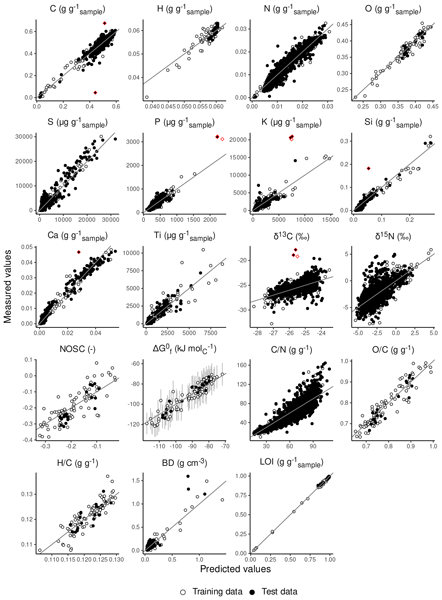
Here, we present transmission-MIRS prediction models for peat which are openly available, easy to use, have basic quality checks for prediction quality, and propagate prediction errors. The models target element contents (C, N, H, O, P, S, K, Ca, Si, Ti), element ratios (C/N, H/C, O/C), isotope values (δ13C, δ15N), physical properties (bulk density, loss on ignition (LOI), macroporosity, non-macroporosity, volume fraction of solids, hydraulic conductivity, specific heat capacity, dry thermal conductivity), thermodynamic properties (Gibbs free energy of formation (ΔGf0)), and nominal oxidation state of carbon (NOSC). They are representative for more diverse peat samples than currently existing peat-exclusive models while having a competitive predictive accuracy. Relatively accurate predictions can be made for example for many element contents (C, N, O, S, Si, Ca, ΔGf0, O/C, H/C, bulk density, and LOI).
Many of these properties are not predicted by existing high-quality prediction models focusing on mineral soils. For some of the target variables, high-quality prediction models focusing on mineral soils exist. These models may be more accurate, but reported predictive accuracies are not directly comparable due to imbalances in the amount of organic vs mineral soil samples in the training data. We suggest that some soil properties are easier to predict for peat, whereas others are easier to predict for mineral soils, emphasizing that we need new approaches to meaningfully compare prediction errors of spectral models computed on datasets with variable amounts of organic soils. Our tests also indicate that replacing δ13C and δ15N measurements by MIRS models probably is not feasible due to large prediction errors. Future studies should address the lack of open training and validation data for some peat properties (O, H, NOSC, ΔGf0, LOI, H/C, O/C), the lack of mineral-rich peat samples, and improve and standardize model validation and comparison for models trained on data with very different proportions of peat soils. This study is a step to catch up with high quality standards set by models for mineral soils and it provides novel models for several peat properties. By filling data gaps in the Peatland Mid-Infrared Database, we make a step to provide the data required to better understand peatland dynamics.
-
Notice on discussion status
The requested preprint has a corresponding peer-reviewed final revised paper. You are encouraged to refer to the final revised version.
-
Preprint
(1233 KB)
-
Supplement
(2715 KB)
-
The requested preprint has a corresponding peer-reviewed final revised paper. You are encouraged to refer to the final revised version.
- Preprint
(1233 KB) - Metadata XML
-
Supplement
(2715 KB) - BibTeX
- EndNote
- Final revised paper


Journal article(s) based on this preprint
Interactive discussion
Status: closed
-
RC1: 'Comment on egusphere-2025-4955', Anonymous Referee #1, 10 Dec 2025
- AC2: 'Reply on RC1', Henning Teickner, 18 Jan 2026
-
RC2: 'Comment on egusphere-2025-4955', Anonymous Referee #2, 12 Dec 2025
Title of paper reviewed: Prediction of Peat Properties from Transmission Mid-Infrared Spectra
This paper aims to develop high-quality, openly accessible mid-infrared spectral models for key peat properties, establish prediction domains for reliability, propagate uncertainties, and fill gaps in the PMIRD peat database. This work is important because peatlands hold major carbon stocks, yet spectral models for peat are far less developed than for mineral soils; improving them will strengthen peatland research and monitoring. Overall, the paper is structured relatively well, addresses a gap in peatland research. Nonetheless, there are several contradictory statements within the text that should be rectified. Furthermore, I did not see any error propagation that was mentioned in the objectives.Comments on specific lines:
L20: Adding couple sentences describing the usage of11 these peat properties would be good. Are these properties related to the ability of soil as a carbon sink or something else?
L153-155: I found the sentences confusing, and I could not follow or understand what the authors are trying to imply here. Is DOM a relevant property for peat soil? Is it analysed? if not simply remove it from the text all together.
L176: check package name
L210: how are the testing dataset is being selected? the training is trained with Kennard Stone as mentioned in the paragraph. If the aim is to build prediction model that covers a large space of prediction domains, should not all the dataset be used to train the model?? The number of samples shown on Table 2 does not reflect the sentence here.
L224-225: It is still not clear here how the test samples are being obtained?
L227: define ELPD, or equation used for this before explaining threshold limit.
L245-253: Why do you need to check if the input data are within testing OR training instead of just the training domain? If the spectra are out of the prediction domain of the training dataset, won't it give unreliable estimates as mentioned?
L284: authors claimed to provide comparison of the models with other studies, but later in L292 claims the comparison is not comparable. Please elaborate.
Fig2: what is being plotted here? training/testing?? labels and legends would be helpful.
L347: Please clarify the difficulty of estimating S here. It looks like prediction fits the 1:1 line quite nicely.
L400-405: Authors explains that the testing prediction domain is a small fraction of the training prediction domain, and because of that the prediction might be erroneous. However, the authors described it differently in 2.6; in which it is recommended that the new data should be within the prediction or training domain. Fig 4 shows that this testing domain clearly falls within the training domain. Yet the sentence is contradictory. Please clarify the use of the prediction domains within text and rectify results and explanations accordingly.Citation: https://doi.org/10.5194/egusphere-2025-4955-RC2 - AC1: 'Reply on RC2', Henning Teickner, 18 Jan 2026


Interactive discussion
Status: closed
-
RC1: 'Comment on egusphere-2025-4955', Anonymous Referee #1, 10 Dec 2025
This manuscript provides an overview of a variety of open, accessible chemometric models produced to provide rapid assessment tools for peat soils akin to the many spectroscopic tools available for mineral soils. The work describes the research gaps that currently exist for global assessments of peatland, outlining a diverse range of important analytes that are not commonly collected on mineral soils (important elemental contents, thermodynamic properties, etc), and which due to complex project and sampling demands, are not always assessed on all peat samples. It highlights how the developments in spectral prediction pipelines for mineral soils, particularly the focus on prediction domain analysis, error propagation, open access code and data and user friendly tooling, have allowed for the inference of analytes to soils where they were not originally collected in a robust and repeatable manner, and sets the scene for the development of similar models for peatlands.
The authors produced an assemblage of models from the pmird database of varying qualities, and using modelled parameters along with pedotransfer derived properties, gap-filled the database to provide a broad range of peat properties over thousands of additional samples.
In all, the paper presents an important contribution towards improving tools and databases for the monitoring and reporting of under-measured peatland. It extends recent developments in spectral inference for mineral soils to comparatively under-assessed peat environments. Further, the application of such techniques for relatively un-explored properties, such as new elemental contents and ratios, and peat specific thermodynamic properties is quite novel. while the manuscript is generally well written, moderate revision and refinement of the messaging in the introduction and discussion could improve clarity for the reader.
Comments:
- The introduction features repeated reference to Bulk density as a predictable property through spectra in mineral soils, on lines 54 and 69. This physical property is influenced in situ by landscape position, biotic interactions and soil composition. Many would not regard it as a property that is commonly considered predictable through spectroscopic approaches, particularly in cases where spectra are sampled in laboratory conditions, after soil processing. Though Dangal and Sanderman have modeled BD observations to moderate success with MIR spectra, other studies, such as Minasny et al 2008 suggest that properties that involve soil-pore relationships are less reliably predicted, which is logically consistent for analysis on disturbed soil.
As this potential to model BD underpins the proposed pedotransfer functions for porosity, hydraulic conductivity, specific heat capacity and thermal conductivity, the paper requires more depth in the introduction on developments or suggestions that would argue against this thesis.
See: Minasny, B., McBratney, A. B., Tranter, G., & Murphy, B. W. (2008). Using soil knowledge for the evaluation of mid-infrared diffuse reflectance spectroscopy for predicting soil physical and mechanical properties. European Journal of Soil Science, 59(5), 960–971. https://doi.org/10.1111/j.1365-2389.2008.01058.
- Similarly, isotope ratios of δ13C and δ15N are introduced following the aims of the paper as a property of interest to model. Given their under-performance, and general absence from modelling in other soil spectral libraries, a deeper dive into both the utility of this information, and justification for what about the variation in δ13C and δ15N ratios can be detected within the MIR region. If this is exploratory in nature, as indicated by the results, and the minimal gap filling achieved in pmird, it is important to temper the reader’s expectations here appropriately.
- The prediction domain of the models generated from pmird is highly dependent on the observed variation in peat analytical data and spectra available in the database. A sound understanding of the model calibration space is important to reduce mis-application of the models. As such, some greater exploratory data analysis on the pmird data can provide additional context to the reader, perhaps a table of summary statistics of the properties to be modelled, and the map showing the distribution of peat samples that comprise this dataset. As the pmird database itself is in pre-print, this does not need to be extensive here.
- The presented model quality metrics are an important consideration that guide potential users and readers to a greater understanding of the implications of your work. As such, if the work adapts techniques from spectral modelling of mineral soils, It could benefit the ease of interpretation of the work to further adapt some commonly used quality metrics as well. I would suggest initially the MEC, RPIQ and LCCC as useful guides that users more familiar with modelling of mineral soils may useful.
See: Bellon-Maurel, V., Fernandez-Ahumada, E., Palagos, B., Roger, J.-M., & McBratney, A. (2010). Critical review of chemometric indicators commonly used for assessing the quality of the prediction of soil attributes by NIR spectroscopy. TrAC Trends in Analytical Chemistry, 29(9), 1073–1081. https://doi.org/10.1016/j.trac.2010.05.006
Additional clarity issues:
- Lines 33–38: The paragraph is vague regarding “sufficient resolution and detail.” Define what constitutes “sufficient.”
- Lines 233:236: Sentence is quite long, with many clauses, please break this up.
- Line 240: this paragraph repeats context established in the introduction, much of this is redundant within the methods.
- Lines 377:385: The discussion on blank effect corrections for isotopic measurements is confusing. It first suggests these effects are only a minor contributor to RMSE, then proposes they may explain large prediction errors. This whole argument is quite confusing, consider omitting lines 384/385 for clarity.
- In figure 4, fixing the y axis, and grouping the facets by derivative of spectra may make the prediction domains easier to interpret across the different properties being assessed.
Citation: https://doi.org/10.5194/egusphere-2025-4955-RC1 - AC2: 'Reply on RC1', Henning Teickner, 18 Jan 2026
- The introduction features repeated reference to Bulk density as a predictable property through spectra in mineral soils, on lines 54 and 69. This physical property is influenced in situ by landscape position, biotic interactions and soil composition. Many would not regard it as a property that is commonly considered predictable through spectroscopic approaches, particularly in cases where spectra are sampled in laboratory conditions, after soil processing. Though Dangal and Sanderman have modeled BD observations to moderate success with MIR spectra, other studies, such as Minasny et al 2008 suggest that properties that involve soil-pore relationships are less reliably predicted, which is logically consistent for analysis on disturbed soil.
-
RC2: 'Comment on egusphere-2025-4955', Anonymous Referee #2, 12 Dec 2025
Title of paper reviewed: Prediction of Peat Properties from Transmission Mid-Infrared Spectra
This paper aims to develop high-quality, openly accessible mid-infrared spectral models for key peat properties, establish prediction domains for reliability, propagate uncertainties, and fill gaps in the PMIRD peat database. This work is important because peatlands hold major carbon stocks, yet spectral models for peat are far less developed than for mineral soils; improving them will strengthen peatland research and monitoring. Overall, the paper is structured relatively well, addresses a gap in peatland research. Nonetheless, there are several contradictory statements within the text that should be rectified. Furthermore, I did not see any error propagation that was mentioned in the objectives.Comments on specific lines:
L20: Adding couple sentences describing the usage of11 these peat properties would be good. Are these properties related to the ability of soil as a carbon sink or something else?
L153-155: I found the sentences confusing, and I could not follow or understand what the authors are trying to imply here. Is DOM a relevant property for peat soil? Is it analysed? if not simply remove it from the text all together.
L176: check package name
L210: how are the testing dataset is being selected? the training is trained with Kennard Stone as mentioned in the paragraph. If the aim is to build prediction model that covers a large space of prediction domains, should not all the dataset be used to train the model?? The number of samples shown on Table 2 does not reflect the sentence here.
L224-225: It is still not clear here how the test samples are being obtained?
L227: define ELPD, or equation used for this before explaining threshold limit.
L245-253: Why do you need to check if the input data are within testing OR training instead of just the training domain? If the spectra are out of the prediction domain of the training dataset, won't it give unreliable estimates as mentioned?
L284: authors claimed to provide comparison of the models with other studies, but later in L292 claims the comparison is not comparable. Please elaborate.
Fig2: what is being plotted here? training/testing?? labels and legends would be helpful.
L347: Please clarify the difficulty of estimating S here. It looks like prediction fits the 1:1 line quite nicely.
L400-405: Authors explains that the testing prediction domain is a small fraction of the training prediction domain, and because of that the prediction might be erroneous. However, the authors described it differently in 2.6; in which it is recommended that the new data should be within the prediction or training domain. Fig 4 shows that this testing domain clearly falls within the training domain. Yet the sentence is contradictory. Please clarify the use of the prediction domains within text and rectify results and explanations accordingly.Citation: https://doi.org/10.5194/egusphere-2025-4955-RC2 - AC1: 'Reply on RC2', Henning Teickner, 18 Jan 2026
Peer review completion


Journal article(s) based on this preprint
Data sets
Peatland Mid-Infrared Database (1.0.0) H. Teickner et al. https://doi.org/10.5281/zenodo.17092587
Gap-filled subset of the Peatland Mid-Infrared Database (1.0.0) H. Teickner and K.-H. Knorr https://doi.org/10.5281/zenodo.17187559
Model code and software
Compendium of R code and data for "Prediction of Peat Properties from Transmission Mid-Infrared Spectra" H. Teickner and K.-H. Knorr https://doi.org/10.5281/zenodo.17209177
irpeatmodels: Mid-infrared prediction models for peat H. Teickner https://doi.org/10.5281/zenodo.17187912
irpeat 0.3.0: Functions to Analyze Mid-Infrared Spectra of Peat Samples H. Teickner and S. Hodgkins https://doi.org/10.5281/zenodo.17200517
Viewed
| HTML | XML | Total | Supplement | BibTeX | EndNote | |
|---|---|---|---|---|---|---|
| 818 | 398 | 82 | 1,298 | 190 | 52 | 65 |
- HTML: 818
- PDF: 398
- XML: 82
- Total: 1,298
- Supplement: 190
- BibTeX: 52
- EndNote: 65
Viewed (geographical distribution)
| Country | # | Views | % |
|---|
| Total: | 0 |
| HTML: | 0 |
| PDF: | 0 |
| XML: | 0 |
- 1
Henning Teickner
Klaus-Holger Knorr
The requested preprint has a corresponding peer-reviewed final revised paper. You are encouraged to refer to the final revised version.
- Preprint
(1233 KB) - Metadata XML
-
Supplement
(2715 KB) - BibTeX
- EndNote
- Final revised paper
This manuscript provides an overview of a variety of open, accessible chemometric models produced to provide rapid assessment tools for peat soils akin to the many spectroscopic tools available for mineral soils. The work describes the research gaps that currently exist for global assessments of peatland, outlining a diverse range of important analytes that are not commonly collected on mineral soils (important elemental contents, thermodynamic properties, etc), and which due to complex project and sampling demands, are not always assessed on all peat samples. It highlights how the developments in spectral prediction pipelines for mineral soils, particularly the focus on prediction domain analysis, error propagation, open access code and data and user friendly tooling, have allowed for the inference of analytes to soils where they were not originally collected in a robust and repeatable manner, and sets the scene for the development of similar models for peatlands.
The authors produced an assemblage of models from the pmird database of varying qualities, and using modelled parameters along with pedotransfer derived properties, gap-filled the database to provide a broad range of peat properties over thousands of additional samples.
In all, the paper presents an important contribution towards improving tools and databases for the monitoring and reporting of under-measured peatland. It extends recent developments in spectral inference for mineral soils to comparatively under-assessed peat environments. Further, the application of such techniques for relatively un-explored properties, such as new elemental contents and ratios, and peat specific thermodynamic properties is quite novel. while the manuscript is generally well written, moderate revision and refinement of the messaging in the introduction and discussion could improve clarity for the reader.
Comments:
As this potential to model BD underpins the proposed pedotransfer functions for porosity, hydraulic conductivity, specific heat capacity and thermal conductivity, the paper requires more depth in the introduction on developments or suggestions that would argue against this thesis.
See: Minasny, B., McBratney, A. B., Tranter, G., & Murphy, B. W. (2008). Using soil knowledge for the evaluation of mid-infrared diffuse reflectance spectroscopy for predicting soil physical and mechanical properties. European Journal of Soil Science, 59(5), 960–971. https://doi.org/10.1111/j.1365-2389.2008.01058.
See: Bellon-Maurel, V., Fernandez-Ahumada, E., Palagos, B., Roger, J.-M., & McBratney, A. (2010). Critical review of chemometric indicators commonly used for assessing the quality of the prediction of soil attributes by NIR spectroscopy. TrAC Trends in Analytical Chemistry, 29(9), 1073–1081. https://doi.org/10.1016/j.trac.2010.05.006
Additional clarity issues: