
the Creative Commons Attribution 4.0 License.
the Creative Commons Attribution 4.0 License.
 | 15 Oct 2025
Response of the Nordic Seas to the 2–6 February 2020 Marine Cold Air Outbreak in the GLORYS12 Ocean Reanalysis
Abstract. Marine Cold Air Outbreaks (MCAOs) play a crucial role in wintertime water mass transformation in the Nordic Seas. However, due to the spatio-temporal variability of atmospheric forcing and lateral ocean transport, the processes by which MCAOs influence the ocean remain unclear. Using the eddy-resolving ocean and sea ice reanalysis GLORYS12, we investigate the mechanisms driving the ocean response over the Nordic Seas to the particularly intense 2–6 February 2020 MCAO event. To assess the impact of the MCAO on the ocean, we quantify the contributions of the mean surface turbulent heat flux relative to the mean change in ocean heat content during the event. The western part of the Nordic Seas (Greenland Sea and northern interior Iceland Sea) was primarily affected by the air-sea heat exchanges, with an overall mixed layer cooling by approximately 0.02 °C·day-1 during the event in the interior Greenland Sea and a deepening of more than 30 m·day-1 in some areas. In the eastern part (Norwegian Sea), on the other hand, the air-sea heat exchanges were masked by stronger lateral oceanic heat transport, with a cooling or warming of an order of magnitude higher. In the interior part of northern Iceland Sea, the mixed-layer depth increased by approximately 5 m·day-1, while it decreased near the boundary current in the western Iceland Sea by approximately 8 m·day-1 concomitantly with a shoaling of the warm Atlantic-origin water mass.
-
Notice on discussion status
The requested preprint has a corresponding peer-reviewed final revised paper. You are encouraged to refer to the final revised version.
-
Preprint
(6933 KB)
-
Supplement
(2672 KB)
-
The requested preprint has a corresponding peer-reviewed final revised paper. You are encouraged to refer to the final revised version.
- Preprint
(6933 KB) - Metadata XML
-
Supplement
(2672 KB) - BibTeX
- EndNote
- Final revised paper


Journal article(s) based on this preprint
Interactive discussion
Status: closed
-
RC1: 'Comment on egusphere-2025-4944', Anonymous Referee #1, 14 Nov 2025
- AC1: 'Reply on RC1', Svenya Chripko, 29 Jan 2026
-
RC2: 'Comment on egusphere-2025-4944', Anonymous Referee #2, 17 Nov 2025
This paper examines how the Nordic Seas responded to a significant marine cold air outbreak in the winter of 2020. The authors use atmospheric and oceanic reanalysis data to examine this question. The authors quantify the contributions of the mean surface turbulent heat flux relative to the mean change in ocean heat content during the event. The authors find the air-sea fluxes dominant in the western part of the Nordic Seas, while finding lateral oceanic heat transport more important in the east.
This is an interesting paper, looking in detail at a given atmospheric event. All possible processes are considered, and their relative roles (spatially) are considered and explored. The paper is generally well written. That said, there are some limitations to the study, and some places where the work could be expanded on. Thus, I would recommend moderate revisions. Specific comments are provided below.The ocean fields used come from the GLORYSV12 reanalysis product. The authors reference other studies showing the quality of this product in the Nordic Seas. That said, it is a single product, with biases. Why did the authors not consider using several reanalyzes to determine how robust their analysis is?
As a side point, at 1/12 degree resolution, the GLORSYSV12 product is not fully eddy-permitting. It resolves the largest eddies in the region, but not all. I believe the terminology eddy-rich would be more appropriate.
The atmospheric product used is ERA5. It has known biases, including being too warm in polar regions, and having events with extreme wind anomalies. It would be good to confirm how those might impact the authors’ study for the given MCAO.The methods section requires some further details on the approaches used. The authors discuss using fields from ERA5. But what bulk formulae were used in the calculations? How were these computed in conjunction with GLORYSV12 – especially if the authors used daily outputs from the ocean reanalysis and higher frequency fields from ERA5? How were the fluxes computed over the model grid cells with sea-ice? Were all the calculations done at the location of the model T-grid cells? Or interpolated to them?
I don’t understand why the heat budget is computed over the total ocean depth (i.e. using Dbot). The lower layers are not going to be impacted by the atmospheric forcing. Thus, the size of the signals shown will be impacted by the ocean depth, which doesn’t seem relevant to the authors’ questions. Especially for the ratio calculation, such as in figure 5. Yes, not using the bottom depth does mean looking at vertical heat fluxes, but it shouldn’t be especially hard to compute. As well, that approach could mean that the authors could look at the very fluxes into and out of given watermass layers, such as the Atlantic Water layer.
Given the importance of sea-ice in modifying the air-sea fluxes, I would have liked to seen more discussed about it in the paper (rather than just seeing the ice edge on figures). Since the authors discuss this at line 140 (for example), could the authors’ show sea-ice growth rates, thickness changes and/or advection during the MCAO event, as the sea-ice is likely also responded to it.
In section 4.3.1, the authors’ discuss how both Polar Surface Water and Atlantic origin Water were transported southward. It would be nice to quantify this, with timeseries, to help see how the transport changes during the MCAO.
In the conclusion, the authors start by stating they use the high-resolution GLORYSV12 reanalysis. Beyond my above point related to eddy-permitting vs eddy-rich, I don’t feel like the authors really take advantage of the resolution of the product. It would be good to know where the given resolution is most helpful for the study. Or, even better, can the authors examine the role of the eddies and mesoscale in their results, for example, their role in the lateral oceanic heat transport in the eastern part of the domain.
L124: Fram Strait
Figure 4 caption: The authors state they are comparing surface ocean conditions pre and post the MCAO. Yet, if the MCAO covered Feb 2-6, while Jan 31 is pre-MCAO, Feb 6 is still during the MCAO. Shouldn’t the plots then use Feb 7? And why not Feb 1, instead of two days before for the pre-MCAO panels?
Figures 6 and 7: The thick black, blue and red lines to show the mixed layer depth are discontinuous, and not easy to follow in places where the depth changes rapidly. The plotting of these lines could be improved (with a continuous line).
Citation: https://doi.org/10.5194/egusphere-2025-4944-RC2 - AC2: 'Reply on RC2', Svenya Chripko, 29 Jan 2026
Peer review completion


Interactive discussion
Status: closed
-
RC1: 'Comment on egusphere-2025-4944', Anonymous Referee #1, 14 Nov 2025
The authors discuss oceanic response to 2-6 February 2020 Marine Cold Air Outbreak event using atmospheric reanalysis ERA5 and ocean reanalysis GLORYS. It uses a simple water column heat budget to assess relative importance of surface heat fluxes and oceanic heat flux convergence. Major results are the temperature/salinity/MLD differences across two zonal sections in the Greenland and Iceland Sea, respectively. The authors attribute those changes to MCAO event and boundary currents. They also found “opposite MLD changes near the Ice edge compared to the interior Iceland Sea and attributed to shoaling of the Atlantic-origin water” without further explanation. The method is reasonable, yet a proper heat budget can be presented in a more rigid way. Analysis is a bit descriptive and may ignore other factors and can be strengthened with more evidence or arguments, before final publication.
Major comments
Section 2.3 ocean heat budget: A proper heat budget should be evaluated in a fixed control volume, so that “Heat in” equals “Heat out” and your equation (2) holds, although a residual can occur due to modeling reason. For instance, this is performed and discussed in Årthun, M., & Eldevik, T. (2016). The referenced heat budget in Roberts et al. (2017) is integrated over mixed layer in the global ocean, probably suffer less from that. Essentially, the authors need to make sure equation (2) holds valid, if not, explain why. Could the imported cold Polar water volume from the Fram Strait be increased over this event and cools the Greenland Sea? and how to account it in the heat budget?
Section 3 Atmospheric and sea ice conditions during the MCAO
MCAOs events bring cold, dry Arctic Air over warmer open ocean, and produce strong oceanic heat loss. My impression is that eastern Nordic is under less influence of MCAOs, most studies focused on the Greenland and Iceland Seas, also as the authors do in this paper. But authors also discussed much on the eastern Nordic Sea, and attributed changes there to ocean currents there. For me, it is a bit like two regimes under two systems, the eastern warm Atlantic Water domain is subject to upstream inflow variability whereas the Greenland and Iceland Sea can be directly influenced by MCAOs. Apart from stressing this MCAO event classifies as a "very strong" intensity event, the authors probably also need to elaborate synoptic progresses or northwest-southeast contrast over the Nordic Seas. By the time the air mass from northwest reaches to the Norwegian Sea, MCAO signature is weaker and probably lost some of its convective intensity.
line 135-140: “Sea ice edge expanded offshore” over such a few days is not really noticeable for me at least, unless you plot ice edge lines in one figure. But you have it in Figure 4. “A structure reminiscent of the Odden ice tongue” (and thereafter) you referred is not really a “tongue”, Odden Ice tongue should be a continuous tongue-like feature extending from MIZ, instead of an isolated ice pack. I believe this formed isolated sea ice is more likely due to model’s deficiency, given GLORYS’s insufficient resolution over this region and relatively large forcing uncertainties over MIZ in ERA5 (Renfrew et al., 2021). If you want to mention sea ice response, observational data would be more convincing. Having a quick look on ice chart from Norwegian Meteorological Institute (https://cryo.met.no/archive/ice-service/icecharts/quicklooks/2020/20200206/denmrk_20200206_col.png), I don’t see this feature.
Section 4.2 Contribution of surface heat fluxes
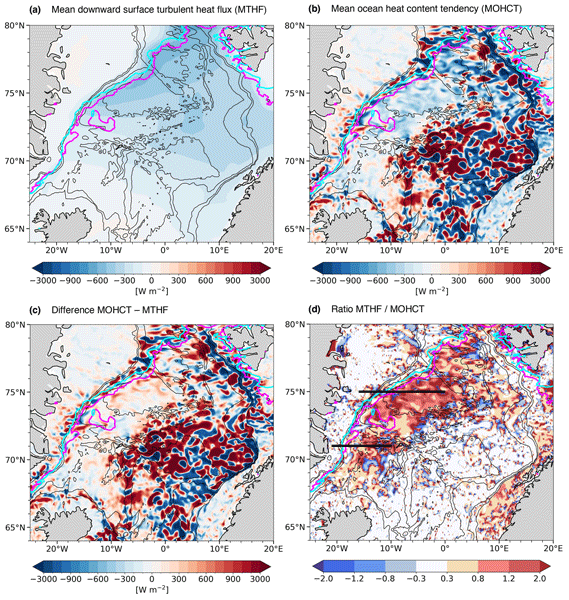
Attributing changes in eastern AW domain to strong current and eddies but not showing convergence term due to currents explicitly (CONV in equation 2) makes interpretation and heat budget less convincing. As in Figure 5, only parts of the budgets are presented. There is a strong contrast in ocean heat tendency between the Greenland and Norwegian Sea, to emphasize atmospheric fluxes brought by MCAO and downplay ocean currents, it might be worthwhile to reconsider whether to include the Norwegian Sea under the MCAOs framework.
Figure 5(a), ocean heat content tendency is integrated from bottom to surface while MCAO event has major influence on upper ocean. Such large -3000 W/m2 heat change along the Norwegian Atlantic Slope Current probably shadows heat loss in the Greenland Sea.
Figure 5(b) caption: “downward surface turbulent heat flux” is confusing, as the ocean loses heat to atmosphere, the flux is then upward.
Section 4.3
Regarding MLD bias in GLORYS, the authors can simply calculate and correct it.
Regarding the upshoaling of Atlantic-origin water and mixed-layer in the boundary current region, the authors compared to the last day MCAO 06/02/2020. Does this hold if you compared to the peak day 03/02/2020? As on 06/02/2020, shown in Figure 2g, a cyclone is above the Iceland Sea centered around ice edge, with positive wind stress curl leading to ocean upwelling there, which explains upshoaling. But this cyclone is not MCAO feature as it comes from the south?
Minor comments:
Line 16: I am not sure (Gebbie and Huybers, 2010) is a proper reference here.
Line 20: Overflow occurs not only via Denmark Strait but also via eastern past of Greenland-Scotland ridge.
Lines 50-55: the introduction of GLORYS here could be integrated in section 2.1 Data and Methods.
Figure 1: Some arrowheads are disconnected.
Line 66-67: Given forcing uncertainties, authors should be more cautious on later interpretation near MIZ.
Line 124: Fram Strait.
Line 128: What “flow configuration” ?
Line 154-155: It seems redundant, basically, you are saying: GLORYS is consistent with (the combination of GLORYS + satellite observation), and we already know that GLORYS has assimilated satellite observation.
Lines 190-194: supporting arguments or references? related to major comments.
Figure 6: incorrect captions: “before the MCAO (06/02/2020) and during the last day (06/02/2020)” and also Figure 7 caption: “before the MCAO (02/02/2020) and during the last day (06/02/2020)”
Line 294: can becoming more saline be attributed to heat loss?
Reference
Årthun, M., & Eldevik, T. (2016). On anomalous ocean heat transport toward the Arctic and associated climate predictability. Journal of Climate, 29(2), 689-704.
Citation: https://doi.org/10.5194/egusphere-2025-4944-RC1 - AC1: 'Reply on RC1', Svenya Chripko, 29 Jan 2026
-
RC2: 'Comment on egusphere-2025-4944', Anonymous Referee #2, 17 Nov 2025
This paper examines how the Nordic Seas responded to a significant marine cold air outbreak in the winter of 2020. The authors use atmospheric and oceanic reanalysis data to examine this question. The authors quantify the contributions of the mean surface turbulent heat flux relative to the mean change in ocean heat content during the event. The authors find the air-sea fluxes dominant in the western part of the Nordic Seas, while finding lateral oceanic heat transport more important in the east.
This is an interesting paper, looking in detail at a given atmospheric event. All possible processes are considered, and their relative roles (spatially) are considered and explored. The paper is generally well written. That said, there are some limitations to the study, and some places where the work could be expanded on. Thus, I would recommend moderate revisions. Specific comments are provided below.The ocean fields used come from the GLORYSV12 reanalysis product. The authors reference other studies showing the quality of this product in the Nordic Seas. That said, it is a single product, with biases. Why did the authors not consider using several reanalyzes to determine how robust their analysis is?
As a side point, at 1/12 degree resolution, the GLORSYSV12 product is not fully eddy-permitting. It resolves the largest eddies in the region, but not all. I believe the terminology eddy-rich would be more appropriate.
The atmospheric product used is ERA5. It has known biases, including being too warm in polar regions, and having events with extreme wind anomalies. It would be good to confirm how those might impact the authors’ study for the given MCAO.The methods section requires some further details on the approaches used. The authors discuss using fields from ERA5. But what bulk formulae were used in the calculations? How were these computed in conjunction with GLORYSV12 – especially if the authors used daily outputs from the ocean reanalysis and higher frequency fields from ERA5? How were the fluxes computed over the model grid cells with sea-ice? Were all the calculations done at the location of the model T-grid cells? Or interpolated to them?
I don’t understand why the heat budget is computed over the total ocean depth (i.e. using Dbot). The lower layers are not going to be impacted by the atmospheric forcing. Thus, the size of the signals shown will be impacted by the ocean depth, which doesn’t seem relevant to the authors’ questions. Especially for the ratio calculation, such as in figure 5. Yes, not using the bottom depth does mean looking at vertical heat fluxes, but it shouldn’t be especially hard to compute. As well, that approach could mean that the authors could look at the very fluxes into and out of given watermass layers, such as the Atlantic Water layer.
Given the importance of sea-ice in modifying the air-sea fluxes, I would have liked to seen more discussed about it in the paper (rather than just seeing the ice edge on figures). Since the authors discuss this at line 140 (for example), could the authors’ show sea-ice growth rates, thickness changes and/or advection during the MCAO event, as the sea-ice is likely also responded to it.
In section 4.3.1, the authors’ discuss how both Polar Surface Water and Atlantic origin Water were transported southward. It would be nice to quantify this, with timeseries, to help see how the transport changes during the MCAO.
In the conclusion, the authors start by stating they use the high-resolution GLORYSV12 reanalysis. Beyond my above point related to eddy-permitting vs eddy-rich, I don’t feel like the authors really take advantage of the resolution of the product. It would be good to know where the given resolution is most helpful for the study. Or, even better, can the authors examine the role of the eddies and mesoscale in their results, for example, their role in the lateral oceanic heat transport in the eastern part of the domain.
L124: Fram Strait
Figure 4 caption: The authors state they are comparing surface ocean conditions pre and post the MCAO. Yet, if the MCAO covered Feb 2-6, while Jan 31 is pre-MCAO, Feb 6 is still during the MCAO. Shouldn’t the plots then use Feb 7? And why not Feb 1, instead of two days before for the pre-MCAO panels?
Figures 6 and 7: The thick black, blue and red lines to show the mixed layer depth are discontinuous, and not easy to follow in places where the depth changes rapidly. The plotting of these lines could be improved (with a continuous line).
Citation: https://doi.org/10.5194/egusphere-2025-4944-RC2 - AC2: 'Reply on RC2', Svenya Chripko, 29 Jan 2026
Peer review completion
Journal article(s) based on this preprint
Viewed
| HTML | XML | Total | Supplement | BibTeX | EndNote | |
|---|---|---|---|---|---|---|
| 1,793 | 920 | 231 | 2,944 | 355 | 184 | 193 |
- HTML: 1,793
- PDF: 920
- XML: 231
- Total: 2,944
- Supplement: 355
- BibTeX: 184
- EndNote: 193
Viewed (geographical distribution)
| Country | # | Views | % |
|---|
| Total: | 0 |
| HTML: | 0 |
| PDF: | 0 |
| XML: | 0 |
- 1

Thomas Spengler
Stefanie Semper
Kjetil Våge
The requested preprint has a corresponding peer-reviewed final revised paper. You are encouraged to refer to the final revised version.
- Preprint
(6933 KB) - Metadata XML
-
Supplement
(2672 KB) - BibTeX
- EndNote
- Final revised paper
The authors discuss oceanic response to 2-6 February 2020 Marine Cold Air Outbreak event using atmospheric reanalysis ERA5 and ocean reanalysis GLORYS. It uses a simple water column heat budget to assess relative importance of surface heat fluxes and oceanic heat flux convergence. Major results are the temperature/salinity/MLD differences across two zonal sections in the Greenland and Iceland Sea, respectively. The authors attribute those changes to MCAO event and boundary currents. They also found “opposite MLD changes near the Ice edge compared to the interior Iceland Sea and attributed to shoaling of the Atlantic-origin water” without further explanation. The method is reasonable, yet a proper heat budget can be presented in a more rigid way. Analysis is a bit descriptive and may ignore other factors and can be strengthened with more evidence or arguments, before final publication.
Major comments
Section 2.3 ocean heat budget: A proper heat budget should be evaluated in a fixed control volume, so that “Heat in” equals “Heat out” and your equation (2) holds, although a residual can occur due to modeling reason. For instance, this is performed and discussed in Årthun, M., & Eldevik, T. (2016). The referenced heat budget in Roberts et al. (2017) is integrated over mixed layer in the global ocean, probably suffer less from that. Essentially, the authors need to make sure equation (2) holds valid, if not, explain why. Could the imported cold Polar water volume from the Fram Strait be increased over this event and cools the Greenland Sea? and how to account it in the heat budget?
Section 3 Atmospheric and sea ice conditions during the MCAO
MCAOs events bring cold, dry Arctic Air over warmer open ocean, and produce strong oceanic heat loss. My impression is that eastern Nordic is under less influence of MCAOs, most studies focused on the Greenland and Iceland Seas, also as the authors do in this paper. But authors also discussed much on the eastern Nordic Sea, and attributed changes there to ocean currents there. For me, it is a bit like two regimes under two systems, the eastern warm Atlantic Water domain is subject to upstream inflow variability whereas the Greenland and Iceland Sea can be directly influenced by MCAOs. Apart from stressing this MCAO event classifies as a "very strong" intensity event, the authors probably also need to elaborate synoptic progresses or northwest-southeast contrast over the Nordic Seas. By the time the air mass from northwest reaches to the Norwegian Sea, MCAO signature is weaker and probably lost some of its convective intensity.
line 135-140: “Sea ice edge expanded offshore” over such a few days is not really noticeable for me at least, unless you plot ice edge lines in one figure. But you have it in Figure 4. “A structure reminiscent of the Odden ice tongue” (and thereafter) you referred is not really a “tongue”, Odden Ice tongue should be a continuous tongue-like feature extending from MIZ, instead of an isolated ice pack. I believe this formed isolated sea ice is more likely due to model’s deficiency, given GLORYS’s insufficient resolution over this region and relatively large forcing uncertainties over MIZ in ERA5 (Renfrew et al., 2021). If you want to mention sea ice response, observational data would be more convincing. Having a quick look on ice chart from Norwegian Meteorological Institute (https://cryo.met.no/archive/ice-service/icecharts/quicklooks/2020/20200206/denmrk_20200206_col.png), I don’t see this feature.
Section 4.2 Contribution of surface heat fluxes
Attributing changes in eastern AW domain to strong current and eddies but not showing convergence term due to currents explicitly (CONV in equation 2) makes interpretation and heat budget less convincing. As in Figure 5, only parts of the budgets are presented. There is a strong contrast in ocean heat tendency between the Greenland and Norwegian Sea, to emphasize atmospheric fluxes brought by MCAO and downplay ocean currents, it might be worthwhile to reconsider whether to include the Norwegian Sea under the MCAOs framework.
Figure 5(a), ocean heat content tendency is integrated from bottom to surface while MCAO event has major influence on upper ocean. Such large -3000 W/m2 heat change along the Norwegian Atlantic Slope Current probably shadows heat loss in the Greenland Sea.
Figure 5(b) caption: “downward surface turbulent heat flux” is confusing, as the ocean loses heat to atmosphere, the flux is then upward.
Section 4.3
Regarding MLD bias in GLORYS, the authors can simply calculate and correct it.
Regarding the upshoaling of Atlantic-origin water and mixed-layer in the boundary current region, the authors compared to the last day MCAO 06/02/2020. Does this hold if you compared to the peak day 03/02/2020? As on 06/02/2020, shown in Figure 2g, a cyclone is above the Iceland Sea centered around ice edge, with positive wind stress curl leading to ocean upwelling there, which explains upshoaling. But this cyclone is not MCAO feature as it comes from the south?
Minor comments:
Line 16: I am not sure (Gebbie and Huybers, 2010) is a proper reference here.
Line 20: Overflow occurs not only via Denmark Strait but also via eastern past of Greenland-Scotland ridge.
Lines 50-55: the introduction of GLORYS here could be integrated in section 2.1 Data and Methods.
Figure 1: Some arrowheads are disconnected.
Line 66-67: Given forcing uncertainties, authors should be more cautious on later interpretation near MIZ.
Line 124: Fram Strait.
Line 128: What “flow configuration” ?
Line 154-155: It seems redundant, basically, you are saying: GLORYS is consistent with (the combination of GLORYS + satellite observation), and we already know that GLORYS has assimilated satellite observation.
Lines 190-194: supporting arguments or references? related to major comments.
Figure 6: incorrect captions: “before the MCAO (06/02/2020) and during the last day (06/02/2020)” and also Figure 7 caption: “before the MCAO (02/02/2020) and during the last day (06/02/2020)”
Line 294: can becoming more saline be attributed to heat loss?
Reference
Årthun, M., & Eldevik, T. (2016). On anomalous ocean heat transport toward the Arctic and associated climate predictability. Journal of Climate, 29(2), 689-704.