
the Creative Commons Attribution 4.0 License.
the Creative Commons Attribution 4.0 License.
 | 16 Oct 2025
Fine and coarse dust radiative impact during an intense Saharan dust outbreak over the Iberian Peninsula – long-wave and net direct radiative effect
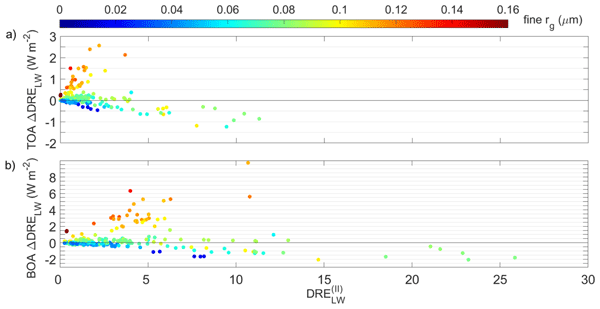
Abstract. The dust direct radiative effect (DRE) in long-wave (DRELW), and net effect (DRENET), is analysed during an intense and long-lasting Saharan dust intrusion over the Iberian Peninsula, complementing the study on the short-wave DRE (DRESW) (López-Cayuela et al., 2025). In LW, a warming effect at both bottom-of-atmosphere (BOA) and the top-of-atmosphere (TOA) levels is induced by the fine (Df) and coarse (Dc) dust particles (Dc dominant). The DRELW-to-DRESW ratio for Df ranged 4–8 % at BOA (1–4 % at TOA), and for Dc it was rather higher (39–54 % at BOA and 20–50 % at TOA). DRENET was consistently negative (net cooling) at both levels, and hence the atmospheric DRENET was positive (net warming). The Df contribution to DRENET was 12 % (LW) and 30 % (SW). The SW aerosol heating rate (AHR) peaked at higher altitudes, inducing warming within the dust layer, than LW AHR (weaker cooling). Consequently, a net warming inside the dust layer was found, with potential cooling below and above. While SW dominates the net atmospheric warming, LW cooling partially mitigates it. DRELW (and DRENET) is underestimated (overestimated) by using the dust-mode separation approach when fine radii are lesser (greater) than a particular threshold (e.g., 0.1 μm), revealing the particle size impact in DRELW. The dust-induced net effect is primarily driven by SW and modulated by LW. The classical (no separation) approach overestimates DRENET, with mean relative differences of -5 %/-9 % at BOA/TOA. Moreover, under moderate-to-high dust, separating Df and Dc contributions yields a weaker (stronger) net cooling at BOA (TOA).
-
Notice on discussion status
The requested preprint has a corresponding peer-reviewed final revised paper. You are encouraged to refer to the final revised version.
-
Preprint
(2498 KB)
-
Supplement
(1870 KB)
-
The requested preprint has a corresponding peer-reviewed final revised paper. You are encouraged to refer to the final revised version.
- Preprint
(2498 KB) - Metadata XML
-
Supplement
(1870 KB) - BibTeX
- EndNote
- Final revised paper


Journal article(s) based on this preprint
Interactive discussion
Status: closed
-
RC1: 'Comment on egusphere-2025-4905', Anonymous Referee #1, 07 Nov 2025
- AC1: 'Reply on RC1 and RC2', Carmen Cordoba-Jabonero, 30 Jan 2026
-
RC2: 'Comment on egusphere-2025-4905', Anonymous Referee #2, 09 Nov 2025
This study estimates the temporal variation of direct radiative effects (DRE) of fine and coarse dust in the LW and net DRE during an intense dust outbreak over the Iberian Peninsula using lidar observations from five stations and the GAME radiative transfer model. The differences in dust DRE obtained from the combination of separately computed coarse and fine dust contributions versus the classical approach (no separation) are examined. The aerosol heating rate is also discussed. The analyses are comprehensive, but major revisions are needed to address several concerns and to present the results more clearly and concisely.
- Given the absence of flux measurements for evaluation, it is unclear if separating dust into fine and coarse modes and computing their properties independently yields more accurate results than the classical approach. A clear conceptual justification is needed.
- The uncertainties of DRE should be estimated, or at least the main uncertainty sources should be discussed. It is possible that the uncertainty magnitude exceeds the difference between the two approaches. Consider uncertainties from lidar measurements, AERONET data, the GAME model, etc.
Specific Issues:
Page 1, line 25: Change “and hence the atmospheric DREnet was positive” to “and the derived atmospheric DREnet was positive” given the unclear causal relationship in the sentence.
Page 1, line 30: Be cautious when using “underestimate” or "overestimate,” as there are no reference data to determine accuracy.
Page 2, line 65: Station abbreviations, locations, and the dust outbreak period should be mentioned in the methods section, not in the introduction. A site map in the Supplement would also be helpful, given the frequent discussion of site-to-site differences.
Page 2, line 75: Specify which components are meant in “separation of both components”.
Page 3, line 105: Avoid unnecessary acronyms throughout the paper, e.g., those for surface albedo here and for supplementary materials elsewhere, since the paper already includes numerous variable acronyms.
Page 3, line 110: Suggest comparing this refractive index data with more recent datasets, such as Di Biagio et al., 2017 (Atmospheric Chemistry and Physics, 17, 1901–1929). This is also an important source of uncertainty.
Page 5, line 200: Clarify what “those values” refer to.
Page 7, line 250: Remind readers what δDRE represents.
Page 8, line 295: Several connecting words (e.g., indeed, moreover, being) are used unnecessarily or incorrectly in multiple places. Suggest revising for smoother flow.
Page 8, line 310: Correct “being 45% in and the SW range”; the word “being” is misused here and elsewhere; revise accordingly.
Page 8, 315: Similarly, suggest modifying “According to other studies, similar results are found, being the DRELW/DRESW greater at BOA than at TOA” to “Other studies also report higher DRELW/DRESW values at BOA than at TOA” to avoid misuse of “being” and reduce redundancy. Redundant expressions should also be avoided throughout the manuscript to improve readability and conciseness.
Page 9, line 365: Suggest changing “impact” to “temporal change” for clarity.
Page 9, line 375: The maximum hourly values at ATM in Figure 4 appear to be much higher than +5.8 (+1.3) W m-2; please verify.
Page 10, line 385: Provide context for why SZA < 70 is specified here.
Page 10, line 405: Use “underestimation” and “overestimation” to describe the traditional approach, not the dust-mode separation approach, if the latter is considered more accurate.
Page 10, line 410: The lower mean values for finer rg >= 0.1 um seem inconsistent with the earlier discussion; please clarify.
Figure 1(b): Suggest adding fitting statistics to the plot.
Figure 2: Add indicators for days with daily DD DOD532 greater or less than 0.5, since this threshold is referenced multiple times. Explain the inset numbers in panels (a) and (b).
Table 2: Suggest adding standard errors to the fitted slope values.
Citation: https://doi.org/10.5194/egusphere-2025-4905-RC2 - AC2: 'Reply on RC2 and RC1', Carmen Cordoba-Jabonero, 30 Jan 2026
Peer review completion


Interactive discussion
Status: closed
-
RC1: 'Comment on egusphere-2025-4905', Anonymous Referee #1, 07 Nov 2025
This manuscript presents a comprehensive analysis of long-wave (LW) and net direct radiative effects (DRE) during an intense Saharan dust outbreak over the Iberian Peninsula in March-April 2021. The study employs lidar observations from five stations combined with the GAME radiative transfer model to quantify the separate contributions of fine (Df) and coarse (Dc) dust particles to dust LW DRE. This work complements the authors' previous study on short-wave (SW) effects (López-Cayuela et al., 2025) and introduces a novel comparison between two methodological approaches: (1) calculating DRE by separating Df and Dc contributions versus (2) treating total dust as a single component. The science merits publication in ACP, but major revisions are needed for the following concerns.
- The paper need to discuss that why the estimation of dust DRE by simulating the contribution of Df and Dc components separately (the major contribution of this study) is a better option (or is necessary) compared to directly simulating DRE for the total dust component as a whole. For example, what would be the advantage by doing this? Or what is the improvement by doing this? The motivation should be clearly stated in the introduction section.
- Assuming night-time hourly LW fluxes to be equal to the mean value of the daytime LW ones may not be appropriate as there could be strong diurnal variation of dust AOD overland (Tindan et al., 2023; Tindan et al., 2025), so as the LST (as shown in Figure 1a). A justification should be made by either providing evidence of insignificant diurnal variation of dust LW DRE in previous studies, or modifications in calculating night-time hourly LW fluxes separately from day-time hourly LW fluxes.
- The extinction coefficient of coarse portion of dust be larger than the extinction of total dust in LW, is not physically meaningful, as fine particles has non-negative extinction coefficient in LW. From my understanding, α_LW / α_532 ratio for coarse mode is coarse-mode α_LW / coarse-mode α_532, while total α_LW / α_532 ratio is total α_LW / total α_
Consider total α_532 > coarse-mode α_532, and total α_LW could be similar to total α_LW due to low sensitivity of fine mode in LW, it could therefore lead to greater coarse-mode α_LW / α_532 ratio than total α_LW / α_532 ratio, as shown in Figure 1c.
However, it does not mean coarse-mode α_LW > total α_LW. Therefore, I suggest the authors clarify such statement in the manuscript (lines 223-226; lines 533-536). It is also suggested to plot the absolute value of α_532 and the Mie-calculated α_LW (total, fine and coarse) in the LW spectrum, which is helpful for the above explanations. - Another question is, how does the authors calculate α_LW in Df and Dc modes? For example, in Dc mode, are they calculated as α_LW,Dc = α_532 * α_LW,Dc / α_532,Dc? or as α_LW,Dc = α_532,Dc * α_LW,Dc / α_532, Dc? I suggest providing the equations of calculating α_LW in the manuscript.
Minor concerns:
Line 536: “These findings align with previous literature and were validated in Section 4.”. Section 4 is summary and conclusion, there is no validation in Section 4. Please clarify.
Reference:
- Tindan, J. Z., Jin, Q., and Pu, B.: Understanding day–night differences in dust aerosols over the dust belt of North Africa, the Middle East, and Asia, Atmos. Chem. Phys., 23, 5435-5466, 10.5194/acp-23-5435-2023, 2023.
- Tindan, J. Z., Pu, B., and Jin, Q.: Trends in daytime and nighttime dust aerosols over the Dust Belt revealed by IASI, Science of The Total Environment, 1004, 180742, https://doi.org/10.1016/j.scitotenv.2025.180742, 2025.
Citation: https://doi.org/10.5194/egusphere-2025-4905-RC1 - AC1: 'Reply on RC1 and RC2', Carmen Cordoba-Jabonero, 30 Jan 2026
-
RC2: 'Comment on egusphere-2025-4905', Anonymous Referee #2, 09 Nov 2025
This study estimates the temporal variation of direct radiative effects (DRE) of fine and coarse dust in the LW and net DRE during an intense dust outbreak over the Iberian Peninsula using lidar observations from five stations and the GAME radiative transfer model. The differences in dust DRE obtained from the combination of separately computed coarse and fine dust contributions versus the classical approach (no separation) are examined. The aerosol heating rate is also discussed. The analyses are comprehensive, but major revisions are needed to address several concerns and to present the results more clearly and concisely.
- Given the absence of flux measurements for evaluation, it is unclear if separating dust into fine and coarse modes and computing their properties independently yields more accurate results than the classical approach. A clear conceptual justification is needed.
- The uncertainties of DRE should be estimated, or at least the main uncertainty sources should be discussed. It is possible that the uncertainty magnitude exceeds the difference between the two approaches. Consider uncertainties from lidar measurements, AERONET data, the GAME model, etc.
Specific Issues:
Page 1, line 25: Change “and hence the atmospheric DREnet was positive” to “and the derived atmospheric DREnet was positive” given the unclear causal relationship in the sentence.
Page 1, line 30: Be cautious when using “underestimate” or "overestimate,” as there are no reference data to determine accuracy.
Page 2, line 65: Station abbreviations, locations, and the dust outbreak period should be mentioned in the methods section, not in the introduction. A site map in the Supplement would also be helpful, given the frequent discussion of site-to-site differences.
Page 2, line 75: Specify which components are meant in “separation of both components”.
Page 3, line 105: Avoid unnecessary acronyms throughout the paper, e.g., those for surface albedo here and for supplementary materials elsewhere, since the paper already includes numerous variable acronyms.
Page 3, line 110: Suggest comparing this refractive index data with more recent datasets, such as Di Biagio et al., 2017 (Atmospheric Chemistry and Physics, 17, 1901–1929). This is also an important source of uncertainty.
Page 5, line 200: Clarify what “those values” refer to.
Page 7, line 250: Remind readers what δDRE represents.
Page 8, line 295: Several connecting words (e.g., indeed, moreover, being) are used unnecessarily or incorrectly in multiple places. Suggest revising for smoother flow.
Page 8, line 310: Correct “being 45% in and the SW range”; the word “being” is misused here and elsewhere; revise accordingly.
Page 8, 315: Similarly, suggest modifying “According to other studies, similar results are found, being the DRELW/DRESW greater at BOA than at TOA” to “Other studies also report higher DRELW/DRESW values at BOA than at TOA” to avoid misuse of “being” and reduce redundancy. Redundant expressions should also be avoided throughout the manuscript to improve readability and conciseness.
Page 9, line 365: Suggest changing “impact” to “temporal change” for clarity.
Page 9, line 375: The maximum hourly values at ATM in Figure 4 appear to be much higher than +5.8 (+1.3) W m-2; please verify.
Page 10, line 385: Provide context for why SZA < 70 is specified here.
Page 10, line 405: Use “underestimation” and “overestimation” to describe the traditional approach, not the dust-mode separation approach, if the latter is considered more accurate.
Page 10, line 410: The lower mean values for finer rg >= 0.1 um seem inconsistent with the earlier discussion; please clarify.
Figure 1(b): Suggest adding fitting statistics to the plot.
Figure 2: Add indicators for days with daily DD DOD532 greater or less than 0.5, since this threshold is referenced multiple times. Explain the inset numbers in panels (a) and (b).
Table 2: Suggest adding standard errors to the fitted slope values.
Citation: https://doi.org/10.5194/egusphere-2025-4905-RC2 - AC2: 'Reply on RC2 and RC1', Carmen Cordoba-Jabonero, 30 Jan 2026
Peer review completion
Journal article(s) based on this preprint
Viewed
| HTML | XML | Total | Supplement | BibTeX | EndNote | |
|---|---|---|---|---|---|---|
| 1,800 | 851 | 217 | 2,868 | 412 | 148 | 175 |
- HTML: 1,800
- PDF: 851
- XML: 217
- Total: 2,868
- Supplement: 412
- BibTeX: 148
- EndNote: 175
Viewed (geographical distribution)
| Country | # | Views | % |
|---|
| Total: | 0 |
| HTML: | 0 |
| PDF: | 0 |
| XML: | 0 |
- 1
María Ángeles López-Cayuela
Carmen Córdoba-Jabonero

Michaël Sicard
Jesús Abril-Gago
Vanda Salgueiro
Adolfo Comerón
María José Granados-Muñoz
Maria João Costa
Constantino Muñoz-Porcar
Juan Antonio Bravo-Aranda
Daniele Bortoli
Alejandro Rodríguez-Gómez
Lucas Alados-Arboledas
Juan Luis Guerrero-Rascado
The requested preprint has a corresponding peer-reviewed final revised paper. You are encouraged to refer to the final revised version.
- Preprint
(2498 KB) - Metadata XML
-
Supplement
(1870 KB) - BibTeX
- EndNote
- Final revised paper
This manuscript presents a comprehensive analysis of long-wave (LW) and net direct radiative effects (DRE) during an intense Saharan dust outbreak over the Iberian Peninsula in March-April 2021. The study employs lidar observations from five stations combined with the GAME radiative transfer model to quantify the separate contributions of fine (Df) and coarse (Dc) dust particles to dust LW DRE. This work complements the authors' previous study on short-wave (SW) effects (López-Cayuela et al., 2025) and introduces a novel comparison between two methodological approaches: (1) calculating DRE by separating Df and Dc contributions versus (2) treating total dust as a single component. The science merits publication in ACP, but major revisions are needed for the following concerns.
Consider total α_532 > coarse-mode α_532, and total α_LW could be similar to total α_LW due to low sensitivity of fine mode in LW, it could therefore lead to greater coarse-mode α_LW / α_532 ratio than total α_LW / α_532 ratio, as shown in Figure 1c.
However, it does not mean coarse-mode α_LW > total α_LW. Therefore, I suggest the authors clarify such statement in the manuscript (lines 223-226; lines 533-536). It is also suggested to plot the absolute value of α_532 and the Mie-calculated α_LW (total, fine and coarse) in the LW spectrum, which is helpful for the above explanations.
Minor concerns:
Line 536: “These findings align with previous literature and were validated in Section 4.”. Section 4 is summary and conclusion, there is no validation in Section 4. Please clarify.
Reference: