
the Creative Commons Attribution 4.0 License.
the Creative Commons Attribution 4.0 License.
 | 10 Oct 2025
Spatiotemporal Variability and Environmental Controls on Aquatic Methane Emissions in an Arctic Permafrost Catchment
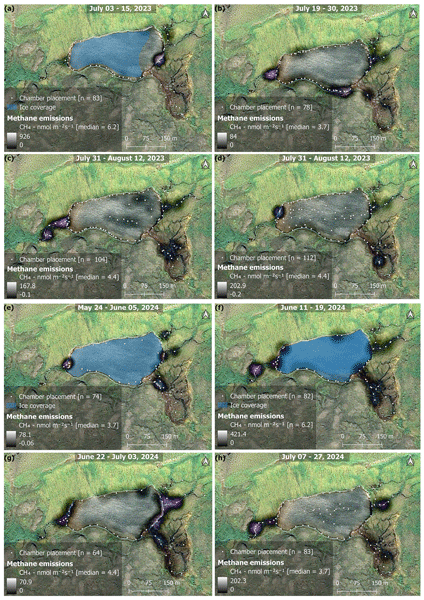
Abstract. Understanding spatiotemporal dynamics and drivers of methane (CH4) fluxes from rapidly changing permafrost regions is critical for improving our understanding of such changes. Between May and August 2023 and 2024, we measured CH4 using floating chambers in a small Arctic permafrost catchment on Disko Island, Greenland. Diffusive and ebullitive fluxes were derived from 707 measurements using a semi-automated algorithm incorporating boosted regression trees and generalized additive models. Highest fluxes occurred in streams and along lakeshores associated with inlets. Diffusion processes dominated (98 %), while 2 % were split between ebullition and uptake. Median diffusive fluxes were 5.0 nmol m-2s-1, (-0.1 to 271.8), peaking at ice-break. Ebullition had a median of 939 nmol m-2s-1 (5.2–14,893), but did not impact overall fluxes. Model results suggest thaw-season fluxes reflected meteorology and soil wetness effects, later shifting to biogeochemical controls: dissolved organic matter, oxygen saturation, and pH. Spatial variability arose from patchy conditions shaped by substrate, primary producers and microbial assemblages.
-
Notice on discussion status
The requested preprint has a corresponding peer-reviewed final revised paper. You are encouraged to refer to the final revised version.
-
Preprint
(2720 KB)
-
Supplement
(1396 KB)
-
The requested preprint has a corresponding peer-reviewed final revised paper. You are encouraged to refer to the final revised version.
- Preprint
(2720 KB) - Metadata XML
-
Supplement
(1396 KB) - BibTeX
- EndNote
- Final revised paper


Journal article(s) based on this preprint
Interactive discussion
Status: closed
-
RC1: 'Comment on egusphere-2025-4754', Anonymous Referee #1, 03 Nov 2025
-
AC1: 'Reply on RC1', Michael Thayne, 08 Dec 2025
Thank you for taking the time to review our manuscript and provide constructive comments. We have provided here a point by point response with suggested edits and clarifications to improve the manuscript. Thank you again for your comments, as we believe the helped improve the overall interpretation of the results.
-
AC1: 'Reply on RC1', Michael Thayne, 08 Dec 2025
-
RC2: 'Comment on egusphere-2025-4754', Anonymous Referee #2, 18 Nov 2025
Comment on "Spatiotemporal Variability and Environmental Controls on Aquatic Methane Emissions in an Arctic Permafrost Catchment" by Thayne et al., Biogeosciences
General comments
The authors deployed floating chambers during 2023 and 2024 summer to measure CH4 amount and applied General additive model (GAM) plus binary regression tree (BRT) to fit CH4 fluxes and separate ebullition from diffusion in a small arctic permafrost catchment. Further analysis of CH4 fluxes against dynamics of other environmental variables highlighted a dynamic and intertwined network of environmental variables affecting each other, and determined the spatial and temporal variations in CH4 fluxes as the outcome. The major conclusion and explanation is valid, though I have questions on some of the details.
Specific comments:
I have one major concern on "ebullition". Based on the paper description, I did not find authors using other data sources to validate the ebullition detection. Authors explained that the "ebullition" in their study is actually "non-linear concentration increases", which I believe include ebullition events (since quasi-ebullition is steady and can be similar to diffusive fluxes) and sudden increase of diffusive fluxes. I would strongly suggest authors to reconsider using "ebullition" in the main text, especially abstract, which is a well-defined gas transport pathway.
Technical correction:
Line 19: "later shifting to biogeochemical controls", how late? Several days or several weeks? A precise number can be the best.
Line 28: "which produce carbon as a result of their metabolic processes" shall be "which accelerate decomposition of soil organic carbon as a result of their metabolic processes" or "which increase portable carbon input to atmosphere and riverine system as a result of their metabolic processes".
Line 66: Shall remove "systems" after "freshwater ecosystems"
Figure 1: Can authors improve the figure quality? Could it be better if I use pictures with DPI >= 300? Also, it is better to add a simple compass rose to the map.
Line 121: "We used a self-built cylindrical chamber made of semi-transparent plastic" I can barely imagine what your chamber looks like, but it will be very helpful if you don't mind uploading a picture of your equipment, since it is self-built. This is more like a suggestion rather than request.
Line 135 ~ 138: What is the major reason for changing the measuring object for the control period?
Line 173: Since you have certain different treatment on equipment between 2023 and 2024, Are you fitting a general GAM for both years or one for each year separately?
Line 202: Shall be section 2.4
Line 203: There're a bunch of assumptions you used for estimating different metabolic fluxes, can you put some reference or available 3rd party data to validate your results?
Line 220: This also depends on how you can smooth your collected data to a coarser temporal resolution.
Line 223: Shall be section 2.5
Line 236: "Kurskal-Wallis test" shall be "Kruskal-Wallis test"?
Line 250 ~ 253: I'm not sure how you obtained these measurements? What equipment did you use to measure these variables?
Line 256 & Fig. S7 How do you account for the soil temperature depth for stream and lake? Start from the bottom of the lake? In line 256 you mentioned using soil temperatures "at 40 cm" to analyze correlation to surface water CH4 fluxes, which seems to be quite irrelevant if it means 40 cm below lake bottom.
Line 245 ~ 267: This paragraph shall clarify what different variables you measured for lake, stream and upland separately. If all variables are measured, shall explain if any different treatment is applied. For example, soil volumetric content seems not to be a measurable variable for lakes?
Line 277: A more popular range of bag fraction is 0.5 ~ 0.8, while here authors chose a relatively low bag fraction, it might make sense that authors expect more smoothed time series rather than over-fitting since the measured methane might be quite non-linear. Suggest explaining your choice.
Fig. 4: Is it possible to show the relative locations of different lake and stream classes in Fig. 5?
Line 286: How did you calculate deviance?
Figure 7. I assume the shaded area represents standard deviation, but authors shall add explanation.
Line 389: "Fluxes dissipated through the season until fluxes were isolated to the warm spring inlet and the eastern inlets (Figure 5)." I find it hard to interpret this sentence. Can you rephrase it?
Line 429: "The distribution of nutrients, i.e., dissolved organic matter (DOM)," DOM is not nutrients, but an indicator. Please correct.
Line 494: "that increasing pH and oxygen saturation as a result of primary production drive CH4 emissions down through the growing season (Figure 7c-d and Figure A1)." This conclusion is not precise. Suggest to say "increasing pH and oxygen saturation as a result of primary production and providing a vibrant aerobic environment, thus favored methanotrophic activities and then drive CH4 emissions down through the growing season (Figure 7c-d and Figure A1)."?
In supplemental material, line 21: I feel really hard to interpret "least mean deviance standard error".
Citation: https://doi.org/10.5194/egusphere-2025-4754-RC2 -
AC2: 'Reply on RC2', Michael Thayne, 08 Dec 2025
Thank you for reviewing our manuscript and providing constructive feedback/comments. We have provided here a point by point response with suggestions for edits and clarifications to the manuscript. We believe that your comments have improved the manuscript and appreciate the time you took to provide your thoughts.
-
AC2: 'Reply on RC2', Michael Thayne, 08 Dec 2025
Peer review completion


Interactive discussion
Status: closed
-
RC1: 'Comment on egusphere-2025-4754', Anonymous Referee #1, 03 Nov 2025
Thank you for having an opportunity to review the paper named “Spatiotemporal Variability and Environmental Controls on Aquatic Methane Emissions in an Arctic Permafrost Catchment” by Thayne et al. The authors evaluated methane emissions by using floating chambers in an Arctic permafrost catchment and compared the results from different water conditions, e.g., lake, streams, and ice/snow-covered surfaces. This is an interesting paper that used the observed data, combined with the statistical analysis, to constrain methane emissions in the study area. Though this is a small area, the authors discussed the potential factors that might influence methane variability. They also pointed out detailed environmental control mechanisms on methane biogeochemistry during seasonal transition, which improves the current knowledge of methane fluxes in such permafrost catchments. From my point of view, the descriptions and discussion are basically correct. I have some suggestions for the author reference.
My comments are line by line – not in order of importance.
Line 25 (Fox-Kemper et al., 2021)
Line 40 The reference to "Saunois et al., 2016” can be updated in 2025.
Line 64 “methanotroph and methanogen microbial assemblages along an upland-wetland environmental gradient were…” I suggest rephrasing this sentence to improve readability.
Line 104 I suggest outlining the specific locations of wetlands, rivers, and tributaries in Fig. 1.
Line 121 semi-transparent plastic material. This is one of my concerns in the paper. Could you please give the detailed information about this chamber, e.g., sealing performance? This raises my concern because the plastic material is not a “regular” material in detecting trace gases. This may cause systematic error when calculating methane fluxes by using linear fitting. In addition, the data between 2023 and 2024 were collected by using different chamber types, which weakens the results and discussion when comparing these two years of data.
Another concern is that the calculation fluxes were not revised for the real wind speed. I know this is difficult based on current data, but a discussion on how the wind speed would disturb the water surface and methane emission should be included. Besides, an uncertainty evaluation of chamber-based flux should also be included so that it is convenient to compare with the fluxes reported in other areas.
Line 138 Did the 707 chamber measurements take place twice (2023 and 2024) or several times on different days? I think this information is important to evaluate the significance of this study, though I found some of it in the figures.
Line 197 Typo after the word “ebullition”.
Line 205 How did you measure the DO concentration? At a one-minute frequency, I suppose a probe was used. The method, precision, and uncertainty should be clarified.
Line 223 Should be section 2.6 instead of 2.4.
Line 244 Should be Section 2.7.
Line 256 Why did you use the soil at 40 cm but not at the surface or top 10 cm to match the soil volumetric water content’s standard?
Line 270 "7 of the 21 weighted predictors." This was inconsistent with that in Fig. 3, which says 8 of the 21 of the weighted predictors. Please check.
Line 335-338 The discussion jumped from different figures, weakening the flow. In addition, these sentences were saying the advantages of KDE, which I think is not suitable in the Discussion, but in the Method.
Citation: https://doi.org/10.5194/egusphere-2025-4754-RC1 -
AC1: 'Reply on RC1', Michael Thayne, 08 Dec 2025
Thank you for taking the time to review our manuscript and provide constructive comments. We have provided here a point by point response with suggested edits and clarifications to improve the manuscript. Thank you again for your comments, as we believe the helped improve the overall interpretation of the results.
-
AC1: 'Reply on RC1', Michael Thayne, 08 Dec 2025
-
RC2: 'Comment on egusphere-2025-4754', Anonymous Referee #2, 18 Nov 2025
Comment on "Spatiotemporal Variability and Environmental Controls on Aquatic Methane Emissions in an Arctic Permafrost Catchment" by Thayne et al., Biogeosciences
General comments
The authors deployed floating chambers during 2023 and 2024 summer to measure CH4 amount and applied General additive model (GAM) plus binary regression tree (BRT) to fit CH4 fluxes and separate ebullition from diffusion in a small arctic permafrost catchment. Further analysis of CH4 fluxes against dynamics of other environmental variables highlighted a dynamic and intertwined network of environmental variables affecting each other, and determined the spatial and temporal variations in CH4 fluxes as the outcome. The major conclusion and explanation is valid, though I have questions on some of the details.
Specific comments:
I have one major concern on "ebullition". Based on the paper description, I did not find authors using other data sources to validate the ebullition detection. Authors explained that the "ebullition" in their study is actually "non-linear concentration increases", which I believe include ebullition events (since quasi-ebullition is steady and can be similar to diffusive fluxes) and sudden increase of diffusive fluxes. I would strongly suggest authors to reconsider using "ebullition" in the main text, especially abstract, which is a well-defined gas transport pathway.
Technical correction:
Line 19: "later shifting to biogeochemical controls", how late? Several days or several weeks? A precise number can be the best.
Line 28: "which produce carbon as a result of their metabolic processes" shall be "which accelerate decomposition of soil organic carbon as a result of their metabolic processes" or "which increase portable carbon input to atmosphere and riverine system as a result of their metabolic processes".
Line 66: Shall remove "systems" after "freshwater ecosystems"
Figure 1: Can authors improve the figure quality? Could it be better if I use pictures with DPI >= 300? Also, it is better to add a simple compass rose to the map.
Line 121: "We used a self-built cylindrical chamber made of semi-transparent plastic" I can barely imagine what your chamber looks like, but it will be very helpful if you don't mind uploading a picture of your equipment, since it is self-built. This is more like a suggestion rather than request.
Line 135 ~ 138: What is the major reason for changing the measuring object for the control period?
Line 173: Since you have certain different treatment on equipment between 2023 and 2024, Are you fitting a general GAM for both years or one for each year separately?
Line 202: Shall be section 2.4
Line 203: There're a bunch of assumptions you used for estimating different metabolic fluxes, can you put some reference or available 3rd party data to validate your results?
Line 220: This also depends on how you can smooth your collected data to a coarser temporal resolution.
Line 223: Shall be section 2.5
Line 236: "Kurskal-Wallis test" shall be "Kruskal-Wallis test"?
Line 250 ~ 253: I'm not sure how you obtained these measurements? What equipment did you use to measure these variables?
Line 256 & Fig. S7 How do you account for the soil temperature depth for stream and lake? Start from the bottom of the lake? In line 256 you mentioned using soil temperatures "at 40 cm" to analyze correlation to surface water CH4 fluxes, which seems to be quite irrelevant if it means 40 cm below lake bottom.
Line 245 ~ 267: This paragraph shall clarify what different variables you measured for lake, stream and upland separately. If all variables are measured, shall explain if any different treatment is applied. For example, soil volumetric content seems not to be a measurable variable for lakes?
Line 277: A more popular range of bag fraction is 0.5 ~ 0.8, while here authors chose a relatively low bag fraction, it might make sense that authors expect more smoothed time series rather than over-fitting since the measured methane might be quite non-linear. Suggest explaining your choice.
Fig. 4: Is it possible to show the relative locations of different lake and stream classes in Fig. 5?
Line 286: How did you calculate deviance?
Figure 7. I assume the shaded area represents standard deviation, but authors shall add explanation.
Line 389: "Fluxes dissipated through the season until fluxes were isolated to the warm spring inlet and the eastern inlets (Figure 5)." I find it hard to interpret this sentence. Can you rephrase it?
Line 429: "The distribution of nutrients, i.e., dissolved organic matter (DOM)," DOM is not nutrients, but an indicator. Please correct.
Line 494: "that increasing pH and oxygen saturation as a result of primary production drive CH4 emissions down through the growing season (Figure 7c-d and Figure A1)." This conclusion is not precise. Suggest to say "increasing pH and oxygen saturation as a result of primary production and providing a vibrant aerobic environment, thus favored methanotrophic activities and then drive CH4 emissions down through the growing season (Figure 7c-d and Figure A1)."?
In supplemental material, line 21: I feel really hard to interpret "least mean deviance standard error".
Citation: https://doi.org/10.5194/egusphere-2025-4754-RC2 -
AC2: 'Reply on RC2', Michael Thayne, 08 Dec 2025
Thank you for reviewing our manuscript and providing constructive feedback/comments. We have provided here a point by point response with suggestions for edits and clarifications to the manuscript. We believe that your comments have improved the manuscript and appreciate the time you took to provide your thoughts.
-
AC2: 'Reply on RC2', Michael Thayne, 08 Dec 2025
Peer review completion
Journal article(s) based on this preprint
Viewed
| HTML | XML | Total | Supplement | BibTeX | EndNote | |
|---|---|---|---|---|---|---|
| 1,020 | 430 | 103 | 1,553 | 195 | 67 | 77 |
- HTML: 1,020
- PDF: 430
- XML: 103
- Total: 1,553
- Supplement: 195
- BibTeX: 67
- EndNote: 77
Viewed (geographical distribution)
| Country | # | Views | % |
|---|
| Total: | 0 |
| HTML: | 0 |
| PDF: | 0 |
| XML: | 0 |
- 1
Michael W. Thayne

Karl Kemper
Christian Wille
Aram Kalhori
Torsten Sachs
The requested preprint has a corresponding peer-reviewed final revised paper. You are encouraged to refer to the final revised version.
- Preprint
(2720 KB) - Metadata XML
-
Supplement
(1396 KB) - BibTeX
- EndNote
- Final revised paper
Thank you for having an opportunity to review the paper named “Spatiotemporal Variability and Environmental Controls on Aquatic Methane Emissions in an Arctic Permafrost Catchment” by Thayne et al. The authors evaluated methane emissions by using floating chambers in an Arctic permafrost catchment and compared the results from different water conditions, e.g., lake, streams, and ice/snow-covered surfaces. This is an interesting paper that used the observed data, combined with the statistical analysis, to constrain methane emissions in the study area. Though this is a small area, the authors discussed the potential factors that might influence methane variability. They also pointed out detailed environmental control mechanisms on methane biogeochemistry during seasonal transition, which improves the current knowledge of methane fluxes in such permafrost catchments. From my point of view, the descriptions and discussion are basically correct. I have some suggestions for the author reference.
My comments are line by line – not in order of importance.
Line 25 (Fox-Kemper et al., 2021)
Line 40 The reference to "Saunois et al., 2016” can be updated in 2025.
Line 64 “methanotroph and methanogen microbial assemblages along an upland-wetland environmental gradient were…” I suggest rephrasing this sentence to improve readability.
Line 104 I suggest outlining the specific locations of wetlands, rivers, and tributaries in Fig. 1.
Line 121 semi-transparent plastic material. This is one of my concerns in the paper. Could you please give the detailed information about this chamber, e.g., sealing performance? This raises my concern because the plastic material is not a “regular” material in detecting trace gases. This may cause systematic error when calculating methane fluxes by using linear fitting. In addition, the data between 2023 and 2024 were collected by using different chamber types, which weakens the results and discussion when comparing these two years of data.
Another concern is that the calculation fluxes were not revised for the real wind speed. I know this is difficult based on current data, but a discussion on how the wind speed would disturb the water surface and methane emission should be included. Besides, an uncertainty evaluation of chamber-based flux should also be included so that it is convenient to compare with the fluxes reported in other areas.
Line 138 Did the 707 chamber measurements take place twice (2023 and 2024) or several times on different days? I think this information is important to evaluate the significance of this study, though I found some of it in the figures.
Line 197 Typo after the word “ebullition”.
Line 205 How did you measure the DO concentration? At a one-minute frequency, I suppose a probe was used. The method, precision, and uncertainty should be clarified.
Line 223 Should be section 2.6 instead of 2.4.
Line 244 Should be Section 2.7.
Line 256 Why did you use the soil at 40 cm but not at the surface or top 10 cm to match the soil volumetric water content’s standard?
Line 270 "7 of the 21 weighted predictors." This was inconsistent with that in Fig. 3, which says 8 of the 21 of the weighted predictors. Please check.
Line 335-338 The discussion jumped from different figures, weakening the flow. In addition, these sentences were saying the advantages of KDE, which I think is not suitable in the Discussion, but in the Method.