
the Creative Commons Attribution 4.0 License.
the Creative Commons Attribution 4.0 License.
 | 09 Oct 2025
A modified parameterization of stratiform cloud microphysics for the Community Earth System Model
Abstract. Large-scale stratiform clouds are widespread and dominate the Earth's radiation budget. Their radiative and microphysical properties are inseparable, depending on ambient aerosol conditions and on properties of any convective outflow. In the Community Atmospheric Model, version 6 (CAM6), large-scale clouds were originally treated two decades ago with a two-moment bulk microphysics approach. Since then, the technological and empirical basis of global models has improved, for example by representing cloud microphysics to encompass extra processes of ice and droplet initiation, including dependencies on aerosol conditions of size, composition, and loading.
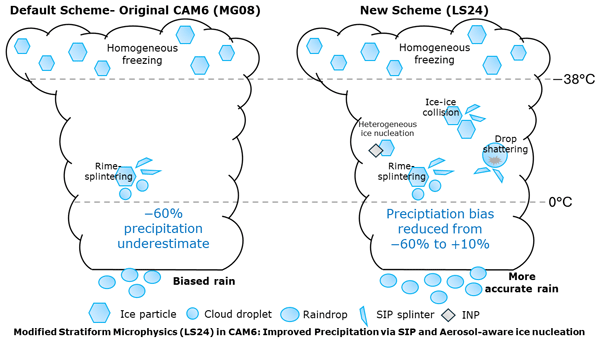
To advance the microphysical realism of the large-scale cloud scheme of the global model CAM6, most of the known mechanisms of secondary ice production (SIP) and an empirical formulation for heterogeneous ice nucleation have been represented in the stratiform scheme of the Global model CAM6. We included a hybrid bin/bulk scheme that treats aerosol activation, growth processes of accretion, aggregation, and riming, and three SIP mechanisms in the stratiform cloud scheme. We simulated an observed case of a mesoscale convective system during the Mid-latitude Continental Convective Clouds Experiment (MC3E) in Oklahoma, USA, using the Single-Column Atmosphere Model (SCAM6). The results from the simulations are validated against the aircraft, satellite, and ground measurements.
Results show that the modified stratiform scheme can predict the cloud properties of the observed stratiform clouds realistically. Together with our improved convective scheme in CAM6, this paves the way for more realism in the treatment of aerosol cloud interaction in global climate change by conventional climate Models.
-
Notice on discussion status
The requested preprint has a corresponding peer-reviewed final revised paper. You are encouraged to refer to the final revised version.
-
Preprint
(973 KB)
-
The requested preprint has a corresponding peer-reviewed final revised paper. You are encouraged to refer to the final revised version.
- Preprint
(973 KB) - Metadata XML
- BibTeX
- EndNote
- Final revised paper


Journal article(s) based on this preprint
Interactive discussion
Status: closed
-
RC1: 'Comment on egusphere-2025-4740', Anonymous Referee #1, 11 Nov 2025
The comment was uploaded in the form of a supplement: https://egusphere.copernicus.org/preprints/2025/egusphere-2025-4740/egusphere-2025-4740-RC1-supplement.pdfCitation: https://doi.org/
10.5194/egusphere-2025-4740-RC1 -
AC2: 'Reply on RC1', Chandra Shekhar Pant, 26 Jan 2026
The comment was uploaded in the form of a supplement: https://egusphere.copernicus.org/preprints/2025/egusphere-2025-4740/egusphere-2025-4740-AC2-supplement.pdf
-
AC2: 'Reply on RC1', Chandra Shekhar Pant, 26 Jan 2026
-
RC2: 'Comment on egusphere-2025-4740', Anonymous Referee #2, 15 Dec 2025
The comment was uploaded in the form of a supplement: https://egusphere.copernicus.org/preprints/2025/egusphere-2025-4740/egusphere-2025-4740-RC2-supplement.pdf
- AC3: 'Reply on RC2', Chandra Shekhar Pant, 26 Jan 2026
-
AC1: 'Comment on egusphere-2025-4740', Chandra Shekhar Pant, 26 Jan 2026
The comment was uploaded in the form of a supplement: https://egusphere.copernicus.org/preprints/2025/egusphere-2025-4740/egusphere-2025-4740-AC1-supplement.pdf


Interactive discussion
Status: closed
-
RC1: 'Comment on egusphere-2025-4740', Anonymous Referee #1, 11 Nov 2025
The comment was uploaded in the form of a supplement: https://egusphere.copernicus.org/preprints/2025/egusphere-2025-4740/egusphere-2025-4740-RC1-supplement.pdf
-
AC2: 'Reply on RC1', Chandra Shekhar Pant, 26 Jan 2026
The comment was uploaded in the form of a supplement: https://egusphere.copernicus.org/preprints/2025/egusphere-2025-4740/egusphere-2025-4740-AC2-supplement.pdf
-
AC2: 'Reply on RC1', Chandra Shekhar Pant, 26 Jan 2026
-
RC2: 'Comment on egusphere-2025-4740', Anonymous Referee #2, 15 Dec 2025
The comment was uploaded in the form of a supplement: https://egusphere.copernicus.org/preprints/2025/egusphere-2025-4740/egusphere-2025-4740-RC2-supplement.pdf
- AC3: 'Reply on RC2', Chandra Shekhar Pant, 26 Jan 2026
-
AC1: 'Comment on egusphere-2025-4740', Chandra Shekhar Pant, 26 Jan 2026
The comment was uploaded in the form of a supplement: https://egusphere.copernicus.org/preprints/2025/egusphere-2025-4740/egusphere-2025-4740-AC1-supplement.pdf
Peer review completion


Post-review adjustments
Journal article(s) based on this preprint
Viewed
| HTML | XML | Total | BibTeX | EndNote | |
|---|---|---|---|---|---|
| 2,192 | 918 | 204 | 3,314 | 175 | 141 |
- HTML: 2,192
- PDF: 918
- XML: 204
- Total: 3,314
- BibTeX: 175
- EndNote: 141
Viewed (geographical distribution)
| Country | # | Views | % |
|---|
| Total: | 0 |
| HTML: | 0 |
| PDF: | 0 |
| XML: | 0 |
- 1
Deepak Waman
Sachin Patade
Akash Deshmukh
Vaughan Phillips
The requested preprint has a corresponding peer-reviewed final revised paper. You are encouraged to refer to the final revised version.
- Preprint
(973 KB) - Metadata XML