
the Creative Commons Attribution 4.0 License.
the Creative Commons Attribution 4.0 License.
 | 08 Oct 2025
Characterizing Near-Surface Permafrost in Utqiaġvik, Alaska, using Electrical Resistivity Tomography and Ground Penetrating Radar
Abstract. Permafrost degradation in Arctic lowlands is a critical geomorphic process, increasingly driven by climate warming and infrastructure development. This study applies an integrated geophysical and surveying approach – Electrical Resistivity Tomography (ERT), Ground Penetrating Radar (GPR), and thaw probing – to characterize near-surface permafrost variability across four land use types in Utqiaġvik, Alaska: gravel road, snow fence, residential building and undisturbed tundra. Results reveal pronounced heterogeneity in thaw depths (0.2 to >1 m) and ice content, shaped by both natural features such as ice wedges and frost heave and anthropogenic disturbances. Roads and snow fences altered surface drainage and snow accumulation, promoting differential thaw, deeper active layers, and localized ground deformation. Buildings in permafrost regions alter the local thermal regime through multiple interacting factors – for example, solar radiation, thermal leakage, snow cover dynamics, and surface disturbance – among others. ERT identified high-resistivity zones (>1,000 Ω·m) interpreted as ice-rich permafrost and low-resistivity features (<5 Ω·m) likely associated with cryopegs or thaw zones. GPR delineated subsurface stratigraphy and supported interpretation of ice-rich layers and permafrost features. These findings underscore the strong spatial coupling between surface infrastructure and subsurface thermal and hydrological regimes in ice-rich permafrost. Geophysical methods revealed subsurface features and thaw depth variations across different land use types in Utqiaġvik, highlighting how infrastructure alters permafrost conditions. These findings support localized assessment of ground stability in Arctic environments.
-
Notice on discussion status
The requested preprint has a corresponding peer-reviewed final revised paper. You are encouraged to refer to the final revised version.
-
Preprint
(7923 KB)
-
The requested preprint has a corresponding peer-reviewed final revised paper. You are encouraged to refer to the final revised version.
- Preprint
(7923 KB) - Metadata XML
- BibTeX
- EndNote
- Final revised paper


Journal article(s) based on this preprint
Interactive discussion
Status: closed
-
RC1: 'Comment on egusphere-2025-4702', Anonymous Referee #1, 05 Nov 2025
-
AC1: 'Reply on RC1', Valentina Ekimova, 19 Nov 2025
Thank you very much for your positive assessment and helpful comments. We have increased the size of all figures, with special attention to GPR profiles, and adjusted the font size of all associated labels to improve readability. We have also revised the manuscript layout to ensure that, wherever possible, each figure now appears on the same page as its corresponding caption.
Citation: https://doi.org/10.5194/egusphere-2025-4702-AC1
-
AC1: 'Reply on RC1', Valentina Ekimova, 19 Nov 2025
-
RC2: 'Comment on egusphere-2025-4702', Anonymous Referee #2, 06 Nov 2025
Paper presents an interesting analysis of several sites in Alaska examined via ERT, GPR and thaw probing. Revision of the figures is necessary to make the results clearer to the reader as they are difficult to read with the current size and text sizes. Additional images of the sites without the scans overlaid would also aid in the interpretation of the results and understanding of the sites.
Paper's aims would be aided by a discussion section linking the results and a discussion of the results of the different monitoring methods/a more robust analysis of how they compare/can be aided by one another. And an explanation of where they differ.
Additionally for Figure 1: the naming scheme for sites could be clarified between figures and the text.
For the methods, an discussion of soil conditions in the region would aid in the analysis.
Citation: https://doi.org/10.5194/egusphere-2025-4702-RC2 -
AC2: 'Reply on RC2', Valentina Ekimova, 21 Nov 2025
Thank you very much for your helpful comments and suggestions. Based on your feedback, we revised the manuscript to improve clarity and readability:
1. We increased the size of all figures and the font size of all labels, colorbars, and annotations.
2. We added several photographs of the study sites to aid interpretation of the geophysical results.
3. We expanded the description of how the different methods (ERT, GPR, and thaw probing) agree or disagree at each site, and we highlight these comparisons at the end of each results subsection.
4. We clarified and standardized the site naming used in Figure 1 and ensured consistency with the text and other figures.
5. We added additional information on soil and sediment conditions in the Utqiagvik.
Citation: https://doi.org/10.5194/egusphere-2025-4702-AC2
-
AC2: 'Reply on RC2', Valentina Ekimova, 21 Nov 2025
-
CC1: 'Comment on egusphere-2025-4702', Rachel Harris, 14 Nov 2025
This manuscript “Characterizing Near-Surface Permafrost in Utqiaġvik, Alaska, using Electrical Resistivity Tomography and Ground Penetrating Radar” describes a geophysical investigation of permafrost structure in Northern Alaksa. The submission focuses on the differences in active layer within different land types of continuous permafrost and therefore appears to fall within the scope of the journal The Cryosphere. However, it is recommended that the authors revise the manuscript to address the following comments.
General Comments:
- It is not clear what the guiding scientific question is for this work, which makes it difficult to assess how effectively the study design and results address the intended objectives. A definitive scientific question that is stated in the introduction, reiterated in the conclusion, and answered in the discussion, would aid reviewers’ ability to judge the scientific results.
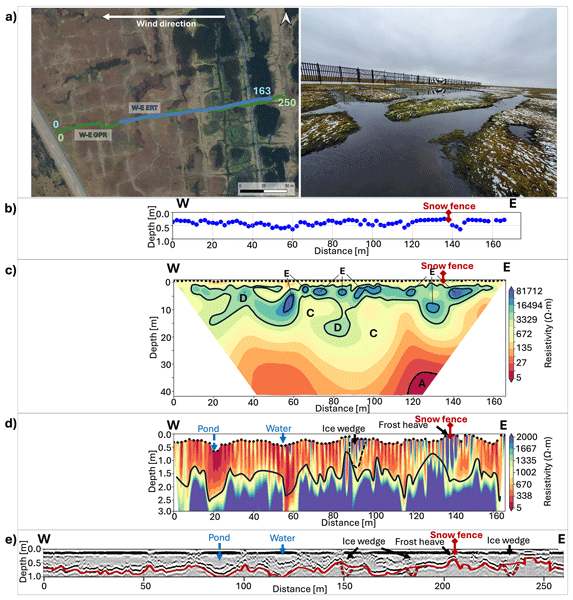
- For the GPR profiles where the author interprets ice wedges and labels them with dashed red lines on the profiles, the annotation lines extend to the surface, which is contrary to the understanding of ice wedge processes detailed in the published literature (e.g., Shur et al., 2025). The interpretation of the ice wedges within the active layer, as presented in the GPR results, also appears inconsistent with both the expected thermal regime of the permafrost and the corresponding ERT resistivity values for massive ice presence. Ice wedges typically occur below the active layer, within the perennially frozen zone, and their identification at shallower depths within the active layer should be carefully reconsidered. The authors could revisit their GPR interpretation and clarify whether the observed reflections may instead represent other features. Alternatively, if the authors have additional field observation, or ground truthing to support the presence of ice wedges within the active layer, this evidence should be explicitly presented or discussed.
- The manuscript would benefit from revisions to improve figure quality and consistency. At present, the figures are too small to be easily read and interpreted; larger, higher resolution versions with larger text/label size are recommended. Review figure axes, color scales, and labelling so that they are consistent throughout each figure and the paper overall. For Figure 6, subfigure labels are incorrectly referenced in the text.
- For the ERT figures specifically:
- The range on the color bar and the color bar label make it unclear if the resistivity values shown in the tomograms are on a log or linear scale. This may be related to a plotting bug in ResIPy.
- The color bar scales should be identical within the same figure since the entire cross-section and the zoomed in cross-section are showing the same data.
- The ERT tomograms show elevation above sea level while the GPR radargrams show depth. The y-axis should be consistent between ERT and GPR images to facilitate direct comparisons between the two results.
- The resistivity zones (A-E) are inconsistently labeled and referenced between all the figures and captions.
- The ERT tomograms appear to have abundant vertical artifacts present within the inversion (Figure 5 in particular). It is recommended that the authors assess if the artifacts are a color bar scale issue, a mesh issue, or an issue with the inversion settings.
Minor comments:
- The satellite maps currently include only a scale and a north arrow. It would improve spatial interpretation if a graticule or coordinate grid were added to provide more specific location information.
- Providing a more detailed description of the thaw-probing methods would aid in the transparency and repeatability of the experiment.
- The description of the “undisturbed tundra” site (site D) requires further clarification. Given the close proximity to a gravel road and an observatory, it would be useful to justify more clearly why the site that is located along the same road as sites B and C and near the building is considered undisturbed and used as a natural reference, and/or to adjust the terminology accordingly.
Reference:Shur, Y., Jones, B. M., Jorgenson, M. T., Kanevskiy, M. Z., Liljedahl, A., Walker, D. A., Ward Jones, M. K., Fortier, D., & Vasiliev, A. (2025). Formation of Low-Centered Ice-Wedge Polygons and Their Orthogonal Systems: A Review. Geosciences, 15(7), 249. https://doi.org/10.3390/geosciences15070249
This review was created as a group effort during a graduate seminar.
Citation: https://doi.org/10.5194/egusphere-2025-4702-CC1 -
AC3: 'Reply on CC1', Valentina Ekimova, 21 Nov 2025
Thank you very much for your interest in the article and for the detailed and thoughtful comments. According to your comments and suggestions, we revised the manuscript as follows:
-
“It is not clear what the guiding scientific question is for this work…”
The main scientific question of this study is to assess how near-surface permafrost (active layer thickness and shallow structure) responds to different land types and infrastructure impact in Utqiagvik, and how the combination of GPR, ERT, and thaw-depth probing can be used together to characterize these differences. We added a clearer formulation of this question at the end of the Introduction and refer back to it in the Conclusion section. -
“For the GPR profiles where the author interprets ice wedges and labels them with dashed red lines…”
Thank you a lot for this important comment. We revisited our GPR interpretation and the way ice-wedge–related features are shown. In the revised figures, the dashed lines no longer extend through the entire active layer up to the surface. Instead, we restrict them to the deeper, perennially frozen zone.
-
“The manuscript would benefit from revisions to improve figure quality and consistency. At present, the figures are too small…”
Thank you for this comment. We increased the size of all figures and the font size of axis labels, colorbars, and annotations to make them easier to read and interpret.
-
“Review figure axes, color scales, and labelling… For the ERT figures specifically…”
Thank you for the suggestions. We checked and corrected the consistency among all figures and the text. The ERT resistivity values are displayed on a linear scale and are now clearly labeled as resistivity in Ω·m. The color bar is different on the large scale and the coarse scale, because the large scale demonstrates subsurface ice-rich features, while the coarse scale mainly aims to show active layer depth. References to subfigure labels (including Figure 6) were also corrected in the text.
-
“The ERT tomograms show elevation above sea level while the GPR radargrams show depth…”
Thank you. We changed the vertical axis in the ERT tomograms to Depth (m), which makes them consistent with the GPR profiles and simplifies direct comparison between the two methods.
-
“The resistivity zones (A–E) are inconsistently labeled and referenced…”
Thank you. We checked all ERT figures, captions, and the main text and corrected the labelling so that zones A–E are used consistently throughout the manuscript.
-
“The ERT tomograms appear to have abundant vertical artifacts…”
Thank you for pointing this out. We examined the inversion settings and mesh, and we agree that some of the vertical streaks in Figure 5 likely represent inversion artifacts and local small-scale heterogeneity. In the revised text, we explicitly state that these vertical features are not interpreted as discrete geological bodies and that our estimates of active layer depth are based on broader, laterally coherent patterns in the tomograms. Therefore, these artifacts do not affect our main interpretation of active layer thickness.
-
“The satellite maps currently include only a scale and a north arrow…”
Thank you. We updated the satellite maps to include a simple coordinate grid (latitude and longitude), which improves the spatial interpretation and provides more precise location information.
-
“Providing a more detailed description of the thaw-probing methods would aid in the transparency and repeatability…”
Thank you. We added clarification in the Methods section, including details on the probe type, spacing of measurements, and procedure for recording thaw depth.
-
“The description of the ‘undisturbed tundra’ site (site D) requires further clarification…”
Thank you for this remark. We clarified in the text that Site D is used as a local reference tundra site that is less directly influenced by infrastructure. We also added a note that the vegetation cover and surface drainage appear undisturbed in this area.
Citation: https://doi.org/10.5194/egusphere-2025-4702-AC3 -
Peer review completion


Interactive discussion
Status: closed
-
RC1: 'Comment on egusphere-2025-4702', Anonymous Referee #1, 05 Nov 2025
I believe this should be accepted with minor corrections, those corrections solely being the formatting of the manuscript. Some of the figures, particularly the GPR B Scans are small and are not easy to read. Additionally the formatting is such that the figure captions are on different pages to the figures in some locations.
The application of methods is appropriate for the setting and there is a clear justification for the purpose and necessity for this research.
Citation: https://doi.org/10.5194/egusphere-2025-4702-RC1 -
AC1: 'Reply on RC1', Valentina Ekimova, 19 Nov 2025
Thank you very much for your positive assessment and helpful comments. We have increased the size of all figures, with special attention to GPR profiles, and adjusted the font size of all associated labels to improve readability. We have also revised the manuscript layout to ensure that, wherever possible, each figure now appears on the same page as its corresponding caption.
Citation: https://doi.org/10.5194/egusphere-2025-4702-AC1
-
AC1: 'Reply on RC1', Valentina Ekimova, 19 Nov 2025
-
RC2: 'Comment on egusphere-2025-4702', Anonymous Referee #2, 06 Nov 2025
Paper presents an interesting analysis of several sites in Alaska examined via ERT, GPR and thaw probing. Revision of the figures is necessary to make the results clearer to the reader as they are difficult to read with the current size and text sizes. Additional images of the sites without the scans overlaid would also aid in the interpretation of the results and understanding of the sites.
Paper's aims would be aided by a discussion section linking the results and a discussion of the results of the different monitoring methods/a more robust analysis of how they compare/can be aided by one another. And an explanation of where they differ.
Additionally for Figure 1: the naming scheme for sites could be clarified between figures and the text.
For the methods, an discussion of soil conditions in the region would aid in the analysis.
Citation: https://doi.org/10.5194/egusphere-2025-4702-RC2 -
AC2: 'Reply on RC2', Valentina Ekimova, 21 Nov 2025
Thank you very much for your helpful comments and suggestions. Based on your feedback, we revised the manuscript to improve clarity and readability:
1. We increased the size of all figures and the font size of all labels, colorbars, and annotations.
2. We added several photographs of the study sites to aid interpretation of the geophysical results.
3. We expanded the description of how the different methods (ERT, GPR, and thaw probing) agree or disagree at each site, and we highlight these comparisons at the end of each results subsection.
4. We clarified and standardized the site naming used in Figure 1 and ensured consistency with the text and other figures.
5. We added additional information on soil and sediment conditions in the Utqiagvik.
Citation: https://doi.org/10.5194/egusphere-2025-4702-AC2
-
AC2: 'Reply on RC2', Valentina Ekimova, 21 Nov 2025
-
CC1: 'Comment on egusphere-2025-4702', Rachel Harris, 14 Nov 2025
This manuscript “Characterizing Near-Surface Permafrost in Utqiaġvik, Alaska, using Electrical Resistivity Tomography and Ground Penetrating Radar” describes a geophysical investigation of permafrost structure in Northern Alaksa. The submission focuses on the differences in active layer within different land types of continuous permafrost and therefore appears to fall within the scope of the journal The Cryosphere. However, it is recommended that the authors revise the manuscript to address the following comments.
General Comments:
- It is not clear what the guiding scientific question is for this work, which makes it difficult to assess how effectively the study design and results address the intended objectives. A definitive scientific question that is stated in the introduction, reiterated in the conclusion, and answered in the discussion, would aid reviewers’ ability to judge the scientific results.
- For the GPR profiles where the author interprets ice wedges and labels them with dashed red lines on the profiles, the annotation lines extend to the surface, which is contrary to the understanding of ice wedge processes detailed in the published literature (e.g., Shur et al., 2025). The interpretation of the ice wedges within the active layer, as presented in the GPR results, also appears inconsistent with both the expected thermal regime of the permafrost and the corresponding ERT resistivity values for massive ice presence. Ice wedges typically occur below the active layer, within the perennially frozen zone, and their identification at shallower depths within the active layer should be carefully reconsidered. The authors could revisit their GPR interpretation and clarify whether the observed reflections may instead represent other features. Alternatively, if the authors have additional field observation, or ground truthing to support the presence of ice wedges within the active layer, this evidence should be explicitly presented or discussed.
- The manuscript would benefit from revisions to improve figure quality and consistency. At present, the figures are too small to be easily read and interpreted; larger, higher resolution versions with larger text/label size are recommended. Review figure axes, color scales, and labelling so that they are consistent throughout each figure and the paper overall. For Figure 6, subfigure labels are incorrectly referenced in the text.
- For the ERT figures specifically:
- The range on the color bar and the color bar label make it unclear if the resistivity values shown in the tomograms are on a log or linear scale. This may be related to a plotting bug in ResIPy.
- The color bar scales should be identical within the same figure since the entire cross-section and the zoomed in cross-section are showing the same data.
- The ERT tomograms show elevation above sea level while the GPR radargrams show depth. The y-axis should be consistent between ERT and GPR images to facilitate direct comparisons between the two results.
- The resistivity zones (A-E) are inconsistently labeled and referenced between all the figures and captions.
- The ERT tomograms appear to have abundant vertical artifacts present within the inversion (Figure 5 in particular). It is recommended that the authors assess if the artifacts are a color bar scale issue, a mesh issue, or an issue with the inversion settings.
Minor comments:
- The satellite maps currently include only a scale and a north arrow. It would improve spatial interpretation if a graticule or coordinate grid were added to provide more specific location information.
- Providing a more detailed description of the thaw-probing methods would aid in the transparency and repeatability of the experiment.
- The description of the “undisturbed tundra” site (site D) requires further clarification. Given the close proximity to a gravel road and an observatory, it would be useful to justify more clearly why the site that is located along the same road as sites B and C and near the building is considered undisturbed and used as a natural reference, and/or to adjust the terminology accordingly.
Reference:Shur, Y., Jones, B. M., Jorgenson, M. T., Kanevskiy, M. Z., Liljedahl, A., Walker, D. A., Ward Jones, M. K., Fortier, D., & Vasiliev, A. (2025). Formation of Low-Centered Ice-Wedge Polygons and Their Orthogonal Systems: A Review. Geosciences, 15(7), 249. https://doi.org/10.3390/geosciences15070249
This review was created as a group effort during a graduate seminar.
Citation: https://doi.org/10.5194/egusphere-2025-4702-CC1 -
AC3: 'Reply on CC1', Valentina Ekimova, 21 Nov 2025
Thank you very much for your interest in the article and for the detailed and thoughtful comments. According to your comments and suggestions, we revised the manuscript as follows:
-
“It is not clear what the guiding scientific question is for this work…”
The main scientific question of this study is to assess how near-surface permafrost (active layer thickness and shallow structure) responds to different land types and infrastructure impact in Utqiagvik, and how the combination of GPR, ERT, and thaw-depth probing can be used together to characterize these differences. We added a clearer formulation of this question at the end of the Introduction and refer back to it in the Conclusion section. -
“For the GPR profiles where the author interprets ice wedges and labels them with dashed red lines…”
Thank you a lot for this important comment. We revisited our GPR interpretation and the way ice-wedge–related features are shown. In the revised figures, the dashed lines no longer extend through the entire active layer up to the surface. Instead, we restrict them to the deeper, perennially frozen zone.
-
“The manuscript would benefit from revisions to improve figure quality and consistency. At present, the figures are too small…”
Thank you for this comment. We increased the size of all figures and the font size of axis labels, colorbars, and annotations to make them easier to read and interpret.
-
“Review figure axes, color scales, and labelling… For the ERT figures specifically…”
Thank you for the suggestions. We checked and corrected the consistency among all figures and the text. The ERT resistivity values are displayed on a linear scale and are now clearly labeled as resistivity in Ω·m. The color bar is different on the large scale and the coarse scale, because the large scale demonstrates subsurface ice-rich features, while the coarse scale mainly aims to show active layer depth. References to subfigure labels (including Figure 6) were also corrected in the text.
-
“The ERT tomograms show elevation above sea level while the GPR radargrams show depth…”
Thank you. We changed the vertical axis in the ERT tomograms to Depth (m), which makes them consistent with the GPR profiles and simplifies direct comparison between the two methods.
-
“The resistivity zones (A–E) are inconsistently labeled and referenced…”
Thank you. We checked all ERT figures, captions, and the main text and corrected the labelling so that zones A–E are used consistently throughout the manuscript.
-
“The ERT tomograms appear to have abundant vertical artifacts…”
Thank you for pointing this out. We examined the inversion settings and mesh, and we agree that some of the vertical streaks in Figure 5 likely represent inversion artifacts and local small-scale heterogeneity. In the revised text, we explicitly state that these vertical features are not interpreted as discrete geological bodies and that our estimates of active layer depth are based on broader, laterally coherent patterns in the tomograms. Therefore, these artifacts do not affect our main interpretation of active layer thickness.
-
“The satellite maps currently include only a scale and a north arrow…”
Thank you. We updated the satellite maps to include a simple coordinate grid (latitude and longitude), which improves the spatial interpretation and provides more precise location information.
-
“Providing a more detailed description of the thaw-probing methods would aid in the transparency and repeatability…”
Thank you. We added clarification in the Methods section, including details on the probe type, spacing of measurements, and procedure for recording thaw depth.
-
“The description of the ‘undisturbed tundra’ site (site D) requires further clarification…”
Thank you for this remark. We clarified in the text that Site D is used as a local reference tundra site that is less directly influenced by infrastructure. We also added a note that the vegetation cover and surface drainage appear undisturbed in this area.
Citation: https://doi.org/10.5194/egusphere-2025-4702-AC3 -
Peer review completion
Journal article(s) based on this preprint
Data sets
Utqiaġvik permafrost geophysics datasets (2021–2023) Valentina Ekimova et al. https://doi.org/10.5281/zenodo.17096203
Viewed
| HTML | XML | Total | BibTeX | EndNote | |
|---|---|---|---|---|---|
| 1,064 | 1,252 | 132 | 2,448 | 87 | 112 |
- HTML: 1,064
- PDF: 1,252
- XML: 132
- Total: 2,448
- BibTeX: 87
- EndNote: 112
Viewed (geographical distribution)
| Country | # | Views | % |
|---|
| Total: | 0 |
| HTML: | 0 |
| PDF: | 0 |
| XML: | 0 |
- 1
Valentina Ekimova

MacKenzie A. Nelson
Taylor Sullivan
Thomas A. Douglas
Howard E. Epstein
Matthew G. Jull
The requested preprint has a corresponding peer-reviewed final revised paper. You are encouraged to refer to the final revised version.
- Preprint
(7923 KB) - Metadata XML
I believe this should be accepted with minor corrections, those corrections solely being the formatting of the manuscript. Some of the figures, particularly the GPR B Scans are small and are not easy to read. Additionally the formatting is such that the figure captions are on different pages to the figures in some locations.
The application of methods is appropriate for the setting and there is a clear justification for the purpose and necessity for this research.