
the Creative Commons Attribution 4.0 License.
the Creative Commons Attribution 4.0 License.
 | 17 Oct 2025
Spatiotemporal dynamics of riparian vegetation NDVI as indicators of bio-hydromorphological interactions
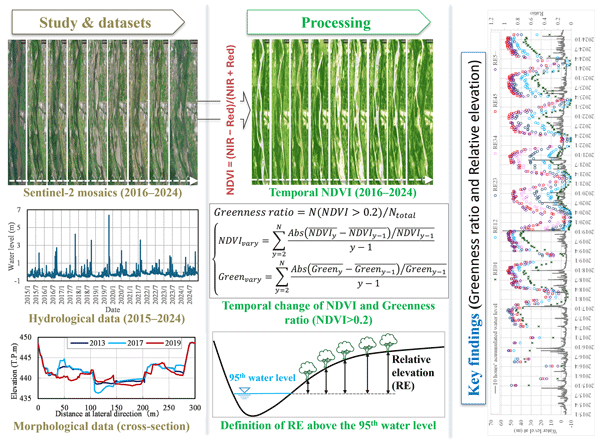
Abstract. The Normalized Difference Vegetation Index (NDVI) can be effectively used for monitoring the spatial and temporal dynamics of riparian vegetation. However, quantitative and efficient evaluations of the relationship between NDVI and bio-hydromorphological processes remain limited, particularly in the context of riverine floodplain management, where dense in-channel vegetation can obstruct flow and reduce conveyance capacity. Using 200 cloud-free Sentinel-2 images (2015–2024) for a 20-km reach of the Chikuma River (Japan), we evaluated the utility of NDVI (extracted from Sentinel-2 images) and the greenness index (defined as NDVI > 0.2) as quantitative indicators of bio-hydromorphological interactions, focusing on: (1) the relationship between NDVI dynamics, flood magnitude, and lateral channel morphology of relative elevation, and (2) the seasonal dynamics of riparian vegetation within frequently disturbed channels. Results indicated that NDVI fluctuations strongly corresponded to flood disturbances at lower elevations, while vegetation at higher elevations remained relatively stable. Along cross-channel transects, the maximum greenness ratio was well represented by a logistic model, with parameters varying according to flood magnitude from the previous year. Annual vegetation greenness additionally exhibited clear seasonal cycles, showing a late-summer greenness peak (August–September). The spatial and seasonal characteristics of NDVI displayed its potential as an indicator for operationalizing the “where” (priority bands by relative elevation) and “when” (phenological window) of vegetation control, and offered a transferable, remotely sensed basis for flood-risk mitigation and ecohydraulic planning.
-
Notice on discussion status
The requested preprint has a corresponding peer-reviewed final revised paper. You are encouraged to refer to the final revised version.
-
Preprint
(2785 KB)
-
The requested preprint has a corresponding peer-reviewed final revised paper. You are encouraged to refer to the final revised version.
- Preprint
(2785 KB) - Metadata XML
- BibTeX
- EndNote
- Final revised paper


Journal article(s) based on this preprint
Interactive discussion
Status: closed
-
RC1: 'Comment on egusphere-2025-4675', Maarten Kleinhans, 05 Nov 2025
-
AC1: 'Reply on RC1', Yuexia ZHOU, 10 Nov 2025
Dear Pro. Maarten Kleinhans
Thank you very much for your careful and constructive review. Before undertaking a full revision, we would like to clarify the scope of our study and outline our revision plan.
Our paper does not primarily address “relations between river channel change and vegetation.” Rather, it focuses on:1. the relations between hydrodynamics (flood magnitude) and vegetation dynamics across lateral relative elevation gradients; and
2. how these relations, derived from readily available datasets (Sentinel-2 imagery and near-real-time gauge data), can be translated into actionable guidance for river management (i.e., when and where to intervene).
This framing reflects an urgent management need in many Japanese rivers to balance flood-risk reduction with the maintenance of ecosystem diversity.
Revision plan (in response to your comments)
Aim & hypotheses: We will rewrite the objectives and add explicit, testable hypotheses linking flood magnitude, relative elevation, and vegetation response, and we will separate Results from Discussion for clarity.
- Literature integration: We will substantially expand the review to cover vegetation–hydrodynamics (e.g., flood magnitude and inundation duration), while explaining how our management-oriented scope complements this body of work.
- Morphodynamic context: Although our primary analyses target hydrodynamics–vegetation relations, we will incorporate available morphodynamic indicators (e.g., DEM and lateral cross-section change) to enable comparative discussion with prior studies.
- Figures & terminology: We will improve map resolution, add representative NDVI and relative elevation panels for improving the readability, and clarify terms (e.g., “accumulated water level”).
- Data & code availability: We have listed ~200 Sentinel-2 scenes and the hydrological data sources used. In the revision, we will deposit processed the relative-elevation calculation workflow, and analysis scripts in a public repository with a DOI, and reference these in the manuscript.
We appreciate your guidance on sharpening the paper’s scope and strengthening its scholarly grounding. If this plan aligns with your expectations, we will proceed accordingly and submit a revised manuscript.
With kind regards,
Yuexia Zhou, Yuji Toda and Runye Zhu
Citation: https://doi.org/10.5194/egusphere-2025-4675-AC1
-
AC1: 'Reply on RC1', Yuexia ZHOU, 10 Nov 2025
-
RC2: 'Comment on egusphere-2025-4675', Anonymous Referee #2, 10 Nov 2025
Review for: Spatiotemporal dynamics of riparian vegetation NDVI as indicators of bio-hydromorphological interactions
This manuscript analyzes the relation between flooding interval, magnitude, and vegetation dynamics across a riparian elevation gradient. The authors briefly discuss the management implications of their findings, however, the broader scope and applicability of their analysis is unclear. The title suggests a broadly applicable novel methodology and discussion of this topic on a large scale, yet I was left wanting more depth to this discussion and questioned whether this 20km stretch of river can be seen as representative of other rivers in Japan or in other countries. The manuscript would benefit from having a standalone discussion section to address how other these findings pertain to other rivers or even to other sections of this same river, as well as different management scenarios. There are several interesting and promising findings presented in the manuscript, but the discussion of these findings needs greater depth.
Major Comments:
Why was this 20 km stretch of river chosen as the study area, and would the study have benefited from examining additional stretches of the river and/or additional study sites? If this stretch of river is the only portion where it changes course, has steep banks, and extensive woody encroachment, please openly state this. Overall, I am curious about the decision to include this specific 20 km area in the study and why other stretches of the river were not included (e.g., limited by availability of gauges, topographic data, etc.).
I wonder how the authors view the broader scale applicability of this study and study area, e.g., if other rivers might behave the same or differently in general? I would like this addressed in greater depth in Section 2.1 or in the discussion of broader applicability for management decisions.
Similarly, I was hoping for a more definitive discussion about how flooding magnitude and interval influence or are influenced by vegetation coverage/type and elevation. Are these metrics correlated or linked to each other in any conclusive way? How may these correlations differ for other river and vegetation types?
Since the overall aim of this study seems to be coming from a management viewpoint, I was also hoping for more analysis and discussion of how different management decisions may influence flooding magnitude and frequency.
Each figure includes a caption that only contains essentially a figure title. It would benefit the reader to include more detail in the figure captions. For example, in the Fig. 6 caption, the abbreviation RE could be defined, and in Fig. 8 h0 could be defined.
Minor and Technical Comments:
L4: Capitalize author’s affiliation
Were 200 images obtained at multiple time steps (once or more than once per year)? Were images obtained on the same day of the year? Were images from different days used to create the stitched composite images in Fig. 1 (Section 2.3)?
Figure 1: The map extent in 1a can be focused on only Japan. All parts of the figure need to be better resolution. I would suggest trimming the images in a way that looks less mosaic and zooming in more so the river can be seen in better detail. Maybe consider restructuring the figure panels so the river runs vertically, instead of from right to left, to maximize the page space and reduce the amount of whitespace in panels c-e.
L78-80: Section 2.2 font size looks larger than rest of text.
L85: can remove comma after 200
L89: Use full name for MLIT at first mention here (instead of L106), and also in Fig. 1.
Figure 2, Section 2.2.2: Perhaps provide the exact dates of the first and second floods in the figure, figure caption, or text.
L179-180: Use full name for Ueda at first mention here. Can this data source be cited in a more permanent way and included in the references section rather than a temporary URL in the text? On that topic, can the data be made accessible to the reader?
Figure 6: “Accumulated” is spelt incorrectly in the figure (accumulated over what time period?). Legend does not indicate what the light green circles represent (legend has 6 symbols but 7 panels). Also, unclear what RE5~ represents (what range of relative elevation is this? Or is RE representing “return interval”…this should be specified in the caption and/or text) …should this read RE50 or RE5 instead? Perhaps the figure caption can be used to describe the legend and panels in greater detail. Also in panels 2, 3, and 5, the axis title “Ratio” overlaps with the axis labels (and suggest spelling out “Greenness ratio”). Also consider using “hydro-morphological dynamics” rather than “hydro-morphology dynamics”.
Figure 7 is interesting but I feel like it would be better presented as a scatterplot or line graph rather than a bar graph. Having the water level – which should be 2 separate words in the figure to match its spelling in the caption and elsewhere in the text – as downward bars does not make it easy for the reader to easily compare these quantities to each other. Also “greenness” is spelt incorrectly in the figure legend. I suggest making both the water level and greenness axes read from the bottom up. If the authors chose to keep bars instead of points, I suggest having the blue water level bars next to the greenness bars for each year.
L223-224: This statement is helpful for the reader and would be even more useful earlier in the text before the figures that utilize the greenness ratio, perhaps in section 2.3.1.
L230: Perhaps spell out Figure here instead of shortening to Fig.
Figure 8: In Y-axis title, every word is capitalized, but in other figures only the first word is capitalized. Make sure all axes titles consistently follow the journal’s guidelines.
Figure 9: “waterlevel” change to “water level” in legend and also h0 should include the subscript.
Figure 10: Again, a more descriptive caption would be helpful, for example, explicitly state what the blue circles are indicating.
L265-266 and Figure 11: Italicize Latin names.
L289-290: Would help to include the dates/number of years averaged to create Fig. 12.
Figure 12: Cosine is capitalized but vegetation is not. Keep consistent for all figures.
Section 3.2: This secondary growth phase later in summer is characteristic in many species. Perhaps more definitive and less speculative reasoning (using literature citations) can be implemented early in the section to describe why this phenomenon occurs. The authors’ explanation for how seasonal trends may affect flooding is well-reasoned and interesting. The use of the cosine curve model roughly conforms to the seasonal trend observed, however, the text discusses how the fitted model overpredicts the greenness ratio during the early growing season and underpredicts during mid-summer. Therefore, this model seems overly simplified because it does not seem to predict the dampened peaks observed during the summer. Does this limitation affect any of the results?
Section 3.3: This section suggesting management implications is thought provoking. Perhaps mention of the intermediate disturbance hypothesis deserves mention in this discussion, and whether it is supported by these findings. It may also be helpful if a theoretical example was proposed here; for example, how would management actions at high, low, or intermediate elevations interact with flooding frequency and magnitude, and would this also affect the ecosystem’s resistance and/or resilience to flooding, and what other responses would be affected by more targeted control?
L375-377: Review punctuation for alternatives that would be more direct and improve sentence flow (consider removing commas and semicolon, perhaps using dashes or splitting the sentence up).
Citation: https://doi.org/10.5194/egusphere-2025-4675-RC2


Interactive discussion
Status: closed
-
RC1: 'Comment on egusphere-2025-4675', Maarten Kleinhans, 05 Nov 2025
Review of: Spatiotemporal dynamics of riparian vegetation NDVI as indicators of bio-hydromorphological interactions
Authors: Zhou, Toda & Zhu
Reviewer: Maarten G Kleinhans, d.d. 5 Nov 2025The manuscript reports on combination of bed elevation data, a proxy for vegetation (greenness from NDVI) and water level measurements used to conduct flow modelling for a steep Japanese (gravel) river. The data are promising, the manuscript is reasonably well written and the analyses look repeatable and valid. However, the scope of the paper is unclear and if the objective is indeed to study relations between river channel change and vegetation, then review of relevant literature and a specific hypothesis is needed. In view of the concrete analyses possible with the data to address such a concrete topic, this suggests a rejection.
MAIN POINTS
The scope of the paper is not so clear. The 3 research questions are somewhat clear but the earlier stated objectives are too vague. Furthermore, there is no clear answer to the first research question, even though these data clearly allow answering it. The mixture of results and discussion is part of this problem: separation of these sections is needed precisely to make clear what the result of this work are and how this is contextualized by literature.
The literature on channel pattern and channel mobility in interaction with vegetation is ignored. I am thinking of the classic experimental work by Tal and Paola on braided river experiments with vegetation, conceptual work by Gurnell and Corenblit, the modelling by us (van Oorschot et al) and many other works. For review, see papers by Corenblit and by me (e.g. https://doi.org/10.1144/SP540-2022-138, also available as open access through utrecht university on my profile page).
Alternatively, one could think of analysis of tolerance limits of the various species to inundation depth, and erosion, and ripping out by high flow velocity. Also in this case that needs comparison to literature, plus analysis of morphological change and possible effects of seasonality and the timing of floods (there is a figure suggesting that bed elevation maps of the river are available for three years).The figures need improvement and clarification and some map figures would be much appreciated.
Making data available upon request is not acceptable in this day and age anymore. One can easily provide the depth and greenness maps and the timeseries through an online repository. This would be valuable for future analyses of vegetation-river interactions.
DETAILED POINTS (referring to figures and line numbers)Fig 1 there is not much to see of the river and its morphology. Please enhance image resolution and consider including another figure with a small section shown much larger as image and as (detrended) bed elevation
45-56 the objective is rather vague. The first primary research question is concrete, but this requires review before on the possible effects of riparian vegetation on expected effects on the interactions between vegetation, inundation duration (hydroperiod) and channel morphodynamics. Line 138 is too late and merely a beginning.
Fig 3 and the text suggest you have three bed elevation maps and the greenness maps but these are shown nowhere. I strongly suggest showing these for a short stretch of the river as to illustrate the patterns and the dynamics, so that the reader knows what lateral channel dynamics to expect in the data analysis.
Fig 4 would be more understandable if zoomed out a bit, or if showing more upstream and downstream of the river (make the panel higher)
Fig 6 says "10 hours' acuumulated water level" but what is accumulated water level? time-averaged?
Two or three panels will do to show the general pattern and then we know what the data underlying the data reduction in later figures is.Fig 9 help the reader and state again what h0 is. Combine with Fig 7 (put the panels together in one multipanel figure at the same scale)
Fig 10 explain RE again in the caption. I suggest that this figure is much more readable if it is turned into a line plot with lines for all the years and RE on the horizontal axis. These will then be much easier compared.
Fig 12 and Fig 13 can also be combined in a multipanel figure with exactly the same x-axis for better analysis by the reader
Citation: https://doi.org/10.5194/egusphere-2025-4675-RC1 -
AC1: 'Reply on RC1', Yuexia ZHOU, 10 Nov 2025
Dear Pro. Maarten Kleinhans
Thank you very much for your careful and constructive review. Before undertaking a full revision, we would like to clarify the scope of our study and outline our revision plan.
Our paper does not primarily address “relations between river channel change and vegetation.” Rather, it focuses on:1. the relations between hydrodynamics (flood magnitude) and vegetation dynamics across lateral relative elevation gradients; and
2. how these relations, derived from readily available datasets (Sentinel-2 imagery and near-real-time gauge data), can be translated into actionable guidance for river management (i.e., when and where to intervene).
This framing reflects an urgent management need in many Japanese rivers to balance flood-risk reduction with the maintenance of ecosystem diversity.
Revision plan (in response to your comments)
Aim & hypotheses: We will rewrite the objectives and add explicit, testable hypotheses linking flood magnitude, relative elevation, and vegetation response, and we will separate Results from Discussion for clarity.
- Literature integration: We will substantially expand the review to cover vegetation–hydrodynamics (e.g., flood magnitude and inundation duration), while explaining how our management-oriented scope complements this body of work.
- Morphodynamic context: Although our primary analyses target hydrodynamics–vegetation relations, we will incorporate available morphodynamic indicators (e.g., DEM and lateral cross-section change) to enable comparative discussion with prior studies.
- Figures & terminology: We will improve map resolution, add representative NDVI and relative elevation panels for improving the readability, and clarify terms (e.g., “accumulated water level”).
- Data & code availability: We have listed ~200 Sentinel-2 scenes and the hydrological data sources used. In the revision, we will deposit processed the relative-elevation calculation workflow, and analysis scripts in a public repository with a DOI, and reference these in the manuscript.
We appreciate your guidance on sharpening the paper’s scope and strengthening its scholarly grounding. If this plan aligns with your expectations, we will proceed accordingly and submit a revised manuscript.
With kind regards,
Yuexia Zhou, Yuji Toda and Runye Zhu
Citation: https://doi.org/10.5194/egusphere-2025-4675-AC1
-
AC1: 'Reply on RC1', Yuexia ZHOU, 10 Nov 2025
-
RC2: 'Comment on egusphere-2025-4675', Anonymous Referee #2, 10 Nov 2025
Review for: Spatiotemporal dynamics of riparian vegetation NDVI as indicators of bio-hydromorphological interactions
This manuscript analyzes the relation between flooding interval, magnitude, and vegetation dynamics across a riparian elevation gradient. The authors briefly discuss the management implications of their findings, however, the broader scope and applicability of their analysis is unclear. The title suggests a broadly applicable novel methodology and discussion of this topic on a large scale, yet I was left wanting more depth to this discussion and questioned whether this 20km stretch of river can be seen as representative of other rivers in Japan or in other countries. The manuscript would benefit from having a standalone discussion section to address how other these findings pertain to other rivers or even to other sections of this same river, as well as different management scenarios. There are several interesting and promising findings presented in the manuscript, but the discussion of these findings needs greater depth.
Major Comments:
Why was this 20 km stretch of river chosen as the study area, and would the study have benefited from examining additional stretches of the river and/or additional study sites? If this stretch of river is the only portion where it changes course, has steep banks, and extensive woody encroachment, please openly state this. Overall, I am curious about the decision to include this specific 20 km area in the study and why other stretches of the river were not included (e.g., limited by availability of gauges, topographic data, etc.).
I wonder how the authors view the broader scale applicability of this study and study area, e.g., if other rivers might behave the same or differently in general? I would like this addressed in greater depth in Section 2.1 or in the discussion of broader applicability for management decisions.
Similarly, I was hoping for a more definitive discussion about how flooding magnitude and interval influence or are influenced by vegetation coverage/type and elevation. Are these metrics correlated or linked to each other in any conclusive way? How may these correlations differ for other river and vegetation types?
Since the overall aim of this study seems to be coming from a management viewpoint, I was also hoping for more analysis and discussion of how different management decisions may influence flooding magnitude and frequency.
Each figure includes a caption that only contains essentially a figure title. It would benefit the reader to include more detail in the figure captions. For example, in the Fig. 6 caption, the abbreviation RE could be defined, and in Fig. 8 h0 could be defined.
Minor and Technical Comments:
L4: Capitalize author’s affiliation
Were 200 images obtained at multiple time steps (once or more than once per year)? Were images obtained on the same day of the year? Were images from different days used to create the stitched composite images in Fig. 1 (Section 2.3)?
Figure 1: The map extent in 1a can be focused on only Japan. All parts of the figure need to be better resolution. I would suggest trimming the images in a way that looks less mosaic and zooming in more so the river can be seen in better detail. Maybe consider restructuring the figure panels so the river runs vertically, instead of from right to left, to maximize the page space and reduce the amount of whitespace in panels c-e.
L78-80: Section 2.2 font size looks larger than rest of text.
L85: can remove comma after 200
L89: Use full name for MLIT at first mention here (instead of L106), and also in Fig. 1.
Figure 2, Section 2.2.2: Perhaps provide the exact dates of the first and second floods in the figure, figure caption, or text.
L179-180: Use full name for Ueda at first mention here. Can this data source be cited in a more permanent way and included in the references section rather than a temporary URL in the text? On that topic, can the data be made accessible to the reader?
Figure 6: “Accumulated” is spelt incorrectly in the figure (accumulated over what time period?). Legend does not indicate what the light green circles represent (legend has 6 symbols but 7 panels). Also, unclear what RE5~ represents (what range of relative elevation is this? Or is RE representing “return interval”…this should be specified in the caption and/or text) …should this read RE50 or RE5 instead? Perhaps the figure caption can be used to describe the legend and panels in greater detail. Also in panels 2, 3, and 5, the axis title “Ratio” overlaps with the axis labels (and suggest spelling out “Greenness ratio”). Also consider using “hydro-morphological dynamics” rather than “hydro-morphology dynamics”.
Figure 7 is interesting but I feel like it would be better presented as a scatterplot or line graph rather than a bar graph. Having the water level – which should be 2 separate words in the figure to match its spelling in the caption and elsewhere in the text – as downward bars does not make it easy for the reader to easily compare these quantities to each other. Also “greenness” is spelt incorrectly in the figure legend. I suggest making both the water level and greenness axes read from the bottom up. If the authors chose to keep bars instead of points, I suggest having the blue water level bars next to the greenness bars for each year.
L223-224: This statement is helpful for the reader and would be even more useful earlier in the text before the figures that utilize the greenness ratio, perhaps in section 2.3.1.
L230: Perhaps spell out Figure here instead of shortening to Fig.
Figure 8: In Y-axis title, every word is capitalized, but in other figures only the first word is capitalized. Make sure all axes titles consistently follow the journal’s guidelines.
Figure 9: “waterlevel” change to “water level” in legend and also h0 should include the subscript.
Figure 10: Again, a more descriptive caption would be helpful, for example, explicitly state what the blue circles are indicating.
L265-266 and Figure 11: Italicize Latin names.
L289-290: Would help to include the dates/number of years averaged to create Fig. 12.
Figure 12: Cosine is capitalized but vegetation is not. Keep consistent for all figures.
Section 3.2: This secondary growth phase later in summer is characteristic in many species. Perhaps more definitive and less speculative reasoning (using literature citations) can be implemented early in the section to describe why this phenomenon occurs. The authors’ explanation for how seasonal trends may affect flooding is well-reasoned and interesting. The use of the cosine curve model roughly conforms to the seasonal trend observed, however, the text discusses how the fitted model overpredicts the greenness ratio during the early growing season and underpredicts during mid-summer. Therefore, this model seems overly simplified because it does not seem to predict the dampened peaks observed during the summer. Does this limitation affect any of the results?
Section 3.3: This section suggesting management implications is thought provoking. Perhaps mention of the intermediate disturbance hypothesis deserves mention in this discussion, and whether it is supported by these findings. It may also be helpful if a theoretical example was proposed here; for example, how would management actions at high, low, or intermediate elevations interact with flooding frequency and magnitude, and would this also affect the ecosystem’s resistance and/or resilience to flooding, and what other responses would be affected by more targeted control?
L375-377: Review punctuation for alternatives that would be more direct and improve sentence flow (consider removing commas and semicolon, perhaps using dashes or splitting the sentence up).
Citation: https://doi.org/10.5194/egusphere-2025-4675-RC2
Peer review completion


Post-review adjustments
Journal article(s) based on this preprint
Viewed
| HTML | XML | Total | BibTeX | EndNote | |
|---|---|---|---|---|---|
| 739 | 449 | 75 | 1,263 | 50 | 74 |
- HTML: 739
- PDF: 449
- XML: 75
- Total: 1,263
- BibTeX: 50
- EndNote: 74
Viewed (geographical distribution)
| Country | # | Views | % |
|---|
| Total: | 0 |
| HTML: | 0 |
| PDF: | 0 |
| XML: | 0 |
- 1
Yuji Toda
Runye Zhu
The requested preprint has a corresponding peer-reviewed final revised paper. You are encouraged to refer to the final revised version.
- Preprint
(2785 KB) - Metadata XML
Review of: Spatiotemporal dynamics of riparian vegetation NDVI as indicators of bio-hydromorphological interactions
Authors: Zhou, Toda & Zhu
Reviewer: Maarten G Kleinhans, d.d. 5 Nov 2025
The manuscript reports on combination of bed elevation data, a proxy for vegetation (greenness from NDVI) and water level measurements used to conduct flow modelling for a steep Japanese (gravel) river. The data are promising, the manuscript is reasonably well written and the analyses look repeatable and valid. However, the scope of the paper is unclear and if the objective is indeed to study relations between river channel change and vegetation, then review of relevant literature and a specific hypothesis is needed. In view of the concrete analyses possible with the data to address such a concrete topic, this suggests a rejection.
MAIN POINTS
The scope of the paper is not so clear. The 3 research questions are somewhat clear but the earlier stated objectives are too vague. Furthermore, there is no clear answer to the first research question, even though these data clearly allow answering it. The mixture of results and discussion is part of this problem: separation of these sections is needed precisely to make clear what the result of this work are and how this is contextualized by literature.
The literature on channel pattern and channel mobility in interaction with vegetation is ignored. I am thinking of the classic experimental work by Tal and Paola on braided river experiments with vegetation, conceptual work by Gurnell and Corenblit, the modelling by us (van Oorschot et al) and many other works. For review, see papers by Corenblit and by me (e.g. https://doi.org/10.1144/SP540-2022-138, also available as open access through utrecht university on my profile page).
Alternatively, one could think of analysis of tolerance limits of the various species to inundation depth, and erosion, and ripping out by high flow velocity. Also in this case that needs comparison to literature, plus analysis of morphological change and possible effects of seasonality and the timing of floods (there is a figure suggesting that bed elevation maps of the river are available for three years).
The figures need improvement and clarification and some map figures would be much appreciated.
Making data available upon request is not acceptable in this day and age anymore. One can easily provide the depth and greenness maps and the timeseries through an online repository. This would be valuable for future analyses of vegetation-river interactions.
DETAILED POINTS (referring to figures and line numbers)
Fig 1 there is not much to see of the river and its morphology. Please enhance image resolution and consider including another figure with a small section shown much larger as image and as (detrended) bed elevation
45-56 the objective is rather vague. The first primary research question is concrete, but this requires review before on the possible effects of riparian vegetation on expected effects on the interactions between vegetation, inundation duration (hydroperiod) and channel morphodynamics. Line 138 is too late and merely a beginning.
Fig 3 and the text suggest you have three bed elevation maps and the greenness maps but these are shown nowhere. I strongly suggest showing these for a short stretch of the river as to illustrate the patterns and the dynamics, so that the reader knows what lateral channel dynamics to expect in the data analysis.
Fig 4 would be more understandable if zoomed out a bit, or if showing more upstream and downstream of the river (make the panel higher)
Fig 6 says "10 hours' acuumulated water level" but what is accumulated water level? time-averaged?
Two or three panels will do to show the general pattern and then we know what the data underlying the data reduction in later figures is.
Fig 9 help the reader and state again what h0 is. Combine with Fig 7 (put the panels together in one multipanel figure at the same scale)
Fig 10 explain RE again in the caption. I suggest that this figure is much more readable if it is turned into a line plot with lines for all the years and RE on the horizontal axis. These will then be much easier compared.
Fig 12 and Fig 13 can also be combined in a multipanel figure with exactly the same x-axis for better analysis by the reader