
the Creative Commons Attribution 4.0 License.
the Creative Commons Attribution 4.0 License.
 | 03 Nov 2025
3D Transport Characteristics of Ozone Pollution Affected by Tropical cyclones over the Greater Bay Area, China: Insights from a Radar Wind Profiler Network, Surface observations, and Model Simulations
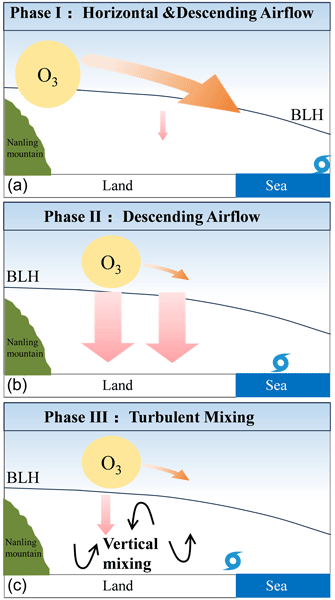
Abstract. Tropical cyclones (TCs) exert a profound influence on ground-level ozone (O3) pollution dynamics in China's Guangdong-Hong Kong-Macao Greater Bay Area (GBA). Although TC-related O3 transport processes are well recognized, their three-dimensional characteristics remain inadequately characterized. This study provides the first comprehensive observational analysis of O3 pollution transport mechanisms in the GBA under the influence of TC, integrating high-temporal-resolution wind profile measurements with hourly meteorological and air quality data and model simulations. The findings indicate that TC activity accounts for 39.9 % of O3 pollution episodes in the region, with pollutants advection from northern mainland areas to coastal cities. When TCs are located at a distance of approximately 1800–2000 km, horizontal transport mechanisms dominate, facilitating the conveyance of inland ozone to coastal regions. As the proximity of the TC decreases to within 1000–1700 km, the descending air currents intensify, driving ozone from coastal areas into the boundary layer and resulting in reduced O3 concentrations inland while they increase along the coast. In particular, when TCs approach Taiwan (less than 800 km, NE), increased vertical wind shear occurs about 34.25 % than before , particularly over coastal zones, facilitating the injection of free-atmosphere ozone into the boundary layer. This mechanism prolongs surface O3 pollution episodes. Our findings offer critical insights for O3 pollution mitigation strategies in the GBA and are of relevance for other globally significant bay regions susceptible to TC impacts, including Hangzhou Bay (China), Tokyo Bay (Japan), and the Bay of Bengal (India).
Competing interests: At least one of the (co-)authors is a member of the editorial board of Atmospheric Measurement Techniques.
Publisher's note: Copernicus Publications remains neutral with regard to jurisdictional claims made in the text, published maps, institutional affiliations, or any other geographical representation in this paper. While Copernicus Publications makes every effort to include appropriate place names, the final responsibility lies with the authors. Views expressed in the text are those of the authors and do not necessarily reflect the views of the publisher.-
Notice on discussion status
The requested preprint has a corresponding peer-reviewed final revised paper. You are encouraged to refer to the final revised version.
-
Preprint
(2936 KB)
-
The requested preprint has a corresponding peer-reviewed final revised paper. You are encouraged to refer to the final revised version.
- Preprint
(2936 KB) - Metadata XML
- BibTeX
- EndNote
- Final revised paper


Journal article(s) based on this preprint
Interactive discussion
Status: closed
-
RC1: 'Comment on egusphere-2025-4668', Anonymous Referee #2, 18 Nov 2025
This manuscript presents a significant and timely contribution to our understanding of ozonepollution dynamics in the GBA under tropical cyclone influence. The study provides acomprehensive three-dimensional characterization of O3 transport mechanisms during TCevents, thereby moving beyond previous work that has primarily focused on general TC-O3relationships. The combination of high-temporal-resolution wind profile measurements withhourly meteorological and air quality observations, supplemented by model simulations,represents a methodologically robust approach that enables detailed process-levelunderstanding. The manuscript offers valuable quantitative insights into distance-dependenttransport mechanisms. Notably, the finding that TC activity accounts for 39.9% of O3pollution episodes underscores the practical importance of this work for pollution forecastingand mitigation strategies in the GBA and other TC-affected bay regions globally.Despite these considerable strengths, several aspects of the manuscript would benefit fromfurther clarification and refinement to strengthen its scientific contribution and accessibility tothe broader readership. Therefore recommend this manuscript for publication after minorrevisions addressing the following points:1.Formatting issues with superscript units. Multiple instances of incorrect superscriptformatting for units such as "μg m -3" and "m s -1" are found throughout the manuscript.Please check and correct all unit expressions consistently throughout the text.2.Lines 290-295: There appears to be a date inconsistency in this section. Please clarifywhether the events occurred in July or August.3.Line 295: The model results do not adequately address whether the elevated ozoneconcentrations at the HD site on the 23rd-24th were primarily due to local photochemicalproduction or regional transport. Please provide additional analysis.4.Line 341: There is an inconsistency in the surface wind direction for the HK on August24th. Line 281 and Figure 5c both indicate southwesterly winds, while Line 341 describesnorthwesterly winds. Please verify the actual wind direction from the observational data andcorrect this discrepancy.5.Line371-374: How does the RI value at the GZ site indicate the occurrence of convergence?Does " which led to reduced wind speeds within the boundary layer" refer to horizontal orvertical wind speed? Please specify.And The explanation in lines 371-374 transitions abruptlyfrom wind speed changes to terrain and urbanization effects. Please provide more detailedexplaining.6.Line 376: Based on Figure 10, O₃ appears to be more uniformly mixed within the boundarylayer at the GZ site, which seems inconsistent with the text description.7.Line 385-392: The relationship between O₃ and VWS requires more detailed explanation. Specifically, the authors should clarify: (1) how VWS magnitude corresponds to O₃ levels(i.e., whether larger/smaller VWS values correspond to higher or lower O₃ concentrations),and (2) how changes in VWS affect o O₃ concentrations. Currently, this section providesminimal explanation of these mechanisms . And "But the HK station had a higher boundarylayer height that could accommodate more O₃." this statement appears contradictory: if theboundary layer can accommodate more O₃, one might reasonably infer that O₃ concentrationswould be lower. However, the HK actually exhibits higher O₃ concentrations. The authorsshould provide more comprehensive explanations to reconcile this apparent inconsistency andensure logical coherence in their interpretation.Citation: https://doi.org/
10.5194/egusphere-2025-4668-RC1 - AC1: 'Reply on RC1', Yuanjian Yang, 28 Dec 2025
- AC2: 'Reply on RC1', Yuanjian Yang, 28 Dec 2025
-
RC2: 'Comment on egusphere-2025-4668', Anonymous Referee #1, 24 Nov 2025
This study examines the three-dimensional transport characteristics of ozone (O3) pollution in the Greater Bay Area (GBA) under the influence of tropical cyclones (TCs). The integration of wind profiler radar observations, surface measurements, and model analysis is a key strength, offering valuable insights into how TC-induced circulation modulates both horizontal and vertical O3 transport. The impacts of TCs on O3 pollution exhibit a systematic variation with distance from the GBA: horizontal advection dominates at distant locations (1800–2000 km), enhanced subsidence and downward transport become significant at intermediate distances (1000–1700 km), and strong vertical wind shear drives boundary-layer mixing and coastal O3 enhancement when TCs move within 800 km of the region. The manuscript is generally well-organized, and the identification of three transport phases provides an important understanding of the dynamic processes influencing O3 variability during TC events. However, I have several suggestions to improve the study:
Major comments:
How did the authors isolate the impact of tropical cyclones on O3 pollution from other synoptic-scale weather systems?
What datasets were used to validate the WRF-Chem model outputs, and how was the evaluation conducted?
Why was the role of VOCs in O3 formation and pollution during TC events not analyzed in the study?
What are the spatial resolutions of all datasets used in the research?
Minor comments:
Page 4, Lines 110–112: The detection heights of the wind profiler radar differ across the three stations. Could this difference affect the vertical profile data?
Page 4, Line 119: The temporal resolution of the best-track TC dataset is 6 hours. Could you clarify how this dataset is matched with the 1-hour resolution data used in the study?
Page 4, Line 120: Please provide references defining “TC days.”
Page 5, Line 131: Please provide a reference for the national standard of "MDA8", e.g., doi: 10.1016/j.rse.2021.112775
Page 5, Line 132: Please provide references that define "O3 pollution" in the GBA.
Table 2: Please include the calculation methods for the statistical metrics, such as MB, FE, and FB.
Page 8, Line 201: Please clarify the standard used to define "O3 pollution day" and cite related references, for example: doi:10.1016/j.rse.2024.114482
Page 9, Lines 220–221: Please provide possible explanations for the observed results.
Figure 3: Some regions in the figure appear to lack data. Please clarify.
Page 13, Line 239: It appears that subfigure (d) is missing from the figure.
Figure 10: The units of O3 in the text are µg/m3, but they are given in ppmv here. Please maintain consistency in the units.
Figure 12: Why do the VWS grids differ in size among the three station regions? Please clarify this discrepancy.
Citation: https://doi.org/10.5194/egusphere-2025-4668-RC2 - AC3: 'Reply on RC2', Yuanjian Yang, 28 Dec 2025
Peer review completion
Post-review adjustments


Interactive discussion
Status: closed
-
RC1: 'Comment on egusphere-2025-4668', Anonymous Referee #2, 18 Nov 2025
This manuscript presents a significant and timely contribution to our understanding of ozonepollution dynamics in the GBA under tropical cyclone influence. The study provides acomprehensive three-dimensional characterization of O3 transport mechanisms during TCevents, thereby moving beyond previous work that has primarily focused on general TC-O3relationships. The combination of high-temporal-resolution wind profile measurements withhourly meteorological and air quality observations, supplemented by model simulations,represents a methodologically robust approach that enables detailed process-levelunderstanding. The manuscript offers valuable quantitative insights into distance-dependenttransport mechanisms. Notably, the finding that TC activity accounts for 39.9% of O3pollution episodes underscores the practical importance of this work for pollution forecastingand mitigation strategies in the GBA and other TC-affected bay regions globally.Despite these considerable strengths, several aspects of the manuscript would benefit fromfurther clarification and refinement to strengthen its scientific contribution and accessibility tothe broader readership. Therefore recommend this manuscript for publication after minorrevisions addressing the following points:1.Formatting issues with superscript units. Multiple instances of incorrect superscriptformatting for units such as "μg m -3" and "m s -1" are found throughout the manuscript.Please check and correct all unit expressions consistently throughout the text.2.Lines 290-295: There appears to be a date inconsistency in this section. Please clarifywhether the events occurred in July or August.3.Line 295: The model results do not adequately address whether the elevated ozoneconcentrations at the HD site on the 23rd-24th were primarily due to local photochemicalproduction or regional transport. Please provide additional analysis.4.Line 341: There is an inconsistency in the surface wind direction for the HK on August24th. Line 281 and Figure 5c both indicate southwesterly winds, while Line 341 describesnorthwesterly winds. Please verify the actual wind direction from the observational data andcorrect this discrepancy.5.Line371-374: How does the RI value at the GZ site indicate the occurrence of convergence?Does " which led to reduced wind speeds within the boundary layer" refer to horizontal orvertical wind speed? Please specify.And The explanation in lines 371-374 transitions abruptlyfrom wind speed changes to terrain and urbanization effects. Please provide more detailedexplaining.6.Line 376: Based on Figure 10, O₃ appears to be more uniformly mixed within the boundarylayer at the GZ site, which seems inconsistent with the text description.7.Line 385-392: The relationship between O₃ and VWS requires more detailed explanation. Specifically, the authors should clarify: (1) how VWS magnitude corresponds to O₃ levels(i.e., whether larger/smaller VWS values correspond to higher or lower O₃ concentrations),and (2) how changes in VWS affect o O₃ concentrations. Currently, this section providesminimal explanation of these mechanisms . And "But the HK station had a higher boundarylayer height that could accommodate more O₃." this statement appears contradictory: if theboundary layer can accommodate more O₃, one might reasonably infer that O₃ concentrationswould be lower. However, the HK actually exhibits higher O₃ concentrations. The authorsshould provide more comprehensive explanations to reconcile this apparent inconsistency andensure logical coherence in their interpretation.
- AC1: 'Reply on RC1', Yuanjian Yang, 28 Dec 2025
- AC2: 'Reply on RC1', Yuanjian Yang, 28 Dec 2025
-
RC2: 'Comment on egusphere-2025-4668', Anonymous Referee #1, 24 Nov 2025
This study examines the three-dimensional transport characteristics of ozone (O3) pollution in the Greater Bay Area (GBA) under the influence of tropical cyclones (TCs). The integration of wind profiler radar observations, surface measurements, and model analysis is a key strength, offering valuable insights into how TC-induced circulation modulates both horizontal and vertical O3 transport. The impacts of TCs on O3 pollution exhibit a systematic variation with distance from the GBA: horizontal advection dominates at distant locations (1800–2000 km), enhanced subsidence and downward transport become significant at intermediate distances (1000–1700 km), and strong vertical wind shear drives boundary-layer mixing and coastal O3 enhancement when TCs move within 800 km of the region. The manuscript is generally well-organized, and the identification of three transport phases provides an important understanding of the dynamic processes influencing O3 variability during TC events. However, I have several suggestions to improve the study:
Major comments:
How did the authors isolate the impact of tropical cyclones on O3 pollution from other synoptic-scale weather systems?
What datasets were used to validate the WRF-Chem model outputs, and how was the evaluation conducted?
Why was the role of VOCs in O3 formation and pollution during TC events not analyzed in the study?
What are the spatial resolutions of all datasets used in the research?
Minor comments:
Page 4, Lines 110–112: The detection heights of the wind profiler radar differ across the three stations. Could this difference affect the vertical profile data?
Page 4, Line 119: The temporal resolution of the best-track TC dataset is 6 hours. Could you clarify how this dataset is matched with the 1-hour resolution data used in the study?
Page 4, Line 120: Please provide references defining “TC days.”
Page 5, Line 131: Please provide a reference for the national standard of "MDA8", e.g., doi: 10.1016/j.rse.2021.112775
Page 5, Line 132: Please provide references that define "O3 pollution" in the GBA.
Table 2: Please include the calculation methods for the statistical metrics, such as MB, FE, and FB.
Page 8, Line 201: Please clarify the standard used to define "O3 pollution day" and cite related references, for example: doi:10.1016/j.rse.2024.114482
Page 9, Lines 220–221: Please provide possible explanations for the observed results.
Figure 3: Some regions in the figure appear to lack data. Please clarify.
Page 13, Line 239: It appears that subfigure (d) is missing from the figure.
Figure 10: The units of O3 in the text are µg/m3, but they are given in ppmv here. Please maintain consistency in the units.
Figure 12: Why do the VWS grids differ in size among the three station regions? Please clarify this discrepancy.
Citation: https://doi.org/10.5194/egusphere-2025-4668-RC2 - AC3: 'Reply on RC2', Yuanjian Yang, 28 Dec 2025
Peer review completion
Post-review adjustments
Journal article(s) based on this preprint
Viewed
| HTML | XML | Total | BibTeX | EndNote | |
|---|---|---|---|---|---|
| 846 | 490 | 105 | 1,441 | 70 | 73 |
- HTML: 846
- PDF: 490
- XML: 105
- Total: 1,441
- BibTeX: 70
- EndNote: 73
Viewed (geographical distribution)
| Country | # | Views | % |
|---|
| Total: | 0 |
| HTML: | 0 |
| PDF: | 0 |
| XML: | 0 |
- 1
Yuanjian Yang

Chenjie Qian
Minxuan Zhang
Chenchao Zhan
Zhenxin Liu
Pak Wai Chan
Xueyan Bi
Simone Lolli
The requested preprint has a corresponding peer-reviewed final revised paper. You are encouraged to refer to the final revised version.
- Preprint
(2936 KB) - Metadata XML