
the Creative Commons Attribution 4.0 License.
the Creative Commons Attribution 4.0 License.
 | 29 Sep 2025
Strong springtime increase of ice-nucleating particle concentration in the Rocky Mountains
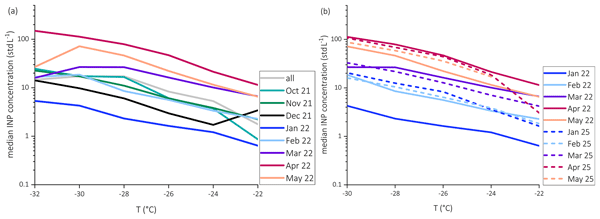
Abstract. Ice nucleating particles (INPs) exert a substantial impact on radiative properties and lifetimes of mixed-phase clouds and can modulate their precipitation efficiency. Advancing our understanding of the abundance and properties of INPs is essential to elucidate how clouds change in a warming climate. We conducted INP measurements at the Storm Peak Laboratory (3200 m a.s.l.), in the Rocky Mountains (CO, USA) during two field campaigns in 2021/2022 and in 2025. INP concentrations were continuously measured with the Portable Ice Nucleation Experiment between −22 and −32 °C. INP concentrations were remarkably similar during the two campaigns and followed a seasonal pattern. Lowest concentrations were observed during winter, with median January values falling below 10 INP stdL−1 at T > −26 °C. In spring, median INP concentrations increased by approximately one order of magnitude. Springtime is associated with increased dust concentrations in the Western United States, and back trajectories revealed regional and local dust regions as INP sources. As climate change is expected to intensify the influence of dust sources from deserts and semi-arid regions, this might impact INP concentrations. Moreover, INP sizes were investigated by ranked correlation coefficient analysis of parallel measurements of super-micrometer particles, the application of a novel setup of a pumped-counterflow virtual impactor downstream of PINE to analyze the sizes of ice residuals, and alternated INP measurements at a 1 µm impactor. Overall, super-micrometer particles were found to contribute significantly to the INP population throughout the entire campaign, with a reduced importance during winter.
Competing interests: At least one of the (co-)authors is a member of the editorial board of Atmospheric Chemistry and Physics. The peer-review process was guided by an independent editor, and the authors also have no other competing interests to declare.
Publisher's note: Copernicus Publications remains neutral with regard to jurisdictional claims made in the text, published maps, institutional affiliations, or any other geographical representation in this paper. While Copernicus Publications makes every effort to include appropriate place names, the final responsibility lies with the authors. Views expressed in the text are those of the authors and do not necessarily reflect the views of the publisher.-
Notice on discussion status
The requested preprint has a corresponding peer-reviewed final revised paper. You are encouraged to refer to the final revised version.
-
Preprint
(5999 KB)
-
The requested preprint has a corresponding peer-reviewed final revised paper. You are encouraged to refer to the final revised version.
- Preprint
(5999 KB) - Metadata XML
- BibTeX
- EndNote
- Final revised paper


Journal article(s) based on this preprint
Interactive discussion
Status: closed
-
RC1: 'Comment on egusphere-2025-4492', Anonymous Referee #1, 31 Oct 2025
- AC1: 'Reply on RC1', Larissa Lacher, 12 Jan 2026
-
RC2: 'Comment on egusphere-2025-4492', Anonymous Referee #2, 17 Nov 2025
Lacher et al, is a well-written study that clearly incorporates a lot of effort and data collected from a valuable high altitude site in the mid-latitudes. I think the approaches are well-designed and presented in a logical format. The diagram in Figure 1 is very helpful. It is good to see multiple approaches for looking at the potential INP sizes at these temperatures, and the use of the virtual impactor with the PINE is exciting for this work and the future. I only have a few minor comments, with my main point of concern that the conclusion surrounding the source of dust needs further strengthening. Overall, nice work.
Lines 238-239: I think I know what you mean, but this sentence is hard to follow. Is there any meaningful interpretation that more points were seen below the detection limit during the 2025 campaign during April and May?
Lines 245-246, 249, and subsequent uses: Please go through the text and make the definition of the seasons consistent throughout. It is confusing. Here, winter is defined as December and January, where later on in Figure 5, winter includes February. I would also suggest that the months included in the seasons are defined at first use. In Figure 5, winter cannot include December for the 2025 campaign if you didn’t sample during that period, but it is discussed like December is included in the caption.
Line 258: Do you mean January 2022 here? January 2025 looks different.
Figure 4a: It is hard to see the line from the whole campaign here. Maybe it could be a thicker line?
Figure 5: Similar to my earlier comment, I would just ensure that the figures are showing comparable data: so, in 5b, Winter should contain the same months for each year, so probably not December in that particular figure.
Figure 6: Why does panel a show the whole campaign with autumn, while the rest of the panels stand alone? I do like the color choices and overall presentation.
Section 3.2: I like the approach; however, I think it would benefit to look at cases of low INPs in April or other peaks in early May where the INP concentrations are still elevated, to see how these finding hold up. For example, in Lines 302-304, the authors suggest that the lower INP concentrations could be tied to the footprint encompassing only pre-drought conditions. Potentially, but the reason this case was picked in the first place was due to the elevated INP concentrations, right? It would make more sense to pick some of the lowest INP concentrations instead. I think this section needs strengthening.
Figure 7: Could you please explain somewhere the units for the VegDRI? For example, what does <64 mean that indicates it to be an extreme drought?
Section 3.3: You touch on it in a few places, but February clearly is an outlier with the correlation. I would appreciate some more discussion/hypotheses surrounding this. Is this primarily based on one year? You mention January and February together in Line 349, but the months are very different.
Section 3.3: It is unclear why 0.45 µm is used, when the discussion is focused around super and submicron particles.
Citation: https://doi.org/10.5194/egusphere-2025-4492-RC2 - AC2: 'Reply on RC2', Larissa Lacher, 12 Jan 2026
Peer review completion


Interactive discussion
Status: closed
-
RC1: 'Comment on egusphere-2025-4492', Anonymous Referee #1, 31 Oct 2025
Summary:
This study by Lacher et al. describes ice nucleating particle measurements made during 2 campaigns at the Storm Peak Laboratory (Rocky Mountains, CO, USA) during two different years. INP measurements were made with the online expansion chamber instrument PINE, with additional aerosol measurements of supermicron particles from an APS. Measurements ranged from fall to spring (2021-2022) and winter to spring (2025), with the lowest INP concentrations observed in winter, and the highest in spring in both years. Supplemental backtrajectory analyses of air mass source “footprints” was combined with an aridity dataset, and suggested elevated INP concentrations in spring were correlated with local/regional dust emissions. The sizes of INPs were investigated in a few different ways, including correlations with supermicron particle concentrations and direct size measurements of INP residuals. The indirect correlations suggested the importance of supermicron particles to INP concentrations, particularly in fall and spring. Unfortunately, the direct measurements were only performed for a short period in one winter campaign, but suggested both sub- and super- micron particles were important at Storm Peak Lab during the winter.
I found the article easy to read, the structure logical, and the figures well-labeled and clear. I have a few major comments about some additional analyses or text that would strengthen the sections on the impact of local/regional dust and the ice residual size measurements with the PCVI, which are included below.
Major Comments:
- Cases with the highest INP concentrations during April 2022 and 2025 were additionally analyzed with backtrajectories to determine source footprints and compared to the aridity dataset. The determination of how important local/regional dust sources are to the SPL INP concentration would be stronger if some periods with lower INP concentrations were analyzed, both during the same month, and also in a different season, when INP concentrations were lower (ie winter). If the source region is different and/or the aridity is lower when the INP concentrations are low, it would help validate the role of local dust during the high INP concentration periods.
- Additional information and/or calculations are needed regarding the PCVI measurements of ice residuals. These include:
- Does the D50 depend on particle shape or density? Cloud droplets are generally spherical, while ice crystals are highly non-spherical, and cloud droplets, ice crystals, and aerosols all have different densities.
- Different concentration factors are listed for the PCVI throughout the manuscript- how much did it vary over time and with particle size, and how was it measured?
- Why was the calibration presented in the Appendix performed for an Finlet of 4.2 lpm, when the campaign has an Finlet of 3.3 lpm? Is the calibration presented here relevant to the conditions during ambient sampling? Does Finlet impact the PCVI D50 or the transmission efficiency of particles of any size?
- The conclusion from the droplet evaporation calculation would be strengthened in two ways. First, if these calculations are repeated for a warmer temperature (>-28°C) where Fig. A4 suggests transmission of cloud droplets through the PCVI, do the calculations also suggest the cloud droplets are larger than the PCVI D50? And second, since the cloud droplets are being measured during expansions with the PINE OPC, are the sizes calculated in Fig. A5 consistent with the measurements?
- Some of the issues are potentially to do with pdf conversion, but many of the figures have blurry lines, text, or axes. The axes are generally very thin and faint, and the text is too small in many of the figures.
Minor Comments:
- Line 24: Measurements of INP residuals downstream of related instruments (ie CFDC) have been performed previously, so be clear about what exactly is novel here (for example, Cornwell et al. (2019)). Is it just the coupling to PINE, specifically?
- Lines 53-66, discussion of other methods/direct measurements of ice residuals: The addition of an impactor to CFDC instruments has enabled a similar set of chemical/size measurements on collected INP residuals in both mesocosm and field campaign settings. See, for example DeMott et al. (2023) and Twohy et al. (2021). See also Burrows et al. (2022) for an overview of other techniques that achieve single-INP chemical measurements (ie cold stage activation + microscopy). Some have been applied to field measurements. Or, if you are only discussing fully online techniques, clarify that.
- Lines 58-59: Coupled online INP + PCVI + single particle mass spectrometry has also been performed for ambient air at a coastal marine site, not just for cirrus clouds (Cornwell et al., 2019).
- Line 70: Given the measurements presented here are from the US, I'm unsure why the focus here is on seasonal cycles in Europe. Similar annual cycles of INPs have also been seen in the high Arctic (Creamean et al., 2022; Tobo et al., 2024) and Greenland (Sze et al., 2023), among others. More relevant to this study are the 2 years of INP observations from SAIL, in Crested Butte, CO (Feldman et al., 2023; Zhou et al., 2025).
- Lines 119-120: What happens if the background experiments (sample air passed through a filter) have INP concentrations above zero?
- Line 124: The D50 of the PINE inlet is listed as 4μm, as is the D50 of the PCVI later in the manuscript. This implies large aerosols near the 4μm cutoff will be directly transferred to the PCVI, along with ice crystals or large cloud droplets. Why not use a larger D50 for the PCVI, to avoid this? What was the minimum size observed for ice crystals in PINE? Is there any overlap with the aerosol distribution?
- Line 126: Can you be more specific about what a “rime-free aerosol inlet” means? Is it heated?
- Line 127: What is the aerosol inlet D50 for realistic wind speeds sampled during the campaign?
- Line 177: Are the size distributions mentioned (Fig. 2a) measured by the PINE OPC, or separate instruments (ie SMPS/APS)? If in PINE, were these distributions measured during the flush or expansion period- ie are there are cloud droplets and ice crystals at the larger sizes, or only unactivated aerosols?
- Line 185: How was the ice transmission efficiency through the PCVI calculated? I’m unclear how to combine the INP concentration with the “small aerosol rejection factor” to give the transmission efficiency listed (16%).
- Line 212: Are the footprints for each ensemble released (one per hour) averaged together to give an average footprint for each event? This is not clear from Sec. 3.2 and Fig. 7.
- Line 220: Was the VegDRI dataset averaged separately over April 2022 and April 2025, or were both years averaged together? If the latter, why not leave them separate, since each event is being investigated separately?
- Line 220-221: I’m unclear on what the “dry and more dry conditions” refers to. Are these specific definitions from the VegDRI dataset? What are these percent differences used for/where are they shown in the manuscript?
- Line 246: The definition of spring used in this manuscript (March/April/May) should be moved up here, with the definitions of the other seasons. Also, February seems to be sometimes included with winter and sometimes excluded entirely, so please be clear in these definitions and consistent throughout the discussion.
- Line 247: The statement that both years have similar values in the same month is clear from Fig. 4b, except for January. Could shading or some other uncertainty estimate be added to the figure to help with this assessment?
- Line 276-277: The way this sentence is written: “…strong increase…in the median and inter-quartile range…”, it sounds like sounds like the median increased and the range also got larger/wider during spring, which doesn't appear to be the case based on Fig. 5. Did you just mean that all the concentrations increased?
- 3.2: Some of the INP concentrations quoted are for -28°C, some for -30°C, and some don’t have a temperature listed. Please list temperatures for all the measurements and consider standardizing the concentrations in this section to one temperature.
- Line 299: When, exactly, are the footprints plotted in Fig. 8 from? Are they some average over part of each event? The footprint coinciding with just the peak INP concentrations?
- Line 300: The two events in April 2022 have quite different footprints, with April 11 having sources directly west in a narrow latitude band, while the April 26 footprint covers almost the entire US desert ecoregion, with the strongest source coming from the southwest, not the northwest. If you want to talk about them together, perhaps just say "...indicate arid regions west of SPL contributed to the measurements, where pre-drought...".
- Line 303: Suggest clarifying that “only pre-drought conditions occurred in the source region” for the April 7 2025 case because the footprint for this case is northwest of SPL, where the aridity is lower, whereas other cases are more west or southwest.
- Lines 335-337: The final sentence in this paragraph feels out of place, which has no other mention of instrumentation, and also unbalanced/missing nuance. 2.5μm captures a significant portion of the supermicron aerosol number distribution in most cases. Although it is certainly true some portion of the distribution is missed by CFDCs, the same is true for PINE, with a maximum size of 4μm. Was a significant portion of the supermicron aerosol seen between 2.5-4μm in this campaign?
- Line 346: Instead of just saying these correlations are “relatively high” compared to other studies, could the range of correlation coefficients be listed for one or a few examples, for comparison?
- Line 348: Was the correlation with smaller aerosols also tested? Showing that the correlation with submicron aerosols was smaller than the correlation with supermicron aerosols would strengthen this point.
- Line 363-364: What is the rationale for separating the ice residual distribution at a size of 0.45 μm? The focus throughout the rest of the paper, including Sec. 3.3.1, is on submicron vs supermicron particles, so this seems out of place.
- Line 372: Is the larger enhancement for larger ice residuals due to a size-dependent enhancement in the PCVI? Different concentration factors are listed for the PCVI throughout the manuscript- how much did it vary over time and with particle size, and how was it measured?
- Line 372: Please clarify the scientific reason for comparing the INP residual distribution to the SPX/PCVI background measurement? Shouldn't the residual size distribution be compared to the PINE OPC size distribution for the flush prior or immediately after the expansion of interest?
- Paragraph starting with line 381: This section would flow better if this paragraph (“Moreover…”) was moved up above the previous paragraph (“However, it is notable…”).
- Line 393: What is meant by “PSL diameter”?
- Line 429: Same as Minor Comment #16. The change in inter-quartile range is likely to be interpreted as getting wider.
- Line 433: What is meant by “INP concentration is solid”?
- Lines 436-437: The last sentence of the paragraph doesn’t fit together. Both statements are true, but they don't go together. Changes in desert emissions may impact cloud properties, which will be important to measure. And improving model representations of ice processes are also important. But simply making more measurements at SPL or other sites will not improve modeled microphysics in a broad way. For that, measurements in a variety of environments, with differing aerosol, dynamics, and cloud properties are needed.
- Line 447: Same as Minor Comment #1, be specific about what is “novel” about this setup.
- Line 664: Does the PCVI D50 depend on particle shape or density? Cloud droplets are generally spherical, while ice crystals are highly non-spherical, and cloud droplets, ice crystals, and aerosols all have different densities.
- Line 715: Are there any measurements to verify the assumption that S<1.01? Does the cloud droplet maximum size meaningfully change if S=1.02 or 1.03, for example?
- Line 716: What is SPL01?
- Line 716: Would the expansion described, with a temperature decrease from -24 to -29°C, be considered a measurement at -29°C?
- Line 725: Citation missing for “Hinds”.
- Grammatical suggestions are included in the attached pdf.
Figure/Table Notes:
- Figure 1: The caption says “…only the larger ice crystals are of sufficient size…”. Does that mean there is a potential bias in the size or number of the ice crystal residuals if only a portion of the ice crystal distribution is sampled and measured by the SPX? Or do you just mean the ice crystals are larger than the cloud droplets and aerosols?
- Also, a label for Fout is missing from the diagram.
- Table 1/Figure 2a: The D50 for the PCVI is the same as was listed for the PINE inlet cutoff D50 (line 124), implying the largest aerosol particles/cloud droplets (if not evaporated enough) may pass through the PCVI and be counted as ice crystal residuals. From the PINE OPC, what was the typical ice crystal size distribution? Was there any overlap between ice, cloud droplets, and large aerosols ~4μm? If Fig. 2a shows PINE OPC size distributions during an expansion, is the ice crystal peak at ~3.5μm?
- Figure 2: The PCVI concentration factor mentioned in the caption should be discussed in the methods section 2.4.
- Table 2: Could the min values listed as 0.1 instead be listed as <LOD, for clarity? Or make it clear in the caption that values of 0.1 represent concentrations below the LOD.
- Would it also be possible to list the 2022 and 2025 values here to see if there are any inter-annual differences? Something like "overall value (2022 value / 2025 value)" for each temperature? Table A1 in the appendix provides this information, but since it is also separated by month, the reader would have to calculate all these statistics themselves to get the annual values.
- Figure 4: The February line (light blue) and all line (light gray) are quite difficult to see. This is especially true for the dashed line in panel b. Consider making these colors darker, make the lines thicker, or otherwise make them more visible.
- Does the "all" line in panel a include 2025, or just 2021/2022 data?
- Figure 5: Perhaps this is just the pdf conversion, but the legends in this figure are very hard to read. The boxes with colors are partially blanked out and vary in size, so it is unclear which color is which month/season/year. The same is true of the individual measurements in each panel- some are partially blanked out, some have outlines of a different color.
- Figure 6: Could the "all" range be added to all the panels, so it is easier to compare?
- Since the different years are separated in this figure, please use the same colors for the same months. The lighter colors for winter 2025, and particularly February 2025, are hard to see.
- Figure 7: Please list the years with each date, for clarity.
- The figure caption appears to have been cut off in the middle; there is no description for panels b-d, the legend for the VegDRI colorbar, or the icon (I assume) depicting the location of SPL.
- Figure 8: The right y-axis color is much lighter than the corresponding symbols for aerosol concentration. Could they be made to match?
- Could the size be explicitly listed on the right y-axis label? ie "particle concentration > 1μm".
- Could the particle concentration <1μm also be shown, or was that not measured?
- Figure 9: The text is very small on this figure, could it be increased to improve readability?
- Could the correlation coefficient be listed on each panel, for comparison?
- Figure 11: The lines, axes, and text on this figure are very light/faded.
- Figure A2: What is the “percentage change in aridity relative to? The previous month? Some climatology for April?
- The scale/colorbar for panel b needs more information. What do values in the middle mean? Where is "normal"? Are they numerical, or only categorical values?
- Can April 2022 and April 2025 be shown separately instead of averaged together? The main text notes they are similar, but it is not possible for the reader to see that when they have been averaged together.
- Figure A4: Should the y-axis label on panel b just be "SPX IR (stdL-1)"? If both sets of markers in panel b are really small IR, a different legend is needed for panel b.
- Could a correlation between PINE INP and SPX IR be shown in Fig A4 as well? That would support the claim that only ice crystals are being transmitted. Since the PINE droplet concentration is fairly constant below -28°C, the SPX IR also being constant below that temperature is not conclusive by itself.
- Figure A5: The axes and text on this figure are very faint and small.
- Table A2: What do “percentage completions” above 100% indicate?
References:
Burrows, S. M., McCluskey, C. S., Cornwell, G., Steinke, I., Zhang, K., Zhao, B., et al. (2022). Ice-Nucleating Particles That Impact Clouds and Climate: Observational and Modeling Research Needs. Reviews of Geophysics, 60(2), e2021RG000745. https://doi.org/10.1029/2021RG000745
Cornwell, G. C., McCluskey, C. S., Levin, E. J. T., Suski, K. J., DeMott, P. J., Kreidenweis, S. M., & Prather, K. A. (2019). Direct Online Mass Spectrometry Measurements of Ice Nucleating Particles at a California Coastal Site. Journal of Geophysical Research: Atmospheres, 124(22), 12157–12172. https://doi.org/10.1029/2019JD030466
Creamean, J. M., Barry, K., Hill, T. C. J., Hume, C., DeMott, P. J., Shupe, M. D., et al. (2022). Annual cycle observations of aerosols capable of ice formation in central Arctic clouds. Nature Communications, 13(1), 3537. https://doi.org/10.1038/s41467-022-31182-x
DeMott, P. J., Hill, T. C. J., Moore, K. A., Perkins, R. J., Mael, L. E., Busse, H. L., et al. (2023). Atmospheric oxidation impact on sea spray produced ice nucleating particles. Environmental Science: Atmospheres, 3(10), 1513–1532. https://doi.org/10.1039/D3EA00060E
Feldman, D. R., Aiken, A. C., Boos, W. R., Carroll, R. W. H., Chandrasekar, V., Collis, S., et al. (2023). The Surface Atmosphere Integrated Field Laboratory (SAIL) Campaign. https://doi.org/10.1175/BAMS-D-22-0049.1
Sze, K. C. H., Wex, H., Hartmann, M., Skov, H., Massling, A., Villanueva, D., & Stratmann, F. (2023). Ice-nucleating particles in northern Greenland: annual cycles, biological contribution and parameterizations. Atmospheric Chemistry and Physics, 23(8), 4741–4761. https://doi.org/10.5194/acp-23-4741-2023
Tobo, Y., Adachi, K., Kawai, K., Matsui, H., Ohata, S., Oshima, N., et al. (2024). Surface warming in Svalbard may have led to increases in highly active ice-nucleating particles. Communications Earth & Environment, 5(1), 516. https://doi.org/10.1038/s43247-024-01677-0
Twohy, C. H., DeMott, P. J., Russell, L. M., Toohey, D. W., Rainwater, B., Geiss, R., et al. (2021). Cloud-Nucleating Particles Over the Southern Ocean in a Changing Climate. Earth’s Future, 9(3), e2020EF001673. https://doi.org/10.1029/2020EF001673
Zhou, R., Perkins, R., Juergensen, D., Barry, K., Ayars, K., Dutton, O., et al. (2025). Seasonal variability, sources, and parameterization of ice-nucleating particles in the Rocky Mountain region. EGUsphere, 1–48. https://doi.org/10.5194/egusphere-2025-4306
- AC1: 'Reply on RC1', Larissa Lacher, 12 Jan 2026
-
RC2: 'Comment on egusphere-2025-4492', Anonymous Referee #2, 17 Nov 2025
Lacher et al, is a well-written study that clearly incorporates a lot of effort and data collected from a valuable high altitude site in the mid-latitudes. I think the approaches are well-designed and presented in a logical format. The diagram in Figure 1 is very helpful. It is good to see multiple approaches for looking at the potential INP sizes at these temperatures, and the use of the virtual impactor with the PINE is exciting for this work and the future. I only have a few minor comments, with my main point of concern that the conclusion surrounding the source of dust needs further strengthening. Overall, nice work.
Lines 238-239: I think I know what you mean, but this sentence is hard to follow. Is there any meaningful interpretation that more points were seen below the detection limit during the 2025 campaign during April and May?
Lines 245-246, 249, and subsequent uses: Please go through the text and make the definition of the seasons consistent throughout. It is confusing. Here, winter is defined as December and January, where later on in Figure 5, winter includes February. I would also suggest that the months included in the seasons are defined at first use. In Figure 5, winter cannot include December for the 2025 campaign if you didn’t sample during that period, but it is discussed like December is included in the caption.
Line 258: Do you mean January 2022 here? January 2025 looks different.
Figure 4a: It is hard to see the line from the whole campaign here. Maybe it could be a thicker line?
Figure 5: Similar to my earlier comment, I would just ensure that the figures are showing comparable data: so, in 5b, Winter should contain the same months for each year, so probably not December in that particular figure.
Figure 6: Why does panel a show the whole campaign with autumn, while the rest of the panels stand alone? I do like the color choices and overall presentation.
Section 3.2: I like the approach; however, I think it would benefit to look at cases of low INPs in April or other peaks in early May where the INP concentrations are still elevated, to see how these finding hold up. For example, in Lines 302-304, the authors suggest that the lower INP concentrations could be tied to the footprint encompassing only pre-drought conditions. Potentially, but the reason this case was picked in the first place was due to the elevated INP concentrations, right? It would make more sense to pick some of the lowest INP concentrations instead. I think this section needs strengthening.
Figure 7: Could you please explain somewhere the units for the VegDRI? For example, what does <64 mean that indicates it to be an extreme drought?
Section 3.3: You touch on it in a few places, but February clearly is an outlier with the correlation. I would appreciate some more discussion/hypotheses surrounding this. Is this primarily based on one year? You mention January and February together in Line 349, but the months are very different.
Section 3.3: It is unclear why 0.45 µm is used, when the discussion is focused around super and submicron particles.
Citation: https://doi.org/10.5194/egusphere-2025-4492-RC2 - AC2: 'Reply on RC2', Larissa Lacher, 12 Jan 2026
Peer review completion
Journal article(s) based on this preprint
Viewed
| HTML | XML | Total | BibTeX | EndNote | |
|---|---|---|---|---|---|
| 3,953 | 1,229 | 211 | 5,393 | 156 | 180 |
- HTML: 3,953
- PDF: 1,229
- XML: 211
- Total: 5,393
- BibTeX: 156
- EndNote: 180
Viewed (geographical distribution)
| Country | # | Views | % |
|---|
| Total: | 0 |
| HTML: | 0 |
| PDF: | 0 |
| XML: | 0 |
- 1
Cited



A. Gannet Hallar
Ian B. McCubbin
Joey Bail
Karl D. Froyd
Justin Jacquot
Xiaoli Shen
Christopher Rapp
Ottmar Möhler
Daniel Cziczo
The requested preprint has a corresponding peer-reviewed final revised paper. You are encouraged to refer to the final revised version.
- Preprint
(5999 KB) - Metadata XML
Summary:
This study by Lacher et al. describes ice nucleating particle measurements made during 2 campaigns at the Storm Peak Laboratory (Rocky Mountains, CO, USA) during two different years. INP measurements were made with the online expansion chamber instrument PINE, with additional aerosol measurements of supermicron particles from an APS. Measurements ranged from fall to spring (2021-2022) and winter to spring (2025), with the lowest INP concentrations observed in winter, and the highest in spring in both years. Supplemental backtrajectory analyses of air mass source “footprints” was combined with an aridity dataset, and suggested elevated INP concentrations in spring were correlated with local/regional dust emissions. The sizes of INPs were investigated in a few different ways, including correlations with supermicron particle concentrations and direct size measurements of INP residuals. The indirect correlations suggested the importance of supermicron particles to INP concentrations, particularly in fall and spring. Unfortunately, the direct measurements were only performed for a short period in one winter campaign, but suggested both sub- and super- micron particles were important at Storm Peak Lab during the winter.
I found the article easy to read, the structure logical, and the figures well-labeled and clear. I have a few major comments about some additional analyses or text that would strengthen the sections on the impact of local/regional dust and the ice residual size measurements with the PCVI, which are included below.
Major Comments:
Minor Comments:
Figure/Table Notes:
References:
Burrows, S. M., McCluskey, C. S., Cornwell, G., Steinke, I., Zhang, K., Zhao, B., et al. (2022). Ice-Nucleating Particles That Impact Clouds and Climate: Observational and Modeling Research Needs. Reviews of Geophysics, 60(2), e2021RG000745. https://doi.org/10.1029/2021RG000745
Cornwell, G. C., McCluskey, C. S., Levin, E. J. T., Suski, K. J., DeMott, P. J., Kreidenweis, S. M., & Prather, K. A. (2019). Direct Online Mass Spectrometry Measurements of Ice Nucleating Particles at a California Coastal Site. Journal of Geophysical Research: Atmospheres, 124(22), 12157–12172. https://doi.org/10.1029/2019JD030466
Creamean, J. M., Barry, K., Hill, T. C. J., Hume, C., DeMott, P. J., Shupe, M. D., et al. (2022). Annual cycle observations of aerosols capable of ice formation in central Arctic clouds. Nature Communications, 13(1), 3537. https://doi.org/10.1038/s41467-022-31182-x
DeMott, P. J., Hill, T. C. J., Moore, K. A., Perkins, R. J., Mael, L. E., Busse, H. L., et al. (2023). Atmospheric oxidation impact on sea spray produced ice nucleating particles. Environmental Science: Atmospheres, 3(10), 1513–1532. https://doi.org/10.1039/D3EA00060E
Feldman, D. R., Aiken, A. C., Boos, W. R., Carroll, R. W. H., Chandrasekar, V., Collis, S., et al. (2023). The Surface Atmosphere Integrated Field Laboratory (SAIL) Campaign. https://doi.org/10.1175/BAMS-D-22-0049.1
Sze, K. C. H., Wex, H., Hartmann, M., Skov, H., Massling, A., Villanueva, D., & Stratmann, F. (2023). Ice-nucleating particles in northern Greenland: annual cycles, biological contribution and parameterizations. Atmospheric Chemistry and Physics, 23(8), 4741–4761. https://doi.org/10.5194/acp-23-4741-2023
Tobo, Y., Adachi, K., Kawai, K., Matsui, H., Ohata, S., Oshima, N., et al. (2024). Surface warming in Svalbard may have led to increases in highly active ice-nucleating particles. Communications Earth & Environment, 5(1), 516. https://doi.org/10.1038/s43247-024-01677-0
Twohy, C. H., DeMott, P. J., Russell, L. M., Toohey, D. W., Rainwater, B., Geiss, R., et al. (2021). Cloud-Nucleating Particles Over the Southern Ocean in a Changing Climate. Earth’s Future, 9(3), e2020EF001673. https://doi.org/10.1029/2020EF001673
Zhou, R., Perkins, R., Juergensen, D., Barry, K., Ayars, K., Dutton, O., et al. (2025). Seasonal variability, sources, and parameterization of ice-nucleating particles in the Rocky Mountain region. EGUsphere, 1–48. https://doi.org/10.5194/egusphere-2025-4306