
the Creative Commons Attribution 4.0 License.
the Creative Commons Attribution 4.0 License.
 | 24 Sep 2025
High resolution quantification of SO2 emissions over India based on TROPOMI observations
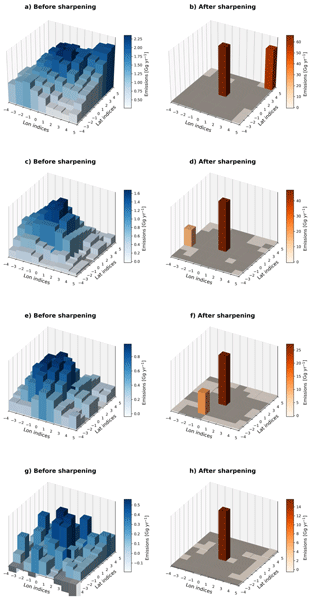
Abstract. India is a country with high sulfur dioxide (SO2) emissions mainly resulting from the large number of coal-fired thermal power plants. SO2 column observations from the Sentinel-5P Tropospheric Monitoring Instrument (TROPOMI) satellite instrument, in combination with inverse modelling techniques can be used to derive observation-based SO2 emission estimates. The flux-divergence emission estimation method is sensitive to point source emissions and is well-suited for estimating SO2 emissions in India. However, the flux-divergence method combined with satellite observations spreads out the calculated emissions to grid cells in the neighborhood of the point source. This spreading effect weakens the signal of point sources at their exact location, making it harder to quantify the exact emissions. In this paper, we describe a deconvolution algorithm to reverse the spreading and sharpen the emission signals. Our deconvolution algorithm ensures mass conservation of the emissions. We apply the deconvolution algorithm on gridded SO2 emissions at a high spatial resolution of 0.025° × 0.025° (2.5 km × 2.5 km) derived from TROPOMI observations with a typical mean footprint size of 6 km. After the deconvolution, the effective spatial resolution of emissions is enhanced to match the grid cell resolutions. The point source emissions significantly increase at their exact locations and emissions in the neighbor grid cells become lower. In our inventory, about 80 % of coal-based power plants with a capacity above 100 MW are detected at the correct location, while the remaining 20 % fall below the noise level. The detected power plants account for 99 % of India’s total coal-based power generation. We also identify 7 previously unreported SO2 point sources, including coal-based thermal power plants, cement plants, copper industry, and crude oil facility. This deconvolution algorithm improves emission detection and can also be used for other pollutants emitted by point sources to enhance the accuracy of emission inventories.
-
Notice on discussion status
The requested preprint has a corresponding peer-reviewed final revised paper. You are encouraged to refer to the final revised version.
-
Preprint
(5756 KB)
-
Supplement
(882 KB)
-
The requested preprint has a corresponding peer-reviewed final revised paper. You are encouraged to refer to the final revised version.
- Preprint
(5756 KB) - Metadata XML
-
Supplement
(882 KB) - BibTeX
- EndNote
- Final revised paper


Journal article(s) based on this preprint
Interactive discussion
Status: closed
-
RC1: 'Comment on egusphere-2025-4490', Christian Borger, 07 Jan 2026
- AC2: 'Reply on RC1', Yutao Chen, 25 Feb 2026
-
RC2: 'Comment on egusphere-2025-4490', Anonymous Referee #2, 11 Jan 2026
This paper present a new method to derive the SO2 emissions over Indian using the TROPOMI observations. The new method combines a flux-divergence method and a deconvolution algorithm to both identify and sharpen the SO2 emission signals. The paper is well written and the proposed method proves to be effective to detect power plants in India. I think this paper can be accepted after addressing the following issues.
- The divergence method seems to sacrifice the temporal resolution to give a high spatial resolution. This paper calculate a 5-year averaged SO2 emissions. Is the 5-year dataset necessary to get the high spatial resolution. Will the long-period dataset introduce errors to the result?
- The final result is based on the TROPOMI SO2 column dataset between December 2018 to November 2023. But the description for the determination of the spreading kernel in the manuscript is based on data from December 2022 to November 2023 and validation with the CAMS model is based on the experiment from December 2019 to November 2020. Could you explain the reason of this time inconsistency.
- The noise level appears many time in the manuscript. And SO2 emissions sharpened only above the noise level. How does it calculated or given?
- The deconvolution method update the emissions iteratively. How many iterations does require normally? Will it affect the computational efficiency? This information could be stated in the paper if this is a issue.
- Line 70: change “time and computational efficient” to “time- and computational efficient”
- Line 96: change “horizonal” to “horizontal”
- Line 185: change “e” to “ε”
This paper presents a new method to derive SO₂ emissions over India using TROPOMI observations. The proposed approach combines a flux-divergence method with a deconvolution algorithm to both identify and sharpen SO₂ emission signals. The manuscript is well written, and the proposed method proves effective in detecting power plants in India. I believe the paper can be accepted after addressing the following issues.
- The divergence method appears to sacrifice temporal resolution in order to achieve high spatial resolution. This paper calculates a 5-year averaged SO₂ emission inventory. Is the use of a 5-year dataset necessary to obtain the high spatial resolution? Could the long averaging period introduce biases or errors in the derived emissions?
- The final results are based on the TROPOMI SO₂ column dataset from December 2018 to November 2023. However, the determination of the spreading kernel is described using data from December 2022 to November 2023, while the validation with the CAMS model is based on simulations from December 2019 to November 2020. Please explain the reason for this temporal inconsistency.
- The concept of the noise level appears multiple times in the manuscript, and SO₂ emissions are sharpened only above this threshold. How is the noise level defined and quantified?
- The deconvolution method updates the emissions iteratively. How many iterations are typically required for convergence? Does this iterative procedure significantly affect computational efficiency? If so, this information should be stated and discussed in the paper.
- Line 38: change “powerplants” to “power plants”
- Line 70: change “time and computational efficient” to “time- and computationally efficient”.
- Line 96: change “horizonal” to “horizontal”.
- Line 185: change “e” to “ε”.
Citation: https://doi.org/10.5194/egusphere-2025-4490-RC2 - AC1: 'Reply on RC2', Yutao Chen, 25 Feb 2026
Peer review completion


Interactive discussion
Status: closed
-
RC1: 'Comment on egusphere-2025-4490', Christian Borger, 07 Jan 2026
General comments
Chen et al. present a new method to improve the identification of SO2 point sources from TROPOMI satellite observations, focusing on India. Building on emissions derived with the flux divergence approach, the authors apply a deconvolution step that yields markedly sharper source localization and appears capable of revealing previously unreported sources.
The paper is conceptually clear and easy to follow. Given how widely the flux divergence framework is used in the community, this additional, relatively simple processing step is likely to attract broad interest and could be adopted relatively quickly. A transfer to global applications and to other trace gases such as NO2 seems plausible. I recommend publication provided the issues raised below are addressed.
Major concerns
In recent years, important methodological improvements to flux-divergence-type emission estimates have been developed, but they are not reflected in the current manuscript. In particular, the following aspects should be considered and incorporated:
- Advection rather than divergence in the formulation (Beirle et al., 2023).
- Topography-related corrections, which can be important in complex terrain (Sun, 2022).
- AMF-related consistency: it is currently unclear whether and how an AMF correction is applied. This matters especially because winds are referenced to a specific vertical level (e.g., PBL midpoint), and because plume height and vertical sensitivity can affect the effective column-to-mass conversion. The manuscript should clearly state the chosen approach (e.g., total column AMF or AMF at PBL midpoint).
- Swath-dependent pixel size and wind rotation, which can bias the derivative-based quantities and source shapes if ignored (Beirle et al., 2023).
Ayazpour et al. (2025) provide a helpful overview and classification of related approaches (flux divergence vs. direct derivative). Jost (2025) may also be relevant specifically for SO2 in this context.
These factors influence the spatial distribution, apparent morphology, and magnitude of the inferred sources. Because the proposed pipeline is fundamentally an image-processing workflow, the quality and physical consistency of the input fields directly control the reliability of the outputs. If the corrections above are not addressed, suboptimal or biased results are likely. Thus, the authors should incorporate these points, or at minimum justify their choices. Overall, a better documentation of the full processing chain in sufficient detail would facilitate reproducibility.
Minor issues
- Title: “High-resolution quantification” is potentially misleading. The conclusions correctly note that robust emission estimates require integration over a small area. A phrasing such as “super-resolution localization” would better reflect the main contribution.
- Section 2.1: Please clarify what is meant by the “midpoint of the PBL” and describe how the AMF is adjusted accordingly (or why no correction is needed).
- Section 3.1: The conclusion that derivatives should be computed on the native TROPOMI grid is well established (see de Foy and Schauer, 2022). Since the main value here is likely illustrative rather than novel, I suggest moving most of Section 3.1 to the appendix or supplement. In the main text, it may be more useful to expand the description of the divergence or advection computation, including practical details and assumptions.
- Section 3.2: Please explain how B is constructed before presenting results in Figs. 2 and 3. When reading, the definition currently comes too late. Also specify the dimension of B (e.g., 5x5, 7x7). A figure showing the original kernel and the inverted kernel would help. Please also report the estimated noise level used for filtering.
- Emission maps: Color bars should include negative values rather than stopping at 0. This can be diagnostically useful and may reveal, for example, topography-related artifacts.
Further questions
- The analysis relies on multi-year mean SO₂ emission maps. How feasible would it be to apply the method to annual means? While the noise level would increase, this could enable analysis of temporal evolution such as commissioning of new facilities or shutdowns. Would monthly or quarterly averages be realistic, and what would the limiting factors be?
- The conclusions mention transfer to NO₂. Would the authors suggest that this approach could also be applied to methane or are there any limiting factors (for example, lifetime, background variability, and retrieval characteristics)?
Technical comments
- The manuscript is difficult to read in places, particularly at the start of the introduction, and there are several sentence-level repetitions (for example in Section 3.2.2). A careful language edit would substantially improve clarity and flow. Given the list of experienced co-authors, this should be easily achievable.
- L14: second “instrument” at the end of the line is redundant.
- L22: Does “6 km” refer to square kilometers? Please clarify.
- L53: Consider revising to “band of the electromagnetic spectrum.”
- L109: Please provide the DOI for the CAMS product.
- L185: The symbol for epsilon differs from Eq. (6).
- Figure 5: Please provide more details on the CAMS-GLOB-ANT-4.2 product.
- Table 2: Are some of the listed sources still active?
- L481: Krol et al. is no longer a preprint. Please update the reference.
- L531: “Steinfeld” should be “Seinfeld.” ?
Literature
Ayazpour, Z., Sun, K., Zhang, R., & Shen, H. (2025). Evaluation of the directional derivative approach for timely and accurate satellite-based emission estimation using chemical transport model simulations of nitrogen oxides. Journal of Geophysical Research: Atmospheres, 130, e2024JD042817. https://doi.org/10.1029/2024JD042817
Beirle, S., Borger, C., Jost, A., & Wagner, T. (2023). Improved catalog of NOₓ point source emissions (version 2). Earth System Science Data, 15, 3051–3073. https://doi.org/10.5194/essd-15-3051-2023
de Foy, B., & Schauer, J. (2022). An improved understanding of NOₓ emissions in South Asian megacities using TROPOMI NO₂ retrievals. Environmental Research Letters, 17, 024006. https://doi.org/10.1088/1748-9326/ac48b4
Jost, A. (2025). Improving global SO₂ emission inventories using Sentinel-5P TROPOMI satellite data. Master’s thesis, Johannes Gutenberg University Mainz. https://hdl.handle.net/21.11116/0000-0011-813C-8
Sun, K. (2022). Derivation of emissions from satellite-observed column amounts and its application to TROPOMI NO₂ and CO observations. Geophysical Research Letters, 49, e2022GL101102. https://doi.org/10.1029/2022GL101102
Citation: https://doi.org/10.5194/egusphere-2025-4490-RC1 - AC2: 'Reply on RC1', Yutao Chen, 25 Feb 2026
-
RC2: 'Comment on egusphere-2025-4490', Anonymous Referee #2, 11 Jan 2026
This paper present a new method to derive the SO2 emissions over Indian using the TROPOMI observations. The new method combines a flux-divergence method and a deconvolution algorithm to both identify and sharpen the SO2 emission signals. The paper is well written and the proposed method proves to be effective to detect power plants in India. I think this paper can be accepted after addressing the following issues.
- The divergence method seems to sacrifice the temporal resolution to give a high spatial resolution. This paper calculate a 5-year averaged SO2 emissions. Is the 5-year dataset necessary to get the high spatial resolution. Will the long-period dataset introduce errors to the result?
- The final result is based on the TROPOMI SO2 column dataset between December 2018 to November 2023. But the description for the determination of the spreading kernel in the manuscript is based on data from December 2022 to November 2023 and validation with the CAMS model is based on the experiment from December 2019 to November 2020. Could you explain the reason of this time inconsistency.
- The noise level appears many time in the manuscript. And SO2 emissions sharpened only above the noise level. How does it calculated or given?
- The deconvolution method update the emissions iteratively. How many iterations does require normally? Will it affect the computational efficiency? This information could be stated in the paper if this is a issue.
- Line 70: change “time and computational efficient” to “time- and computational efficient”
- Line 96: change “horizonal” to “horizontal”
- Line 185: change “e” to “ε”
This paper presents a new method to derive SO₂ emissions over India using TROPOMI observations. The proposed approach combines a flux-divergence method with a deconvolution algorithm to both identify and sharpen SO₂ emission signals. The manuscript is well written, and the proposed method proves effective in detecting power plants in India. I believe the paper can be accepted after addressing the following issues.
- The divergence method appears to sacrifice temporal resolution in order to achieve high spatial resolution. This paper calculates a 5-year averaged SO₂ emission inventory. Is the use of a 5-year dataset necessary to obtain the high spatial resolution? Could the long averaging period introduce biases or errors in the derived emissions?
- The final results are based on the TROPOMI SO₂ column dataset from December 2018 to November 2023. However, the determination of the spreading kernel is described using data from December 2022 to November 2023, while the validation with the CAMS model is based on simulations from December 2019 to November 2020. Please explain the reason for this temporal inconsistency.
- The concept of the noise level appears multiple times in the manuscript, and SO₂ emissions are sharpened only above this threshold. How is the noise level defined and quantified?
- The deconvolution method updates the emissions iteratively. How many iterations are typically required for convergence? Does this iterative procedure significantly affect computational efficiency? If so, this information should be stated and discussed in the paper.
- Line 38: change “powerplants” to “power plants”
- Line 70: change “time and computational efficient” to “time- and computationally efficient”.
- Line 96: change “horizonal” to “horizontal”.
- Line 185: change “e” to “ε”.
Citation: https://doi.org/10.5194/egusphere-2025-4490-RC2 - AC1: 'Reply on RC2', Yutao Chen, 25 Feb 2026
Peer review completion
Journal article(s) based on this preprint
Viewed
| HTML | XML | Total | Supplement | BibTeX | EndNote | |
|---|---|---|---|---|---|---|
| 2,373 | 906 | 92 | 3,371 | 216 | 100 | 114 |
- HTML: 2,373
- PDF: 906
- XML: 92
- Total: 3,371
- Supplement: 216
- BibTeX: 100
- EndNote: 114
Viewed (geographical distribution)
| Country | # | Views | % |
|---|
| Total: | 0 |
| HTML: | 0 |
| PDF: | 0 |
| XML: | 0 |
- 1

Ronald J. van der A
Henk Eskes
Felipe Cifuentes
Pieternel F. Levelt
The requested preprint has a corresponding peer-reviewed final revised paper. You are encouraged to refer to the final revised version.
- Preprint
(5756 KB) - Metadata XML
-
Supplement
(882 KB) - BibTeX
- EndNote
- Final revised paper
General comments
Chen et al. present a new method to improve the identification of SO2 point sources from TROPOMI satellite observations, focusing on India. Building on emissions derived with the flux divergence approach, the authors apply a deconvolution step that yields markedly sharper source localization and appears capable of revealing previously unreported sources.
The paper is conceptually clear and easy to follow. Given how widely the flux divergence framework is used in the community, this additional, relatively simple processing step is likely to attract broad interest and could be adopted relatively quickly. A transfer to global applications and to other trace gases such as NO2 seems plausible. I recommend publication provided the issues raised below are addressed.
Major concerns
In recent years, important methodological improvements to flux-divergence-type emission estimates have been developed, but they are not reflected in the current manuscript. In particular, the following aspects should be considered and incorporated:
Ayazpour et al. (2025) provide a helpful overview and classification of related approaches (flux divergence vs. direct derivative). Jost (2025) may also be relevant specifically for SO2 in this context.
These factors influence the spatial distribution, apparent morphology, and magnitude of the inferred sources. Because the proposed pipeline is fundamentally an image-processing workflow, the quality and physical consistency of the input fields directly control the reliability of the outputs. If the corrections above are not addressed, suboptimal or biased results are likely. Thus, the authors should incorporate these points, or at minimum justify their choices. Overall, a better documentation of the full processing chain in sufficient detail would facilitate reproducibility.
Minor issues
Further questions
Technical comments
Literature
Ayazpour, Z., Sun, K., Zhang, R., & Shen, H. (2025). Evaluation of the directional derivative approach for timely and accurate satellite-based emission estimation using chemical transport model simulations of nitrogen oxides. Journal of Geophysical Research: Atmospheres, 130, e2024JD042817. https://doi.org/10.1029/2024JD042817
Beirle, S., Borger, C., Jost, A., & Wagner, T. (2023). Improved catalog of NOₓ point source emissions (version 2). Earth System Science Data, 15, 3051–3073. https://doi.org/10.5194/essd-15-3051-2023
de Foy, B., & Schauer, J. (2022). An improved understanding of NOₓ emissions in South Asian megacities using TROPOMI NO₂ retrievals. Environmental Research Letters, 17, 024006. https://doi.org/10.1088/1748-9326/ac48b4
Jost, A. (2025). Improving global SO₂ emission inventories using Sentinel-5P TROPOMI satellite data. Master’s thesis, Johannes Gutenberg University Mainz. https://hdl.handle.net/21.11116/0000-0011-813C-8
Sun, K. (2022). Derivation of emissions from satellite-observed column amounts and its application to TROPOMI NO₂ and CO observations. Geophysical Research Letters, 49, e2022GL101102. https://doi.org/10.1029/2022GL101102