
the Creative Commons Attribution 4.0 License.
the Creative Commons Attribution 4.0 License.
 | 22 Sep 2025
Feldspar alteration by disequilibrium CO2-H2O fluids in reservoir sandstones: Implications for CCS
Abstract. Understanding how the minerals in reservoir rocks respond to CO2 injection is vital for the success and safety of Carbon Capture and Storage (CCS) projects. Feldspars are the most common mineral in the Earth’s crust and act as primary framework grains in sandstones. Compared to quartz, feldspars are mechanically weak and chemically reactive. Dissolved feldspars can re-precipitate as clays, which in CCS reservoirs could impact fluid-flow. While caprock mineral stability is well studied, reservoir mineral reactivity, particularly of feldspars, remains understudied. To address this knowledge gap, we present microstructural and geochemical data from batch experiments that reacted CO2-enriched fluids with feldspar-bearing sandstone sampled from the Captain Sandstone Member, the primary reservoir for the Acorn CCS Project (UK).
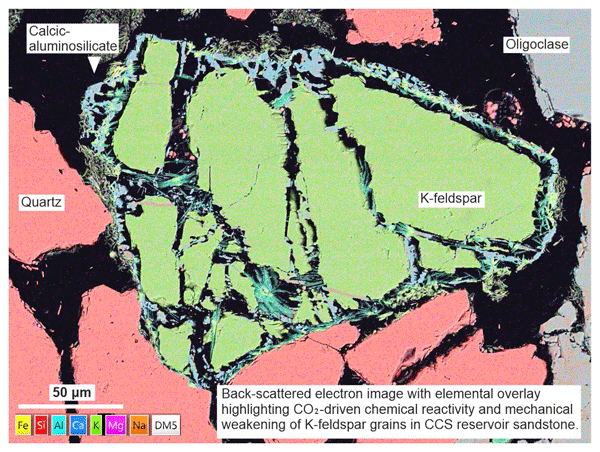
Experiments were conducted in a hydrostatic pressure vessel at 70 MPa confining pressure, 50 MPa pore pressure, and temperatures ranging from 80 °C to 550 °C, using CO2-enriched water to simulate reservoir conditions. Pre- and post-reaction samples were analysed using XRD, SEM-EDS, and XCT to assess microstructural and mineralogical changes. Results show that CO2:feldspar interactions differ significantly from control experiments involving water alone. At reservoir-relevant temperatures (80 °C), incongruent dissolution of K-feldspar weakened grains which led to microfracturing. At 250 °C, CO2 fluids caused total dissolution of calcite grains and cement and selective leaching of calcium from oligoclase, enriching the pore fluid with Ca²⁺. Above 400 °C, coupled dissolution–precipitation processes were observed, including congruent K-feldspar dissolution, secondary porosity development, and localised precipitation of Ca-aluminosilicates and K-bearing phases around dissolving K-feldspars. These transformations could alter reservoir flow pathways and induce mechanical risks, i.e. destabilising nearby faults or initiating reservoir collapse. Given feldspars’ prevalence in crustal rocks and CCS sandstone reservoirs, their reactive behaviour under in-situ conditions and in the presence of aggressive fluids demands greater attention.
-
Notice on discussion status
The requested preprint has a corresponding peer-reviewed final revised paper. You are encouraged to refer to the final revised version.
-
Preprint
(3026 KB)
-
Supplement
(4298 KB)
-
The requested preprint has a corresponding peer-reviewed final revised paper. You are encouraged to refer to the final revised version.
- Preprint
(3026 KB) - Metadata XML
-
Supplement
(4298 KB) - BibTeX
- EndNote
- Final revised paper


Journal article(s) based on this preprint
Interactive discussion
Status: closed
-
CC1: 'Comment on egusphere-2025-4419', Giacomo Medici, 02 Oct 2025
General comments
Very good research. Please, follow my specific comments to bring the impact of your research out.
Specific comments
Lines 51-54. “This requires both a specific knowledge of the pre-injection micro-scale reservoir properties, e.g., pore volume, pore connectivity…safety”. Insert recent literature on the pore connectivity/effective porosity of sandstone aquifers, both the researches discuss CO2 storage:
- Agbotui, P.Y., Firouzbehi, F., Medici, G. 2025. Review of effective porosity in sandstone aquifers: insights for representation of contaminant transport. Sustainability, 17(14), 6469.
- Lai, J., Wang, G., Wang, Z., Chen, J., Pang, X., Wang, S., ... & Fan, X. (2018). A review on pore structure characterization in tight sandstones. Earth-Science Reviews, 177, 436-457.
Line 92. Clearly state the specific objectives of your research by using numbers (e.g., i, ii, and iii).
Lines 112-113. Fluvial, aeolian or turbiditic sandstone? Please, specify the palaeo-environment.
Line 142. Provide update for this reference.
Line 144. Specify the total number of samples analyzed.
Line 145. Convert depth in meters. You need to use international units.
Line 289. “seams’ what do you mean? Some authors use the term granulation seams for deformation bands of tectonic origin in sandstones.
Lines 335-336. Ok such features are related to dissolution. Make sure clarity throughout the manuscript.
Figures and tables
Figures 1, 2 and 4-10. Spatial scale very difficult to read.
Figure 2. Specify that the images are produced by a SEM. The same for the other figures analyzed using SEM.
Figure 11. Make the letters and the numbers larger.
Citation: https://doi.org/10.5194/egusphere-2025-4419-CC1 -
AC3: 'Reply on CC1', Natalie Farrell, 23 Jan 2026
Thank you for your constructive comments. We have addressed them in the following text;
Line 92. Clearly state the specific objectives of your research by using numbers (e.g., i, ii, and iii).
Authors’ response - I don’t think we need to add objectives here as it would require restructuring
Lines 112-113. Fluvial, aeolian or turbiditic sandstone? Please, specify the palaeo-environment.
Authors’ response - This is stated in section 2.1. Materials
Line 142. Provide update for this reference.
Authors’ response - Flowerdew et al., 2024.
Flowerdew, M.J., Farrell, N., Yang, L., Badenszki, E,. Mark, C,. Ardo, B. and Taylor, K.: Feldspars in CCS reservoirs: overlooked or unimportant?, CCS4G Symposium 2024, 17 December 2024, https://www.ges-gb.org.uk/events/ccs4g-symposium-2024/, 2024.
Line 144. Specify the total number of samples analyzed.
Authors’ response - Updated to Core plugs used in these experiments were taken from two sites within the historic petroleum well (14/29a‑5, Goldeneye Field, around 8500 ft), specifically from the D sand top and D sand middle intervals. These sandstones form the target ‘D sand’ unit of the planned CO₂ storage reservoir at the Acorn CO₂ storage site, Scotland (Alcalde et al., 2019).
Line 145. Convert depth in meters. You need to use international units.
Authors’ response - Done
Line 289. “seams’ what do you mean? Some authors use the term granulation seams for deformation bands of tectonic origin in sandstones.
Lines 335-336. Ok such features are related to dissolution. Make sure clarity throughout the manuscript.
Authors’ response - Done
Figures and tables
Figures 1, 2 and 4-10. Spatial scale very difficult to read.
Figure 2. Specify that the images are produced by a SEM. The same for the other figures analyzed using SEM.
Authors’ response - We have expanded the acronyms in Figs. 1 and 2 and the text.
Figure 11. Make the letters and the numbers larger.
Authors’ response - Done
Citation: https://doi.org/10.5194/egusphere-2025-4419-AC3 -
AC4: 'Reply on CC1', Natalie Farrell, 23 Jan 2026
Thank you for your constructive comments. We have addressed them in the following text;
Line 92. Clearly state the specific objectives of your research by using numbers (e.g., i, ii, and iii).
Authors’ response - I don’t think we need to add objectives here as it would require restructuring
Lines 112-113. Fluvial, aeolian or turbiditic sandstone? Please, specify the palaeo-environment.
Authors’ response - This is stated in section 2.1. Materials
Line 142. Provide update for this reference.
Authors’ response - Flowerdew et al., 2024.
Flowerdew, M.J., Farrell, N., Yang, L., Badenszki, E,. Mark, C,. Ardo, B. and Taylor, K.: Feldspars in CCS reservoirs: overlooked or unimportant?, CCS4G Symposium 2024, 17 December 2024, https://www.ges-gb.org.uk/events/ccs4g-symposium-2024/, 2024.
Line 144. Specify the total number of samples analyzed.
Authors’ response - Updated to Core plugs used in these experiments were taken from two sites within the historic petroleum well (14/29a‑5, Goldeneye Field, around 8500 ft), specifically from the D sand top and D sand middle intervals. These sandstones form the target ‘D sand’ unit of the planned CO₂ storage reservoir at the Acorn CO₂ storage site, Scotland (Alcalde et al., 2019).
Line 145. Convert depth in meters. You need to use international units.
Authors’ response - Done
Line 289. “seams’ what do you mean? Some authors use the term granulation seams for deformation bands of tectonic origin in sandstones.
Lines 335-336. Ok such features are related to dissolution. Make sure clarity throughout the manuscript.
Authors’ response - Done
Figures and tables
Figures 1, 2 and 4-10. Spatial scale very difficult to read.
Figure 2. Specify that the images are produced by a SEM. The same for the other figures analyzed using SEM.
Authors’ response - We have expanded the acronyms in Figs. 1 and 2 and the text.
Figure 11. Make the letters and the numbers larger.
Authors’ response - Done
Citation: https://doi.org/10.5194/egusphere-2025-4419-AC4
-
AC3: 'Reply on CC1', Natalie Farrell, 23 Jan 2026
-
RC1: 'Comment on egusphere-2025-4419', Laura Airaghi, 26 Nov 2025
This is a very interesting work, with broad and applied implications and that reads very well. To strengthen and calrify the manuscript I suggest the authors to adress the following issues :
- While microstructures show preferential K-feldspar dissolution expecially at high temperature (i.e. Fig. 4), estimation for volume amont of K-feldspar grains in starting material up to higher temperature for experiments with CO2-bearing fluid do not seems to show any variation within the uncertainty (Fig. 11B). Do the authors have an estimate of the aboundance of secondary minerals as clay replacing K-feldspar ? Instead the vol % of plagioclase seem to significantly decreases (more the one of K-feldpar) in CO2-bearing experiences (Fig. 11C). I suggest to revise the discussion taking this observations into account.
- As also stated by the authors, low temperature conditions and heterogeneous physical properties of the starting material (porosity, permeability etc.) favour chemical equilibrium at the grain-scale. It will be useful that the authors therefore further clarify how images presented in Fig. 4, 6 and 7 are rapresentative of what seen in all grains of the sample (for the same phase), or, if it is not the case, how such microstructures depend on a particular physico-chemical environnement (microstructural site relative to cracks/faults, domains with different initial grainsize, domains with different proportions of the different mineral phases etc.)
- The vol % of calcite grains and ciment has been estimated at 1 % by X-ray diffraction. 1 vol % is at the limit of what can be detected with image processing by tresholding. This opens two questions : first, how these estimates depend on the chosen area. The volume of calcite being so low and local, the choice of the analyzed area can strongly affects its volume estimate (as one cas see in Fig. S4 where calcite can make up a significant part of the surface). Secondly, how a decrease from 0.3-1 vol % to 0-0.2 vol % can be efficiently detected with the image tresholding on EDS images given locally the small grainsize? More generally, can the authors clarify the uncertainty that are associated to estimates based on EDS image tresholding (due to zone sampling biaisis and processing procedure) and compare them with estimated volume decrease for calcite and other phases ?
- I find very interesting that the main reactional features are acquired at 80°C and then their effects (in terms of changes in mineral proportions) remained rather unchanged for higher temperatures. This may appear controintuitive because one may expect that the higher the temperature, the fastest and most complete the reaction, included the mineral dissolution. Can the authors comment on this and link them with the decreasing of porosity that instead goes the other way from 250-300°C ?
- To make the manuscript easier to follow, I would suggest to summarize the occurrence of mineral phases in each sample in a table and to write explicitly reactions going on in each sample.
- I did not well understand what the authors mean by « weakening » mechanism of feldspar. I would rather define cracking as a deformation mechanism or a mechanism of strain accommodation in feldspar that may lead to weakening of the bulk aggregate because of grainsize reduction and transformation of the strong feldspar phase into a fine-grained weaker secondary phase (as illite). Furthermore, feldspar is generally considered as the strong phases relative to quartz, expecially at such low temperature conditions where it cracks instead of deforming plastically , even if, I completely agree, it is more reactive than quartz.
Citation: https://doi.org/10.5194/egusphere-2025-4419-RC1 -
AC2: 'Reply on RC1', Natalie Farrell, 23 Jan 2026
Thank you for your constructive review. We have addressed the comments in the following text;
While microstructures show preferential K-feldspar dissolution expecially at high temperature (i.e. Fig. 4), estimation for volume amont of K-feldspar grains in starting material up to higher temperature for experiments with CO2-bearing fluid do not seems to show any variation within the uncertainty (Fig. 11B).
Authors’ response - The discrepancy between the text and the figure is a data error in the K-feldspar percentages used for the pre-experiment samples in the preprint figure, which were not normalised to the total number of grains quantified from each image. This occurred while copying the data from excel into SPSS software. The data have now been corrected so that all the boxplots show the proportion of reactive grains (K-feldspar, plagioclase, and calcite) relative to the total number of mineral grains that were quantified in each image. We have also included the original excel spreadsheet containing both the uncorrected and normalised data in the Supplementary Material.
Do the authors have an estimate of the aboundance of secondary minerals as clay replacing K-feldspar ?
Authors’ response - No, we could not reliably quantify mineral content using image analysis, and the post-experiment cores were epoxy-impregnated for thin sectioning, preventing XRD analysis. Ideally, the experiments would be repeated to allow post-experimental geochemical analysis.
Instead the vol % of plagioclase seem to significantly decreases (more the one of K-feldpar) in CO2-bearing experiences (Fig. 11C). I suggest to revise the discussion taking this observations into account.
Authors’ response - This was due to a data error in the graph and has been corrected (see earlier response above).
As also stated by the authors, low temperature conditions and heterogeneous physical properties of the starting material (porosity, permeability etc.) favour chemical equilibrium at the grain-scale. It will be useful that the authors therefore further clarify how images presented in Fig. 4, 6 and 7 are representative of what seen in all grains of the sample (for the same phase), or, if it is not the case, how such microstructures depend on a particular physico-chemical environment (microstructural site relative to cracks/faults, domains with different initial grainsize, domains with different proportions of the different mineral phases etc.)
Authors’ response - Section 2.1 (Materials) describes pre-existing reactivity in the feldspars of the starting material, evidenced by albitisation of oligoclase, kaolinite precipitation, and minor dissolution of albitised portions of perthitic K-feldspar. The BSE images in Figs. 4, 6 and 7 were selected from a larger dataset and are representative of deformation textures observed repeatedly within the same mineral phases across the samples; many additional high-magnification examples provided in the Supplementary Materials.
We acknowledge that post-experimental microstructural alteration could not be directly related to pre-experimental individual grain textures or grain-scale environments. As the reviewer suggests, this could be addressed in future work through repeat experiments in an X-ray-transparent reaction rig, which we plan to pursue.
The vol % of calcite grains and ciment has been estimated at 1 % by X-ray diffraction. 1 vol % is at the limit of what can be detected with image processing by tresholding.
Authors’ response - Mineralogical quantification from XRD was used solely to establish baseline mineral proportions in the starting material and should not be directly compared with grain-scale quantification derived from image analysis, which operates at a finer spatial scale. We recognise that the original text could be interpreted as directly comparing XRD and image-based measurements, and we have therefore revised the text to clarify this distinction.
This opens two questions : first, how these estimates depend on the chosen area. The volume of calcite being so low and local, the choice of the analyzed area can strongly affects its volume estimate (as one cas see in Fig. S4 where calcite can make up a significant part of the surface).
Authors’ response - We agree that the choice of analysed area, as well as the chance orientation of the thin section, can strongly influence calcite volume estimates given its low and spatially heterogeneous abundance. To account for this heterogeneity, we applied the approach of Hall et al. (2015), quantifying mineral area percentages from multiple subsections of each thin section covering the entire thin section (between 6 and 12 images per sample depending on the size of the thin sectioned rock). The resulting distributions are presented as box-and-whisker plots (Fig. 11) to capture spatial variability rather than relying on single-area estimates (see Section 3.4).
Secondly, how a decrease from 0.3-1 vol % to 0-0.2 vol % can be efficiently detected with the image tresholding on EDS images given locally the small grainsize?
Authors’ response - In image-based analyses, the minimum detectable area (or volume) fraction is controlled by pixel size rather than an absolute percentage threshold, and can therefore be well below 1%, depending on image resolution. In this study, BSE images have a pixel resolution of 0.5 µm and EDS maps 1 µm, both of which are smaller than the practical uncertainty associated with image segmentation based on grey-scale or compositional thresholds. Edge effects (e.g. grain–pore transitions) introduce uncertainties on the order of 1 µm, while the effective sampled interaction volume for EDS is 3 µm, which we take as the relevant uncertainty scale.
The resulting uncertainty depends on grain size, perimeter length, and grain abundance within each segmented image. We therefore assess uncertainty by applying conservative and aggressive thresholding bounds (excluding versus including grain edges), with the range between these end-members representing the segmentation uncertainty. Applying multiple images across a poorly sorted sandstone section would tend to overestimate uncertainty due to large natural variability in grain size, abundance, and composition. Despite differences between segmentation approaches (e.g. ImageJ versus AZtec), the relative change between sections and experiments is consistent. We therefore have confidence that the reported decrease in volume fraction is robust. This information has been included in the Supplementary Material.
More generally, can the authors clarify the uncertainty that are associated to estimates based on EDS image tresholding (due to zone sampling biaisis and processing procedure) and compare them with estimated volume decrease for calcite and other phases ?
Authors’ response - We agree that estimates derived from thin section image thresholding are associated with uncertainties related to sampling bias, image resolution, and processing. In our dataset, however, calcite occurs as discrete grains and cement patches that extend over many thousands of pixels in the thresholded images, well above the minimum resolvable area defined by pixel size. The same thresholding method was applied consistently to all images, minimising variability due to processing choices. As a result, uncertainties related to pixel resolution and partial-volume effects are small relative to the measured calcite areas. While some uncertainty remains due the edge effects around grains images using BSE detection, the magnitude of the observed calcite reductions, particularly the >50% decrease in calcite and zero calcite content in all images of CO₂-reacted samples at 400 and 550C, exceeds these uncertainties. We therefore consider the relative changes in calcite abundance to be robust, even if absolute area fractions should be interpreted with an understanding of imaging uncertainty.
I find very interesting that the main reactional features are acquired at 80°C and then their effects (in terms of changes in mineral proportions) remained rather unchanged for higher temperatures. This may appear controintuitive because one may expect that the higher the temperature, the fastest and most complete the reaction, included the mineral dissolution. Can the authors comment on this and link them with the decreasing of porosity that instead goes the other way from 250-300°C ?
Authors’ response - We agree that K-feldspar and plagioclase dissolution is apparent at 80 °C, with relatively little additional effect observed at 400 °C and 550 °C. This likely reflects that the dissolution reactions occur early in the experiments. We did not test whether equilibrium was reached, as the 6-day duration was chosen due to project time constraints. It is possible that dissolution was initially driven by ion-exchange reactions involving available calcite, and once the calcite in grains and oligoclase was depleted, the reactions largely ceased, limiting further changes in mineral proportions at higher temperatures.
The observed decrease in pore area, in contrast, is likely controlled by additional processes. Pressure solution may reduce porosity at the grain scale, and compaction could occur due to the production of secondary pores associated with K-feldspar and calcite dissolution. Together, these mechanisms help explain why porosity continues to decrease at higher temperatures even though the bulk mineral proportions remain largely unchanged.
To make the manuscript easier to follow, I would suggest to summarize the occurrence of mineral phases in each sample in a table and to write explicitly reactions going on in each sample.
Authors’ response - We have added a summary table summarising the interpreted reactions and deformation mechanisms operating in each experiment (Table 2) and a schematic figure to summarise the changes in mineralogy (Figure 12). These figures have been integrated into the manuscript.
“Reactions, deformation mechanisms observed in experiments are summarised in Table 2 and key mineral phases present in the Cretaceous Acorn sandstone before, during and after experiments are highlighted in Figure 12.”
I did not well understand what the authors mean by « weakening » mechanism of feldspar. I would rather define cracking as a deformation mechanism or a mechanism of strain accommodation in feldspar that may lead to weakening of the bulk aggregate because of grainsize reduction and transformation of the strong feldspar phase into a fine-grained weaker secondary phase (as illite). Furthermore, feldspar is generally considered as the strong phases relative to quartz, expecially at such low temperature conditions where it cracks instead of deforming plastically , even if, I completely agree, it is more reactive than quartz.
Authors’ response - Mechanical weakening is a standard term in the context of brittle microstructures and rock deformation; however, we agree with the reviewer that “weakening” could be more clearly distinguished from deformation mechanisms. We have therefore revised the text to remove instances where “weakening” was conflated with deformation mechanisms, including on lines 607, 617, and 673.
Citation: https://doi.org/10.5194/egusphere-2025-4419-AC2
-
RC2: 'Comment on egusphere-2025-4419', Alexis Cartwright-Taylor, 12 Dec 2025
This interesting paper addresses an important knowledge gap with a novel experimental methodology and is well-written. It presents key findings about the degree of K-feldspar alteration under reservoir pressures and temperatures relevant for CCS. Increasing temperatures were used as a proxy for increased reaction rates and significant K-feldspar dissolution and fracturing were observed, among other dissolution/precipitation behaviour.
I recommend the following minor changes and clarifications:
- Table 1 - why did Pc conditions vary from 70-80MPa? Could this variability have influenced reaction kinetics?
- Line 259 – reference here to more detail in the Sup. Mat. but there is no further information there. Suggest including specific details of the imagej processing and analysis workflow and parameters that were used.
- Lines 261-262 – mention here of additional 3D micro-CT from pre- and post-experiment samples to assess grain deformation and pore networks but there is no information about how these images were processed and no micro-CT data is presented in the results. Please clarify.
- Line 279 – check figure number in the reference – Fig. 3 is the experimental schematic, but text is discussing the BSE images.
- Fig 6. caption – specify which images relate to which temperatures (not clear from caption or main text).
- Line 422 – mentions only H2O pore area decrease at 400 ºC but CO2 showed similar pore area decrease at 400º
- Lines 430-435 and Fig 11b – the figure does not appear to support the text here. The grey boxes show very little variation in K-feldspar % across the temperature range, while the blue H2O boxes show much more variation (decreasing and then increasing and then decreasing again) and wider interquartile ranges than the grey boxes. Fig 11 seems inconsistent with Fig 4 which shows K-feldspar dissolution – why is this? Are there competing precipitation reactions that might balance out the average % changes? Would be helpful to summarise the expected reactions for each phase/fluid in the main text somewhere.
- Lines 438-439 and Fig 11c – the figure does not appear to support the text. The blue H2O boxes show some small variability around 6% but without knowing the error on the measurements and how large of a change is significant it would be difficult to infer that the plagioclase area had increased with temperature.
- Fig 11 – what are the errors of the mean for these measurements?
- Fig 11 – was an experiment done at freezing point (0ºC) as stated in the figure? Or should this be shown as room temp?
- Fig 11d – these values are very small % changes – what is the resolution on the segmentation? Is it possible to distinguish such small changes?
- Line 577 – mention of enhanced K-feldspar dissolution in CO2 enriched fluids but this is not supported by Fig 11b, although supported by Fig. 4. Please clarify (see also comment #7).
Citation: https://doi.org/10.5194/egusphere-2025-4419-RC2 -
AC1: 'Reply on RC2', Natalie Farrell, 23 Jan 2026
Thank you for your constructive comments. We have responded to specific comments in following text;
Table 1 - why did Pc conditions vary from 70-80MPa? Could this variability have influenced reaction kinetics?
Authors’ response - The confining pressure (Pc) was initially increased in line with the pore fluid pressure (Pf) to prevent pore collapse via mechanical compaction (see line 214). While Pf is servo-controlled, Pc is pump-controlled and also rises with temperature, so we used a prediction curve from rig calibration experiments to estimate the appropriate Pc at room temperature and the expected final pressure at the target experimental temperature. In some cases, the final Pc slightly exceeded the intended 70 MPa. Reducing the pressure to exactly 70 MPa risked experimental failure, so a small range was allowed. We consider it unlikely that this variation in Pc had any meaningful effect on reaction kinetics.
Line 259 – reference here to more detail in the Sup. Mat. but there is no further information there. Suggest including specific details of the imagej processing and analysis workflow and parameters that were used.
Authors’ response - Text added to the Supplementary data document.
Lines 261-262 – mention here of additional 3D micro-CT from pre- and post-experiment samples to assess grain deformation and pore networks but there is no information about how these images were processed and no micro-CT data is presented in the results. Please clarify.
Authors’ response - We collected XCT images of samples before and after the experiments, but their lower spatial resolution compared to BSE images limited quantitative analysis. Funding constraints also prevented full analysis of both XCT datasets. However, the XCT data are included in the Supplementary Material, and we have added details on their acquisition and processing.
Line 279 – check figure number in the reference – Fig. 3 is the experimental schematic, but text is discussing the BSE images.
Authors’ response - Corrected
Fig 6. caption – specify which images relate to which temperatures (not clear from caption or main text).
Authors’ response - Done
Line 422 – mentions only H2O pore area decrease at 400 ºC but CO2 showed similar pore area decrease at 400ºC
Authors’ response - Corrected to “However, this decreased to 26% pore area in samples reacted with H2O and CO2 at 400°C and with H2O 550°C, possibly due to enhanced grain packing and pressure solution observed in images”
Lines 430-435 and Fig 11b – the figure does not appear to support the text here. The grey boxes show very little variation in K-feldspar % across the temperature range, while the blue H2O boxes show much more variation (decreasing and then increasing and then decreasing again) and wider interquartile ranges than the grey boxes.
Authors’ response - The discrepancy between the text and the figure is a data error in the K-feldspar percentages used for the pre-experiment samples in the preprint figure, which were not normalised to the total number of grains quantified from each image. This occurred while copying the data from excel into SPSS software. The data have now been corrected so that all the boxplots show the proportion of reactive grains (K-feldspar, plagioclase, and calcite) relative to the total number of mineral grains that were quantified in each image. We have also included the original excel spreadsheet containing both the uncorrected and normalised data in the Supplementary Material.
Fig 11 seems inconsistent with Fig 4 which shows K-feldspar dissolution – why is this? Are there competing precipitation reactions that might balance out the average % changes?
Authors’ response - This was due to a graphing mistake in the % K-feldspar in the pre experiment sample
Would be helpful to summarise the expected reactions for each phase/fluid in the main text somewhere.
Authors’ response - See comments to R1 regarding table and schematic
Lines 438-439 and Fig 11c – the figure does not appear to support the text. The blue H2O boxes show some small variability around 6% but without knowing the error on the measurements and how large of a change is significant it would be difficult to infer that the plagioclase area had increased with temperature.
Authors’ response - Agreed and we have updated the text to reflect this "In samples reacted with CO2, the proportion of plagioclase decreased by approximately 25%, indicating some dissolution. In contrast, H2O-reacted samples show little change in plagioclase area (Fig. 11c)."
Fig 11 – what are the errors of the mean for these measurements?
Authors’ response - Standard deviations for each suite of area % has been added to the summary excel file
Fig 11 – was an experiment done at freezing point (0ºC) as stated in the figure? Or should this be shown as room temp?
Authors’ response - These values are for image analysis completed on the pre experiment starting material which was at lab temperature of 20degsC. We have highlighted this on Figure 11.
Fig 11d – these values are very small % changes – what is the resolution on the segmentation? Is it possible to distinguish such small changes?
Authors’ response - In the high resolution images calcite occurs as discrete grains and cement patches that extend over many thousands of pixels in the thresholded images, well above the minimum resolvable area defined by pixel size. While some uncertainty remains due the edge effects around grains images using BSE detection, the magnitude of the observed calcite reductions, particularly the >50% decrease in calcite and zero calcite content in all images of CO₂-reacted samples at 400 and 550degsC, exceeds these uncertainties.
Line 577 – mention of enhanced K-feldspar dissolution in CO2 enriched fluids but this is not supported by Fig 11b, although supported by Fig. 4. Please clarify (see also comment #7).
Authors’ response - See comment regarding error in the graphed pre experiment data above
Citation: https://doi.org/10.5194/egusphere-2025-4419-AC1
Peer review completion


Interactive discussion
Status: closed
-
CC1: 'Comment on egusphere-2025-4419', Giacomo Medici, 02 Oct 2025
General comments
Very good research. Please, follow my specific comments to bring the impact of your research out.
Specific comments
Lines 51-54. “This requires both a specific knowledge of the pre-injection micro-scale reservoir properties, e.g., pore volume, pore connectivity…safety”. Insert recent literature on the pore connectivity/effective porosity of sandstone aquifers, both the researches discuss CO2 storage:
- Agbotui, P.Y., Firouzbehi, F., Medici, G. 2025. Review of effective porosity in sandstone aquifers: insights for representation of contaminant transport. Sustainability, 17(14), 6469.
- Lai, J., Wang, G., Wang, Z., Chen, J., Pang, X., Wang, S., ... & Fan, X. (2018). A review on pore structure characterization in tight sandstones. Earth-Science Reviews, 177, 436-457.
Line 92. Clearly state the specific objectives of your research by using numbers (e.g., i, ii, and iii).
Lines 112-113. Fluvial, aeolian or turbiditic sandstone? Please, specify the palaeo-environment.
Line 142. Provide update for this reference.
Line 144. Specify the total number of samples analyzed.
Line 145. Convert depth in meters. You need to use international units.
Line 289. “seams’ what do you mean? Some authors use the term granulation seams for deformation bands of tectonic origin in sandstones.
Lines 335-336. Ok such features are related to dissolution. Make sure clarity throughout the manuscript.
Figures and tables
Figures 1, 2 and 4-10. Spatial scale very difficult to read.
Figure 2. Specify that the images are produced by a SEM. The same for the other figures analyzed using SEM.
Figure 11. Make the letters and the numbers larger.
Citation: https://doi.org/10.5194/egusphere-2025-4419-CC1 -
AC3: 'Reply on CC1', Natalie Farrell, 23 Jan 2026
Thank you for your constructive comments. We have addressed them in the following text;
Line 92. Clearly state the specific objectives of your research by using numbers (e.g., i, ii, and iii).
Authors’ response - I don’t think we need to add objectives here as it would require restructuring
Lines 112-113. Fluvial, aeolian or turbiditic sandstone? Please, specify the palaeo-environment.
Authors’ response - This is stated in section 2.1. Materials
Line 142. Provide update for this reference.
Authors’ response - Flowerdew et al., 2024.
Flowerdew, M.J., Farrell, N., Yang, L., Badenszki, E,. Mark, C,. Ardo, B. and Taylor, K.: Feldspars in CCS reservoirs: overlooked or unimportant?, CCS4G Symposium 2024, 17 December 2024, https://www.ges-gb.org.uk/events/ccs4g-symposium-2024/, 2024.
Line 144. Specify the total number of samples analyzed.
Authors’ response - Updated to Core plugs used in these experiments were taken from two sites within the historic petroleum well (14/29a‑5, Goldeneye Field, around 8500 ft), specifically from the D sand top and D sand middle intervals. These sandstones form the target ‘D sand’ unit of the planned CO₂ storage reservoir at the Acorn CO₂ storage site, Scotland (Alcalde et al., 2019).
Line 145. Convert depth in meters. You need to use international units.
Authors’ response - Done
Line 289. “seams’ what do you mean? Some authors use the term granulation seams for deformation bands of tectonic origin in sandstones.
Lines 335-336. Ok such features are related to dissolution. Make sure clarity throughout the manuscript.
Authors’ response - Done
Figures and tables
Figures 1, 2 and 4-10. Spatial scale very difficult to read.
Figure 2. Specify that the images are produced by a SEM. The same for the other figures analyzed using SEM.
Authors’ response - We have expanded the acronyms in Figs. 1 and 2 and the text.
Figure 11. Make the letters and the numbers larger.
Authors’ response - Done
Citation: https://doi.org/10.5194/egusphere-2025-4419-AC3 -
AC4: 'Reply on CC1', Natalie Farrell, 23 Jan 2026
Thank you for your constructive comments. We have addressed them in the following text;
Line 92. Clearly state the specific objectives of your research by using numbers (e.g., i, ii, and iii).
Authors’ response - I don’t think we need to add objectives here as it would require restructuring
Lines 112-113. Fluvial, aeolian or turbiditic sandstone? Please, specify the palaeo-environment.
Authors’ response - This is stated in section 2.1. Materials
Line 142. Provide update for this reference.
Authors’ response - Flowerdew et al., 2024.
Flowerdew, M.J., Farrell, N., Yang, L., Badenszki, E,. Mark, C,. Ardo, B. and Taylor, K.: Feldspars in CCS reservoirs: overlooked or unimportant?, CCS4G Symposium 2024, 17 December 2024, https://www.ges-gb.org.uk/events/ccs4g-symposium-2024/, 2024.
Line 144. Specify the total number of samples analyzed.
Authors’ response - Updated to Core plugs used in these experiments were taken from two sites within the historic petroleum well (14/29a‑5, Goldeneye Field, around 8500 ft), specifically from the D sand top and D sand middle intervals. These sandstones form the target ‘D sand’ unit of the planned CO₂ storage reservoir at the Acorn CO₂ storage site, Scotland (Alcalde et al., 2019).
Line 145. Convert depth in meters. You need to use international units.
Authors’ response - Done
Line 289. “seams’ what do you mean? Some authors use the term granulation seams for deformation bands of tectonic origin in sandstones.
Lines 335-336. Ok such features are related to dissolution. Make sure clarity throughout the manuscript.
Authors’ response - Done
Figures and tables
Figures 1, 2 and 4-10. Spatial scale very difficult to read.
Figure 2. Specify that the images are produced by a SEM. The same for the other figures analyzed using SEM.
Authors’ response - We have expanded the acronyms in Figs. 1 and 2 and the text.
Figure 11. Make the letters and the numbers larger.
Authors’ response - Done
Citation: https://doi.org/10.5194/egusphere-2025-4419-AC4
-
AC3: 'Reply on CC1', Natalie Farrell, 23 Jan 2026
-
RC1: 'Comment on egusphere-2025-4419', Laura Airaghi, 26 Nov 2025
This is a very interesting work, with broad and applied implications and that reads very well. To strengthen and calrify the manuscript I suggest the authors to adress the following issues :
- While microstructures show preferential K-feldspar dissolution expecially at high temperature (i.e. Fig. 4), estimation for volume amont of K-feldspar grains in starting material up to higher temperature for experiments with CO2-bearing fluid do not seems to show any variation within the uncertainty (Fig. 11B). Do the authors have an estimate of the aboundance of secondary minerals as clay replacing K-feldspar ? Instead the vol % of plagioclase seem to significantly decreases (more the one of K-feldpar) in CO2-bearing experiences (Fig. 11C). I suggest to revise the discussion taking this observations into account.
- As also stated by the authors, low temperature conditions and heterogeneous physical properties of the starting material (porosity, permeability etc.) favour chemical equilibrium at the grain-scale. It will be useful that the authors therefore further clarify how images presented in Fig. 4, 6 and 7 are rapresentative of what seen in all grains of the sample (for the same phase), or, if it is not the case, how such microstructures depend on a particular physico-chemical environnement (microstructural site relative to cracks/faults, domains with different initial grainsize, domains with different proportions of the different mineral phases etc.)
- The vol % of calcite grains and ciment has been estimated at 1 % by X-ray diffraction. 1 vol % is at the limit of what can be detected with image processing by tresholding. This opens two questions : first, how these estimates depend on the chosen area. The volume of calcite being so low and local, the choice of the analyzed area can strongly affects its volume estimate (as one cas see in Fig. S4 where calcite can make up a significant part of the surface). Secondly, how a decrease from 0.3-1 vol % to 0-0.2 vol % can be efficiently detected with the image tresholding on EDS images given locally the small grainsize? More generally, can the authors clarify the uncertainty that are associated to estimates based on EDS image tresholding (due to zone sampling biaisis and processing procedure) and compare them with estimated volume decrease for calcite and other phases ?
- I find very interesting that the main reactional features are acquired at 80°C and then their effects (in terms of changes in mineral proportions) remained rather unchanged for higher temperatures. This may appear controintuitive because one may expect that the higher the temperature, the fastest and most complete the reaction, included the mineral dissolution. Can the authors comment on this and link them with the decreasing of porosity that instead goes the other way from 250-300°C ?
- To make the manuscript easier to follow, I would suggest to summarize the occurrence of mineral phases in each sample in a table and to write explicitly reactions going on in each sample.
- I did not well understand what the authors mean by « weakening » mechanism of feldspar. I would rather define cracking as a deformation mechanism or a mechanism of strain accommodation in feldspar that may lead to weakening of the bulk aggregate because of grainsize reduction and transformation of the strong feldspar phase into a fine-grained weaker secondary phase (as illite). Furthermore, feldspar is generally considered as the strong phases relative to quartz, expecially at such low temperature conditions where it cracks instead of deforming plastically , even if, I completely agree, it is more reactive than quartz.
Citation: https://doi.org/10.5194/egusphere-2025-4419-RC1 -
AC2: 'Reply on RC1', Natalie Farrell, 23 Jan 2026
Thank you for your constructive review. We have addressed the comments in the following text;
While microstructures show preferential K-feldspar dissolution expecially at high temperature (i.e. Fig. 4), estimation for volume amont of K-feldspar grains in starting material up to higher temperature for experiments with CO2-bearing fluid do not seems to show any variation within the uncertainty (Fig. 11B).
Authors’ response - The discrepancy between the text and the figure is a data error in the K-feldspar percentages used for the pre-experiment samples in the preprint figure, which were not normalised to the total number of grains quantified from each image. This occurred while copying the data from excel into SPSS software. The data have now been corrected so that all the boxplots show the proportion of reactive grains (K-feldspar, plagioclase, and calcite) relative to the total number of mineral grains that were quantified in each image. We have also included the original excel spreadsheet containing both the uncorrected and normalised data in the Supplementary Material.
Do the authors have an estimate of the aboundance of secondary minerals as clay replacing K-feldspar ?
Authors’ response - No, we could not reliably quantify mineral content using image analysis, and the post-experiment cores were epoxy-impregnated for thin sectioning, preventing XRD analysis. Ideally, the experiments would be repeated to allow post-experimental geochemical analysis.
Instead the vol % of plagioclase seem to significantly decreases (more the one of K-feldpar) in CO2-bearing experiences (Fig. 11C). I suggest to revise the discussion taking this observations into account.
Authors’ response - This was due to a data error in the graph and has been corrected (see earlier response above).
As also stated by the authors, low temperature conditions and heterogeneous physical properties of the starting material (porosity, permeability etc.) favour chemical equilibrium at the grain-scale. It will be useful that the authors therefore further clarify how images presented in Fig. 4, 6 and 7 are representative of what seen in all grains of the sample (for the same phase), or, if it is not the case, how such microstructures depend on a particular physico-chemical environment (microstructural site relative to cracks/faults, domains with different initial grainsize, domains with different proportions of the different mineral phases etc.)
Authors’ response - Section 2.1 (Materials) describes pre-existing reactivity in the feldspars of the starting material, evidenced by albitisation of oligoclase, kaolinite precipitation, and minor dissolution of albitised portions of perthitic K-feldspar. The BSE images in Figs. 4, 6 and 7 were selected from a larger dataset and are representative of deformation textures observed repeatedly within the same mineral phases across the samples; many additional high-magnification examples provided in the Supplementary Materials.
We acknowledge that post-experimental microstructural alteration could not be directly related to pre-experimental individual grain textures or grain-scale environments. As the reviewer suggests, this could be addressed in future work through repeat experiments in an X-ray-transparent reaction rig, which we plan to pursue.
The vol % of calcite grains and ciment has been estimated at 1 % by X-ray diffraction. 1 vol % is at the limit of what can be detected with image processing by tresholding.
Authors’ response - Mineralogical quantification from XRD was used solely to establish baseline mineral proportions in the starting material and should not be directly compared with grain-scale quantification derived from image analysis, which operates at a finer spatial scale. We recognise that the original text could be interpreted as directly comparing XRD and image-based measurements, and we have therefore revised the text to clarify this distinction.
This opens two questions : first, how these estimates depend on the chosen area. The volume of calcite being so low and local, the choice of the analyzed area can strongly affects its volume estimate (as one cas see in Fig. S4 where calcite can make up a significant part of the surface).
Authors’ response - We agree that the choice of analysed area, as well as the chance orientation of the thin section, can strongly influence calcite volume estimates given its low and spatially heterogeneous abundance. To account for this heterogeneity, we applied the approach of Hall et al. (2015), quantifying mineral area percentages from multiple subsections of each thin section covering the entire thin section (between 6 and 12 images per sample depending on the size of the thin sectioned rock). The resulting distributions are presented as box-and-whisker plots (Fig. 11) to capture spatial variability rather than relying on single-area estimates (see Section 3.4).
Secondly, how a decrease from 0.3-1 vol % to 0-0.2 vol % can be efficiently detected with the image tresholding on EDS images given locally the small grainsize?
Authors’ response - In image-based analyses, the minimum detectable area (or volume) fraction is controlled by pixel size rather than an absolute percentage threshold, and can therefore be well below 1%, depending on image resolution. In this study, BSE images have a pixel resolution of 0.5 µm and EDS maps 1 µm, both of which are smaller than the practical uncertainty associated with image segmentation based on grey-scale or compositional thresholds. Edge effects (e.g. grain–pore transitions) introduce uncertainties on the order of 1 µm, while the effective sampled interaction volume for EDS is 3 µm, which we take as the relevant uncertainty scale.
The resulting uncertainty depends on grain size, perimeter length, and grain abundance within each segmented image. We therefore assess uncertainty by applying conservative and aggressive thresholding bounds (excluding versus including grain edges), with the range between these end-members representing the segmentation uncertainty. Applying multiple images across a poorly sorted sandstone section would tend to overestimate uncertainty due to large natural variability in grain size, abundance, and composition. Despite differences between segmentation approaches (e.g. ImageJ versus AZtec), the relative change between sections and experiments is consistent. We therefore have confidence that the reported decrease in volume fraction is robust. This information has been included in the Supplementary Material.
More generally, can the authors clarify the uncertainty that are associated to estimates based on EDS image tresholding (due to zone sampling biaisis and processing procedure) and compare them with estimated volume decrease for calcite and other phases ?
Authors’ response - We agree that estimates derived from thin section image thresholding are associated with uncertainties related to sampling bias, image resolution, and processing. In our dataset, however, calcite occurs as discrete grains and cement patches that extend over many thousands of pixels in the thresholded images, well above the minimum resolvable area defined by pixel size. The same thresholding method was applied consistently to all images, minimising variability due to processing choices. As a result, uncertainties related to pixel resolution and partial-volume effects are small relative to the measured calcite areas. While some uncertainty remains due the edge effects around grains images using BSE detection, the magnitude of the observed calcite reductions, particularly the >50% decrease in calcite and zero calcite content in all images of CO₂-reacted samples at 400 and 550C, exceeds these uncertainties. We therefore consider the relative changes in calcite abundance to be robust, even if absolute area fractions should be interpreted with an understanding of imaging uncertainty.
I find very interesting that the main reactional features are acquired at 80°C and then their effects (in terms of changes in mineral proportions) remained rather unchanged for higher temperatures. This may appear controintuitive because one may expect that the higher the temperature, the fastest and most complete the reaction, included the mineral dissolution. Can the authors comment on this and link them with the decreasing of porosity that instead goes the other way from 250-300°C ?
Authors’ response - We agree that K-feldspar and plagioclase dissolution is apparent at 80 °C, with relatively little additional effect observed at 400 °C and 550 °C. This likely reflects that the dissolution reactions occur early in the experiments. We did not test whether equilibrium was reached, as the 6-day duration was chosen due to project time constraints. It is possible that dissolution was initially driven by ion-exchange reactions involving available calcite, and once the calcite in grains and oligoclase was depleted, the reactions largely ceased, limiting further changes in mineral proportions at higher temperatures.
The observed decrease in pore area, in contrast, is likely controlled by additional processes. Pressure solution may reduce porosity at the grain scale, and compaction could occur due to the production of secondary pores associated with K-feldspar and calcite dissolution. Together, these mechanisms help explain why porosity continues to decrease at higher temperatures even though the bulk mineral proportions remain largely unchanged.
To make the manuscript easier to follow, I would suggest to summarize the occurrence of mineral phases in each sample in a table and to write explicitly reactions going on in each sample.
Authors’ response - We have added a summary table summarising the interpreted reactions and deformation mechanisms operating in each experiment (Table 2) and a schematic figure to summarise the changes in mineralogy (Figure 12). These figures have been integrated into the manuscript.
“Reactions, deformation mechanisms observed in experiments are summarised in Table 2 and key mineral phases present in the Cretaceous Acorn sandstone before, during and after experiments are highlighted in Figure 12.”
I did not well understand what the authors mean by « weakening » mechanism of feldspar. I would rather define cracking as a deformation mechanism or a mechanism of strain accommodation in feldspar that may lead to weakening of the bulk aggregate because of grainsize reduction and transformation of the strong feldspar phase into a fine-grained weaker secondary phase (as illite). Furthermore, feldspar is generally considered as the strong phases relative to quartz, expecially at such low temperature conditions where it cracks instead of deforming plastically , even if, I completely agree, it is more reactive than quartz.
Authors’ response - Mechanical weakening is a standard term in the context of brittle microstructures and rock deformation; however, we agree with the reviewer that “weakening” could be more clearly distinguished from deformation mechanisms. We have therefore revised the text to remove instances where “weakening” was conflated with deformation mechanisms, including on lines 607, 617, and 673.
Citation: https://doi.org/10.5194/egusphere-2025-4419-AC2
-
RC2: 'Comment on egusphere-2025-4419', Alexis Cartwright-Taylor, 12 Dec 2025
This interesting paper addresses an important knowledge gap with a novel experimental methodology and is well-written. It presents key findings about the degree of K-feldspar alteration under reservoir pressures and temperatures relevant for CCS. Increasing temperatures were used as a proxy for increased reaction rates and significant K-feldspar dissolution and fracturing were observed, among other dissolution/precipitation behaviour.
I recommend the following minor changes and clarifications:
- Table 1 - why did Pc conditions vary from 70-80MPa? Could this variability have influenced reaction kinetics?
- Line 259 – reference here to more detail in the Sup. Mat. but there is no further information there. Suggest including specific details of the imagej processing and analysis workflow and parameters that were used.
- Lines 261-262 – mention here of additional 3D micro-CT from pre- and post-experiment samples to assess grain deformation and pore networks but there is no information about how these images were processed and no micro-CT data is presented in the results. Please clarify.
- Line 279 – check figure number in the reference – Fig. 3 is the experimental schematic, but text is discussing the BSE images.
- Fig 6. caption – specify which images relate to which temperatures (not clear from caption or main text).
- Line 422 – mentions only H2O pore area decrease at 400 ºC but CO2 showed similar pore area decrease at 400º
- Lines 430-435 and Fig 11b – the figure does not appear to support the text here. The grey boxes show very little variation in K-feldspar % across the temperature range, while the blue H2O boxes show much more variation (decreasing and then increasing and then decreasing again) and wider interquartile ranges than the grey boxes. Fig 11 seems inconsistent with Fig 4 which shows K-feldspar dissolution – why is this? Are there competing precipitation reactions that might balance out the average % changes? Would be helpful to summarise the expected reactions for each phase/fluid in the main text somewhere.
- Lines 438-439 and Fig 11c – the figure does not appear to support the text. The blue H2O boxes show some small variability around 6% but without knowing the error on the measurements and how large of a change is significant it would be difficult to infer that the plagioclase area had increased with temperature.
- Fig 11 – what are the errors of the mean for these measurements?
- Fig 11 – was an experiment done at freezing point (0ºC) as stated in the figure? Or should this be shown as room temp?
- Fig 11d – these values are very small % changes – what is the resolution on the segmentation? Is it possible to distinguish such small changes?
- Line 577 – mention of enhanced K-feldspar dissolution in CO2 enriched fluids but this is not supported by Fig 11b, although supported by Fig. 4. Please clarify (see also comment #7).
Citation: https://doi.org/10.5194/egusphere-2025-4419-RC2 -
AC1: 'Reply on RC2', Natalie Farrell, 23 Jan 2026
Thank you for your constructive comments. We have responded to specific comments in following text;
Table 1 - why did Pc conditions vary from 70-80MPa? Could this variability have influenced reaction kinetics?
Authors’ response - The confining pressure (Pc) was initially increased in line with the pore fluid pressure (Pf) to prevent pore collapse via mechanical compaction (see line 214). While Pf is servo-controlled, Pc is pump-controlled and also rises with temperature, so we used a prediction curve from rig calibration experiments to estimate the appropriate Pc at room temperature and the expected final pressure at the target experimental temperature. In some cases, the final Pc slightly exceeded the intended 70 MPa. Reducing the pressure to exactly 70 MPa risked experimental failure, so a small range was allowed. We consider it unlikely that this variation in Pc had any meaningful effect on reaction kinetics.
Line 259 – reference here to more detail in the Sup. Mat. but there is no further information there. Suggest including specific details of the imagej processing and analysis workflow and parameters that were used.
Authors’ response - Text added to the Supplementary data document.
Lines 261-262 – mention here of additional 3D micro-CT from pre- and post-experiment samples to assess grain deformation and pore networks but there is no information about how these images were processed and no micro-CT data is presented in the results. Please clarify.
Authors’ response - We collected XCT images of samples before and after the experiments, but their lower spatial resolution compared to BSE images limited quantitative analysis. Funding constraints also prevented full analysis of both XCT datasets. However, the XCT data are included in the Supplementary Material, and we have added details on their acquisition and processing.
Line 279 – check figure number in the reference – Fig. 3 is the experimental schematic, but text is discussing the BSE images.
Authors’ response - Corrected
Fig 6. caption – specify which images relate to which temperatures (not clear from caption or main text).
Authors’ response - Done
Line 422 – mentions only H2O pore area decrease at 400 ºC but CO2 showed similar pore area decrease at 400ºC
Authors’ response - Corrected to “However, this decreased to 26% pore area in samples reacted with H2O and CO2 at 400°C and with H2O 550°C, possibly due to enhanced grain packing and pressure solution observed in images”
Lines 430-435 and Fig 11b – the figure does not appear to support the text here. The grey boxes show very little variation in K-feldspar % across the temperature range, while the blue H2O boxes show much more variation (decreasing and then increasing and then decreasing again) and wider interquartile ranges than the grey boxes.
Authors’ response - The discrepancy between the text and the figure is a data error in the K-feldspar percentages used for the pre-experiment samples in the preprint figure, which were not normalised to the total number of grains quantified from each image. This occurred while copying the data from excel into SPSS software. The data have now been corrected so that all the boxplots show the proportion of reactive grains (K-feldspar, plagioclase, and calcite) relative to the total number of mineral grains that were quantified in each image. We have also included the original excel spreadsheet containing both the uncorrected and normalised data in the Supplementary Material.
Fig 11 seems inconsistent with Fig 4 which shows K-feldspar dissolution – why is this? Are there competing precipitation reactions that might balance out the average % changes?
Authors’ response - This was due to a graphing mistake in the % K-feldspar in the pre experiment sample
Would be helpful to summarise the expected reactions for each phase/fluid in the main text somewhere.
Authors’ response - See comments to R1 regarding table and schematic
Lines 438-439 and Fig 11c – the figure does not appear to support the text. The blue H2O boxes show some small variability around 6% but without knowing the error on the measurements and how large of a change is significant it would be difficult to infer that the plagioclase area had increased with temperature.
Authors’ response - Agreed and we have updated the text to reflect this "In samples reacted with CO2, the proportion of plagioclase decreased by approximately 25%, indicating some dissolution. In contrast, H2O-reacted samples show little change in plagioclase area (Fig. 11c)."
Fig 11 – what are the errors of the mean for these measurements?
Authors’ response - Standard deviations for each suite of area % has been added to the summary excel file
Fig 11 – was an experiment done at freezing point (0ºC) as stated in the figure? Or should this be shown as room temp?
Authors’ response - These values are for image analysis completed on the pre experiment starting material which was at lab temperature of 20degsC. We have highlighted this on Figure 11.
Fig 11d – these values are very small % changes – what is the resolution on the segmentation? Is it possible to distinguish such small changes?
Authors’ response - In the high resolution images calcite occurs as discrete grains and cement patches that extend over many thousands of pixels in the thresholded images, well above the minimum resolvable area defined by pixel size. While some uncertainty remains due the edge effects around grains images using BSE detection, the magnitude of the observed calcite reductions, particularly the >50% decrease in calcite and zero calcite content in all images of CO₂-reacted samples at 400 and 550degsC, exceeds these uncertainties.
Line 577 – mention of enhanced K-feldspar dissolution in CO2 enriched fluids but this is not supported by Fig 11b, although supported by Fig. 4. Please clarify (see also comment #7).
Authors’ response - See comment regarding error in the graphed pre experiment data above
Citation: https://doi.org/10.5194/egusphere-2025-4419-AC1
Peer review completion
Journal article(s) based on this preprint
Viewed
| HTML | XML | Total | Supplement | BibTeX | EndNote | |
|---|---|---|---|---|---|---|
| 2,043 | 752 | 98 | 2,893 | 272 | 84 | 120 |
- HTML: 2,043
- PDF: 752
- XML: 98
- Total: 2,893
- Supplement: 272
- BibTeX: 84
- EndNote: 120
Viewed (geographical distribution)
| Country | # | Views | % |
|---|
| Total: | 0 |
| HTML: | 0 |
| PDF: | 0 |
| XML: | 0 |
- 1
Natalie Jane Charlotte Farrell

Lining Yang
Michael Flowerdew
Chris Mark
Buhari Ardo
Kevin Taylor
Nico Bigaroni
Michael Pointon
Lewis Hughes
John Waters
Lee Paul
The requested preprint has a corresponding peer-reviewed final revised paper. You are encouraged to refer to the final revised version.
- Preprint
(3026 KB) - Metadata XML
-
Supplement
(4298 KB) - BibTeX
- EndNote
- Final revised paper