
the Creative Commons Attribution 4.0 License.
the Creative Commons Attribution 4.0 License.
 | 17 Sep 2025
Eddy kinetic energy and baroclinic and barotropic energy conversion rates along the Atlantic Water boundary current north of Svalbard
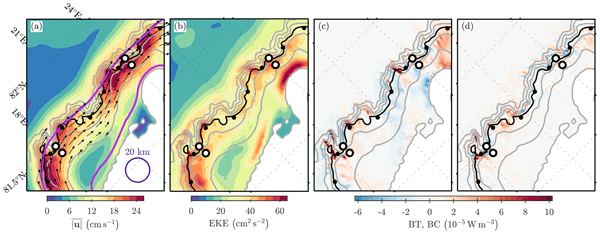
Abstract. On the continental slope north of Svalbard, the boundary current carrying Atlantic Water (AW) loses heat as it flows eastward. This cooling cannot be fully attributed to atmospheric heat loss or turbulent mixing. Lateral exchange, potentially linked to mesoscale activity, has previously been proposed as a contributing factor, based on limited observations of eddies. Here, we analyse a year‑long dataset of hydrography and velocity observations from two mooring arrays, supplemented by output from an eddy‑resolving ocean model, to quantify the seasonal variability of eddy kinetic energy (EKE) and baroclinic and barotropic energy conversion rates over time-scales from days to months. Both EKE and conversion rates peak in autumn and winter, coinciding with the strongest boundary current and the warmest AW. Local EKE variability, however, is only weakly associated with conversion rates, suggesting advection from upstream generation sites or unresolved variability from limited measurements. Conversion is mainly baroclinic, indicating boundary current instability and providing conditions favourable for offshore propagation of warm-core eddies. The model underscores the need for adequate spatial and temporal averaging and reveals substantial conversion rates on the offshore, deeper side of the boundary current, with comparable contributions from baroclinic and barotropic processes. Resulting mesoscale activity likely enhances lateral stirring and heat loss from the boundary current, particularly in winter and spring, contributing to the along-stream cooling of AW.
Competing interests: At least one of the (co-)authors is a member of the editorial board of Ocean Science. The peer-review process was guided by an independent editor, and the authors also have no other competing interests to declare.
Publisher's note: Copernicus Publications remains neutral with regard to jurisdictional claims made in the text, published maps, institutional affiliations, or any other geographical representation in this paper. While Copernicus Publications makes every effort to include appropriate place names, the final responsibility lies with the authors. Views expressed in the text are those of the authors and do not necessarily reflect the views of the publisher.-
Notice on discussion status
The requested preprint has a corresponding peer-reviewed final revised paper. You are encouraged to refer to the final revised version.
-
Preprint
(8156 KB)
-
The requested preprint has a corresponding peer-reviewed final revised paper. You are encouraged to refer to the final revised version.
- Preprint
(8156 KB) - Metadata XML
- BibTeX
- EndNote
- Final revised paper


Journal article(s) based on this preprint
Interactive discussion
Status: closed
-
RC1: 'Comment on egusphere-2025-4402', Andrey Pnyushkov, 31 Oct 2025
- AC1: 'Reply on RC1', Kjersti Kalhagen, 19 Dec 2025
-
RC2: 'Comment on egusphere-2025-4402', Wilken-Jon von Appen, 10 Nov 2025
Review of “Eddy kinetic energy and baroclinic and barotropic energy conversion rates along the Atlantic Water boundary current north of Svalbard” by Kalhagen et al.
The paper uses methods previously applied to other mooring arrays and applies them to two mooring arrays north of Svalbard (other aspects of these mooring arrays had already been presented in other publications in the past). In particular, this allows to get an idea on the stability of the boundary current that carries warm Atlantic Water into the Arctic Ocean. If this boundary current loses water through mesoscale instabilities, that has impacts on the heat budget and thus e.g. the sea ice distribution across the Arctic Ocean. The paper is well-written and clear in all its statements. I find no major issues with it. Especially, the discussion regarding what the point estimates of the conversion rates as obtained from the moorings can actually be used for (what they are and are not representative for) is very useful for the literature. The comparison to the estimates from the numerical model is very insightful. As such I think this paper will make a valuable contribution to the literature and it fits the scope of Ocean Science. Hence, I recommend minor revision in order for the authors to be able to address the minor points below.
L39 Are the references cited on this line really original references for these statements or did they not themselves just cite the supported statements from somewhere else?
Tab.1 “… temporal coverage (UTC) of …”
L77 “…E3 (Table 1) which were separated by a distance of approximately 9km.” Also, the sentence states that you use only data from the deeper pairs and not the shallower pairs. Why do you disregard this additional information? Maybe briefly comment on that in the main text.
L92 “April 2019” Why did you not use April 2018 to have the mooring deployment embedded in the model simulation time?
L105 band pass filtering from 35 hours to 2 weeks: Note that von Appen et al (2016) used a filtering of 48 hours to 30 days. While you are free to choose your cutoff times (and they will hopefully not have a huge impact on the results), it is not clear that this will not result in some differences. Given that you later (L296) make direct comparisons to the quantitive results of von Appen et al (2016) and your study it might be worthwhile to be aware (also make the reader aware?) that this is an additional source of possible differences in the numbers.
L114 Please make it more explicit what the ^-1 refers to by putting brackets around the fraction (partial rho/partial z)^-1.
L120 “with 20° (i.e. counter clockwise) … and -5° (i.e. clockwise) …”
Fig.2 The symbols for RCM and for 90% are both black squares/rectangles. They cannot be distinguished in the plot, so maybe choose some other symbols. Why do you not also show the sensor distribution of shallower moorings in the bottom panels?
Fig.3. “v is offset by -10cm/s” How so? In which direction? The statement as it stands now is very ambiguous, but it is also unnecessary to do this offsetting, so I recommend to just not offset v.
L179 “remained low” Relative to what? Put this into context somehow.
L196/210 320m is not “upper water column” in the strongly stratified Arctic Ocean.
L221/232 Maybe put these numbers into context: How long do the conversion rates need to be active to produce the observed EKE? This timescale compared to the residence time/advective time over the domain where the estimated conversion rates may be representative may tell one whether the conversion rates and the EKE are reasonably linked to each other, i.e. a parcel of water is subject to the conversion rates for long enough to produce the observed EKE.
L279 Add the following to make the statement on L301 easier to understand: “… in February as determined from observations at 78°50’N...”
L301 “…downstream of the WSC … from mooring records at ~80°N, ~6°E…”
L303 Space after “.”
L307 The statement regarding the equivalence of the two numbers given is misleading. I think what you meant to say is that if the vertical average over the top 1000m of the water column of the conversion rate is 5*10^-5Wm^-3, then the integrated conversion rate over the top 1000m of the water column is 5*10^-5m^3s^-3. That is, the two numbers are related to each other by two factors of 10^3: the density of sea water (1025kgm^-3) and the water depth of 1000m.
L320 Consider adding “… north of Svalbard with implications across the entire Arctic Ocean.”
L334 “earlier observations of eddies” Why would the presence of eddies there indicate conversion there? Was the eddy not just advected in the offshore direction after its formation?
L350 “topographic vorticity waves” Is it not more common to call these “topographic Rossby waves”? If that is what you mean, then at least also mention the latter term to make it clear to the reader who might suspect that it is what you want to say, but who might not be sure.
L351 “An ongoing study (unpublished)” Would it not be better to call this “pers. comm.” and to then specify who this communication is with? As it is written currently, it is unclear who is responsible for this statement.
L359 topographic beta is not the easiest concept ever for readers to deal with. On L257 you call it “topographic beta” rather than “beta_topo” as on L359. I would recommend to also call it “topographic beta” on L359. In addition, it might even be helpful to explicitly refer to its definition on L359: “variation in bathymetry through topographic beta as defined in Section 2.3.4.”
L375 “…value of Ri in summer was …”
L410/411 Very nice and useful conclusion.
Citation: https://doi.org/10.5194/egusphere-2025-4402-RC2 - AC2: 'Reply on RC2', Kjersti Kalhagen, 19 Dec 2025
Peer review completion


Interactive discussion
Status: closed
-
RC1: 'Comment on egusphere-2025-4402', Andrey Pnyushkov, 31 Oct 2025
Please, see my comments in a separate pdf file.
- AC1: 'Reply on RC1', Kjersti Kalhagen, 19 Dec 2025
-
RC2: 'Comment on egusphere-2025-4402', Wilken-Jon von Appen, 10 Nov 2025
Review of “Eddy kinetic energy and baroclinic and barotropic energy conversion rates along the Atlantic Water boundary current north of Svalbard” by Kalhagen et al.
The paper uses methods previously applied to other mooring arrays and applies them to two mooring arrays north of Svalbard (other aspects of these mooring arrays had already been presented in other publications in the past). In particular, this allows to get an idea on the stability of the boundary current that carries warm Atlantic Water into the Arctic Ocean. If this boundary current loses water through mesoscale instabilities, that has impacts on the heat budget and thus e.g. the sea ice distribution across the Arctic Ocean. The paper is well-written and clear in all its statements. I find no major issues with it. Especially, the discussion regarding what the point estimates of the conversion rates as obtained from the moorings can actually be used for (what they are and are not representative for) is very useful for the literature. The comparison to the estimates from the numerical model is very insightful. As such I think this paper will make a valuable contribution to the literature and it fits the scope of Ocean Science. Hence, I recommend minor revision in order for the authors to be able to address the minor points below.
L39 Are the references cited on this line really original references for these statements or did they not themselves just cite the supported statements from somewhere else?
Tab.1 “… temporal coverage (UTC) of …”
L77 “…E3 (Table 1) which were separated by a distance of approximately 9km.” Also, the sentence states that you use only data from the deeper pairs and not the shallower pairs. Why do you disregard this additional information? Maybe briefly comment on that in the main text.
L92 “April 2019” Why did you not use April 2018 to have the mooring deployment embedded in the model simulation time?
L105 band pass filtering from 35 hours to 2 weeks: Note that von Appen et al (2016) used a filtering of 48 hours to 30 days. While you are free to choose your cutoff times (and they will hopefully not have a huge impact on the results), it is not clear that this will not result in some differences. Given that you later (L296) make direct comparisons to the quantitive results of von Appen et al (2016) and your study it might be worthwhile to be aware (also make the reader aware?) that this is an additional source of possible differences in the numbers.
L114 Please make it more explicit what the ^-1 refers to by putting brackets around the fraction (partial rho/partial z)^-1.
L120 “with 20° (i.e. counter clockwise) … and -5° (i.e. clockwise) …”
Fig.2 The symbols for RCM and for 90% are both black squares/rectangles. They cannot be distinguished in the plot, so maybe choose some other symbols. Why do you not also show the sensor distribution of shallower moorings in the bottom panels?
Fig.3. “v is offset by -10cm/s” How so? In which direction? The statement as it stands now is very ambiguous, but it is also unnecessary to do this offsetting, so I recommend to just not offset v.
L179 “remained low” Relative to what? Put this into context somehow.
L196/210 320m is not “upper water column” in the strongly stratified Arctic Ocean.
L221/232 Maybe put these numbers into context: How long do the conversion rates need to be active to produce the observed EKE? This timescale compared to the residence time/advective time over the domain where the estimated conversion rates may be representative may tell one whether the conversion rates and the EKE are reasonably linked to each other, i.e. a parcel of water is subject to the conversion rates for long enough to produce the observed EKE.
L279 Add the following to make the statement on L301 easier to understand: “… in February as determined from observations at 78°50’N...”
L301 “…downstream of the WSC … from mooring records at ~80°N, ~6°E…”
L303 Space after “.”
L307 The statement regarding the equivalence of the two numbers given is misleading. I think what you meant to say is that if the vertical average over the top 1000m of the water column of the conversion rate is 5*10^-5Wm^-3, then the integrated conversion rate over the top 1000m of the water column is 5*10^-5m^3s^-3. That is, the two numbers are related to each other by two factors of 10^3: the density of sea water (1025kgm^-3) and the water depth of 1000m.
L320 Consider adding “… north of Svalbard with implications across the entire Arctic Ocean.”
L334 “earlier observations of eddies” Why would the presence of eddies there indicate conversion there? Was the eddy not just advected in the offshore direction after its formation?
L350 “topographic vorticity waves” Is it not more common to call these “topographic Rossby waves”? If that is what you mean, then at least also mention the latter term to make it clear to the reader who might suspect that it is what you want to say, but who might not be sure.
L351 “An ongoing study (unpublished)” Would it not be better to call this “pers. comm.” and to then specify who this communication is with? As it is written currently, it is unclear who is responsible for this statement.
L359 topographic beta is not the easiest concept ever for readers to deal with. On L257 you call it “topographic beta” rather than “beta_topo” as on L359. I would recommend to also call it “topographic beta” on L359. In addition, it might even be helpful to explicitly refer to its definition on L359: “variation in bathymetry through topographic beta as defined in Section 2.3.4.”
L375 “…value of Ri in summer was …”
L410/411 Very nice and useful conclusion.
Citation: https://doi.org/10.5194/egusphere-2025-4402-RC2 - AC2: 'Reply on RC2', Kjersti Kalhagen, 19 Dec 2025
Peer review completion
Journal article(s) based on this preprint
Viewed
| HTML | XML | Total | BibTeX | EndNote | |
|---|---|---|---|---|---|
| 5,295 | 1,810 | 189 | 7,294 | 235 | 257 |
- HTML: 5,295
- PDF: 1,810
- XML: 189
- Total: 7,294
- BibTeX: 235
- EndNote: 257
Viewed (geographical distribution)
| Country | # | Views | % |
|---|
| Total: | 0 |
| HTML: | 0 |
| PDF: | 0 |
| XML: | 0 |
- 1
Ilker Fer
Till M. Baumann
Jon Albretsen
Lukas Frank
The requested preprint has a corresponding peer-reviewed final revised paper. You are encouraged to refer to the final revised version.
- Preprint
(8156 KB) - Metadata XML
Please, see my comments in a separate pdf file.