
the Creative Commons Attribution 4.0 License.
the Creative Commons Attribution 4.0 License.
 | 04 Sep 2025
What caused record-breaking aerosol loading over the South China Sea in April 2023
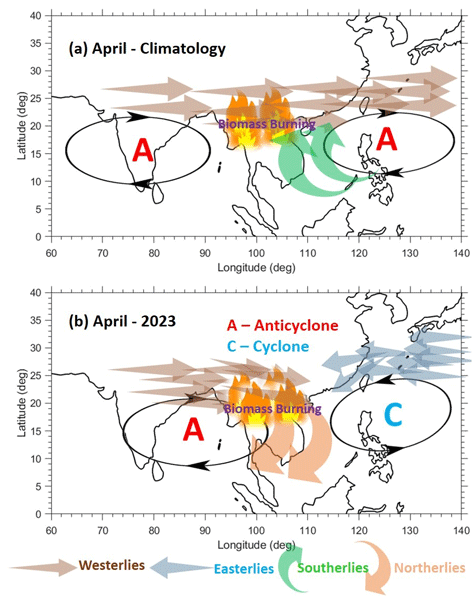
Abstract. In April 2023, the South China Sea (SCS) experienced an unprecedented surge in aerosol loading, reaching the highest levels recorded in the two-decade Moderate Resolution Imaging Spectroradiometer (MODIS) satellite data period (2003–2023). Satellite observations revealed a 150 % increase in aerosol optical depth (AOD) from MODIS and a 50 % rise in carbon monoxide (CO) at 700 and 500 hPa from Measurements Of Pollution In The Troposphere (MOPITT) over SCS. Here, we investigate the drivers and atmospheric mechanisms responsible for this extreme event, identifying large-scale biomass burning (BB) across northern Peninsular Southeast Asia (PSEA), particularly Laos and Myanmar as the primary source. Our analysis indicates that anomalously high surface temperatures, low soil moisture, reduced precipitation, and a persistent upper-tropospheric anticyclone created favorable BB conditions over PSEA. Laos alone accounted for ~56 % of the BB activity in the region, recording its largest monthly burned area (1.08 million hectares) since 2002. Dynamical analysis of the large-scale atmospheric circulation patterns revealed a major shift in regional wind regimes: the climatological south-westerlies over the SCS were replaced by anomalous northerlies, driven by the eastward shift of the Bay of Bengal anticyclone and the development of a cyclone anomaly over the western North Pacific (WNP). These changes redirected smoke transport from the usual WNP pathway to the SCS, resulting in significant transboundary pollution. This study highlights the critical role of compound meteorological extremes and circulation anomalies in amplifying regional aerosol loading, with implications for air quality, climate feedbacks, and environmental monitoring across Southeast Asia.
Competing interests: The contact author has declared that neither of the authors has any competing interests.
Publisher's note: Copernicus Publications remains neutral with regard to jurisdictional claims made in the text, published maps, institutional affiliations, or any other geographical representation in this paper. While Copernicus Publications makes every effort to include appropriate place names, the final responsibility lies with the authors. Views expressed in the text are those of the authors and do not necessarily reflect the views of the publisher.-
Notice on discussion status
The requested preprint has a corresponding peer-reviewed final revised paper. You are encouraged to refer to the final revised version.
-
Preprint
(2727 KB)
-
Supplement
(3184 KB)
-
The requested preprint has a corresponding peer-reviewed final revised paper. You are encouraged to refer to the final revised version.
- Preprint
(2727 KB) - Metadata XML
-
Supplement
(3184 KB) - BibTeX
- EndNote
- Final revised paper


Journal article(s) based on this preprint
Interactive discussion
Status: closed
-
RC1: 'Comment on egusphere-2025-4223', Anonymous Referee #1, 26 Sep 2025
-
AC1: 'Reply on RC1', Saginela Ravindra Babu, 08 Jan 2026
The comment was uploaded in the form of a supplement: https://egusphere.copernicus.org/preprints/2025/egusphere-2025-4223/egusphere-2025-4223-AC1-supplement.pdf
-
AC1: 'Reply on RC1', Saginela Ravindra Babu, 08 Jan 2026
-
RC2: 'Comment on egusphere-2025-4223', Anonymous Referee #2, 26 Sep 2025
This paper investigates the drivers of the record-breaking aerosol loading event over the South China Sea in April 2023, combining satellite observations, reanalysis data, and ground-based measurements. The study convincingly shows that large-scale biomass burning in northern Laos and Myanmar, combined with anomalous circulation patterns, caused unprecedented aerosol transport into the SCS. The integration of multiple datasets (MODIS, MOPITT, AIRS, OMI/MLS, and MERRA-2) strengthens the analysis, and the paper provides timely insights into extreme aerosol events under changing climate conditions. Overall, this work makes a valuable contribution to understanding regional transboundary pollution processes. I recommend minor revisions before acceptance.
(1) The fire activity analysis over Laos is a highlight of the study. Since you mention that 2023 had the largest monthly burned area on record, adding a supplementary figure comparing 2023 with other extreme fire years (e.g., 2016, 2003) would strengthen the historical context.
(2) The study identifies biomass burning in Laos as the major contributor to the April 2023 event. Could the authors clarify whether other regional fire sources (e.g., Maritime Continent or southern China) were quantitatively excluded, or whether their contributions are negligible compared to Laos?
(3) The circulation analysis (anticyclone over Bay of Bengal and cyclone over WNP) is central to the conclusions. It would help if the authors could briefly discuss whether such anomalous circulation patterns are unique to 2023, or if similar circulation shifts have occurred in past years without producing record-breaking aerosol loading.
(4) The study shows a strong correlation (r ~ 0.65) between AOD and CO anomalies. Could the authors expand on the physical interpretation? For example, does this imply biomass burning was the sole driver, or might secondary aerosol formation also have amplified AOD?
(5) The discussion links record-low soil moisture in Laos with enhanced fire intensity. Would it be possible to show a supplementary time series of soil moisture anomalies alongside fire counts to more directly demonstrate this relationship?
(6) Figure 2-4 provides rich information, but it is quite dense. For readers who are not familiar with the dataset, more explanatory notes or simplified illustrations (such as highlighting Laos as a fire hotspot) can improve accessibility. Figure 2c can be changed in color to highlight the contrast between Aqua and Terra.
(7) The schematic diagram in Figure 8 is excellent. Consider changing the color scheme of A/C cyclone and east-west wind to improve readability.
(8) The description of datasets is clear, but it would be useful to briefly summarize in one table the different satellite/reanalysis products used, their spatial/temporal resolutions, and the key variables. This would make the methodology section more reader-friendly.
(9) Since the paper emphasizes Southeast Asian fire climatology, it may be helpful to cite prior works that have quantified the magnitude and variability of fire activity in this region, such as Cohen (2014) and Cohen et al. (2017). Adding these references would provide a stronger background for the discussion of extreme fire activity in 2023. (https://doi.org/10.1088/1748-9326/9/11/114018; https://doi.org/10.5194/acp-17-721-2017)
(10) When mentioning black carbon transport and associated trace gases, the authors may consider citing recent top-down studies on BC and CO emissions in Asia (e.g., Wang et al., 2021; Wang et al., 2025). These works would complement the current study by highlighting related emission and transport perspectives. (https://doi.org/10.1029/2021EF002167; https://doi.org/10.1038/s41612-025-00977-2)
Citation: https://doi.org/10.5194/egusphere-2025-4223-RC2 -
AC2: 'Reply on RC2', Saginela Ravindra Babu, 08 Jan 2026
The comment was uploaded in the form of a supplement: https://egusphere.copernicus.org/preprints/2025/egusphere-2025-4223/egusphere-2025-4223-AC2-supplement.pdf
-
AC2: 'Reply on RC2', Saginela Ravindra Babu, 08 Jan 2026
-
RC3: 'Comment on egusphere-2025-4223', Anonymous Referee #3, 26 Sep 2025
The manuscript presents a thorough analysis of an unprecedented aerosol loading event over the South China Sea (SCS) in April 2023, using multiple satellite datasets and reanalysis products. The authors convincingly identify biomass burning in Laos and Myanmar as the primary source, and they discuss the unusual circulation anomalies that directed smoke transport into the SCS. The study is timely, relevant, and potentially impactful, especially given the increasing frequency of climate–fire extremes. However, I believe the manuscript requires further development before it can be accepted. My major concerns relate to the quantification of uncertainties, the robustness of transport attribution, and the integration of climate drivers. I detail my comments below.
Major Comments
- Uncertainties in Observational Datasets
- The manuscript reports extreme anomalies in MODIS AOD (>4σ) and MOPITT/AIRS CO (>3σ), but little discussion is provided regarding retrieval errors, biases, or limitations.
- Please provide a clearer treatment of uncertainties, for example: known MODIS biases over ocean and land, vertical sensitivity limits in MOPITT CO, and representativeness of reanalysis aerosol products. A sensitivity analysis (e.g., comparison across Aqua vs. Terra MODIS, MOPITT vs. AIRS CO) would help quantify robustness.
- Transport Attribution and Circulation Analysis
- The explanation of northerly transport due to the Bay of Bengal anticyclone and western North Pacific cyclone anomaly is plausible, but remains descriptive.
- I strongly recommend including trajectory or dispersion modeling (e.g., HYSPLIT, FLEXPART) to explicitly demonstrate that biomass burning plumes from Laos could reach the SCS. Alternatively, a composite analysis of circulation anomalies in other strong-fire years could be used to strengthen causality.
- Link to Large-Scale Climate Drivers
- The manuscript notes the La Niña–El Niño transition and a tri-polar SST anomaly structure but does not fully connect these anomalies to the extreme biomass burning and circulation changes.
- Please expand the discussion to show whether such SST/ENSO anomalies have historically coincided with enhanced PSEA burning or altered circulation patterns. This would greatly strengthen the broader climate relevance of the study.
Minor Comments
- Figures and Visualization
- Several figures (e.g., Figs. 2, 3, 5, 6) are visually dense with overlapping hatching and color contours. Please simplify or separate key results, and ensure legends are large and consistent.
- Terminology Consistency
- The text alternates between “TCO” and “TOC” for tropospheric ozone. Please standardize terminology throughout.
- Ground-Based Validation
- AERONET data from Dongsha Island and Lulin are mentioned but not analyzed in detail. I suggest including explicit time series plots and quantitative comparisons with satellite AOD to reinforce credibility.
- Literature Context
- The manuscript could benefit from more thorough discussion of prior SCS and Southeast Asian biomass burning studies (e.g., 7-SEAS campaigns, Lin et al. 2013; Reid et al. 2013). This would help contextualize the novelty of the April 2023 event.
- Language and Style
- Some sentences are repetitive (e.g., emphasis on Laos’ share of BB activity) and could be streamlined. Please also ensure consistent reference to “Supplementary Figures” rather than “Sup. Figures.”
- Outlook / Future Work
- The conclusions briefly mention aerosol–radiation interactions and links to heatwaves. I encourage a more explicit outlook section, highlighting next steps such as quantifying radiative forcing or simulating impacts with chemistry–climate models.
Citation: https://doi.org/10.5194/egusphere-2025-4223-RC3 -
AC3: 'Reply on RC3', Saginela Ravindra Babu, 08 Jan 2026
The comment was uploaded in the form of a supplement: https://egusphere.copernicus.org/preprints/2025/egusphere-2025-4223/egusphere-2025-4223-AC3-supplement.pdf
Peer review completion


Interactive discussion
Status: closed
-
RC1: 'Comment on egusphere-2025-4223', Anonymous Referee #1, 26 Sep 2025
General Comment
The manuscript addresses the record-breaking aerosol loading over the South China Sea (SCS) in April 2023, attributed to biomass burning (BB) over the northern Indochina Peninsula. While the topic is of regional and global importance, the study suffers from several critical issues. The methodology is overly simplistic, the novelty is limited, the logical flow is confusing, and key presentation elements (maps, data classification, figures) do not meet the standards of a top-tier journal. In its current form, the manuscript reads more like a descriptive case report rather than an in-depth scientific analysis. Substantial revision is needed before it can be considered for publication.
Major Comments
- Scientific Significance and Novelty
- Biomass burning over Indochina and its long-range transport to the SCS is a well-documented and recurring phenomenon (e.g., Lin et al., 2013; Reid et al., 2013). The manuscript merely shows that April 2023 recorded the highest anomalies in AOD/CO/ozone in the past two decades.
- Without deeper analysis of what makes 2023 fundamentally different (e.g., unique transport pathways, distinct chemical mechanisms, significant health/climate impacts), the work risks being a replication of prior studies with little added value. The authors need to explicitly demonstrate the novelty and scientific importance of this case beyond being “the largest on record.”
- Mismatch Between Analysis and Conclusions
- The conclusions claim clear attribution to Laos fires and anomalous circulation systems. However, the analysis is largely descriptive, relying on anomaly maps and percentage changes.
- The causal chain (fire activity → transport anomalies → AOD/CO increases → ozone formation) is not rigorously substantiated. For example, CO–AOD correlation (~0.65) only suggests coincidence, not causality. Ozone enhancement is attributed to BB emissions without distinguishing between primary transport and secondary chemistry.
- The authors should either strengthen the causal evidence (e.g., trajectory modeling, chemical transport simulations, Rossby wave diagnostics) or tone down the conclusions.
- Methodology Too Simplistic
- The methodology is limited to anomaly calculations relative to the 2003–2022 climatology and σ-thresholds.
- No advanced statistical diagnostics (EOF, regression, composite analysis) or modeling tools (WRF-Chem, GEOS-Chem, HYSPLIT) are applied.
- For a high-impact journal, such purely descriptive methods are insufficient. More mechanistic or quantitative approaches are expected to justify publication.
- Logical Flow and Structure
- The introduction devotes excessive space to global wildfire events (Canada, Hawaii, Mediterranean), which dilutes the focus on the SCS case.
- The Results and Discussion section frequently shifts between AOD, CO, fire counts, meteorology, circulation, and ozone, without a clear hierarchical structure. This leads to a confusing narrative.
- The manuscript would benefit from a re-organization: Phenomenon confirmation → Source attribution → Circulation mechanisms → Chemical/ozone impacts → Implications.
- Data Classification and Transparency
- Satellite products (MODIS, MOPITT, AIRS, OMI/MLS), reanalysis datasets (MERRA-2, GLDAS, GPCP), and in-situ measurements (AERONET, ozonesondes) are all mixed together in one section.
- It is difficult for the reader to distinguish between direct observations, model-assimilated reanalysis, and ground truth data.
- The Data and Methodology section should be reorganized into clear categories: (1) Satellite remote sensing, (2) Reanalysis/model products, (3) Ground-based observations.
- Use of Supplementary Figures
- Key evidence (e.g., climatological AOD distributions, long-term time series) is presented only in Supplementary Figures.
- Essential results should be in the main text, with Supplementary reserved for additional details or robustness checks. As written, the paper is not self-contained.
- Map Presentation and Political Sensitivity
- Several figures show solid boundary lines in regions with disputed territories (e.g., South China Sea). International journals require disputed boundaries to be indicated with dashed lines and/or with a neutral disclaimer in the captions.
- The authors must revise all maps accordingly to comply with cartographic and editorial standards.
- Lack of Impact Assessment
- The study stops at describing anomalies. There is no evaluation of downstream consequences (e.g., impacts on regional air quality, radiative forcing, health risks).
- Without such discussion, the significance of the findings remains limited.
Minor Comments
- Figures are overcrowded, with small fonts and inconsistent styles (gradient colors vs. hatching). Improve readability and adopt a uniform design.
- Figure 8 schematic is overly simplistic compared to the complexity of earlier figures; it should more clearly contrast climatological vs. 2023 circulation states.
- Reference formatting is inconsistent; some entries are incomplete or lack DOI.
- The writing style is verbose. The introduction should be shortened and sharpened to highlight the scientific problem.
- The format are not clearly uniform between 1∘ × 1∘ in L116 and 0.25° in L124. The font format of L124-125 is different from other context.
- L140, why the skin temperature is used in this work?
- L187, L198, add ° for the logitude and latitude.
- L185, Sup. Figures, L188, Sup—Figures, P201, Sup. Fig. and so on, keep the same citaiton style, refer to the papers in the top journals.
- L 241, the maps are not correct, as we know, there are still undecided boarders between China and India, the author should clearly state them in the maps.
Citation: https://doi.org/10.5194/egusphere-2025-4223-RC1 -
AC1: 'Reply on RC1', Saginela Ravindra Babu, 08 Jan 2026
The comment was uploaded in the form of a supplement: https://egusphere.copernicus.org/preprints/2025/egusphere-2025-4223/egusphere-2025-4223-AC1-supplement.pdf
-
RC2: 'Comment on egusphere-2025-4223', Anonymous Referee #2, 26 Sep 2025
This paper investigates the drivers of the record-breaking aerosol loading event over the South China Sea in April 2023, combining satellite observations, reanalysis data, and ground-based measurements. The study convincingly shows that large-scale biomass burning in northern Laos and Myanmar, combined with anomalous circulation patterns, caused unprecedented aerosol transport into the SCS. The integration of multiple datasets (MODIS, MOPITT, AIRS, OMI/MLS, and MERRA-2) strengthens the analysis, and the paper provides timely insights into extreme aerosol events under changing climate conditions. Overall, this work makes a valuable contribution to understanding regional transboundary pollution processes. I recommend minor revisions before acceptance.
(1) The fire activity analysis over Laos is a highlight of the study. Since you mention that 2023 had the largest monthly burned area on record, adding a supplementary figure comparing 2023 with other extreme fire years (e.g., 2016, 2003) would strengthen the historical context.
(2) The study identifies biomass burning in Laos as the major contributor to the April 2023 event. Could the authors clarify whether other regional fire sources (e.g., Maritime Continent or southern China) were quantitatively excluded, or whether their contributions are negligible compared to Laos?
(3) The circulation analysis (anticyclone over Bay of Bengal and cyclone over WNP) is central to the conclusions. It would help if the authors could briefly discuss whether such anomalous circulation patterns are unique to 2023, or if similar circulation shifts have occurred in past years without producing record-breaking aerosol loading.
(4) The study shows a strong correlation (r ~ 0.65) between AOD and CO anomalies. Could the authors expand on the physical interpretation? For example, does this imply biomass burning was the sole driver, or might secondary aerosol formation also have amplified AOD?
(5) The discussion links record-low soil moisture in Laos with enhanced fire intensity. Would it be possible to show a supplementary time series of soil moisture anomalies alongside fire counts to more directly demonstrate this relationship?
(6) Figure 2-4 provides rich information, but it is quite dense. For readers who are not familiar with the dataset, more explanatory notes or simplified illustrations (such as highlighting Laos as a fire hotspot) can improve accessibility. Figure 2c can be changed in color to highlight the contrast between Aqua and Terra.
(7) The schematic diagram in Figure 8 is excellent. Consider changing the color scheme of A/C cyclone and east-west wind to improve readability.
(8) The description of datasets is clear, but it would be useful to briefly summarize in one table the different satellite/reanalysis products used, their spatial/temporal resolutions, and the key variables. This would make the methodology section more reader-friendly.
(9) Since the paper emphasizes Southeast Asian fire climatology, it may be helpful to cite prior works that have quantified the magnitude and variability of fire activity in this region, such as Cohen (2014) and Cohen et al. (2017). Adding these references would provide a stronger background for the discussion of extreme fire activity in 2023. (https://doi.org/10.1088/1748-9326/9/11/114018; https://doi.org/10.5194/acp-17-721-2017)
(10) When mentioning black carbon transport and associated trace gases, the authors may consider citing recent top-down studies on BC and CO emissions in Asia (e.g., Wang et al., 2021; Wang et al., 2025). These works would complement the current study by highlighting related emission and transport perspectives. (https://doi.org/10.1029/2021EF002167; https://doi.org/10.1038/s41612-025-00977-2)
Citation: https://doi.org/10.5194/egusphere-2025-4223-RC2 -
AC2: 'Reply on RC2', Saginela Ravindra Babu, 08 Jan 2026
The comment was uploaded in the form of a supplement: https://egusphere.copernicus.org/preprints/2025/egusphere-2025-4223/egusphere-2025-4223-AC2-supplement.pdf
-
AC2: 'Reply on RC2', Saginela Ravindra Babu, 08 Jan 2026
-
RC3: 'Comment on egusphere-2025-4223', Anonymous Referee #3, 26 Sep 2025
The manuscript presents a thorough analysis of an unprecedented aerosol loading event over the South China Sea (SCS) in April 2023, using multiple satellite datasets and reanalysis products. The authors convincingly identify biomass burning in Laos and Myanmar as the primary source, and they discuss the unusual circulation anomalies that directed smoke transport into the SCS. The study is timely, relevant, and potentially impactful, especially given the increasing frequency of climate–fire extremes. However, I believe the manuscript requires further development before it can be accepted. My major concerns relate to the quantification of uncertainties, the robustness of transport attribution, and the integration of climate drivers. I detail my comments below.
Major Comments
- Uncertainties in Observational Datasets
- The manuscript reports extreme anomalies in MODIS AOD (>4σ) and MOPITT/AIRS CO (>3σ), but little discussion is provided regarding retrieval errors, biases, or limitations.
- Please provide a clearer treatment of uncertainties, for example: known MODIS biases over ocean and land, vertical sensitivity limits in MOPITT CO, and representativeness of reanalysis aerosol products. A sensitivity analysis (e.g., comparison across Aqua vs. Terra MODIS, MOPITT vs. AIRS CO) would help quantify robustness.
- Transport Attribution and Circulation Analysis
- The explanation of northerly transport due to the Bay of Bengal anticyclone and western North Pacific cyclone anomaly is plausible, but remains descriptive.
- I strongly recommend including trajectory or dispersion modeling (e.g., HYSPLIT, FLEXPART) to explicitly demonstrate that biomass burning plumes from Laos could reach the SCS. Alternatively, a composite analysis of circulation anomalies in other strong-fire years could be used to strengthen causality.
- Link to Large-Scale Climate Drivers
- The manuscript notes the La Niña–El Niño transition and a tri-polar SST anomaly structure but does not fully connect these anomalies to the extreme biomass burning and circulation changes.
- Please expand the discussion to show whether such SST/ENSO anomalies have historically coincided with enhanced PSEA burning or altered circulation patterns. This would greatly strengthen the broader climate relevance of the study.
Minor Comments
- Figures and Visualization
- Several figures (e.g., Figs. 2, 3, 5, 6) are visually dense with overlapping hatching and color contours. Please simplify or separate key results, and ensure legends are large and consistent.
- Terminology Consistency
- The text alternates between “TCO” and “TOC” for tropospheric ozone. Please standardize terminology throughout.
- Ground-Based Validation
- AERONET data from Dongsha Island and Lulin are mentioned but not analyzed in detail. I suggest including explicit time series plots and quantitative comparisons with satellite AOD to reinforce credibility.
- Literature Context
- The manuscript could benefit from more thorough discussion of prior SCS and Southeast Asian biomass burning studies (e.g., 7-SEAS campaigns, Lin et al. 2013; Reid et al. 2013). This would help contextualize the novelty of the April 2023 event.
- Language and Style
- Some sentences are repetitive (e.g., emphasis on Laos’ share of BB activity) and could be streamlined. Please also ensure consistent reference to “Supplementary Figures” rather than “Sup. Figures.”
- Outlook / Future Work
- The conclusions briefly mention aerosol–radiation interactions and links to heatwaves. I encourage a more explicit outlook section, highlighting next steps such as quantifying radiative forcing or simulating impacts with chemistry–climate models.
Citation: https://doi.org/10.5194/egusphere-2025-4223-RC3 -
AC3: 'Reply on RC3', Saginela Ravindra Babu, 08 Jan 2026
The comment was uploaded in the form of a supplement: https://egusphere.copernicus.org/preprints/2025/egusphere-2025-4223/egusphere-2025-4223-AC3-supplement.pdf
Peer review completion
Journal article(s) based on this preprint
Viewed
| HTML | XML | Total | Supplement | BibTeX | EndNote | |
|---|---|---|---|---|---|---|
| 13,917 | 1,010 | 238 | 15,165 | 478 | 205 | 202 |
- HTML: 13,917
- PDF: 1,010
- XML: 238
- Total: 15,165
- Supplement: 478
- BibTeX: 205
- EndNote: 202
Viewed (geographical distribution)
| Country | # | Views | % |
|---|
| Total: | 0 |
| HTML: | 0 |
| PDF: | 0 |
| XML: | 0 |
- 1
Saginela Ravindra Babu

Neng-Huei Lin
The requested preprint has a corresponding peer-reviewed final revised paper. You are encouraged to refer to the final revised version.
- Preprint
(2727 KB) - Metadata XML
-
Supplement
(3184 KB) - BibTeX
- EndNote
- Final revised paper
General Comment
The manuscript addresses the record-breaking aerosol loading over the South China Sea (SCS) in April 2023, attributed to biomass burning (BB) over the northern Indochina Peninsula. While the topic is of regional and global importance, the study suffers from several critical issues. The methodology is overly simplistic, the novelty is limited, the logical flow is confusing, and key presentation elements (maps, data classification, figures) do not meet the standards of a top-tier journal. In its current form, the manuscript reads more like a descriptive case report rather than an in-depth scientific analysis. Substantial revision is needed before it can be considered for publication.
Major Comments
Minor Comments