
the Creative Commons Attribution 4.0 License.
the Creative Commons Attribution 4.0 License.
 | 15 Aug 2025
Introducing aerosol-cloud interactions in the ECMWF model reveals new constraints on aerosol representation
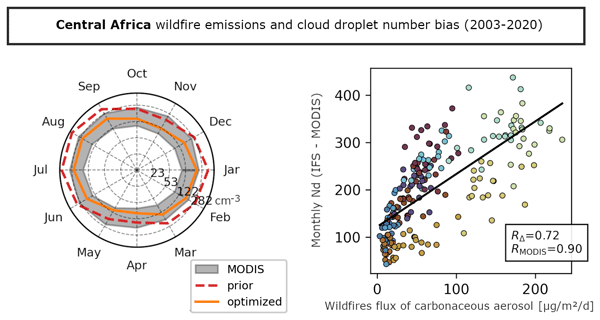
Abstract. Realistic number concentrations of aerosol cloud condensation nuclei (CCN) are critical to simulate the Earth’s atmosphere radiative budget. However, CCN concentrations are very uncertain, which critically limits our capacity to precisely predict climate change. This is partly because aerosol optical depth (AOD) observations, traditionally used for validation of and assimilation into aerosol models, weakly constrain number concentrations. We introduce aerosol-cloud interactions (ACI) in the European Centre for Medium-Range Weather Forecasts (ECMWF) Integrated Forecasting System (IFS) to simulate the activation of aerosols into cloud droplets driven by aerosol concentrations from the Copernicus Atmosphere Monitoring System (CAMS), using offline computations from a parcel model. Then, we use an 18-year-long series of MODIS cloud droplet number concentrations (Nd) retrievals to tune aerosol size distributions and simulated number concentrations. Finally, we validate the system using AOD observations, all-sky broadband SW fluxes, Angstrom exponent and size spectra from satellite and AERONET. We found that CAMS aerosols allows simulating overall realistic Nd values, but these are systematically overestimated over most of sub-Saharan Africa and underestimated at latitudes higher than 60° N and 45° S. While the first bias hints at issues with carbonaceous aerosols from African wildfires, the high-latitude bias originates from too efficient aerosol scavenging in mixed-phase clouds. We finally show that addressing this last issue dramatically improves simulated clouds over the Southern Ocean. This study showcases that representing ACI in a weather model is a powerful diagnostic tool to improve aerosol representations and processes, potentially informing also applications in climate models.
-
Notice on discussion status
The requested preprint has a corresponding peer-reviewed final revised paper. You are encouraged to refer to the final revised version.
-
Preprint
(5690 KB)
-
The requested preprint has a corresponding peer-reviewed final revised paper. You are encouraged to refer to the final revised version.
- Preprint
(5690 KB) - Metadata XML
- BibTeX
- EndNote
- Final revised paper


Journal article(s) based on this preprint
Interactive discussion
Status: closed
- RC1: 'Comment on egusphere-2025-3790', Anonymous Referee #1, 12 Nov 2025
-
RC2: 'Comment on egusphere-2025-3790', Anonymous Referee #2, 25 Nov 2025
In this study, the authors propose a simplified representation of aerosol activation in the IFS model, aiming to link aerosol mass to cloud condensation nuclei (CCN) concentrations. The primary objective is to enhance the capability to represent the aerosol size distribution and associated radiative forcing by using satellite retrievals of droplet number concentration. This is a topic of significant relevance to the atmospheric science community, since most operational weather forecasting systems lack explicit representations of aerosol–cloud interactions (ACIs). However, the methodology adopted by the authors is based on assumptions that are neither sufficiently justified nor robust, introducing substantial biases in the modeled droplet number concentration (Nd). Moreover, the authors overlook a substantial body of literature that could have informed and strengthened their approach. Given these critical issues, the manuscript is not suitable for publication.
Major Comments:
- The implementation of aerosol–cloud interactions in weather and climate models has been a longstanding topic of research. Numerous global climate models, seasonal forecasting systems, and modern reanalyses already include such representations (e.g., Seinfeld et al., 2016; Benedetti and Vitart, 2018; Wang et al., 2021; Song et al., 2025). Additionally, aerosol activation parameterizations have undergone extensive development over the past decades, resulting in computationally efficient schemes (e.g., Ghan et al., 2011). Retrievals of CCN concentrations from aerosol reanalyses such as CAMS have also been demonstrated (Block et al., 2024). A more thorough discussion of this existing body of work would have helped guide the authors’ methodology and contextualize their contribution.
- The manuscript does not clearly define what is meant by the implementation of ACIs. Most of the discussion focuses on adjustments to the aerosol size distribution and the resulting changes in aerosol fields, with minimal reference to cloud properties. It remains unclear whether the computed Nd is actively used to influence or update any cloud-related processes in the model, raising doubts about the actual implementation of ACIs.
- The assumption of a constant updraft velocity of 1 m/s lacks physical justification and is not supported by observational or theoretical evidence. It is well established that Nd is highly sensitive to updraft velocity, which has profound implications for the aerosol indirect effect (Sullivan et al., 2016). While it is true that updraft is among the most uncertain parameters in ACI modeling, applying a fixed and globally unrealistic value, appropriate only for small marine cumulus clouds, is not defensible.
- The treatment of satellite retrieval uncertainties is problematic. The authors appear to treat differences arising from alternate retrieval assumptions as equivalent to experimental error, which is not technically sound. Moreover, model outputs must be sampled in a manner consistent with the assumptions of the satellite retrievals to avoid artificial biases. For instance, retrieval filters based on temperature and cloud fraction tend to exclude clouds with low Nd, particularly in high-latitude regions. If such filters are not consistently applied to the model data, it can lead to systematic biases, potentially causing the authors to erroneously tune scavenging parameters in response to what is essentially a sampling artefact.
- The global optimization approach based on satellite retrievals fails to account for their limited validity. Retrieval techniques are typically applicable to vertically homogeneous, adiabatic, low-level clouds, which are the exception rather than the norm. Despite this, the authors extend the use of the retrieval to mixed-phase clouds and regimes strongly influenced by convection, where the assumptions underlying the retrieval no longer hold.
- The manuscript does not include a data availability statement. The code availability statement does not refer to the parcel model, nor the lookup table used in this work. Given the nature of the work and its reliance on numerical model development and evaluation, it is essential that both the data and the implementation code be made publicly accessible to support reproducibility and validation.
References:
- Benedetti, A., & Vitart, F. (2018). Can the direct effect of aerosols improve subseasonal predictability? Monthly Weather Review, 146, 3481–3498. https://doi.org/10.1175/MWR-D-17-0282.1
- Block, K., Haghighatnasab, M., Partridge, D. G., Stier, P., & Quaas, J. (2024). Cloud condensation nuclei concentrations derived from the CAMS reanalysis. Earth System Science Data, 16, 443–470. https://doi.org/10.5194/essd-16-443-2024
- Ghan, S. J., Abdul-Razzak, H., Nenes, A., Ming, Y., Liu, X., Ovchinnikov, M., Shipway, B., Meskhidze, N., Xu, J., & Shi, X. (2011). Droplet nucleation: Physically-based parameterizations and comparative evaluation. Journal of Advances in Modeling Earth Systems, 3(4). https://doi.org/10.1029/2011MS000074
- Seinfeld, J. H., Bretherton, C., Carslaw, K. S., et al. (2016). Improving our fundamental understanding of the role of aerosol–cloud interactions in the climate system. Proceedings of the National Academy of Sciences, 113(21), 5781–5790. https://doi.org/10.1073/pnas.1514043113
- Song, C., McCoy, D., Molod, A., Aerenson, T., & Barahona, D. (2025). Signatures of aerosol–cloud interactions in GiOcean: A coupled global reanalysis with two-moment cloud microphysics. Atmospheric Chemistry and Physics, 25, 15567–15592. https://doi.org/10.5194/acp-25-15567-2025
- Sullivan, S. C., Lee, D., Oreopoulos, L., & Nenes, A. (2016). Role of updraft velocity in temporal variability of global cloud hydrometeor number. Proceedings of the National Academy of Sciences, 113(21), 5791–5796. https://doi.org/10.1073/pnas.1514039113
- Wang, C., Soden, B. J., Yang, W., & Vecchi, G. A. (2021). Compensation between cloud feedback and aerosol–cloud interaction in CMIP6 models. Geophysical Research Letters, 48(4), e2020GL091024. https://doi.org/10.1029/2020GL091024
Citation: https://doi.org/10.5194/egusphere-2025-3790-RC2 - AC1: 'Response to discussion comments', Paolo Andreozzi, 16 Jan 2026
Peer review completion


Interactive discussion
Status: closed
-
RC1: 'Comment on egusphere-2025-3790', Anonymous Referee #1, 12 Nov 2025
Review of Andreozzi et al. (2025)
This study aims to introduce aerosol-cloud interactions in the ECMWF IFS model. The authors performed offline parcel model simulations and created a lookup table (LUT) for Nd prediction. MODIS Nd retrievals were used to constrain/optimize the median radius of the aerosol size distribution (ASD) for Nd prediction. Observed aerosol optical properties and SW fluxes were used to evaluate the model. They found large biases over high latitudes and attributed this to overly efficient aerosol wet removal in mixed-phase clouds using sensitivity simulations. The scientific motivation is sound and addresses an important challenge in weather forecasting. Implementing ACI in operational weather prediction models is inherently complex due to computational costs and intricate aerosol-cloud process interactions, making simplified treatments a reasonable approach. However, I have some concerns about the evaluation of input fields (e.g., aerosol mass concentrations), potential sampling mismatches, the optimization concept and procedure, and the interpretation of results.
1. The model/simulation description and configuration are not very clear. The study aims to "introduce aerosol-cloud interactions," but it does not mention: a) whether and/or how the computed Nd values will affect cloud droplet effective radius and autoconversion calculations; and b) whether the modified cloud properties/lifetime will provide feedback to radiation or meteorology. For the results discussed, it is often difficult to determine whether they are from offline calculations or online simulations.
2. The optimization only considers the impact of aerosol size distribution (or r_med) changes on Nd, assuming that the aerosol mass fields and thermodynamical fields for activation calculations and the sampling/averaging are "perfect." The authors did not provide any evaluation of these fields or relevant references. For example, do CAMS aerosol forecasts have known substantial biases and uncertainties over regions with stratiform warm clouds? What is the uncertainty associated with sampling errors? Without considering these aspects, the optimization could compensate for systematic biases in these fields through unrealistic size distribution adjustments.
3. Critical model/retrieval sampling mismatch. The comparison between model-derived and satellite-observed Nd may suffer from sampling inconsistencies that invalidate the optimization results: a) different cloud detection methods: ERA5 model diagnostics vs. satellite radiance retrievals define "cloud top" differently; b) spatial resolution mismatch: 3°×3° model data (aerosol concentrations and meteorological fields) are used to calculate Nd and compared with MODIS data - although MODIS data are also regridded to a 3°×3° grid, they are aggregated and averaged from finer resolution, so they represent vastly different sampling volumes; c) temporal sampling bias: model data (4 times daily, every 5th day) vs. actual satellite overpass times; d) vertical sampling inconsistency: model-diagnosed cloud levels vs. satellite-retrieved cloud properties may sample completely different atmospheric layers. The current study lacks uncertainty estimates related to these issues.
4. Physical inconsistency in process representation considered for optimization (Section 4.3). If I understand it correctly, the authors extract aerosol concentrations at "cloud top" and apply a 1 m/s updraft velocity to simulate activation at this level using the lookup table. I assume this approach considers that Nd retrievals are for "cloud top" only, but the method contradicts basic cloud microphysical principles. In reality, CCN activation occurs at cloud base during initial adiabatic ascent where supersaturation develops, and the resulting droplet population is then transported vertically through the cloud. Nd satellite retrievals often assume adiabatic conditions, where Nd is considered constant throughout the cloud. Additionally, cloud tops typically experience subsiding air masses, entrainment of dry air, and near-zero or negative vertical velocities, so the 1 m/s (upward) vertical velocity assumption at cloud top is very likely unrealistic for most of the time. Aerosol populations at cloud top have been modified by scavenging, entrainment, and chemistry, making them fundamentally different from the original CCN population (consistent with results shown in figure 10). The authors seem to have realized this issue, as indicated by the comparison of InCloud and ClBase3 results in Table 3 and Figures 4&10.
Specific comments:
Title: If the goal is really to show the introduction of ACI in IFS helps to constrain the aerosol representation, a more comprehensive evaluation of the aerosol properties is needed (e.g., evaluation of aerosol size distribution using in-situ data). In my opinion (and as the authors discussed in the introduction), the value of this work is more on providing a simplified but practical treatment of Nd prediction and ACI representation in the IFS model, which will allow IFS (with CAMS) to consider the impact of aerosols on clouds in the future.
Page 1, Line 10: “We found that CAMS aerosols allows simulating overall realistic Nd values”. Is this conclusion for un-optimized or optimized ASD?
Page 2, Line 24: “have been for are” check grammar here.
Page 4, Line 93: The direct aerosol effect should also affect the meteorological fields, not only semi-direct effect.
Page 4, Line 105: Will hydrophobic aerosols be removed by precipitation?
Page 4, Line 115: Does hydrophilic BC have hygroscopic growth and is it considered in activation? Or “hydrophilic” BC only applies to wet removal calculation?
Page 6, Line 144: It seems to me the change in k_ext is quite large for certain spices at certain RHs. It would be useful to calculate the difference using the default and optimized r_med values.
Page 8, Line 165-170: Please provide the references of Q06, G18, and BR17.
Page 10, Line 216-217: How large is the uncertainty associated with these assumptions?
Page 10, Line 224: The assumed updraft/vertical velocity is pretty large, and is associated with large uncertainties.
Page 11, Line 238: T255 should be at ~80km resolution, instead of 38km? Please double check.
Page 11, Line 250: Does the MODIS retrieval apply a similar conditional sampling?
Page 12, section 4.3: I assume this approach considers that Nd retrievals are for "cloud top" only, but the method contradicts basic cloud microphysical principles. In reality, CCN activation occurs at cloud base during initial adiabatic ascent where supersaturation develops, and the resulting droplet population is then transported vertically through the cloud. Nd satellite retrievals often assume adiabatic conditions, where Nd is considered constant throughout the cloud.
Page 12, section 4.3, formula 7: Why only Nd_Q06 is considered in the numerator?
Page 12, Line 285: a brief description of the "Nelder-Mead” algothrim is necessary. How to simutaneously optimize different r_med values for individual aerosol species?
Page 12, section 4.3: please also discuss how the temporal co-location and averaging are applied.
Page 13, Table 3: Please discuss values in the 4th column (ClBase3).
Page 19, Figure 8: What is Nd,modis? Which of Q06, G18, and BR17?
Page 20, Figure 9: How is the IFS “ctrl” simulation configured? Would be useful to compare the simulations with original and modified r_med values.
Citation: https://doi.org/10.5194/egusphere-2025-3790-RC1 -
RC2: 'Comment on egusphere-2025-3790', Anonymous Referee #2, 25 Nov 2025
In this study, the authors propose a simplified representation of aerosol activation in the IFS model, aiming to link aerosol mass to cloud condensation nuclei (CCN) concentrations. The primary objective is to enhance the capability to represent the aerosol size distribution and associated radiative forcing by using satellite retrievals of droplet number concentration. This is a topic of significant relevance to the atmospheric science community, since most operational weather forecasting systems lack explicit representations of aerosol–cloud interactions (ACIs). However, the methodology adopted by the authors is based on assumptions that are neither sufficiently justified nor robust, introducing substantial biases in the modeled droplet number concentration (Nd). Moreover, the authors overlook a substantial body of literature that could have informed and strengthened their approach. Given these critical issues, the manuscript is not suitable for publication.
Major Comments:
- The implementation of aerosol–cloud interactions in weather and climate models has been a longstanding topic of research. Numerous global climate models, seasonal forecasting systems, and modern reanalyses already include such representations (e.g., Seinfeld et al., 2016; Benedetti and Vitart, 2018; Wang et al., 2021; Song et al., 2025). Additionally, aerosol activation parameterizations have undergone extensive development over the past decades, resulting in computationally efficient schemes (e.g., Ghan et al., 2011). Retrievals of CCN concentrations from aerosol reanalyses such as CAMS have also been demonstrated (Block et al., 2024). A more thorough discussion of this existing body of work would have helped guide the authors’ methodology and contextualize their contribution.
- The manuscript does not clearly define what is meant by the implementation of ACIs. Most of the discussion focuses on adjustments to the aerosol size distribution and the resulting changes in aerosol fields, with minimal reference to cloud properties. It remains unclear whether the computed Nd is actively used to influence or update any cloud-related processes in the model, raising doubts about the actual implementation of ACIs.
- The assumption of a constant updraft velocity of 1 m/s lacks physical justification and is not supported by observational or theoretical evidence. It is well established that Nd is highly sensitive to updraft velocity, which has profound implications for the aerosol indirect effect (Sullivan et al., 2016). While it is true that updraft is among the most uncertain parameters in ACI modeling, applying a fixed and globally unrealistic value, appropriate only for small marine cumulus clouds, is not defensible.
- The treatment of satellite retrieval uncertainties is problematic. The authors appear to treat differences arising from alternate retrieval assumptions as equivalent to experimental error, which is not technically sound. Moreover, model outputs must be sampled in a manner consistent with the assumptions of the satellite retrievals to avoid artificial biases. For instance, retrieval filters based on temperature and cloud fraction tend to exclude clouds with low Nd, particularly in high-latitude regions. If such filters are not consistently applied to the model data, it can lead to systematic biases, potentially causing the authors to erroneously tune scavenging parameters in response to what is essentially a sampling artefact.
- The global optimization approach based on satellite retrievals fails to account for their limited validity. Retrieval techniques are typically applicable to vertically homogeneous, adiabatic, low-level clouds, which are the exception rather than the norm. Despite this, the authors extend the use of the retrieval to mixed-phase clouds and regimes strongly influenced by convection, where the assumptions underlying the retrieval no longer hold.
- The manuscript does not include a data availability statement. The code availability statement does not refer to the parcel model, nor the lookup table used in this work. Given the nature of the work and its reliance on numerical model development and evaluation, it is essential that both the data and the implementation code be made publicly accessible to support reproducibility and validation.
References:
- Benedetti, A., & Vitart, F. (2018). Can the direct effect of aerosols improve subseasonal predictability? Monthly Weather Review, 146, 3481–3498. https://doi.org/10.1175/MWR-D-17-0282.1
- Block, K., Haghighatnasab, M., Partridge, D. G., Stier, P., & Quaas, J. (2024). Cloud condensation nuclei concentrations derived from the CAMS reanalysis. Earth System Science Data, 16, 443–470. https://doi.org/10.5194/essd-16-443-2024
- Ghan, S. J., Abdul-Razzak, H., Nenes, A., Ming, Y., Liu, X., Ovchinnikov, M., Shipway, B., Meskhidze, N., Xu, J., & Shi, X. (2011). Droplet nucleation: Physically-based parameterizations and comparative evaluation. Journal of Advances in Modeling Earth Systems, 3(4). https://doi.org/10.1029/2011MS000074
- Seinfeld, J. H., Bretherton, C., Carslaw, K. S., et al. (2016). Improving our fundamental understanding of the role of aerosol–cloud interactions in the climate system. Proceedings of the National Academy of Sciences, 113(21), 5781–5790. https://doi.org/10.1073/pnas.1514043113
- Song, C., McCoy, D., Molod, A., Aerenson, T., & Barahona, D. (2025). Signatures of aerosol–cloud interactions in GiOcean: A coupled global reanalysis with two-moment cloud microphysics. Atmospheric Chemistry and Physics, 25, 15567–15592. https://doi.org/10.5194/acp-25-15567-2025
- Sullivan, S. C., Lee, D., Oreopoulos, L., & Nenes, A. (2016). Role of updraft velocity in temporal variability of global cloud hydrometeor number. Proceedings of the National Academy of Sciences, 113(21), 5791–5796. https://doi.org/10.1073/pnas.1514039113
- Wang, C., Soden, B. J., Yang, W., & Vecchi, G. A. (2021). Compensation between cloud feedback and aerosol–cloud interaction in CMIP6 models. Geophysical Research Letters, 48(4), e2020GL091024. https://doi.org/10.1029/2020GL091024
Citation: https://doi.org/10.5194/egusphere-2025-3790-RC2 - AC1: 'Response to discussion comments', Paolo Andreozzi, 16 Jan 2026
Peer review completion
Journal article(s) based on this preprint
Viewed
| HTML | XML | Total | BibTeX | EndNote | |
|---|---|---|---|---|---|
| 12,615 | 1,686 | 220 | 14,521 | 292 | 285 |
- HTML: 12,615
- PDF: 1,686
- XML: 220
- Total: 14,521
- BibTeX: 292
- EndNote: 285
Viewed (geographical distribution)
| Country | # | Views | % |
|---|
| Total: | 0 |
| HTML: | 0 |
| PDF: | 0 |
| XML: | 0 |
- 1
Paolo Andreozzi

Mark D. Fielding
Robin J. Hogan
Richard M. Forbes
Samuel Rémy
Birger Bohn
Ulrich Löhnert
The requested preprint has a corresponding peer-reviewed final revised paper. You are encouraged to refer to the final revised version.
- Preprint
(5690 KB) - Metadata XML
Review of Andreozzi et al. (2025)
This study aims to introduce aerosol-cloud interactions in the ECMWF IFS model. The authors performed offline parcel model simulations and created a lookup table (LUT) for Nd prediction. MODIS Nd retrievals were used to constrain/optimize the median radius of the aerosol size distribution (ASD) for Nd prediction. Observed aerosol optical properties and SW fluxes were used to evaluate the model. They found large biases over high latitudes and attributed this to overly efficient aerosol wet removal in mixed-phase clouds using sensitivity simulations. The scientific motivation is sound and addresses an important challenge in weather forecasting. Implementing ACI in operational weather prediction models is inherently complex due to computational costs and intricate aerosol-cloud process interactions, making simplified treatments a reasonable approach. However, I have some concerns about the evaluation of input fields (e.g., aerosol mass concentrations), potential sampling mismatches, the optimization concept and procedure, and the interpretation of results.
1. The model/simulation description and configuration are not very clear. The study aims to "introduce aerosol-cloud interactions," but it does not mention: a) whether and/or how the computed Nd values will affect cloud droplet effective radius and autoconversion calculations; and b) whether the modified cloud properties/lifetime will provide feedback to radiation or meteorology. For the results discussed, it is often difficult to determine whether they are from offline calculations or online simulations.
2. The optimization only considers the impact of aerosol size distribution (or r_med) changes on Nd, assuming that the aerosol mass fields and thermodynamical fields for activation calculations and the sampling/averaging are "perfect." The authors did not provide any evaluation of these fields or relevant references. For example, do CAMS aerosol forecasts have known substantial biases and uncertainties over regions with stratiform warm clouds? What is the uncertainty associated with sampling errors? Without considering these aspects, the optimization could compensate for systematic biases in these fields through unrealistic size distribution adjustments.
3. Critical model/retrieval sampling mismatch. The comparison between model-derived and satellite-observed Nd may suffer from sampling inconsistencies that invalidate the optimization results: a) different cloud detection methods: ERA5 model diagnostics vs. satellite radiance retrievals define "cloud top" differently; b) spatial resolution mismatch: 3°×3° model data (aerosol concentrations and meteorological fields) are used to calculate Nd and compared with MODIS data - although MODIS data are also regridded to a 3°×3° grid, they are aggregated and averaged from finer resolution, so they represent vastly different sampling volumes; c) temporal sampling bias: model data (4 times daily, every 5th day) vs. actual satellite overpass times; d) vertical sampling inconsistency: model-diagnosed cloud levels vs. satellite-retrieved cloud properties may sample completely different atmospheric layers. The current study lacks uncertainty estimates related to these issues.
4. Physical inconsistency in process representation considered for optimization (Section 4.3). If I understand it correctly, the authors extract aerosol concentrations at "cloud top" and apply a 1 m/s updraft velocity to simulate activation at this level using the lookup table. I assume this approach considers that Nd retrievals are for "cloud top" only, but the method contradicts basic cloud microphysical principles. In reality, CCN activation occurs at cloud base during initial adiabatic ascent where supersaturation develops, and the resulting droplet population is then transported vertically through the cloud. Nd satellite retrievals often assume adiabatic conditions, where Nd is considered constant throughout the cloud. Additionally, cloud tops typically experience subsiding air masses, entrainment of dry air, and near-zero or negative vertical velocities, so the 1 m/s (upward) vertical velocity assumption at cloud top is very likely unrealistic for most of the time. Aerosol populations at cloud top have been modified by scavenging, entrainment, and chemistry, making them fundamentally different from the original CCN population (consistent with results shown in figure 10). The authors seem to have realized this issue, as indicated by the comparison of InCloud and ClBase3 results in Table 3 and Figures 4&10.
Specific comments:
Title: If the goal is really to show the introduction of ACI in IFS helps to constrain the aerosol representation, a more comprehensive evaluation of the aerosol properties is needed (e.g., evaluation of aerosol size distribution using in-situ data). In my opinion (and as the authors discussed in the introduction), the value of this work is more on providing a simplified but practical treatment of Nd prediction and ACI representation in the IFS model, which will allow IFS (with CAMS) to consider the impact of aerosols on clouds in the future.
Page 1, Line 10: “We found that CAMS aerosols allows simulating overall realistic Nd values”. Is this conclusion for un-optimized or optimized ASD?
Page 2, Line 24: “have been for are” check grammar here.
Page 4, Line 93: The direct aerosol effect should also affect the meteorological fields, not only semi-direct effect.
Page 4, Line 105: Will hydrophobic aerosols be removed by precipitation?
Page 4, Line 115: Does hydrophilic BC have hygroscopic growth and is it considered in activation? Or “hydrophilic” BC only applies to wet removal calculation?
Page 6, Line 144: It seems to me the change in k_ext is quite large for certain spices at certain RHs. It would be useful to calculate the difference using the default and optimized r_med values.
Page 8, Line 165-170: Please provide the references of Q06, G18, and BR17.
Page 10, Line 216-217: How large is the uncertainty associated with these assumptions?
Page 10, Line 224: The assumed updraft/vertical velocity is pretty large, and is associated with large uncertainties.
Page 11, Line 238: T255 should be at ~80km resolution, instead of 38km? Please double check.
Page 11, Line 250: Does the MODIS retrieval apply a similar conditional sampling?
Page 12, section 4.3: I assume this approach considers that Nd retrievals are for "cloud top" only, but the method contradicts basic cloud microphysical principles. In reality, CCN activation occurs at cloud base during initial adiabatic ascent where supersaturation develops, and the resulting droplet population is then transported vertically through the cloud. Nd satellite retrievals often assume adiabatic conditions, where Nd is considered constant throughout the cloud.
Page 12, section 4.3, formula 7: Why only Nd_Q06 is considered in the numerator?
Page 12, Line 285: a brief description of the "Nelder-Mead” algothrim is necessary. How to simutaneously optimize different r_med values for individual aerosol species?
Page 12, section 4.3: please also discuss how the temporal co-location and averaging are applied.
Page 13, Table 3: Please discuss values in the 4th column (ClBase3).
Page 19, Figure 8: What is Nd,modis? Which of Q06, G18, and BR17?
Page 20, Figure 9: How is the IFS “ctrl” simulation configured? Would be useful to compare the simulations with original and modified r_med values.