
the Creative Commons Attribution 4.0 License.
the Creative Commons Attribution 4.0 License.
 | 29 Sep 2025
Use of nonlinear principal components of CHIRPS precipitation data and ocean-atmospheric variables for streamflow forecasting in an area of scarce data. Case study, Tocaría river basin – Orinoquia Colombiana
Abstract. Accurate streamflow forecasting is critical for mitigating the impacts of hydrological extremes and guiding sustainable water resource management, particularly in poorly gauged tropical catchments. This study presents a hybrid forecasting framework that integrates Neural Network Seasonal Autoregressive Integrated Moving Average using exogenous variables (NN-SARIMAX) models with nonlinear principal components (NLPCs) derived from CHIRPS precipitation data, and large-scale ocean–atmosphere indices (macroclimatic variables, MVs). Four monthly models were developed and tested for the Tocaría River basin in the Colombian Orinoquía region: (1) a baseline SARIMA (4,0,4) (0,0,3)12 model; (2) SARIMAX with exogenous MVs; (3) NN-SARIMAX with NLPCs; and (4) a hybrid NN-SARIMAX combining both MVs and NLPCs. The hybrid model achieved the best performance with an R2 of 0.78 during the validation period. These results underscore the effectiveness of integrating local precipitation variability and large-scale climatic drivers to enhance forecast accuracy under data-scarce conditions. The proposed methodology offers a transferable approach for operational forecasting in ungauged or sparsely monitored basins, contributing to early warning systems, drought preparedness, and adaptive water governance in vulnerable tropical regions.
-
Notice on discussion status
The requested preprint has a corresponding peer-reviewed final revised paper. You are encouraged to refer to the final revised version.
-
Preprint
(3063 KB)
-
Supplement
(78 KB)
-
The requested preprint has a corresponding peer-reviewed final revised paper. You are encouraged to refer to the final revised version.
- Preprint
(3063 KB) - Metadata XML
-
Supplement
(78 KB) - BibTeX
- EndNote
- Final revised paper


Journal article(s) based on this preprint
A forecasting framework was developed to river flow prediction in data-scarce tropical regions. The study extracted hidden rainfall patterns from satellite precipitation records and integrated them with large-scale ocean–atmosphere climate signals into a statistical model, resulting in improved predictive accuracy. These findings can support more effective water-resources management during dry periods and strengthen early warning systems in regions with limited hydrometeorological monitoring.
Interactive discussion
Status: closed
-
RC1: 'Comment on egusphere-2025-3694', Anonymous Referee #1, 26 Oct 2025
-
AC1: 'Reply on RC1', Jhon Sarria, 21 Jan 2026
COMMENTS FOR THE AUTHOR:
Response to Reviewer 1
We would like to thank the reviewer for his/her helpful comments. Thank you. All of your comments have been taken into consideration, and the paper was modified accordingly. Please find below our responses.
Comment 1: Section 2.5:
- It would be beneficial to provide a detailed explanation of the Neural Network parameters and the architecture of the NN-SARIMAX model to help readers easily and clearly understand the structure of the neural network.
Answer: A detailed description of the neural network architecture and its associated parameters was added to Section 2.4.1. This description clarifies the structure of the neural network employed within the NLPCA framework, including its role in processing CHIRPS precipitation data and its integration into the SARIMAX modeling approach as an exogenous variable, thereby enhancing model transparency and reproducibility.
Comment 2: Section 3.2.1
- It is stated that two non-linear principal components (explaining 92.5% and 7.4% of the variance, respectively) were selected out of a total of 81 components, collectively explaining 99.9% of the variance. However, this approach may lead to overfitting, as it effectively considers nearly the entire variation unless the model is validated through cross-validation or other model selection criteria (e.g., AIC, BIC, etc.) to determine the optimal number of components. Therefore, it should be clearly explained how potential overfitting was assessed and mitigated.
Answer: Potential overfitting associated with the selection of NLPCs was explicitly assessed and mitigated by implementing a data-splitting strategy within the NLPCA framework. The dataset was divided into independent training, validation, and testing subsets.
- It is also unclear why only the first two principal components account for 99.9% of the variance, while the remaining 79 components contribute only 0.1%. This large discrepancy warrants further clarification.
Answer: The apparent concentration of variance in the first two nonlinear principal components arises from the use of a nonlinear PCA (NLPCA) approach implemented through an autoencoder-based neural network. Unlike linear PCA, NLPCA does not decompose variance through orthogonal eigenvectors but instead learns a low-dimensional nonlinear manifold that captures the dominant structure of the data.
Although the input consists of 81 CHIRPS grid cells, these variables exhibit strong spatial coherence. As a result, the majority of the precipitation variability can be effectively represented by two latent nonlinear components (NLPC1 and NLPC2), which together explain 100% of the reconstructed variance, while the remaining components account for negligible residual variability.
Comment 3: Section 2.4.3:
- The approach used to address multicollinearity is generally sound and viable. However, there is no clear evidence indicating that the multicollinearity issue has been fully resolved, such as through recalculating the Variance Inflation Factor (VIF) after the iterative removal of collinear and less important predictors. Many of the retained variables still exhibit extremely high VIF values (e.g., NINO4 = 29,126; NINO12 = 2,492; NP = 17,705; TNA = ∞; and TSA = ∞). It remains unclear whether multicollinearity persists among these nine predictors or not.
Answer: The assessment of multicollinearity was strengthened by applying a more stringent variable-selection procedure. Following the iterative removal of collinear and less influential predictors, the VIF was recalculated for the final set of retained meteorological variables. This additional step confirmed that multicollinearity was effectively reduced. See in the section 3.2.3.
We thank the reviewer for the thorough evaluation, constructive comments, and helpful recommendations. We have carefully addressed all observations and hope that the revisions adequately strengthen the manuscript. We would be pleased to have the opportunity for the revised version to be re-evaluated.
-
AC1: 'Reply on RC1', Jhon Sarria, 21 Jan 2026
-
RC2: 'Comment on egusphere-2025-3694', Anonymous Referee #2, 20 Nov 2025
-
AC2: 'Reply on RC2', Jhon Sarria, 21 Jan 2026
COMMENTS FOR THE AUTHOR:
Response to Reviewer 2
We would like to thank the reviewer for his/her helpful comments. Thank you. All of your comments have been taken into consideration, and the paper was modified accordingly. Please find below our responses.
Comment 1: The description of the hybrid model is not sufficiently precise for reproducibility. It is unclear:
- How exactly the ANN interacts with SARIMA (residual modelling? parallel modelling? combined loss?).
- What is the ANN architecture (layers, activation functions, training epochs, optimizer).
- How exogenous variables are lagged to avoid information leakage.
- How the model moves from open-loop to closed-loop.
A fully explicit mathematical formulation and a schematic model diagram are required.
Answer: A detailed description of the neural network architecture and its associated parameters has been added to Section 2.4.1. This revision clarifies the structure of the neural network employed within the NLPCA framework, its role in processing CHIRPS precipitation data, and its integration into the SARIMAX modeling approach as an exogenous variable, thereby improving model transparency and reproducibility.
Comment 2: The autoencoder used for nonlinear PCA is described only conceptually. Please specify:
- Number of hidden layers and units
- Type of activation functions
- Loss function
- Training epochs
- Optimizer
- Reconstruction error achieved
- Rationale for selecting exactly two nonlinear components At the moment, NLPCA cannot be reproduced from the information provided
Answer: A detailed description of the autoencoder architecture used for nonlinear PCA and its associated training parameters has been added to Section 2.4.1. This revision provides the necessary information to fully specify the NLPCA implementation, thereby ensuring methodological transparency and reproducibility.
Comment 3: You report remarkably high R² values (0.75–0.78) for 24-month-ahead forecasts. This is unusual for tropical hydrology, where long-lead predictions are extremely difficult. Please:
- Include a baseline benchmark vs climatology and persistence
- Provide an alternative validation in which the training/validation split is shifted forward in time
- Discuss the potential risk of overfitting when many exogenous predictors are used for a single station
- Verify that no future information enters through the NLPCA step
Answer: We thank the reviewer for this important observation. Following the reviewer’s suggestions, the analysis has been updated, resulting in more realistic R² values for long-lead forecasts and mitigating the risk of overfitting. Specifically:
- A baseline benchmark including climatology and persistence has been incorporated, enabling a clear comparison with the SARIMAX model.
- The potential risk of overfitting associated with the use of multiple exogenous predictors for a single station has been addressed and is discussed in the revised manuscript.
- The NLPCA transformation was recalculated using only the training period to ensure that no future information is inadvertently introduced.
Together, these revisions ensure that the reported long-lead forecast skill is both realistic and robust.
Comment 4: Table 2 shows extreme VIF values reaching 81,825, and two variables with infinite VIF. However, the process of variable selection is narrated but not clearly documented. I suggest:
- Provide a clear step-by-step table describing which variables were removed and why
- Avoid keeping multiple ENSO indices that are functionally redundant
- Confirm that the final chosen set has acceptable VIF values
This will make your variable selection reproducible.
Answer: The variable-selection process has been improved and clearly documented in Sections 2.4.3 and 3.2.3, where we now provide a step-by-step description of how the meteorological variables (MVs) were screened and selected. This revision clarifies how functionally redundant MVs were avoided and how the final set was retained based on the strongest correlation with the streamflow data. In addition, VIF values were recalculated for the retained MVs (see Table 2), confirming that all final predictors have acceptable multicollinearity levels (VIF < 10). As a result, the final set of exogenous MVs is shorter and more reproducible.
Comment 5: Pettitt p-value is reported as 1.99, which is impossible (p-values must be ≤ 1). Please revise all statistical outputs and their interpretations.
Answer: We thank the reviewer for this observation. The reported Pettitt p-value greater than 1 was due to a typographical error, which has been corrected in the revised manuscript. In addition, all statistical outputs and their corresponding interpretations have been carefully reviewed to ensure consistency and correctness throughout the manuscript.
Comment 6: The Breusch–Pagan test indicates heteroscedasticity, and the residuals vs. fitted plot confirms this. Please discuss or explore:
- Log transformation of discharge
- Box–Cox transformation
- Weighted regression or heteroscedasticity-aware models
- Impact on long-term forecast uncertainty
Answer: The log transformation of discharge was implemented and used as input data for all models. Model performance using log-transformed streamflow was superior compared to the non-transformed case. Accordingly, Section 2.6 has been added to the manuscript to document this procedure and its impact on model performance.
Comment 7: Forecasts are presented only as point estimates. Please include:
- Confidence intervals
- Prediction intervals
- Bootstrapped ensembles
- At minimum, a written discussion about uncertainty.
This is essential in hydrological forecasting.
Answer: Predictions and their associated confidence intervals were obtained, and Sections 2.7.1 and 3.3.1 were expanded to describe the corresponding methodology and results.
Comment 8: NLPC1 and NLPC2 remain abstract. Please include:
- Spatial loading maps • Seasonal cycle of each component
- Their relationship to ENSO/ITCZ migration
- Interpretation of their hydrological meaning This would strengthen the scientific contribution.
Answer: We thank the reviewer for this thoughtful and constructive comment. We agree that analyses of spatial loading patterns, seasonal cycles, and physical interpretations of the nonlinear principal components (NLPCs), including their relationships with ENSO or ITCZ migration, could provide valuable climatological and hydrological insights. However, the primary objective of this study is not the physical interpretation of the extracted components, but rather their use as predictive features within a streamflow forecasting framework.
In this context, NLPC1 and NLPC2 are employed as latent predictors designed to efficiently summarize large-scale climate variability and enhance forecasting skill, rather than to represent physically interpretable modes of variability. A detailed analysis of spatial loadings, seasonal behavior, and teleconnection mechanisms would require additional datasets, methodological developments, and extended discussion beyond the scope of the present work, and would substantially shift the focus of the manuscript from forecasting to process-based climate–hydrology analysis.
For clarity, the manuscript has been revised to explicitly state that the NLPCs are used as predictive variables without attempting a detailed physical interpretation. We consider a comprehensive diagnostic analysis of their climatological and hydrological meaning to be a valuable direction for future research.
Comment 9: Figure 1
- Caption should be more descriptive.
- Ensure all acronyms in the image are defined.
Answer: The caption of Figure 1 has been revised to be more descriptive, and all acronyms used in the figure have been defined.
Comment 10: Figure 2
- In IS the units for kilometers are km not Kms
Answer: The units in Figure 2 have been corrected to use km in accordance with the International System of Units (SI).
Comment 11: Table 1
- As said, Pettitt p-value impossible (1.99).
- Units missing for mean, min, max, and standard deviation (m³/s).
- The title should specify “Streamflow characteristics at El Playón station”.
Answer: Pettitt p-value was reviewed. Regarding the descriptive statistics, the units (m³/s) for mean, minimum, maximum, and standard deviation have now been explicitly indicated to avoid ambiguity. Finally, the title has been revised to explicitly specify “Streamflow characteristics at El Playón station”, as suggested by the reviewer.
Comment 12: Table 2 (VIF)
- Should include a final column indicating whether each variable was retained or dropped.
Answer: Table 2 has been modified to include an explicit indication of whether each variable was retained or removed.
Comment 13: Table 3
- Units missing for RMSE.
- AIC/BIC interpretations should be provided in a footnote.
Answer: The units for RMSE have been added, and interpretations of AIC and BIC have been included as a footnote in Table 3.
Comment 14: Table 4
- Clarify if these R² values are from training, validation, or test datasets.
Answer: The R² values reported in Table 4 correspond to the validation phase.
Comment 15: Stationarity section needs rewriting
Some expressions are grammatically incorrect:
“supporting weak stationarity assumptions component lacking any systematic trend”
Please rewrite this entire subsection more clearly.
Answer: Section 3.1.2 (Stationarity analysis) has been rewritten to improve clarity and grammatical accuracy, and the interpretation of the seasonal decomposition has been enhanced.
Comment 15: Improve logic flow between sections
Sometimes:
- The same idea is repeated (e.g., ENSO relevance).
- Paragraphs begin with generic phrases (“These results confirm…”).
A more synthetic writing style would improve clarity.
Answer: The entire manuscript has been reviewed and rewritten to improve logical flow, reduce redundancy, and enhance overall clarity.
Comment 16: Please check all units
I found several missing or unclear units:
Answer: The entire manuscript has been reviewed to ensure that all units are clearly and consistently reported.
Comment 17: I strongly recommend adding:
- A short description of software used (Python, R, MATLAB).
- Version numbers for key libraries (TensorFlow, PyTorch, statsmodels, etc.).
- Pseudocode or model-training flowchart.
Answer: We thank the reviewer for this valuable suggestion. In response, a short description of the software environment has been added to the manuscript, indicating that the analyses were performed using Python and specifying the main libraries employed. The corresponding package information has been incorporated accordingly in the section 2.3.
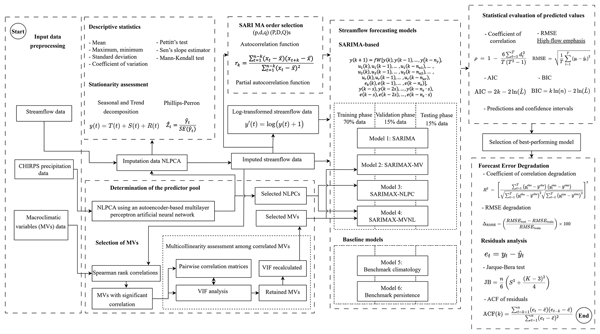
Regarding the request for a model-training flowchart or pseudocode, we clarify that Figure 1 serves this purpose by visually summarizing the complete modeling workflow, from data preprocessing to model training, validation, and evaluation. To further address the reviewer’s comment, Figure 1 has been revised to enhance clarity and better represent the sequence of steps involved in the modeling process. We believe these revisions improve the transparency and reproducibility of the study and adequately address the reviewer’s recommendation.
Comment 18: My recommendation is Major Revision.
I hope my comments help you strengthen your manuscript. I would be very happy to re-evaluate a revised version.
We thank the reviewer for the thorough evaluation, constructive comments, and helpful recommendations. We have carefully addressed all observations and hope that the revisions adequately strengthen the manuscript. We would be pleased to have the opportunity for the revised version to be re-evaluated.
-
AC2: 'Reply on RC2', Jhon Sarria, 21 Jan 2026
Peer review completion


Interactive discussion
Status: closed
-
RC1: 'Comment on egusphere-2025-3694', Anonymous Referee #1, 26 Oct 2025
Dear Authors,
Thank you very much for submitting your research article to NHESS. The manuscript addresses an important topic and is clearly written, with a coherent and logical flow. However, there are a few minor issues that need to be addressed, as outlined below.
Section 2.5:
- It would be beneficial to provide a detailed explanation of the Neural Network parameters and the architecture of the NN-SARIMAX model to help readers easily and clearly understand the structure of the neural network.
Section 3.2.1
- It is stated that two non-linear principal components (explaining 92.5% and 7.4% of the variance, respectively) were selected out of a total of 81 components, collectively explaining 99.9% of the variance. However, this approach may lead to overfitting, as it effectively considers nearly the entire variation unless the model is validated through cross-validation or other model selection criteria (e.g., AIC, BIC, etc.) to determine the optimal number of components. Therefore, it should be clearly explained how potential overfitting was assessed and mitigated.
- It is also unclear why only the first two principal components account for 99.9% of the variance, while the remaining 79 components contribute only 0.1%. This large discrepancy warrants further clarification.
Section 2.4.3:
- The approach used to address multicollinearity is generally sound and viable. However, there is no clear evidence indicating that the multicollinearity issue has been fully resolved, such as through recalculating the Variance Inflation Factor (VIF) after the iterative removal of collinear and less important predictors. Many of the retained variables still exhibit extremely high VIF values (e.g., NINO4 = 29,126; NINO12 = 2,492; NP = 17,705; TNA = ∞; and TSA = ∞). It remains unclear whether multicollinearity persists among these nine predictors or not.
Citation: https://doi.org/10.5194/egusphere-2025-3694-RC1 -
AC1: 'Reply on RC1', Jhon Sarria, 21 Jan 2026
COMMENTS FOR THE AUTHOR:
Response to Reviewer 1
We would like to thank the reviewer for his/her helpful comments. Thank you. All of your comments have been taken into consideration, and the paper was modified accordingly. Please find below our responses.
Comment 1: Section 2.5:
- It would be beneficial to provide a detailed explanation of the Neural Network parameters and the architecture of the NN-SARIMAX model to help readers easily and clearly understand the structure of the neural network.
Answer: A detailed description of the neural network architecture and its associated parameters was added to Section 2.4.1. This description clarifies the structure of the neural network employed within the NLPCA framework, including its role in processing CHIRPS precipitation data and its integration into the SARIMAX modeling approach as an exogenous variable, thereby enhancing model transparency and reproducibility.
Comment 2: Section 3.2.1
- It is stated that two non-linear principal components (explaining 92.5% and 7.4% of the variance, respectively) were selected out of a total of 81 components, collectively explaining 99.9% of the variance. However, this approach may lead to overfitting, as it effectively considers nearly the entire variation unless the model is validated through cross-validation or other model selection criteria (e.g., AIC, BIC, etc.) to determine the optimal number of components. Therefore, it should be clearly explained how potential overfitting was assessed and mitigated.
Answer: Potential overfitting associated with the selection of NLPCs was explicitly assessed and mitigated by implementing a data-splitting strategy within the NLPCA framework. The dataset was divided into independent training, validation, and testing subsets.
- It is also unclear why only the first two principal components account for 99.9% of the variance, while the remaining 79 components contribute only 0.1%. This large discrepancy warrants further clarification.
Answer: The apparent concentration of variance in the first two nonlinear principal components arises from the use of a nonlinear PCA (NLPCA) approach implemented through an autoencoder-based neural network. Unlike linear PCA, NLPCA does not decompose variance through orthogonal eigenvectors but instead learns a low-dimensional nonlinear manifold that captures the dominant structure of the data.
Although the input consists of 81 CHIRPS grid cells, these variables exhibit strong spatial coherence. As a result, the majority of the precipitation variability can be effectively represented by two latent nonlinear components (NLPC1 and NLPC2), which together explain 100% of the reconstructed variance, while the remaining components account for negligible residual variability.
Comment 3: Section 2.4.3:
- The approach used to address multicollinearity is generally sound and viable. However, there is no clear evidence indicating that the multicollinearity issue has been fully resolved, such as through recalculating the Variance Inflation Factor (VIF) after the iterative removal of collinear and less important predictors. Many of the retained variables still exhibit extremely high VIF values (e.g., NINO4 = 29,126; NINO12 = 2,492; NP = 17,705; TNA = ∞; and TSA = ∞). It remains unclear whether multicollinearity persists among these nine predictors or not.
Answer: The assessment of multicollinearity was strengthened by applying a more stringent variable-selection procedure. Following the iterative removal of collinear and less influential predictors, the VIF was recalculated for the final set of retained meteorological variables. This additional step confirmed that multicollinearity was effectively reduced. See in the section 3.2.3.
We thank the reviewer for the thorough evaluation, constructive comments, and helpful recommendations. We have carefully addressed all observations and hope that the revisions adequately strengthen the manuscript. We would be pleased to have the opportunity for the revised version to be re-evaluated.
-
RC2: 'Comment on egusphere-2025-3694', Anonymous Referee #2, 20 Nov 2025
-
AC2: 'Reply on RC2', Jhon Sarria, 21 Jan 2026
COMMENTS FOR THE AUTHOR:
Response to Reviewer 2
We would like to thank the reviewer for his/her helpful comments. Thank you. All of your comments have been taken into consideration, and the paper was modified accordingly. Please find below our responses.
Comment 1: The description of the hybrid model is not sufficiently precise for reproducibility. It is unclear:
- How exactly the ANN interacts with SARIMA (residual modelling? parallel modelling? combined loss?).
- What is the ANN architecture (layers, activation functions, training epochs, optimizer).
- How exogenous variables are lagged to avoid information leakage.
- How the model moves from open-loop to closed-loop.
A fully explicit mathematical formulation and a schematic model diagram are required.
Answer: A detailed description of the neural network architecture and its associated parameters has been added to Section 2.4.1. This revision clarifies the structure of the neural network employed within the NLPCA framework, its role in processing CHIRPS precipitation data, and its integration into the SARIMAX modeling approach as an exogenous variable, thereby improving model transparency and reproducibility.
Comment 2: The autoencoder used for nonlinear PCA is described only conceptually. Please specify:
- Number of hidden layers and units
- Type of activation functions
- Loss function
- Training epochs
- Optimizer
- Reconstruction error achieved
- Rationale for selecting exactly two nonlinear components At the moment, NLPCA cannot be reproduced from the information provided
Answer: A detailed description of the autoencoder architecture used for nonlinear PCA and its associated training parameters has been added to Section 2.4.1. This revision provides the necessary information to fully specify the NLPCA implementation, thereby ensuring methodological transparency and reproducibility.
Comment 3: You report remarkably high R² values (0.75–0.78) for 24-month-ahead forecasts. This is unusual for tropical hydrology, where long-lead predictions are extremely difficult. Please:
- Include a baseline benchmark vs climatology and persistence
- Provide an alternative validation in which the training/validation split is shifted forward in time
- Discuss the potential risk of overfitting when many exogenous predictors are used for a single station
- Verify that no future information enters through the NLPCA step
Answer: We thank the reviewer for this important observation. Following the reviewer’s suggestions, the analysis has been updated, resulting in more realistic R² values for long-lead forecasts and mitigating the risk of overfitting. Specifically:
- A baseline benchmark including climatology and persistence has been incorporated, enabling a clear comparison with the SARIMAX model.
- The potential risk of overfitting associated with the use of multiple exogenous predictors for a single station has been addressed and is discussed in the revised manuscript.
- The NLPCA transformation was recalculated using only the training period to ensure that no future information is inadvertently introduced.
Together, these revisions ensure that the reported long-lead forecast skill is both realistic and robust.
Comment 4: Table 2 shows extreme VIF values reaching 81,825, and two variables with infinite VIF. However, the process of variable selection is narrated but not clearly documented. I suggest:
- Provide a clear step-by-step table describing which variables were removed and why
- Avoid keeping multiple ENSO indices that are functionally redundant
- Confirm that the final chosen set has acceptable VIF values
This will make your variable selection reproducible.
Answer: The variable-selection process has been improved and clearly documented in Sections 2.4.3 and 3.2.3, where we now provide a step-by-step description of how the meteorological variables (MVs) were screened and selected. This revision clarifies how functionally redundant MVs were avoided and how the final set was retained based on the strongest correlation with the streamflow data. In addition, VIF values were recalculated for the retained MVs (see Table 2), confirming that all final predictors have acceptable multicollinearity levels (VIF < 10). As a result, the final set of exogenous MVs is shorter and more reproducible.
Comment 5: Pettitt p-value is reported as 1.99, which is impossible (p-values must be ≤ 1). Please revise all statistical outputs and their interpretations.
Answer: We thank the reviewer for this observation. The reported Pettitt p-value greater than 1 was due to a typographical error, which has been corrected in the revised manuscript. In addition, all statistical outputs and their corresponding interpretations have been carefully reviewed to ensure consistency and correctness throughout the manuscript.
Comment 6: The Breusch–Pagan test indicates heteroscedasticity, and the residuals vs. fitted plot confirms this. Please discuss or explore:
- Log transformation of discharge
- Box–Cox transformation
- Weighted regression or heteroscedasticity-aware models
- Impact on long-term forecast uncertainty
Answer: The log transformation of discharge was implemented and used as input data for all models. Model performance using log-transformed streamflow was superior compared to the non-transformed case. Accordingly, Section 2.6 has been added to the manuscript to document this procedure and its impact on model performance.
Comment 7: Forecasts are presented only as point estimates. Please include:
- Confidence intervals
- Prediction intervals
- Bootstrapped ensembles
- At minimum, a written discussion about uncertainty.
This is essential in hydrological forecasting.
Answer: Predictions and their associated confidence intervals were obtained, and Sections 2.7.1 and 3.3.1 were expanded to describe the corresponding methodology and results.
Comment 8: NLPC1 and NLPC2 remain abstract. Please include:
- Spatial loading maps • Seasonal cycle of each component
- Their relationship to ENSO/ITCZ migration
- Interpretation of their hydrological meaning This would strengthen the scientific contribution.
Answer: We thank the reviewer for this thoughtful and constructive comment. We agree that analyses of spatial loading patterns, seasonal cycles, and physical interpretations of the nonlinear principal components (NLPCs), including their relationships with ENSO or ITCZ migration, could provide valuable climatological and hydrological insights. However, the primary objective of this study is not the physical interpretation of the extracted components, but rather their use as predictive features within a streamflow forecasting framework.
In this context, NLPC1 and NLPC2 are employed as latent predictors designed to efficiently summarize large-scale climate variability and enhance forecasting skill, rather than to represent physically interpretable modes of variability. A detailed analysis of spatial loadings, seasonal behavior, and teleconnection mechanisms would require additional datasets, methodological developments, and extended discussion beyond the scope of the present work, and would substantially shift the focus of the manuscript from forecasting to process-based climate–hydrology analysis.
For clarity, the manuscript has been revised to explicitly state that the NLPCs are used as predictive variables without attempting a detailed physical interpretation. We consider a comprehensive diagnostic analysis of their climatological and hydrological meaning to be a valuable direction for future research.
Comment 9: Figure 1
- Caption should be more descriptive.
- Ensure all acronyms in the image are defined.
Answer: The caption of Figure 1 has been revised to be more descriptive, and all acronyms used in the figure have been defined.
Comment 10: Figure 2
- In IS the units for kilometers are km not Kms
Answer: The units in Figure 2 have been corrected to use km in accordance with the International System of Units (SI).
Comment 11: Table 1
- As said, Pettitt p-value impossible (1.99).
- Units missing for mean, min, max, and standard deviation (m³/s).
- The title should specify “Streamflow characteristics at El Playón station”.
Answer: Pettitt p-value was reviewed. Regarding the descriptive statistics, the units (m³/s) for mean, minimum, maximum, and standard deviation have now been explicitly indicated to avoid ambiguity. Finally, the title has been revised to explicitly specify “Streamflow characteristics at El Playón station”, as suggested by the reviewer.
Comment 12: Table 2 (VIF)
- Should include a final column indicating whether each variable was retained or dropped.
Answer: Table 2 has been modified to include an explicit indication of whether each variable was retained or removed.
Comment 13: Table 3
- Units missing for RMSE.
- AIC/BIC interpretations should be provided in a footnote.
Answer: The units for RMSE have been added, and interpretations of AIC and BIC have been included as a footnote in Table 3.
Comment 14: Table 4
- Clarify if these R² values are from training, validation, or test datasets.
Answer: The R² values reported in Table 4 correspond to the validation phase.
Comment 15: Stationarity section needs rewriting
Some expressions are grammatically incorrect:
“supporting weak stationarity assumptions component lacking any systematic trend”
Please rewrite this entire subsection more clearly.
Answer: Section 3.1.2 (Stationarity analysis) has been rewritten to improve clarity and grammatical accuracy, and the interpretation of the seasonal decomposition has been enhanced.
Comment 15: Improve logic flow between sections
Sometimes:
- The same idea is repeated (e.g., ENSO relevance).
- Paragraphs begin with generic phrases (“These results confirm…”).
A more synthetic writing style would improve clarity.
Answer: The entire manuscript has been reviewed and rewritten to improve logical flow, reduce redundancy, and enhance overall clarity.
Comment 16: Please check all units
I found several missing or unclear units:
Answer: The entire manuscript has been reviewed to ensure that all units are clearly and consistently reported.
Comment 17: I strongly recommend adding:
- A short description of software used (Python, R, MATLAB).
- Version numbers for key libraries (TensorFlow, PyTorch, statsmodels, etc.).
- Pseudocode or model-training flowchart.
Answer: We thank the reviewer for this valuable suggestion. In response, a short description of the software environment has been added to the manuscript, indicating that the analyses were performed using Python and specifying the main libraries employed. The corresponding package information has been incorporated accordingly in the section 2.3.
Regarding the request for a model-training flowchart or pseudocode, we clarify that Figure 1 serves this purpose by visually summarizing the complete modeling workflow, from data preprocessing to model training, validation, and evaluation. To further address the reviewer’s comment, Figure 1 has been revised to enhance clarity and better represent the sequence of steps involved in the modeling process. We believe these revisions improve the transparency and reproducibility of the study and adequately address the reviewer’s recommendation.
Comment 18: My recommendation is Major Revision.
I hope my comments help you strengthen your manuscript. I would be very happy to re-evaluate a revised version.
We thank the reviewer for the thorough evaluation, constructive comments, and helpful recommendations. We have carefully addressed all observations and hope that the revisions adequately strengthen the manuscript. We would be pleased to have the opportunity for the revised version to be re-evaluated.
-
AC2: 'Reply on RC2', Jhon Sarria, 21 Jan 2026
Peer review completion
Journal article(s) based on this preprint
A forecasting framework was developed to river flow prediction in data-scarce tropical regions. The study extracted hidden rainfall patterns from satellite precipitation records and integrated them with large-scale ocean–atmosphere climate signals into a statistical model, resulting in improved predictive accuracy. These findings can support more effective water-resources management during dry periods and strengthen early warning systems in regions with limited hydrometeorological monitoring.
Data sets
The climate hazards infrared precipitation with stations – a new environmental record for monitoring extremes Chris Funk et al. https://doi.org/10.1038/sdata.2015.66
Viewed
| HTML | XML | Total | Supplement | BibTeX | EndNote | |
|---|---|---|---|---|---|---|
| 2,636 | 1,178 | 158 | 3,972 | 245 | 105 | 218 |
- HTML: 2,636
- PDF: 1,178
- XML: 158
- Total: 3,972
- Supplement: 245
- BibTeX: 105
- EndNote: 218
Viewed (geographical distribution)
| Country | # | Views | % |
|---|
| Total: | 0 |
| HTML: | 0 |
| PDF: | 0 |
| XML: | 0 |
- 1
Jhon Derly Sarria-Ospina

Camilo Ocampo-Marulanda
Lina Maria Ceron-Aramburo
Teresita Canchala
Tiago Alessandro Ferreira
The requested preprint has a corresponding peer-reviewed final revised paper. You are encouraged to refer to the final revised version.
- Preprint
(3063 KB) - Metadata XML
-
Supplement
(78 KB) - BibTeX
- EndNote
- Final revised paper
Dear Authors,
Thank you very much for submitting your research article to NHESS. The manuscript addresses an important topic and is clearly written, with a coherent and logical flow. However, there are a few minor issues that need to be addressed, as outlined below.
Section 2.5:
Section 3.2.1
Section 2.4.3: