
the Creative Commons Attribution 4.0 License.
the Creative Commons Attribution 4.0 License.
 | 03 Sep 2025
Assessing Earth’s sphericity effects in the specific case of geostationary satellites observations: focus on operational land/aerosol applications from Meteosat Third Generation-Imager
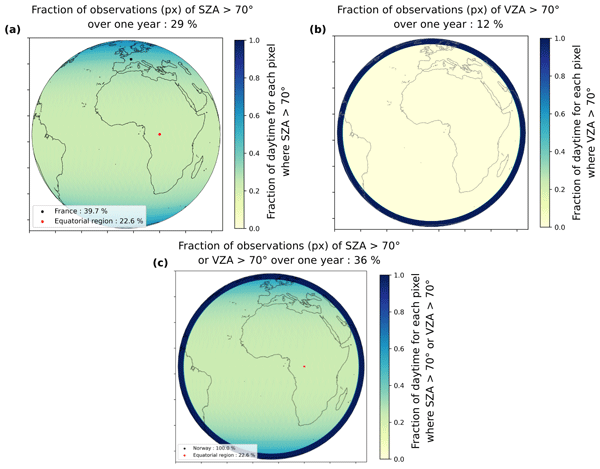
Abstract. Geostationary satellites allow a continuous sub-hourly monitoring of the Earth including land surfaces and aerosols, which can now benefit from the advanced measuring performances of the new Meteosat Third Generation-Imager and its Flexible Combined Imager on board (FCI). In this study, we aim to improve our understanding of the impact of the Earth's sphericity on geostationary observations. Although sphericity effects in satellite data have been studied for many years, the curvature of our planet is still not accounted for in many operational radiative transfer-based retrieval algorithms due to the required increase in processing time, and therefore a plane-parallel atmosphere-surface system is assumed instead. While the limitations of this approximation have been widely assessed in the case of low Earth orbit satellites, they must be reevaluated with regard to geostationary satellites, which have a broader range of observing and illumination geometries. Furthermore, we currently lack precise benchmarking of the errors caused by neglecting the Earth's sphericity in the case of land surface and aerosol applications, which show significant differences with respect to the commonly considered ocean color applications. For example, surface/aerosol algorithms use instrument channels in the red and near-infrared spectral ranges where there is a growing impact of molecular absorption compared to the ocean color-sensitive blue channels where Rayleigh scattering predominates. In this context, we perform quantitative analyses of the impact of ignoring the Earth's curvature on FCI-like top-of-atmosphere reflectance calculations using the accurate Monte Carlo radiative transfer code SMART-G. Results enable quantification of important biases introduced by the plane-parallel assumption, with a strong dependency on the satellite acquisition geometry and, to a lesser extent, the measuring wavelength, but without significant dependency on surface and aerosol properties. We also find that 36 % of FCI observations are significantly affected by sphericity effects, in particular in the channels centered at short visible wavelengths (i.e., 444 and 510 nm for FCI). Based on these results, this study makes recommendations on the development of methods to correct geostationary data for sphericity effects so that one can keep using plane-parallel radiative transfer codes for near-real-time operational applications.
-
Notice on discussion status
The requested preprint has a corresponding peer-reviewed final revised paper. You are encouraged to refer to the final revised version.
-
Preprint
(3425 KB)
-
The requested preprint has a corresponding peer-reviewed final revised paper. You are encouraged to refer to the final revised version.
- Preprint
(3425 KB) - Metadata XML
- BibTeX
- EndNote
- Final revised paper


Journal article(s) based on this preprint
Interactive discussion
Status: closed
-
RC1: 'Comment on egusphere-2025-3263', Anonymous Referee #1, 02 Oct 2025
-
RC2: 'Reply on RC1', Anonymous Referee #1, 03 Oct 2025
Additional comment:
Line 344: "... suggesting that the Earth's sphericity effects may slightly depend on surface albedo.".
The simulation in Sect. 4.3 were done for the VIS 0.6 channel.
At shorter wavelengths, the surface reflection can enhance the molecular scattering, via repeated reflections between atmosphere and surface.
What would be the Earth's sphericity impact dependence on surface albedo in the VIS 0.4 channel?Citation: https://doi.org/10.5194/egusphere-2025-3263-RC2 - AC1: 'Reply on RC1', Gloria Klein, 15 Jan 2026
-
RC3: 'Reply on RC1', Anonymous Referee #1, 03 Oct 2025
Last comment:
Besides VZA = 60 degrees relevant for Europe, please also explore the sphericity effect dependencies on scene parameters at VZA = 80 degrees, which is an exploration of the most extreme geometries encountered for geostationary satellites (see also you Fig. 3).
I am curious to see those results. Good luck with the revision!Citation: https://doi.org/10.5194/egusphere-2025-3263-RC3 - AC1: 'Reply on RC1', Gloria Klein, 15 Jan 2026
- AC1: 'Reply on RC1', Gloria Klein, 15 Jan 2026
-
RC2: 'Reply on RC1', Anonymous Referee #1, 03 Oct 2025
-
RC4: 'Comment on egusphere-2025-3263', Anonymous Referee #2, 26 Nov 2025
This manuscript explores the impacts of using the plane parallel geometry on radiative transfer simulations with solar and viewing angles relevant for geostationary satellites observing at visible and short infrared wavelengths. Radiative transfer simulations using a Monte Carlo algorithm are compared, using the plane parallel assumption or the spherical shell assumption. The impact of the different geometries, wavelengths, surface albedo and atmospheric components is analysed.
This work is very interesting and such an analysis is important for the correct understanding and use of the new instrument data, such as FCI and more recently IRS (in the thermal IR range, not considered here).
However, I have some major comments to be addressed before final publication.
General comments
1) Except for Experiment 1, all others were run at VZA of 45°. However, experiment 1 clearly showed that VZA impacts the PPA for high angles, and considering those high angles is the main specificity of this work. Therefore I think that all experiments should be run also for high VZA values, and I would expect all parameters to have a different impact on the PPA correction for such high angles as they do for high SZA, and maybe the final conclusions will be different. This is a very important point, as currently the final conclusion state that the correction should depend only on angles and wavelength, while maybe the atmospheric composition also plays a non-negligible role for high VZA.
2) Please discuss what is considered a major / significant impact on the calculated radiance / reflectance / TOA intensity. The current status is inconsistent along the paper. Line 286 mentions 1% (and a very short discussion of this number is in the conclusion, but should come also much earlier), but then in the next lines and section 4.1.1 the cutoff is set at SZA 70° and VZA 70° , while looking at Table 2 the numbers do not match (e.g. SZA 70-80° lead to errors larger than 1% only when VZA is larger than 75°, which is already in the cutoff for VZA anyway). Then line 322 “significant biases” are discussed, for SZA larger than 70° in all channels, but from table 3 the error remains way below 1% in the 70-80° SZA range, for all channels. So the “significant biases” in this section relate to another cutoff and this is not explained or justified. Same again for the surface albedo section… And again in the conclusion.
3) The presentation of the concept of correction for sphericity effects must be changed. For the moment, it is always (mostly in introduction, discussion and and conclusion) presented as a correction to apply on the observation / data, while the correction must be done at the radiative transfer level, or after it. The observations themselves should never be corrected.
4) Section 4.5: it took me a while to realize that the aerosol properties were taken exactly as in the OPAC aerosol mixed types, which contain not only the optical properties but also the vertical profile and AOD; please provide a clearer and more complete description in the manuscript
Specific comments
lines 46-48 (also comes in line 54): please explain what this atmospheric correction means
lines 66-68 and 161-163: please provide references for those earlier studies. They are given later, when this previous literature is discussed (starting line 170) but should already be listed the first times earlier studies are mentioned. Also, a quick search gave me this very recent publication https://doi.org/10.3390/atmos16080977 addressing similar issues - I know it was published after submission of this manuscript, but it would be interesting to mention it and highlight what is different in the current study (and also in the results analysis section).
Line 262: what means “the illuminated volume”? Do you mean the optical path length?
Figure 2 / section 4.1: For the sake of completeness, the non-symmetry of the SZA dependence should be explained (only once, not for each of the next figures)
Tables 2 and next: is the SZA range considered for both positive and “negative” SZA?
Line 313: please avoid imprecise phrasing such as “extremely close to zero” (replace by under …, for example)
Line 376: please be more specific about the “opposite physical properties” of the two aerosol types. It is not only important to know if particles are fine or coarse, but also their absorptive properties, maybe also the particle shape
Lines382-383: please explain “the peaked phase function of such coarse particles that cause convergence issues when using the local estimate technique”
Figure 8 is not the right one or the legend is not correct… Legend is like Figure 7, but the plots are different.
Line 453-4: please list the relevant wavelengths
Table 9: Please be slightly more specific than “yes” and add “cutoff” angles / wavelengths here
Line 503: I don’t really understand what is written; to my understanding, errors are in radiative transfer calculations under the PPA assumption
Lines 508-510: those results do not apply to any geo weather satellite: there are also such instruments measuring at thermal IR wavelengths, for which another study would be needed
Minor comments / technical / language
line 35: slightly rephrase to make clear what became operational in 2024 and was renamed Meteosat-12 (only FCI or the whole satellite?)
line 43: its -> their ?
equations 1,3,4: maybe consider to avoid starting an equation with the minus sign? although correct, I think it is not very common to write it like that
Figure 1: e missing in plane parallel assumption in the figure; in the legend, rephrase “height of the atmosphere”
Line 192: for the estimation OF land surface parameters
Line 270: VZA>=75°
Line 332: I think ‘around’ should be removed
Line 344: “may slightly depend on surface albedo” is a weird phrasing, as we know there is a dependence, and the question is how large / significant it is
Line 352: surface of albedo -> surface albedo
Section 4.4: Maybe you could show those different profiles? They are easy to find, but it could be nice for the reader to easily see how much they change
Line 390: correspond (without the s)
Citation: https://doi.org/10.5194/egusphere-2025-3263-RC4 - AC2: 'Reply on RC4', Gloria Klein, 15 Jan 2026


Interactive discussion
Status: closed
-
RC1: 'Comment on egusphere-2025-3263', Anonymous Referee #1, 02 Oct 2025
The authors present simulation results of the radiance reflected at TOA using the spherical Monte Carlo code SMART-G, and explore the bias of using the plane-parallel assumption instead of the spherical shell assumption. They also explore the dependence of this bias on various parameters such as viewing and illumination geometry, surface albedo, wavelength, and aerosol (layer) type.
Below I state my three major concerns which should be addressed before publication:
In the abstract, Table 9, and the conclusion, the authors conclude a weak dependence of the above-mentioned bias on wavelength and insignificant dependencies on the surface albedo and aerosol properties. However, those effects are explored at a VZA of 45 degrees only, while most significant sphericity effects may be expected at the largest VZAs (which the authors also show for the default settings in their Fig. 1).
This is problematic for the manuscript, because the authors claim novelty of their work based on the large viewing zenith angle range (relevant for geostationary satellites as compared to polar orbiting satellites). The conclusion of the bias dependencies thus may be subjective to the choice of VZA. The editor already suggested the VZA of 45 degrees, but I would like to ask the authors to include simulations at a VZA of 60 degrees (representative for Mid Europe, see e.g. Fig. 1 of Masiello et al. 2015, https://amt.copernicus.org/articles/8/2981/2015/amt-8-2981-2015.pdf), which may possibly change the conclusions of the paper.
Another claimed novelty by the authors of their sphericity analysis is the inclusion of near-infrared (NIR) wavelengths where gaseous absorption plays a role. In Sect. 4.2, they attribute the relatively large errors at the longer wavelengths for SZA > 80 degrees to gaseous absorption, however, no evidence is provided. Could those errors possibly also be related to the wavelength dependence of the Rayleigh scattering efficiency in combination with sphericity effects at large SZA? I would like to ask the authors to include simulation results at a long wavelength, but without gaseous absorption, to prove that gaseous absorption is indeed responsible. This would improve the physical understanding of the simulation results.
In Sect. 2.3., an explanation is provided for the cause of the bias of the PPA results compared to those of the SSA, for large SZA, and for large VZA. The authors state that (1) “high SZA causes an overestimation of the optical path in PPA, leading to an overestimation of the attenuation of the solar beam in the atmosphere, causing the PPA to induce a negative bias in TOA radiance estimation” and (2) “high VZA leads to an overestimation of the illuminated volume and Rayleigh scattering, creating a positive bias induced by the PPA in the simulated TOA radiances”. However, from Adams and Kattawar (1978), I understand that in a spherical atmosphere (1) with increasing SZA, less photons reach the (black) surface, increasing the reflected radiance w.r.t. the PPA (indeed, in the twilight zone, at a SZA of 90 degrees and slightly larger, there is still signal due to horizontal scattering) and (2) with increasing VZA, the optical paths through the atmosphere along the line of sight from the detector are shorter (for VZA defined at TOA, with an optical path approaching 0 for VZA= 90 deg), yielding smaller radiances for SSA w.r.t. PPA. Although the signs of the biases are correct here, I would like the authors to reconsider the explanation of the cause of those biases, because it is key for the physical understanding of the simulations results in this paper. Including a sketch could be helpful. In addition, please cite the relevant literature here where those insights were introduced, for the readers seeking further explanation.
Other comments:
The authors state that pseudo-spherical approximations are not feasible in operational algorithms, however, I think many satellite algorithms use the pseudo-spherical approximation. Do the authors have an example of an algorithm that cannot use the pseudo-spherical approximation due to computational constraints. Could the authors include the remaining error of the pseudo-spherical approximation? This would greatly improve the relevance of the paper.
Figure 1: Why are two satellites and two suns shown? This may be confusing, because also two systems are shown: PPA and SSA. I suggest removing one sun and one satellite in the sketch. I also suggest adding multiple layers to the sketch, as they are mentioned in the first sentence of Sect. 2.2.
Line 150: “Rayleigh scattering is the main radiance-inducing atmospheric process in the short visible spectrum, corresponding to the first measuring channels of most geostationary satellite images. Therefore, the difference between the PPA and SSA geometries will primarily affect Rayleigh scattering.” This is poor logical reasoning: if phenomenon A is dominant, it is not guaranteed that phenomenon B primarily affects A. Please rephrase.
Line 207: Please explain more clearly in one sentence what REPTRAN does.
Line 212: “Since absorption cannot be neglected in the considered long visible and near-infrared channels.” Please state the relevant gases here (probably H2O). Can absorption be neglected at the shorter VIS channels? What about O3?
Sect 3.3: Please include the wavelength ranges of the channels, and the indicate per channel which absorbing gases play a role, because this information is relevant to interpret the simulation results. A table could be helpful.
Line 257: “One should note the negative sign before SZA values in Fig .2 has no physical nor mathematical meaning in this manuscript…” Please remove the minus signs in all figures and add ‘RAA = 0 deg’ and ‘RAA = 180 deg’ labels to the figures.
Line 262: “Indeed, when VZA increases the illuminated volume grows” Do you mean “the observed volume”?
Line 265: “… PPA leads to an overestimation of the solar beam attenuation in Rayleigh dominated wavelengths.” Please reconsider this explanation.
Line 269: “the relative error (in absolute values)” may be confusing. Please explain or remove ‘(in absolute values)’.
Sect. 4.2: Please mention what absorbing gases are relevant at the considered wavelengths. Please note that gaseous absorption (by O3) also occurs at shorter (VIS) wavelengths, at high altitudes, while H2O mainly absorbs at lower altitudes. Does the altitude dependence of the gas abundances affect the sphericity impact (since at large SZA and VZA, the reflected radiances is more sensitive to higher atmospheric layers)?
Figure 3c could be considered redundant and can be removed, because is the combination of Figs. 3a and 3b. The combination is also covered in the main text.
Sect. 4.4: The authors explore the effect of different atmospheric profiles but also mention that ‘fluctuations in Rayleigh optical depth between atmospheric profiles are below 1%’. How do the input profiles differ? Please explain and if relevant, include a figure of the profiles.
Editing suggestions:
Title: ‘… geostationary satellites observations… ‘ --> ‘… geostationary satellite observations …’, remove the s.
line 1: ‘… allow a continuous …’ --> ‘… allow continuous’
line 2: ‘performances’ --> ‘performance’
line 15: ‘measuring wavelength’ --> ‘measurement wavelength’
line 59: ‘well known’ --> ‘well-known’
line 60: Please use a more logical start of a new paragraph, e.g.: ‘An example of an algorithm that uses the PPA is… ‘
line 67: ‘… in the specific of geostationary sensors, which for example provide …’ -->
‘… in the application to geostationary sensors, which provide …’
Line 84: ‘The Earth consists in a near-spherical 3-D system,’ Change ‘consists in’ to ‘consists of’ or rephrase.
Line 91; ‘a scattered radiation being scattered’ --> ‘radiation being scattered’
Line 94: ‘identifying the invariances’, I suggest rephrasing and use another work than ‘invariances’.
Line 99: ‘all the atmospheric layers as infinite parallel planets’ --> ‘all the atmospheric layer boundaries at infinite parallel horizontal planes’
Line 101: Do you mean viewing or solar zenith and azimuth angles here? Please specify.
Line 234: ‘consists in’ --> ‘consists of’ or rephrase
Line 249: ‘simulations results’ --> ‘simulation results’
Line 340: ‘which makes sense considering’ --> ‘because’
Line 390: ‘does corresponds to’ --> ‘corresponds to’
Citation: https://doi.org/10.5194/egusphere-2025-3263-RC1 -
RC2: 'Reply on RC1', Anonymous Referee #1, 03 Oct 2025
Additional comment:
Line 344: "... suggesting that the Earth's sphericity effects may slightly depend on surface albedo.".
The simulation in Sect. 4.3 were done for the VIS 0.6 channel.
At shorter wavelengths, the surface reflection can enhance the molecular scattering, via repeated reflections between atmosphere and surface.
What would be the Earth's sphericity impact dependence on surface albedo in the VIS 0.4 channel?Citation: https://doi.org/10.5194/egusphere-2025-3263-RC2 - AC1: 'Reply on RC1', Gloria Klein, 15 Jan 2026
-
RC3: 'Reply on RC1', Anonymous Referee #1, 03 Oct 2025
Last comment:
Besides VZA = 60 degrees relevant for Europe, please also explore the sphericity effect dependencies on scene parameters at VZA = 80 degrees, which is an exploration of the most extreme geometries encountered for geostationary satellites (see also you Fig. 3).
I am curious to see those results. Good luck with the revision!Citation: https://doi.org/10.5194/egusphere-2025-3263-RC3 - AC1: 'Reply on RC1', Gloria Klein, 15 Jan 2026
- AC1: 'Reply on RC1', Gloria Klein, 15 Jan 2026
-
RC2: 'Reply on RC1', Anonymous Referee #1, 03 Oct 2025
-
RC4: 'Comment on egusphere-2025-3263', Anonymous Referee #2, 26 Nov 2025
This manuscript explores the impacts of using the plane parallel geometry on radiative transfer simulations with solar and viewing angles relevant for geostationary satellites observing at visible and short infrared wavelengths. Radiative transfer simulations using a Monte Carlo algorithm are compared, using the plane parallel assumption or the spherical shell assumption. The impact of the different geometries, wavelengths, surface albedo and atmospheric components is analysed.
This work is very interesting and such an analysis is important for the correct understanding and use of the new instrument data, such as FCI and more recently IRS (in the thermal IR range, not considered here).
However, I have some major comments to be addressed before final publication.
General comments
1) Except for Experiment 1, all others were run at VZA of 45°. However, experiment 1 clearly showed that VZA impacts the PPA for high angles, and considering those high angles is the main specificity of this work. Therefore I think that all experiments should be run also for high VZA values, and I would expect all parameters to have a different impact on the PPA correction for such high angles as they do for high SZA, and maybe the final conclusions will be different. This is a very important point, as currently the final conclusion state that the correction should depend only on angles and wavelength, while maybe the atmospheric composition also plays a non-negligible role for high VZA.
2) Please discuss what is considered a major / significant impact on the calculated radiance / reflectance / TOA intensity. The current status is inconsistent along the paper. Line 286 mentions 1% (and a very short discussion of this number is in the conclusion, but should come also much earlier), but then in the next lines and section 4.1.1 the cutoff is set at SZA 70° and VZA 70° , while looking at Table 2 the numbers do not match (e.g. SZA 70-80° lead to errors larger than 1% only when VZA is larger than 75°, which is already in the cutoff for VZA anyway). Then line 322 “significant biases” are discussed, for SZA larger than 70° in all channels, but from table 3 the error remains way below 1% in the 70-80° SZA range, for all channels. So the “significant biases” in this section relate to another cutoff and this is not explained or justified. Same again for the surface albedo section… And again in the conclusion.
3) The presentation of the concept of correction for sphericity effects must be changed. For the moment, it is always (mostly in introduction, discussion and and conclusion) presented as a correction to apply on the observation / data, while the correction must be done at the radiative transfer level, or after it. The observations themselves should never be corrected.
4) Section 4.5: it took me a while to realize that the aerosol properties were taken exactly as in the OPAC aerosol mixed types, which contain not only the optical properties but also the vertical profile and AOD; please provide a clearer and more complete description in the manuscript
Specific comments
lines 46-48 (also comes in line 54): please explain what this atmospheric correction means
lines 66-68 and 161-163: please provide references for those earlier studies. They are given later, when this previous literature is discussed (starting line 170) but should already be listed the first times earlier studies are mentioned. Also, a quick search gave me this very recent publication https://doi.org/10.3390/atmos16080977 addressing similar issues - I know it was published after submission of this manuscript, but it would be interesting to mention it and highlight what is different in the current study (and also in the results analysis section).
Line 262: what means “the illuminated volume”? Do you mean the optical path length?
Figure 2 / section 4.1: For the sake of completeness, the non-symmetry of the SZA dependence should be explained (only once, not for each of the next figures)
Tables 2 and next: is the SZA range considered for both positive and “negative” SZA?
Line 313: please avoid imprecise phrasing such as “extremely close to zero” (replace by under …, for example)
Line 376: please be more specific about the “opposite physical properties” of the two aerosol types. It is not only important to know if particles are fine or coarse, but also their absorptive properties, maybe also the particle shape
Lines382-383: please explain “the peaked phase function of such coarse particles that cause convergence issues when using the local estimate technique”
Figure 8 is not the right one or the legend is not correct… Legend is like Figure 7, but the plots are different.
Line 453-4: please list the relevant wavelengths
Table 9: Please be slightly more specific than “yes” and add “cutoff” angles / wavelengths here
Line 503: I don’t really understand what is written; to my understanding, errors are in radiative transfer calculations under the PPA assumption
Lines 508-510: those results do not apply to any geo weather satellite: there are also such instruments measuring at thermal IR wavelengths, for which another study would be needed
Minor comments / technical / language
line 35: slightly rephrase to make clear what became operational in 2024 and was renamed Meteosat-12 (only FCI or the whole satellite?)
line 43: its -> their ?
equations 1,3,4: maybe consider to avoid starting an equation with the minus sign? although correct, I think it is not very common to write it like that
Figure 1: e missing in plane parallel assumption in the figure; in the legend, rephrase “height of the atmosphere”
Line 192: for the estimation OF land surface parameters
Line 270: VZA>=75°
Line 332: I think ‘around’ should be removed
Line 344: “may slightly depend on surface albedo” is a weird phrasing, as we know there is a dependence, and the question is how large / significant it is
Line 352: surface of albedo -> surface albedo
Section 4.4: Maybe you could show those different profiles? They are easy to find, but it could be nice for the reader to easily see how much they change
Line 390: correspond (without the s)
Citation: https://doi.org/10.5194/egusphere-2025-3263-RC4 - AC2: 'Reply on RC4', Gloria Klein, 15 Jan 2026
Peer review completion


Journal article(s) based on this preprint
Viewed
| HTML | XML | Total | BibTeX | EndNote | |
|---|---|---|---|---|---|
| 5,447 | 489 | 109 | 6,045 | 105 | 109 |
- HTML: 5,447
- PDF: 489
- XML: 109
- Total: 6,045
- BibTeX: 105
- EndNote: 109
Viewed (geographical distribution)
| Country | # | Views | % |
|---|
| Total: | 0 |
| HTML: | 0 |
| PDF: | 0 |
| XML: | 0 |
- 1
Gloria Klein
Jérôme Vidot
Didier Ramon
Mustapha Moulana
The requested preprint has a corresponding peer-reviewed final revised paper. You are encouraged to refer to the final revised version.
- Preprint
(3425 KB) - Metadata XML
The authors present simulation results of the radiance reflected at TOA using the spherical Monte Carlo code SMART-G, and explore the bias of using the plane-parallel assumption instead of the spherical shell assumption. They also explore the dependence of this bias on various parameters such as viewing and illumination geometry, surface albedo, wavelength, and aerosol (layer) type.
Below I state my three major concerns which should be addressed before publication:
In the abstract, Table 9, and the conclusion, the authors conclude a weak dependence of the above-mentioned bias on wavelength and insignificant dependencies on the surface albedo and aerosol properties. However, those effects are explored at a VZA of 45 degrees only, while most significant sphericity effects may be expected at the largest VZAs (which the authors also show for the default settings in their Fig. 1).
This is problematic for the manuscript, because the authors claim novelty of their work based on the large viewing zenith angle range (relevant for geostationary satellites as compared to polar orbiting satellites). The conclusion of the bias dependencies thus may be subjective to the choice of VZA. The editor already suggested the VZA of 45 degrees, but I would like to ask the authors to include simulations at a VZA of 60 degrees (representative for Mid Europe, see e.g. Fig. 1 of Masiello et al. 2015, https://amt.copernicus.org/articles/8/2981/2015/amt-8-2981-2015.pdf), which may possibly change the conclusions of the paper.
Another claimed novelty by the authors of their sphericity analysis is the inclusion of near-infrared (NIR) wavelengths where gaseous absorption plays a role. In Sect. 4.2, they attribute the relatively large errors at the longer wavelengths for SZA > 80 degrees to gaseous absorption, however, no evidence is provided. Could those errors possibly also be related to the wavelength dependence of the Rayleigh scattering efficiency in combination with sphericity effects at large SZA? I would like to ask the authors to include simulation results at a long wavelength, but without gaseous absorption, to prove that gaseous absorption is indeed responsible. This would improve the physical understanding of the simulation results.
In Sect. 2.3., an explanation is provided for the cause of the bias of the PPA results compared to those of the SSA, for large SZA, and for large VZA. The authors state that (1) “high SZA causes an overestimation of the optical path in PPA, leading to an overestimation of the attenuation of the solar beam in the atmosphere, causing the PPA to induce a negative bias in TOA radiance estimation” and (2) “high VZA leads to an overestimation of the illuminated volume and Rayleigh scattering, creating a positive bias induced by the PPA in the simulated TOA radiances”. However, from Adams and Kattawar (1978), I understand that in a spherical atmosphere (1) with increasing SZA, less photons reach the (black) surface, increasing the reflected radiance w.r.t. the PPA (indeed, in the twilight zone, at a SZA of 90 degrees and slightly larger, there is still signal due to horizontal scattering) and (2) with increasing VZA, the optical paths through the atmosphere along the line of sight from the detector are shorter (for VZA defined at TOA, with an optical path approaching 0 for VZA= 90 deg), yielding smaller radiances for SSA w.r.t. PPA. Although the signs of the biases are correct here, I would like the authors to reconsider the explanation of the cause of those biases, because it is key for the physical understanding of the simulations results in this paper. Including a sketch could be helpful. In addition, please cite the relevant literature here where those insights were introduced, for the readers seeking further explanation.
Other comments:
The authors state that pseudo-spherical approximations are not feasible in operational algorithms, however, I think many satellite algorithms use the pseudo-spherical approximation. Do the authors have an example of an algorithm that cannot use the pseudo-spherical approximation due to computational constraints. Could the authors include the remaining error of the pseudo-spherical approximation? This would greatly improve the relevance of the paper.
Figure 1: Why are two satellites and two suns shown? This may be confusing, because also two systems are shown: PPA and SSA. I suggest removing one sun and one satellite in the sketch. I also suggest adding multiple layers to the sketch, as they are mentioned in the first sentence of Sect. 2.2.
Line 150: “Rayleigh scattering is the main radiance-inducing atmospheric process in the short visible spectrum, corresponding to the first measuring channels of most geostationary satellite images. Therefore, the difference between the PPA and SSA geometries will primarily affect Rayleigh scattering.” This is poor logical reasoning: if phenomenon A is dominant, it is not guaranteed that phenomenon B primarily affects A. Please rephrase.
Line 207: Please explain more clearly in one sentence what REPTRAN does.
Line 212: “Since absorption cannot be neglected in the considered long visible and near-infrared channels.” Please state the relevant gases here (probably H2O). Can absorption be neglected at the shorter VIS channels? What about O3?
Sect 3.3: Please include the wavelength ranges of the channels, and the indicate per channel which absorbing gases play a role, because this information is relevant to interpret the simulation results. A table could be helpful.
Line 257: “One should note the negative sign before SZA values in Fig .2 has no physical nor mathematical meaning in this manuscript…” Please remove the minus signs in all figures and add ‘RAA = 0 deg’ and ‘RAA = 180 deg’ labels to the figures.
Line 262: “Indeed, when VZA increases the illuminated volume grows” Do you mean “the observed volume”?
Line 265: “… PPA leads to an overestimation of the solar beam attenuation in Rayleigh dominated wavelengths.” Please reconsider this explanation.
Line 269: “the relative error (in absolute values)” may be confusing. Please explain or remove ‘(in absolute values)’.
Sect. 4.2: Please mention what absorbing gases are relevant at the considered wavelengths. Please note that gaseous absorption (by O3) also occurs at shorter (VIS) wavelengths, at high altitudes, while H2O mainly absorbs at lower altitudes. Does the altitude dependence of the gas abundances affect the sphericity impact (since at large SZA and VZA, the reflected radiances is more sensitive to higher atmospheric layers)?
Figure 3c could be considered redundant and can be removed, because is the combination of Figs. 3a and 3b. The combination is also covered in the main text.
Sect. 4.4: The authors explore the effect of different atmospheric profiles but also mention that ‘fluctuations in Rayleigh optical depth between atmospheric profiles are below 1%’. How do the input profiles differ? Please explain and if relevant, include a figure of the profiles.
Editing suggestions:
Title: ‘… geostationary satellites observations… ‘ --> ‘… geostationary satellite observations …’, remove the s.
line 1: ‘… allow a continuous …’ --> ‘… allow continuous’
line 2: ‘performances’ --> ‘performance’
line 15: ‘measuring wavelength’ --> ‘measurement wavelength’
line 59: ‘well known’ --> ‘well-known’
line 60: Please use a more logical start of a new paragraph, e.g.: ‘An example of an algorithm that uses the PPA is… ‘
line 67: ‘… in the specific of geostationary sensors, which for example provide …’ -->
‘… in the application to geostationary sensors, which provide …’
Line 84: ‘The Earth consists in a near-spherical 3-D system,’ Change ‘consists in’ to ‘consists of’ or rephrase.
Line 91; ‘a scattered radiation being scattered’ --> ‘radiation being scattered’
Line 94: ‘identifying the invariances’, I suggest rephrasing and use another work than ‘invariances’.
Line 99: ‘all the atmospheric layers as infinite parallel planets’ --> ‘all the atmospheric layer boundaries at infinite parallel horizontal planes’
Line 101: Do you mean viewing or solar zenith and azimuth angles here? Please specify.
Line 234: ‘consists in’ --> ‘consists of’ or rephrase
Line 249: ‘simulations results’ --> ‘simulation results’
Line 340: ‘which makes sense considering’ --> ‘because’
Line 390: ‘does corresponds to’ --> ‘corresponds to’