
the Creative Commons Attribution 4.0 License.
the Creative Commons Attribution 4.0 License.
 | 20 Aug 2025
Future Retreat of Great Aletsch Glacier and Hintereisferner – application of a full-Stokes model to two valley glaciers in the European Alps
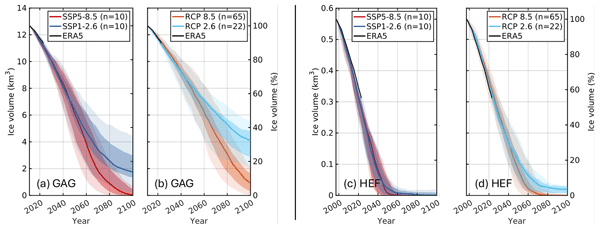
Abstract. We simulate the future evolution of two valley glaciers in the European Alps over the course of the 21st century. The model setup combines a numerical realization of full-Stokes ice dynamics and a surface mass balance model forced with the sustained (inline with the Paris Agreement) and highest climate emission scenarios based on CMIP5 and CMIP6 data pools. The initialization of the three-dimensional glacier flow model is based on data assimilation, where a detailed observed ice surface velocity map serves as reference for constraining unknown parameters by means of inversion techniques. This setup is applied to Great Aletsch Glacier (GAG) and Hintereisferner (HEF) to assess their individual responses to climate change in the western and eastern European Alps, respectively. The model results of both glaciers are calibrated with comprehensive glaciological observations over several years to ensure a realistic glacier response in the observation period. The end-of-the-century projections reveal a substantial volume loss of both glaciers: HEF is projected to vanish in the middle of the 21st century regardless of the climate emission scenario. GAG is likely to disappear at the end of the 21st century under high-emission scenarios RCP 8.5 and SSP5-8.5, whereas low-emission scenarios RCP 2.6 and SSP1-2.6 predict a median ice volume reduction of 67.7 % [62.2 to 77.6 %] and 86.4 % [76.2 to 89.4 %], respectively (values in brackets correspond to the 17th to 83rd percentile range). Our individual and detailed results of glacier evolution provide well-constrained estimates to complement large-scale modelling efforts. In general, our findings of substantial volume loss at the end of the 21st century align with large-scale modelling outcomes; however, a rough model-intercomparison study reveals a large spread of volume projections with the different glacier models.
Competing interests: Gong Cheng is a member of the editorial board of The Cryosphere. All other authors declare that they have no conflict of interest.
Publisher's note: Copernicus Publications remains neutral with regard to jurisdictional claims made in the text, published maps, institutional affiliations, or any other geographical representation in this paper. While Copernicus Publications makes every effort to include appropriate place names, the final responsibility lies with the authors. Views expressed in the text are those of the authors and do not necessarily reflect the views of the publisher.-
Notice on discussion status
The requested preprint has a corresponding peer-reviewed final revised paper. You are encouraged to refer to the final revised version.
-
Preprint
(22126 KB)
-
The requested preprint has a corresponding peer-reviewed final revised paper. You are encouraged to refer to the final revised version.
- Preprint
(22126 KB) - Metadata XML
- BibTeX
- EndNote
- Final revised paper


Journal article(s) based on this preprint
Interactive discussion
Status: closed
-
RC1: 'Comment on egusphere-2025-3150', Anonymous Referee #1, 12 Sep 2025
-
AC3: 'Reply on RC1', Martin Rückamp, 05 Feb 2026
The comment was uploaded in the form of a supplement: https://egusphere.copernicus.org/preprints/2025/egusphere-2025-3150/egusphere-2025-3150-AC3-supplement.pdf
-
AC3: 'Reply on RC1', Martin Rückamp, 05 Feb 2026
-
RC2: 'Comment on egusphere-2025-3150', Yoni Verhaegen, 26 Sep 2025
-
AC2: 'Reply on RC2', Martin Rückamp, 05 Feb 2026
The comment was uploaded in the form of a supplement: https://egusphere.copernicus.org/preprints/2025/egusphere-2025-3150/egusphere-2025-3150-AC2-supplement.pdf
-
AC2: 'Reply on RC2', Martin Rückamp, 05 Feb 2026
-
RC3: 'Comment on egusphere-2025-3150', Anonymous Referee #3, 24 Oct 2025
-
AC1: 'Reply on RC3', Martin Rückamp, 05 Feb 2026
The comment was uploaded in the form of a supplement: https://egusphere.copernicus.org/preprints/2025/egusphere-2025-3150/egusphere-2025-3150-AC1-supplement.pdf
-
AC1: 'Reply on RC3', Martin Rückamp, 05 Feb 2026
Peer review completion


Post-review adjustments


Interactive discussion
Status: closed
-
RC1: 'Comment on egusphere-2025-3150', Anonymous Referee #1, 12 Sep 2025
-
AC3: 'Reply on RC1', Martin Rückamp, 05 Feb 2026
The comment was uploaded in the form of a supplement: https://egusphere.copernicus.org/preprints/2025/egusphere-2025-3150/egusphere-2025-3150-AC3-supplement.pdf
-
AC3: 'Reply on RC1', Martin Rückamp, 05 Feb 2026
-
RC2: 'Comment on egusphere-2025-3150', Yoni Verhaegen, 26 Sep 2025
-
AC2: 'Reply on RC2', Martin Rückamp, 05 Feb 2026
The comment was uploaded in the form of a supplement: https://egusphere.copernicus.org/preprints/2025/egusphere-2025-3150/egusphere-2025-3150-AC2-supplement.pdf
-
AC2: 'Reply on RC2', Martin Rückamp, 05 Feb 2026
-
RC3: 'Comment on egusphere-2025-3150', Anonymous Referee #3, 24 Oct 2025
-
AC1: 'Reply on RC3', Martin Rückamp, 05 Feb 2026
The comment was uploaded in the form of a supplement: https://egusphere.copernicus.org/preprints/2025/egusphere-2025-3150/egusphere-2025-3150-AC1-supplement.pdf
-
AC1: 'Reply on RC3', Martin Rückamp, 05 Feb 2026
Peer review completion
Post-review adjustments
Journal article(s) based on this preprint
Viewed
| HTML | XML | Total | BibTeX | EndNote | |
|---|---|---|---|---|---|
| 15,990 | 1,795 | 296 | 18,081 | 516 | 565 |
- HTML: 15,990
- PDF: 1,795
- XML: 296
- Total: 18,081
- BibTeX: 516
- EndNote: 565
Viewed (geographical distribution)
| Country | # | Views | % |
|---|
| Total: | 0 |
| HTML: | 0 |
| PDF: | 0 |
| XML: | 0 |
- 1
Cited



Gong Cheng
Karlheinz Gutjahr
Marco Möller
Petri K. E. Pellikka
Christoph Mayer
The requested preprint has a corresponding peer-reviewed final revised paper. You are encouraged to refer to the final revised version.
- Preprint
(22126 KB) - Metadata XML
See attachment