
the Creative Commons Attribution 4.0 License.
the Creative Commons Attribution 4.0 License.
 | 07 Jul 2025
Processes driving the regional sensitivities of summertime PM2.5 to temperature across the US: New insights from model simulations
Abstract. The temperature sensitivity of fine particulate matter (PM2.5) critically influences air quality and human health under a warming climate, yet models struggle to accurately reproduce observed sensitivities. This study improves the representation of PM2.5-temperature relationships in the chemical transport model GEOS-Chem through targeted improvements and analyses of the underlying drivers based on simulations across the contiguous US (2000–2022). Our simulations reveal that chemical production processes, particularly isoprene secondary organic aerosols (SOA) and sulfate formation, determine the magnitude of PM2.5 sensitivity in the eastern US. In the Western US, primary emissions drive the increasing PM2.5-temperature sensitivity. Transport processes contribute to interannual variability in PM2.5 sensitivity across all regions. We quantified the contributions from individual temperature-sensitive processes for the first time. Sulfate concentration plays a pivotal role in modulating the sensitivity of isoprene SOA due to its direct influence on isoprene SOA formation. Furthermore, the increased SO2 emissions on warm days dictates both the magnitude and variability of sulfate sensitivity in the Eastern and Central US. In the Western US, however, sulfate sensitivity is primarily controlled by the temperature response of hydroxyl radicals (·OH). These findings highlight the impact of anthropogenic emission reductions on declining PM2.5–temperature sensitivity in the eastern US, improve our understanding of climate-driven air quality changes, and underscore the importance of accurately representing temperature-dependent processes in future air quality projections.
-
Notice on discussion status
The requested preprint has a corresponding peer-reviewed final revised paper. You are encouraged to refer to the final revised version.
-
Preprint
(2804 KB)
-
Supplement
(20551 KB)
-
The requested preprint has a corresponding peer-reviewed final revised paper. You are encouraged to refer to the final revised version.
- Preprint
(2804 KB) - Metadata XML
-
Supplement
(20551 KB) - BibTeX
- EndNote
- Final revised paper


Journal article(s) based on this preprint
Interactive discussion
Status: closed
-
RC1: 'Comment on egusphere-2025-2872', Anonymous Referee #1, 19 Sep 2025
In this manuscript, the authors build upon previous literature examining relationships between air pollution and climate variability, focusing here on ways in which temperature affects PM2.5 in the United States. Using a wide ranging set of chemical transport model simulations, they attempt to identify key connections and mechanisms linking temperature to PM2.5 through a rolling window of gridded sensitivity calculations. On the whole I find many aspects of this study to be thoughtfully composed and presented, and I see many strengths and valuable elements. At the same time, I am also puzzled by several key elements and decisions, including fundamental model setup and case parameter choices. While I can see core elements of this study that should become valuable additions to the literature on publication, I have some major concerns and suggestions for improvement that I believe are necessary to tighten up the comparisons being made and resolve issues in analysis.
- As one large and general criticism, I find the full set of model simulations, as described in Table 1, to be overly varied and confusingly named. The so-called BASE case has almost nothing in common with any of the other simulations. It uses a significantly older version of model code, with major differences across the board in terms of functionality and operation. Emissions, SOA scheme, and even the range of years modeled are either unique to this case or shared by only one other, which in my mind really stretches the assumed definition of a “BASE” case. MOD in this list does not represent a “modified” version of the BASE case, but rather an entirely new model version with almost entirely new model inputs. Considering the age of the code used in the BASE case (currently over 7 years old representing a gap of three major code releases and numerous smaller fixes and updates relevant to this study topic), I do not see much value in including the BASE simulation at all, unless a more systematic review of all updated components is performed. Since this study is more focused on chemistry/climate sensitivities, and less focused on cataloguing individual modeling improvements that have been made over the past decade, I suggest that the currently named BASE case be removed from the study in the sake of clarity and consistency, and all cases be renamed to better reflect their true roles and points of comparison.
- On a similar note, I think the SIM_BC case (4x5 horizontal resolution global simulation with Simple SOA) is not currently effective as a sensitivity test due to having too many changes relative to the MOD case. It shares a coarse resolution with MOD_BC, but has a unique SOA scheme and (confusingly) a shorter run length. Again, there are too many unique elements to make this an effective and meaningful comparison against the high resolution MOD case that is actually at the heart of the study. If the domain run time were lengthened it could serve as a reasonable comparison against MOD_BC, but grouped together with all cases as it often is in manuscript tables and figures it is somewhat misleading, since it is not clear whether differences against MOD are due to resolution, SOA scheme, temporal domain differences, or some combination of the three.
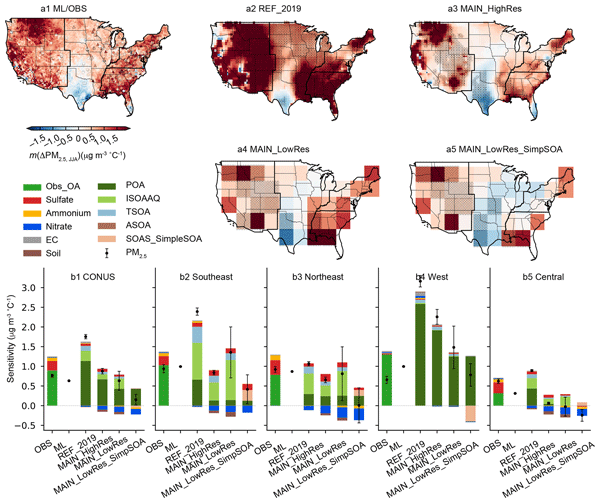
- I also have concerns related to overall model performance, as shown in Supplementary Figure 4. Considering the proposed importance of OA sensitivities and the mechanisms underlying its formation and fate, the massive overprediction in later years strikes me as especially problematic. The fact that this overprediction appears to have such a strong impact on the sensitivities shown in Figure 2 is even more concerning, and deserves more analysis and discussion. An overabundance of fire emissions from GFED4 is offered as a potential reason for these effects, but this issue and its downstream impacts on resulting sensitivity analyses are far too brief, to my eye. Even assuming that PM overpredictions are being caused by overestimated primary emissions from GFED, what is the reason for the massive and regionally varying impacts on sensitivities (Figure 2, b2-b5)? What does it show about the robustness of this methodology, if one year of overestimated fire emissions can drive such wild swings in calculated sensitivities across over one third of the modeled years, for some regions? And perhaps most importantly, if 2021 fire emissions are indeed so problematic, why include that year at all? Considering how much of the sensitivity time series is apparently dominated or at least heavily impacted by this issue, I am not comfortable putting much weight on final numbers until either the issue is resolved or the impacted years are removed.
- I question the decision and justification for running Complex SOA scheme model simulations without the semivolatile POA option. In defense of this choice, the authors argue that “non-volatile POA treatment more accurately reproduces the low-troposphere POA profile compared to the semi-volatile approach”. However, the cited paper (Pai et al., 2020) appears to offer the exact opposite recommendation, saying that “a semi-volatile treatment of POA is superior to a non-volatile treatment” and “we recommend that POA be modeled as semi-volatile”. The authors here later claim that “since oxidized POA is not included in the SOA mass, disabling the semi-volatile POA scheme does not impact SOA simulation results and helps reduce computational costs”, but again I question this justification, considering the frequent use of overall PM2.5 and total OA in study figures. Turning this option off should be supported by more extensive testing to confirm that key sensitivity metrics are indeed not affected by its omission.
- In section 3.4, model sensitivities are further explored through a breakdown by model process, with a focus on vertical levels within the PBL. I can understand the rationale for zeroing in on near-surface processes, but I would like to at least see what things look like higher up as well, considering the potential for important chemistry and transport at higher altitudes that can influence surface concentrations. Meaningful chemistry impacts aloft should be categorized as such, not folded into mixing or transport.
- Likewise, while isoprene may show up as the strongest SOA signal in the US (Figure 3), it would be worthwhile to see sensitivities of other SOA species as well. Figures 3 and 4 together appear to leave major gaps in understanding temperature sensitivities outside of the sulfate and isoprene dominated regions to the East, and getting a better handle on how SOA appears to behave elsewhere could be useful.
- Early descriptions of the climate penalty with respect to PM2.5 appear to be overly simplistic relative to the cited literature. The authors state that “Higher temperatures are generally associated with exacerbated PM2.5 pollution”, but multiple studies (including some of those immediately cited) have offered a far more mixed message on observed and modeled PM2.5 temperature sensitivities, especially relative to those of tropospheric ozone. Later discussions towards the end of the introduction do go into more depth and detail on some of the disagreements seen in the literature, but I think this nuance and complexity should at least be mentioned earlier on as well, especially if papers showing differing sensitivity results are being cited.
Citation: https://doi.org/10.5194/egusphere-2025-2872-RC1 -
RC2: 'Comment on egusphere-2025-2872', Anonymous Referee #2, 04 Oct 2025
This manuscript presents a rigorous analysis of the regional and temporal trends in the sensitivity of PM2.5 to temperature across CONUS. The improved model modifications (e.g. using GFED4, including the SOA coating effects, and the scaling of SO2 emissions) yield outputs that agree sufficiently well with observations, for the most part. Moreover, the breakdown quantifying the contributions of individual processes within the model is significant in advancing the study of model evaluations and design beyond simple observational correlations. However, the analysis reveals a few structural and methodological issues that, if addressed, would greatly increase the paper's overall impact and credibility.
1. Addressing discrepancies in the representation of nitrate with temperature:
The model's strong negative correlation for nitrate and the resulting bias in ammonium sensitivity represent the most persistent and significant discrepancy between simulations and observations in the Eastern and Central US. I suggest using the decomposition approach to try and quantify the relative contribution of competing effects in driving the negative nitrate bias. For example, discerning between the sensitivity of the gas-particle partitioning with temperature and the sensitivity of NOx emissions with temperature.
2. Addressing uncertainty in the decomposition of individual processes
The decomposition of the total sensitivity into contributions from precursors relies on a linear regression of detrended anomalies as a proxy for partial derivatives. While the results generally align with the total sensitivity, the acknowledged interdependencies among variables suggest this simplification may introduce uncertainty. To increase the robustness of this quantification method, I might include a simple uncertainty assessment, even if only for a smaller (but key) representative region (e.g. SO4 in the Southeast US). This could involve demonstrating that the derived process sensitivities are robust across different rolling temporal windows or alternative detrending methods.
3. Addressing outlying regarding wildfire OA sensitivity in the Western US
The authors acknowledge that the significant OA sensitivity overestimation in the Western US in more recent years (2016-2022) could be attributed to extreme values in the GFED4 inventory. However, it might be more impactful to reframe this occurrence, rather than with a critique of the GFED4 inventory itself but with an acknowledgment that the current CTM framework does not handle these extreme events well. The modeling of the impact of future wildfires will always carry significant uncertainty, and for certain regions of the US, this inability to accurately predict wildfire contributions has a large impact on overall PM2.5 projections. However, it’s clear that the wildly exaggerated modeled primary OA sensitivities (as shown in Figure 2) are obfuscating trends in SOA that are perhaps more useful to focus on in designing CTMs. Indeed, the scaling on row b of Figure 2 makes discerning trends very difficult prior to the sudden increase. (This criticism is one that I would apply to many of the figures in this manuscript, text is too small, plots are too crowded, and it is a struggle to try and make sense of things).
4. There are minor grammatical inaccuracies throughout. I’ll list some examples here, as shown from Lines 695-708. My suggestions are written in capitalized letters.
“We quantified the contributions from THE temperature-dependence of isoprene and sulfate to ISOAAQ sensitivity.”
“Given the important role of gas-phase production in MODULATING sulfate sensitivity, as indicated by our findings, we further quantified the contributions from the temperature response of precursors of THE gas phase reaction… and THE cloud fraction to sulfate temperature sensitivity.”
“The long-term temporal pattern of THE temperature sensitivity of sulfate is mainly driven by the decreasing response of SO2 concentrations to temperature as SO2 emissions declined OVERALL.” (Remove “rise” to make the sentence flow better).
“For monoterpene SOA, gas-particle phase partitioning plays a significant role in overall sensitivity, while its dependence on precursor concentrations, including monoterpeneS, ·OH, and NOₓ, collectively contributes to interannual variability.” (I think monoterpenes should be pluralized here, to indicate the full class of molecules.)
I picked this paragraph as an example, but similar grammatical inconsistencies are found throughout the paper. I suggest doing a full round of edits looking specifically at the wording.
Citation: https://doi.org/10.5194/egusphere-2025-2872-RC2 - AC1: 'Comment on egusphere-2025-2872', Lifei Yin, 12 Feb 2026
Peer review completion


Interactive discussion
Status: closed
-
RC1: 'Comment on egusphere-2025-2872', Anonymous Referee #1, 19 Sep 2025
In this manuscript, the authors build upon previous literature examining relationships between air pollution and climate variability, focusing here on ways in which temperature affects PM2.5 in the United States. Using a wide ranging set of chemical transport model simulations, they attempt to identify key connections and mechanisms linking temperature to PM2.5 through a rolling window of gridded sensitivity calculations. On the whole I find many aspects of this study to be thoughtfully composed and presented, and I see many strengths and valuable elements. At the same time, I am also puzzled by several key elements and decisions, including fundamental model setup and case parameter choices. While I can see core elements of this study that should become valuable additions to the literature on publication, I have some major concerns and suggestions for improvement that I believe are necessary to tighten up the comparisons being made and resolve issues in analysis.
- As one large and general criticism, I find the full set of model simulations, as described in Table 1, to be overly varied and confusingly named. The so-called BASE case has almost nothing in common with any of the other simulations. It uses a significantly older version of model code, with major differences across the board in terms of functionality and operation. Emissions, SOA scheme, and even the range of years modeled are either unique to this case or shared by only one other, which in my mind really stretches the assumed definition of a “BASE” case. MOD in this list does not represent a “modified” version of the BASE case, but rather an entirely new model version with almost entirely new model inputs. Considering the age of the code used in the BASE case (currently over 7 years old representing a gap of three major code releases and numerous smaller fixes and updates relevant to this study topic), I do not see much value in including the BASE simulation at all, unless a more systematic review of all updated components is performed. Since this study is more focused on chemistry/climate sensitivities, and less focused on cataloguing individual modeling improvements that have been made over the past decade, I suggest that the currently named BASE case be removed from the study in the sake of clarity and consistency, and all cases be renamed to better reflect their true roles and points of comparison.
- On a similar note, I think the SIM_BC case (4x5 horizontal resolution global simulation with Simple SOA) is not currently effective as a sensitivity test due to having too many changes relative to the MOD case. It shares a coarse resolution with MOD_BC, but has a unique SOA scheme and (confusingly) a shorter run length. Again, there are too many unique elements to make this an effective and meaningful comparison against the high resolution MOD case that is actually at the heart of the study. If the domain run time were lengthened it could serve as a reasonable comparison against MOD_BC, but grouped together with all cases as it often is in manuscript tables and figures it is somewhat misleading, since it is not clear whether differences against MOD are due to resolution, SOA scheme, temporal domain differences, or some combination of the three.
- I also have concerns related to overall model performance, as shown in Supplementary Figure 4. Considering the proposed importance of OA sensitivities and the mechanisms underlying its formation and fate, the massive overprediction in later years strikes me as especially problematic. The fact that this overprediction appears to have such a strong impact on the sensitivities shown in Figure 2 is even more concerning, and deserves more analysis and discussion. An overabundance of fire emissions from GFED4 is offered as a potential reason for these effects, but this issue and its downstream impacts on resulting sensitivity analyses are far too brief, to my eye. Even assuming that PM overpredictions are being caused by overestimated primary emissions from GFED, what is the reason for the massive and regionally varying impacts on sensitivities (Figure 2, b2-b5)? What does it show about the robustness of this methodology, if one year of overestimated fire emissions can drive such wild swings in calculated sensitivities across over one third of the modeled years, for some regions? And perhaps most importantly, if 2021 fire emissions are indeed so problematic, why include that year at all? Considering how much of the sensitivity time series is apparently dominated or at least heavily impacted by this issue, I am not comfortable putting much weight on final numbers until either the issue is resolved or the impacted years are removed.
- I question the decision and justification for running Complex SOA scheme model simulations without the semivolatile POA option. In defense of this choice, the authors argue that “non-volatile POA treatment more accurately reproduces the low-troposphere POA profile compared to the semi-volatile approach”. However, the cited paper (Pai et al., 2020) appears to offer the exact opposite recommendation, saying that “a semi-volatile treatment of POA is superior to a non-volatile treatment” and “we recommend that POA be modeled as semi-volatile”. The authors here later claim that “since oxidized POA is not included in the SOA mass, disabling the semi-volatile POA scheme does not impact SOA simulation results and helps reduce computational costs”, but again I question this justification, considering the frequent use of overall PM2.5 and total OA in study figures. Turning this option off should be supported by more extensive testing to confirm that key sensitivity metrics are indeed not affected by its omission.
- In section 3.4, model sensitivities are further explored through a breakdown by model process, with a focus on vertical levels within the PBL. I can understand the rationale for zeroing in on near-surface processes, but I would like to at least see what things look like higher up as well, considering the potential for important chemistry and transport at higher altitudes that can influence surface concentrations. Meaningful chemistry impacts aloft should be categorized as such, not folded into mixing or transport.
- Likewise, while isoprene may show up as the strongest SOA signal in the US (Figure 3), it would be worthwhile to see sensitivities of other SOA species as well. Figures 3 and 4 together appear to leave major gaps in understanding temperature sensitivities outside of the sulfate and isoprene dominated regions to the East, and getting a better handle on how SOA appears to behave elsewhere could be useful.
- Early descriptions of the climate penalty with respect to PM2.5 appear to be overly simplistic relative to the cited literature. The authors state that “Higher temperatures are generally associated with exacerbated PM2.5 pollution”, but multiple studies (including some of those immediately cited) have offered a far more mixed message on observed and modeled PM2.5 temperature sensitivities, especially relative to those of tropospheric ozone. Later discussions towards the end of the introduction do go into more depth and detail on some of the disagreements seen in the literature, but I think this nuance and complexity should at least be mentioned earlier on as well, especially if papers showing differing sensitivity results are being cited.
Citation: https://doi.org/10.5194/egusphere-2025-2872-RC1 -
RC2: 'Comment on egusphere-2025-2872', Anonymous Referee #2, 04 Oct 2025
This manuscript presents a rigorous analysis of the regional and temporal trends in the sensitivity of PM2.5 to temperature across CONUS. The improved model modifications (e.g. using GFED4, including the SOA coating effects, and the scaling of SO2 emissions) yield outputs that agree sufficiently well with observations, for the most part. Moreover, the breakdown quantifying the contributions of individual processes within the model is significant in advancing the study of model evaluations and design beyond simple observational correlations. However, the analysis reveals a few structural and methodological issues that, if addressed, would greatly increase the paper's overall impact and credibility.
1. Addressing discrepancies in the representation of nitrate with temperature:
The model's strong negative correlation for nitrate and the resulting bias in ammonium sensitivity represent the most persistent and significant discrepancy between simulations and observations in the Eastern and Central US. I suggest using the decomposition approach to try and quantify the relative contribution of competing effects in driving the negative nitrate bias. For example, discerning between the sensitivity of the gas-particle partitioning with temperature and the sensitivity of NOx emissions with temperature.
2. Addressing uncertainty in the decomposition of individual processes
The decomposition of the total sensitivity into contributions from precursors relies on a linear regression of detrended anomalies as a proxy for partial derivatives. While the results generally align with the total sensitivity, the acknowledged interdependencies among variables suggest this simplification may introduce uncertainty. To increase the robustness of this quantification method, I might include a simple uncertainty assessment, even if only for a smaller (but key) representative region (e.g. SO4 in the Southeast US). This could involve demonstrating that the derived process sensitivities are robust across different rolling temporal windows or alternative detrending methods.
3. Addressing outlying regarding wildfire OA sensitivity in the Western US
The authors acknowledge that the significant OA sensitivity overestimation in the Western US in more recent years (2016-2022) could be attributed to extreme values in the GFED4 inventory. However, it might be more impactful to reframe this occurrence, rather than with a critique of the GFED4 inventory itself but with an acknowledgment that the current CTM framework does not handle these extreme events well. The modeling of the impact of future wildfires will always carry significant uncertainty, and for certain regions of the US, this inability to accurately predict wildfire contributions has a large impact on overall PM2.5 projections. However, it’s clear that the wildly exaggerated modeled primary OA sensitivities (as shown in Figure 2) are obfuscating trends in SOA that are perhaps more useful to focus on in designing CTMs. Indeed, the scaling on row b of Figure 2 makes discerning trends very difficult prior to the sudden increase. (This criticism is one that I would apply to many of the figures in this manuscript, text is too small, plots are too crowded, and it is a struggle to try and make sense of things).
4. There are minor grammatical inaccuracies throughout. I’ll list some examples here, as shown from Lines 695-708. My suggestions are written in capitalized letters.
“We quantified the contributions from THE temperature-dependence of isoprene and sulfate to ISOAAQ sensitivity.”
“Given the important role of gas-phase production in MODULATING sulfate sensitivity, as indicated by our findings, we further quantified the contributions from the temperature response of precursors of THE gas phase reaction… and THE cloud fraction to sulfate temperature sensitivity.”
“The long-term temporal pattern of THE temperature sensitivity of sulfate is mainly driven by the decreasing response of SO2 concentrations to temperature as SO2 emissions declined OVERALL.” (Remove “rise” to make the sentence flow better).
“For monoterpene SOA, gas-particle phase partitioning plays a significant role in overall sensitivity, while its dependence on precursor concentrations, including monoterpeneS, ·OH, and NOₓ, collectively contributes to interannual variability.” (I think monoterpenes should be pluralized here, to indicate the full class of molecules.)
I picked this paragraph as an example, but similar grammatical inconsistencies are found throughout the paper. I suggest doing a full round of edits looking specifically at the wording.
Citation: https://doi.org/10.5194/egusphere-2025-2872-RC2 - AC1: 'Comment on egusphere-2025-2872', Lifei Yin, 12 Feb 2026
Peer review completion
Journal article(s) based on this preprint
Viewed
| HTML | XML | Total | Supplement | BibTeX | EndNote | |
|---|---|---|---|---|---|---|
| 2,296 | 504 | 111 | 2,911 | 417 | 119 | 122 |
- HTML: 2,296
- PDF: 504
- XML: 111
- Total: 2,911
- Supplement: 417
- BibTeX: 119
- EndNote: 122
Viewed (geographical distribution)
| Country | # | Views | % |
|---|
| Total: | 0 |
| HTML: | 0 |
| PDF: | 0 |
| XML: | 0 |
- 1
Lifei Yin
Yiqi Zheng
Bin Bai
Bingqing Zhang
Rachel Silvern
Jingqiu Mao
Loretta Mickley

The requested preprint has a corresponding peer-reviewed final revised paper. You are encouraged to refer to the final revised version.
- Preprint
(2804 KB) - Metadata XML
-
Supplement
(20551 KB) - BibTeX
- EndNote
- Final revised paper