
the Creative Commons Attribution 4.0 License.
the Creative Commons Attribution 4.0 License.
 | 01 Sep 2025
Refining gravity anomaly data of coastal areas by combining XGM2019e-2159 and SRTM/GEBCO_2024 residual terrain model with forward modeling method
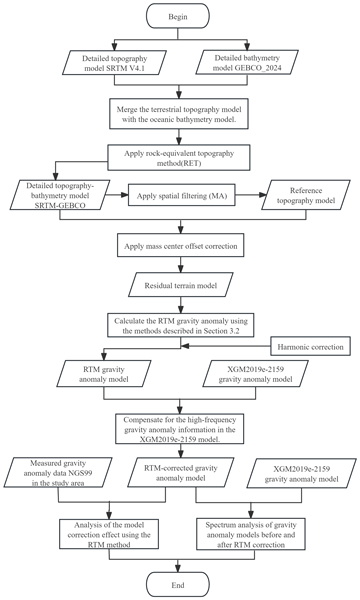
Abstract. As one of the Earth's fundamental physical fields, the gravity field model’s accuracy is considerably constrained in areas with sparse coverage or data gaps. In coastal areas, satellite altimetry data are affected by land contamination and errors from tidal models, while shipborne gravity measurements fail to obtain valid gravity data in nearshore regions. Therefore, gravity field models’ accuracy in coastal areas is relatively lower. Additionally, due to the truncation of global gravity field models at specific degrees, truncation errors prevent the acquisition of high-precision gravity anomaly (GA) information. In response to this problem, this study introduces detailed land topography and ocean bathymetry data, and adopts a gravity forward modeling method based on the residual terrain model (RTM) to reduce the truncation error of the gravity field model in the target coastal area. Thus, high-precision GA information can be obtained in the coastal area. First, the high-resolution terrestrial digital elevation model SRTM V4.1 is merged with the marine bathymetry model GEBCO_2024, and then combined with the reference topography model Earth2014 to construct the RTM. The RTM is then discretized into regular grid prisms, and the GA generated by the RTM at target points is computed in the spatial domain using the prism integration method to refine the XGM2019e-2159 gravity anomaly (XGM-GA) model. For computational points located in coastal areas, the rock-equivalent topography (RET) method is employed to avoid distinguishing between the different densities of land and ocean prisms during the calculation process. Based on this, a mass center offset correction is proposed to address the errors caused by prism position shifts in the RET method. To validate the feasibility of this method, this study focuses on a selected region along the U.S. West Coast (125° W–122° W, 39° N–42° N) and refines the XGM-GA model. Measured GA data from NGS99 serve as the reference for validating the experimental results. The research results show that after applying the RTM method, the root mean square error between the modeled GA and the measured GA decreased from 14.55 mGal to 8.19 mGal over the entire study area, and from 14.98 mGal to 8.19 mGal in the coastal area. The power spectral density analysis conducted at the end of this study shows that the power spectral density of the high-frequency band of the XGM-GA model significantly increased after applying the RTM method. All the above results prove the feasibility of the RTM gravity forward modeling method in improving the accuracy of the gravity anomaly model.
-
Notice on discussion status
The requested preprint has a corresponding peer-reviewed final revised paper. You are encouraged to refer to the final revised version.
-
Preprint
(1745 KB)
-
The requested preprint has a corresponding peer-reviewed final revised paper. You are encouraged to refer to the final revised version.
- Preprint
(1745 KB) - Metadata XML
- BibTeX
- EndNote
- Final revised paper


Journal article(s) based on this preprint
Interactive discussion
Status: closed
-
RC1: 'Comment on egusphere-2025-2585', Anonymous Referee #1, 01 Oct 2025
- AC1: 'Reply on RC1', Jinyun Guo, 21 Oct 2025
-
RC2: 'Comment on egusphere-2025-2585', Qiujie Chen, 02 Oct 2025
This manuscript addresses a practically significant problem: refining the accuracy of global gravity field models in coastal areas using high-resolution topography and bathymetry data via the Residual Terrain Model (RTM) forward modeling method. The methodology is sound, the experimental design is robust, the data is substantial, and the results clearly demonstrate the effectiveness of the proposed approach. The study makes a clear contribution to improving gravity field models in coastal and rugged terrains. The paper is well-structured and clearly written. I recommend acceptance after addressing the following minor points.
(1) Accuracy of Figure References:
The text contains inaccurate figure reference. For instance, Section 3.4 refers to "Fig. 2" in the context of illustrating computation points, but based on the context, this should likely be "Fig 3". Please conduct a thorough check to ensure all figure and table citations are correct throughout the manuscript.
(2) Quantifying the Contribution of the Mass Center Correction:
The proposed mass center offset correction for the RET method is a valuable improvement. However, its quantitative impact and necessity are not currently demonstrated. Providing a simple comparative result would significantly strengthen the argument for its inclusion and help readers appreciate its contribution.
(3) Justification for Using the XGM2019e Model:
The XGM2019e model provided a version up to d/o 5399 (about 2” resolution), which theoretically contains higher-resolution signal. Please justify the choice of using only the d/o 2159 model for your modeling, or demonstrate whether the XGM/RTM-GA can achieve performance superior to that of the d/o 5399 XGM2019e model.
(4) Discussion on Computational Efficiency and Relation to Existing Models:
The method developed in this study is targeted at the challenging coastal areas. However, for land areas, high-resolution gravity field models like the SRTM2Gravity model by Hirt et al. (2019) already exist and could potentially reduce computational burden. While the current manuscript is complete, I would be interested in the potential for a hybrid approach in the future: leveraging existing models over land and focusing the RTM forward modeling presented here primarily on the coastal transition zone. A discussion on this prospect would be valuable.
(5) Validation Data Coverage and Diversity:
I note that Fig. 2 shows a notable absence of validation points in the coast area (about 20km). Could you comment on the availability of other datasets that could potentially validate the model in this critical zone? Additionally, while the NGS99 dataset is robust, incorporating additional independent validation data (such as shipborne data) would further strengthen the reliability and generalizability of the manuscript.
Citation: https://doi.org/10.5194/egusphere-2025-2585-RC2 - AC2: 'Reply on RC2', Jinyun Guo, 21 Oct 2025
Peer review completion


Interactive discussion
Status: closed
-
RC1: 'Comment on egusphere-2025-2585', Anonymous Referee #1, 01 Oct 2025
Dear Authors,
Please find my review report in the attachment.
Best regards.
- AC1: 'Reply on RC1', Jinyun Guo, 21 Oct 2025
-
RC2: 'Comment on egusphere-2025-2585', Qiujie Chen, 02 Oct 2025
This manuscript addresses a practically significant problem: refining the accuracy of global gravity field models in coastal areas using high-resolution topography and bathymetry data via the Residual Terrain Model (RTM) forward modeling method. The methodology is sound, the experimental design is robust, the data is substantial, and the results clearly demonstrate the effectiveness of the proposed approach. The study makes a clear contribution to improving gravity field models in coastal and rugged terrains. The paper is well-structured and clearly written. I recommend acceptance after addressing the following minor points.
(1) Accuracy of Figure References:
The text contains inaccurate figure reference. For instance, Section 3.4 refers to "Fig. 2" in the context of illustrating computation points, but based on the context, this should likely be "Fig 3". Please conduct a thorough check to ensure all figure and table citations are correct throughout the manuscript.
(2) Quantifying the Contribution of the Mass Center Correction:
The proposed mass center offset correction for the RET method is a valuable improvement. However, its quantitative impact and necessity are not currently demonstrated. Providing a simple comparative result would significantly strengthen the argument for its inclusion and help readers appreciate its contribution.
(3) Justification for Using the XGM2019e Model:
The XGM2019e model provided a version up to d/o 5399 (about 2” resolution), which theoretically contains higher-resolution signal. Please justify the choice of using only the d/o 2159 model for your modeling, or demonstrate whether the XGM/RTM-GA can achieve performance superior to that of the d/o 5399 XGM2019e model.
(4) Discussion on Computational Efficiency and Relation to Existing Models:
The method developed in this study is targeted at the challenging coastal areas. However, for land areas, high-resolution gravity field models like the SRTM2Gravity model by Hirt et al. (2019) already exist and could potentially reduce computational burden. While the current manuscript is complete, I would be interested in the potential for a hybrid approach in the future: leveraging existing models over land and focusing the RTM forward modeling presented here primarily on the coastal transition zone. A discussion on this prospect would be valuable.
(5) Validation Data Coverage and Diversity:
I note that Fig. 2 shows a notable absence of validation points in the coast area (about 20km). Could you comment on the availability of other datasets that could potentially validate the model in this critical zone? Additionally, while the NGS99 dataset is robust, incorporating additional independent validation data (such as shipborne data) would further strengthen the reliability and generalizability of the manuscript.
Citation: https://doi.org/10.5194/egusphere-2025-2585-RC2 - AC2: 'Reply on RC2', Jinyun Guo, 21 Oct 2025
Peer review completion
Journal article(s) based on this preprint
Viewed
| HTML | XML | Total | BibTeX | EndNote | |
|---|---|---|---|---|---|
| 4,922 | 781 | 120 | 5,823 | 87 | 104 |
- HTML: 4,922
- PDF: 781
- XML: 120
- Total: 5,823
- BibTeX: 87
- EndNote: 104
Viewed (geographical distribution)
| Country | # | Views | % |
|---|
| Total: | 0 |
| HTML: | 0 |
| PDF: | 0 |
| XML: | 0 |
- 1
Yixiang Liu

Bin Guan
Shaofeng Bian
Heping Sun
Xin Liu
The requested preprint has a corresponding peer-reviewed final revised paper. You are encouraged to refer to the final revised version.
- Preprint
(1745 KB) - Metadata XML
Dear Authors,
Please find my review report in the attachment.
Best regards.