
the Creative Commons Attribution 4.0 License.
the Creative Commons Attribution 4.0 License.
 | 22 Jul 2025
Developing a Coastal Hazard Prediction System in Ice-Infested Waters, Part 1: High-Resolution Regional Wave Modeling in The Estuary and Gulf of St. Lawrence
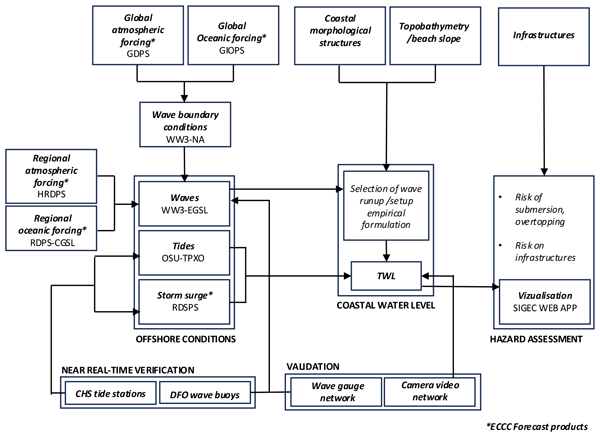
Abstract. This study is the first of a two-part paper that summarizes the development of a prototype coastal hazard prediction system providing short-term (+48 h) forecasts of the total water level (TWL) at 50 m resolution for the province of Quebec, Eastern Canada. In this first part, the implementation of the offshore wave model component of the system, which is a regional 1 km-resolution WAVEWATCH III™(WW3) configuration for the Estuary and Gulf of St. Lawrence (EGSL), is presented and discussed. The configuration is forced by high resolution atmosphere, ocean and sea ice forecasts provided by Environment and Climate Change Canada (ECCC) and includes a state-of-the-art parameterization of wave propagation and attenuation in sea ice that has been tuned with observations from the EGSL. Performances are assessed against wave data collected over a two-year period during which the forecasting system was running operationally, and against historical storm data using a model hindcast. Results demonstrate reasonable forecast skills both for normal and extreme wave conditions during ice-free periods with errors ranging from 15 % to 31 % of the mean wave height. However, when sea ice is present, performances are drastically reduced, primarily due to inaccuracies in the predicted ice fields at spatial scales over which wave energy typically dissipates in sea ice.
-
Notice on discussion status
The requested preprint has a corresponding peer-reviewed final revised paper. You are encouraged to refer to the final revised version.
-
Preprint
(42760 KB)
-
The requested preprint has a corresponding peer-reviewed final revised paper. You are encouraged to refer to the final revised version.
- Preprint
(42760 KB) - Metadata XML
- BibTeX
- EndNote
- Final revised paper


Journal article(s) based on this preprint
Interactive discussion
Status: closed
-
RC1: 'Comment on egusphere-2025-2168', Anonymous Referee #1, 15 Dec 2025
-
AC1: 'Reply on RC1', Jeremy Baudry, 05 Mar 2026
Thank you for the thorough review of our manuscript and the useful comments provided, it is much appreciated. Please find below our response to all questions from Reviewer 1.
This paper reports on the implementation of the wind wave component of a forecasting system for coastal hazard. As such, it is an interesting paper to read. As stated by the authors, much progress is still needed for the proper representation of the complex interactions between atmosphere, waves, currents and sea ice. It is a bit worrisome that the wave predictions were quite well off the observations and potentially not providing much guidance. One could wonder whether an ensemble approach should be used to sample the large uncertainty in the sea ice conditions (i.e. what would the wave conditions be if the sea ice conditions were to be a lot less)?
In general, we would say that in the context of an early warning system an ensemble approach is indeed more desirable than a purely deterministic approach. Knowledge of the uncertainty/spread of the prediction is an important parameter to take into account for decision-making and risk management—arguably just as important as the predicted value itself. However, we see some potential challenges associated with running ensemble simulations in this context (without mentioning, of course, the significant computational cost associated with ensemble prediction using a high-resolution model). The most critical concern is regarding how the system is perturbed to construct the ensemble. Ensemble forecasting is primarily intended to address model sensitivity to initial conditions that arise with highly non-linear equations, or uncertainties in the model’s physical parameters (which are themselves often linked to unresolved subgrid-scale processes). One must therefore sample from a distribution with a known uncertainty —and most importantly unbiased—in the initial conditions/or physical parameters to construct the ensemble members. The issue raised in our paper is not really an initial conditions problem. In fact, the data assimilation system forces the ice model to directly stick to observations derived from ice charts constructed from satellite imagery. The issue primarily comes from the ice model physics itself, which does not allow for an adequate representation of the dynamics of fragmented ice, and the creation of heterogeneous and “patchy” medium as we observed in reality at these spatial scales. It therefore seems extremely difficult to obtain an unbiased ensemble spread. To our knowledge, there are not many short-term ensemble forecasting systems for sea ice. Nevertheless, at the time we write this response, we just came across a recent article currently under review on EGUsphere that specifically addresses parameter perturbation methods (notably P*, the compressive strength of ice) to construct ensembles in the context of seasonal forecasting: https://egusphere.copernicus.org/preprints/2026/egusphere-2025-6402/. Finally, to address your question, “what would happen if there were much less ice, or even no ice at all?”, we believe this is a highly relevant question in the context of coastal hazard risk prediction and assessment. We can think as a useful “ensemble”, one composed by only two members: a control member corresponding to the current deterministic forecast, and a second member assuming completely ice-free conditions, intended to represent the worst-case scenario that could occur during a given storm.
A discussion on this point is added in the concluding section of the revised manuscript.Table 1: what is the justification for using ST3 as most WW3 these days are using ST4 or ST6?
The use of ST3 in this study does not necessarily reflect an improvement compared to ST4 and ST6, and we do not claim that ST3 performs significantly better than the other parameterizations. While we agree that nowadays the use of ST4 and ST6 is probably more widespread and seems to improve overall performances, each of these parameterizations have their strengths and weaknesses under different sea states, the use of ST6 for example have been shown to overestimate Hs under wind-wave-dominated sea states (Lin et al. 2020). The difference between ST3, ST4, and ST6 under the typical wave conditions of the St. Lawrence and for our intended application remains altogether minor. Overall, differences among these three parameterizations mainly affect the spectrum shape ( especially at the high-frequency tail of the spectrum that might affect higher-order spectral moments), but the difference remains second-order compared for example to the impact of the resolution of the wind forcing itself.A note an that point has been added in the revised manuscript advising the reader that changing the wave input-dissipation parameterization might potentially improve the results.
Lin, S., Sheng, J., & Xing, J. (2020). Performance evaluation of parameterizations for wind input and wave dissipation in the spectral wave model for the northwest Atlantic Ocean. Atmosphere-Ocean, 58(4), 258-286.
117: WW3 employs logarithmically frequencies: f(n) = r * f(n-1).
With f(1)=0.05 and f(25)=1.1 Hz would imply r=1.1375, which is a bit unusual. Is it what was used? More commonly used is r=1.1, which would make the frequency discretisation slightly less coarse and probably more appropriate for low energy, short fetch conditions. You would have had to increase the total number of the frequencies to 34 but noting that the set-up is for high resolution forecasts, it might have been relevant.
Good catch. This is an error in the manuscript. In our configuration, we indeed used r=1.1, which gives f = [0.05, 0.5].193: what is the frequency used for the calculation of the mean wave period (Tm2)? Is it consistent with what the model is using? From figures B1 and B2, it does look to me that the model and the prediction have used different frequency range when estimating Tm2. Not using the same frequency range will results in a systematic bias between the two quantities.
This is another good catch. There is indeed a discrepancy between the two ranges. Data from the AWAC have been computed over 0.055-1.0 Hz and we agree that discrepancy, especially at the high frequencies, introduces a bias. AWAC data have been re-extracted with the correct frequency band, and figures and performance statistics have been updated accordingly.215: are you sure about your definition of MBE (A1)? From Figure 7, it looks to me that biases should be negative, i.e. Observations are more often larger than Prediction. Hence while you could say that here is an underestimation of the highest waves by the model.
Good catch, thanks. All metrics have been computed according to: Observation – Predictions. Corrections have been applied in the revised manuscriptMinor correction:
Table 1: WAM Cycle 4 -> WAM Cycle 4 (ecWAM) (i.e. ST3 in WW3 5.16 is based on ECMWF modifications of the original WAM Cycle 4)Corrected
wave breaking -> bottom induced wave breaking
Thank you for the precision. We made the suggested change in the revised manuscript.119: 3h -> 3-hourly
Corrected.127: is the forecast output also 3-hourly?
HRDPS forecasts are provided hourly. This is now specified in the revised version.Figure 10: wave direction -> mean wave direction?
Corrected.Citation: https://doi.org/10.5194/egusphere-2025-2168-AC1
-
AC1: 'Reply on RC1', Jeremy Baudry, 05 Mar 2026
-
RC2: 'Comment on egusphere-2025-2168', Tarmo Soomere, 24 May 2026
Wave modelling in seasonally ice-covered seas is one of the major challenges in contemporary operational oceanography because of several reasons, from uncertainties in the specification of the ice boundary and wave propagation through unconsolidated ice up to issues related with the appropriate definition of statistical properties of wave fields in such water bodies (Tuomi et al., 2011). In this context, it is definitely interesting to address how adequately state-of-the-art hydrodynamic, ice and wave models replicate reality in such conditions. The manuscript makes clear where the knowledge gap is (the presence of ice has been ignored so far in forecasts in the study area) and presents a set of models to fill this gap. To my eyes, the main novelty is systematically including the contribution of ice and waves to the forecast of total water level.
The justification and analysis in the manuscript are professional and sound. The challenges (wind forcing selection and the challenges associated with wave-ice interactions) are basically global for all seasonally ice-covered seas.
The largest issue highlighted and extensively discussed by the authors (Section 4.2) is extensive mismatch between recorded and modelled wave properties in winter. This mismatch is associated with problems in specification of ice properties.
There is one more reason for this feature that, theoretically, may stem from the use of only 25 frequency bins (waves with periods starting from 0.9 s) in the model. Depending on the implementation of the wave model, the model may show too low growth rate of small waves in short fetch and weaker wind conditions (e.g., at the beginning of storm events). For this reason, the WAM model has been implemented in smaller regions of the Baltic Sea using up to 42 frequencies (Soomere, 2005), covering waves with periods starting from about 0.4 s and ensuring that the model properly spins up after calm situations. Doing so led to clearly better representation of growth curves of waves.
Such an increase in spectral coverage may unproportionally increase the computational costs; however, it could help in situations when the effective fetch length is drastically reduced by the presence of ice and when the model spin-up may take too long time. In this context, it might be useful to check whether the wave model properly represents growth curves of relatively low and short waves under moderate winds.
Single minor comments
Line 31: it is questionable whether storm surges can be termed as high-frequency fluctuations as their usual duration is several hours. The same applies to wave set-up that can last as long as high waves approach the shore at a relatively small angle.
Lines 35–36: as wave set-up may last quite some time, some authors associate the contribution of set-up with storm surge and consider run-up and swash as processes that occur on the background of the elevated water level that consist of the sum of surge and set-up. I guess that Stockdon et al. (2023) integrate them into one expression just for simplicity (and ignore the dependence of the magnitude of both phenomena on the approach angle of waves).
Line 45: it would be more specific (albeit somewhat clumsy) to say that changes to the (mean) water level influence the rate of transfer of radiation stress to the nearshore water column.
Line 56: it might be good to mention that the loss of sea ice commonly leads to intensification of coastal processes because of an increase in the cumulative wave energy flux to the non-frozen shore sediment (Orviku et al., 2003; Ryabchuk et al., 2011) and thus, generic concerns about stability of sedimentary shores (which is wider than an increase in the number of extreme events).
Line 71: explain USGS
Lines 87–88: it seems that the approach works equally well in situations that are not fetch-limited as wave fields in the North Atlantic are also evaluated as boundary conditions.
Line 131: consider rephrasing “wind speed’s intensity”.
Line 132: explain NCEP.
Line 189–190: no need to re-introduce AWAC.
Figure 4, small plots of Hm0/Tm02: explain the meaning of the line across diagrams.
Lines 248–254: a reference to (Tuomi et al., 2019) would be appropriate here.
Lilne 279: “This relation” obviously is used to denote the situation where the two sides of the preceding relation are equal; please rephrase accordingly.
Lines 301–302: “above the higher high water large tide” sounds strange.
Line 311: probably significant wave height is meant.
References
Orviku, K., Jaagus, J., Kont, A., Ratas, U., Rivis, R., 2003. Increasing activity of coastal processes associated with climate change in Estonia. J. Coast. Res. 19, 364–375. https://www.jstor.org/stable/4299178
Ryabchuk, D., Kolesov, A., Chubarenko, B., Spiridonov, M., Kurennoy, D., Soomere, T. 2011. Coastal erosion processes in the eastern Gulf of Finland and their links with geological and hydrometeorological factors, Boreal Environ. Res., 16 (Supplement A), 117–137.
Soomere, T., 2005. Wind wave statistics in Tallinn Bay. Boreal Environ. Res. 10 (2), 103–118. http://www.borenv.net/BER/archive/pdfs/ber10/ber10-103.pdf
Tuomi, L., Kahma, K.K., Pettersson, H., 2011. Wave hindcast statistics in the seasonally ice-covered Baltic Sea. Boreal Environ. Res. 16 (6), 451–472. http://www.borenv.net/BER/archive/pdfs/ber16/ber16-451.pdf
Tuomi, L., Kanarik, H., Björkqvist, J.-V., Marjamaa, R., Vainio, J., Hordoir, R., Höglund, A., Kahma, K.K., 2019. Impact of ice data quality and treatment on wave hindcast statistics in seasonally ice-covered seas. Front. Earth Sci. 7, 166. https://doi.org/10.3389/feart.2019.00166
Citation: https://doi.org/10.5194/egusphere-2025-2168-RC2 -
AC2: 'Reply on RC2', Jeremy Baudry, 09 Jun 2026
Wave modelling in seasonally ice-covered seas is one of the major challenges in contemporary operational oceanography because of several reasons, from uncertainties in the specification of the ice boundary and wave propagation through unconsolidated ice up to issues related with the appropriate definition of statistical properties of wave fields in such water bodies (Tuomi et al., 2011). In this context, it is definitely interesting to address how adequately state-of-the-art hydrodynamic, ice and wave models replicate reality in such conditions. The manuscript makes clear where the knowledge gap is (the presence of ice has been ignored so far in forecasts in the study area) and presents a set of models to fill this gap. To my eyes, the main novelty is systematically including the contribution of ice and waves to the forecast of total water level.
The justification and analysis in the manuscript are professional and sound. The challenges (wind forcing selection and the challenges associated with wave-ice interactions) are basically global for all seasonally ice-covered seas.
The largest issue highlighted and extensively discussed by the authors (Section 4.2) is extensive mismatch between recorded and modelled wave properties in winter. This mismatch is associated with problems in specification of ice properties.
There is one more reason for this feature that, theoretically, may stem from the use of only 25 frequency bins (waves with periods starting from 0.9 s) in the model. Depending on the implementation of the wave model, the model may show too low growth rate of small waves in short fetch and weaker wind conditions (e.g., at the beginning of storm events). For this reason, the WAM model has been implemented in smaller regions of the Baltic Sea using up to 42 frequencies (Soomere, 2005), covering waves with periods starting from about 0.4 s and ensuring that the model properly spins up after calm situations. Doing so led to clearly better representation of growth curves of waves.
Such an increase in spectral coverage may unproportionally increase the computational costs; however, it could help in situations when the effective fetch length is drastically reduced by the presence of ice and when the model spin-up may take too long time. In this context, it might be useful to check whether the wave model properly represents growth curves of relatively low and short waves under moderate winds.
We sincerely thank the reviewer for the thorough assessment of our manuscript and for providing valuable comments, relevant references, and helpful corrections.
We agree that the number of frequency bins can influence wave growth in the high-frequency tail of the spectrum, and that increasing spectral resolution could potentially improve model performance, particularly in high-resolution configurations. However, the results presented in Section 4.1, which evaluate model accuracy under ice-free conditions, show generally good agreement with observations, including in fetch-limited sites such as PMZA-RIKI.
Therefore, while modifications to model settings, such as increasing the number of frequency bins or selecting a different wave input parameterization, may lead to incremental improvements in model accuracy, the marked differences between the summer and winter periods strongly suggest that inaccuracies in the sea ice fields remain, at least to first order, the dominant source of error in the wave predictions.
As Reviewer #1 also raised similar concerns regarding the choice of wave input parameterization and frequency resolution, we added a discussion in the revised manuscript to address these concerns and incorporated the following references:
Soomere, T. (2005). Wind wave statistics in Tallinn Bay. Boreal Environment Research, 10(2), 103–118.
Lin, S., Sheng, J., & Xing, J. (2020). Performance evaluation of parameterizations for wind input and wave dissipation in the spectral wave model for the northwest Atlantic Ocean. Atmosphere-Ocean, 58(4), 258-286
Single minor comments
Line 31: it is questionable whether storm surges can be termed as high-frequency fluctuations as their usual duration is several hours. The same applies to wave set-up that can last as long as high waves approach the shore at a relatively small angle.
The term “high frequency” has been removed to avoid confusion.
Lines 35–36: as wave set-up may last quite some time, some authors associate the contribution of set-up with storm surge and consider run-up and swash as processes that occur on the background of the elevated water level that consist of the sum of surge and set-up. I guess that Stockdon et al. (2023) integrate them into one expression just for simplicity (and ignore the dependence of the magnitude of both phenomena on the approach angle of waves).
In Stockdon et al. (2023) and many other authors, the set-up is part of the runup empirical formulation:
R2 = 1.1(ηsetup + S/2)
This is the partitioning approach we adopt here, i.e. that the wave set-up and run-up are both included in the wave-induced effects.
Line 45: it would be more specific (albeit somewhat clumsy) to say that changes to the (mean) water level influence the rate of transfer of radiation stress to the nearshore water column.
The sentence has been adapted in the revised manuscript.
Line 56: it might be good to mention that the loss of sea ice commonly leads to intensification of coastal processes because of an increase in the cumulative wave energy flux to the non-frozen shore sediment (Orviku et al., 2003; Ryabchuk et al., 2011) and thus, generic concerns about stability of sedimentary shores (which is wider than an increase in the number of extreme events).
We agree that changes in sea ice conditions can also lead to significant impacts on coastal geomorphological processes. While these processes were not discussed in detail in the introduction, as our prediction system focus primarily on coastal flooding events, we recognize the importance of mentioning the links between sea ice variability and coastal erosion, sediment transport, and shoreline retreat. To address this point, we have added a sentence in the introduction, highlighting these broader geomorphological implications of changing sea ice conditions.
Line 71: explain USGS
Done. We define the acronym (United States Geological Survey) in the revised version.
Lines 87–88: it seems that the approach works equally well in situations that are not fetch-limited as wave fields in the North Atlantic are also evaluated as boundary conditions.
Yes, the results can be extended to environments that are not necessarily fetch-limited. We removed “fetch-limited” in this sentence.
Line 131: consider rephrasing “wind speed’s intensity”.
Replaced by “wind speed”
Line 132: explain NCEP.
Done. We define the acronym (National Centers for Environmental Prediction) in the revised version.
Line 189–190: no need to re-introduce AWAC.
Ok. we removed the first occurrence line 174 instead to introduce it in the “observations” section.
Figure 4, small plots of Hm0/Tm02: explain the meaning of the line across diagrams.
It was originally meant to represent the empirical relationship between Hm0/Tm02 in the study area, but since we do not really discuss that topic in the article, we decided to remove it in the revised manuscript.
Lines 248–254: a reference to (Tuomi et al., 2019) would be appropriate here.
Thanks for the recommendation. It is indeed a very appropriate reference to the topic of our article. We added it.
Lilne 279: “This relation” obviously is used to denote the situation where the two sides of the preceding relation are equal; please rephrase accordingly.
We changed the sentence “This relation becomes valid only if F is linear or weakly nonlinear” by “the two terms are equal only if F is linear”.
Lines 301–302: “above the higher high water large tide” sounds strange.
The term “higher high water large tide” is the official designation used by the Canadian government that represent the average over 19 years of the highest predicted high water level of each year.
We will put it in italic to highlight the fact that it is an official designation.
Line 311: probably significant wave height is meant.
Yes. We replaced “maximum wave height” by “maximum significant wave height”
Citation: https://doi.org/10.5194/egusphere-2025-2168-AC2
-
AC2: 'Reply on RC2', Jeremy Baudry, 09 Jun 2026
Peer review completion


Interactive discussion
Status: closed
-
RC1: 'Comment on egusphere-2025-2168', Anonymous Referee #1, 15 Dec 2025
Review of “Developing a Coastal Hazard Prediction System in Ice-Infested Waters, Part 1: High-Resolution Regional Wave Modeling in The Estuary and Gulf of St. Lawrence”
This paper reports on the implementation of the wind wave component of a forecasting system for coastal hazard. As such, it is an interesting paper to read. As stated by the authors, much progress is still needed for the proper representation of the complex interactions between atmosphere, waves, currents and sea ice. It is a bit worrisome that the wave predictions were quite well off the observations and potentially not providing much guidance. One could wonder whether an ensemble approach should be used to sample the large uncertainty in the sea ice conditions (i.e. what would the wave conditions be if the sea ice conditions were to be a lot less)?
Some comments and questions:Table 1: what is the justification for using ST3 as most WW3 these days are using ST4 or ST6?
117: WW3 employs logarithmically frequencies: f(n) = r * f(n-1)
with f(1)=0.05 and f(25)=1.1 Hz would imply r=1.1375, which is a bit unusual. Is it what was used? More commonly used is r=1.1, which would make the frequency discretisation slightly less coarse and probably more appropriate for low energy, short fetch conditions. You would have had to increase the total number of the frequencies to 34 but noting that the set-up is for high resolution forecasts, it might have been relevant.193: was there any quality control applied to the observations?
193: what is the frequency used for the calculation of the mean wave period (Tm2)? Is it consistent with what the model is using? From figures B1 and B2, it does look to me that the model and the prediction have used different frequency range when estimating Tm2. Not using the same frequency range will results in a systematic bias between the two quantities.215: are you sure about your definition of MBE (A1)? From Figure 7, it looks to me that biases should be negative, i.e. Observations are more often larger than Prediction. Hence while you could say that here is an underestimation of the highest waves by the model.
Minor correction:
Table 1:WAM Cycle 4 -> WAM Cycle 4 (ecWAM) (i.e. ST3 in WW3 5.16 is based on ECMWF modifications of the original WAM Cycle 4)
wave breaking -> bottom induced wave breaking
119: 3h -> 3-hourly
127: is the forecast output also 3-hourly?
Figure 10: wave direction -> mean wave direction?
Citation: https://doi.org/10.5194/egusphere-2025-2168-RC1 -
AC1: 'Reply on RC1', Jeremy Baudry, 05 Mar 2026
Thank you for the thorough review of our manuscript and the useful comments provided, it is much appreciated. Please find below our response to all questions from Reviewer 1.
This paper reports on the implementation of the wind wave component of a forecasting system for coastal hazard. As such, it is an interesting paper to read. As stated by the authors, much progress is still needed for the proper representation of the complex interactions between atmosphere, waves, currents and sea ice. It is a bit worrisome that the wave predictions were quite well off the observations and potentially not providing much guidance. One could wonder whether an ensemble approach should be used to sample the large uncertainty in the sea ice conditions (i.e. what would the wave conditions be if the sea ice conditions were to be a lot less)?
In general, we would say that in the context of an early warning system an ensemble approach is indeed more desirable than a purely deterministic approach. Knowledge of the uncertainty/spread of the prediction is an important parameter to take into account for decision-making and risk management—arguably just as important as the predicted value itself. However, we see some potential challenges associated with running ensemble simulations in this context (without mentioning, of course, the significant computational cost associated with ensemble prediction using a high-resolution model). The most critical concern is regarding how the system is perturbed to construct the ensemble. Ensemble forecasting is primarily intended to address model sensitivity to initial conditions that arise with highly non-linear equations, or uncertainties in the model’s physical parameters (which are themselves often linked to unresolved subgrid-scale processes). One must therefore sample from a distribution with a known uncertainty —and most importantly unbiased—in the initial conditions/or physical parameters to construct the ensemble members. The issue raised in our paper is not really an initial conditions problem. In fact, the data assimilation system forces the ice model to directly stick to observations derived from ice charts constructed from satellite imagery. The issue primarily comes from the ice model physics itself, which does not allow for an adequate representation of the dynamics of fragmented ice, and the creation of heterogeneous and “patchy” medium as we observed in reality at these spatial scales. It therefore seems extremely difficult to obtain an unbiased ensemble spread. To our knowledge, there are not many short-term ensemble forecasting systems for sea ice. Nevertheless, at the time we write this response, we just came across a recent article currently under review on EGUsphere that specifically addresses parameter perturbation methods (notably P*, the compressive strength of ice) to construct ensembles in the context of seasonal forecasting: https://egusphere.copernicus.org/preprints/2026/egusphere-2025-6402/. Finally, to address your question, “what would happen if there were much less ice, or even no ice at all?”, we believe this is a highly relevant question in the context of coastal hazard risk prediction and assessment. We can think as a useful “ensemble”, one composed by only two members: a control member corresponding to the current deterministic forecast, and a second member assuming completely ice-free conditions, intended to represent the worst-case scenario that could occur during a given storm.
A discussion on this point is added in the concluding section of the revised manuscript.Table 1: what is the justification for using ST3 as most WW3 these days are using ST4 or ST6?
The use of ST3 in this study does not necessarily reflect an improvement compared to ST4 and ST6, and we do not claim that ST3 performs significantly better than the other parameterizations. While we agree that nowadays the use of ST4 and ST6 is probably more widespread and seems to improve overall performances, each of these parameterizations have their strengths and weaknesses under different sea states, the use of ST6 for example have been shown to overestimate Hs under wind-wave-dominated sea states (Lin et al. 2020). The difference between ST3, ST4, and ST6 under the typical wave conditions of the St. Lawrence and for our intended application remains altogether minor. Overall, differences among these three parameterizations mainly affect the spectrum shape ( especially at the high-frequency tail of the spectrum that might affect higher-order spectral moments), but the difference remains second-order compared for example to the impact of the resolution of the wind forcing itself.A note an that point has been added in the revised manuscript advising the reader that changing the wave input-dissipation parameterization might potentially improve the results.
Lin, S., Sheng, J., & Xing, J. (2020). Performance evaluation of parameterizations for wind input and wave dissipation in the spectral wave model for the northwest Atlantic Ocean. Atmosphere-Ocean, 58(4), 258-286.
117: WW3 employs logarithmically frequencies: f(n) = r * f(n-1).
With f(1)=0.05 and f(25)=1.1 Hz would imply r=1.1375, which is a bit unusual. Is it what was used? More commonly used is r=1.1, which would make the frequency discretisation slightly less coarse and probably more appropriate for low energy, short fetch conditions. You would have had to increase the total number of the frequencies to 34 but noting that the set-up is for high resolution forecasts, it might have been relevant.
Good catch. This is an error in the manuscript. In our configuration, we indeed used r=1.1, which gives f = [0.05, 0.5].193: what is the frequency used for the calculation of the mean wave period (Tm2)? Is it consistent with what the model is using? From figures B1 and B2, it does look to me that the model and the prediction have used different frequency range when estimating Tm2. Not using the same frequency range will results in a systematic bias between the two quantities.
This is another good catch. There is indeed a discrepancy between the two ranges. Data from the AWAC have been computed over 0.055-1.0 Hz and we agree that discrepancy, especially at the high frequencies, introduces a bias. AWAC data have been re-extracted with the correct frequency band, and figures and performance statistics have been updated accordingly.215: are you sure about your definition of MBE (A1)? From Figure 7, it looks to me that biases should be negative, i.e. Observations are more often larger than Prediction. Hence while you could say that here is an underestimation of the highest waves by the model.
Good catch, thanks. All metrics have been computed according to: Observation – Predictions. Corrections have been applied in the revised manuscriptMinor correction:
Table 1: WAM Cycle 4 -> WAM Cycle 4 (ecWAM) (i.e. ST3 in WW3 5.16 is based on ECMWF modifications of the original WAM Cycle 4)Corrected
wave breaking -> bottom induced wave breaking
Thank you for the precision. We made the suggested change in the revised manuscript.119: 3h -> 3-hourly
Corrected.127: is the forecast output also 3-hourly?
HRDPS forecasts are provided hourly. This is now specified in the revised version.Figure 10: wave direction -> mean wave direction?
Corrected.Citation: https://doi.org/10.5194/egusphere-2025-2168-AC1
-
AC1: 'Reply on RC1', Jeremy Baudry, 05 Mar 2026
-
RC2: 'Comment on egusphere-2025-2168', Tarmo Soomere, 24 May 2026
Wave modelling in seasonally ice-covered seas is one of the major challenges in contemporary operational oceanography because of several reasons, from uncertainties in the specification of the ice boundary and wave propagation through unconsolidated ice up to issues related with the appropriate definition of statistical properties of wave fields in such water bodies (Tuomi et al., 2011). In this context, it is definitely interesting to address how adequately state-of-the-art hydrodynamic, ice and wave models replicate reality in such conditions. The manuscript makes clear where the knowledge gap is (the presence of ice has been ignored so far in forecasts in the study area) and presents a set of models to fill this gap. To my eyes, the main novelty is systematically including the contribution of ice and waves to the forecast of total water level.
The justification and analysis in the manuscript are professional and sound. The challenges (wind forcing selection and the challenges associated with wave-ice interactions) are basically global for all seasonally ice-covered seas.
The largest issue highlighted and extensively discussed by the authors (Section 4.2) is extensive mismatch between recorded and modelled wave properties in winter. This mismatch is associated with problems in specification of ice properties.
There is one more reason for this feature that, theoretically, may stem from the use of only 25 frequency bins (waves with periods starting from 0.9 s) in the model. Depending on the implementation of the wave model, the model may show too low growth rate of small waves in short fetch and weaker wind conditions (e.g., at the beginning of storm events). For this reason, the WAM model has been implemented in smaller regions of the Baltic Sea using up to 42 frequencies (Soomere, 2005), covering waves with periods starting from about 0.4 s and ensuring that the model properly spins up after calm situations. Doing so led to clearly better representation of growth curves of waves.
Such an increase in spectral coverage may unproportionally increase the computational costs; however, it could help in situations when the effective fetch length is drastically reduced by the presence of ice and when the model spin-up may take too long time. In this context, it might be useful to check whether the wave model properly represents growth curves of relatively low and short waves under moderate winds.
Single minor comments
Line 31: it is questionable whether storm surges can be termed as high-frequency fluctuations as their usual duration is several hours. The same applies to wave set-up that can last as long as high waves approach the shore at a relatively small angle.
Lines 35–36: as wave set-up may last quite some time, some authors associate the contribution of set-up with storm surge and consider run-up and swash as processes that occur on the background of the elevated water level that consist of the sum of surge and set-up. I guess that Stockdon et al. (2023) integrate them into one expression just for simplicity (and ignore the dependence of the magnitude of both phenomena on the approach angle of waves).
Line 45: it would be more specific (albeit somewhat clumsy) to say that changes to the (mean) water level influence the rate of transfer of radiation stress to the nearshore water column.
Line 56: it might be good to mention that the loss of sea ice commonly leads to intensification of coastal processes because of an increase in the cumulative wave energy flux to the non-frozen shore sediment (Orviku et al., 2003; Ryabchuk et al., 2011) and thus, generic concerns about stability of sedimentary shores (which is wider than an increase in the number of extreme events).
Line 71: explain USGS
Lines 87–88: it seems that the approach works equally well in situations that are not fetch-limited as wave fields in the North Atlantic are also evaluated as boundary conditions.
Line 131: consider rephrasing “wind speed’s intensity”.
Line 132: explain NCEP.
Line 189–190: no need to re-introduce AWAC.
Figure 4, small plots of Hm0/Tm02: explain the meaning of the line across diagrams.
Lines 248–254: a reference to (Tuomi et al., 2019) would be appropriate here.
Lilne 279: “This relation” obviously is used to denote the situation where the two sides of the preceding relation are equal; please rephrase accordingly.
Lines 301–302: “above the higher high water large tide” sounds strange.
Line 311: probably significant wave height is meant.
References
Orviku, K., Jaagus, J., Kont, A., Ratas, U., Rivis, R., 2003. Increasing activity of coastal processes associated with climate change in Estonia. J. Coast. Res. 19, 364–375. https://www.jstor.org/stable/4299178
Ryabchuk, D., Kolesov, A., Chubarenko, B., Spiridonov, M., Kurennoy, D., Soomere, T. 2011. Coastal erosion processes in the eastern Gulf of Finland and their links with geological and hydrometeorological factors, Boreal Environ. Res., 16 (Supplement A), 117–137.
Soomere, T., 2005. Wind wave statistics in Tallinn Bay. Boreal Environ. Res. 10 (2), 103–118. http://www.borenv.net/BER/archive/pdfs/ber10/ber10-103.pdf
Tuomi, L., Kahma, K.K., Pettersson, H., 2011. Wave hindcast statistics in the seasonally ice-covered Baltic Sea. Boreal Environ. Res. 16 (6), 451–472. http://www.borenv.net/BER/archive/pdfs/ber16/ber16-451.pdf
Tuomi, L., Kanarik, H., Björkqvist, J.-V., Marjamaa, R., Vainio, J., Hordoir, R., Höglund, A., Kahma, K.K., 2019. Impact of ice data quality and treatment on wave hindcast statistics in seasonally ice-covered seas. Front. Earth Sci. 7, 166. https://doi.org/10.3389/feart.2019.00166
Citation: https://doi.org/10.5194/egusphere-2025-2168-RC2 -
AC2: 'Reply on RC2', Jeremy Baudry, 09 Jun 2026
Wave modelling in seasonally ice-covered seas is one of the major challenges in contemporary operational oceanography because of several reasons, from uncertainties in the specification of the ice boundary and wave propagation through unconsolidated ice up to issues related with the appropriate definition of statistical properties of wave fields in such water bodies (Tuomi et al., 2011). In this context, it is definitely interesting to address how adequately state-of-the-art hydrodynamic, ice and wave models replicate reality in such conditions. The manuscript makes clear where the knowledge gap is (the presence of ice has been ignored so far in forecasts in the study area) and presents a set of models to fill this gap. To my eyes, the main novelty is systematically including the contribution of ice and waves to the forecast of total water level.
The justification and analysis in the manuscript are professional and sound. The challenges (wind forcing selection and the challenges associated with wave-ice interactions) are basically global for all seasonally ice-covered seas.
The largest issue highlighted and extensively discussed by the authors (Section 4.2) is extensive mismatch between recorded and modelled wave properties in winter. This mismatch is associated with problems in specification of ice properties.
There is one more reason for this feature that, theoretically, may stem from the use of only 25 frequency bins (waves with periods starting from 0.9 s) in the model. Depending on the implementation of the wave model, the model may show too low growth rate of small waves in short fetch and weaker wind conditions (e.g., at the beginning of storm events). For this reason, the WAM model has been implemented in smaller regions of the Baltic Sea using up to 42 frequencies (Soomere, 2005), covering waves with periods starting from about 0.4 s and ensuring that the model properly spins up after calm situations. Doing so led to clearly better representation of growth curves of waves.
Such an increase in spectral coverage may unproportionally increase the computational costs; however, it could help in situations when the effective fetch length is drastically reduced by the presence of ice and when the model spin-up may take too long time. In this context, it might be useful to check whether the wave model properly represents growth curves of relatively low and short waves under moderate winds.
We sincerely thank the reviewer for the thorough assessment of our manuscript and for providing valuable comments, relevant references, and helpful corrections.
We agree that the number of frequency bins can influence wave growth in the high-frequency tail of the spectrum, and that increasing spectral resolution could potentially improve model performance, particularly in high-resolution configurations. However, the results presented in Section 4.1, which evaluate model accuracy under ice-free conditions, show generally good agreement with observations, including in fetch-limited sites such as PMZA-RIKI.
Therefore, while modifications to model settings, such as increasing the number of frequency bins or selecting a different wave input parameterization, may lead to incremental improvements in model accuracy, the marked differences between the summer and winter periods strongly suggest that inaccuracies in the sea ice fields remain, at least to first order, the dominant source of error in the wave predictions.
As Reviewer #1 also raised similar concerns regarding the choice of wave input parameterization and frequency resolution, we added a discussion in the revised manuscript to address these concerns and incorporated the following references:
Soomere, T. (2005). Wind wave statistics in Tallinn Bay. Boreal Environment Research, 10(2), 103–118.
Lin, S., Sheng, J., & Xing, J. (2020). Performance evaluation of parameterizations for wind input and wave dissipation in the spectral wave model for the northwest Atlantic Ocean. Atmosphere-Ocean, 58(4), 258-286
Single minor comments
Line 31: it is questionable whether storm surges can be termed as high-frequency fluctuations as their usual duration is several hours. The same applies to wave set-up that can last as long as high waves approach the shore at a relatively small angle.
The term “high frequency” has been removed to avoid confusion.
Lines 35–36: as wave set-up may last quite some time, some authors associate the contribution of set-up with storm surge and consider run-up and swash as processes that occur on the background of the elevated water level that consist of the sum of surge and set-up. I guess that Stockdon et al. (2023) integrate them into one expression just for simplicity (and ignore the dependence of the magnitude of both phenomena on the approach angle of waves).
In Stockdon et al. (2023) and many other authors, the set-up is part of the runup empirical formulation:
R2 = 1.1(ηsetup + S/2)
This is the partitioning approach we adopt here, i.e. that the wave set-up and run-up are both included in the wave-induced effects.
Line 45: it would be more specific (albeit somewhat clumsy) to say that changes to the (mean) water level influence the rate of transfer of radiation stress to the nearshore water column.
The sentence has been adapted in the revised manuscript.
Line 56: it might be good to mention that the loss of sea ice commonly leads to intensification of coastal processes because of an increase in the cumulative wave energy flux to the non-frozen shore sediment (Orviku et al., 2003; Ryabchuk et al., 2011) and thus, generic concerns about stability of sedimentary shores (which is wider than an increase in the number of extreme events).
We agree that changes in sea ice conditions can also lead to significant impacts on coastal geomorphological processes. While these processes were not discussed in detail in the introduction, as our prediction system focus primarily on coastal flooding events, we recognize the importance of mentioning the links between sea ice variability and coastal erosion, sediment transport, and shoreline retreat. To address this point, we have added a sentence in the introduction, highlighting these broader geomorphological implications of changing sea ice conditions.
Line 71: explain USGS
Done. We define the acronym (United States Geological Survey) in the revised version.
Lines 87–88: it seems that the approach works equally well in situations that are not fetch-limited as wave fields in the North Atlantic are also evaluated as boundary conditions.
Yes, the results can be extended to environments that are not necessarily fetch-limited. We removed “fetch-limited” in this sentence.
Line 131: consider rephrasing “wind speed’s intensity”.
Replaced by “wind speed”
Line 132: explain NCEP.
Done. We define the acronym (National Centers for Environmental Prediction) in the revised version.
Line 189–190: no need to re-introduce AWAC.
Ok. we removed the first occurrence line 174 instead to introduce it in the “observations” section.
Figure 4, small plots of Hm0/Tm02: explain the meaning of the line across diagrams.
It was originally meant to represent the empirical relationship between Hm0/Tm02 in the study area, but since we do not really discuss that topic in the article, we decided to remove it in the revised manuscript.
Lines 248–254: a reference to (Tuomi et al., 2019) would be appropriate here.
Thanks for the recommendation. It is indeed a very appropriate reference to the topic of our article. We added it.
Lilne 279: “This relation” obviously is used to denote the situation where the two sides of the preceding relation are equal; please rephrase accordingly.
We changed the sentence “This relation becomes valid only if F is linear or weakly nonlinear” by “the two terms are equal only if F is linear”.
Lines 301–302: “above the higher high water large tide” sounds strange.
The term “higher high water large tide” is the official designation used by the Canadian government that represent the average over 19 years of the highest predicted high water level of each year.
We will put it in italic to highlight the fact that it is an official designation.
Line 311: probably significant wave height is meant.
Yes. We replaced “maximum wave height” by “maximum significant wave height”
Citation: https://doi.org/10.5194/egusphere-2025-2168-AC2
-
AC2: 'Reply on RC2', Jeremy Baudry, 09 Jun 2026
Peer review completion
Journal article(s) based on this preprint
Viewed
| HTML | XML | Total | BibTeX | EndNote | |
|---|---|---|---|---|---|
| 10,714 | 632 | 205 | 11,551 | 286 | 294 |
- HTML: 10,714
- PDF: 632
- XML: 205
- Total: 11,551
- BibTeX: 286
- EndNote: 294
Viewed (geographical distribution)
| Country | # | Views | % |
|---|
| Total: | 0 |
| HTML: | 0 |
| PDF: | 0 |
| XML: | 0 |
- 1

Dany Dumont
David Didier
Pascal Bernatchez
Sebastien Dugas
The requested preprint has a corresponding peer-reviewed final revised paper. You are encouraged to refer to the final revised version.
- Preprint
(42760 KB) - Metadata XML
Review of “Developing a Coastal Hazard Prediction System in Ice-Infested Waters, Part 1: High-Resolution Regional Wave Modeling in The Estuary and Gulf of St. Lawrence”
This paper reports on the implementation of the wind wave component of a forecasting system for coastal hazard. As such, it is an interesting paper to read. As stated by the authors, much progress is still needed for the proper representation of the complex interactions between atmosphere, waves, currents and sea ice. It is a bit worrisome that the wave predictions were quite well off the observations and potentially not providing much guidance. One could wonder whether an ensemble approach should be used to sample the large uncertainty in the sea ice conditions (i.e. what would the wave conditions be if the sea ice conditions were to be a lot less)?
Some comments and questions:
Table 1: what is the justification for using ST3 as most WW3 these days are using ST4 or ST6?
117: WW3 employs logarithmically frequencies: f(n) = r * f(n-1)
with f(1)=0.05 and f(25)=1.1 Hz would imply r=1.1375, which is a bit unusual. Is it what was used? More commonly used is r=1.1, which would make the frequency discretisation slightly less coarse and probably more appropriate for low energy, short fetch conditions. You would have had to increase the total number of the frequencies to 34 but noting that the set-up is for high resolution forecasts, it might have been relevant.
193: was there any quality control applied to the observations?
193: what is the frequency used for the calculation of the mean wave period (Tm2)? Is it consistent with what the model is using? From figures B1 and B2, it does look to me that the model and the prediction have used different frequency range when estimating Tm2. Not using the same frequency range will results in a systematic bias between the two quantities.
215: are you sure about your definition of MBE (A1)? From Figure 7, it looks to me that biases should be negative, i.e. Observations are more often larger than Prediction. Hence while you could say that here is an underestimation of the highest waves by the model.
Minor correction:
Table 1:
WAM Cycle 4 -> WAM Cycle 4 (ecWAM) (i.e. ST3 in WW3 5.16 is based on ECMWF modifications of the original WAM Cycle 4)
wave breaking -> bottom induced wave breaking
119: 3h -> 3-hourly
127: is the forecast output also 3-hourly?
Figure 10: wave direction -> mean wave direction?