
the Creative Commons Attribution 4.0 License.
the Creative Commons Attribution 4.0 License.
 | 15 May 2025
Radiation and surface wetness drive carbon monoxide fluxes from an Arctic peatland
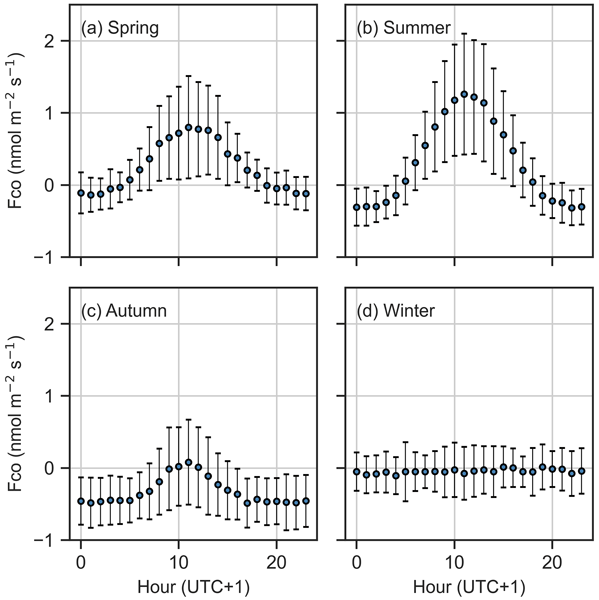
Abstract. Carbon monoxide (CO) is an important trace gas in the atmosphere. However, its sinks and sources in terrestrial ecosystems remain poorly quantified. Understanding the terrestrial sink and source dynamics is crucial for better assessing the global CO budget. In this study, we investigated CO exchange in an Arctic peatland in northern Sweden to quantify the magnitude and key drivers of fluxes at the site. We measured CO fluxes using the eddy covariance method from August 2022 to September 2024. The study site was characterized by a heterogeneous surface structure with elevated dry palsas surrounded by wetter areas of bog. We found that the peatland was a net CO source during the measurement period, with fluxes ranging from –0.29 to 0.34 nmol m-2 s-1 (25th and 75th percentiles). The fluxes showed a systematic diurnal cycle, with daytime emission and nighttime uptake. Emissions were mainly driven by radiation, suggesting photo-driven production. Soil uptake was dependent on surface wetness, with higher consumption occurring in the dry parts of the peatland, suggesting that oxic conditions may favor CO uptake. The annual cumulative CO flux for the dry parts of the peatland was estimated to be -44 mg CO m-2 yr-1 in 2022–2023 and -52 mg CO m-2 yr-1 in 2023–2024, while the flux for the wet parts of the peatland was 93 mg CO m-2 yr-1 in 2022–2023 and 84 mg CO m-2 yr-1 in 2023–2024. Despite the relatively small amount of CO released from the peatland, our study suggests that current global models may underestimate the CO source from northern wetlands.
-
Notice on discussion status
The requested preprint has a corresponding peer-reviewed final revised paper. You are encouraged to refer to the final revised version.
-
Preprint
(4369 KB)
-
Supplement
(3732 KB)
-
The requested preprint has a corresponding peer-reviewed final revised paper. You are encouraged to refer to the final revised version.
- Preprint
(4369 KB) - Metadata XML
-
Supplement
(3732 KB) - BibTeX
- EndNote
- Final revised paper


Journal article(s) based on this preprint
Interactive discussion
Status: closed
-
RC1: 'Comment on egusphere-2025-2094', Anonymous Referee #1, 26 Jun 2025
The comment was uploaded in the form of a supplement: https://egusphere.copernicus.org/preprints/2025/egusphere-2025-2094/egusphere-2025-2094-RC1-supplement.pdfCitation: https://doi.org/
10.5194/egusphere-2025-2094-RC1 - AC1: 'Reply on RC1', Asta Laasonen, 22 Aug 2025
-
RC2: 'Comment on egusphere-2025-2094', Anonymous Referee #2, 03 Jul 2025
- AC2: 'Reply on RC2', Asta Laasonen, 22 Aug 2025


Interactive discussion
Status: closed
-
RC1: 'Comment on egusphere-2025-2094', Anonymous Referee #1, 26 Jun 2025
The comment was uploaded in the form of a supplement: https://egusphere.copernicus.org/preprints/2025/egusphere-2025-2094/egusphere-2025-2094-RC1-supplement.pdf
- AC1: 'Reply on RC1', Asta Laasonen, 22 Aug 2025
-
RC2: 'Comment on egusphere-2025-2094', Anonymous Referee #2, 03 Jul 2025
- AC2: 'Reply on RC2', Asta Laasonen, 22 Aug 2025
Peer review completion


Post-review adjustments
Journal article(s) based on this preprint
Viewed
| HTML | XML | Total | Supplement | BibTeX | EndNote | |
|---|---|---|---|---|---|---|
| 754 | 61 | 25 | 840 | 44 | 26 | 43 |
- HTML: 754
- PDF: 61
- XML: 25
- Total: 840
- Supplement: 44
- BibTeX: 26
- EndNote: 43
Viewed (geographical distribution)
| Country | # | Views | % |
|---|
| Total: | 0 |
| HTML: | 0 |
| PDF: | 0 |
| XML: | 0 |
- 1
Alexander Buzacott
Kukka-Maaria Kohonen
Erik Lundin
Alexander Meire
Mari Pihlatie
Ivan Mammarella
The requested preprint has a corresponding peer-reviewed final revised paper. You are encouraged to refer to the final revised version.
- Preprint
(4369 KB) - Metadata XML
-
Supplement
(3732 KB) - BibTeX
- EndNote
- Final revised paper