
the Creative Commons Attribution 4.0 License.
the Creative Commons Attribution 4.0 License.
 | 25 Apr 2025
Precipitation, Moisture Sources and Transport Pathways associated with Summertime North Atlantic Deep Cyclones
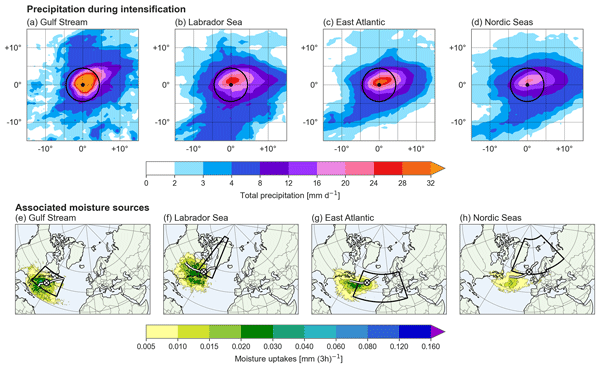
Abstract. Extratropical cyclones are essential for redistributing moisture from lower latitudes to the poles, and are known for their ability to produce (extreme) precipitation. While wintertime extratropical cyclones have been studied in great detail, little is known about these systems in summer. Therefore, the objective of this study is to improve our understanding of how summertime extratropical cyclones shape the characteristics of the water cycle, focusing on their moisture sources and the transport of moisture to cyclone centers. For this purpose, 8-day backward trajectories are calculated for all air parcels in the vicinity of cyclone centers, for a subset of the most intense summertime cyclones over the North Atlantic. Subsequently, moisture uptakes along the trajectories of precipitating air parcels are identified using the moisture source diagnostic WaterSip. Using this approach, it is found that the bulk of the precipitation associated with summertime cyclones falls close to the cyclone center in the warm conveyor belt (WCB) and along the fronts, mainly during the cyclone’s intensification phase. The origin of this moisture correspond to areas of high ocean evaporation, with significant hotspots on the warm side of the Gulf Stream Front. In addition, some continental sources are found, especially for cyclones in the Labrador Sea. Moisture uptake occurs primarily in regions where the strong SST gradient induces intense ocean evaporation and during cold-air advection within the cyclone’s cold sector, where oceanic evaporation is enhanced due to the strong air-sea temperature contrast. The moisture accumulated in the cold sector of the cyclone does not necessarily contribute to precipitation in its own center, but it can act as a source of moisture for a subsequent cyclone. As cyclones mature, the dominant moisture sources shift from remote regions to more localized sources, but the atmospheric residence time of moisture of about four days remains approximately the same throughout the cyclone life cycle. This is because the decrease in source distance is compensated by weaker winds and less strong convergence. Overall, these results are fairly similar to those found in a previous study for winter cyclones, although in winter there is more moisture exchange between primary and secondary cyclones, and stronger vertical ascent in the WCB. Summer cyclones, on the other hand, are distinguished by their greater moisture supply from continental sources, and the significant influence from cyclones of tropical origin undergoing extratropical transition.
Competing interests: One of the co-authors is a member of the editorial board of Weather and Climate Dynamics. The authors declare that they have no other conflict of interest.
Publisher's note: Copernicus Publications remains neutral with regard to jurisdictional claims made in the text, published maps, institutional affiliations, or any other geographical representation in this paper. While Copernicus Publications makes every effort to include appropriate place names, the final responsibility lies with the authors. Views expressed in the text are those of the authors and do not necessarily reflect the views of the publisher.-
Notice on discussion status
The requested preprint has a corresponding peer-reviewed final revised paper. You are encouraged to refer to the final revised version.
-
Preprint
(5164 KB)
-
The requested preprint has a corresponding peer-reviewed final revised paper. You are encouraged to refer to the final revised version.
- Preprint
(5164 KB) - Metadata XML
- BibTeX
- EndNote
- Final revised paper


Journal article(s) based on this preprint
Interactive discussion
Status: closed
-
RC1: 'Comment on egusphere-2025-1752', Helen Dacre, 06 May 2025
The comment was uploaded in the form of a supplement: https://egusphere.copernicus.org/preprints/2025/egusphere-2025-1752/egusphere-2025-1752-RC1-supplement.pdfCitation: https://doi.org/
10.5194/egusphere-2025-1752-RC1 -
CC1: 'Comment on egusphere-2025-1752', Luis Gimeno, 13 May 2025
Although the authors would not necessarily be aware of this work, a recent article with similar aims and methods has been published (Coll-Hidalgo et al. 2025)
https://www.sciencedirect.com/science/article/pii/S0169809525002972?via%3Dihub#f0025
I believe that the manuscript would benefit from a comparison with the methods, results and conclusions of this article.
Patricia Coll-Hidalgo, P, R. Nieto, J.C. Fernández-Alvarez and L. Gimeno (2025) Assessment of the origin of moisture for the precipitation of North Atlantic extratropical cyclones: Insights from downscaled ERA5, Atmospheric Research, Volume 324, https://doi.org/10.1016/j.atmosres.2025.108205.
Citation: https://doi.org/10.5194/egusphere-2025-1752-CC1 - RC2: 'Comment on egusphere-2025-1752', Anonymous Referee #2, 16 Jun 2025
- AC1: 'Final response', Rikke Stoffels, 11 Jul 2025


Interactive discussion
Status: closed
-
RC1: 'Comment on egusphere-2025-1752', Helen Dacre, 06 May 2025
The comment was uploaded in the form of a supplement: https://egusphere.copernicus.org/preprints/2025/egusphere-2025-1752/egusphere-2025-1752-RC1-supplement.pdf
-
CC1: 'Comment on egusphere-2025-1752', Luis Gimeno, 13 May 2025
Although the authors would not necessarily be aware of this work, a recent article with similar aims and methods has been published (Coll-Hidalgo et al. 2025)
https://www.sciencedirect.com/science/article/pii/S0169809525002972?via%3Dihub#f0025
I believe that the manuscript would benefit from a comparison with the methods, results and conclusions of this article.
Patricia Coll-Hidalgo, P, R. Nieto, J.C. Fernández-Alvarez and L. Gimeno (2025) Assessment of the origin of moisture for the precipitation of North Atlantic extratropical cyclones: Insights from downscaled ERA5, Atmospheric Research, Volume 324, https://doi.org/10.1016/j.atmosres.2025.108205.
Citation: https://doi.org/10.5194/egusphere-2025-1752-CC1 - RC2: 'Comment on egusphere-2025-1752', Anonymous Referee #2, 16 Jun 2025
- AC1: 'Final response', Rikke Stoffels, 11 Jul 2025
Peer review completion


Journal article(s) based on this preprint
Viewed
| HTML | XML | Total | BibTeX | EndNote | |
|---|---|---|---|---|---|
| 845 | 115 | 27 | 987 | 28 | 53 |
- HTML: 845
- PDF: 115
- XML: 27
- Total: 987
- BibTeX: 28
- EndNote: 53
Viewed (geographical distribution)
| Country | # | Views | % |
|---|
| Total: | 0 |
| HTML: | 0 |
| PDF: | 0 |
| XML: | 0 |
- 1
Rikke Stoffels
Imme Benedict
Lukas Papritz
Frank Selten
Chris Weijenborg
The requested preprint has a corresponding peer-reviewed final revised paper. You are encouraged to refer to the final revised version.
- Preprint
(5164 KB) - Metadata XML