
the Creative Commons Attribution 4.0 License.
the Creative Commons Attribution 4.0 License.
 | 05 Dec 2024
Intended and Unintended Consequences of Atmospheric Methane Oxidation Enhancement
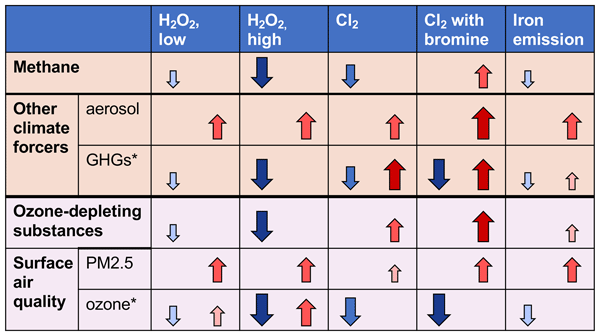
Abstract. Atmospheric oxidation enhancement (AOE) of methane via either tropospheric hydroxyl radicals (OH) or chlorine (Cl) radicals is being considered as a method to decrease greenhouse gas concentrations. The chemistry involved is coupled; is nonlinear; and affects air quality, other greenhouse gases, and ozone-depleting substances. Here I perform a suite of experiments in a three-dimensional (3D) atmospheric chemistry model representing different OH- and Cl-based atmospheric oxidation enhancement methods, to estimate the effectiveness of each at decreasing greenhouse gases and the impacts on air quality and stratospheric ozone. I find that iron salt aerosol may not be effective at reducing methane on a global scale, depending on the reaction mechanism employed. More work is needed to understand the kinetics of chlorine release from iron salt aerosol and the potential for bromine co-release, which further decreases effectiveness. Hydrogen peroxide–based approaches can decrease global methane, but the hydrogen peroxide emissions required may be too large to be feasible. I find that limiting emissions to daytime for hydrogen peroxide–based scenarios has negligible effects. All methods increase surface particulate matter (PM) pollution and in some regions lead to exceedances of annual air quality standards. Cl-based methods decrease ozone air pollution, but OH-based methods increase ozone air pollution in populated areas. While Cl-based methods can increase ozone-depleting substances, I predict minimal changes in stratospheric ozone after 1 year of deployment. The overall impacts of atmospheric oxidation enhancement methods on climate and human health involve multiple competing factors.
-
Notice on discussion status
The requested preprint has a corresponding peer-reviewed final revised paper. You are encouraged to refer to the final revised version.
-
Preprint
(1152 KB)
-
Supplement
(702 KB)
-
The requested preprint has a corresponding peer-reviewed final revised paper. You are encouraged to refer to the final revised version.
- Preprint
(1152 KB) - Metadata XML
-
Supplement
(702 KB) - BibTeX
- EndNote
- Final revised paper


Journal article(s) based on this preprint
Interactive discussion
Status: closed
-
RC1: 'Comments on ‘Intended and Unintended Consequences of Atmospheric Methane Oxidation Enhancement’', Matthew Johnson, 05 Jan 2025
-
AC2: 'Reply on RC1', Hannah Marie Horowitz, 31 Jan 2026
The comment was uploaded in the form of a supplement: https://egusphere.copernicus.org/preprints/2024/egusphere-2024-3139/egusphere-2024-3139-AC2-supplement.pdf
-
AC2: 'Reply on RC1', Hannah Marie Horowitz, 31 Jan 2026
-
RC2: 'Comment on egusphere-2024-3139', Anonymous Referee #3, 04 Mar 2025
Review of “Intended and Unintended Consequences of Atmospheric Methane Oxidation Enhancement”
This paper addresses various methodologies and their effectiveness in reducing atmospheric methane on a global scale and the effect of these methodologies on overall atmospheric chemical cycling. This paper also makes a nice follow-up to a number of previous papers concentrating on the global effects of aerosol iron chemistry on chlorine release but using a different parameterization for the release of chlorine. The paper is well written and makes a nice contribution to the literature on this subject.
Main Comments.
1. There are a number of sections of this paper that should not be included.
- The effects on the stratosphere should not be included in a model simulation of only a couple years. I take the authors point that this version of their model produces a credible stratospheric simulation. However, given the long transport timescale from the troposphere to the stratosphere and the long lifetime of stratospheric air a simulation of only a couple years cannot be expected to give an accurate account of the impact of the impact on stratospheric chemistry, even in a model with a credible stratospheric simulation.
- Likewise, the effect of chlorine release on species with a longer lifetime (e.g., greater than approximately 6 months) should not be included. To investigate the impact on methane the author calculates the steady-state response using the calculated species lifetime and a feedback factor (equation 1). However, with other long-lived species no such adjustment is made. I don’t see how a short simulation of 1-2 years could shed light on the response of species with a lifetime significantly longer than this.
- The section on the hydrogen economy seems largely based on a review of others work and is somewhat speculative. I would recommend omitting this section.
- Figure 2. Geographical variations in this figure look to be very small. Moreover, it is not clear that the variations that exist are not due to interannual variability (which we cannot know as the simulation is only for a year). I would suggest this figure be omitted.
2. There are also a number of sections of the paper that could be profitably expanded.
- I found that the written description of table 2 is clear on a careful reading. However, the text discusses relative rates of increase between different scenarios which are not clearly indicated by looking at the table. There are number of non-linearities described e that might be expanded in graphical form so as to make the results easier to follow. Section 3.3.1 The authors might consider a few plots to illustrate and clarify some of their points. The paper is fairly plot free.
- One of the interests in the paper is a global simulation of the impacts of chlorine release following the Chen et al. (2024) parameterization (instead of the parameterization proposed in van Herpen et al (2023)). It would be worthwhile to review in detail the derivation of the parameterization given Chen et al (2024) (perhaps in the supplement) in light of the comments by Johnson and van Herpen, but also in light of the derivation given in Chen et al. (2024). For example, Chen et al gives the chlorine production rate of 5.2×10^11atoms cm-2 s-1, but this can’t be correct as I believe the corresponding rates in Wittmer et al (2015) are 8.7–13 ×10^21atoms cm-2 h-1 (from table 2). It is not clear how to get the numbers given in Chen et al. (2024). Moreover, Wittmer et al (2015) examines a number of experiments. Chen et al (2024) derives the parameterization from one of the experiments and tests it against another. Is it valid to evaluate against more of the experiments (e.g., the cases given in the comments by Johnson and van Herpen)?
- Differences in the response of methane depending on the addition of iron or iron-chloride is interesting. While the iron addition seems to lead to a relatively small loss of methane from a comparatively small chlorine increase, the iron chloride addition results in a methane increase from a larger chlorine increase. These results seem at odds with Li et al (2023) where methane only decreases at the higher rates of chlorine release. Further investigation of the author’s results seems profitable. Is chlorine released in different locations or heights in the two experiments?
3. When the parameterized mineral dust–sea spray aerosol is added to the two different models via different parameterizations the methane loss from chlorine increased by 20% in van Herpen et al, but only 0.2% in the present work (a factor of 100). One might ascribe this to a different effectiveness of the two parameterizations in releasing chlorine. However, van Herpen et al. finds a change in the ozone burden of 0.7% while it is 0.07% in the present study (a factor of 10). Thus, the response of methane versus the response of ozone seems to be very different in the two simulations. This is despite the fact that the two models appear to have an approximately similar response to chlorine additions (lines 309-313). I wander if there is a typo in the numbers given in the paper, or can the author explain these differences in response?
Minor Comments
L41 “demonstrated” : This seems too strong. “hypothesized” would be better. More extensive measurements (both laboratory and field) would be required to say that this mechanism has been demonstrated to occur.
Section 2.1 As emissions are often input into the boundary layer in these experiments it would be good to know how boundary layer mixing is parameterized and approximate vertical resolution of the oceanic boundary layer.
Section 2.1 Does the standard chemistry include acid displacement?
L144 “similar changes”. Similar changes in what? It is hard to understand the magnitude of the emissions in the three cases for H2O2 (low, mid, high). It would be valuable to compare the magnitude of these emissions to the overall tropospheric HOx production. Much of these emissions are presumably lost to surface deposition, particularly over the ocean. How will this impact the results? The emissions of H2O2 seem to increase exponentially between experiments. Is the increase arbitrary or how was the increase determined?
L154 “midrange scenario for methane” – it would help clarify the amount of methane this scenario removed in Li et al. (2023).
L161 “It is not possible to remove 100% of bromide from pure chlorine salts”. This seems to need a reference
L182 “This reaction occurs on accumulation mode chloride aerosol”. Some more information on the aerosol scheme would be helpful. What is a chloride aerosol? Is it sea-salt? And are the aerosols internally mixed? I assume iron is emitted as an aerosol?
L194 “Major differences”. It seems another major difference is that while van Herpen et al (2023) derives the parameterization from Barbados measurements Chen et al (2024) uses the photolysis rate of jno2 on a global basis.
L199 “additional reaction” – please specify. I assume you mean from equation 2.
L242/L268 Some of the key chemical reactions and additional chemical explanation should be included. For example, it is not clear why Cl should increase due to an increase in H2O2. Why is the bromine burden impacted in these experiments and why does the NOx decrease despite a decrease in OH?
L263. The agreement with Li et al (2023) in the Cl2 case is actually fairly good. It seems that speculation as to the specific process is not worthwhile: different transport, different cloudiness, different photolysis rates etc may all contribute to this difference.
L263. It would be worthwhile to discuss in more detail about the case where bromine is emitted.
L268 It is not clear why it is reasonable to compare the OH experiments with the H2O2 experiments. The H2O2 emissions are at the surface (with presumably high surface deposition) and OH production is distributed with height and presumably not lost to surface deposition.
L305 “the chemical loss through the Cl pathway is shut down” for H2O2_high, but Table 2 suggests a significant increase in Cly. Please explain.
L306 “comparable” – again it is not clear how these simulations are comparable.
L423 “cobenefits” seems to apply there are benefits in the first place which doesn’t seem to be true in all experiments.
-------
Chen, Q., Wang, X., Fu, X., Li, X., Alexander, B., Peng, X., Wang, W., Xia, M., Tan, Y., Gao, J., Chen, J., Mu, Y., Liu, P., & Wang, T. (2024). Impact of molecular chlorine production from aerosol iron photochemistry on atmospheric oxidative capacity in North China. Environmental Science & Technology, 58(28), 12585–12597. https://doi.org/10.1021/acs.est.4c02534
Li, Q., D. Meidan, P. Hess, J. A. Añel, C. A. Cuevas, S. Doney, M. S. Johnson, D. E. Kinnison, R. P. Fernandez, M. van Herpen, L. Höglund-Isaksson, J.-F. Lamarque, T. Röckmann, N. M. Mahowald, A. Saiz-Lopez (2023) Global environmental implications of atmospheric methane removal through chlorine-mediated chemistry-climate interactions, Nature Communications 14(4045).
van Herpen, M. M., Li, Q., Saiz-Lopez, A., Liisberg, J. B., Röckmann, T., Cuevas, C. A., Fernandez, R. P., Mak, J. E., Mahowald, N. M., Hess, P., Meidan, D., Stuut, J.-B., Johnson, M. S. (2023), Photocatalytic chlorine atom production on mineral dust–sea spray aerosols over the North Atlantic, Proceedings of the National Academy of Sciences 120(31), e2303974120.
Wittmer, J., Bleicher, S., Ofner, J., & Zetzsch, C. (2015). Iron(III)-induced activation of chloride from artificial sea-salt aerosol. Environmental Chemistry, 12(4), 461–475. https://doi.org/10.1071/EN14279
Citation: https://doi.org/10.5194/egusphere-2024-3139-RC2 -
AC1: 'Reply on RC2', Hannah Marie Horowitz, 31 Jan 2026
The comment was uploaded in the form of a supplement: https://egusphere.copernicus.org/preprints/2024/egusphere-2024-3139/egusphere-2024-3139-AC1-supplement.pdf
Peer review completion


Interactive discussion
Status: closed
-
RC1: 'Comments on ‘Intended and Unintended Consequences of Atmospheric Methane Oxidation Enhancement’', Matthew Johnson, 05 Jan 2025
By Matthew S. Johnson1 and Maarten van Herpen2
- Department of Chemistry, University of Copenhagen, Copenhagen, Denmark
- Acacia Impact Innovation, Heesch, The Netherlands
General Comments
This paper uses a 3D atmospheric chemistry model to examine some of the methods that have been proposed for increasing methane oxidation in the atmosphere by enhancing concentrations of OH and Cl radicals, the two main radical sinks in today's atmosphere. The context for the paper includes the recent report by the U. S. National Academies of Sciences, A Research Agenda Toward Atmospheric Methane Removal [NASEM, 2024] which discusses Atmospheric Oxidation Enhancement, and the work was financed by a grant from the National Academies of Sciences, Engineering and Medicine. While the paper is significant and well written, and the model itself is sound, there are concerns with the assumptions and mechanisms used in the tested scenarios that lead to significant doubt regarding the conclusions. These include the use of the Chen parameterization for iron-salt aerosol, and the duration of the simulation. Besides these however, the assumptions are well described and largely reasonable, appropriate scenarios have been used, the impact is significant, and overall the work is of high quality. There are issues, described below, that must be addressed before we can recommend publication. These include: 1. Discussing the impacts of the differences between the description achieved using a model with coarse resolution as in this work, and the chemistry arising from point source interventions such as a plume of H2O2 or Cl2. 2. Refining and presenting key results and numbers, and including additional discussion of the error budget. 3. There is not consensus in the literature regarding some of the mechanisms and parameterizations employed, and their impact on the results should be described in more detail. 4. There are important additional papers in the field that should be referenced and included in the revised introduction and discussion. In general reviewers should try to refrain from citing their own work, with exceptions; as described below we believe this is one of those cases. Overall this paper will be a welcome addition to the literature, pending revision to address the points raised below.
Specific Comments
The Abstract is well written. The opening sequence is strong, for example 'The chemistry involved is coupled; is nonlinear; and affects air quality, other greenhouse gases, and ozone-depleting substances.' In comparison the final sentence 'The overall impacts of atmospheric oxidation enhancement methods on climate and human health involve multiple competing factors.' is diffuse and anticlimactic. Please rewrite to clarify. If there is space, we suggest adding specific numerical results to the abstract.
The abstract includes “I find that iron salt aerosol may not be effective at reducing methane on a global scale, depending on the reaction mechanism employed” and this conclusion should be deleted, because the parameterization used for ISA is likely underestimating Cl2 production from iron-salt aerosol by 3 orders of magnitude (see explanation below). The way it is written here could confuse the reader making them think it is a trustworthy conclusion. Instead, we recommend to rephrasing this sentence to be specific about the mechanism, not about iron-salt aerosol.
As well-described in the abstract 'The chemistry involved is coupled; is nonlinear..' Therefore more commentary is needed on the impacts or potential impacts of model resolution on the results. The model resolution is 4° latitude by 5° longitude, at the equator this is ca. 450 by 550 km. Many of the methods described in this paper are much more local. Examples include species that are lofted into the atmosphere from the surface by whirlwinds/convergences: Mineral dust is often stratified with variable dust densities. Similarly, sea spray aerosol, initially near the surface, is lofted high into the troposphere by local updrafts. Critically many of the interventions described here such as the addition of Cl2 or H2O2 from a point source would occur as plumes with a high local concentration in the plume, that cannot be modeled accurately by taking a single average concentration over a grid cell hundreds of kilometers in each horizontal dimension, as, as was stated, the chemistry is coupled and nonlinear. Plumes will be lost to deposition before becoming mixed to the scale of this resolution. The effect is critical for a chlorine intervention due to the interaction of Cl with NOx and the reaction of Cl with O3, and the effects of NOx and ozone on OH production. Ozone has a short lifetime and is produced locally, in contrast methane has a very long lifetime and is mixed globally. This means that a chlorine intervention diluted to the model resolution will have to interact with many orders of magnitude more ozone than would take place in a real world intervention. The effect of this discrepancy between model resolution and plume dimension must be discussed, including an estimate of its impact on the results of the study. (A model of plume chemistry for high Cl conditions has been described in a preprint posted by Pennacchio et al [2024a].)
Another paper by Pennacchio et al [Pennacchio, 2024b] includes a section on Atmospheric Oxidation Enhancement in the context of feasibility and physical limitations to effective interventions. The Supporting Information includes a discussion of the yield of OH from H2O2 addition. Clearly the Horowitz approach is more sophisticated. How does the estimate of the OH yield in the two papers compare?
In this paper, the parameterization of the ISA mechanism describes chlorine production as a function of aerosol surface area density, S (equation 2, section 2.2.2.3). This approach assumes that aerosol surface area is the relevant parameter. Another approach would be to base chlorine production on the concentration of the photoactive chromophore. Mikkelsen and coworkers [Mikkelsen, 2024] used experiment, quantum chemistry and an aqueous phase equilibrium model to investigate the ISA mechanism and demonstrate conclusively that the iron chloride chromophores are the key to production of chlorine. Although there could conceivably be a role for the surface area density in modulating chlorine release, Lim et al. [Lim, 2006] demonstrate chlorine production by shining light on a variety of bulk iron chloride solutions, showing that Cl2produced in bulk solutions escapes to the gas phase (with no dependence on the surface area of the solution). So it would seem that the Chen parameterization [20234] based on Wittmer [2015] depends on the conditions of their specific experiment and is difficult to generalize. In contrast an approach based on the concentration of the photoabsorbing species, such as iron(III) di- or tri-chloride, is more general.
Equation (2) is said to be based on Wittmer laboratory experiments, but when we compare Wittmer’s experiments regarding the role of aerosol surface area (S) and [Cl-], they do not agree with equation 2. Note that Wittmer varied the Cl-/Fe3+ ratio by changing [Fe3+], so this ratio does not represent large changes in [Cl-]. Wittmer [2015] included 3 ‘zero air’ experiments where only [Fe3+], S, and [Cl-] were varied, and each of these experiments showed exactly the same Cl2 production per Fe3+ atom per unit time (referred to as lambda by Wittmer). Below we summarize these experiments:
[Cl-]/[Fe3+]
S (10-2 m2 m-3)
[Cl-] (mmol l-1)
[Cl-] x S
101
2.5
29
72.5
51
3.2
30
96
13
3.0
37
111
From these Wittmer experiments, it is clear that if equation (2) were true, there should be a 50% difference in the Cl production per Fe3+ atom between these experiments, but instead each experiment showed the same Cl production rate per Fe. Therefore, based on the Wittmer results, there is absolutely no reason to assume that [Cl-] or S should be included in equation 2.
The implication of using S in the equation, if there should not really be a dependence on this parameter, is that it introduces a large effect when translating the laboratory experiment to real world conditions. Wittmer used an aerosol surface area of ca. 10-2 m2/m3, which corresponds to ca. 30.000 mm2/cm3. In an ocean region, aerosol surface area density may be in the range of 10 – 60 mm2/cm3, which is at least 1000x lower. This could explain why the implementation of equation (2) reported in this article here has orders of magnitude lower Cl production than the one reported by van Herpen [2023].
The article under review also identifies this discrepancy on page 13, lines 322-330, where it compares the impact of the two models on methane oxidation (0.2% with the Chen parameters versus 20% in the van Herpen parameterization, for methane oxidation by mineral dust). This factor of 100 difference can be explained as being due to the impact of using the S parameter (dust will increase S, but not to the levels used by Wittmer). Note that the article calculated ‘up to 10 times higher’ in line 331, but this should be ‘at least 100x higher’.
Another way to compare van Herpen with the Chen parameterization is to consider that iron-salt aerosols produce Cl2 in the model. This implies that the Cl2 and the Iron scenario are in principle the same, but different amounts of Cl2 are emitted. The Cl2 scenario emitted 1250 Tg Cl2 to increase the Cl burden by 2185%, while the iron scenario emitted 565 Tg Fe to increase the Cl burden by 179%. Assuming a linear relation between Cl2 and Cl (considering the majority of Cly is Cl2), this suggests that the iron scenario emitted 8.2% as much Cl2 compared to the Cl2 scenario, thus 102.5 Tg Cl2. This corresponds to 0.18 g Cl2per g Fe emission, while van Herpen found 70 g Cl2 per g Fe emission per day (and multiplied by an average 5 days lifetime is 350 g Cl2 per g Fe). This leads to a difference between van Herpen and Chen of up to 3 orders of magnitude.
We also note that the van Herpen parameterization has been validated against observations in the real atmosphere and against laboratory observations, and it agrees with the cycling rates reported by Wittmer. While there is no discussion about the validity of the Chen parameterization in the paper it would clearly not agree with observations if it results in 3 orders of magnitude lower Cl2 production.
Regarding equation (2), the author should also better clarify how the parameters [Cl-] and [Fe3+] are defined. Are these aqueous phase concentrations (so for example the concentration of Fe3+ in the aerosol), or are they a concentration per volume of air? Please provide some typical numbers for these concentrations, so that it is possible to make a calculation and check the validity of this equation.
Finally, the paper is only using accumulation mode Fe3+, while Fe photochemistry has been shown to also occur in large particles. What is the rationale for only including accumulation mode Fe3+? If the aerosol mix and grow in size, the model would exclude them from the calculation of chlorine production. Clearly this is not the case in reality. How much chlorine production is being excluded by the model?
In section 2.2.1.1, a test is made of the impact of releasing the total annual production of H2O2 into the atmosphere, 4.1 Tg(H2O2)/year. Although the impact (we assume on global methane concentration, please clarify) was negligible, it would be interesting to learn the yield from the model. What is the mole fraction of change in methane to change in H2O2? What fraction of the H2O2 resulted in additional OH in the atmosphere, and what fraction of that OH reacted with CH4? To put the intervention into perspective, what is the current annual natural production of H2O2 in the atmosphere? Also, the paper states that releasing H2O2at altitude, or only during the day, resulted in increased methane oxidation. Please quantify this increase, for example through the yield of methane removed per H2O2 emitted. Also, if H2O2 release at altitude and during the day led to increased methane removal, please explain why this approach was not chosen for the H2O2 scenarios.
In section 2.2.1.2, please state the H2O2 photolysis lifetime (2 days?), this may help readers understand why limiting H2O2 emissions to daytime had negligible effects and why the OH yield from this source is as low as it is. A qualitative statement is made, 'Not all hydrogen peroxide is immediately photolyzed to produce OH and may undergo alternate reactions.', which could be better understood by providing this value.
In section 2.2.2.1 on emission of chlorine, it would be useful to compare the emission scenarios to the present annual production of Cl2, as was done for H2O2. We found one reference which indicates production is about 60 Tg(Cl2)/year (https://www.chlorineinstitute.org/chlorine-manufacture).
We are wondering about the formation of air pollution as a consequence of the chlorine intervention. A simplistic 'zero sum game' point of view would be that there is a certain yield of O3 and PM (smog) from the amount of VOC that is emitted, and that atmospheric oxidation enhancement (AOE) would merely change the location of the smog formation, without changing the amount of smog formation. This is rather like the analysis that cloud seeding would potentially only change the location of the rainfall without changing the total rainfall. If this is the case then the formation of air pollution from the introduction of Cl or OH could be seen as 'a feature not a bug', as smog formation could be triggered to occur over unpopulated areas and away from sensitive ecosystems (for example smog impacts on land plants is larger than the impact of smog occurring over the oceans).
The picture becomes more complicated when methane is added to the mix. In contrast to the VOCs, it’s long lifetime means it is well mixed globally. A reduction in methane means air quality will improve globally as less ozone will be made. It is difficult to see how this interaction can be described in a model that only runs for one year. This issue would seem to interfere with the ability of the study to make conclusions concerning certain aspects of air quality such as inorganic aerosols and SOA. While the model predicts an instantaneous change, one would also like to know the steady state change, as could be derived in the multiple year models such as Li [2023] and Meidan [2024]. This is not possible when methane has been fixed. Therefore, we recommend removing the sections that discuss air pollution impact on PM2.5 and inorganic aerosols. If the author decides to keep it in, please discuss the issue in the comparison with the Meidan and Li results. Moreover, the model in its current form will likely overpredict air pollution because VOCs and DMS do not have time to decrease, they are always at or near peak, while at the same time methane is fixed.The same argument applies to the discussion of changes in CO (page 19), which would also be temporarily increased until longer-lived precursors (CH4 and VOCs) are allowed to stabilize.
The scenario described in Section 2.2.2.2 on bromine contamination describes the impact of emitting bromine at a mass fraction corresponding to 20% of chlorine emission (or 9% as mole fraction). Reference is given to experiments by Wittmer et al. on Br and Cl production from artificial seawater, which found that the mass fraction of Br to Cl ranged from 0 to 2.5, and to experiments where undetectable traces of Br in a salt pan resulted in 1:1 emission of Br. Based on this evidence, the factor of 20% is chosen for the simulation. Note however that the experiments measured initial emission of bromine, during a phase of the experiment where Br has not yet been depleted from the aerosols. Bromide is a minor component of seawater occurring at a Br/Cl mass fraction of 0.35% or mole fraction of 0.154%. Studies show that bromide ions are substantially depleted in sea-salt aerosols in the field [Sander, 2003; Saiz-Lopez, 2006], which implies that after the original Br is depleted, it’s chemistry is no longer relevant -- there is simply not much Br there relative to Cl. Thus, in real world situations, bromine will be depleted very rapidly and the net result will not be 20% but something about 100 times lower, with a steady state more closely corresponding to the ratios found in seawater. This is especially true when aerosol chloride becomes depleted to the point that re-uptake of HCl from the gas phase to the particle phase becomes the most important source of chloride for ISA. How do the results change if a realistic Br- fraction is used? Please modify text and comment accordingly.
Section 2.2.2.3 describes the Iron Salt Aerosol scenario, including the alpha factor which scales Cl2production using the surface area concentration. As noted previously there does not seem to be a convincing physical mechanism behind this parameterization as chlorine production is due to absorption of light by the iron chloride chromophore, and re-oxidation of Fe(II) by H2O2, and doesn't involve the surface area. The chromophore concentration depends on the volume of liquid and the concentration of the iron chlorides. An alternative mechanism is described in the paper by van Herpen et al [2023] and validated using the results of field experiments [Zhu, 1993; Mak, 2003; van Herpen, 2023]. It is clear that the two methods are not in agreement. Although Table S4 provides a descriptive overview of the two models, the paper does not include an analysis of why the Chen model was chosen. Critically, the Chen model seems unphysical and requires much more iron, resulting in an inaccurate assessment of the environmental impact of ISA. The paper concludes (Line 332) that 'With the parametrization used in this study, iron salt aerosol cannot produce enough chlorine to overcome the decrease in methane loss via the OH channel.' This conclusion is dependent on the seemingly unphysical and erroneous choice of parameterization of the ISA mechanism.
How would correction for the model resolution problem, by inclusion of a proper description of the much more concentrated chemistry occurring in a plume, affect the conclusion 'With the parametrization used in this study, iron salt aerosol cannot produce enough chlorine to overcome the decrease in methane loss via the OH channel.'? Please consider and modify as may be needed. It seems that such a general categorical conclusion is not supported given the assumptions and errors.
Line 314, it is not clear how the Cl + CH4 reaction is air-density dependent? The reaction rate coefficient k is temperature dependent, that is true, but it is not air-density dependent. The rate of methane change will be given by $r$ = -$d$[CH4]/$dt$ = $k$[Cl][CH4]. Here the rate r depends on the concentrations of the species, but k does not. Please rewrite to clarify.
Line 342, check 'Here I find that emitting sea salt chloride instead of or along with particulate iron worsens methane outcomes.' and modify depending on circumstances. Also note that sea spray aerosol is ubiquitous in the marine environment so under those circumstances chloride is abundant.
It looks like atmospheric hydrogen (H2) is only discussed on page 21, in section 3.1.5. This interlude is disconnected from the rest of the paper, superficial and not connected to the modelling work (the manuscript states that in the model hydrogen is fixed and so it is not possible to examine hydrogen-related questions) and without clear conclusions, and we recommend that it be cut from the manuscript. Perhaps it could be developed into a future publication. The section begins by claiming that increases in hydrogen emissions will lead to a positive feedback on methane. If we see widespread adopttion of hydrogen as an energy carrier in the future,presumably it will replace carbon based energy carriers, leading to a decrease in methane emissions from natural gas and fossil related sources. This claim seems doubtful and unsupported by evidence. It is unclear if 'positive feedback on methane' and 'increases in methane' refer to methane lifetime or atmospheric concentration. Also it is not immediately clear whether addition of H2 would lead to increased OH or decreased, as much of the H2 would presumably be emitted in high-NOx northern hemisphere conditions where more OH is produced by HO2 + NO than from ozone, and also, given the lifetime of H2, most of it will be oxidised in the hemisphere in which it is emitted.
The discussion of uncertainties needs to include much more detail in order to increase usefulness to other researchers - whether their goal is to use the results (and then they need to understand the uncertainties), or to find ways to reduce the uncertainties using models, field studies or laboratory work. The text states that the use of a coarse resolution global model is not appropriate for point source applications near high methane emitters. Neither is it appropriate for point source applications not near high methane emitters. IWe recommend that this section also states what errors will arise from the use of a coarse grid, and how large these errors could potentially be. The discussion of the uncertainties in the ISA mechanism glosses over the issues, that a model was chosen that is based on a questionable mechanism and parameterization, and ignores available field studies. Overall, it is better to give details or leave out the discussion if it is only superficial.
In the conclusions, please be sure to come back to the expectations that the title, 'Intended and Unintended Consequences of Atmospheric Methane Oxidation Enhancement' engendered in the reader. Make a clear summary of the consequences - the present conclusion lacks the hard edge it ought to have.
Overall, there are a lot of things to like in this article and it is the nature of reviewing to mainly comment on the aspects that the reviewers believe could or should be improved.
Technical Corrections
Line 13, '..depending on the reaction mechanism employed.' Check word choice, the mechanism is ISA, but the result will depend on the parameterization used in the model. The sentence suggests that a comparison was made between different parameterizations. This would be good to do, but then the author should also run the model with the van Herpen parameterization.
Note the important distinction between chloride (Cl-) and chlorine (Cl(0), e.g. Cl and Cl2). Check usage, be consistent and specific.
Line 24. Please add a reference to the National Academies of Sciences, Engineering and Medicine (NASEM) report [2024] 'A Research Agenda Toward Atmospheric Methane Removal'.
Line 25, the manuscript states that tropospheric chlorine is responsible for 1–5% of methane removal, with reference to five papers on methane removal. van Herpen et al. [2023] give this range as 0.8 to 3.3%, with reference to five papers on atmospheric chlorine. There seems to be a discrepancy and it is important, as the Cl reaction has a large kinetic isotope effect affecting models of methane emissions sources [Röckmann 2024]. Please double check the numbers and use primary sources when possible.
Line 32, add reference to NASEM report [2024]-- one of the key conclusions is 'For example, a technology gap exists in which no commercial mitigation technologies oxidize methane at concentrations below 1,000 parts per million (ppm) even though most methane emissions are found at concentrations closer to 2 ppm.' Add reference to Pennacchio [2024b] which concludes that there are considerable physical and practical constraints to currently available technologies.
Line 33, no reference is given for OH generators on a smaller scale. Such systems are described in e.g. Meusinger [2017] and Johnson [2014].
Line 39, Technically, these experiments demonstrated release of molecular chlorine Cl2 not chlorine atoms. In addition to these references, note that the wavelength dependence of the release of Cl2 from sodium/iron salt samples is described by Mikkelsen et al. [2024]
Line 72, note that the chemical form of the iron will have a large impact on its activity. Iron could be metallic particles, mixed iron oxides/hydroxides, iron chlorides, iron complexes with organic molecules, iron locked in minerals, and so on.
Line 97, It is impressive that the 2019 annual mean surface methane concentration is known to so many digits of accuracy, 1866.58 ppb. It may be useful to note the range of values that are encountered in the atmosphere through the course of one year, ca 20 ppb.
Line 168, change 'that even when Br atom was below the detection..' to 'that even when Br atoms were below the detection..'
Line 170, 'which would also release Br atoms in equal quantities' and 'Here I assume that of the total desired chlorine release.., 20% of that by mass of bromine is released in equal parts Br2 and BrCl’. It is confusing to sometimes consider amount (number of atoms/molecules) and sometimes massit would perhaps be preferrable to stick with one or the other or to explain carefully. If the mass fraction of bromine to chlorine release is 0.2, then as a mole fraction, only 9% as much Br as Cl is released, as the ratio of the atomic mass of Br to Cl is 2.25. It would be worth mentioning this in the text. Also Hossaini [2016] uses 35% BrCl and 65% Br2. Do you have a reference or an explanation for using equal parts instead?
Line 176 change 'dCl2/dt' to $d$[Cl$_2$]/$dt$. Note that 'molec' is not a unit and should not be used as a unit, see IUPAC and SI nomenclature references.
Line 206, change 'chloride emissions' to 'chlorine emissions'? Check use of chloride vs. chlorine throughout.
Table 2. Preferred usage is that if for example $\Delta[H_2O_2]_{high}$ = -11.1\%, this equation can be rearranged by dividing both sides by the unit to yield $\Delta[H_2O_2]_{high}$/\% = -11.1. The lhs is used as the label of a column, row or axis, and then the value in the table, or that is plotted in a figure, is a pure number in this case -11.1. The unit is found in the table. It is unconventional to give the unit of some of the values, '%' in the table caption instead of in the table.
Line 243 it could be useful here to explain the mechanism leading to Cl increase, presumably the OH + HCl reaction.
Line 252: “the same amount of total chlorine” is misleading, because in the CL2 scenario Cl2 is emitted, while in the other scenarios Cl- is emitted (one is reactive, the other is not).
Line 300 see previous comment on '1-5%, please check, modify to 0.8 top 3.3% as may be indicated.
line 527, recommend changing 'demand' to 'production'
Line 561 note that the organization is called 'The National Academies of Sciences, Engineering, and Medicine' and is also known as 'The National Academies', but it is not called 'the National Academies of Science'.
Line 617 Update reference to Gorham et al. the final paper has been published [Gorham, 2024].
In the Supplemental Information Figure S2, the data formats in the boxes are not standard between the OH and Cl sections of the figure. The blue boxes say for example '1.6x10⁷ Tg/yr' while the green boxes could say 'pFe: 565Tg/yr'. Note that there should always be a space between number and unit, add space to read '565 Tg/yr'. Questions include, mass of what, particles or active iron or iron? Recommend using the same nomenclature throughout e.g. '1.6x10⁷ Tg(H2O2)/yr' and '565 Tg(pFe)/yr'
Table S2 give units for the reaction rate coefficients. Remember that 'molecule' is not a unit.
Table S5, are numbers like 41.2 percentages? It does not say. As noted previously this should be indicated in the heading so for example 'OH_mid / %'. Similar in Table S6 and S7, indicate what are percentages.
Table S6 and S7, there is a stray '40' and '55' in the right column of the respective tables? Maybe this is a line number, but it should not be there.
References
Chen, Q., Wang, X., Fu, X., Li, X., Alexander, B., Peng, X., Wang, W., Xia, M., Tan, Y., Gao, J., Chen, J., Mu, Y., Liu, P., & Wang, T. (2024). Impact of molecular chlorine production from aerosol iron photochemistry on atmospheric oxidative capacity in North China. Environmental Science & Technology, 58(28), 12585–12597. https://doi.org/10.1021/acs.est.4c02534
Gorham, K.A., Abernethy, S., Jones, T.R., Hess, P., Mahowald, N.M., Meidan, D., Johnson, M.S., van Herpen, M.M., Xu, Y., Saiz-Lopez, A. and Röckmann, T., 2024. Opinion: A research roadmap for exploring atmospheric methane removal via iron salt aerosol. Atmospheric Chemistry and Physics, 24(9), pp.5659-5670.
Hossaini, R., Chipperfield, M. P., Saiz‐Lopez, A., Fernandez, R., Monks, S., Feng, W., Brauer, P., & Von Glasow, R. (2016). A global model of tropospheric chlorine chemistry: Organic versus inorganic sources and impact on methane oxidation. Journal of Geophysical Research: Atmospheres, 121(23), 14271–14297. https://doi.org/10.1002/2016JD025756
Johnson, M. S., E. J. K. Nilsson, E. A. Svensson, S. Langer, Gas Phase Advanced Oxidation for Effective, Efficient In Situ Control of Pollution, Environmental Science & Technology 48(15), 8768–8776, 2014.
Li, Q., D. Meidan, P. Hess, J. A. Añel, C. A. Cuevas, S. Doney, M. S. Johnson, D. E. Kinnison, R. P. Fernandez, M. van Herpen, L. Höglund-Isaksson, J.-F. Lamarque, T. Röckmann, N. M. Mahowald, A. Saiz-Lopez, Global environmental implications of atmospheric methane removal through chlorine-mediated chemistry-climate interactions, Nature Communications 14(4045), 2023.
Lim, M., Chiang, K., & Amal, R. (2006). Photochemical synthesis of chlorine gas from iron (III) and chloride solution. Journal of Photochemistry and Photobiology A: Chemistry, 183(1-2), 126-132.
Mak, J.E., Kra, G., Sandomenico, T. and Bergamaschi, P., 2003. The seasonally varying isotopic composition of the sources of carbon monoxide at Barbados, West Indies. Journal of Geophysical Research: Atmospheres, 108(D20).
Meidan, D., Li, Q., Cuevas, C. A., Doney, S. C., Fernandez, R. P., van Herpen, M. M., Johnson, M. S., Kinnison, D. E., Li, L., Hamilton, D. S., Saiz-Lopez, A., Hess, P. and N. M. Mahowald (2024). Evaluating the potential of iron-based interventions in methane reduction and climate mitigation. Environmental Research Letters, 19(5), 054023.
Meusinger, C., A. B. Bluhme, J. L. Ingemar, A. Feilberg, S. Christiansen, C. Andersen, and M. S. Johnson, Treatment of Reduced Sulphur Compounds and SO2 by Gas Phase Advanced Oxidation, Chemical Engineering Journal, 307, 427-434, 2017.
Mikkelsen, M. K., Liisberg, J. B., van Herpen, M. M. J. W., Mikkelsen, K. V., and Johnson, M. S.: Photocatalytic chloride-to-chlorine conversion by ionic iron in aqueous aerosols: a combined experimental, quantum chemical, and chemical equilibrium model study, Aerosol Research, 2, 31–47, https://doi.org/10.5194/ar-2-31-2024, 2024.
National Academies of Sciences, Engineering, and Medicine. 2024. A Research Agenda Toward Atmospheric Methane Removal. Washington, DC: The National Academies Press. https://doi.org/10.17226/27157.
Pennacchio, L., M. van Herpen, D. Meidan, A. Saiz-Lopez and M. S. Johnson (2024a). Catalytic efficiencies for atmospheric methane removal in the high-chlorine regime. ChemRxiv. 2024; doi:10.26434/chemrxiv-2023-3r8sf-v2
Pennacchio, L., Mikkelsen, M. K., Krogsbøll, M., van Herpen, M., and Johnson, M. S. (2024b). Physical and practical constraints on atmospheric methane removal technologies. Environmental Research Letters, 19(10), 104058.
Röckmann, T., Van Herpen, M.M., Brashear, C., Van der Veen, C., Gromov, S., Li, Q., Saiz-Lopez, A., Meidan, D., Barreto, A., Prats, N., Marmol, I., Ramos, R., Banos, I, Arrieta, J., Zaehnle, S., Jordan, A., Moossen, H., Timas, H., Young, D., Sperlich, P., Moss, R. and Johnson, M. S., (2024). The use of δ13C in CO to determine removal of CH4 by Cl radicals in the atmosphere. Environmental Research Letters.
Saiz-Lopez, A., Shillito, J. A., Coe, H., and Plane, J. M. C.: Measurements and modelling of I2, IO, OIO, BrO and NO3 in the mid-latitude marine boundary layer, Atmos. Chem. Phys., 6, 1513–1528, https://doi.org/10.5194/acp-6-1513-2006, 2006.
Sander, R., Keene, W. C., Pszenny, A. A. P., Arimoto, R., Ayers, G. P., Baboukas, E., Cainey, J. M., Crutzen, P. J., Duce, R. A., Hönninger, G., Huebert, B. J., Maenhaut, W., Mihalopoulos, N., Turekian, V. C., and Van Dingenen, R.: Inorganic bromine in the marine boundary layer: a critical review, Atmos. Chem. Phys., 3, 1301–1336, https://doi.org/10.5194/acp-3-1301-2003, 2003.
van Herpen, M. M., Li, Q., Saiz-Lopez, A., Liisberg, J. B., Röckmann, T., Cuevas, C. A., Fernandez, R. P., Mak, J. E., Mahowald, N. M., Hess, P., Meidan, D., Stuut, J.-B., Johnson, M. S., Photocatalytic chlorine atom production on mineral dust–sea spray aerosols over the North Atlantic, Proceedings of the National Academy of Sciences 120(31), e2303974120, 2023.
Wittmer, J., Bleicher, S., Ofner, J., & Zetzsch, C. (2015). Iron(III)-induced activation of chloride from artificial sea-salt aerosol. Environmental Chemistry, 12(4), 461–475. https://doi.org/10.1071/EN14279
Wittmer, J., Bleicher, S., & Zetzsch, C. (2015). Iron(III)-induced activation of chloride and bromide from modeled salt pans. The Journal of Physical Chemistry A, 119(19), 4373–4385. https://doi.org/10.1021/jp508006s
Zhu, X., Prospero, J.M., Savoie, D.L., Millero, F.J., Zika, R.G. and Saltzman, E.S., 1993. Photoreduction of iron (III) in marine mineral aerosol solutions. Journal of Geophysical Research: Atmospheres, 98(D5), pp.9039-9046.
Citation: https://doi.org/10.5194/egusphere-2024-3139-RC1 -
AC2: 'Reply on RC1', Hannah Marie Horowitz, 31 Jan 2026
The comment was uploaded in the form of a supplement: https://egusphere.copernicus.org/preprints/2024/egusphere-2024-3139/egusphere-2024-3139-AC2-supplement.pdf
-
RC2: 'Comment on egusphere-2024-3139', Anonymous Referee #3, 04 Mar 2025
Review of “Intended and Unintended Consequences of Atmospheric Methane Oxidation Enhancement”
This paper addresses various methodologies and their effectiveness in reducing atmospheric methane on a global scale and the effect of these methodologies on overall atmospheric chemical cycling. This paper also makes a nice follow-up to a number of previous papers concentrating on the global effects of aerosol iron chemistry on chlorine release but using a different parameterization for the release of chlorine. The paper is well written and makes a nice contribution to the literature on this subject.
Main Comments.
1. There are a number of sections of this paper that should not be included.
- The effects on the stratosphere should not be included in a model simulation of only a couple years. I take the authors point that this version of their model produces a credible stratospheric simulation. However, given the long transport timescale from the troposphere to the stratosphere and the long lifetime of stratospheric air a simulation of only a couple years cannot be expected to give an accurate account of the impact of the impact on stratospheric chemistry, even in a model with a credible stratospheric simulation.
- Likewise, the effect of chlorine release on species with a longer lifetime (e.g., greater than approximately 6 months) should not be included. To investigate the impact on methane the author calculates the steady-state response using the calculated species lifetime and a feedback factor (equation 1). However, with other long-lived species no such adjustment is made. I don’t see how a short simulation of 1-2 years could shed light on the response of species with a lifetime significantly longer than this.
- The section on the hydrogen economy seems largely based on a review of others work and is somewhat speculative. I would recommend omitting this section.
- Figure 2. Geographical variations in this figure look to be very small. Moreover, it is not clear that the variations that exist are not due to interannual variability (which we cannot know as the simulation is only for a year). I would suggest this figure be omitted.
2. There are also a number of sections of the paper that could be profitably expanded.
- I found that the written description of table 2 is clear on a careful reading. However, the text discusses relative rates of increase between different scenarios which are not clearly indicated by looking at the table. There are number of non-linearities described e that might be expanded in graphical form so as to make the results easier to follow. Section 3.3.1 The authors might consider a few plots to illustrate and clarify some of their points. The paper is fairly plot free.
- One of the interests in the paper is a global simulation of the impacts of chlorine release following the Chen et al. (2024) parameterization (instead of the parameterization proposed in van Herpen et al (2023)). It would be worthwhile to review in detail the derivation of the parameterization given Chen et al (2024) (perhaps in the supplement) in light of the comments by Johnson and van Herpen, but also in light of the derivation given in Chen et al. (2024). For example, Chen et al gives the chlorine production rate of 5.2×10^11atoms cm-2 s-1, but this can’t be correct as I believe the corresponding rates in Wittmer et al (2015) are 8.7–13 ×10^21atoms cm-2 h-1 (from table 2). It is not clear how to get the numbers given in Chen et al. (2024). Moreover, Wittmer et al (2015) examines a number of experiments. Chen et al (2024) derives the parameterization from one of the experiments and tests it against another. Is it valid to evaluate against more of the experiments (e.g., the cases given in the comments by Johnson and van Herpen)?
- Differences in the response of methane depending on the addition of iron or iron-chloride is interesting. While the iron addition seems to lead to a relatively small loss of methane from a comparatively small chlorine increase, the iron chloride addition results in a methane increase from a larger chlorine increase. These results seem at odds with Li et al (2023) where methane only decreases at the higher rates of chlorine release. Further investigation of the author’s results seems profitable. Is chlorine released in different locations or heights in the two experiments?
3. When the parameterized mineral dust–sea spray aerosol is added to the two different models via different parameterizations the methane loss from chlorine increased by 20% in van Herpen et al, but only 0.2% in the present work (a factor of 100). One might ascribe this to a different effectiveness of the two parameterizations in releasing chlorine. However, van Herpen et al. finds a change in the ozone burden of 0.7% while it is 0.07% in the present study (a factor of 10). Thus, the response of methane versus the response of ozone seems to be very different in the two simulations. This is despite the fact that the two models appear to have an approximately similar response to chlorine additions (lines 309-313). I wander if there is a typo in the numbers given in the paper, or can the author explain these differences in response?
Minor Comments
L41 “demonstrated” : This seems too strong. “hypothesized” would be better. More extensive measurements (both laboratory and field) would be required to say that this mechanism has been demonstrated to occur.
Section 2.1 As emissions are often input into the boundary layer in these experiments it would be good to know how boundary layer mixing is parameterized and approximate vertical resolution of the oceanic boundary layer.
Section 2.1 Does the standard chemistry include acid displacement?
L144 “similar changes”. Similar changes in what? It is hard to understand the magnitude of the emissions in the three cases for H2O2 (low, mid, high). It would be valuable to compare the magnitude of these emissions to the overall tropospheric HOx production. Much of these emissions are presumably lost to surface deposition, particularly over the ocean. How will this impact the results? The emissions of H2O2 seem to increase exponentially between experiments. Is the increase arbitrary or how was the increase determined?
L154 “midrange scenario for methane” – it would help clarify the amount of methane this scenario removed in Li et al. (2023).
L161 “It is not possible to remove 100% of bromide from pure chlorine salts”. This seems to need a reference
L182 “This reaction occurs on accumulation mode chloride aerosol”. Some more information on the aerosol scheme would be helpful. What is a chloride aerosol? Is it sea-salt? And are the aerosols internally mixed? I assume iron is emitted as an aerosol?
L194 “Major differences”. It seems another major difference is that while van Herpen et al (2023) derives the parameterization from Barbados measurements Chen et al (2024) uses the photolysis rate of jno2 on a global basis.
L199 “additional reaction” – please specify. I assume you mean from equation 2.
L242/L268 Some of the key chemical reactions and additional chemical explanation should be included. For example, it is not clear why Cl should increase due to an increase in H2O2. Why is the bromine burden impacted in these experiments and why does the NOx decrease despite a decrease in OH?
L263. The agreement with Li et al (2023) in the Cl2 case is actually fairly good. It seems that speculation as to the specific process is not worthwhile: different transport, different cloudiness, different photolysis rates etc may all contribute to this difference.
L263. It would be worthwhile to discuss in more detail about the case where bromine is emitted.
L268 It is not clear why it is reasonable to compare the OH experiments with the H2O2 experiments. The H2O2 emissions are at the surface (with presumably high surface deposition) and OH production is distributed with height and presumably not lost to surface deposition.
L305 “the chemical loss through the Cl pathway is shut down” for H2O2_high, but Table 2 suggests a significant increase in Cly. Please explain.
L306 “comparable” – again it is not clear how these simulations are comparable.
L423 “cobenefits” seems to apply there are benefits in the first place which doesn’t seem to be true in all experiments.
-------
Chen, Q., Wang, X., Fu, X., Li, X., Alexander, B., Peng, X., Wang, W., Xia, M., Tan, Y., Gao, J., Chen, J., Mu, Y., Liu, P., & Wang, T. (2024). Impact of molecular chlorine production from aerosol iron photochemistry on atmospheric oxidative capacity in North China. Environmental Science & Technology, 58(28), 12585–12597. https://doi.org/10.1021/acs.est.4c02534
Li, Q., D. Meidan, P. Hess, J. A. Añel, C. A. Cuevas, S. Doney, M. S. Johnson, D. E. Kinnison, R. P. Fernandez, M. van Herpen, L. Höglund-Isaksson, J.-F. Lamarque, T. Röckmann, N. M. Mahowald, A. Saiz-Lopez (2023) Global environmental implications of atmospheric methane removal through chlorine-mediated chemistry-climate interactions, Nature Communications 14(4045).
van Herpen, M. M., Li, Q., Saiz-Lopez, A., Liisberg, J. B., Röckmann, T., Cuevas, C. A., Fernandez, R. P., Mak, J. E., Mahowald, N. M., Hess, P., Meidan, D., Stuut, J.-B., Johnson, M. S. (2023), Photocatalytic chlorine atom production on mineral dust–sea spray aerosols over the North Atlantic, Proceedings of the National Academy of Sciences 120(31), e2303974120.
Wittmer, J., Bleicher, S., Ofner, J., & Zetzsch, C. (2015). Iron(III)-induced activation of chloride from artificial sea-salt aerosol. Environmental Chemistry, 12(4), 461–475. https://doi.org/10.1071/EN14279
Citation: https://doi.org/10.5194/egusphere-2024-3139-RC2 -
AC1: 'Reply on RC2', Hannah Marie Horowitz, 31 Jan 2026
The comment was uploaded in the form of a supplement: https://egusphere.copernicus.org/preprints/2024/egusphere-2024-3139/egusphere-2024-3139-AC1-supplement.pdf
Peer review completion
Journal article(s) based on this preprint
Viewed
| HTML | XML | Total | Supplement | BibTeX | EndNote | |
|---|---|---|---|---|---|---|
| 8,033 | 1,399 | 281 | 9,713 | 476 | 280 | 471 |
- HTML: 8,033
- PDF: 1,399
- XML: 281
- Total: 9,713
- Supplement: 476
- BibTeX: 280
- EndNote: 471
Viewed (geographical distribution)
| Country | # | Views | % |
|---|
| Total: | 0 |
| HTML: | 0 |
| PDF: | 0 |
| XML: | 0 |
- 1
Hannah Marie Horowitz

The requested preprint has a corresponding peer-reviewed final revised paper. You are encouraged to refer to the final revised version.
- Preprint
(1152 KB) - Metadata XML
-
Supplement
(702 KB) - BibTeX
- EndNote
- Final revised paper
By Matthew S. Johnson1 and Maarten van Herpen2
General Comments
This paper uses a 3D atmospheric chemistry model to examine some of the methods that have been proposed for increasing methane oxidation in the atmosphere by enhancing concentrations of OH and Cl radicals, the two main radical sinks in today's atmosphere. The context for the paper includes the recent report by the U. S. National Academies of Sciences, A Research Agenda Toward Atmospheric Methane Removal [NASEM, 2024] which discusses Atmospheric Oxidation Enhancement, and the work was financed by a grant from the National Academies of Sciences, Engineering and Medicine. While the paper is significant and well written, and the model itself is sound, there are concerns with the assumptions and mechanisms used in the tested scenarios that lead to significant doubt regarding the conclusions. These include the use of the Chen parameterization for iron-salt aerosol, and the duration of the simulation. Besides these however, the assumptions are well described and largely reasonable, appropriate scenarios have been used, the impact is significant, and overall the work is of high quality. There are issues, described below, that must be addressed before we can recommend publication. These include: 1. Discussing the impacts of the differences between the description achieved using a model with coarse resolution as in this work, and the chemistry arising from point source interventions such as a plume of H2O2 or Cl2. 2. Refining and presenting key results and numbers, and including additional discussion of the error budget. 3. There is not consensus in the literature regarding some of the mechanisms and parameterizations employed, and their impact on the results should be described in more detail. 4. There are important additional papers in the field that should be referenced and included in the revised introduction and discussion. In general reviewers should try to refrain from citing their own work, with exceptions; as described below we believe this is one of those cases. Overall this paper will be a welcome addition to the literature, pending revision to address the points raised below.
Specific Comments
The Abstract is well written. The opening sequence is strong, for example 'The chemistry involved is coupled; is nonlinear; and affects air quality, other greenhouse gases, and ozone-depleting substances.' In comparison the final sentence 'The overall impacts of atmospheric oxidation enhancement methods on climate and human health involve multiple competing factors.' is diffuse and anticlimactic. Please rewrite to clarify. If there is space, we suggest adding specific numerical results to the abstract.
The abstract includes “I find that iron salt aerosol may not be effective at reducing methane on a global scale, depending on the reaction mechanism employed” and this conclusion should be deleted, because the parameterization used for ISA is likely underestimating Cl2 production from iron-salt aerosol by 3 orders of magnitude (see explanation below). The way it is written here could confuse the reader making them think it is a trustworthy conclusion. Instead, we recommend to rephrasing this sentence to be specific about the mechanism, not about iron-salt aerosol.
As well-described in the abstract 'The chemistry involved is coupled; is nonlinear..' Therefore more commentary is needed on the impacts or potential impacts of model resolution on the results. The model resolution is 4° latitude by 5° longitude, at the equator this is ca. 450 by 550 km. Many of the methods described in this paper are much more local. Examples include species that are lofted into the atmosphere from the surface by whirlwinds/convergences: Mineral dust is often stratified with variable dust densities. Similarly, sea spray aerosol, initially near the surface, is lofted high into the troposphere by local updrafts. Critically many of the interventions described here such as the addition of Cl2 or H2O2 from a point source would occur as plumes with a high local concentration in the plume, that cannot be modeled accurately by taking a single average concentration over a grid cell hundreds of kilometers in each horizontal dimension, as, as was stated, the chemistry is coupled and nonlinear. Plumes will be lost to deposition before becoming mixed to the scale of this resolution. The effect is critical for a chlorine intervention due to the interaction of Cl with NOx and the reaction of Cl with O3, and the effects of NOx and ozone on OH production. Ozone has a short lifetime and is produced locally, in contrast methane has a very long lifetime and is mixed globally. This means that a chlorine intervention diluted to the model resolution will have to interact with many orders of magnitude more ozone than would take place in a real world intervention. The effect of this discrepancy between model resolution and plume dimension must be discussed, including an estimate of its impact on the results of the study. (A model of plume chemistry for high Cl conditions has been described in a preprint posted by Pennacchio et al [2024a].)
Another paper by Pennacchio et al [Pennacchio, 2024b] includes a section on Atmospheric Oxidation Enhancement in the context of feasibility and physical limitations to effective interventions. The Supporting Information includes a discussion of the yield of OH from H2O2 addition. Clearly the Horowitz approach is more sophisticated. How does the estimate of the OH yield in the two papers compare?
In this paper, the parameterization of the ISA mechanism describes chlorine production as a function of aerosol surface area density, S (equation 2, section 2.2.2.3). This approach assumes that aerosol surface area is the relevant parameter. Another approach would be to base chlorine production on the concentration of the photoactive chromophore. Mikkelsen and coworkers [Mikkelsen, 2024] used experiment, quantum chemistry and an aqueous phase equilibrium model to investigate the ISA mechanism and demonstrate conclusively that the iron chloride chromophores are the key to production of chlorine. Although there could conceivably be a role for the surface area density in modulating chlorine release, Lim et al. [Lim, 2006] demonstrate chlorine production by shining light on a variety of bulk iron chloride solutions, showing that Cl2produced in bulk solutions escapes to the gas phase (with no dependence on the surface area of the solution). So it would seem that the Chen parameterization [20234] based on Wittmer [2015] depends on the conditions of their specific experiment and is difficult to generalize. In contrast an approach based on the concentration of the photoabsorbing species, such as iron(III) di- or tri-chloride, is more general.
Equation (2) is said to be based on Wittmer laboratory experiments, but when we compare Wittmer’s experiments regarding the role of aerosol surface area (S) and [Cl-], they do not agree with equation 2. Note that Wittmer varied the Cl-/Fe3+ ratio by changing [Fe3+], so this ratio does not represent large changes in [Cl-]. Wittmer [2015] included 3 ‘zero air’ experiments where only [Fe3+], S, and [Cl-] were varied, and each of these experiments showed exactly the same Cl2 production per Fe3+ atom per unit time (referred to as lambda by Wittmer). Below we summarize these experiments:
[Cl-]/[Fe3+]
S (10-2 m2 m-3)
[Cl-] (mmol l-1)
[Cl-] x S
101
2.5
29
72.5
51
3.2
30
96
13
3.0
37
111
From these Wittmer experiments, it is clear that if equation (2) were true, there should be a 50% difference in the Cl production per Fe3+ atom between these experiments, but instead each experiment showed the same Cl production rate per Fe. Therefore, based on the Wittmer results, there is absolutely no reason to assume that [Cl-] or S should be included in equation 2.
The implication of using S in the equation, if there should not really be a dependence on this parameter, is that it introduces a large effect when translating the laboratory experiment to real world conditions. Wittmer used an aerosol surface area of ca. 10-2 m2/m3, which corresponds to ca. 30.000 mm2/cm3. In an ocean region, aerosol surface area density may be in the range of 10 – 60 mm2/cm3, which is at least 1000x lower. This could explain why the implementation of equation (2) reported in this article here has orders of magnitude lower Cl production than the one reported by van Herpen [2023].
The article under review also identifies this discrepancy on page 13, lines 322-330, where it compares the impact of the two models on methane oxidation (0.2% with the Chen parameters versus 20% in the van Herpen parameterization, for methane oxidation by mineral dust). This factor of 100 difference can be explained as being due to the impact of using the S parameter (dust will increase S, but not to the levels used by Wittmer). Note that the article calculated ‘up to 10 times higher’ in line 331, but this should be ‘at least 100x higher’.
Another way to compare van Herpen with the Chen parameterization is to consider that iron-salt aerosols produce Cl2 in the model. This implies that the Cl2 and the Iron scenario are in principle the same, but different amounts of Cl2 are emitted. The Cl2 scenario emitted 1250 Tg Cl2 to increase the Cl burden by 2185%, while the iron scenario emitted 565 Tg Fe to increase the Cl burden by 179%. Assuming a linear relation between Cl2 and Cl (considering the majority of Cly is Cl2), this suggests that the iron scenario emitted 8.2% as much Cl2 compared to the Cl2 scenario, thus 102.5 Tg Cl2. This corresponds to 0.18 g Cl2per g Fe emission, while van Herpen found 70 g Cl2 per g Fe emission per day (and multiplied by an average 5 days lifetime is 350 g Cl2 per g Fe). This leads to a difference between van Herpen and Chen of up to 3 orders of magnitude.
We also note that the van Herpen parameterization has been validated against observations in the real atmosphere and against laboratory observations, and it agrees with the cycling rates reported by Wittmer. While there is no discussion about the validity of the Chen parameterization in the paper it would clearly not agree with observations if it results in 3 orders of magnitude lower Cl2 production.
Regarding equation (2), the author should also better clarify how the parameters [Cl-] and [Fe3+] are defined. Are these aqueous phase concentrations (so for example the concentration of Fe3+ in the aerosol), or are they a concentration per volume of air? Please provide some typical numbers for these concentrations, so that it is possible to make a calculation and check the validity of this equation.
Finally, the paper is only using accumulation mode Fe3+, while Fe photochemistry has been shown to also occur in large particles. What is the rationale for only including accumulation mode Fe3+? If the aerosol mix and grow in size, the model would exclude them from the calculation of chlorine production. Clearly this is not the case in reality. How much chlorine production is being excluded by the model?
In section 2.2.1.1, a test is made of the impact of releasing the total annual production of H2O2 into the atmosphere, 4.1 Tg(H2O2)/year. Although the impact (we assume on global methane concentration, please clarify) was negligible, it would be interesting to learn the yield from the model. What is the mole fraction of change in methane to change in H2O2? What fraction of the H2O2 resulted in additional OH in the atmosphere, and what fraction of that OH reacted with CH4? To put the intervention into perspective, what is the current annual natural production of H2O2 in the atmosphere? Also, the paper states that releasing H2O2at altitude, or only during the day, resulted in increased methane oxidation. Please quantify this increase, for example through the yield of methane removed per H2O2 emitted. Also, if H2O2 release at altitude and during the day led to increased methane removal, please explain why this approach was not chosen for the H2O2 scenarios.
In section 2.2.1.2, please state the H2O2 photolysis lifetime (2 days?), this may help readers understand why limiting H2O2 emissions to daytime had negligible effects and why the OH yield from this source is as low as it is. A qualitative statement is made, 'Not all hydrogen peroxide is immediately photolyzed to produce OH and may undergo alternate reactions.', which could be better understood by providing this value.
In section 2.2.2.1 on emission of chlorine, it would be useful to compare the emission scenarios to the present annual production of Cl2, as was done for H2O2. We found one reference which indicates production is about 60 Tg(Cl2)/year (https://www.chlorineinstitute.org/chlorine-manufacture).
We are wondering about the formation of air pollution as a consequence of the chlorine intervention. A simplistic 'zero sum game' point of view would be that there is a certain yield of O3 and PM (smog) from the amount of VOC that is emitted, and that atmospheric oxidation enhancement (AOE) would merely change the location of the smog formation, without changing the amount of smog formation. This is rather like the analysis that cloud seeding would potentially only change the location of the rainfall without changing the total rainfall. If this is the case then the formation of air pollution from the introduction of Cl or OH could be seen as 'a feature not a bug', as smog formation could be triggered to occur over unpopulated areas and away from sensitive ecosystems (for example smog impacts on land plants is larger than the impact of smog occurring over the oceans).
The picture becomes more complicated when methane is added to the mix. In contrast to the VOCs, it’s long lifetime means it is well mixed globally. A reduction in methane means air quality will improve globally as less ozone will be made. It is difficult to see how this interaction can be described in a model that only runs for one year. This issue would seem to interfere with the ability of the study to make conclusions concerning certain aspects of air quality such as inorganic aerosols and SOA. While the model predicts an instantaneous change, one would also like to know the steady state change, as could be derived in the multiple year models such as Li [2023] and Meidan [2024]. This is not possible when methane has been fixed. Therefore, we recommend removing the sections that discuss air pollution impact on PM2.5 and inorganic aerosols. If the author decides to keep it in, please discuss the issue in the comparison with the Meidan and Li results. Moreover, the model in its current form will likely overpredict air pollution because VOCs and DMS do not have time to decrease, they are always at or near peak, while at the same time methane is fixed.
The same argument applies to the discussion of changes in CO (page 19), which would also be temporarily increased until longer-lived precursors (CH4 and VOCs) are allowed to stabilize.
The scenario described in Section 2.2.2.2 on bromine contamination describes the impact of emitting bromine at a mass fraction corresponding to 20% of chlorine emission (or 9% as mole fraction). Reference is given to experiments by Wittmer et al. on Br and Cl production from artificial seawater, which found that the mass fraction of Br to Cl ranged from 0 to 2.5, and to experiments where undetectable traces of Br in a salt pan resulted in 1:1 emission of Br. Based on this evidence, the factor of 20% is chosen for the simulation. Note however that the experiments measured initial emission of bromine, during a phase of the experiment where Br has not yet been depleted from the aerosols. Bromide is a minor component of seawater occurring at a Br/Cl mass fraction of 0.35% or mole fraction of 0.154%. Studies show that bromide ions are substantially depleted in sea-salt aerosols in the field [Sander, 2003; Saiz-Lopez, 2006], which implies that after the original Br is depleted, it’s chemistry is no longer relevant -- there is simply not much Br there relative to Cl. Thus, in real world situations, bromine will be depleted very rapidly and the net result will not be 20% but something about 100 times lower, with a steady state more closely corresponding to the ratios found in seawater. This is especially true when aerosol chloride becomes depleted to the point that re-uptake of HCl from the gas phase to the particle phase becomes the most important source of chloride for ISA. How do the results change if a realistic Br- fraction is used? Please modify text and comment accordingly.
Section 2.2.2.3 describes the Iron Salt Aerosol scenario, including the alpha factor which scales Cl2production using the surface area concentration. As noted previously there does not seem to be a convincing physical mechanism behind this parameterization as chlorine production is due to absorption of light by the iron chloride chromophore, and re-oxidation of Fe(II) by H2O2, and doesn't involve the surface area. The chromophore concentration depends on the volume of liquid and the concentration of the iron chlorides. An alternative mechanism is described in the paper by van Herpen et al [2023] and validated using the results of field experiments [Zhu, 1993; Mak, 2003; van Herpen, 2023]. It is clear that the two methods are not in agreement. Although Table S4 provides a descriptive overview of the two models, the paper does not include an analysis of why the Chen model was chosen. Critically, the Chen model seems unphysical and requires much more iron, resulting in an inaccurate assessment of the environmental impact of ISA. The paper concludes (Line 332) that 'With the parametrization used in this study, iron salt aerosol cannot produce enough chlorine to overcome the decrease in methane loss via the OH channel.' This conclusion is dependent on the seemingly unphysical and erroneous choice of parameterization of the ISA mechanism.
How would correction for the model resolution problem, by inclusion of a proper description of the much more concentrated chemistry occurring in a plume, affect the conclusion 'With the parametrization used in this study, iron salt aerosol cannot produce enough chlorine to overcome the decrease in methane loss via the OH channel.'? Please consider and modify as may be needed. It seems that such a general categorical conclusion is not supported given the assumptions and errors.
Line 314, it is not clear how the Cl + CH4 reaction is air-density dependent? The reaction rate coefficient k is temperature dependent, that is true, but it is not air-density dependent. The rate of methane change will be given by $r$ = -$d$[CH4]/$dt$ = $k$[Cl][CH4]. Here the rate r depends on the concentrations of the species, but k does not. Please rewrite to clarify.
Line 342, check 'Here I find that emitting sea salt chloride instead of or along with particulate iron worsens methane outcomes.' and modify depending on circumstances. Also note that sea spray aerosol is ubiquitous in the marine environment so under those circumstances chloride is abundant.
It looks like atmospheric hydrogen (H2) is only discussed on page 21, in section 3.1.5. This interlude is disconnected from the rest of the paper, superficial and not connected to the modelling work (the manuscript states that in the model hydrogen is fixed and so it is not possible to examine hydrogen-related questions) and without clear conclusions, and we recommend that it be cut from the manuscript. Perhaps it could be developed into a future publication. The section begins by claiming that increases in hydrogen emissions will lead to a positive feedback on methane. If we see widespread adopttion of hydrogen as an energy carrier in the future,presumably it will replace carbon based energy carriers, leading to a decrease in methane emissions from natural gas and fossil related sources. This claim seems doubtful and unsupported by evidence. It is unclear if 'positive feedback on methane' and 'increases in methane' refer to methane lifetime or atmospheric concentration. Also it is not immediately clear whether addition of H2 would lead to increased OH or decreased, as much of the H2 would presumably be emitted in high-NOx northern hemisphere conditions where more OH is produced by HO2 + NO than from ozone, and also, given the lifetime of H2, most of it will be oxidised in the hemisphere in which it is emitted.
The discussion of uncertainties needs to include much more detail in order to increase usefulness to other researchers - whether their goal is to use the results (and then they need to understand the uncertainties), or to find ways to reduce the uncertainties using models, field studies or laboratory work. The text states that the use of a coarse resolution global model is not appropriate for point source applications near high methane emitters. Neither is it appropriate for point source applications not near high methane emitters. IWe recommend that this section also states what errors will arise from the use of a coarse grid, and how large these errors could potentially be. The discussion of the uncertainties in the ISA mechanism glosses over the issues, that a model was chosen that is based on a questionable mechanism and parameterization, and ignores available field studies. Overall, it is better to give details or leave out the discussion if it is only superficial.
In the conclusions, please be sure to come back to the expectations that the title, 'Intended and Unintended Consequences of Atmospheric Methane Oxidation Enhancement' engendered in the reader. Make a clear summary of the consequences - the present conclusion lacks the hard edge it ought to have.
Overall, there are a lot of things to like in this article and it is the nature of reviewing to mainly comment on the aspects that the reviewers believe could or should be improved.
Technical Corrections
Line 13, '..depending on the reaction mechanism employed.' Check word choice, the mechanism is ISA, but the result will depend on the parameterization used in the model. The sentence suggests that a comparison was made between different parameterizations. This would be good to do, but then the author should also run the model with the van Herpen parameterization.
Note the important distinction between chloride (Cl-) and chlorine (Cl(0), e.g. Cl and Cl2). Check usage, be consistent and specific.
Line 24. Please add a reference to the National Academies of Sciences, Engineering and Medicine (NASEM) report [2024] 'A Research Agenda Toward Atmospheric Methane Removal'.
Line 25, the manuscript states that tropospheric chlorine is responsible for 1–5% of methane removal, with reference to five papers on methane removal. van Herpen et al. [2023] give this range as 0.8 to 3.3%, with reference to five papers on atmospheric chlorine. There seems to be a discrepancy and it is important, as the Cl reaction has a large kinetic isotope effect affecting models of methane emissions sources [Röckmann 2024]. Please double check the numbers and use primary sources when possible.
Line 32, add reference to NASEM report [2024]-- one of the key conclusions is 'For example, a technology gap exists in which no commercial mitigation technologies oxidize methane at concentrations below 1,000 parts per million (ppm) even though most methane emissions are found at concentrations closer to 2 ppm.' Add reference to Pennacchio [2024b] which concludes that there are considerable physical and practical constraints to currently available technologies.
Line 33, no reference is given for OH generators on a smaller scale. Such systems are described in e.g. Meusinger [2017] and Johnson [2014].
Line 39, Technically, these experiments demonstrated release of molecular chlorine Cl2 not chlorine atoms. In addition to these references, note that the wavelength dependence of the release of Cl2 from sodium/iron salt samples is described by Mikkelsen et al. [2024]
Line 72, note that the chemical form of the iron will have a large impact on its activity. Iron could be metallic particles, mixed iron oxides/hydroxides, iron chlorides, iron complexes with organic molecules, iron locked in minerals, and so on.
Line 97, It is impressive that the 2019 annual mean surface methane concentration is known to so many digits of accuracy, 1866.58 ppb. It may be useful to note the range of values that are encountered in the atmosphere through the course of one year, ca 20 ppb.
Line 168, change 'that even when Br atom was below the detection..' to 'that even when Br atoms were below the detection..'
Line 170, 'which would also release Br atoms in equal quantities' and 'Here I assume that of the total desired chlorine release.., 20% of that by mass of bromine is released in equal parts Br2 and BrCl’. It is confusing to sometimes consider amount (number of atoms/molecules) and sometimes massit would perhaps be preferrable to stick with one or the other or to explain carefully. If the mass fraction of bromine to chlorine release is 0.2, then as a mole fraction, only 9% as much Br as Cl is released, as the ratio of the atomic mass of Br to Cl is 2.25. It would be worth mentioning this in the text. Also Hossaini [2016] uses 35% BrCl and 65% Br2. Do you have a reference or an explanation for using equal parts instead?
Line 176 change 'dCl2/dt' to $d$[Cl$_2$]/$dt$. Note that 'molec' is not a unit and should not be used as a unit, see IUPAC and SI nomenclature references.
Line 206, change 'chloride emissions' to 'chlorine emissions'? Check use of chloride vs. chlorine throughout.
Table 2. Preferred usage is that if for example $\Delta[H_2O_2]_{high}$ = -11.1\%, this equation can be rearranged by dividing both sides by the unit to yield $\Delta[H_2O_2]_{high}$/\% = -11.1. The lhs is used as the label of a column, row or axis, and then the value in the table, or that is plotted in a figure, is a pure number in this case -11.1. The unit is found in the table. It is unconventional to give the unit of some of the values, '%' in the table caption instead of in the table.
Line 243 it could be useful here to explain the mechanism leading to Cl increase, presumably the OH + HCl reaction.
Line 252: “the same amount of total chlorine” is misleading, because in the CL2 scenario Cl2 is emitted, while in the other scenarios Cl- is emitted (one is reactive, the other is not).
Line 300 see previous comment on '1-5%, please check, modify to 0.8 top 3.3% as may be indicated.
line 527, recommend changing 'demand' to 'production'
Line 561 note that the organization is called 'The National Academies of Sciences, Engineering, and Medicine' and is also known as 'The National Academies', but it is not called 'the National Academies of Science'.
Line 617 Update reference to Gorham et al. the final paper has been published [Gorham, 2024].
In the Supplemental Information Figure S2, the data formats in the boxes are not standard between the OH and Cl sections of the figure. The blue boxes say for example '1.6x10⁷ Tg/yr' while the green boxes could say 'pFe: 565Tg/yr'. Note that there should always be a space between number and unit, add space to read '565 Tg/yr'. Questions include, mass of what, particles or active iron or iron? Recommend using the same nomenclature throughout e.g. '1.6x10⁷ Tg(H2O2)/yr' and '565 Tg(pFe)/yr'
Table S2 give units for the reaction rate coefficients. Remember that 'molecule' is not a unit.
Table S5, are numbers like 41.2 percentages? It does not say. As noted previously this should be indicated in the heading so for example 'OH_mid / %'. Similar in Table S6 and S7, indicate what are percentages.
Table S6 and S7, there is a stray '40' and '55' in the right column of the respective tables? Maybe this is a line number, but it should not be there.
References
Chen, Q., Wang, X., Fu, X., Li, X., Alexander, B., Peng, X., Wang, W., Xia, M., Tan, Y., Gao, J., Chen, J., Mu, Y., Liu, P., & Wang, T. (2024). Impact of molecular chlorine production from aerosol iron photochemistry on atmospheric oxidative capacity in North China. Environmental Science & Technology, 58(28), 12585–12597. https://doi.org/10.1021/acs.est.4c02534
Gorham, K.A., Abernethy, S., Jones, T.R., Hess, P., Mahowald, N.M., Meidan, D., Johnson, M.S., van Herpen, M.M., Xu, Y., Saiz-Lopez, A. and Röckmann, T., 2024. Opinion: A research roadmap for exploring atmospheric methane removal via iron salt aerosol. Atmospheric Chemistry and Physics, 24(9), pp.5659-5670.
Hossaini, R., Chipperfield, M. P., Saiz‐Lopez, A., Fernandez, R., Monks, S., Feng, W., Brauer, P., & Von Glasow, R. (2016). A global model of tropospheric chlorine chemistry: Organic versus inorganic sources and impact on methane oxidation. Journal of Geophysical Research: Atmospheres, 121(23), 14271–14297. https://doi.org/10.1002/2016JD025756
Johnson, M. S., E. J. K. Nilsson, E. A. Svensson, S. Langer, Gas Phase Advanced Oxidation for Effective, Efficient In Situ Control of Pollution, Environmental Science & Technology 48(15), 8768–8776, 2014.
Li, Q., D. Meidan, P. Hess, J. A. Añel, C. A. Cuevas, S. Doney, M. S. Johnson, D. E. Kinnison, R. P. Fernandez, M. van Herpen, L. Höglund-Isaksson, J.-F. Lamarque, T. Röckmann, N. M. Mahowald, A. Saiz-Lopez, Global environmental implications of atmospheric methane removal through chlorine-mediated chemistry-climate interactions, Nature Communications 14(4045), 2023.
Lim, M., Chiang, K., & Amal, R. (2006). Photochemical synthesis of chlorine gas from iron (III) and chloride solution. Journal of Photochemistry and Photobiology A: Chemistry, 183(1-2), 126-132.
Mak, J.E., Kra, G., Sandomenico, T. and Bergamaschi, P., 2003. The seasonally varying isotopic composition of the sources of carbon monoxide at Barbados, West Indies. Journal of Geophysical Research: Atmospheres, 108(D20).
Meidan, D., Li, Q., Cuevas, C. A., Doney, S. C., Fernandez, R. P., van Herpen, M. M., Johnson, M. S., Kinnison, D. E., Li, L., Hamilton, D. S., Saiz-Lopez, A., Hess, P. and N. M. Mahowald (2024). Evaluating the potential of iron-based interventions in methane reduction and climate mitigation. Environmental Research Letters, 19(5), 054023.
Meusinger, C., A. B. Bluhme, J. L. Ingemar, A. Feilberg, S. Christiansen, C. Andersen, and M. S. Johnson, Treatment of Reduced Sulphur Compounds and SO2 by Gas Phase Advanced Oxidation, Chemical Engineering Journal, 307, 427-434, 2017.
Mikkelsen, M. K., Liisberg, J. B., van Herpen, M. M. J. W., Mikkelsen, K. V., and Johnson, M. S.: Photocatalytic chloride-to-chlorine conversion by ionic iron in aqueous aerosols: a combined experimental, quantum chemical, and chemical equilibrium model study, Aerosol Research, 2, 31–47, https://doi.org/10.5194/ar-2-31-2024, 2024.
National Academies of Sciences, Engineering, and Medicine. 2024. A Research Agenda Toward Atmospheric Methane Removal. Washington, DC: The National Academies Press. https://doi.org/10.17226/27157.
Pennacchio, L., M. van Herpen, D. Meidan, A. Saiz-Lopez and M. S. Johnson (2024a). Catalytic efficiencies for atmospheric methane removal in the high-chlorine regime. ChemRxiv. 2024; doi:10.26434/chemrxiv-2023-3r8sf-v2
Pennacchio, L., Mikkelsen, M. K., Krogsbøll, M., van Herpen, M., and Johnson, M. S. (2024b). Physical and practical constraints on atmospheric methane removal technologies. Environmental Research Letters, 19(10), 104058.
Röckmann, T., Van Herpen, M.M., Brashear, C., Van der Veen, C., Gromov, S., Li, Q., Saiz-Lopez, A., Meidan, D., Barreto, A., Prats, N., Marmol, I., Ramos, R., Banos, I, Arrieta, J., Zaehnle, S., Jordan, A., Moossen, H., Timas, H., Young, D., Sperlich, P., Moss, R. and Johnson, M. S., (2024). The use of δ13C in CO to determine removal of CH4 by Cl radicals in the atmosphere. Environmental Research Letters.
Saiz-Lopez, A., Shillito, J. A., Coe, H., and Plane, J. M. C.: Measurements and modelling of I2, IO, OIO, BrO and NO3 in the mid-latitude marine boundary layer, Atmos. Chem. Phys., 6, 1513–1528, https://doi.org/10.5194/acp-6-1513-2006, 2006.
Sander, R., Keene, W. C., Pszenny, A. A. P., Arimoto, R., Ayers, G. P., Baboukas, E., Cainey, J. M., Crutzen, P. J., Duce, R. A., Hönninger, G., Huebert, B. J., Maenhaut, W., Mihalopoulos, N., Turekian, V. C., and Van Dingenen, R.: Inorganic bromine in the marine boundary layer: a critical review, Atmos. Chem. Phys., 3, 1301–1336, https://doi.org/10.5194/acp-3-1301-2003, 2003.
van Herpen, M. M., Li, Q., Saiz-Lopez, A., Liisberg, J. B., Röckmann, T., Cuevas, C. A., Fernandez, R. P., Mak, J. E., Mahowald, N. M., Hess, P., Meidan, D., Stuut, J.-B., Johnson, M. S., Photocatalytic chlorine atom production on mineral dust–sea spray aerosols over the North Atlantic, Proceedings of the National Academy of Sciences 120(31), e2303974120, 2023.
Wittmer, J., Bleicher, S., Ofner, J., & Zetzsch, C. (2015). Iron(III)-induced activation of chloride from artificial sea-salt aerosol. Environmental Chemistry, 12(4), 461–475. https://doi.org/10.1071/EN14279
Wittmer, J., Bleicher, S., & Zetzsch, C. (2015). Iron(III)-induced activation of chloride and bromide from modeled salt pans. The Journal of Physical Chemistry A, 119(19), 4373–4385. https://doi.org/10.1021/jp508006s
Zhu, X., Prospero, J.M., Savoie, D.L., Millero, F.J., Zika, R.G. and Saltzman, E.S., 1993. Photoreduction of iron (III) in marine mineral aerosol solutions. Journal of Geophysical Research: Atmospheres, 98(D5), pp.9039-9046.