
the Creative Commons Attribution 4.0 License.
the Creative Commons Attribution 4.0 License.
 | 01 Jul 2024
Pristine oceans control the uncertainty in aerosol–cloud interactions
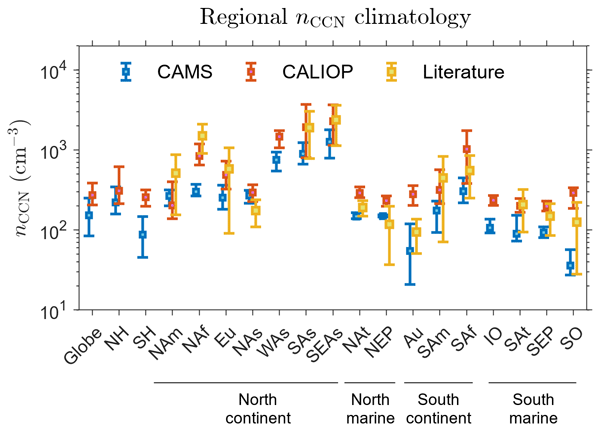
Abstract. Quantifying global cloud condensation nuclei (CCN) concentrations is crucial for reducing uncertainties in radiative forcing resulting from aerosol-cloud interactions. This study analyzes two novel, independent, open-source global CCN datasets derived from spaceborne Cloud Aerosol Lidar with Orthogonal Polarization (CALIOP) measurements and Copernicus Atmosphere Monitoring Service (CAMS) reanalysis and examines the spatio-temporal variability of CCN concentrations pertinent to liquid clouds. The results reveal consistent large-scale patterns in both CALIOP and CAMS datasets, although CALIOP values are approximately 79 % higher than those from CAMS. Comparisons with existing literature demonstrate that these datasets effectively bound the regionally observed CCN concentrations, with CALIOP typically representing the upper bound and CAMS the lower bound. Monthly and annual variations in CCN concentrations obtained from the two datasets largely agree over the Northern Hemisphere and align with previously reported variations. However, inconsistencies emerge over pristine oceans, particularly in the Southern Hemisphere, where the datasets show not only opposing seasonal changes but also contrasting annual trends. A closure study of trends in CCN and cloud droplet concentrations suggests that dust-influenced and pristine-maritime environments primarily limit our current understanding of CCN-cloud-droplet relationships. Long-term CCN observations in these regions are crucial for improving global datasets and advancing our understanding of aerosol-cloud interactions.
Competing interests: At least one of the (co-)authors is a member of the editorial board of Atmospheric Chemistry and Physics.
Publisher's note: Copernicus Publications remains neutral with regard to jurisdictional claims made in the text, published maps, institutional affiliations, or any other geographical representation in this paper. While Copernicus Publications makes every effort to include appropriate place names, the final responsibility lies with the authors. Views expressed in the text are those of the authors and do not necessarily reflect the views of the publisher.-
Notice on discussion status
The requested preprint has a corresponding peer-reviewed final revised paper. You are encouraged to refer to the final revised version.
-
Preprint
(2102 KB)
-
The requested preprint has a corresponding peer-reviewed final revised paper. You are encouraged to refer to the final revised version.
- Preprint
(2102 KB) - Metadata XML
- BibTeX
- EndNote
- Final revised paper


Journal article(s) based on this preprint
Interactive discussion
Status: closed
-
RC1: 'Comment on egusphere-2024-1863', Anonymous Referee #1, 05 Sep 2024
The manuscript by Choudhury et al. (2024) addresses a very important topic examining and comparing two state-of-the-art cloud condensation nuclei (CCN) abundance data sets. One of these is derived from aerosol extinction calculated from the CALIOP lidar data set by Choudhury and Tesche (2023) and the other a blended aerosol model-MODIS aerosol optical depth data set known as Copernicus Atmosphere Monitoring Service (CAMS) aerosol reanalysis (Inness et al., 2019). Using data from roughly 2007-2020, the authors compare the CCN in various regions of the Earth, examine seasonal cycles in these regions using monthly statistics, and finally examine trends over the period of record – also bringing in MODIS derived cloud droplet number concentrations (Nd) in the trend analysis.
The authors find that the CCN data sets present reasonably good agreement in the Northern Hemisphere. However, the agreement is strikingly different in the pristine Southern Hemisphere oceans. This disagreement shows up in the mean statistics with CAM being significantly lower in the annual mean compared to the CALIOP data. These differences extend to the seasonal cycle where the two data sets are largely opposites with the CALIOP data showing a winter maximum and CAM showing a winter minimum. The trends are also different with the CALIOP data showing an overall decreasing trend that is consistent with the MODIS Nd data whereas, over the pristine Southern Ocean, CAM has an increasing trend. The large differences between the Northern and Southern Hemispheres points to structural issues with at least one of the algorithms in regions of low natural AOD. While the authors are careful to present a balanced examination, they do argue that the CALIOP data set is the more reasonable in the regions of disagreement.
Overall, I find the manuscript to be well written and concise. The authors examine a very important topic. It is my opinion that the manuscript will be an important contribution to the scientific literature on this topic. I do have two major points of criticism, however, that should be addressed before the paper is published.
My main point is that the authors neglect several papers that document the seasonal cycle of CCN in the Southern Ocean. The authors correctly cite the fact that in situ data sets are rare, but they seem to have missed several very strong observational studies that could bring light to the seasonal cycle discrepancy they find in the pristine Southern Hemisphere oceans. For instance, data from the Cape Grim observatory have been used to demonstrate the seasonal cycle in CCN in Southern Ocean air masses in papers dating back to the early1990’s (Ayers and Gras, 1991) and more recently (Gras and Keywood, 2017) looking at more than 3 decades of data. While the Cape Grim observatory is situated just a few hundred km from mainland Australia, the authors of these papers are careful to use only data that represent pristine Southern Ocean air masses that have had long trajectories over open water to the southwest. Both papers show a seasonal cycle in CCN that is in striking agreement with the CAM dataset that have a winter minimum in CCN in all the Southern Ocean regions analyzed. While the authors cite the paper by Humphries et al. (2023) to support the CALIOP winter maximum in Southern Ocean CCN arguing that higher winds drive sea salt aerosol, the Humphries et al. paper also shows in situ seasonal cycles from ships over a wide latitude belt extending from Australia to Antarctica that agree boradly with the winter minimum in CCN. This winter minimum extends to low-level clouds as well. McCoy et al. (2015) demonstrate such a seasonal cycle analyzing MODIS cloud data while Mace and Avey (2017) analyze CloudSat data to also show a significant winter minimum in Nd over the Southern Ocean.
It is my opinion that the authors really must address this body of literature since it seems evident that the CAM data set accurately captures the seasonal cycle in the pristine Southern Ocean while the CALIOP data set simply does not. This would imply that the CALIOP retrieval algorithm has serious issues in pristine oceanic regions. I am also quite skeptical of the trend analysis presented in this paper. There is very little discussion of the methodology. The instruments being used (CALIOP and MODIS) aged substantially over the period considered. The authors do not discuss how they have accounted for the aging of instruments and how this has been accounted for in their trend analysis.
Thus, I recommend a major revision of the paper with more critical focus on the discrepancies in the pristine Southern Ocean.
References that are not cited in the manuscript:
Ayers, G. P., and J. L. Gras (1991), Seasonal relationship between cloud condensation nuclei and aerosol methanesulphonate in marine air, Nature, 353, 834–835.
Gras, J. L. and Keywood, M.: Cloud condensation nuclei over the Southern Ocean: wind dependence and seasonal cycles, Atmos. Chem. Phys., 17, 4419–4432, https://doi.org/10.5194/acp- 17-4419-2017, 2017.
Mace, G. G., and S. Avey (2017), Seasonal variability of warm boundary layer cloud and precipitation properties in the Southern Ocean as diagnosed from A-Train data, J. Geophys. Res. Atmos., 122, 1015–1032, doi:10.1002/2016JD025348.
McCoy, D. t., S. M. Burrows, R. Wood, D. P. Grosvenor, S. M. Elliott, P.-L. Ma, P. J. Rasch, and D. L. Hartmann (2015), Natural aerosols explain seasonal and spatial patterns of Southern Ocean cloud albedo, Sci. Adv., 1, e1500157.
Citation: https://doi.org/10.5194/egusphere-2024-1863-RC1 -
RC2: 'Comment on egusphere-2024-1863', Marc Daniel Mallet, 11 Sep 2024
This is a review for ‘Pristine oceans control the uncertainty in aerosol-cloud interactions’ by Choudhury et al. The study looks at two different datasets of vertically-resolved gridded CCN data. The first is a satellite-derived product using lidar. The second is a reanalysis. At the end of the introduction they state “ Ultimately, this work aims to establish a benchmark for applying and developing CCN-retrieval algorithms in the context of aerosol-cloud interactions”. I will target my review with this in mind. I have two major comments and several specific/minor comments. I want to emphasise though that I really admire the work the authors have put into not only this manuscript, but in generating these datasets in the first place. The suggestions I have are really to expand on the great work already done.
Major comments:
- I understand that the CALIOP and CAMS CCN datasets have their own papers describing how each dataset is produced. I think some of that information needs to be brought over into the discussion in this manuscript, particularly when the different assumptions about the aerosol size distribution, hygroscopicity, and activation diameter could be reasons for differences between the two products. However, the differences in these assumptions also need to be weighed against the potential limitations in the two products as well. For CALIOP, that lies in the fact that CCN concentration doesn’t always correlate with aerosol extinction. For CAMS, the sources and sinks of different species could be over- or underestimated. Around Line 95 there is a discussion about the fact that CALIOP-derived CCN concentrations are consistently larger than CAMS for most regions. They attribute this to the fact that the CALIOP retrieval assumes a fixed CCN-activation radius, whereas the CAMS product calculates CCN based on the simulated mass mixing ratios of different species. Can the authors rule out other possible causes? I’m not suggesting that the authors go and do a whole new study or change anything drastically. But I do wonder if a comparison of the aerosol extinction from CALIOP and calculated aerosol extinction from CAMS might be a fairer comparison, or at least useful in diagnosing the causes of the differences between the two products. At the very least, some discussion should be added on this point, both when discussing the spatial and seasonal differences between the two products.
- It really stands out to me that high latitudes have been excluded from this study, even though there is global data from both the CALIOP and CAMS products. Aside from a small part of the Southern America domain, the regional domains used for this study extend only as far south as 40S. There are in situ observations from the Arctic, the Antarctic continent, and across the Southern Ocean that could be used for comparison as well. The Southern Ocean south of 40S is arguably the most pristine region on the planet, and also very important in terms of aerosol-cloud-radiation interactions. I would not be alone in thinking that it is disappointing that this region has been excluded from the analysis, especially given the title of the study.
Specific comments:
- Figure 3. The differences in the shape of some of these seasonal cycles is stark (i.e. Indian Ocean, Southeast Pacific, South Atlantic). The authors mention that ocean CCN are influenced by more than sea spray aerosol but do not go much further than that. There is certainly enough in situ data to confirm there is an increase in austral summertime biogenic CCN around the Southern Ocean. Furthermore, the South Atlantic is strongly influenced by biomass burning during the dry season. CAMS seems to at least represent these expected seasonal cycles in these regions, where-as the CALIOP product does not. I’d encourage the authors to discuss these limitations in the context of the in situ observational studies that have taken place in these regions. I do think this is important as these products could end up being used to either evaluate or serve as climatologies in future modelling efforts.
- I think the recommendations for future work and conclusions could be strengthened a bit. Although there are perhaps more existing (and planned!) in situ CCN measurements in the remote regions of the Southern Hemisphere oceans than implied in the manuscipt, I agree that the sources (also sinks) of CCN do need to be better represented in CAMS (models in general). But can the authors comment on the suitability of satellite-based products of CCN in these regions? CCN can vary considerably due to variability in aitken and accumulation-mode biogenic aerosol, that could be nearly independent of the sea spray aerosol that determines the larger accumulation and coarse mode that aerosol extinction is sensitive to. How can that limitation be overcome? Maybe it cannot, and a hybrid approach with machine learning or earth system modelling is needed. I think adding this type of discussion is useful for determining when and where each product could be considered a “truth”.
Minor comments:
- How do these two CCN-products compare to MODIS Nd retrievals? It would be really insightful to show the correlation coefficient between Nd and CCN for both datasets (similar plot to Figure A2a).
- I would like to see a version of Figure 1 broken down into seasons in the appendix or supplementary material.
- I would like to see Figure A1 incorporated into Figure 2. The regional domains are used and referenced a lot, so I’m not sure if the map showing what those domains are should be in the Appendix.
- The time period the trends are calculated over in Figure 4 and 5 and A3/A4 should be in the caption or legend.
- Figure A2. There is something that has gone wrong with the plotting for panel b. The coast lines do not match up with the cloud cover pixels properly. You can see this clearly at the bottom of South America, Africa, Australia and New Zealand. Can the authors fix this but also really check the plotting issue isn’t also there in Figures 1, 4, A3, A4, A5.
- Lat and lon grid lines would be very much appreciated on the map plots.
- Line 71: “below 45S” should be “south of 45S” as “lower” latitude is closer to the equator than a “higher” latitude
- Line 81. I’m not quite sure what is meant by land-ocean gradients of e.g 65%.
Citation: https://doi.org/10.5194/egusphere-2024-1863-RC2 - AC1: 'Comment on egusphere-2024-1863', Goutam Choudhury, 30 Oct 2024
Peer review completion


Interactive discussion
Status: closed
-
RC1: 'Comment on egusphere-2024-1863', Anonymous Referee #1, 05 Sep 2024
The manuscript by Choudhury et al. (2024) addresses a very important topic examining and comparing two state-of-the-art cloud condensation nuclei (CCN) abundance data sets. One of these is derived from aerosol extinction calculated from the CALIOP lidar data set by Choudhury and Tesche (2023) and the other a blended aerosol model-MODIS aerosol optical depth data set known as Copernicus Atmosphere Monitoring Service (CAMS) aerosol reanalysis (Inness et al., 2019). Using data from roughly 2007-2020, the authors compare the CCN in various regions of the Earth, examine seasonal cycles in these regions using monthly statistics, and finally examine trends over the period of record – also bringing in MODIS derived cloud droplet number concentrations (Nd) in the trend analysis.
The authors find that the CCN data sets present reasonably good agreement in the Northern Hemisphere. However, the agreement is strikingly different in the pristine Southern Hemisphere oceans. This disagreement shows up in the mean statistics with CAM being significantly lower in the annual mean compared to the CALIOP data. These differences extend to the seasonal cycle where the two data sets are largely opposites with the CALIOP data showing a winter maximum and CAM showing a winter minimum. The trends are also different with the CALIOP data showing an overall decreasing trend that is consistent with the MODIS Nd data whereas, over the pristine Southern Ocean, CAM has an increasing trend. The large differences between the Northern and Southern Hemispheres points to structural issues with at least one of the algorithms in regions of low natural AOD. While the authors are careful to present a balanced examination, they do argue that the CALIOP data set is the more reasonable in the regions of disagreement.
Overall, I find the manuscript to be well written and concise. The authors examine a very important topic. It is my opinion that the manuscript will be an important contribution to the scientific literature on this topic. I do have two major points of criticism, however, that should be addressed before the paper is published.
My main point is that the authors neglect several papers that document the seasonal cycle of CCN in the Southern Ocean. The authors correctly cite the fact that in situ data sets are rare, but they seem to have missed several very strong observational studies that could bring light to the seasonal cycle discrepancy they find in the pristine Southern Hemisphere oceans. For instance, data from the Cape Grim observatory have been used to demonstrate the seasonal cycle in CCN in Southern Ocean air masses in papers dating back to the early1990’s (Ayers and Gras, 1991) and more recently (Gras and Keywood, 2017) looking at more than 3 decades of data. While the Cape Grim observatory is situated just a few hundred km from mainland Australia, the authors of these papers are careful to use only data that represent pristine Southern Ocean air masses that have had long trajectories over open water to the southwest. Both papers show a seasonal cycle in CCN that is in striking agreement with the CAM dataset that have a winter minimum in CCN in all the Southern Ocean regions analyzed. While the authors cite the paper by Humphries et al. (2023) to support the CALIOP winter maximum in Southern Ocean CCN arguing that higher winds drive sea salt aerosol, the Humphries et al. paper also shows in situ seasonal cycles from ships over a wide latitude belt extending from Australia to Antarctica that agree boradly with the winter minimum in CCN. This winter minimum extends to low-level clouds as well. McCoy et al. (2015) demonstrate such a seasonal cycle analyzing MODIS cloud data while Mace and Avey (2017) analyze CloudSat data to also show a significant winter minimum in Nd over the Southern Ocean.
It is my opinion that the authors really must address this body of literature since it seems evident that the CAM data set accurately captures the seasonal cycle in the pristine Southern Ocean while the CALIOP data set simply does not. This would imply that the CALIOP retrieval algorithm has serious issues in pristine oceanic regions. I am also quite skeptical of the trend analysis presented in this paper. There is very little discussion of the methodology. The instruments being used (CALIOP and MODIS) aged substantially over the period considered. The authors do not discuss how they have accounted for the aging of instruments and how this has been accounted for in their trend analysis.
Thus, I recommend a major revision of the paper with more critical focus on the discrepancies in the pristine Southern Ocean.
References that are not cited in the manuscript:
Ayers, G. P., and J. L. Gras (1991), Seasonal relationship between cloud condensation nuclei and aerosol methanesulphonate in marine air, Nature, 353, 834–835.
Gras, J. L. and Keywood, M.: Cloud condensation nuclei over the Southern Ocean: wind dependence and seasonal cycles, Atmos. Chem. Phys., 17, 4419–4432, https://doi.org/10.5194/acp- 17-4419-2017, 2017.
Mace, G. G., and S. Avey (2017), Seasonal variability of warm boundary layer cloud and precipitation properties in the Southern Ocean as diagnosed from A-Train data, J. Geophys. Res. Atmos., 122, 1015–1032, doi:10.1002/2016JD025348.
McCoy, D. t., S. M. Burrows, R. Wood, D. P. Grosvenor, S. M. Elliott, P.-L. Ma, P. J. Rasch, and D. L. Hartmann (2015), Natural aerosols explain seasonal and spatial patterns of Southern Ocean cloud albedo, Sci. Adv., 1, e1500157.
Citation: https://doi.org/10.5194/egusphere-2024-1863-RC1 -
RC2: 'Comment on egusphere-2024-1863', Marc Daniel Mallet, 11 Sep 2024
This is a review for ‘Pristine oceans control the uncertainty in aerosol-cloud interactions’ by Choudhury et al. The study looks at two different datasets of vertically-resolved gridded CCN data. The first is a satellite-derived product using lidar. The second is a reanalysis. At the end of the introduction they state “ Ultimately, this work aims to establish a benchmark for applying and developing CCN-retrieval algorithms in the context of aerosol-cloud interactions”. I will target my review with this in mind. I have two major comments and several specific/minor comments. I want to emphasise though that I really admire the work the authors have put into not only this manuscript, but in generating these datasets in the first place. The suggestions I have are really to expand on the great work already done.
Major comments:
- I understand that the CALIOP and CAMS CCN datasets have their own papers describing how each dataset is produced. I think some of that information needs to be brought over into the discussion in this manuscript, particularly when the different assumptions about the aerosol size distribution, hygroscopicity, and activation diameter could be reasons for differences between the two products. However, the differences in these assumptions also need to be weighed against the potential limitations in the two products as well. For CALIOP, that lies in the fact that CCN concentration doesn’t always correlate with aerosol extinction. For CAMS, the sources and sinks of different species could be over- or underestimated. Around Line 95 there is a discussion about the fact that CALIOP-derived CCN concentrations are consistently larger than CAMS for most regions. They attribute this to the fact that the CALIOP retrieval assumes a fixed CCN-activation radius, whereas the CAMS product calculates CCN based on the simulated mass mixing ratios of different species. Can the authors rule out other possible causes? I’m not suggesting that the authors go and do a whole new study or change anything drastically. But I do wonder if a comparison of the aerosol extinction from CALIOP and calculated aerosol extinction from CAMS might be a fairer comparison, or at least useful in diagnosing the causes of the differences between the two products. At the very least, some discussion should be added on this point, both when discussing the spatial and seasonal differences between the two products.
- It really stands out to me that high latitudes have been excluded from this study, even though there is global data from both the CALIOP and CAMS products. Aside from a small part of the Southern America domain, the regional domains used for this study extend only as far south as 40S. There are in situ observations from the Arctic, the Antarctic continent, and across the Southern Ocean that could be used for comparison as well. The Southern Ocean south of 40S is arguably the most pristine region on the planet, and also very important in terms of aerosol-cloud-radiation interactions. I would not be alone in thinking that it is disappointing that this region has been excluded from the analysis, especially given the title of the study.
Specific comments:
- Figure 3. The differences in the shape of some of these seasonal cycles is stark (i.e. Indian Ocean, Southeast Pacific, South Atlantic). The authors mention that ocean CCN are influenced by more than sea spray aerosol but do not go much further than that. There is certainly enough in situ data to confirm there is an increase in austral summertime biogenic CCN around the Southern Ocean. Furthermore, the South Atlantic is strongly influenced by biomass burning during the dry season. CAMS seems to at least represent these expected seasonal cycles in these regions, where-as the CALIOP product does not. I’d encourage the authors to discuss these limitations in the context of the in situ observational studies that have taken place in these regions. I do think this is important as these products could end up being used to either evaluate or serve as climatologies in future modelling efforts.
- I think the recommendations for future work and conclusions could be strengthened a bit. Although there are perhaps more existing (and planned!) in situ CCN measurements in the remote regions of the Southern Hemisphere oceans than implied in the manuscipt, I agree that the sources (also sinks) of CCN do need to be better represented in CAMS (models in general). But can the authors comment on the suitability of satellite-based products of CCN in these regions? CCN can vary considerably due to variability in aitken and accumulation-mode biogenic aerosol, that could be nearly independent of the sea spray aerosol that determines the larger accumulation and coarse mode that aerosol extinction is sensitive to. How can that limitation be overcome? Maybe it cannot, and a hybrid approach with machine learning or earth system modelling is needed. I think adding this type of discussion is useful for determining when and where each product could be considered a “truth”.
Minor comments:
- How do these two CCN-products compare to MODIS Nd retrievals? It would be really insightful to show the correlation coefficient between Nd and CCN for both datasets (similar plot to Figure A2a).
- I would like to see a version of Figure 1 broken down into seasons in the appendix or supplementary material.
- I would like to see Figure A1 incorporated into Figure 2. The regional domains are used and referenced a lot, so I’m not sure if the map showing what those domains are should be in the Appendix.
- The time period the trends are calculated over in Figure 4 and 5 and A3/A4 should be in the caption or legend.
- Figure A2. There is something that has gone wrong with the plotting for panel b. The coast lines do not match up with the cloud cover pixels properly. You can see this clearly at the bottom of South America, Africa, Australia and New Zealand. Can the authors fix this but also really check the plotting issue isn’t also there in Figures 1, 4, A3, A4, A5.
- Lat and lon grid lines would be very much appreciated on the map plots.
- Line 71: “below 45S” should be “south of 45S” as “lower” latitude is closer to the equator than a “higher” latitude
- Line 81. I’m not quite sure what is meant by land-ocean gradients of e.g 65%.
Citation: https://doi.org/10.5194/egusphere-2024-1863-RC2 - AC1: 'Comment on egusphere-2024-1863', Goutam Choudhury, 30 Oct 2024
Peer review completion
Journal article(s) based on this preprint
Viewed
| HTML | XML | Total | BibTeX | EndNote | |
|---|---|---|---|---|---|
| 2,323 | 614 | 593 | 3,530 | 140 | 221 |
- HTML: 2,323
- PDF: 614
- XML: 593
- Total: 3,530
- BibTeX: 140
- EndNote: 221
Viewed (geographical distribution)
| Country | # | Views | % |
|---|
| Total: | 0 |
| HTML: | 0 |
| PDF: | 0 |
| XML: | 0 |
- 1
Goutam Choudhury

Karoline Block
Mahnoosh Haghighatnasab
Johannes Quaas
Tom Goren
Matthias Tesche
The requested preprint has a corresponding peer-reviewed final revised paper. You are encouraged to refer to the final revised version.
- Preprint
(2102 KB) - Metadata XML