
the Creative Commons Attribution 4.0 License.
the Creative Commons Attribution 4.0 License.
 | 05 Mar 2026
The Impact of NaOH, CaO, and HCO3–+ Ca+2 Addition on PIC and POC Formation in Los Angeles Harbor Waters
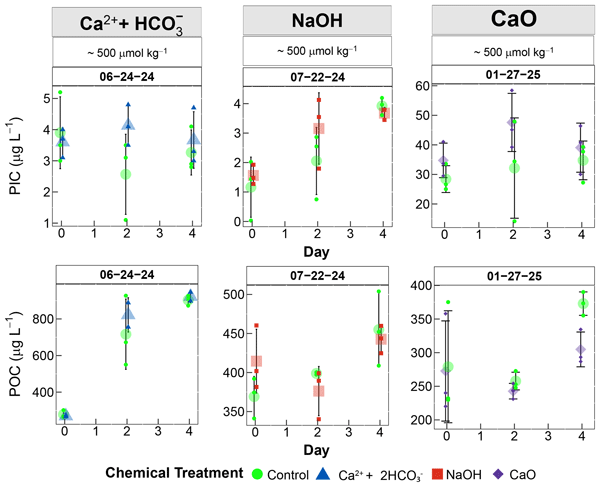
Abstract. Negative CO2 emission technologies such as ocean alkalinity enhancement (OAE), in tandem with emissions reduction are necessary to keep the climate system below a critical tipping point. While the biogeochemical consequences of OAE remain poorly constrained, field deployment is accelerating in the commercial sector, leaving questions of ecosystem impact in the wake. In this study we conduct alkalinity perturbation experiments to capture the resultant impact to the organic carbon and calcium carbonate pools. We quantify shifts in dissolved/particulate inorganic (DIC, PIC) and organic (DOC, POC) carbon after the addition of three alkalinity sources – NaOH, CaO, and NaHCO3 + CaCl2 (to simulate dissolved limestone). These experiments are conducted with coastal sea water with enhancements of +500–1000 µmol kg–1 alkalinity, and incubated in situ, to elucidate their impact over the short term, 0–4 days. Select experiments are also completely isolated from the light via bottle shading. With most treatments, there is no statistically significant CaCO3 precipitation after OAE nor changes in organic matter production or consumption, relative to the untreated controls. One exception is when CaO addition enriches the water by 1000 µmol kg–1, here we find a significant decline in POC production. 13C isotope spikes were added to trace C partitioning throughout the experiment. The seawater used in these experiments had a wide range of initial ambient PIC and POC, and within this wide range, a +500 µmol kg–1 alkalinity in the form of NaOH, CaO or NaHCO3 + CaCl2 addition did not change the production or consumption of carbon in these waters.
Competing interests: WB is the co-founder of Calcarea, Inc. The authors declare that they have no other competing interests.
Publisher's note: Copernicus Publications remains neutral with regard to jurisdictional claims made in the text, published maps, institutional affiliations, or any other geographical representation in this paper. While Copernicus Publications makes every effort to include appropriate place names, the final responsibility lies with the authors. Views expressed in the text are those of the authors and do not necessarily reflect the views of the publisher.-
Notice on discussion status
The requested preprint has a corresponding peer-reviewed final revised paper. You are encouraged to refer to the final revised version.
-
Preprint
(1838 KB)
-
Supplement
(552 KB)
-
The requested preprint has a corresponding peer-reviewed final revised paper. You are encouraged to refer to the final revised version.
- Preprint
(1838 KB) - Metadata XML
-
Supplement
(552 KB) - BibTeX
- EndNote
- Final revised paper


Journal article(s) based on this preprint
Interactive discussion
Status: closed
-
RC1: 'Comment on egusphere-2026-982', Anonymous Referee #1, 02 Apr 2026
- AC1: 'Reply on RC1', Rucha Wani, 07 May 2026
-
RC2: 'Comment on egusphere-2026-982', Anonymous Referee #2, 08 Apr 2026
Dear authors,
Please find attached my review.
Kind regards.
- AC2: 'Reply on RC2', Rucha Wani, 07 May 2026
Peer review completion


Interactive discussion
Status: closed
-
RC1: 'Comment on egusphere-2026-982', Anonymous Referee #1, 02 Apr 2026
The manuscript assesses the impact of alkalinity addition via different methods (NaOH, CaO, and bicarbonate+calcium to simulate accelerated limestone weathering) on the organic and inorganic carbon partition. The study was conducted using bottle incubations in Los Angeles Harbor, with effects of additions at different concentrations being measured for about 4 days. In general, the study is well designed, and the figures reflect the results discussed. I missed some discussion on the limitations of the study in addressing possible detrimental effects to the ecosystem throughout the manuscript, but this was added to the discussion in a clear way. There are a few points in the manuscript that require clarification of some rewriting, as pointed out in the specific comments below. Authors sometimes compare two different carbon variables assuming the reader will know why that comparison is being made, which might not be the case especially for an mCDR related publication that can attract readers outside of the ocean carbon scientific community. Some general interpretation on what results mean throughout the results section and pointers on how it will be added to the discussion would be useful as well, for example pointing to potential impacts on biology in section 3.3.1.
In general, however, the manuscript is well written and adds useful information to the much needed and mounting literature assessing the impact of alkalinity additions on water chemistry and on biology. With some relatively minor reviews, it should be ready for publication.
L40: Needs reference
L42: Also worth discussing other impacts of dissolving all calcium carbonate
L43: I would add a “potentially” here
Table 1: All salinities were exactly 35?
L140: Consider adding equations here
L165-167: I would rephrase or add more information here, as is it reads like a preemptive rebuttal of criticism without offering arguments. Adding some information on which aspects are desirable would be more helpful.
L186-187: All bottles got the 13C tracer?
L304-307: This was a bit confusing to read. Would be less so to say both POC and DOC change, and explain why you are comparing these two variables
L355: Consider adding the date to the subtitle here as well
L446-447: Where did you get these numbers from?
L448-450: Consider rephrasing. The first sentence says there was no change, and the following one starts with DIC decrease. In general good to be more clear about which experiments you are talking about throughout the manuscript.
L463-464: as seen/assessed where/how?
L509: how quickly?
L514: Can you add another sentence or two on the ranges and setups of these experiments?
L541: How are you assessing negative impact? This is quite a broad term.
L568: Was not reproduced?
Citation: https://doi.org/10.5194/egusphere-2026-982-RC1 - AC1: 'Reply on RC1', Rucha Wani, 07 May 2026
-
RC2: 'Comment on egusphere-2026-982', Anonymous Referee #2, 08 Apr 2026
Dear authors,
Please find attached my review.
Kind regards.
- AC2: 'Reply on RC2', Rucha Wani, 07 May 2026
Peer review completion
Journal article(s) based on this preprint
Data sets
Wani-et-al-OAE-Carbon-Partioning Rucha P. Wani, et al. https://github.com/ruchap-wani/Wani-et-al-OAE-Carbon-Partioning
Viewed
| HTML | XML | Total | Supplement | BibTeX | EndNote | |
|---|---|---|---|---|---|---|
| 1,150 | 461 | 95 | 1,706 | 219 | 102 | 97 |
- HTML: 1,150
- PDF: 461
- XML: 95
- Total: 1,706
- Supplement: 219
- BibTeX: 102
- EndNote: 97
Viewed (geographical distribution)
| Country | # | Views | % |
|---|
| Total: | 0 |
| HTML: | 0 |
| PDF: | 0 |
| XML: | 0 |
- 1

Devan Roper
Ria Agrawal
Esther J. Lim
Nick E. Rollins
William M. Berelson
The requested preprint has a corresponding peer-reviewed final revised paper. You are encouraged to refer to the final revised version.
- Preprint
(1838 KB) - Metadata XML
-
Supplement
(552 KB) - BibTeX
- EndNote
- Final revised paper
The manuscript assesses the impact of alkalinity addition via different methods (NaOH, CaO, and bicarbonate+calcium to simulate accelerated limestone weathering) on the organic and inorganic carbon partition. The study was conducted using bottle incubations in Los Angeles Harbor, with effects of additions at different concentrations being measured for about 4 days. In general, the study is well designed, and the figures reflect the results discussed. I missed some discussion on the limitations of the study in addressing possible detrimental effects to the ecosystem throughout the manuscript, but this was added to the discussion in a clear way. There are a few points in the manuscript that require clarification of some rewriting, as pointed out in the specific comments below. Authors sometimes compare two different carbon variables assuming the reader will know why that comparison is being made, which might not be the case especially for an mCDR related publication that can attract readers outside of the ocean carbon scientific community. Some general interpretation on what results mean throughout the results section and pointers on how it will be added to the discussion would be useful as well, for example pointing to potential impacts on biology in section 3.3.1.
In general, however, the manuscript is well written and adds useful information to the much needed and mounting literature assessing the impact of alkalinity additions on water chemistry and on biology. With some relatively minor reviews, it should be ready for publication.
L40: Needs reference
L42: Also worth discussing other impacts of dissolving all calcium carbonate
L43: I would add a “potentially” here
Table 1: All salinities were exactly 35?
L140: Consider adding equations here
L165-167: I would rephrase or add more information here, as is it reads like a preemptive rebuttal of criticism without offering arguments. Adding some information on which aspects are desirable would be more helpful.
L186-187: All bottles got the 13C tracer?
L304-307: This was a bit confusing to read. Would be less so to say both POC and DOC change, and explain why you are comparing these two variables
L355: Consider adding the date to the subtitle here as well
L446-447: Where did you get these numbers from?
L448-450: Consider rephrasing. The first sentence says there was no change, and the following one starts with DIC decrease. In general good to be more clear about which experiments you are talking about throughout the manuscript.
L463-464: as seen/assessed where/how?
L509: how quickly?
L514: Can you add another sentence or two on the ranges and setups of these experiments?
L541: How are you assessing negative impact? This is quite a broad term.
L568: Was not reproduced?