
the Creative Commons Attribution 4.0 License.
the Creative Commons Attribution 4.0 License.
 | 20 Mar 2026
The complex effect of climate change and urbanization on streamflow in small–medium Mediterranean catchments
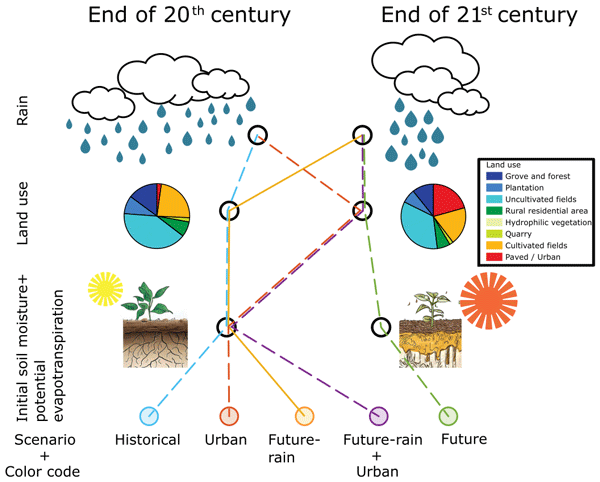
Abstract. Future floods in the Mediterranean region are influenced by the dual pressures of accelerated climate change and rapid urbanization. Yet the small spatial scale and complexity of hydrometeorological processes make it difficult to project their joint effects. Intra-basin flood projections, in particular, remain absent. This study examines how these drivers affect peak discharge and flood volume in small to medium-sized Mediterranean basins, using high-resolution weather and hydrological models. We analyze 32 rainstorms under historical (late 20th century) and future (late 21st century) climate scenarios, incorporating projected urban expansion. Results show that while short-duration and high rain rates increase, accumulated precipitation, rainfall area, storm duration, and soil water storage significantly decrease. The combined effect of changes in rainfall patterns, soil water storage, and urbanization produces contrasting trends: urbanization alone leads to a substantial increase in mean peak discharge (+43 %) and flood volume (+41 %), especially when soil water storage is undersaturated and the influence of impervious surfaces is greatest. Conversely, considering only projected rainfall scenario yields decreases in mean peak discharge (-21 %) and flood volume (-30 %), despite higher rain intensities. However, during extreme events, when soil moisture approaches saturation, flood intensification can occur. Combined climate and urban scenarios demonstrate that urbanization dominates, resulting in increased mean peak discharge (+13 %). The high-resolution modeling reveals substantial intra-basin variability, with peak discharge intensification concentrated in upstream and urbanized areas. These localized and contrasting effects highlight the need for integrated high-resolution modeling and future land-use planning to support effective flood mitigation and water-management strategies.
-
Notice on discussion status
The requested preprint has a corresponding peer-reviewed final revised paper. You are encouraged to refer to the final revised version.
-
Preprint
(1686 KB)
-
Supplement
(1377 KB)
-
The requested preprint has a corresponding peer-reviewed final revised paper. You are encouraged to refer to the final revised version.
- Preprint
(1686 KB) - Metadata XML
-
Supplement
(1377 KB) - BibTeX
- EndNote
- Final revised paper


Journal article(s) based on this preprint
Interactive discussion
Status: closed
-
RC1: 'Comment on egusphere-2026-972', Anonymous Referee #1, 27 Mar 2026
-
AC1: 'Reply on RC1', Yair Rinat, 02 Jun 2026
RC1: 'Comment on egusphere-2026-972', Anonymous Referee #1, 27 Mar 2026
We thank the reviewer for the helpful comments. All comments were addressed. Our replies are in bold.
This manuscript presents an investigation of the combined effects of climate change and urbanization on flood characteristics in small Mediterranean catchments, using high-resolution climate and distributed hydrological modeling. The study addresses an important and timely question, and the use of convection-permitting simulations represents a clear strength. The focus on intra-basin variability and the distinction between saturated and unsaturated event responses is a very strong contribution of this manuscript. For instance, the analysis of intra-basin variability demonstrates that localized increases in runoff may not translate into increased outlet discharge, with important implications for hazard assessment.
The manuscript is generally well structured and clearly written, and the results are scientifically interesting. In particular, the finding that projected rainfall changes tend to reduce flood magnitude while urbanization increases it, and that the latter can dominate the combined signal under certain conditions, is an important contribution. However, some aspects of the methodology and generalization require clarification and strengthening before the manuscript is suitable for publication.
The study relies on a pseudo-global warming approach based on a multi-model mean signal from CMIP5 (RCP8.5), yet the spread across climate models is not explored. As a result, the projected rainfall changes, which are central to the conclusions, are presented in a somewhat deterministic manner. This limits the robustness of the findings, particularly given that Mediterranean precipitation projections are known to be highly uncertain. The manuscript would benefit from a more explicit discussion of this limitation, including the implications of using an ensemble mean forcing rather than a range of future changes in rainfall. At minimum, the authors should clarify that the results are scenario-based, for the worst-case scenario (RCP8.5) and do not represent probabilistic projections, and discuss how model uncertainty might influence both the sign and magnitude of the reported changes.
We agree with the reviewer about the limitations posed by using a single climate change scenario in our analysis. This approach was taken because high resolution future rainfall fields are necessary as input for our high-resolution hydrological modeling that enables gaining intra-basin-scale insight about the potential impacts of both climate change and land use changes. For the eastern Mediterranean, such convection-permitting future rainfall fields are currently available only from a single study (Armon et al., 2022), which we therefore used in this work. Furthermore, while the inter-model spread among GCMs is large, it is difficult to determine a priori which climate model would provide the best performance after downscaling for event-scale rainfall. We therefore used the ensemble-mean climate-change signal as a pragmatic choice, while acknowledging that it does not capture the full range of possible future changes (see lines 155-158).
With regard to the use of a single forcing scenario (RCP8.5, rather than a multi-scenario approach), we also agree with the reviewer that this is a limitation of the study, and we therefore added a discussion of this issue in the manuscript (Lines 488-494). It is important to note that the aim of this study is not to predict the exact future flood response in the basin, but rather to examine the potential combined effects of climate change and land-use change on flood response.
A second important issue concerns the representation of urbanization. While the study appropriately highlights the hydrological impact of increasing impervious surfaces, the implemented scenario includes a substantial and partly hypothetical expansion of urban areas. This choice appears to strongly influence the results, particularly the conclusion that urbanization dominates over climate change in controlling flood response. However, the realism of this scenario is not sufficiently justified, and key processes such as stormwater management, drainage infrastructure, and mitigation measures are not represented or discussed. These omissions may lead to an overestimation of the hydrological response to urbanization. The authors should better justify the chosen land-use scenario, clarify whether it represents an upper-bound case, and at least discuss how the inclusion of urban drainage systems or green infrastructure could alter the results.
We added clarification to our choice to add a hypothetical urban region scenario (see lines 224-557). We also added information about Harish, a city situated near our study site, that was used as an example to justify the urbanization. Harish is considered as the fastest growing town in Israel, extending from just 0.1 km2 in to 3.5 km2 in three years (3400%) (Lines 227-228). Finaly, we added a discussion on various stormwater mitigation actions as suggested (Lines 529-545).
The generalizability of the findings is another aspect that requires careful consideration. Although the manuscript frequently refers to the Mediterranean region as a whole, the analysis is based on a single study area in the eastern Mediterranean. Also, I do not quite understand why the results of only one basin are presented, and the results for the other ones are kept in supplementary materials. While the process-based insights are likely transferable, the quantitative results are strongly dependent on local climatic, topographic, and land-use conditions. The manuscript would benefit from a clearer distinction between site-specific findings and more general conclusions. Yet, I fully understand that this type of study cannot be conducted at the large scale.
We changed the title to focus on the eastern Mediterranean region and the locality of the findings has been emphasized throughout the manuscript as suggested. The results for the other three basins are available for the reader but we chose to leave them in the supplement, as they do not provide additional insights beyond those already discussed in the manuscript, and excluding them helps keep the main paper concise.
Some specific comments along the manuscript:
Line 31. It would be helpful to include a few references that specifically address urban development and how it can alter hydrological responses, particularly in Mediterranean or semi-arid regions.
OK, references were added, for example: Orenstein and Hamburg, (2010), Fletcher et al. (2024), Nussbaum et al. (2026), and Schwake, (2020).
Line 62: I think it is necessary to clarify here that it is primarily the magnitude frequent floods that are decreasing. On the other hand, there are indications of an increase in the most extreme and rare floods linked to the intensity of precipitation. See: Tarasova, L., Lun, D., Merz, R. et al. Shifts in flood generation processes exacerbate regional flood anomalies in Europe. Commun Earth Environ 4, 49 (2023). https://doi.org/10.1038/s43247-023-00714-8.
A sentence was added for clarification (Lines 59-60) : “The magnitude of low-flows and frequent floods are decreasing , while most extreme floods are likely to intensify (Marx et al., 2018; Tarasova et al., 2023).”
Line 82. There is a study that clearly show that while the signal for relatively frequent floods is very close to zero, there is a fairly systematic increase in the most extreme floods projected for the future. Nevertheless, the scope of these conclusions must be limited due to the short length of the time series available in these high-resolution simulations: Poncet N., Tramblay Y., Lucas-Picher P., Thirel G., Caillaud C., 2025. Projections of extreme rainfall and floods in Mediterranean basins from an ensemble of convection-permitting models, Climatic Change, 178, 141. https://doi.org/10.1007/s10584-025-03983-8.
Thank you, a sentence was added (Lines 85-87): “Resent study by Poncet et al. (2025) is the first to use an ensemble of convection-permitting models. It projects increasing flood intensities in twelve Mediterranean basins in France, particularly for extreme events, although the results are limited by the short simulation length.”
Line 114: It might be interesting, if possible, to quantify the change in the percentage of urbanized area over time within the basin during the historical period.
We wrote in the text that the region “remained relatively stable until the 1990s” and that “the settlements in the region expanded in recent decades by approximately 20% including the building of a small power station.” Further data is not easily accessible as digitized maps from this period were not classified to different land uses. We believe that additional quantification would not yield meaningful insights to the reader.
Line 122. I'm not sure I understand this part =’with an average of 7 flow events’ does this mean it's an intermittent river where flow is observed only seven times a year?
The original sentence has been changed for clarification and replaced by (Lines 125-126): “The study area is characterized by ephemeral streams that experience, on average, 7 flood events per year. These floods are typically initiated within hours of intense rainfall and last for approximately 3 days”.
Line 209. +876% seems like a lot. It might be interesting to put that into perspective by comparing it with other projections in different contexts or with other statistics in Israel that would make these trends seem more plausible.
Although the value of +876% is accurate, we agree with the reviewer that it looks exaggerated. It is more informative to present explicitly the values of urban fraction of the basin. Therefore, we have changed the values in the text and table from precent of change from historical scenario to the actual basin coverage present. Thus, instead of using an increase of 876% we state that urban regions increased from 1% (0.42 km2) to 20% (8.4 km2) (See lines 230-231 and Table 1). In recent years several cities were established in Israel turning natural land uses to urban ones. For example the city Harish that we mention in the text is considered the fastest growing city in Israel (Schwake, 2020) extending from just 0.1 km2 in 2016 to 3.5 km2 in 2019 (3400% increase) (see lines 227-228 and ).
Line 255: Why are two tests used at the same time? In particular, the ttest is questionable, it is more suited to normal distributions. Figure 4 show that the two test give similar results.
We included the t-test as a complement to the Wilcoxon signed-rank non-parametric test because it is a parametric method and is generally considered appropriate for sample sizes greater than 30 (32 in our case). The parametric tests are in general more powerful while the non-parametric are more robust. We chose to present both to emphasize the consistency of the results.
Line 265. It isn't made clear enough here that this isn't a continuous forecast for rain, but rather for individual episodes. The study focuses on a subset of heavy precipitation events exceeding a threshold associated with flood generation, rather than a continuous or climatologically representative sample. While this approach is appropriate for analyzing flood-producing storms, it may bias the results toward certain types of events and does not allow conclusions about changes in flood frequency or seasonal behavior.
We thank the reviewer. This point was emphasized at the specific mentioned location and throughout the text. For example, the following sentence was added (Lines 278-279): “It is important to emphasize that these event-based results do not capture potential shifts in flood frequency or seasonal dynamics.”
Line 290. It is important here to explain what it is “saturated”. Soil storage above a threshold value? it is not clearly explained in section 2.3. For example, in Tarasova et al. cited above, there a procedure to estimate the saturated soil conditons.
Thank you. We have clarified this section and explicitly stated the >90% peak soil water storage threshold for Future-rain scenarios (Lines 317–321)
Line 355. I don’t understand ‘Urbanization has a limited effect on peak discharge ‘ in this context. Seems contradictory with the main results.
A clarification was added (see lines 379-382): “When most of the basin is saturated, the relative contribution of urbanized areas to local flood intensification and outlet peak discharge is reduced. This is reflected in the near-zero normalized change in stream cells draining these regions in the Urban scenario, and in the minimal contribution observed in the Future-rain + Urban scenario compared with the Future-rain scenario (Fig. 6).”
Section 4.4.3. This type of analysis is really interesting, and I haven't come across any other examples in the literature where this kind of analysis has been conducted. I think there should be more clear explanation of the implications of this type of analysis and its main conclusions in a slightly less technical way.
The first paragraph in this section that included a technical explanation was moved to the Methods section (Lines: 205-217). This ensures a smoother, more coherent representation of the results. Possible implications are in the discussion section.
Line 410 and after: Not clear if it is literature or findings of the present study. Please clarify.
References were added where needed throughout the paragraph.
Line 428: Yes, your results show a decrease in precipitation during events, but that is not the case at all in other projections or in other regions of the Mediterranean (see Poncet et al 2025 above), so you really need to put this result into perspective.
It was better clarified here and throughout the manuscript that the results apply to small to medium-sized basins in the Eastern Mediterranean.
Line 465: The reason high-resolution RCM models are not yet widely used is that they still have significant limitations. They cover only a few regions; there are few simulations available; and, most importantly, these simulations cover only short time periods.
A clarification was added (Lines 483-486): “Long-term (~10 y) high-resolution simulations of climate change are becoming available for limited regions (e.g., Berthou et al., 2020; Liu et al., 2017). However, their use remains limited because they are available for only a few regions and typically cover short time periods. As a result, large parts of the world, including the eastern Mediterranean, are still excluded from such simulations.”
Line 496 It would be interesting to clarify whether the river discharge used for the reservoirs affect the flood event described in this basin.
The main reservoir receives its water from the downstream sections of the basins and does not affect the simulations. A clarification was added (Line 520).
Line 515. It is really important to say here that this applies to small to medium-sized basins in Israel. These projections do not necessarily apply throughout the Mediterranean.
It was better clarified here (Lines 547-548) and throughout the manuscript.
References:
Berthou, S., Kendon, E. J., Chan, S. C., Ban, N., Leutwyler, D., Schär, C., and Fosser, G.: Pan-European climate at convection-permitting scale: a model intercomparison study, Clim. Dyn., 55, 35–59, https://doi.org/10.1007/s00382-018-4114-6, 2020.
Fletcher, T. D., Burns, M. J., Russell, K. L., Hamel, P., Duchesne, S., Cherqui, F., and Roy, A. H.: Concepts and evolution of urban hydrology, Nat. Rev. Earth Environ., 5, 789–801, https://doi.org/10.1038/s43017-024-00599-x, 2024.
Liu, C., Ikeda, K., Rasmussen, R., Barlage, M., Newman, A. J., Prein, A. F., Chen, F., Chen, L., Clark, M., Dai, A., Dudhia, J., Eidhammer, T., Gochis, D., Gutmann, E., Kurkute, S., Li, Y., Thompson, G., and Yates, D.: Continental-scale convection-permitting modeling of the current and future climate of North America, Clim. Dyn., 49, 71–95, https://doi.org/10.1007/s00382-016-3327-9, 2017.
Marx, A., Kumar, R., Thober, S., Rakovec, O., Wanders, N., Zink, M., Wood, E. F., Pan, M., Sheffield, J., and Samaniego, L.: Climate change alters low flows in Europe under global warming of 1.5, 2, and 3°C, Hydrol. Earth Syst. Sci., 22, 1017–1032, https://doi.org/10.5194/hess-22-1017-2018, 2018.
Nussbaum, R., Armon, M., and Morin, E.: Dual urban runoff response to urbanization and contradictory precipitation trends driven by climate change, under Rev., 2026.
Orenstein, D. E. and Hamburg, S. P.: Population and pavement: Population growth and land development in Israel, Popul. Environ., 31, 223–254, https://doi.org/10.1007/s11111-010-0102-4, 2010.
Poncet, N., Tramblay, Y., Lucas-Picher, P., Thirel, G., and Caillaud, C.: Projections of extreme rainfall and floods in Mediterranean basins from an ensemble of convection-permitting models, Clim. Change, 178, 1–26, https://doi.org/10.1007/s10584-025-03983-8, 2025.
Schwake, G.: Financialising the frontier: Harish City, Cities, 107, https://doi.org/10.1016/j.cities.2020.102945, 2020.
Tarasova, L., Lun, D., Merz, R., Blöschl, G., Basso, S., Bertola, M., Miniussi, A., Rakovec, O., Samaniego, L., Thober, S., and Kumar, R.: Shifts in flood generation processes exacerbate regional flood anomalies in Europe, Commun. Earth Environ., 4, https://doi.org/10.1038/s43247-023-00714-8, 2023.
Citation: https://doi.org/10.5194/egusphere-2026-972-AC1
-
AC1: 'Reply on RC1', Yair Rinat, 02 Jun 2026
-
RC2: 'Comment on egusphere-2026-972', Anonymous Referee #2, 22 Apr 2026
The comment was uploaded in the form of a supplement: https://egusphere.copernicus.org/preprints/2026/egusphere-2026-972/egusphere-2026-972-RC2-supplement.pdf
-
AC2: 'Reply on RC2', Yair Rinat, 02 Jun 2026
Reply to RC2
We thank the reviewer for the helpful comments. All comments were addressed. Our replies appear in bold text.
Review egusphere-2026-972
The complex effect of climate change and urbanization on streamflow in small–medium Mediterranean catchments. Yair Rinat, Moshe Armon, and Efrat Morin
This article has a very interesting and unusual objective. While studies on hydrological trends and scenarios in medium and large basins are plentiful, the same cannot be said for small basins, and even less so for Mediterranean basins, which frequently experience flash floods as a result of intense rainfall. The results obtained are of considerable interest from both a scientific and an adaptation perspective, particularly in land-use planning. This is a robust study, and the discussion and limitations sections add to its quality. The article is also based on extensive and up-to-date bibliography. I congratulate the authors on the rigor, originality, and contribution of their article.
Minor comments
The scenarios for the end of the century incorporate projected urban expansion, which is a very wise decision. Climatically, it uses a multi-model regional output ensemble derived from CMIP5 for the RCP8.5 scenario. The authors have considered an increase in the urbanized area, assuming impermeable soil. However, nowadays this can be accompanied by flood adaptation measures that mitigate its impact, such as the use of semi-permeable soils, the construction of rainwater harvesting systems, or the digitization of the urban drainage system, which could offset the effect of this potential urban expansion. Therefore, it would be beneficial to consider these points in the Discussion section.
The section on urban flood mitigation solution was extended and appear at the end of the discussion in lines: 529-545.
Given that the authors analyze only one basin in Israel, and that the regime of intense rainfall is not the same for the entire Mediterranean region, nor is the impact of climate change, I recommend changing the title to: The complex effect of climate change and urbanization on streamflow in small–medium Eastern Mediterranean catchments.
The eastern Mediterranean focus of the study was also emphasized at other sections throughout the manuscript and in the title.
In the rainfall data section, you indicate that the input data comes from the work of Aaramon et al., 2020, after applying the WRF model to the outputs of ERA-Interim for historical events and CMIP5 for future events. This section needs further development. First, when referring to RCP8.5 scenarios, you should specify the time period for which they are obtained. To better understand the subsequent results, it would be helpful to include more information about the estimated changes in rainfall, for example, a graph showing the current estimated rainfall and the predicted rainfall. On the other hand, some parts of the text mention using IMS rain gauges (line 537), when in reality the 32 rainfall points referred to are model outputs. Could you clarify this?
RCP8.5 scenarios were taken from ensemble mean change of 29 CMIP5 models between two reference periods 2074–2099 and 1979–2004 (see line 154 in the revised manuscript). Additional information on the model was added (Lines 147-149): “The model realistically reproduces the spatial structure, location, seasonal evolution, and areal rainfall characteristics of heavy precipitation events in the region, despite a moderate positive bias in rainfall totals (Armon et al., 2020).“
Measured rainfall and temperature data were taken from the Israel Meteorological Services (IMS) and used with the DREAM model to account for initial soil water storage. 10 min, 1 km2 resolution WRF data are used as an input to the hydrological model. We added a clarification to the text (Lines 571-572 in the revised manuscript).
Comments on the edition
Line 33. Replace “vulnerability” by “risk” in the sentence “The combined climate change and urbanization pressures increase the region’s vulnerability”. Done
Line 40. This characterization of the Mediterranean climate is correct in the East. In the western region, the rainy months are concentrated in spring and autumn. It is better to write "The Eastern Mediterranean climate..." Corrected
Lines 49-50. Please, specify that these statements about rainy seasons and dry spells refer to the Eastern part of the Mediterranean region. The own references corroborate it. Corrected
Line 122. The fact that there are approximately 7 flow events per year in a normally dry river does not mean there are 7 flash flood events. How many floods occurred during the study period? The original sentence has been changed for clarification and replaced by: “The study area is characterized by ephemeral streams that experience, on average, 7 flood events per year. These floods are typically initiated within hours of intense rainfall and last for approximately 3 days” (Lines 125-126 in the revised manuscript).
Line 123. If the maximum flow rate was around 3 m³/s, how is it possible that it caused so much damage and even fatalities? Please provide an example of a case. Please note the maximum flow rate is in specific peak discharge units: 3.3 m3 s-1 km-2. The line has been slightly modified for clarity (Lines 126-128): “The maximum recorded specific peak discharge (1950–2024) is 3.3 m3 s-1 km-2, and extreme floods result in damage and casualties, notably in 2001, 2006 and 2020 (Grodek et al., 2012; Inbar, 2019; Morin et al., 2007).”
Lines 141-142. You state that "Rainfall data were taken from a selection of rainstorms simulated at high-resolution using the weather research and forecasting...". This sentence is confusing because it suggests rain gauges located on the ground, not the precipitation estimate from the grid points of a weather model. Later, you mention rain gauges. To avoid confusion, please modify this sentence and write something like "Rainfall data were taken from the weather research and forecasting..." The sentence was modified for clarity: “A selection of rainstorms were simulated at high-resolution using the weather research and forecasting (WRF) model. (See line 143).”
Lines 155-156. You state: "rainstorms with total precipitation greater than 20 mm over the studied catchments in the historical simulations." Are you referring to the average value for the basin? Or are you referring to the minimum value at some point within the basin? Please clarify this in the text. We refer to the basin averaged. The sentence was re-written: “we retained only rainstorms with basin-averaged total precipitation exceeding 20 mm in the historical simulations (Lines 161-162).”
Line 179. Please remove one parenthesis Done.
Line 257. When discussing urban scenarios, how does it account for the drainage network? And urban vegetation? Or does it simply assume 100% soil runoff? Please clarify this in the article text. We addressed this important point and added a clarification: “Urban sections are represented as homogeneous regions with high curve number parameter values (Table 1), without an urban drainage network or any runoff mitigation measures (Lines 228-229).” In addition, the discussion on urban flood mitigation solutions was expended (Lines 529-545).
References:
Armon, M., Marra, F., Enzel, Y., Rostkier-Edelstein, D., and Morin, E.: Radar-based characterisation of heavy precipitation in the eastern Mediterranean and its representation in a convection-permitting model, Hydrol. Earth Syst. Sci, 24, 1227–1249, https://doi.org/10.5194/hess-24-1227-2020, 2020.
Armon, M., Marra, F., Enzel, Y., Rostkier-Edelstein, D., Garfinkel, C. I., Adam, O., Dayan, U., and Morin, E.: Reduced Rainfall in Future Heavy Precipitation Events Related to Contracted Rain Area Despite Increased Rain Rate, Earth’s Futur., 10, 1–19, https://doi.org/10.1029/2021EF002397, 2022.
Grodek, T., Jacoby, Y., Morin, E., and Katz, O.: Effectiveness of exceptional rainstorms on a small Mediterranean basin, Geomorphology, 159–160, 156–168, https://doi.org/10.1016/j.geomorph.2012.03.016, 2012.
Inbar, M.: Natural disasters in israel, https://geo.hevra.haifa.ac.il/~inh/index.php/en/disasters-en/floods-en, 2019.
Morin, E., Harats, N., Jacoby, Y., Arbel, S., Arazi, A., Grodek, T., Ziv, B., and Dayan, U.: Studying the extremes: hydrometeorological investigation of a flood-causing rainstorm over Israel, Adv. Geosci., 12, 107–114, 2007.
Citation: https://doi.org/10.5194/egusphere-2026-972-AC2
-
AC2: 'Reply on RC2', Yair Rinat, 02 Jun 2026
Peer review completion


Interactive discussion
Status: closed
-
RC1: 'Comment on egusphere-2026-972', Anonymous Referee #1, 27 Mar 2026
This manuscript presents an investigation of the combined effects of climate change and urbanization on flood characteristics in small Mediterranean catchments, using high-resolution climate and distributed hydrological modeling. The study addresses an important and timely question, and the use of convection-permitting simulations represents a clear strength. The focus on intra-basin variability and the distinction between saturated and unsaturated event responses is a very strong contribution of this manuscript. For instance, the analysis of intra-basin variability demonstrates that localized increases in runoff may not translate into increased outlet discharge, with important implications for hazard assessment.
The manuscript is generally well structured and clearly written, and the results are scientifically interesting. In particular, the finding that projected rainfall changes tend to reduce flood magnitude while urbanization increases it, and that the latter can dominate the combined signal under certain conditions, is an important contribution. However, some aspects of the methodology and generalization require clarification and strengthening before the manuscript is suitable for publication.
The study relies on a pseudo-global warming approach based on a multi-model mean signal from CMIP5 (RCP8.5), yet the spread across climate models is not explored. As a result, the projected rainfall changes, which are central to the conclusions, are presented in a somewhat deterministic manner. This limits the robustness of the findings, particularly given that Mediterranean precipitation projections are known to be highly uncertain. The manuscript would benefit from a more explicit discussion of this limitation, including the implications of using an ensemble mean forcing rather than a range of future changes in rainfall. At minimum, the authors should clarify that the results are scenario-based, for the worst-case scenario (RCP8.5) and do not represent probabilistic projections, and discuss how model uncertainty might influence both the sign and magnitude of the reported changes.
A second important issue concerns the representation of urbanization. While the study appropriately highlights the hydrological impact of increasing impervious surfaces, the implemented scenario includes a substantial and partly hypothetical expansion of urban areas. This choice appears to strongly influence the results, particularly the conclusion that urbanization dominates over climate change in controlling flood response. However, the realism of this scenario is not sufficiently justified, and key processes such as stormwater management, drainage infrastructure, and mitigation measures are not represented or discussed. These omissions may lead to an overestimation of the hydrological response to urbanization. The authors should better justify the chosen land-use scenario, clarify whether it represents an upper-bound case, and at least discuss how the inclusion of urban drainage systems or green infrastructure could alter the results.
The generalizability of the findings is another aspect that requires careful consideration. Although the manuscript frequently refers to the Mediterranean region as a whole, the analysis is based on a single study area in the eastern Mediterranean. Also, I do not quite understand why the results of only one basin are presented, and the results for the other ones are kept in supplementary materials. While the process-based insights are likely transferable, the quantitative results are strongly dependent on local climatic, topographic, and land-use conditions. The manuscript would benefit from a clearer distinction between site-specific findings and more general conclusions. Yet, I fully understand that this type of study cannot be conducted at the large scale.
Some specific comments along the manuscript:
Line 31. It would be helpful to include a few references that specifically address urban development and how it can alter hydrological responses, particularly in Mediterranean or semi-arid regions.
Line 62: I think it is necessary to clarify here that it is primarily the magnitude frequent floods that are decreasing. On the other hand, there are indications of an increase in the most extreme and rare floods linked to the intensity of precipitation. See:
Tarasova, L., Lun, D., Merz, R. et al. Shifts in flood generation processes exacerbate regional flood anomalies in Europe. Commun Earth Environ 4, 49 (2023). https://doi.org/10.1038/s43247-023-00714-8
Line 82. There is a study that clearly show that while the signal for relatively frequent floods is very close to zero, there is a fairly systematic increase in the most extreme floods projected for the future. Nevertheless, the scope of these conclusions must be limited due to the short length of the time series available in these high-resolution simulations =
Poncet N., Tramblay Y., Lucas-Picher P., Thirel G., Caillaud C., 2025. Projections of extreme rainfall and floods in Mediterranean basins from an ensemble of convection-permitting models, Climatic Change, 178, 141. https://doi.org/10.1007/s10584-025-03983-8
Line 114: It might be interesting, if possible, to quantify the change in the percentage of urbanized area over time within the basin during the historical period.
Line 122. I'm not sure I understand this part =’with an average of 7 flow events’ does this mean it's an intermittent river where flow is observed only seven times a year?
Line 209. +876% seems like a lot. It might be interesting to put that into perspective by comparing it with other projections in different contexts or with other statistics in Israel that would make these trends seem more plausible.
Line 255: Why are two tests used at the same time? In particular, the ttest is questionable, it is more suited to normal distributions. Figure 4 show that the two test give similar results.
Line 265. It isn't made clear enough here that this isn't a continuous forecast for rain, but rather for individual episodes. The study focuses on a subset of heavy precipitation events exceeding a threshold associated with flood generation, rather than a continuous or climatologically representative sample. While this approach is appropriate for analyzing flood-producing storms, it may bias the results toward certain types of events and does not allow conclusions about changes in flood frequency or seasonal behavior.
Line 290. It is important here to explain what it is “saturated”. Soil storage above a threshold value? it is not clearly explained in section 2.3. For example, in Tarasova et al. cited above, there a procedure to estimate the saturated soil conditons.
Line 355. I don’t understand ‘Urbanization has a limited effect on peak discharge ‘ in this context. Seems contradictory with the main results.
Section 4.4.3. This type of analysis is really interesting, and I haven't come across any other examples in the literature where this kind of analysis has been conducted. I think there should be more clear explanation of the implications of this type of analysis and its main conclusions in a slightly less technical way.
Line 410 and after: Not clear if it is literature or findings of the present study. Please clarify.
Line 428: Yes, your results show a decrease in precipitation during events, but that is not the case at all in other projections or in other regions of the Mediterranean (see Poncet et al 2025 above), so you really need to put this result into perspective.
Line 465: The reason high-resolution RCM models are not yet widely used is that they still have significant limitations. They cover only a few regions; there are few simulations available; and, most importantly, these simulations cover only short time periods.
Line 496 It would be interesting to clarify whether the river discharge used for the reservoirs affect the flood event described in this basin.
Line 515. It is really important to say here that this applies to small to medium-sized basins in Israel. These projections do not necessarily apply throughout the Mediterranean.
Citation: https://doi.org/10.5194/egusphere-2026-972-RC1 -
AC1: 'Reply on RC1', Yair Rinat, 02 Jun 2026
RC1: 'Comment on egusphere-2026-972', Anonymous Referee #1, 27 Mar 2026
We thank the reviewer for the helpful comments. All comments were addressed. Our replies are in bold.
This manuscript presents an investigation of the combined effects of climate change and urbanization on flood characteristics in small Mediterranean catchments, using high-resolution climate and distributed hydrological modeling. The study addresses an important and timely question, and the use of convection-permitting simulations represents a clear strength. The focus on intra-basin variability and the distinction between saturated and unsaturated event responses is a very strong contribution of this manuscript. For instance, the analysis of intra-basin variability demonstrates that localized increases in runoff may not translate into increased outlet discharge, with important implications for hazard assessment.
The manuscript is generally well structured and clearly written, and the results are scientifically interesting. In particular, the finding that projected rainfall changes tend to reduce flood magnitude while urbanization increases it, and that the latter can dominate the combined signal under certain conditions, is an important contribution. However, some aspects of the methodology and generalization require clarification and strengthening before the manuscript is suitable for publication.
The study relies on a pseudo-global warming approach based on a multi-model mean signal from CMIP5 (RCP8.5), yet the spread across climate models is not explored. As a result, the projected rainfall changes, which are central to the conclusions, are presented in a somewhat deterministic manner. This limits the robustness of the findings, particularly given that Mediterranean precipitation projections are known to be highly uncertain. The manuscript would benefit from a more explicit discussion of this limitation, including the implications of using an ensemble mean forcing rather than a range of future changes in rainfall. At minimum, the authors should clarify that the results are scenario-based, for the worst-case scenario (RCP8.5) and do not represent probabilistic projections, and discuss how model uncertainty might influence both the sign and magnitude of the reported changes.
We agree with the reviewer about the limitations posed by using a single climate change scenario in our analysis. This approach was taken because high resolution future rainfall fields are necessary as input for our high-resolution hydrological modeling that enables gaining intra-basin-scale insight about the potential impacts of both climate change and land use changes. For the eastern Mediterranean, such convection-permitting future rainfall fields are currently available only from a single study (Armon et al., 2022), which we therefore used in this work. Furthermore, while the inter-model spread among GCMs is large, it is difficult to determine a priori which climate model would provide the best performance after downscaling for event-scale rainfall. We therefore used the ensemble-mean climate-change signal as a pragmatic choice, while acknowledging that it does not capture the full range of possible future changes (see lines 155-158).
With regard to the use of a single forcing scenario (RCP8.5, rather than a multi-scenario approach), we also agree with the reviewer that this is a limitation of the study, and we therefore added a discussion of this issue in the manuscript (Lines 488-494). It is important to note that the aim of this study is not to predict the exact future flood response in the basin, but rather to examine the potential combined effects of climate change and land-use change on flood response.
A second important issue concerns the representation of urbanization. While the study appropriately highlights the hydrological impact of increasing impervious surfaces, the implemented scenario includes a substantial and partly hypothetical expansion of urban areas. This choice appears to strongly influence the results, particularly the conclusion that urbanization dominates over climate change in controlling flood response. However, the realism of this scenario is not sufficiently justified, and key processes such as stormwater management, drainage infrastructure, and mitigation measures are not represented or discussed. These omissions may lead to an overestimation of the hydrological response to urbanization. The authors should better justify the chosen land-use scenario, clarify whether it represents an upper-bound case, and at least discuss how the inclusion of urban drainage systems or green infrastructure could alter the results.
We added clarification to our choice to add a hypothetical urban region scenario (see lines 224-557). We also added information about Harish, a city situated near our study site, that was used as an example to justify the urbanization. Harish is considered as the fastest growing town in Israel, extending from just 0.1 km2 in to 3.5 km2 in three years (3400%) (Lines 227-228). Finaly, we added a discussion on various stormwater mitigation actions as suggested (Lines 529-545).
The generalizability of the findings is another aspect that requires careful consideration. Although the manuscript frequently refers to the Mediterranean region as a whole, the analysis is based on a single study area in the eastern Mediterranean. Also, I do not quite understand why the results of only one basin are presented, and the results for the other ones are kept in supplementary materials. While the process-based insights are likely transferable, the quantitative results are strongly dependent on local climatic, topographic, and land-use conditions. The manuscript would benefit from a clearer distinction between site-specific findings and more general conclusions. Yet, I fully understand that this type of study cannot be conducted at the large scale.
We changed the title to focus on the eastern Mediterranean region and the locality of the findings has been emphasized throughout the manuscript as suggested. The results for the other three basins are available for the reader but we chose to leave them in the supplement, as they do not provide additional insights beyond those already discussed in the manuscript, and excluding them helps keep the main paper concise.
Some specific comments along the manuscript:
Line 31. It would be helpful to include a few references that specifically address urban development and how it can alter hydrological responses, particularly in Mediterranean or semi-arid regions.
OK, references were added, for example: Orenstein and Hamburg, (2010), Fletcher et al. (2024), Nussbaum et al. (2026), and Schwake, (2020).
Line 62: I think it is necessary to clarify here that it is primarily the magnitude frequent floods that are decreasing. On the other hand, there are indications of an increase in the most extreme and rare floods linked to the intensity of precipitation. See: Tarasova, L., Lun, D., Merz, R. et al. Shifts in flood generation processes exacerbate regional flood anomalies in Europe. Commun Earth Environ 4, 49 (2023). https://doi.org/10.1038/s43247-023-00714-8.
A sentence was added for clarification (Lines 59-60) : “The magnitude of low-flows and frequent floods are decreasing , while most extreme floods are likely to intensify (Marx et al., 2018; Tarasova et al., 2023).”
Line 82. There is a study that clearly show that while the signal for relatively frequent floods is very close to zero, there is a fairly systematic increase in the most extreme floods projected for the future. Nevertheless, the scope of these conclusions must be limited due to the short length of the time series available in these high-resolution simulations: Poncet N., Tramblay Y., Lucas-Picher P., Thirel G., Caillaud C., 2025. Projections of extreme rainfall and floods in Mediterranean basins from an ensemble of convection-permitting models, Climatic Change, 178, 141. https://doi.org/10.1007/s10584-025-03983-8.
Thank you, a sentence was added (Lines 85-87): “Resent study by Poncet et al. (2025) is the first to use an ensemble of convection-permitting models. It projects increasing flood intensities in twelve Mediterranean basins in France, particularly for extreme events, although the results are limited by the short simulation length.”
Line 114: It might be interesting, if possible, to quantify the change in the percentage of urbanized area over time within the basin during the historical period.
We wrote in the text that the region “remained relatively stable until the 1990s” and that “the settlements in the region expanded in recent decades by approximately 20% including the building of a small power station.” Further data is not easily accessible as digitized maps from this period were not classified to different land uses. We believe that additional quantification would not yield meaningful insights to the reader.
Line 122. I'm not sure I understand this part =’with an average of 7 flow events’ does this mean it's an intermittent river where flow is observed only seven times a year?
The original sentence has been changed for clarification and replaced by (Lines 125-126): “The study area is characterized by ephemeral streams that experience, on average, 7 flood events per year. These floods are typically initiated within hours of intense rainfall and last for approximately 3 days”.
Line 209. +876% seems like a lot. It might be interesting to put that into perspective by comparing it with other projections in different contexts or with other statistics in Israel that would make these trends seem more plausible.
Although the value of +876% is accurate, we agree with the reviewer that it looks exaggerated. It is more informative to present explicitly the values of urban fraction of the basin. Therefore, we have changed the values in the text and table from precent of change from historical scenario to the actual basin coverage present. Thus, instead of using an increase of 876% we state that urban regions increased from 1% (0.42 km2) to 20% (8.4 km2) (See lines 230-231 and Table 1). In recent years several cities were established in Israel turning natural land uses to urban ones. For example the city Harish that we mention in the text is considered the fastest growing city in Israel (Schwake, 2020) extending from just 0.1 km2 in 2016 to 3.5 km2 in 2019 (3400% increase) (see lines 227-228 and ).
Line 255: Why are two tests used at the same time? In particular, the ttest is questionable, it is more suited to normal distributions. Figure 4 show that the two test give similar results.
We included the t-test as a complement to the Wilcoxon signed-rank non-parametric test because it is a parametric method and is generally considered appropriate for sample sizes greater than 30 (32 in our case). The parametric tests are in general more powerful while the non-parametric are more robust. We chose to present both to emphasize the consistency of the results.
Line 265. It isn't made clear enough here that this isn't a continuous forecast for rain, but rather for individual episodes. The study focuses on a subset of heavy precipitation events exceeding a threshold associated with flood generation, rather than a continuous or climatologically representative sample. While this approach is appropriate for analyzing flood-producing storms, it may bias the results toward certain types of events and does not allow conclusions about changes in flood frequency or seasonal behavior.
We thank the reviewer. This point was emphasized at the specific mentioned location and throughout the text. For example, the following sentence was added (Lines 278-279): “It is important to emphasize that these event-based results do not capture potential shifts in flood frequency or seasonal dynamics.”
Line 290. It is important here to explain what it is “saturated”. Soil storage above a threshold value? it is not clearly explained in section 2.3. For example, in Tarasova et al. cited above, there a procedure to estimate the saturated soil conditons.
Thank you. We have clarified this section and explicitly stated the >90% peak soil water storage threshold for Future-rain scenarios (Lines 317–321)
Line 355. I don’t understand ‘Urbanization has a limited effect on peak discharge ‘ in this context. Seems contradictory with the main results.
A clarification was added (see lines 379-382): “When most of the basin is saturated, the relative contribution of urbanized areas to local flood intensification and outlet peak discharge is reduced. This is reflected in the near-zero normalized change in stream cells draining these regions in the Urban scenario, and in the minimal contribution observed in the Future-rain + Urban scenario compared with the Future-rain scenario (Fig. 6).”
Section 4.4.3. This type of analysis is really interesting, and I haven't come across any other examples in the literature where this kind of analysis has been conducted. I think there should be more clear explanation of the implications of this type of analysis and its main conclusions in a slightly less technical way.
The first paragraph in this section that included a technical explanation was moved to the Methods section (Lines: 205-217). This ensures a smoother, more coherent representation of the results. Possible implications are in the discussion section.
Line 410 and after: Not clear if it is literature or findings of the present study. Please clarify.
References were added where needed throughout the paragraph.
Line 428: Yes, your results show a decrease in precipitation during events, but that is not the case at all in other projections or in other regions of the Mediterranean (see Poncet et al 2025 above), so you really need to put this result into perspective.
It was better clarified here and throughout the manuscript that the results apply to small to medium-sized basins in the Eastern Mediterranean.
Line 465: The reason high-resolution RCM models are not yet widely used is that they still have significant limitations. They cover only a few regions; there are few simulations available; and, most importantly, these simulations cover only short time periods.
A clarification was added (Lines 483-486): “Long-term (~10 y) high-resolution simulations of climate change are becoming available for limited regions (e.g., Berthou et al., 2020; Liu et al., 2017). However, their use remains limited because they are available for only a few regions and typically cover short time periods. As a result, large parts of the world, including the eastern Mediterranean, are still excluded from such simulations.”
Line 496 It would be interesting to clarify whether the river discharge used for the reservoirs affect the flood event described in this basin.
The main reservoir receives its water from the downstream sections of the basins and does not affect the simulations. A clarification was added (Line 520).
Line 515. It is really important to say here that this applies to small to medium-sized basins in Israel. These projections do not necessarily apply throughout the Mediterranean.
It was better clarified here (Lines 547-548) and throughout the manuscript.
References:
Berthou, S., Kendon, E. J., Chan, S. C., Ban, N., Leutwyler, D., Schär, C., and Fosser, G.: Pan-European climate at convection-permitting scale: a model intercomparison study, Clim. Dyn., 55, 35–59, https://doi.org/10.1007/s00382-018-4114-6, 2020.
Fletcher, T. D., Burns, M. J., Russell, K. L., Hamel, P., Duchesne, S., Cherqui, F., and Roy, A. H.: Concepts and evolution of urban hydrology, Nat. Rev. Earth Environ., 5, 789–801, https://doi.org/10.1038/s43017-024-00599-x, 2024.
Liu, C., Ikeda, K., Rasmussen, R., Barlage, M., Newman, A. J., Prein, A. F., Chen, F., Chen, L., Clark, M., Dai, A., Dudhia, J., Eidhammer, T., Gochis, D., Gutmann, E., Kurkute, S., Li, Y., Thompson, G., and Yates, D.: Continental-scale convection-permitting modeling of the current and future climate of North America, Clim. Dyn., 49, 71–95, https://doi.org/10.1007/s00382-016-3327-9, 2017.
Marx, A., Kumar, R., Thober, S., Rakovec, O., Wanders, N., Zink, M., Wood, E. F., Pan, M., Sheffield, J., and Samaniego, L.: Climate change alters low flows in Europe under global warming of 1.5, 2, and 3°C, Hydrol. Earth Syst. Sci., 22, 1017–1032, https://doi.org/10.5194/hess-22-1017-2018, 2018.
Nussbaum, R., Armon, M., and Morin, E.: Dual urban runoff response to urbanization and contradictory precipitation trends driven by climate change, under Rev., 2026.
Orenstein, D. E. and Hamburg, S. P.: Population and pavement: Population growth and land development in Israel, Popul. Environ., 31, 223–254, https://doi.org/10.1007/s11111-010-0102-4, 2010.
Poncet, N., Tramblay, Y., Lucas-Picher, P., Thirel, G., and Caillaud, C.: Projections of extreme rainfall and floods in Mediterranean basins from an ensemble of convection-permitting models, Clim. Change, 178, 1–26, https://doi.org/10.1007/s10584-025-03983-8, 2025.
Schwake, G.: Financialising the frontier: Harish City, Cities, 107, https://doi.org/10.1016/j.cities.2020.102945, 2020.
Tarasova, L., Lun, D., Merz, R., Blöschl, G., Basso, S., Bertola, M., Miniussi, A., Rakovec, O., Samaniego, L., Thober, S., and Kumar, R.: Shifts in flood generation processes exacerbate regional flood anomalies in Europe, Commun. Earth Environ., 4, https://doi.org/10.1038/s43247-023-00714-8, 2023.
Citation: https://doi.org/10.5194/egusphere-2026-972-AC1
-
AC1: 'Reply on RC1', Yair Rinat, 02 Jun 2026
-
RC2: 'Comment on egusphere-2026-972', Anonymous Referee #2, 22 Apr 2026
The comment was uploaded in the form of a supplement: https://egusphere.copernicus.org/preprints/2026/egusphere-2026-972/egusphere-2026-972-RC2-supplement.pdf
-
AC2: 'Reply on RC2', Yair Rinat, 02 Jun 2026
Reply to RC2
We thank the reviewer for the helpful comments. All comments were addressed. Our replies appear in bold text.
Review egusphere-2026-972
The complex effect of climate change and urbanization on streamflow in small–medium Mediterranean catchments. Yair Rinat, Moshe Armon, and Efrat Morin
This article has a very interesting and unusual objective. While studies on hydrological trends and scenarios in medium and large basins are plentiful, the same cannot be said for small basins, and even less so for Mediterranean basins, which frequently experience flash floods as a result of intense rainfall. The results obtained are of considerable interest from both a scientific and an adaptation perspective, particularly in land-use planning. This is a robust study, and the discussion and limitations sections add to its quality. The article is also based on extensive and up-to-date bibliography. I congratulate the authors on the rigor, originality, and contribution of their article.
Minor comments
The scenarios for the end of the century incorporate projected urban expansion, which is a very wise decision. Climatically, it uses a multi-model regional output ensemble derived from CMIP5 for the RCP8.5 scenario. The authors have considered an increase in the urbanized area, assuming impermeable soil. However, nowadays this can be accompanied by flood adaptation measures that mitigate its impact, such as the use of semi-permeable soils, the construction of rainwater harvesting systems, or the digitization of the urban drainage system, which could offset the effect of this potential urban expansion. Therefore, it would be beneficial to consider these points in the Discussion section.
The section on urban flood mitigation solution was extended and appear at the end of the discussion in lines: 529-545.
Given that the authors analyze only one basin in Israel, and that the regime of intense rainfall is not the same for the entire Mediterranean region, nor is the impact of climate change, I recommend changing the title to: The complex effect of climate change and urbanization on streamflow in small–medium Eastern Mediterranean catchments.
The eastern Mediterranean focus of the study was also emphasized at other sections throughout the manuscript and in the title.
In the rainfall data section, you indicate that the input data comes from the work of Aaramon et al., 2020, after applying the WRF model to the outputs of ERA-Interim for historical events and CMIP5 for future events. This section needs further development. First, when referring to RCP8.5 scenarios, you should specify the time period for which they are obtained. To better understand the subsequent results, it would be helpful to include more information about the estimated changes in rainfall, for example, a graph showing the current estimated rainfall and the predicted rainfall. On the other hand, some parts of the text mention using IMS rain gauges (line 537), when in reality the 32 rainfall points referred to are model outputs. Could you clarify this?
RCP8.5 scenarios were taken from ensemble mean change of 29 CMIP5 models between two reference periods 2074–2099 and 1979–2004 (see line 154 in the revised manuscript). Additional information on the model was added (Lines 147-149): “The model realistically reproduces the spatial structure, location, seasonal evolution, and areal rainfall characteristics of heavy precipitation events in the region, despite a moderate positive bias in rainfall totals (Armon et al., 2020).“
Measured rainfall and temperature data were taken from the Israel Meteorological Services (IMS) and used with the DREAM model to account for initial soil water storage. 10 min, 1 km2 resolution WRF data are used as an input to the hydrological model. We added a clarification to the text (Lines 571-572 in the revised manuscript).
Comments on the edition
Line 33. Replace “vulnerability” by “risk” in the sentence “The combined climate change and urbanization pressures increase the region’s vulnerability”. Done
Line 40. This characterization of the Mediterranean climate is correct in the East. In the western region, the rainy months are concentrated in spring and autumn. It is better to write "The Eastern Mediterranean climate..." Corrected
Lines 49-50. Please, specify that these statements about rainy seasons and dry spells refer to the Eastern part of the Mediterranean region. The own references corroborate it. Corrected
Line 122. The fact that there are approximately 7 flow events per year in a normally dry river does not mean there are 7 flash flood events. How many floods occurred during the study period? The original sentence has been changed for clarification and replaced by: “The study area is characterized by ephemeral streams that experience, on average, 7 flood events per year. These floods are typically initiated within hours of intense rainfall and last for approximately 3 days” (Lines 125-126 in the revised manuscript).
Line 123. If the maximum flow rate was around 3 m³/s, how is it possible that it caused so much damage and even fatalities? Please provide an example of a case. Please note the maximum flow rate is in specific peak discharge units: 3.3 m3 s-1 km-2. The line has been slightly modified for clarity (Lines 126-128): “The maximum recorded specific peak discharge (1950–2024) is 3.3 m3 s-1 km-2, and extreme floods result in damage and casualties, notably in 2001, 2006 and 2020 (Grodek et al., 2012; Inbar, 2019; Morin et al., 2007).”
Lines 141-142. You state that "Rainfall data were taken from a selection of rainstorms simulated at high-resolution using the weather research and forecasting...". This sentence is confusing because it suggests rain gauges located on the ground, not the precipitation estimate from the grid points of a weather model. Later, you mention rain gauges. To avoid confusion, please modify this sentence and write something like "Rainfall data were taken from the weather research and forecasting..." The sentence was modified for clarity: “A selection of rainstorms were simulated at high-resolution using the weather research and forecasting (WRF) model. (See line 143).”
Lines 155-156. You state: "rainstorms with total precipitation greater than 20 mm over the studied catchments in the historical simulations." Are you referring to the average value for the basin? Or are you referring to the minimum value at some point within the basin? Please clarify this in the text. We refer to the basin averaged. The sentence was re-written: “we retained only rainstorms with basin-averaged total precipitation exceeding 20 mm in the historical simulations (Lines 161-162).”
Line 179. Please remove one parenthesis Done.
Line 257. When discussing urban scenarios, how does it account for the drainage network? And urban vegetation? Or does it simply assume 100% soil runoff? Please clarify this in the article text. We addressed this important point and added a clarification: “Urban sections are represented as homogeneous regions with high curve number parameter values (Table 1), without an urban drainage network or any runoff mitigation measures (Lines 228-229).” In addition, the discussion on urban flood mitigation solutions was expended (Lines 529-545).
References:
Armon, M., Marra, F., Enzel, Y., Rostkier-Edelstein, D., and Morin, E.: Radar-based characterisation of heavy precipitation in the eastern Mediterranean and its representation in a convection-permitting model, Hydrol. Earth Syst. Sci, 24, 1227–1249, https://doi.org/10.5194/hess-24-1227-2020, 2020.
Armon, M., Marra, F., Enzel, Y., Rostkier-Edelstein, D., Garfinkel, C. I., Adam, O., Dayan, U., and Morin, E.: Reduced Rainfall in Future Heavy Precipitation Events Related to Contracted Rain Area Despite Increased Rain Rate, Earth’s Futur., 10, 1–19, https://doi.org/10.1029/2021EF002397, 2022.
Grodek, T., Jacoby, Y., Morin, E., and Katz, O.: Effectiveness of exceptional rainstorms on a small Mediterranean basin, Geomorphology, 159–160, 156–168, https://doi.org/10.1016/j.geomorph.2012.03.016, 2012.
Inbar, M.: Natural disasters in israel, https://geo.hevra.haifa.ac.il/~inh/index.php/en/disasters-en/floods-en, 2019.
Morin, E., Harats, N., Jacoby, Y., Arbel, S., Arazi, A., Grodek, T., Ziv, B., and Dayan, U.: Studying the extremes: hydrometeorological investigation of a flood-causing rainstorm over Israel, Adv. Geosci., 12, 107–114, 2007.
Citation: https://doi.org/10.5194/egusphere-2026-972-AC2
-
AC2: 'Reply on RC2', Yair Rinat, 02 Jun 2026
Peer review completion
Journal article(s) based on this preprint
Viewed
| HTML | XML | Total | Supplement | BibTeX | EndNote | |
|---|---|---|---|---|---|---|
| 735 | 468 | 74 | 1,277 | 141 | 55 | 65 |
- HTML: 735
- PDF: 468
- XML: 74
- Total: 1,277
- Supplement: 141
- BibTeX: 55
- EndNote: 65
Viewed (geographical distribution)
| Country | # | Views | % |
|---|
| Total: | 0 |
| HTML: | 0 |
| PDF: | 0 |
| XML: | 0 |
- 1
Saved

Yair Rinat

Moshe Armon
Efrat Morin
The requested preprint has a corresponding peer-reviewed final revised paper. You are encouraged to refer to the final revised version.
- Preprint
(1686 KB) - Metadata XML
-
Supplement
(1377 KB) - BibTeX
- EndNote
- Final revised paper
This manuscript presents an investigation of the combined effects of climate change and urbanization on flood characteristics in small Mediterranean catchments, using high-resolution climate and distributed hydrological modeling. The study addresses an important and timely question, and the use of convection-permitting simulations represents a clear strength. The focus on intra-basin variability and the distinction between saturated and unsaturated event responses is a very strong contribution of this manuscript. For instance, the analysis of intra-basin variability demonstrates that localized increases in runoff may not translate into increased outlet discharge, with important implications for hazard assessment.
The manuscript is generally well structured and clearly written, and the results are scientifically interesting. In particular, the finding that projected rainfall changes tend to reduce flood magnitude while urbanization increases it, and that the latter can dominate the combined signal under certain conditions, is an important contribution. However, some aspects of the methodology and generalization require clarification and strengthening before the manuscript is suitable for publication.
The study relies on a pseudo-global warming approach based on a multi-model mean signal from CMIP5 (RCP8.5), yet the spread across climate models is not explored. As a result, the projected rainfall changes, which are central to the conclusions, are presented in a somewhat deterministic manner. This limits the robustness of the findings, particularly given that Mediterranean precipitation projections are known to be highly uncertain. The manuscript would benefit from a more explicit discussion of this limitation, including the implications of using an ensemble mean forcing rather than a range of future changes in rainfall. At minimum, the authors should clarify that the results are scenario-based, for the worst-case scenario (RCP8.5) and do not represent probabilistic projections, and discuss how model uncertainty might influence both the sign and magnitude of the reported changes.
A second important issue concerns the representation of urbanization. While the study appropriately highlights the hydrological impact of increasing impervious surfaces, the implemented scenario includes a substantial and partly hypothetical expansion of urban areas. This choice appears to strongly influence the results, particularly the conclusion that urbanization dominates over climate change in controlling flood response. However, the realism of this scenario is not sufficiently justified, and key processes such as stormwater management, drainage infrastructure, and mitigation measures are not represented or discussed. These omissions may lead to an overestimation of the hydrological response to urbanization. The authors should better justify the chosen land-use scenario, clarify whether it represents an upper-bound case, and at least discuss how the inclusion of urban drainage systems or green infrastructure could alter the results.
The generalizability of the findings is another aspect that requires careful consideration. Although the manuscript frequently refers to the Mediterranean region as a whole, the analysis is based on a single study area in the eastern Mediterranean. Also, I do not quite understand why the results of only one basin are presented, and the results for the other ones are kept in supplementary materials. While the process-based insights are likely transferable, the quantitative results are strongly dependent on local climatic, topographic, and land-use conditions. The manuscript would benefit from a clearer distinction between site-specific findings and more general conclusions. Yet, I fully understand that this type of study cannot be conducted at the large scale.
Some specific comments along the manuscript:
Line 31. It would be helpful to include a few references that specifically address urban development and how it can alter hydrological responses, particularly in Mediterranean or semi-arid regions.
Line 62: I think it is necessary to clarify here that it is primarily the magnitude frequent floods that are decreasing. On the other hand, there are indications of an increase in the most extreme and rare floods linked to the intensity of precipitation. See:
Tarasova, L., Lun, D., Merz, R. et al. Shifts in flood generation processes exacerbate regional flood anomalies in Europe. Commun Earth Environ 4, 49 (2023). https://doi.org/10.1038/s43247-023-00714-8
Line 82. There is a study that clearly show that while the signal for relatively frequent floods is very close to zero, there is a fairly systematic increase in the most extreme floods projected for the future. Nevertheless, the scope of these conclusions must be limited due to the short length of the time series available in these high-resolution simulations =
Poncet N., Tramblay Y., Lucas-Picher P., Thirel G., Caillaud C., 2025. Projections of extreme rainfall and floods in Mediterranean basins from an ensemble of convection-permitting models, Climatic Change, 178, 141. https://doi.org/10.1007/s10584-025-03983-8
Line 114: It might be interesting, if possible, to quantify the change in the percentage of urbanized area over time within the basin during the historical period.
Line 122. I'm not sure I understand this part =’with an average of 7 flow events’ does this mean it's an intermittent river where flow is observed only seven times a year?
Line 209. +876% seems like a lot. It might be interesting to put that into perspective by comparing it with other projections in different contexts or with other statistics in Israel that would make these trends seem more plausible.
Line 255: Why are two tests used at the same time? In particular, the ttest is questionable, it is more suited to normal distributions. Figure 4 show that the two test give similar results.
Line 265. It isn't made clear enough here that this isn't a continuous forecast for rain, but rather for individual episodes. The study focuses on a subset of heavy precipitation events exceeding a threshold associated with flood generation, rather than a continuous or climatologically representative sample. While this approach is appropriate for analyzing flood-producing storms, it may bias the results toward certain types of events and does not allow conclusions about changes in flood frequency or seasonal behavior.
Line 290. It is important here to explain what it is “saturated”. Soil storage above a threshold value? it is not clearly explained in section 2.3. For example, in Tarasova et al. cited above, there a procedure to estimate the saturated soil conditons.
Line 355. I don’t understand ‘Urbanization has a limited effect on peak discharge ‘ in this context. Seems contradictory with the main results.
Section 4.4.3. This type of analysis is really interesting, and I haven't come across any other examples in the literature where this kind of analysis has been conducted. I think there should be more clear explanation of the implications of this type of analysis and its main conclusions in a slightly less technical way.
Line 410 and after: Not clear if it is literature or findings of the present study. Please clarify.
Line 428: Yes, your results show a decrease in precipitation during events, but that is not the case at all in other projections or in other regions of the Mediterranean (see Poncet et al 2025 above), so you really need to put this result into perspective.
Line 465: The reason high-resolution RCM models are not yet widely used is that they still have significant limitations. They cover only a few regions; there are few simulations available; and, most importantly, these simulations cover only short time periods.
Line 496 It would be interesting to clarify whether the river discharge used for the reservoirs affect the flood event described in this basin.
Line 515. It is really important to say here that this applies to small to medium-sized basins in Israel. These projections do not necessarily apply throughout the Mediterranean.