
the Creative Commons Attribution 4.0 License.
the Creative Commons Attribution 4.0 License.
 | 05 Mar 2026
PALM-CO2 (v01): A High-Resolution Urban CO2 Transport Model with Anthropogenic and Biogenic Fluxes
Abstract. We develop PALM-CO2, a high-resolution urban carbon dioxide transport model with anthropogenic and biogenic carbon emissions. The model is based on an open-source urban flow large eddy simulation (LES) model, PALM, where we implemented a biogenic carbon emission module (Vegetation Photosynthesis and Respiration Model, VPRM) and customised output modules for carbon fluxes. PALM-CO2 is validated through a case study in London, comprising an 8 by 8 km2 domain covering the borough of Camden at a resolution of 10 m. Simulations are driven by reanalysis meteorological forcing and background CO2 concentrations, while the hourly anthropogenic emissions at 10-m resolution are explicitly derived in this study. Validation against eddy-covariance flux measurements inside the study region confirms that the model captures the diurnal variation of the turbulent transport and anthropogenic emissions. Additional validation against monthly biogenic flux diurnal profiles at a deciduous forest site in Czech Republic further confirms the biogenic flux module. The simulations reveal strong spatial heterogeneity in near-surface CO2 concentrations driven by building-induced turbulence, diurnal boundary layer evolution, and emission patterns. PALM-CO2 provides a high-resolution framework for investigating CO2 transport processes in complex urban and vegetated environments, providing improved quantification of urban emission sources.
-
Notice on discussion status
The requested preprint has a corresponding peer-reviewed final revised paper. You are encouraged to refer to the final revised version.
-
Preprint
(4551 KB)
-
The requested preprint has a corresponding peer-reviewed final revised paper. You are encouraged to refer to the final revised version.
- Preprint
(4551 KB) - Metadata XML
- BibTeX
- EndNote
- Final revised paper


Journal article(s) based on this preprint
Interactive discussion
Status: closed
-
RC1: 'Comment on egusphere-2026-970', Anonymous Referee #1, 07 Apr 2026
- AC1: 'Reply on RC1', Linfeng Li, 16 Jun 2026
-
RC2: 'Comment on egusphere-2026-970', Anonymous Referee #2, 02 May 2026
General Comments
This paper by Li et al., titled “PALM-CO2 (v01): A High-Resolution Urban CO₂ Transport Model with Anthropogenic and Biogenic Fluxes,” addresses a highly relevant and timely topic. High-resolution simulations are essential for improving our understanding of complex and heterogeneous urban environments, where spatial variability in emissions and processes plays a crucial role.
However, several important aspects need improvement before the manuscript can be considered for publication. In particular, some key information is missing, and the authors often make statements without supporting statistical analyses, relying solely on qualitative interpretation of figures. The quality and clarity of several figures should also be improved. Additionally, the manuscript contains typos and lacks sufficient bibliographic references in multiple sections, which weakens the scientific rigor of the work.
Overall, I support the publication of this manuscript, provided that the authors address the points raised below through a thorough revision.
Specific Comments
- I recommend standardizing the terminology used throughout the manuscript when referring to anthropogenic emissions and biogenic fluxes. Avoid using the term emissions when referring to biogenic processes; use fluxes consistently for clarity.
- Line 3: The sentence “…a biogenic carbon emissions module (VPRM) and customised output modules for carbon fluxes…” is confusing. The description should clarify that the biogenic flux module (VPRM) is implemented online, while anthropogenic emissions are prescribed as customized inputs.
- The authors make several assertions without supporting references (e.g., Lines 16, 42, 63). Please include appropriate citations.
- Section 2.2 would be better titled “Biogenic Fluxes Model” rather than “Biogenic Emission Model,”.
- In this section, the authors should:
- Include and explain the equations for Wscale and Pscale.
- Provide a table summarizing the VPRM input parameters for each vegetation type used in the domain.
- Include the temperature parameters used for photosynthesis (Tmin, Topt, Tmax).
- Section 2.4 describes the methodology for disaggregating anthropogenic emissions. Was this approach based on previous studies or established methodologies? If so, please cite them.
- Line 179: Provide a clearer link or reference back to the section where the VPRM model is described.
- Figure 2: Improve the resolution and overall clarity. The figure should be more informative and include the locations of observational sites used for model validation.
- Figure 3: Improve resolution and include the location of the eddy covariance tower used to validate CO2 fluxes and wind.
- Figure 4: Use a color scheme that makes different sectors easier to distinguish.
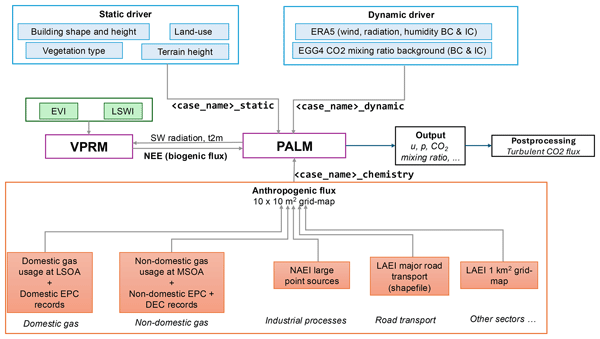
- Table 2: Consider organizing it into sections corresponding to each stage of the model workflow, as presented in Figure 1.
- Section 3.5.2: Were alternative datasets tested for initial and boundary conditions? If so, explain why the EGG4 product was selected.
- Line 335: Again, the terminology referring to anthropogenic emissions and biogenic fluxes is unclear. Please revise for consistency.
- In Section 4.1, the model performance is evaluated only qualitatively through figures. No statistical metrics are presented. The authors should include quantitative evaluation (e.g., RMSE, bias, correlation).
Additionally: - The manuscript claims anthropogenic contributions, but was there a clear separation between anthropogenic and biogenic components?
- If so, include this analysis to quantify their respective contributions.
- Lines 380–390: The authors do not report actual flux values nor compare results with previous studies. Given the scarcity of observations, such comparisons are essential for validation.
Please: - Include quantitative values.
- Compare with existing literature.
- Add a figure showing the diurnal cycle of simulated surface CO2 concentrations to complement the ABL analysis.
- Lines 436–438: The manuscript states that “the model is validated against eddy-covariance flux and wind measurements from multiple sites.” However, it appears validation was conducted for only one site. Please clarify.
Furthermore, no statistical analysis is presented to support the claim of “good agreement,” which is also stated in the conclusions.
Technical Corrections
- Line 22: “uptake” instead of “update”.
- Line 32: “by” instead of “bay”.
- Line 58: Consider “land and vegetation types” instead of “land types and vegetation”.
- Line 63: “…air pollution studies…”, add appropriate citations.
- Line 75: Replace “external forcing” with “external inputs”.
- Figure 1: Improve legend clarity.
- Figure 2: Improve figure and caption quality.
- Figures 5 and 6: Split into panels (A, B, C, D) and describe each in the caption.
- Figure 10: Clearly indicate the locations of the regions used in the cross-section within the domain.
Citation: https://doi.org/10.5194/egusphere-2026-970-RC2 - AC2: 'Reply on RC2', Linfeng Li, 16 Jun 2026
Peer review completion


Interactive discussion
Status: closed
-
RC1: 'Comment on egusphere-2026-970', Anonymous Referee #1, 07 Apr 2026
General comment:
Thank you to the authors for this important work. The implementation of a model of biogenic fluxes in PALM is truly of high value as it opens the possibility for a lot of interesting LES studies that would not be possible without. The additional inclusion of anthropogenic fluxes based on inventories enables the application to urban areas. The implementation itself seems physically consistent and user-friendly as the application is well-designed and can be easily adapted for use in other studies, depending on data availability. The PALM is a free open-source model and the code extension for PALM-CO2 is published on Zenodo so that everyone can access it.
Overall, the manuscript is well structured and easy to follow. However, I’m missing a subchapter on the measurements used for validation in the methods section and the results and discussion section could be a little bit more detailed. There is still significant room for improvement in the validation. I do not find the choice of station for validating biogenic fluxes in the urban LES to be particularly well-suited; however, the authors have made an effort to improve comparability by analyzing the input variables. Nevertheless, the comparison is rather qualitative and a more detailed statistical analysis would be desirable. Furthermore, I think the use ensemble simulations would enhance the quality of the validation and I would like to see a more critical examination of the grid spacing used.
All in all, I strongly support the publication of this manuscript! I hope my comments will help improve it, and I wish the authors every success in revising the manuscript.
Specific comments:
Line 2-3: It says here that the model produces anthropogenic and biogenic carbon emissions and is based on a biogenic carbon emission module (VPRM). This leaves me wondering how anthropogenic carbon emissions were included.
Line 5-7: Was a grid sensitivity study performed to show that a 10 m resolution is sufficient? I wonder if it actually is, as 10 m does not resolve trees or even smaller vegetation, and also street canyons and buildings are probably also not fully resolved (Camden has a lot of small streets with 2-storey houses that are not even 10 m tall).
Line 11: “building-induced turbulence”: I assumed this sentence refers to the forest simulations in Czech Republic. Were there buildings in that forest? Or is this the conclusion for both validation cases? Was the resolution of the Czech forest simulation fine enough to resolve building-induced turbulence?
Line 75-82: If I understand correctly, the anthropogenic fluxes are included as prescribed fluxes based on emission inventories. How is this method different from / does it overcome the problems highlighted in lines 34 to 41? Is the novelty concerning anthropogenic carbon fluxes mainly combining those inventories with a high-resolution LES? It could be briefly highlighted here what the novelty is. I believe including spatially and temporally resolved scalar surface fluxes is something that is not possible by default in PALM. This is worth mentioning here.
Line 121/Figure 1: Is the anthropogenic flux prescribed at the surface or also within the boundary layer? Also, is it an extra input file? Why is it not added to the dynamic driver?
Line 123-125: Could you please include the equations for P_scale and W_scale?
Line 147: Equation 9, claims that spatially filtered quantities are identical with quantities at infinitely small points in space. I think this assumption may be true in certain cases, depending on the time interval for averaging and grid spacing, but it is not generally the case. Please include the information under which circumstances this assumption holds.
Line 149-152: I appreciate the effort, but isn’t that the same as ws_product_av in the default PALM 3D output quantities?
Line 179-181: Does the VPRM also consider water availability (soil moisture relative to soil characteristics such as wilting point) and VPD? In line 125, it says that W_scale accounts for the water content in vegetation. Is this coupled with the soil moisture development in PALM or does it rely solely on input data? Considering Figure 1, I assume the latter is true. In that case, where would one get the necessary information on a sufficient temporal and spatial resolution?
Line 225: Which are the sectors that contribute to less than 10% of the emissions? Isn’t it possible that those contributions are small because they are only very local/short term?
Line 225-231: Is the 10% threshold applied to the sectors or sub-sectors? This is not fully clear in lines 225-228, please specify.
Line 239: Here, it says “sectors” again, but I assume it refers to the sub-sectors mentioned earlier. Please use the words “sectors” and “sub-sectors” consistently throughout the manuscript to avoid confusion.
Line 279: Is this supposed to be 10% (because it says similarly as in spatial disaggregation) or is the threshold different from the spatial disaggregation? Why was a different threshold chosen here?
Line 283-291: I believe this approach is acceptable for the phenology, but water stress is much more variable in time. One possibility to overcome the lack of high temporal resolution data would be to couple the VPRM also with the soil moisture water vapor mixing ratio (to calculate VPD) in PALM and not only with radiation and air temperature. Have you considered that?
Line 299-300: Please see my comment on line149-152.
Line 305: It would also be possible to prescribe leaf area density and thus resolve the canopy (at least trees). Of course, with a resolution of 10 m^3, this is not possible. However, as pointed out in my comment on line 5-7, I wonder whether the resolution in this study is sufficient to resolve urban flow structures, as trees and buildings (at least in some areas) are not properly resolved. Why was this resolution chosen? Was a sensitivity study performed?
Line 342-349: this part belongs in the methods section. A short sub-section on the EC measurements could be included in chapter 3. It should also include a short description of the station location and its surroundings. What types of buildings/parks/roads are within the footprint of the station? How tall is the tower in comparison to the buildings in the area? The location of the EC station could also be marked in Figure 2b.
Line 350-366: The analysis of CO2 fluxes and wind speed is limited to four days, only, but simulations were performed for each month. Were the results of the other 8 days similar or different? Why weren’t they included in the plots (or at least similar plots in the appendix?). Also, have you performed some sort of statistical analysis, e.g., looked at the correlation between field measurements and LES output across all simulated days?
Line 356-358: Why are you so sure that this discrepancy is due to the observation data (=EC measurements?) and not because of the LES? To my understanding, it could also be that this day in reality was different from the average day and the temporal disaggregation of the LES input data doesn’t capture this variability, in which case it would be a limitation of the approach. Carefully checking the quality of the EC measurements on that day and also checking how well the meteorological conditions of that day match between field measurements and LES could provide more insight here. It could also be, e.g., a mismatch of footprints due to non-matching wind directions or so. Also, domestic gas consumption is the largest contributor to CO2 emissions according to figure 4. Shouldn’t the CO2 emissions be lower in summer due to reduced heating demand? The CO2 fluxes produced by the LES are higher in July than in January or October.
Figure 5: I have multiple questions/comments on how the data for this figure was processed. It may be good to have a sub-chapter in the methods section on the post-processing of LES and EC data and the validation approach. (1) How was the moving mean calculated from PALM, if only the 30-min averaged values of CO2 and w were output? (2) Did you have the high-resolution data from the EC station to calculate the running mean for the measurements? (3) Is the LES data extracted from one grid box in the same location as the EC station in the field? (4) This is the most important one: the figure shows one realization of each day from the measurements and one realization of the day from the LES. For the measurements, this is obvious, it’s simply how these particular days developed. However, turbulence is chaotic in nature and even a slight change to the environment or initial conditions can change the outcome severely. It is impossible to precisely reproduce the exact same day, so it cannot be expected that the LES and field observations match perfectly. However, performing ensemble simulations with slightly changed turbulence using different random numbers provides multiple realizations in the LES. This can result in a better understanding of what range of values may result from the LES and whether the field measurements fall within that range. Performing ensemble simulations for the validations would strongly improve the quality of this manuscript.
Line 361-366: To validate the overall comparability of the simulation and the real situation, more variables could be considered in addition to wind speed. E.g., wind direction, temperature, humidity.
Line 367ff: If I understand it correctly, the carbon fluxes from Regent Park forest areas (LES) are compared to field measurements from a forest site in Czech Republic. I think this approach is questionable and not described in enough detail. Why was this station (CZ-Lnz) chosen for comparison? Why is it expected that forests in a London park behave similar to a forest in Czech Republic? Those questions should be answered in the methods section. CZ-Lnz is installed in a floodplain forest in a rural area in south-eastern Czech Republic. London has an oceanic climate with roughly 700 mm annual precipitation and an average temperature of roughly 11 °C. According to the ICOS website, CZ-Lnz has an annual precipitation of 520 mm and average temperature of 10 °C, and it has a continental climate with much lower winter temperatures and higher summer temperatures and also a different precipitation distribution. The soil is likely also very different. I wouldn’t consider this a benchmark for an urban biogenic CO2 flux model in London. Even though it requires more computational resources, I think it is necessary to perform an extra set of LES for a vegetated site where measurements are available. It would not be necessary for this to be an urban site.
Line 374: To my knowledge, ICOS has 48 class 1 sites and a lot more class 2 and associated sites.
Line 274: I’m not sure what “situated in a naturally-surrounding town” means. It is clearly not located in a town, the distance to the next village is over 4 km.
Line 376-378: So here, the surface flux provided by the VPRM is compared to field measurements at a height of ca. 50 m? And also, one single day of LES is compared to a monthly average of field measurements? I think this makes the comparison even more difficult and it is is not considered in the discussion of results. Figure 7 could at least show a standard deviation or min/max values for the field measurements to give an idea of the variability within each month.
Line 386-391: I can follow the argumentation for the differences in spring. However, in autumn, the EVI in Camden decreases but in August and September, it is still higher than at Cz-Lnz, so how does this explain the smaller carbon uptake?
Line 393: Does this show LES output? Please specify here and in the description of Figure 9.
Line 393ff: This section discusses the results in the context of the ABL height. However, ABL height is not characterized at all. Also, in line 400ff, the influence of strong/weak turbulence is discussed. However, this is not quantified, either. Instead, three instantaneous snapshots for two days in January and July are considered and described qualitatively. Please provide the ABL height and a measure of stability (i.e., Obukhov length L or z/L) for these selected situations to show what situations are truly reflected by those snap shots.
Line 408-410: While describing Figure 10, ABL heights are given as “high” and “low”. However, it is not possible to see this in Figure 10. It could by shown by including a line in each subplot and as pointed out in the previous comment, (e.g., spatially averaged +- standard deviation) ABL heights for each snap shot should be provided. Also, it says that “in general, during morning and night, the boundary layer is shallow, trapping CO2 below approximately 300-400 m” while the ABL height is likely much lower in January than in July.
Line 418: I’ve mentioned it before, but I still want to highlight it once more: I think this is not a fine-scale modelling of the urban topography, as a lot of buildings and street canyons in the domain cannot be resolved with this resolution and there have been urban PALM simulations with a much higher resolution of 1 m^3.
Line 419: Despite the previous comment, I fully agree with the authors that fine-resolution models for simulating CO2 transport in urban areas is necessary and technically, the presented implementation in PALM is capable of this. So even if I am not fully convinced by the resolution that was used in this study, the study certainly provides a proof of concept and promising first test of the model. A higher resolution would not change the boundary information provided by the VPRM and the downscaling of anthropogenic fluxes that are prescribed. It would, however, resolve turbulent transport within the complex urban canopy.
Line 420: Could you please repeat the argument of Brunner et al. (2019) here?
Line 421: To be precise, PALM is not an urban LES code, but an LES code for all kinds of applications, not only urban simulations. And as far as I understand, PALM-CO2 could also be applied outside of urban areas by setting the anthropogenic CO2 fluxes to zero and only applying the VPRM. If that is the case, I would drop the limitation to urban areas and instead mention the variety of applications for this approach. While the possibility to include anthropogenic fluxes is of course necessary and therefore highly valuable for urban simulations, it’s not limited to those. It has a great potential!
Line 447-448: Since the idea PALM-CO2 is to provide a model that can resolve the urban distribution of CO2 (fluxes), it would improve the quality of the manuscript to show that this truly works. Yes, Figures 9 and 10 show a very inhomogeneous distribution of CO2 that seems reasonable, but in order to estimate how well the model performs, wouldn’t it be necessary to compare at least the CO2 concentrations to measurements at multiple sites within the domain that have different characteristics and expected CO2 concentrations?
Technical corrections:
Line 17: “the carbon cycle”
Line 19: “the global carbon cycle”
Line 22: “uptake” instead of “update”? (2x!)
Line 26: “the urban environment” or “urban environments”
Line 27: “the energy sector produces”
Line 37: “fine scale emission maps”
Line 117: “the WRF-Chem module”
Line 132: T_air is not used in equations 3 or 4. I assume this refers to T in equations 3 and 4. Please standardize.
Line 142,151: T is here used here and in equation 7 as the time window for averaging but was used in line 127 and equations 3 and 4 as air temperature. Please make sure not to use every symbol only once. Even if T_air was used for air temperature, I think using T for something else is not ideal as T clearly refers to temperature and the subscript only further specifies it.
Line 211: “the London case study”
Figure 2: I think it would be easier to see the domains in both subplots if the lines were different from the coordinate grids (different color or thicker lines).
Line 223: “comprehensive” instead of “comprehend”?
Line 244, 256,257: the abbreviations LSOA and MSOA are reintroduced here, which is unnecessary as they were introduced in line 240 already.
Line 275: “a waster water processing factory” or “waster water processing factories”?
Line 314: “we activated the following surface modules. An urban surface module” (otherwise, urban surface module is a sub-category of urban surface modules)
Line 319: “the ECMWF reanalysis dataset”
Line 406: “vertical cross-section”
Line 407: “ABL height/structure/characteristics”?
Figure 10: The panels and all labels are very small. Stacking all panels vertically (1 column, 6 rows) would improve this.
Line 440: remove “shows”
Citation: https://doi.org/10.5194/egusphere-2026-970-RC1 - AC1: 'Reply on RC1', Linfeng Li, 16 Jun 2026
-
RC2: 'Comment on egusphere-2026-970', Anonymous Referee #2, 02 May 2026
General Comments
This paper by Li et al., titled “PALM-CO2 (v01): A High-Resolution Urban CO₂ Transport Model with Anthropogenic and Biogenic Fluxes,” addresses a highly relevant and timely topic. High-resolution simulations are essential for improving our understanding of complex and heterogeneous urban environments, where spatial variability in emissions and processes plays a crucial role.
However, several important aspects need improvement before the manuscript can be considered for publication. In particular, some key information is missing, and the authors often make statements without supporting statistical analyses, relying solely on qualitative interpretation of figures. The quality and clarity of several figures should also be improved. Additionally, the manuscript contains typos and lacks sufficient bibliographic references in multiple sections, which weakens the scientific rigor of the work.
Overall, I support the publication of this manuscript, provided that the authors address the points raised below through a thorough revision.
Specific Comments
- I recommend standardizing the terminology used throughout the manuscript when referring to anthropogenic emissions and biogenic fluxes. Avoid using the term emissions when referring to biogenic processes; use fluxes consistently for clarity.
- Line 3: The sentence “…a biogenic carbon emissions module (VPRM) and customised output modules for carbon fluxes…” is confusing. The description should clarify that the biogenic flux module (VPRM) is implemented online, while anthropogenic emissions are prescribed as customized inputs.
- The authors make several assertions without supporting references (e.g., Lines 16, 42, 63). Please include appropriate citations.
- Section 2.2 would be better titled “Biogenic Fluxes Model” rather than “Biogenic Emission Model,”.
- In this section, the authors should:
- Include and explain the equations for Wscale and Pscale.
- Provide a table summarizing the VPRM input parameters for each vegetation type used in the domain.
- Include the temperature parameters used for photosynthesis (Tmin, Topt, Tmax).
- Section 2.4 describes the methodology for disaggregating anthropogenic emissions. Was this approach based on previous studies or established methodologies? If so, please cite them.
- Line 179: Provide a clearer link or reference back to the section where the VPRM model is described.
- Figure 2: Improve the resolution and overall clarity. The figure should be more informative and include the locations of observational sites used for model validation.
- Figure 3: Improve resolution and include the location of the eddy covariance tower used to validate CO2 fluxes and wind.
- Figure 4: Use a color scheme that makes different sectors easier to distinguish.
- Table 2: Consider organizing it into sections corresponding to each stage of the model workflow, as presented in Figure 1.
- Section 3.5.2: Were alternative datasets tested for initial and boundary conditions? If so, explain why the EGG4 product was selected.
- Line 335: Again, the terminology referring to anthropogenic emissions and biogenic fluxes is unclear. Please revise for consistency.
- In Section 4.1, the model performance is evaluated only qualitatively through figures. No statistical metrics are presented. The authors should include quantitative evaluation (e.g., RMSE, bias, correlation).
Additionally: - The manuscript claims anthropogenic contributions, but was there a clear separation between anthropogenic and biogenic components?
- If so, include this analysis to quantify their respective contributions.
- Lines 380–390: The authors do not report actual flux values nor compare results with previous studies. Given the scarcity of observations, such comparisons are essential for validation.
Please: - Include quantitative values.
- Compare with existing literature.
- Add a figure showing the diurnal cycle of simulated surface CO2 concentrations to complement the ABL analysis.
- Lines 436–438: The manuscript states that “the model is validated against eddy-covariance flux and wind measurements from multiple sites.” However, it appears validation was conducted for only one site. Please clarify.
Furthermore, no statistical analysis is presented to support the claim of “good agreement,” which is also stated in the conclusions.
Technical Corrections
- Line 22: “uptake” instead of “update”.
- Line 32: “by” instead of “bay”.
- Line 58: Consider “land and vegetation types” instead of “land types and vegetation”.
- Line 63: “…air pollution studies…”, add appropriate citations.
- Line 75: Replace “external forcing” with “external inputs”.
- Figure 1: Improve legend clarity.
- Figure 2: Improve figure and caption quality.
- Figures 5 and 6: Split into panels (A, B, C, D) and describe each in the caption.
- Figure 10: Clearly indicate the locations of the regions used in the cross-section within the domain.
Citation: https://doi.org/10.5194/egusphere-2026-970-RC2 - AC2: 'Reply on RC2', Linfeng Li, 16 Jun 2026
Peer review completion
Journal article(s) based on this preprint
Viewed
| HTML | XML | Total | BibTeX | EndNote | |
|---|---|---|---|---|---|
| 928 | 417 | 74 | 1,419 | 64 | 99 |
- HTML: 928
- PDF: 417
- XML: 74
- Total: 1,419
- BibTeX: 64
- EndNote: 99
Viewed (geographical distribution)
| Country | # | Views | % |
|---|
| Total: | 0 |
| HTML: | 0 |
| PDF: | 0 |
| XML: | 0 |
- 1

Jie Zheng
Fangxin Fang
The requested preprint has a corresponding peer-reviewed final revised paper. You are encouraged to refer to the final revised version.
- Preprint
(4551 KB) - Metadata XML
General comment:
Thank you to the authors for this important work. The implementation of a model of biogenic fluxes in PALM is truly of high value as it opens the possibility for a lot of interesting LES studies that would not be possible without. The additional inclusion of anthropogenic fluxes based on inventories enables the application to urban areas. The implementation itself seems physically consistent and user-friendly as the application is well-designed and can be easily adapted for use in other studies, depending on data availability. The PALM is a free open-source model and the code extension for PALM-CO2 is published on Zenodo so that everyone can access it.
Overall, the manuscript is well structured and easy to follow. However, I’m missing a subchapter on the measurements used for validation in the methods section and the results and discussion section could be a little bit more detailed. There is still significant room for improvement in the validation. I do not find the choice of station for validating biogenic fluxes in the urban LES to be particularly well-suited; however, the authors have made an effort to improve comparability by analyzing the input variables. Nevertheless, the comparison is rather qualitative and a more detailed statistical analysis would be desirable. Furthermore, I think the use ensemble simulations would enhance the quality of the validation and I would like to see a more critical examination of the grid spacing used.
All in all, I strongly support the publication of this manuscript! I hope my comments will help improve it, and I wish the authors every success in revising the manuscript.
Specific comments:
Line 2-3: It says here that the model produces anthropogenic and biogenic carbon emissions and is based on a biogenic carbon emission module (VPRM). This leaves me wondering how anthropogenic carbon emissions were included.
Line 5-7: Was a grid sensitivity study performed to show that a 10 m resolution is sufficient? I wonder if it actually is, as 10 m does not resolve trees or even smaller vegetation, and also street canyons and buildings are probably also not fully resolved (Camden has a lot of small streets with 2-storey houses that are not even 10 m tall).
Line 11: “building-induced turbulence”: I assumed this sentence refers to the forest simulations in Czech Republic. Were there buildings in that forest? Or is this the conclusion for both validation cases? Was the resolution of the Czech forest simulation fine enough to resolve building-induced turbulence?
Line 75-82: If I understand correctly, the anthropogenic fluxes are included as prescribed fluxes based on emission inventories. How is this method different from / does it overcome the problems highlighted in lines 34 to 41? Is the novelty concerning anthropogenic carbon fluxes mainly combining those inventories with a high-resolution LES? It could be briefly highlighted here what the novelty is. I believe including spatially and temporally resolved scalar surface fluxes is something that is not possible by default in PALM. This is worth mentioning here.
Line 121/Figure 1: Is the anthropogenic flux prescribed at the surface or also within the boundary layer? Also, is it an extra input file? Why is it not added to the dynamic driver?
Line 123-125: Could you please include the equations for P_scale and W_scale?
Line 147: Equation 9, claims that spatially filtered quantities are identical with quantities at infinitely small points in space. I think this assumption may be true in certain cases, depending on the time interval for averaging and grid spacing, but it is not generally the case. Please include the information under which circumstances this assumption holds.
Line 149-152: I appreciate the effort, but isn’t that the same as ws_product_av in the default PALM 3D output quantities?
Line 179-181: Does the VPRM also consider water availability (soil moisture relative to soil characteristics such as wilting point) and VPD? In line 125, it says that W_scale accounts for the water content in vegetation. Is this coupled with the soil moisture development in PALM or does it rely solely on input data? Considering Figure 1, I assume the latter is true. In that case, where would one get the necessary information on a sufficient temporal and spatial resolution?
Line 225: Which are the sectors that contribute to less than 10% of the emissions? Isn’t it possible that those contributions are small because they are only very local/short term?
Line 225-231: Is the 10% threshold applied to the sectors or sub-sectors? This is not fully clear in lines 225-228, please specify.
Line 239: Here, it says “sectors” again, but I assume it refers to the sub-sectors mentioned earlier. Please use the words “sectors” and “sub-sectors” consistently throughout the manuscript to avoid confusion.
Line 279: Is this supposed to be 10% (because it says similarly as in spatial disaggregation) or is the threshold different from the spatial disaggregation? Why was a different threshold chosen here?
Line 283-291: I believe this approach is acceptable for the phenology, but water stress is much more variable in time. One possibility to overcome the lack of high temporal resolution data would be to couple the VPRM also with the soil moisture water vapor mixing ratio (to calculate VPD) in PALM and not only with radiation and air temperature. Have you considered that?
Line 299-300: Please see my comment on line149-152.
Line 305: It would also be possible to prescribe leaf area density and thus resolve the canopy (at least trees). Of course, with a resolution of 10 m^3, this is not possible. However, as pointed out in my comment on line 5-7, I wonder whether the resolution in this study is sufficient to resolve urban flow structures, as trees and buildings (at least in some areas) are not properly resolved. Why was this resolution chosen? Was a sensitivity study performed?
Line 342-349: this part belongs in the methods section. A short sub-section on the EC measurements could be included in chapter 3. It should also include a short description of the station location and its surroundings. What types of buildings/parks/roads are within the footprint of the station? How tall is the tower in comparison to the buildings in the area? The location of the EC station could also be marked in Figure 2b.
Line 350-366: The analysis of CO2 fluxes and wind speed is limited to four days, only, but simulations were performed for each month. Were the results of the other 8 days similar or different? Why weren’t they included in the plots (or at least similar plots in the appendix?). Also, have you performed some sort of statistical analysis, e.g., looked at the correlation between field measurements and LES output across all simulated days?
Line 356-358: Why are you so sure that this discrepancy is due to the observation data (=EC measurements?) and not because of the LES? To my understanding, it could also be that this day in reality was different from the average day and the temporal disaggregation of the LES input data doesn’t capture this variability, in which case it would be a limitation of the approach. Carefully checking the quality of the EC measurements on that day and also checking how well the meteorological conditions of that day match between field measurements and LES could provide more insight here. It could also be, e.g., a mismatch of footprints due to non-matching wind directions or so. Also, domestic gas consumption is the largest contributor to CO2 emissions according to figure 4. Shouldn’t the CO2 emissions be lower in summer due to reduced heating demand? The CO2 fluxes produced by the LES are higher in July than in January or October.
Figure 5: I have multiple questions/comments on how the data for this figure was processed. It may be good to have a sub-chapter in the methods section on the post-processing of LES and EC data and the validation approach. (1) How was the moving mean calculated from PALM, if only the 30-min averaged values of CO2 and w were output? (2) Did you have the high-resolution data from the EC station to calculate the running mean for the measurements? (3) Is the LES data extracted from one grid box in the same location as the EC station in the field? (4) This is the most important one: the figure shows one realization of each day from the measurements and one realization of the day from the LES. For the measurements, this is obvious, it’s simply how these particular days developed. However, turbulence is chaotic in nature and even a slight change to the environment or initial conditions can change the outcome severely. It is impossible to precisely reproduce the exact same day, so it cannot be expected that the LES and field observations match perfectly. However, performing ensemble simulations with slightly changed turbulence using different random numbers provides multiple realizations in the LES. This can result in a better understanding of what range of values may result from the LES and whether the field measurements fall within that range. Performing ensemble simulations for the validations would strongly improve the quality of this manuscript.
Line 361-366: To validate the overall comparability of the simulation and the real situation, more variables could be considered in addition to wind speed. E.g., wind direction, temperature, humidity.
Line 367ff: If I understand it correctly, the carbon fluxes from Regent Park forest areas (LES) are compared to field measurements from a forest site in Czech Republic. I think this approach is questionable and not described in enough detail. Why was this station (CZ-Lnz) chosen for comparison? Why is it expected that forests in a London park behave similar to a forest in Czech Republic? Those questions should be answered in the methods section. CZ-Lnz is installed in a floodplain forest in a rural area in south-eastern Czech Republic. London has an oceanic climate with roughly 700 mm annual precipitation and an average temperature of roughly 11 °C. According to the ICOS website, CZ-Lnz has an annual precipitation of 520 mm and average temperature of 10 °C, and it has a continental climate with much lower winter temperatures and higher summer temperatures and also a different precipitation distribution. The soil is likely also very different. I wouldn’t consider this a benchmark for an urban biogenic CO2 flux model in London. Even though it requires more computational resources, I think it is necessary to perform an extra set of LES for a vegetated site where measurements are available. It would not be necessary for this to be an urban site.
Line 374: To my knowledge, ICOS has 48 class 1 sites and a lot more class 2 and associated sites.
Line 274: I’m not sure what “situated in a naturally-surrounding town” means. It is clearly not located in a town, the distance to the next village is over 4 km.
Line 376-378: So here, the surface flux provided by the VPRM is compared to field measurements at a height of ca. 50 m? And also, one single day of LES is compared to a monthly average of field measurements? I think this makes the comparison even more difficult and it is is not considered in the discussion of results. Figure 7 could at least show a standard deviation or min/max values for the field measurements to give an idea of the variability within each month.
Line 386-391: I can follow the argumentation for the differences in spring. However, in autumn, the EVI in Camden decreases but in August and September, it is still higher than at Cz-Lnz, so how does this explain the smaller carbon uptake?
Line 393: Does this show LES output? Please specify here and in the description of Figure 9.
Line 393ff: This section discusses the results in the context of the ABL height. However, ABL height is not characterized at all. Also, in line 400ff, the influence of strong/weak turbulence is discussed. However, this is not quantified, either. Instead, three instantaneous snapshots for two days in January and July are considered and described qualitatively. Please provide the ABL height and a measure of stability (i.e., Obukhov length L or z/L) for these selected situations to show what situations are truly reflected by those snap shots.
Line 408-410: While describing Figure 10, ABL heights are given as “high” and “low”. However, it is not possible to see this in Figure 10. It could by shown by including a line in each subplot and as pointed out in the previous comment, (e.g., spatially averaged +- standard deviation) ABL heights for each snap shot should be provided. Also, it says that “in general, during morning and night, the boundary layer is shallow, trapping CO2 below approximately 300-400 m” while the ABL height is likely much lower in January than in July.
Line 418: I’ve mentioned it before, but I still want to highlight it once more: I think this is not a fine-scale modelling of the urban topography, as a lot of buildings and street canyons in the domain cannot be resolved with this resolution and there have been urban PALM simulations with a much higher resolution of 1 m^3.
Line 419: Despite the previous comment, I fully agree with the authors that fine-resolution models for simulating CO2 transport in urban areas is necessary and technically, the presented implementation in PALM is capable of this. So even if I am not fully convinced by the resolution that was used in this study, the study certainly provides a proof of concept and promising first test of the model. A higher resolution would not change the boundary information provided by the VPRM and the downscaling of anthropogenic fluxes that are prescribed. It would, however, resolve turbulent transport within the complex urban canopy.
Line 420: Could you please repeat the argument of Brunner et al. (2019) here?
Line 421: To be precise, PALM is not an urban LES code, but an LES code for all kinds of applications, not only urban simulations. And as far as I understand, PALM-CO2 could also be applied outside of urban areas by setting the anthropogenic CO2 fluxes to zero and only applying the VPRM. If that is the case, I would drop the limitation to urban areas and instead mention the variety of applications for this approach. While the possibility to include anthropogenic fluxes is of course necessary and therefore highly valuable for urban simulations, it’s not limited to those. It has a great potential!
Line 447-448: Since the idea PALM-CO2 is to provide a model that can resolve the urban distribution of CO2 (fluxes), it would improve the quality of the manuscript to show that this truly works. Yes, Figures 9 and 10 show a very inhomogeneous distribution of CO2 that seems reasonable, but in order to estimate how well the model performs, wouldn’t it be necessary to compare at least the CO2 concentrations to measurements at multiple sites within the domain that have different characteristics and expected CO2 concentrations?
Technical corrections:
Line 17: “the carbon cycle”
Line 19: “the global carbon cycle”
Line 22: “uptake” instead of “update”? (2x!)
Line 26: “the urban environment” or “urban environments”
Line 27: “the energy sector produces”
Line 37: “fine scale emission maps”
Line 117: “the WRF-Chem module”
Line 132: T_air is not used in equations 3 or 4. I assume this refers to T in equations 3 and 4. Please standardize.
Line 142,151: T is here used here and in equation 7 as the time window for averaging but was used in line 127 and equations 3 and 4 as air temperature. Please make sure not to use every symbol only once. Even if T_air was used for air temperature, I think using T for something else is not ideal as T clearly refers to temperature and the subscript only further specifies it.
Line 211: “the London case study”
Figure 2: I think it would be easier to see the domains in both subplots if the lines were different from the coordinate grids (different color or thicker lines).
Line 223: “comprehensive” instead of “comprehend”?
Line 244, 256,257: the abbreviations LSOA and MSOA are reintroduced here, which is unnecessary as they were introduced in line 240 already.
Line 275: “a waster water processing factory” or “waster water processing factories”?
Line 314: “we activated the following surface modules. An urban surface module” (otherwise, urban surface module is a sub-category of urban surface modules)
Line 319: “the ECMWF reanalysis dataset”
Line 406: “vertical cross-section”
Line 407: “ABL height/structure/characteristics”?
Figure 10: The panels and all labels are very small. Stacking all panels vertically (1 column, 6 rows) would improve this.
Line 440: remove “shows”