
the Creative Commons Attribution 4.0 License.
the Creative Commons Attribution 4.0 License.
 | 10 Apr 2026
Representation of the nitrogen cycle and its coupling with the carbon cycle in ISBA (SURFEX v9) the land surface model: evaluation using two Free-Air CO2 Enrichment experiment sites
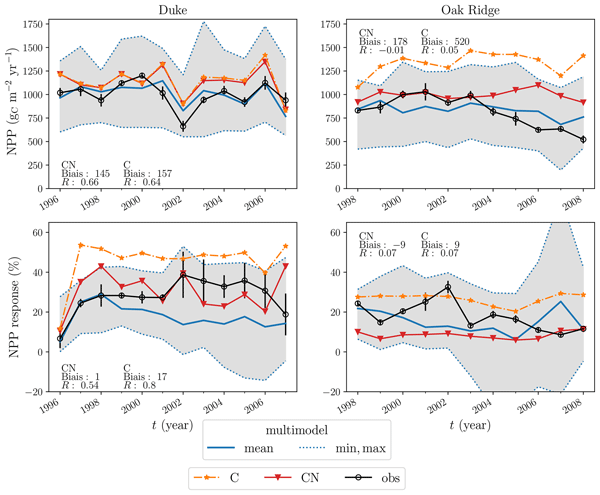
Abstract. Nitrogen (N) is a critical nutrient, that controls photosynthesis and decomposition processes. It is important to include the N cycle in the land component of climate models to improve the exchange fluxes of CO2 between land and atmosphere. We present here the implementation of the N cycle in the CNRM land surface model, namely ISBA. We evaluate the model on two Free-Air Enrichment (FACE), experiments sites: Duke and Oak Ridge. In particular, the response to elevated CO2 is studied. We compare the reference version without the N cycle (C) and the new version in which it is included (CN). A comparison to a multi model analysis shows encouraging results, since the computed NPP and N assimilation flux fall in the inter model range. The CN version performs better than the C version for NPP. Next, we focus on the carbon cycle by confronting simulation results to observations. The CN version improves the carbon stocks, largely overestimated by the C version. In particular, at elevated CO2, in the CN version, photosynthesis is downregulated by the N limitation. This yields a reduction of C accumulation in soil and biomass in comparison to the C version. In the literature, diverging strategies are observed to overcome N limitation. The model reproduces well the main features but fails to represent some sites characteristics. Finally, a detailed analysis of the simulated N dynamics is presented.
-
Notice on discussion status
The requested preprint has a corresponding peer-reviewed final revised paper. You are encouraged to refer to the final revised version.
-
Preprint
(1430 KB)
-
The requested preprint has a corresponding peer-reviewed final revised paper. You are encouraged to refer to the final revised version.
- Preprint
(1430 KB) - Metadata XML
- BibTeX
- EndNote
- Final revised paper


Journal article(s) based on this preprint
Interactive discussion
Status: closed
-
RC1: 'Comment on egusphere-2026-791', Anonymous Referee #1, 11 May 2026
- AC3: 'Reply on RC1', Jeanne Decayeux, 03 Jul 2026
-
RC2: 'Comment on egusphere-2026-791', Anonymous Referee #2, 15 May 2026
This manuscript presents a well-documented model; however, several aspects related to nitrogen cycling formulation and spin-up strategy require clarification to ensure reproducibility and consistency of model behavior.
Major comments:
Spin up
The equilibrium spin-up produces soil carbon stocks approximately five times larger than observations after more than 1000–2000 years of simulation. While the use of an observation-constrained initialization is reasonable, the large discrepancy between equilibrium and observed soil carbon raises concerns regarding model structure and/or parameterization, particularly in soil carbon turnover processes.
The modeled NPP is broadly consistent with observations in both spin-up approaches; therefore, the substantial overestimation of equilibrium soil carbon likely does not arise from carbon inputs. Instead, it suggests potential biases in decomposition rates, soil carbon residence times, or stabilization mechanisms. The current explanation based on similar NPP between the C and CN simulations mainly addresses nitrogen limitation but does not fully explain the unrealistic equilibrium soil carbon state.
Since the manuscript adopts an observation-constrained initialization instead of the equilibrium state, the authors should further clarify why the equilibrium solution is unrealistic and provide justification for the selected initialization strategy. In addition, showing the temporal evolution of soil carbon during the “real” spin-up period would help demonstrate whether the system exhibits any drift toward the higher equilibrium state over longer timescales.
BNF
It may be oversimplified to link biological nitrogen fixation (BNF) directly to NPP in a C–N model, given that BNF is the largest natural nitrogen source and can vary substantially across ecosystems. The model may produce overly positive feedback between CO₂ fertilization and nitrogen input. Recent models often use more mechanistic representations of BNF rather than simple NPP-based relationships (Kou‐Giesbrecht et al., 2022; Yuan et al.,2025). The authors are encouraged to expand the discussion on potential model improvements and the implications and limitations of using this simplified parameterization.
References:
Kou‐Giesbrecht, S., & Arora, V. K. (2022). Representing the Dynamic Response of Vegetation to Nitrogen Limitation via Biological Nitrogen Fixation in the CLASSIC Land Model. Global Biogeochemical Cycles, 36(6), e2022GB007341. https://doi.org/10.1029/2022GB007341
Yuan, Y., Zhuang, Q., Zhao, B., & Liu, L. (2025). Improving the quantification of global free-living and symbiotic nitrogen fixation in natural terrestrial ecosystems: present-day estimates and 21st century projections. Environmental Research Letters. https://doi.org/10.1088/1748-9326/ae198ce:
N deposition
What are the fractions of NH₄⁺ and NO₃⁻ in the N deposition? Please specify. The simulation period is 20 years, and the N deposition in Table 1 appears to use a fixed ratio. If time-series N deposition data were not used, consider adding a sensitivity analysis or discussion, as global time-series N deposition datasets are available.
Reference:
Ackerman, D., Millet, D.B. and Chen, X., 2019. Global estimates of inorganic nitrogen deposition across four decades. Global Biogeochemical Cycles, 33(1), pp.100-107.
Tian, H., Bian, Z., Shi, H., Qin, X., Pan, N., Lu, C., Pan, S., Tubiello, F. N., Chang, J., Conchedda, G., Liu, J., Mueller, N., Nishina, K., Xu, R., Yang, J., You, L., and Zhang, B.: History of anthropogenic Nitrogen inputs (HaNi) to the terrestrial biosphere: a 5 arcmin resolution annual dataset from 1860 to 2019, Earth Syst. Sci. Data, 14, 4551-4568, https://doi.org/10.5194/essd-14-4551-2022, 2022.
Comparison:
The evaluation of the newly implemented nitrogen cycle is limited, as the comparison with observations is restricted to N₂O emissions and nitrate leaching at a single site and have difference in magnitude.
While the scarcity of site-level nitrogen observations is well known and represents a general limitation in evaluating land surface models, key fluxes such as N₂O emissions and biological nitrogen fixation have been synthesized in previous literature and modeling studies, and could be used as potential benchmarks for comparison.
Minor comments:
Line 78-80: Please list the names of those land models.
Line 184: I think it is inappropriate to state that denitrification occurs only under anaerobic conditions, as aerobic denitrification has also been reported. Please revise the description.
Line 210: The N₂O/N₂ product ratio of denitrification is variable and strongly regulated by environmental conditions such as oxygen availability, soil moisture, pH, carbon availability, and microbial community composition. It is acceptable if the study not focus on gas emission, but would be worth to discuss.
Figure 3: Miss the C real line.
Line 389: Did you perform any statistical significance tests, or is the conclusion based solely on visual comparison that the nitrogen cycle does not affect the results?
Table 7: Why is the simulated SOC approximately double the observed value if the spin-up was stopped once the model matched the observations?
Figure 8 and 9: Please specify what each line represents in description, as the abbreviations are difficult to read and interpret.
Table 8: Why the response of Duke is generally larger than Oak Ridge?
Line 444: The statement that leaf N/C ratio is “the only one flexible” is model-specific and should be clarified as a model assumption. Now it is implied as a general ecological characteristic.
Line 462: Why is mineralization at Oak Ridge relatively high during winter but not Duke?
Line 475: There are other environmental factors that influence BNF, not only N status; see the reference provided previously.
4.3 Modeled N dynamics: The nitrogen dynamics are shown in averaged seasonal variations. Could you also present the interannual variability over the simulation period (1996–2006)?
Citation: https://doi.org/10.5194/egusphere-2026-791-RC2 - AC2: 'Reply on RC2', Jeanne Decayeux, 03 Jul 2026
- AC1: 'Reply on RC1', Jeanne Decayeux, 03 Jul 2026
Peer review completion


Interactive discussion
Status: closed
-
RC1: 'Comment on egusphere-2026-791', Anonymous Referee #1, 11 May 2026
This paper describes the addition of a nitrogen cycle to ISBA land surface model. The authors show that the CN model improves agreement with observations from the FACE experiments at Oak Ridge and Duke. The paper is clear and concise, and could benefit from only a few minor clarifications:
* Fig 3: why does spinup protocol change CN results at Oak Ridge but not Duke?
* Line 118: where does the 90% limit come from?
* Line 142: is the model sensitive to these parameters?Typos / wording suggestions:
Line 8: “confronting” → “comparing”
Line 86: “Gazeous” → “Gaseous”
Line 148: “loss” → “lost"
Line 189: “do” → “does”
Line 404: “forest forest” → “forest floor”?
Line 460: “tight” → “tied”?Citation: https://doi.org/10.5194/egusphere-2026-791-RC1 - AC3: 'Reply on RC1', Jeanne Decayeux, 03 Jul 2026
-
RC2: 'Comment on egusphere-2026-791', Anonymous Referee #2, 15 May 2026
This manuscript presents a well-documented model; however, several aspects related to nitrogen cycling formulation and spin-up strategy require clarification to ensure reproducibility and consistency of model behavior.
Major comments:
Spin up
The equilibrium spin-up produces soil carbon stocks approximately five times larger than observations after more than 1000–2000 years of simulation. While the use of an observation-constrained initialization is reasonable, the large discrepancy between equilibrium and observed soil carbon raises concerns regarding model structure and/or parameterization, particularly in soil carbon turnover processes.
The modeled NPP is broadly consistent with observations in both spin-up approaches; therefore, the substantial overestimation of equilibrium soil carbon likely does not arise from carbon inputs. Instead, it suggests potential biases in decomposition rates, soil carbon residence times, or stabilization mechanisms. The current explanation based on similar NPP between the C and CN simulations mainly addresses nitrogen limitation but does not fully explain the unrealistic equilibrium soil carbon state.
Since the manuscript adopts an observation-constrained initialization instead of the equilibrium state, the authors should further clarify why the equilibrium solution is unrealistic and provide justification for the selected initialization strategy. In addition, showing the temporal evolution of soil carbon during the “real” spin-up period would help demonstrate whether the system exhibits any drift toward the higher equilibrium state over longer timescales.
BNF
It may be oversimplified to link biological nitrogen fixation (BNF) directly to NPP in a C–N model, given that BNF is the largest natural nitrogen source and can vary substantially across ecosystems. The model may produce overly positive feedback between CO₂ fertilization and nitrogen input. Recent models often use more mechanistic representations of BNF rather than simple NPP-based relationships (Kou‐Giesbrecht et al., 2022; Yuan et al.,2025). The authors are encouraged to expand the discussion on potential model improvements and the implications and limitations of using this simplified parameterization.
References:
Kou‐Giesbrecht, S., & Arora, V. K. (2022). Representing the Dynamic Response of Vegetation to Nitrogen Limitation via Biological Nitrogen Fixation in the CLASSIC Land Model. Global Biogeochemical Cycles, 36(6), e2022GB007341. https://doi.org/10.1029/2022GB007341
Yuan, Y., Zhuang, Q., Zhao, B., & Liu, L. (2025). Improving the quantification of global free-living and symbiotic nitrogen fixation in natural terrestrial ecosystems: present-day estimates and 21st century projections. Environmental Research Letters. https://doi.org/10.1088/1748-9326/ae198ce:
N deposition
What are the fractions of NH₄⁺ and NO₃⁻ in the N deposition? Please specify. The simulation period is 20 years, and the N deposition in Table 1 appears to use a fixed ratio. If time-series N deposition data were not used, consider adding a sensitivity analysis or discussion, as global time-series N deposition datasets are available.
Reference:
Ackerman, D., Millet, D.B. and Chen, X., 2019. Global estimates of inorganic nitrogen deposition across four decades. Global Biogeochemical Cycles, 33(1), pp.100-107.
Tian, H., Bian, Z., Shi, H., Qin, X., Pan, N., Lu, C., Pan, S., Tubiello, F. N., Chang, J., Conchedda, G., Liu, J., Mueller, N., Nishina, K., Xu, R., Yang, J., You, L., and Zhang, B.: History of anthropogenic Nitrogen inputs (HaNi) to the terrestrial biosphere: a 5 arcmin resolution annual dataset from 1860 to 2019, Earth Syst. Sci. Data, 14, 4551-4568, https://doi.org/10.5194/essd-14-4551-2022, 2022.
Comparison:
The evaluation of the newly implemented nitrogen cycle is limited, as the comparison with observations is restricted to N₂O emissions and nitrate leaching at a single site and have difference in magnitude.
While the scarcity of site-level nitrogen observations is well known and represents a general limitation in evaluating land surface models, key fluxes such as N₂O emissions and biological nitrogen fixation have been synthesized in previous literature and modeling studies, and could be used as potential benchmarks for comparison.
Minor comments:
Line 78-80: Please list the names of those land models.
Line 184: I think it is inappropriate to state that denitrification occurs only under anaerobic conditions, as aerobic denitrification has also been reported. Please revise the description.
Line 210: The N₂O/N₂ product ratio of denitrification is variable and strongly regulated by environmental conditions such as oxygen availability, soil moisture, pH, carbon availability, and microbial community composition. It is acceptable if the study not focus on gas emission, but would be worth to discuss.
Figure 3: Miss the C real line.
Line 389: Did you perform any statistical significance tests, or is the conclusion based solely on visual comparison that the nitrogen cycle does not affect the results?
Table 7: Why is the simulated SOC approximately double the observed value if the spin-up was stopped once the model matched the observations?
Figure 8 and 9: Please specify what each line represents in description, as the abbreviations are difficult to read and interpret.
Table 8: Why the response of Duke is generally larger than Oak Ridge?
Line 444: The statement that leaf N/C ratio is “the only one flexible” is model-specific and should be clarified as a model assumption. Now it is implied as a general ecological characteristic.
Line 462: Why is mineralization at Oak Ridge relatively high during winter but not Duke?
Line 475: There are other environmental factors that influence BNF, not only N status; see the reference provided previously.
4.3 Modeled N dynamics: The nitrogen dynamics are shown in averaged seasonal variations. Could you also present the interannual variability over the simulation period (1996–2006)?
Citation: https://doi.org/10.5194/egusphere-2026-791-RC2 - AC2: 'Reply on RC2', Jeanne Decayeux, 03 Jul 2026
- AC1: 'Reply on RC1', Jeanne Decayeux, 03 Jul 2026
Peer review completion
Journal article(s) based on this preprint
Data sets
Representation of the nitrogen cycle and its coupling with the carbon cycle in ISBA (SURFEX v9) the land surface model: evaluation using two Free-Air CO2 Enrichment experiment sites Jeanne Decayeux https://doi.org/10.5281/zenodo.18459080
Model code and software
model: evaluation using two Free-Air CO2 Enrichment experiment sites Jeanne Decayeux https://doi.org/10.5281/zenodo.18459080
Viewed
| HTML | XML | Total | BibTeX | EndNote | |
|---|---|---|---|---|---|
| 343 | 128 | 37 | 508 | 62 | 62 |
- HTML: 343
- PDF: 128
- XML: 37
- Total: 508
- BibTeX: 62
- EndNote: 62
Viewed (geographical distribution)
| Country | # | Views | % |
|---|
| Total: | 0 |
| HTML: | 0 |
| PDF: | 0 |
| XML: | 0 |
- 1
Jeanne Decayeux

Bertrand Decharme
Romain Darnajoux
Christine Delire
The requested preprint has a corresponding peer-reviewed final revised paper. You are encouraged to refer to the final revised version.
- Preprint
(1430 KB) - Metadata XML
This paper describes the addition of a nitrogen cycle to ISBA land surface model. The authors show that the CN model improves agreement with observations from the FACE experiments at Oak Ridge and Duke. The paper is clear and concise, and could benefit from only a few minor clarifications:
* Fig 3: why does spinup protocol change CN results at Oak Ridge but not Duke?
* Line 118: where does the 90% limit come from?
* Line 142: is the model sensitive to these parameters?
Typos / wording suggestions:
Line 8: “confronting” → “comparing”
Line 86: “Gazeous” → “Gaseous”
Line 148: “loss” → “lost"
Line 189: “do” → “does”
Line 404: “forest forest” → “forest floor”?
Line 460: “tight” → “tied”?