
the Creative Commons Attribution 4.0 License.
the Creative Commons Attribution 4.0 License.
 | 23 Feb 2026
On describing particle nucleation within the Volatility Basis Set
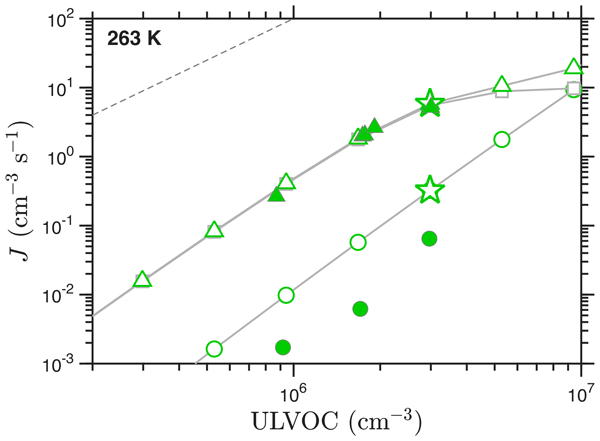
Abstract. We describe atmospheric particle nucleation within the Volatility Basis Set (VBS) by identifying nucleating vapors (“nucleators”) with sufficiently high saturation ratios to drive nucleation under either neutral (termed nLVOC) or ion induced (cLVOC) conditions. These vapors are a subset of Ultra Low Volatility Organic Compounds (ULVOCs, with a saturation mass concentration below 3×10⁻⁹ µg m–3), which mainly arise from the oxidation of monoterpenes and other volatile hydrocarbons in the atmosphere. We determine the effective nucleator concentrations via nucleation efficiencies based on critical saturation ratios for neutral and charged processes. We apply these efficiencies to the overall volatility (concentration) distribution. The nucleator concentrations thus depend on the overall yield and volatility distribution of ULVOC species, as well as ambient temperature. Using organic vapor volatility distributions for α-pinene ozonolysis measured in the CERN CLOUD chamber, we can reproduce the experimental neutral and ion-induced nucleation rates between 223 K and 298 K, over a wide range of ULVOC concentrations and nucleation rates, spanning typical atmospheric values. For this system of oxygenated organic molecules from α-pinene, two competing effects prevail. As temperature drops from 298 K, the slowing rate of autoxidation lowers the ULVOC yield and so initially reduces the nucleation rates. However, at about 263 K, the colder temperatures reduce the volatilities sufficiently for nucleation rates to reverse course and start to increase with further decrease in temperature. This effect is most pronounced for neutral nucleation. The CLOUD measurements show this behavior and are faithfully reproduced in the VBS nucleation model.
Competing interests: At least one of the (co-)authors is a member of the editorial board of Atmospheric Chemistry and Physics. The peer-review process was guided by an independent editor, and the authors also have no other competing interests to declare.
Publisher's note: Copernicus Publications remains neutral with regard to jurisdictional claims made in the text, published maps, institutional affiliations, or any other geographical representation in this paper. While Copernicus Publications makes every effort to include appropriate place names, the final responsibility lies with the authors. Views expressed in the text are those of the authors and do not necessarily reflect the views of the publisher.-
Notice on discussion status
The requested preprint has a corresponding peer-reviewed final revised paper. You are encouraged to refer to the final revised version.
-
Preprint
(1647 KB)
-
The requested preprint has a corresponding peer-reviewed final revised paper. You are encouraged to refer to the final revised version.
- Preprint
(1647 KB) - Metadata XML
- BibTeX
- EndNote
- Final revised paper


Journal article(s) based on this preprint
Interactive discussion
Status: closed
-
RC1: 'Comment on egusphere-2026-763', Anonymous Referee #1, 27 Mar 2026
Donahue et al. present a very interesting and detailed study on how nucleation can be described within the previously established volatility basis set (VBS). In a first part, the thermodynamic principles of nucleation are introduced alongside a description of the VBS and subsequently extended to the nucleation of organic vapors. In the second part, the application of the VBS to nucleation is discussed in a general manner and applied in the following to previously published results from chamber nucleation experiments. The paper is well-written and follows a clear flow and logic. The presented method allows a more detailed investigation of the contribution of organic vapors to nucleation and might have substantial impact in the field.
I have some minor comments and suggestion to consider prior to publication.
- Caption Figure 1. The two panels are described as ‘a)’ and ‘b)’ which is not detailed on the plots.
- l. 107 The term ‘aerosol-phase activity’ is used here to explain decreased tendency of organic vapors to condense on very small particles, but is not well defined in this context. As I understand the reduced interaction with the particle surface due to the contribution of the particle curvature is the reason for this tendency, I suggest a brief introduction of the activity term.
- l. 147 The temperature dependency is introduced very briefly here, although it is the basis for large sections of the conclusions in this paper. I understand that this was largely introduced in the cited studies, but I would suggest adding a few more points on the assumptions necessary and maybe limitations of this approach. This might help to judge the robustness of the derived conclusions.
- l. 152 Here, the authors link nucleation with the saturation ratio of a mixture based on the VBS. The assumption being, that the formation of a cluster is driven by volatility alone and detailed chemical structure is statistically similar enough across the mixture of vapors. In section 3.3, the authors introduce a gain to describe nucleation efficiency, motivating it in part with different functional groups and the resulting different bonding situation. Is the chemical nature of a mixture and its influence on nucleation something that could be parametrized using the approach presented in this manuscript if enough comparable experimental datasets would be available?
- l. 231 should read ‘sensitive to the chemical identity’
- l. 368 the minimum is could as well be outside this window, above 278 K or below 263 K, right?
- More to that point, the measurements seem to have large uncertainties. Did the authors attempt to apply the temperature dependence to estimate the nucleation rate from the chemical composition experiments at another temperature? I understand this might inflate the manuscript too much, but maybe an example case could help to understand how different the chemical composition actually contributes to the nucleation rate.
Citation: https://doi.org/10.5194/egusphere-2026-763-RC1 -
RC2: 'Comment on egusphere-2026-763', Anonymous Referee #2, 21 Apr 2026
The comment was uploaded in the form of a supplement: https://egusphere.copernicus.org/preprints/2026/egusphere-2026-763/egusphere-2026-763-RC2-supplement.pdf
-
AC1: 'Comment on egusphere-2026-763', Neil M. Donahue, 12 May 2026
The comment was uploaded in the form of a supplement: https://egusphere.copernicus.org/preprints/2026/egusphere-2026-763/egusphere-2026-763-AC1-supplement.pdf
Peer review completion


Post-review adjustments


Interactive discussion
Status: closed
-
RC1: 'Comment on egusphere-2026-763', Anonymous Referee #1, 27 Mar 2026
Donahue et al. present a very interesting and detailed study on how nucleation can be described within the previously established volatility basis set (VBS). In a first part, the thermodynamic principles of nucleation are introduced alongside a description of the VBS and subsequently extended to the nucleation of organic vapors. In the second part, the application of the VBS to nucleation is discussed in a general manner and applied in the following to previously published results from chamber nucleation experiments. The paper is well-written and follows a clear flow and logic. The presented method allows a more detailed investigation of the contribution of organic vapors to nucleation and might have substantial impact in the field.
I have some minor comments and suggestion to consider prior to publication.
- Caption Figure 1. The two panels are described as ‘a)’ and ‘b)’ which is not detailed on the plots.
- l. 107 The term ‘aerosol-phase activity’ is used here to explain decreased tendency of organic vapors to condense on very small particles, but is not well defined in this context. As I understand the reduced interaction with the particle surface due to the contribution of the particle curvature is the reason for this tendency, I suggest a brief introduction of the activity term.
- l. 147 The temperature dependency is introduced very briefly here, although it is the basis for large sections of the conclusions in this paper. I understand that this was largely introduced in the cited studies, but I would suggest adding a few more points on the assumptions necessary and maybe limitations of this approach. This might help to judge the robustness of the derived conclusions.
- l. 152 Here, the authors link nucleation with the saturation ratio of a mixture based on the VBS. The assumption being, that the formation of a cluster is driven by volatility alone and detailed chemical structure is statistically similar enough across the mixture of vapors. In section 3.3, the authors introduce a gain to describe nucleation efficiency, motivating it in part with different functional groups and the resulting different bonding situation. Is the chemical nature of a mixture and its influence on nucleation something that could be parametrized using the approach presented in this manuscript if enough comparable experimental datasets would be available?
- l. 231 should read ‘sensitive to the chemical identity’
- l. 368 the minimum is could as well be outside this window, above 278 K or below 263 K, right?
- More to that point, the measurements seem to have large uncertainties. Did the authors attempt to apply the temperature dependence to estimate the nucleation rate from the chemical composition experiments at another temperature? I understand this might inflate the manuscript too much, but maybe an example case could help to understand how different the chemical composition actually contributes to the nucleation rate.
Citation: https://doi.org/10.5194/egusphere-2026-763-RC1 -
RC2: 'Comment on egusphere-2026-763', Anonymous Referee #2, 21 Apr 2026
The comment was uploaded in the form of a supplement: https://egusphere.copernicus.org/preprints/2026/egusphere-2026-763/egusphere-2026-763-RC2-supplement.pdf
-
AC1: 'Comment on egusphere-2026-763', Neil M. Donahue, 12 May 2026
The comment was uploaded in the form of a supplement: https://egusphere.copernicus.org/preprints/2026/egusphere-2026-763/egusphere-2026-763-AC1-supplement.pdf
Peer review completion
Post-review adjustments
Journal article(s) based on this preprint
Viewed
| HTML | XML | Total | BibTeX | EndNote | |
|---|---|---|---|---|---|
| 1,406 | 909 | 113 | 2,428 | 144 | 164 |
- HTML: 1,406
- PDF: 909
- XML: 113
- Total: 2,428
- BibTeX: 144
- EndNote: 164
Viewed (geographical distribution)
| Country | # | Views | % |
|---|
| Total: | 0 |
| HTML: | 0 |
| PDF: | 0 |
| XML: | 0 |
- 1

Lubna Dada
Dominik Stolzenburg
Eva Sommer
Mario Simon
Meredith Schervish
Jenna DeVivo
Alexandra Stinchfield
Natalie Burton
Nirvan Bhattacharyya
Brandon Lopez
Mingyi Wang
Wiebke Scholz
Joao Almeida
Martin Heinritzi
Hamish Gordon
Armin Hansel
Joachim Curtius
Katrianne Lehtipalo
Imad El Haddad
Jasper Kirkby
Richard Flagan
Markku Kulmala
Douglas Worsnop
The requested preprint has a corresponding peer-reviewed final revised paper. You are encouraged to refer to the final revised version.
- Preprint
(1647 KB) - Metadata XML