
the Creative Commons Attribution 4.0 License.
the Creative Commons Attribution 4.0 License.
 | 23 Feb 2026
Patterns of crustal stress derived from the World Stress Map database 2025
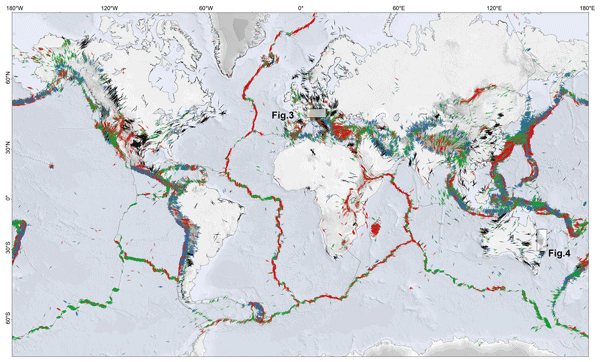
Abstract. Knowledge of the present-day stress field of the Earth’s crust is essential for understanding geodynamic processes, as well as for the exploration and management of geo-reservoirs. The World Stress Map (WSM) project provides the only open-access global database of crustal stress information. To mark the project’s 40th anniversary, the WSM database has been substantially updated, and now contains more than twice the number of data records on the orientation of maximum horizontal stress (SHmax) in comparison to the previous release in 2016. The new database includes 100,842 quality-ranked data records documenting the SHmax orientation in the Earth’s crust. As stress data records are clustered around plate boundaries and in sedimentary basins, we provide mean SHmax orientation estimates on regular global grids of 2°, 1°, 0.5° and 0.2° to facilitate the analysis of stress patterns. The results reveal that in intraplate regions, where stress data density has increased significantly, the earlier hypothesis that plate boundary forces and relative plate motion primarily control SHmax orientation needs to be revised. SHmax rotates by more than 50° over spatial scales of 50–500 km. Two notable examples include an ~50° rotation of SHmax in the Alpine foreland, from N-S in the East to NNW-SSE in the West, and several SHmax rotations > 50° over distances of less than 100 km in eastern Australia.
-
Notice on discussion status
The requested preprint has a corresponding peer-reviewed final revised paper. You are encouraged to refer to the final revised version.
-
Preprint
(3217 KB)
-
The requested preprint has a corresponding peer-reviewed final revised paper. You are encouraged to refer to the final revised version.
- Preprint
(3217 KB) - Metadata XML
- BibTeX
- EndNote
- Final revised paper


Journal article(s) based on this preprint
Interactive discussion
Status: closed
-
RC1: 'Comment on egusphere-2026-735', Anonymous Referee #1, 25 Mar 2026
The manuscript presents the new release of the World Stress Map database, detailing the updated quality ranking scheme and significant data improvements. The authors also briefly summarize the key stages of the World Stress Map project over the last 40 years. The dataset has doubled in size since the last release. The discussion focuses on stress patterns derived from mean stress orientations on regular grids, a method that facilitates the multi-scale analysis of stress field. The conclusions regarding stress rotations are particularly noteworthy.
The scientific interest is well within the scope of the journal. The authors clearly define their contribution and give proper credit to previous research. The references are both sufficient and of high quality. The paper is well structured and clearly written, the title reflects the content, and the abstract provides a comprehensive summary. In my opinion, the manuscript can be accepted in its current form without further modifications.
Specific comments
I have no further specific comments. I just wonder why the authors used A-C quality data in northern Alps area and A-D quality data in Australia. I guess the choice was due to the amount of data relative to the size of the area. This could be misleading for readers.
Technical corrections
Consider some reorganization of the References. Following the Journal guidelines “Heidbach group” is not listed correctly. Rajabi et al. 2025 should go at the end of the “Rajabi group”. Ziegler et al. 2024 should be at the end of the “Ziegler group”. Also Reiter et al. 2024 should be after Reiter at al. 2014
Citation: https://doi.org/10.5194/egusphere-2026-735-RC1 -
AC1: 'Reply on RC1', Oliver Heidbach, 07 Apr 2026
We would like to thank the reviewer for the careful evaluation of the manuscript and for the constructive comments provided. We agree that presenting A-D quality data in the Australia stress map is misleading. We will change this accordingly and show that these changes do not affect the observations at all. We will also change the technical issue of the order in our reference list as indicated.
Citation: https://doi.org/10.5194/egusphere-2026-735-AC1
-
AC1: 'Reply on RC1', Oliver Heidbach, 07 Apr 2026
-
RC2: 'Comment on egusphere-2026-735', David Healy, 02 Apr 2026
General comments
This is a well written, well organised and well-illustrated manuscript.
The provision of global grids to mitigate data clustering is welcome and a significant step change in useability.
I recommend publication with very minor corrections.
Specific comments
Abstract – a rotation from N-S to NNW-SSE in the Alpine foreland is probably more than 50 degrees… Do you mean WNW-ESE?
Line 56 – no mention of flat jack methods in the list - why not?
Line 97 – exceptions (plural)
Line 98 – also Tingay et al. for Nile delta stress rotations with depth
Citation: https://doi.org/10.5194/egusphere-2026-735-RC2 -
AC2: 'Reply on RC2', Oliver Heidbach, 07 Apr 2026
We would like to thank Dave Healy for his careful evaluation of the manuscript and for the constructive comments provided. In the following , we describe how we intend to address the comments:
Abstract: You are right. This is a typo and the rotation is from N-S to NW-SE to be consistent with the cited paper of Heidbach et al. (2025) for the stress pattern of Switzerland.
Line 56 – no mention of flat jack methods in the list - why not?: The listed eigth stress indicator used in the WSM database are the ones that can result in reliable values of one or several components of the in-situ stress tensor. The flat jack method as well as borehole slotter are applied close to a free surface (borehole, cavern, tunnel) which means that they are affected by stress changes due to the free surface to some extend. The measurement itself can be of good quality, but it has a high probability to reflect a very local stress state that is not representative of the in-situ stress state (i.e. the undisturbed one) for a larger rock volume. This is the main reason why these methods are not represented in the WSM. We will add a sentence to clarify this.
Line 97 – exceptions (plural): Will be corrected.
Line 98 – also Tingay et al. for Nile delta stress rotations with depth: Very good idea. I will also add the Brunei paper of Tingay et al. as these are two very well documented examples of stress rotations with depth due to geomechanical decoupling.
Citation: https://doi.org/10.5194/egusphere-2026-735-AC2
-
AC2: 'Reply on RC2', Oliver Heidbach, 07 Apr 2026
-
RC3: 'Comment on egusphere-2026-735', Anonymous Referee #3, 15 Apr 2026
Dear Editors and authors,
The manuscript accompanies a new release of the World Stress Map database. In addition to a description of the newly included data, the manuscript also briefly discuss the updated quality ranking scheme and contains a section on averaging of the maximum horizontal stress (SHmax) to produce stress maps on regular grids. The manuscript is well organized, written and illustrated and with appropriate referencing. I recommend publication with a few minor additions/corrections.
Comments:
- Line 70+: I would like to see a bit more detail on the refinement and clearer rules for quality ranking. For someone using the WSM data this is of course very significant, and perhaps most significant is changes to the the old scheme. The Rajabi et al. (2025) report does not detail changes to the ranking scheme but gives the updated scheme (in Section 3).
- Line 112: text missing "... a few kilometers, where is most relevant..."
- Line 116+: Add somewhere, perhaps here, which data qualities that go into the SHmax grids. The reference https://doi.org/10.5880/WSM.2026.001 says A-C data, which is also indicated on line 141, but in the manuscript A-D data for Australia is used.
- Line 128-129: Different font.
- Line 139+: It would be interesting with a bit more information on the weighting scheme. Which of the three items is most important, is the distance weighting just 1/r (in km?) for all radii such that the weight is always 0.1 at 10 km, is the weight in point 3 equal to one over the distance at 10% of the search radius?
- Line 158: I would write "130N" as N130E
- Line 176 and 180: Curiosity would have liked to see the answer to why the rotations occur.
- Line 242: Perhaps write Zoback, M.D. for extra clarity.Fig 2-4: I appreciate that colouring is difficult, but the white bars are not easy to see in all terrains.
Fig 4: The combination of grid size and search radius produces (I guess) the effect of multiple averaged data points at increasingly large distances away from the data itself. Which makes the averaged data look a little overly extrapolated, in my opinion.Citation: https://doi.org/10.5194/egusphere-2026-735-RC3 -
AC3: 'Reply on RC3', Oliver Heidbach, 24 Apr 2026
We would like to thank the reviewer for the careful evaluation of the manuscript and for the constructive comments provided. In the following, we outline how we will address these points:
Line 70+: I would like to see a bit more detail on the refinement and clearer rules for quality ranking. For someone using the WSM data this is of course very significant, and perhaps most significant is changes to the old scheme. The Rajabi et al. (2025) report does not detail changes to the ranking scheme but gives the updated scheme (in Section 3):
REPLY: We will include the new WSM quality ranking scheme as a table and provide a clear description of the changes made compared to the previous scheme. The reviewer is correct that these changes are not fully explained in the referenced technical report. Most of the updates (beyond the removal of the BS, PC, and FMA stress indicator) relate to a clear distinction between D- and E-quality data. This distinction was not well defined in the earlier version but is now consistently implemented usable in Python routine that is now doing the quality assignment automatically.
Line 112: text missing "... a few kilometres, where is most relevant..."
REPLY: We will modify this section.
Line 116+: Add somewhere, perhaps here, which data qualities that go into the SHmax grids. The reference https://doi.org/10.5880/WSM.2026.001 says A-C data, which is also indicated in line 141, but in the manuscript A-D data for Australia is used.Reply: Yes, the reviewer is correct. Using A-D data for Australia is misleading. We will revise this and clearly state in the text that only A-C data records, as shown in Fig. 1 for the estimation of the mean SHmax orientation. The results and interpretation will be unaffected by this change.
Line 128-129: Different font.REPLY: We will revise this accordingly.
Line 139+: It would be interesting with a bit more information on the weighting scheme. Which of the three items is most important, is the distance weighting just 1/r (in km?) for all radii such that the weight is always 0.1 at 10 km, is the weight in point 3 equal to one over the distance at 10% of the search radius?REPLY: Thank you for this comment. Yes, the reviewer is correct. The way we currently present and describe the weighting is misleading for two reasons. First, there are only two weighting parameters, but we wrote that there are three. The first is based on the assigned data quality and the second on the distance to the grid point. For the latter, we use inverse-distance weighting in estimating the mean SHmax orientation, with a cut-off applied when the distance r between a data record and the grid point is less than 10 % of the respective search radius. This means that all data records within 10% of the search radius receive the same weight, in order to avoid an overrepresentation of data records located very close to the grid point. We will revise, expand, and restructure the text that describe the weighting to make it clearer and precise.
Line 158: I would write "130N" as N130EREPLY: We will revise this accordingly.
Line 176 and 180: Curiosity would have liked to see the answer to why the rotations occur.REPLY: This is a good question, and the short answer is that we do not yet know. So far, we can largely rule out faults (which would have only a very local effect, if any) and topography (which is not that high in Australia and little correlation with the topography gradient). This leaves two potential candidates. Given that stiffness plays a key control on the horizontal stress magnitudes, lateral stiffness contrast could result in a rotation of the SHmax orientation. In addition, where the horizontal differential stress is low, local stress “sources” (such as stiffness and density contrasts associated with fault systems) may have a relatively large impact. At present, however, this remain uncertain and is the focus of our ongoing work using 3-D geomechanical-numerical models. We will add a brief discussion to the manuscript, but we are not able to provide a definitive explanation at this stage.
Line 242: Perhaps write Zoback, M.D. for extra clarity.REPLY: We will modify this accordingly.
Fig 2-4: I appreciate that colouring is difficult, but the white bars are not easy to see in all terrains.
REPLY: We will try our best to increase the contrast by lowering the saturation of the topography.
Fig 4: The combination of grid size and search radius produces (I guess) the effect of multiple averaged data points at increasingly large distances away from the data itself. Which makes the averaged data look a little overly extrapolated, in my opinion.REPLY: Yes this is correct. However, because we apply the inverse-distance weighting, data records at large distance have significantly smaller impact on the estimation of the mean. Our moving-window approach effectively filter the wavelength of the SHmax orientation pattern, as described in the text. An alternative would be to use square bins, which would avoid a data record contributing to the mean SHmax estimation multiple times. The bin size would define the wavelength under consideration, but much less grid points would return a value with the requested minimum number in particular if we would use small bins of 0.2° or 0.5°. This is why we prefer to stay with our approach.
Citation: https://doi.org/10.5194/egusphere-2026-735-AC3
-
AC3: 'Reply on RC3', Oliver Heidbach, 24 Apr 2026
Peer review completion


Interactive discussion
Status: closed
-
RC1: 'Comment on egusphere-2026-735', Anonymous Referee #1, 25 Mar 2026
The manuscript presents the new release of the World Stress Map database, detailing the updated quality ranking scheme and significant data improvements. The authors also briefly summarize the key stages of the World Stress Map project over the last 40 years. The dataset has doubled in size since the last release. The discussion focuses on stress patterns derived from mean stress orientations on regular grids, a method that facilitates the multi-scale analysis of stress field. The conclusions regarding stress rotations are particularly noteworthy.
The scientific interest is well within the scope of the journal. The authors clearly define their contribution and give proper credit to previous research. The references are both sufficient and of high quality. The paper is well structured and clearly written, the title reflects the content, and the abstract provides a comprehensive summary. In my opinion, the manuscript can be accepted in its current form without further modifications.
Specific comments
I have no further specific comments. I just wonder why the authors used A-C quality data in northern Alps area and A-D quality data in Australia. I guess the choice was due to the amount of data relative to the size of the area. This could be misleading for readers.
Technical corrections
Consider some reorganization of the References. Following the Journal guidelines “Heidbach group” is not listed correctly. Rajabi et al. 2025 should go at the end of the “Rajabi group”. Ziegler et al. 2024 should be at the end of the “Ziegler group”. Also Reiter et al. 2024 should be after Reiter at al. 2014
Citation: https://doi.org/10.5194/egusphere-2026-735-RC1 -
AC1: 'Reply on RC1', Oliver Heidbach, 07 Apr 2026
We would like to thank the reviewer for the careful evaluation of the manuscript and for the constructive comments provided. We agree that presenting A-D quality data in the Australia stress map is misleading. We will change this accordingly and show that these changes do not affect the observations at all. We will also change the technical issue of the order in our reference list as indicated.
Citation: https://doi.org/10.5194/egusphere-2026-735-AC1
-
AC1: 'Reply on RC1', Oliver Heidbach, 07 Apr 2026
-
RC2: 'Comment on egusphere-2026-735', David Healy, 02 Apr 2026
General comments
This is a well written, well organised and well-illustrated manuscript.
The provision of global grids to mitigate data clustering is welcome and a significant step change in useability.
I recommend publication with very minor corrections.
Specific comments
Abstract – a rotation from N-S to NNW-SSE in the Alpine foreland is probably more than 50 degrees… Do you mean WNW-ESE?
Line 56 – no mention of flat jack methods in the list - why not?
Line 97 – exceptions (plural)
Line 98 – also Tingay et al. for Nile delta stress rotations with depth
Citation: https://doi.org/10.5194/egusphere-2026-735-RC2 -
AC2: 'Reply on RC2', Oliver Heidbach, 07 Apr 2026
We would like to thank Dave Healy for his careful evaluation of the manuscript and for the constructive comments provided. In the following , we describe how we intend to address the comments:
Abstract: You are right. This is a typo and the rotation is from N-S to NW-SE to be consistent with the cited paper of Heidbach et al. (2025) for the stress pattern of Switzerland.
Line 56 – no mention of flat jack methods in the list - why not?: The listed eigth stress indicator used in the WSM database are the ones that can result in reliable values of one or several components of the in-situ stress tensor. The flat jack method as well as borehole slotter are applied close to a free surface (borehole, cavern, tunnel) which means that they are affected by stress changes due to the free surface to some extend. The measurement itself can be of good quality, but it has a high probability to reflect a very local stress state that is not representative of the in-situ stress state (i.e. the undisturbed one) for a larger rock volume. This is the main reason why these methods are not represented in the WSM. We will add a sentence to clarify this.
Line 97 – exceptions (plural): Will be corrected.
Line 98 – also Tingay et al. for Nile delta stress rotations with depth: Very good idea. I will also add the Brunei paper of Tingay et al. as these are two very well documented examples of stress rotations with depth due to geomechanical decoupling.
Citation: https://doi.org/10.5194/egusphere-2026-735-AC2
-
AC2: 'Reply on RC2', Oliver Heidbach, 07 Apr 2026
-
RC3: 'Comment on egusphere-2026-735', Anonymous Referee #3, 15 Apr 2026
Dear Editors and authors,
The manuscript accompanies a new release of the World Stress Map database. In addition to a description of the newly included data, the manuscript also briefly discuss the updated quality ranking scheme and contains a section on averaging of the maximum horizontal stress (SHmax) to produce stress maps on regular grids. The manuscript is well organized, written and illustrated and with appropriate referencing. I recommend publication with a few minor additions/corrections.
Comments:
- Line 70+: I would like to see a bit more detail on the refinement and clearer rules for quality ranking. For someone using the WSM data this is of course very significant, and perhaps most significant is changes to the the old scheme. The Rajabi et al. (2025) report does not detail changes to the ranking scheme but gives the updated scheme (in Section 3).
- Line 112: text missing "... a few kilometers, where is most relevant..."
- Line 116+: Add somewhere, perhaps here, which data qualities that go into the SHmax grids. The reference https://doi.org/10.5880/WSM.2026.001 says A-C data, which is also indicated on line 141, but in the manuscript A-D data for Australia is used.
- Line 128-129: Different font.
- Line 139+: It would be interesting with a bit more information on the weighting scheme. Which of the three items is most important, is the distance weighting just 1/r (in km?) for all radii such that the weight is always 0.1 at 10 km, is the weight in point 3 equal to one over the distance at 10% of the search radius?
- Line 158: I would write "130N" as N130E
- Line 176 and 180: Curiosity would have liked to see the answer to why the rotations occur.
- Line 242: Perhaps write Zoback, M.D. for extra clarity.Fig 2-4: I appreciate that colouring is difficult, but the white bars are not easy to see in all terrains.
Fig 4: The combination of grid size and search radius produces (I guess) the effect of multiple averaged data points at increasingly large distances away from the data itself. Which makes the averaged data look a little overly extrapolated, in my opinion.Citation: https://doi.org/10.5194/egusphere-2026-735-RC3 -
AC3: 'Reply on RC3', Oliver Heidbach, 24 Apr 2026
We would like to thank the reviewer for the careful evaluation of the manuscript and for the constructive comments provided. In the following, we outline how we will address these points:
Line 70+: I would like to see a bit more detail on the refinement and clearer rules for quality ranking. For someone using the WSM data this is of course very significant, and perhaps most significant is changes to the old scheme. The Rajabi et al. (2025) report does not detail changes to the ranking scheme but gives the updated scheme (in Section 3):
REPLY: We will include the new WSM quality ranking scheme as a table and provide a clear description of the changes made compared to the previous scheme. The reviewer is correct that these changes are not fully explained in the referenced technical report. Most of the updates (beyond the removal of the BS, PC, and FMA stress indicator) relate to a clear distinction between D- and E-quality data. This distinction was not well defined in the earlier version but is now consistently implemented usable in Python routine that is now doing the quality assignment automatically.
Line 112: text missing "... a few kilometres, where is most relevant..."
REPLY: We will modify this section.
Line 116+: Add somewhere, perhaps here, which data qualities that go into the SHmax grids. The reference https://doi.org/10.5880/WSM.2026.001 says A-C data, which is also indicated in line 141, but in the manuscript A-D data for Australia is used.Reply: Yes, the reviewer is correct. Using A-D data for Australia is misleading. We will revise this and clearly state in the text that only A-C data records, as shown in Fig. 1 for the estimation of the mean SHmax orientation. The results and interpretation will be unaffected by this change.
Line 128-129: Different font.REPLY: We will revise this accordingly.
Line 139+: It would be interesting with a bit more information on the weighting scheme. Which of the three items is most important, is the distance weighting just 1/r (in km?) for all radii such that the weight is always 0.1 at 10 km, is the weight in point 3 equal to one over the distance at 10% of the search radius?REPLY: Thank you for this comment. Yes, the reviewer is correct. The way we currently present and describe the weighting is misleading for two reasons. First, there are only two weighting parameters, but we wrote that there are three. The first is based on the assigned data quality and the second on the distance to the grid point. For the latter, we use inverse-distance weighting in estimating the mean SHmax orientation, with a cut-off applied when the distance r between a data record and the grid point is less than 10 % of the respective search radius. This means that all data records within 10% of the search radius receive the same weight, in order to avoid an overrepresentation of data records located very close to the grid point. We will revise, expand, and restructure the text that describe the weighting to make it clearer and precise.
Line 158: I would write "130N" as N130EREPLY: We will revise this accordingly.
Line 176 and 180: Curiosity would have liked to see the answer to why the rotations occur.REPLY: This is a good question, and the short answer is that we do not yet know. So far, we can largely rule out faults (which would have only a very local effect, if any) and topography (which is not that high in Australia and little correlation with the topography gradient). This leaves two potential candidates. Given that stiffness plays a key control on the horizontal stress magnitudes, lateral stiffness contrast could result in a rotation of the SHmax orientation. In addition, where the horizontal differential stress is low, local stress “sources” (such as stiffness and density contrasts associated with fault systems) may have a relatively large impact. At present, however, this remain uncertain and is the focus of our ongoing work using 3-D geomechanical-numerical models. We will add a brief discussion to the manuscript, but we are not able to provide a definitive explanation at this stage.
Line 242: Perhaps write Zoback, M.D. for extra clarity.REPLY: We will modify this accordingly.
Fig 2-4: I appreciate that colouring is difficult, but the white bars are not easy to see in all terrains.
REPLY: We will try our best to increase the contrast by lowering the saturation of the topography.
Fig 4: The combination of grid size and search radius produces (I guess) the effect of multiple averaged data points at increasingly large distances away from the data itself. Which makes the averaged data look a little overly extrapolated, in my opinion.REPLY: Yes this is correct. However, because we apply the inverse-distance weighting, data records at large distance have significantly smaller impact on the estimation of the mean. Our moving-window approach effectively filter the wavelength of the SHmax orientation pattern, as described in the text. An alternative would be to use square bins, which would avoid a data record contributing to the mean SHmax estimation multiple times. The bin size would define the wavelength under consideration, but much less grid points would return a value with the requested minimum number in particular if we would use small bins of 0.2° or 0.5°. This is why we prefer to stay with our approach.
Citation: https://doi.org/10.5194/egusphere-2026-735-AC3
-
AC3: 'Reply on RC3', Oliver Heidbach, 24 Apr 2026
Peer review completion
Journal article(s) based on this preprint
Viewed
| HTML | XML | Total | BibTeX | EndNote | |
|---|---|---|---|---|---|
| 1,147 | 1,337 | 107 | 2,591 | 97 | 128 |
- HTML: 1,147
- PDF: 1,337
- XML: 107
- Total: 2,591
- BibTeX: 97
- EndNote: 128
Viewed (geographical distribution)
| Country | # | Views | % |
|---|
| Total: | 0 |
| HTML: | 0 |
| PDF: | 0 |
| XML: | 0 |
- 1
Oliver Heidbach
Mojtaba Rajabi
The requested preprint has a corresponding peer-reviewed final revised paper. You are encouraged to refer to the final revised version.
- Preprint
(3217 KB) - Metadata XML