
the Creative Commons Attribution 4.0 License.
the Creative Commons Attribution 4.0 License.
 | 16 Feb 2026
Machine learning interatomic potentials with accurate long-range interactions for molecular dynamics collision simulations of atmospherically-relevant molecules
Abstract. Molecular collisions and subsequent clustering events are fundamental to atmospheric cluster formation. Accurately modeling these processes requires interatomic potentials that capture long-range forces governing collision kinetics and short-range quantum effects driving reactivity. In this work, we evaluate the AIMNet2 and PaiNN machine learning architectures trained on GFN1-xTB and ωB97X-3c data for molecular collisions involving sulfuric acid.
The models exhibit low mean absolute errors in energies and forces and accurately reproduce potentials of mean force relative to GFN1-xTB. Comparing models trained on GFN1-xTB and ωB97X-3c data reveals that while increasing the electronic structure theory level significantly alters the potential energy surface in the binding region, it has negligible impact on the long-range shoulder and collision rate coefficients. Notably, PaiNN demonstrates superior performance in reproducing binding and repulsive regions, making it highly effective for sampling stable cluster configurations.
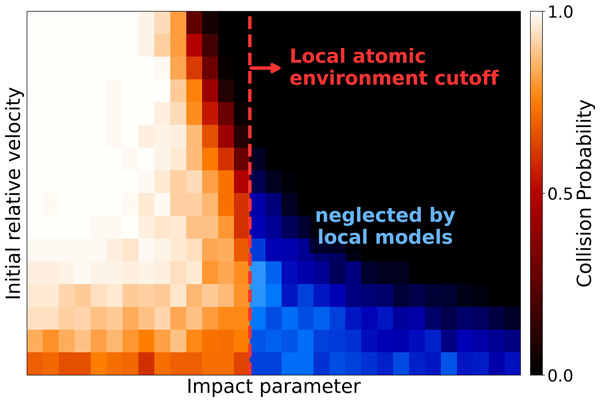
However, discrepancies are observed in collision dynamics. While AIMNet2 accurately reproduces reference collision rates across all systems, PaiNN underestimates the rate for the charged sulfuric acid–bisulfate system by ~50 %. This error originates from the model's local atomic environment approximation, which neglects long-range attractive forces at large intermolecular distances. Comparisons with the OPLS-AA force field demonstrate that simple fixed partial charges are sufficient to describe these interactions.
Our results highlight that while local equivariant models like PaiNN offer exceptional accuracy for thermodynamics, correctly simulating collision kinetics in systems with strong long-range interactions requires models that explicitly account for forces beyond the local environment, such as AIMNet2.
-
Notice on discussion status
The requested preprint has a corresponding peer-reviewed final revised paper. You are encouraged to refer to the final revised version.
-
Preprint
(3103 KB)
-
Supplement
(3474 KB)
-
The requested preprint has a corresponding peer-reviewed final revised paper. You are encouraged to refer to the final revised version.
- Preprint
(3103 KB) - Metadata XML
-
Supplement
(3474 KB) - BibTeX
- EndNote
- Final revised paper


Journal article(s) based on this preprint
Interactive discussion
Status: closed
-
RC1: 'Comment on egusphere-2026-696', Anonymous Referee #1, 09 Mar 2026
The comment was uploaded in the form of a supplement: https://egusphere.copernicus.org/preprints/2026/egusphere-2026-696/egusphere-2026-696-RC1-supplement.pdfCitation: https://doi.org/
10.5194/egusphere-2026-696-RC1 - AC1: 'Reply on RC1', Ivo Neefjes, 01 Apr 2026
-
RC2: 'Comment on egusphere-2026-696', Anonymous Referee #2, 10 Mar 2026
The comment was uploaded in the form of a supplement: https://egusphere.copernicus.org/preprints/2026/egusphere-2026-696/egusphere-2026-696-RC2-supplement.pdf
- AC2: 'Reply on RC2', Ivo Neefjes, 01 Apr 2026
-
RC3: 'Comment on egusphere-2026-696', Patrick Rinke, 13 Mar 2026
The manuscript evaluates machine-learning interatomic potentials for simulating gas-phase collisions and early clustering among key atmospheric precursors (sulfuric acid with itself, dimethylamine, and bisulfate) linking short-range reactive accuracy to long-range interaction fidelity that controls capture and collision rates. Using umbrella sampling and umbrella integration to reconstruct potentials of mean force (PMF) with explicit subtraction of the radial entropic term, the authors derive collision probabilities and rate coefficients from molecular dynamics and analyze how model architecture affects both kinetics and thermodynamics. The simulations capture reactive events such as proton transfer during acid-base encounters, while the conclusions stress that gains in short-range accuracy must not compromise the long-range forces that govern initial approach and rate enhancement; accordingly, the authors urge validation beyond scalar error metrics (MAE/RMSE) and propose deploying models with explicit long-range interactions where collision kinetics are targeted.
For Atmospheric Chemistry and Physics (ACP) readers, the study offers a practical framework to obtain physically faithful collision-sticking rates and PMFs for nucleation-relevant systems and provides actionable guidance on model selection: local, short-range-accurate networks for thermodynamic sampling and global or long-range–aware models for encounter kinetics, consistent with recent ACP advances on collision-sticking analysis. The data, trained models, and scripts are openly available via the Atmospheric Cluster Database, facilitating reproducibility and uptake in nucleation and early growth modelling. I therefore recommend publication once the more detailed comments below have been addressed.
- “IPCC assessment report” - It would be good to spell out IPCC
- “These calculations explicitly account for long-range interactions and provide a fully atomistic description. Furthermore, the resulting trajectories offer insight into the molecular-level dynamics governing collisions and the formation of stable clusters.” There is a logical disconnect in the introduction. After this sentence all seems fine, but I guess that is, because the paragraph leading up to this sentence did not specify how the MD was calculated. Maybe one can allude the reader already to the forthcoming problems otherwise the introduction meanders along for quite a while until the readers reaches the actual problem definition.
- PaiNN section: Is PaiNN actually charge aware? How does PaiNN handle the anionic system in the study?
- AIMNet2 section: “The model combines local atomic environments with learned “atom-in-molecule” (AIM) embeddings” - I don’t understand why these two aspects are singled out for AIMNet2. All message passing graph neural networks do this. Also PaiNN uses a sophisticated input representation of the local atomic environments and then builds up atomic embeddings during the training.
- AIMNet2 section: “These embeddings, available for 14 elements…” - Are the authors speaking of an AIMNet2 foundation or a pre-trained model? Otherwise it shouldn’t matter what the elements are, because a pristine AIMNet2 architecture could be trained on the data at hand and then contain the elements present in that dataset.
- AIMNet2 section: “While it may not match the data efficiency or accuracy of PaiNN for geometry-sensitive properties…” - Citations would be warranted to back up this statement, unless it refers to the conclusions of this study, in which case this should be stated.
- There are no citations in the Delta learning section. At least this statement “When the two levels of theory are correlated, this delta-learning approach can substantially reduce model errors.” could do with a citation.
- Delta learning section: “The main drawback is that the overall efficiency is fundamentally bounded by the cost of the lower-level baseline.” The efficiency of what?
- Data set generation: “Gradient calculations” - What are gradient calculations?
- hyperparameter tuning: “we assigned a great weight to the force loss” - Presumably “great” should read “greater” or simply “larger”.
- hyperparameter tuning: “This makes sense, as the product of the batch size and batches per epoch determines the total number of samples seen in one epoch.” - I am slightly confused. Isn’t the definition of an epoch that it is a full run through the data? Once the batch size is determined, the number of batches is set and then simply determines how often the weights are updated in an epoch.
- hyperparameter tuning: “It is important to note that we did not necessarily identify the optimal hyperparameter combination for our systems.” - Did you consider using hyperparameter tuning with sample efficient Bayesian optimization as shown e.g. by Stuke et al , Mach. Learn.: Sci. Technol. 2, 035022 (2021)?
- NN training: The accuracies reported in Table 3 are impressive. Already the PaiNN and AIMNet2 models achieve very accurate forces of only a few meV per Angstrom. The Delta-PaiNN model is then even better. What accuracy is actually required for the collision calculations?
- Line 265: “This error results from a mismatch between the training labels, which include long-range stabilization, and the model’s short-ranged (<10 Å) representation. At these distances, the reference energies are significantly lowered by electrostatic interactions. However, due to the 10 Å cutoff, PaiNN interprets the collision partners as two non-interacting, free species. Consequently, during training, the model is forced to attribute the substantial stabilization energy of the interacting pair to the local atomic environments of the isolated monomers. In essence, the model erroneously learns that these structures, separated by more than the cutoff yet still interacting, are representative of the free molecular state, resulting in a fundamentally distorted PES.” The analysis sounds interesting, although I would have expected it in the discussion section, but I got a little lost. Figure 2 reports the errors that the authors analyse, but where do we see a mismatch in training labels? And that PaiNN interprets the collision partners as two non-interacting, free species? I feel the reader is given insufficient information to follow the argument.
- Potential of mean force: “The potential of mean force (PMF) along the center-of-mass distance represents the effective free energy averaged over all collision orientations accessed during the simulations, showing how the system’s stability changes as the collision partners approach. The well depth and shape provide information on the binding strength, while the shoulder towards larger distances reflects the strength of long-range interactions.” - Shouldn’t one show a PMF as an example or a sketch of a typical PMF so that the reader can follow the statements here? Otherwise it is hard to imagine what the well depth and the shoulder refer to. (I see now that I have read on that PMFs are shown a little later in the section; maybe refer to them here already.)
- Table 5: How accurate would the collision rates need to be to be useful in downstream modelling? Presumably the small difference between GFN1-xTB and ωB97X-3c for the neutral dimers is not noticeable, but how about the difference of ~1 for H2SO4–HSO4? What I am looking for is some form of contextualisation.
Citation: https://doi.org/10.5194/egusphere-2026-696-RC3 - AC3: 'Reply on RC3', Ivo Neefjes, 01 Apr 2026


Interactive discussion
Status: closed
-
RC1: 'Comment on egusphere-2026-696', Anonymous Referee #1, 09 Mar 2026
The comment was uploaded in the form of a supplement: https://egusphere.copernicus.org/preprints/2026/egusphere-2026-696/egusphere-2026-696-RC1-supplement.pdf
- AC1: 'Reply on RC1', Ivo Neefjes, 01 Apr 2026
-
RC2: 'Comment on egusphere-2026-696', Anonymous Referee #2, 10 Mar 2026
The comment was uploaded in the form of a supplement: https://egusphere.copernicus.org/preprints/2026/egusphere-2026-696/egusphere-2026-696-RC2-supplement.pdf
- AC2: 'Reply on RC2', Ivo Neefjes, 01 Apr 2026
-
RC3: 'Comment on egusphere-2026-696', Patrick Rinke, 13 Mar 2026
The manuscript evaluates machine-learning interatomic potentials for simulating gas-phase collisions and early clustering among key atmospheric precursors (sulfuric acid with itself, dimethylamine, and bisulfate) linking short-range reactive accuracy to long-range interaction fidelity that controls capture and collision rates. Using umbrella sampling and umbrella integration to reconstruct potentials of mean force (PMF) with explicit subtraction of the radial entropic term, the authors derive collision probabilities and rate coefficients from molecular dynamics and analyze how model architecture affects both kinetics and thermodynamics. The simulations capture reactive events such as proton transfer during acid-base encounters, while the conclusions stress that gains in short-range accuracy must not compromise the long-range forces that govern initial approach and rate enhancement; accordingly, the authors urge validation beyond scalar error metrics (MAE/RMSE) and propose deploying models with explicit long-range interactions where collision kinetics are targeted.
For Atmospheric Chemistry and Physics (ACP) readers, the study offers a practical framework to obtain physically faithful collision-sticking rates and PMFs for nucleation-relevant systems and provides actionable guidance on model selection: local, short-range-accurate networks for thermodynamic sampling and global or long-range–aware models for encounter kinetics, consistent with recent ACP advances on collision-sticking analysis. The data, trained models, and scripts are openly available via the Atmospheric Cluster Database, facilitating reproducibility and uptake in nucleation and early growth modelling. I therefore recommend publication once the more detailed comments below have been addressed.
- “IPCC assessment report” - It would be good to spell out IPCC
- “These calculations explicitly account for long-range interactions and provide a fully atomistic description. Furthermore, the resulting trajectories offer insight into the molecular-level dynamics governing collisions and the formation of stable clusters.” There is a logical disconnect in the introduction. After this sentence all seems fine, but I guess that is, because the paragraph leading up to this sentence did not specify how the MD was calculated. Maybe one can allude the reader already to the forthcoming problems otherwise the introduction meanders along for quite a while until the readers reaches the actual problem definition.
- PaiNN section: Is PaiNN actually charge aware? How does PaiNN handle the anionic system in the study?
- AIMNet2 section: “The model combines local atomic environments with learned “atom-in-molecule” (AIM) embeddings” - I don’t understand why these two aspects are singled out for AIMNet2. All message passing graph neural networks do this. Also PaiNN uses a sophisticated input representation of the local atomic environments and then builds up atomic embeddings during the training.
- AIMNet2 section: “These embeddings, available for 14 elements…” - Are the authors speaking of an AIMNet2 foundation or a pre-trained model? Otherwise it shouldn’t matter what the elements are, because a pristine AIMNet2 architecture could be trained on the data at hand and then contain the elements present in that dataset.
- AIMNet2 section: “While it may not match the data efficiency or accuracy of PaiNN for geometry-sensitive properties…” - Citations would be warranted to back up this statement, unless it refers to the conclusions of this study, in which case this should be stated.
- There are no citations in the Delta learning section. At least this statement “When the two levels of theory are correlated, this delta-learning approach can substantially reduce model errors.” could do with a citation.
- Delta learning section: “The main drawback is that the overall efficiency is fundamentally bounded by the cost of the lower-level baseline.” The efficiency of what?
- Data set generation: “Gradient calculations” - What are gradient calculations?
- hyperparameter tuning: “we assigned a great weight to the force loss” - Presumably “great” should read “greater” or simply “larger”.
- hyperparameter tuning: “This makes sense, as the product of the batch size and batches per epoch determines the total number of samples seen in one epoch.” - I am slightly confused. Isn’t the definition of an epoch that it is a full run through the data? Once the batch size is determined, the number of batches is set and then simply determines how often the weights are updated in an epoch.
- hyperparameter tuning: “It is important to note that we did not necessarily identify the optimal hyperparameter combination for our systems.” - Did you consider using hyperparameter tuning with sample efficient Bayesian optimization as shown e.g. by Stuke et al , Mach. Learn.: Sci. Technol. 2, 035022 (2021)?
- NN training: The accuracies reported in Table 3 are impressive. Already the PaiNN and AIMNet2 models achieve very accurate forces of only a few meV per Angstrom. The Delta-PaiNN model is then even better. What accuracy is actually required for the collision calculations?
- Line 265: “This error results from a mismatch between the training labels, which include long-range stabilization, and the model’s short-ranged (<10 Å) representation. At these distances, the reference energies are significantly lowered by electrostatic interactions. However, due to the 10 Å cutoff, PaiNN interprets the collision partners as two non-interacting, free species. Consequently, during training, the model is forced to attribute the substantial stabilization energy of the interacting pair to the local atomic environments of the isolated monomers. In essence, the model erroneously learns that these structures, separated by more than the cutoff yet still interacting, are representative of the free molecular state, resulting in a fundamentally distorted PES.” The analysis sounds interesting, although I would have expected it in the discussion section, but I got a little lost. Figure 2 reports the errors that the authors analyse, but where do we see a mismatch in training labels? And that PaiNN interprets the collision partners as two non-interacting, free species? I feel the reader is given insufficient information to follow the argument.
- Potential of mean force: “The potential of mean force (PMF) along the center-of-mass distance represents the effective free energy averaged over all collision orientations accessed during the simulations, showing how the system’s stability changes as the collision partners approach. The well depth and shape provide information on the binding strength, while the shoulder towards larger distances reflects the strength of long-range interactions.” - Shouldn’t one show a PMF as an example or a sketch of a typical PMF so that the reader can follow the statements here? Otherwise it is hard to imagine what the well depth and the shoulder refer to. (I see now that I have read on that PMFs are shown a little later in the section; maybe refer to them here already.)
- Table 5: How accurate would the collision rates need to be to be useful in downstream modelling? Presumably the small difference between GFN1-xTB and ωB97X-3c for the neutral dimers is not noticeable, but how about the difference of ~1 for H2SO4–HSO4? What I am looking for is some form of contextualisation.
Citation: https://doi.org/10.5194/egusphere-2026-696-RC3 - AC3: 'Reply on RC3', Ivo Neefjes, 01 Apr 2026
Peer review completion


Journal article(s) based on this preprint
Data sets
neefjes26_long_range_NN Ivo Neefjes, Jakub Kubečka, and Jonas Elm https://github.com/elmjonas/ACDB/tree/master/Articles/neefjes26_long_range_NN
Model code and software
neefjes26_long_range_NN Ivo Neefjes, Jakub Kubečka, and Jonas Elm https://github.com/elmjonas/ACDB/tree/master/Articles/neefjes26_long_range_NN
Viewed
| HTML | XML | Total | Supplement | BibTeX | EndNote | |
|---|---|---|---|---|---|---|
| 983 | 534 | 96 | 1,613 | 163 | 66 | 138 |
- HTML: 983
- PDF: 534
- XML: 96
- Total: 1,613
- Supplement: 163
- BibTeX: 66
- EndNote: 138
Viewed (geographical distribution)
| Country | # | Views | % |
|---|
| Total: | 0 |
| HTML: | 0 |
| PDF: | 0 |
| XML: | 0 |
- 1
Jakub Kubečka
Jonas Elm
The requested preprint has a corresponding peer-reviewed final revised paper. You are encouraged to refer to the final revised version.
- Preprint
(3103 KB) - Metadata XML
-
Supplement
(3474 KB) - BibTeX
- EndNote
- Final revised paper