
the Creative Commons Attribution 4.0 License.
the Creative Commons Attribution 4.0 License.
 | 24 Feb 2026
Amplified cooling of Snowball Earth from a salt–albedo feedback
Abstract. It is believed that the atmospheric circulation on Snowball Earth produced a net ablation zone exposing bare sea ice. Under sufficiently low temperatures, salt begins to precipitate out of sea ice, forming a lag deposit of crystals with high albedo as the ice sublimates. This could have resulted in a salt–albedo feedback that has not previously been included in modeling studies of Snowball Earth. We implement a salt-albedo feedback in a simple climate model and show that, once initiated, this mechanism could have intensified global cooling in the initial phase of Snowball Earth. Our results suggest that salt precipitation may have played a role in shaping the early climate of Snowball Earth.
-
Notice on discussion status
The requested preprint has a corresponding peer-reviewed final revised paper. You are encouraged to refer to the final revised version.
-
Preprint
(1977 KB)
-
The requested preprint has a corresponding peer-reviewed final revised paper. You are encouraged to refer to the final revised version.
- Preprint
(1977 KB) - Metadata XML
- BibTeX
- EndNote
- Final revised paper


Journal article(s) based on this preprint
Interactive discussion
Status: closed
-
RC1: 'Comment on egusphere-2026-679', Anonymous Referee #1, 10 Mar 2026
-
AC1: 'Reply on RC1', Aksel Samuelsberg, 19 May 2026
We thank the reviewer for their positive evaluation of our manuscript and for their insightful feedback. We have carefully considered all comments and suggestions, and our responses are detailed below.
SPECIFIC COMMENTS:1. We agree that it is important to further elaborate on the issue of marine ice vs meteoric ice on Snowball Earth in relation to the salt-albedo feedback. We thank the reviewer for pointing us to that relevant study. This point has been further discussed in the revised manuscript on line 115 and line 148.
Other comments:
1. We think this is a good idea and thank the reviewer for this suggestion. We have added a figure like this in the revised manuscript.2. We agree that adding a second x-axis with CO2 would be useful, but this is challenging within the chosen model framework. We have explored this option (see attached PDF), where estimated CO2 concentrations are shown on the secondary axis. However, we think this could mislead the reader into thinking that model responds explicitly to a CO2 input. We believe the second axis reads as a given model output for a given CO2 input, which is not the case. To avoid this potential confusion, we prefer not to prescribe CO2 concentrations in the Snowball Earth hysteresis for this work. We hope the reviewer can accept our justification for omitting a second axis with CO2 in the revised manuscript.
-
AC1: 'Reply on RC1', Aksel Samuelsberg, 19 May 2026
-
RC2: 'Review of egusphere-2026-679', Anonymous Referee #2, 15 Apr 2026
This manuscript investigates a novel salt–albedo feedback mechanism in the context of Snowball Earth glaciations. The authors implemented a parameterisation of salt crystal precipitation on sea ice and its associated high albedo (α = 0.93) within a one-dimensional diffusive energy balance model (EBM). They found that the salt–albedo feedback produces two fully glaciated Snowball Earth equilibria: one with surface salt deposits (significantly colder) and one without. Through bifurcation analysis, the authors argue that the salt-deposit Snowball Earth state is accessible from warm pre-glacial climates, implying that salt precipitation amplified cooling during Snowball Earth events.
Overall Assessment
The paper is clearly written and presents an advancement in the field. Whilst some of the mathematics was beyond my understanding, the mathematical treatment seems comprehensive and consistent with previous EBM studies, and the core result that salt precipitation introduces new stable branches in the bifurcation diagram is reasonable. I feel that several issues should be addressed before publication. In particular, the discussion of model limitations needs to be expanded upon a little, and the physical plausibility and robustness of parameterisation choices should be examined a little bit more in the main text. The Snowball salt-albedo feedback is an interesting and previously overlooked mechanism, which has no modern analogue. Therefore, I think the manuscript is a welcome addition to the field.
1.Comments
1.1 Surface Mass Balance (Accumulation).
The process of salt precipitation on the sea ice, relies on sublimation removing surface ice (to expose the precipitated salt crystals). I think discussion of snow accumulation is required, or at least why this is expected to be less than ablation (so that the mass balance is negative). This should be added to the caveats to the results, which are otherwise extensive.
1.2 Description of albedo values
The description of the albedo values (L28) could be clarified. Also I think the paper would benefit from a figure to accompany Eq. 2, or if the equation was modified to include a descriptor of the α value, for example, α1 (ice-free latitudes), α2(ice/snow cover), α3(bare sea ice region; equatorward of r1), and α4(sea ice topped by salt deposit equatorward of r1).
1.3 Step-function albedo response at the eutectic temperature.
The albedo function (Eq. 2) switches from α3 to α4 at Te = −36°C. Salt precipitation from sea ice would be a progressive process. As the authors note, as the ice cools, brine trapped within the ice matrix reaches saturation for different salt species (e.g., miravalite vs. hydrohalite) at different temperatures. In addition, exposure to salt crystals occurs gradually, leading to spatial heterogeneity. While these omissions are discussed (paragraph starting L133), this could be investigated by conducting sensitivity experiments with reduced α4 (or gradually increasing it) or α4 which is a function of T (I’m unsure if these simulations were time-dependent). This would help to constrain the strength of the feedback. The authors describe that lower albedo shifts bifurcation points b4 and b6 but do not explicitly show these points on Fig. 1 (L144) only Fig. A1d which is not referred to.
1.4 Robustness of Snowball Earth accessibility and sensitivity to parameter choices.
The authors state that the salt-free Snowball Earth is inaccessible for plausible model parameters (L98) which depend upon the Eutectic temperature Te and ice formation temperature Ts (-10°C) and present within Fig.2. Uncertainty in key parameters and their impact on the bifurcation diagram is presented within the Appendix B (Fig. A1) but isn’t discussed further in the main text. I think this would be useful, as the authors have been thorough in their modelling.
2. Minor Comments
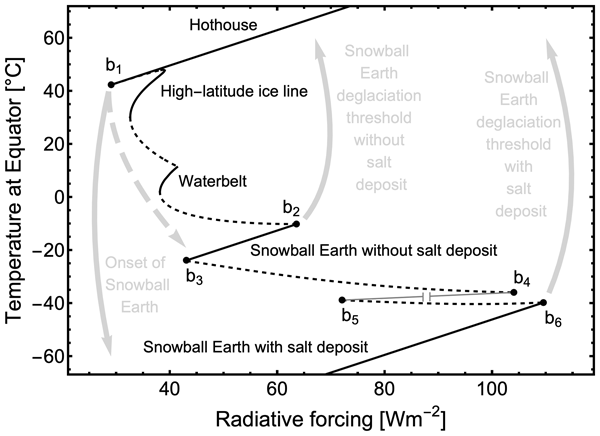
2.1 Figure 1 could be clarified. The transition of b4 to b5 isn’t discussed within the main text – this might be useful. Also indicate more clearly which part of the diagram relate to “Snowball Earth without salt deposit” (b2 – b4) and “Snowball Earth with Salt deposit”. If my understanding is correct, I would also indicate that the “waterbelt” state is the Jormungand hypothesised configuration.
2.2 L186. This is referring to the boundary between the shaded and non-shaded areas within Fig. 2. I would state “as shown in Fig. 2.” or something similar.
Citation: https://doi.org/10.5194/egusphere-2026-679-RC2 -
AC2: 'Reply on RC2', Aksel Samuelsberg, 19 May 2026
We thank the reviewer for their constructive and helpful comments on our work. We have carefully considered all comments and respond to them below.
Comments:1. Our model does not explicitly simulate precipitation and accumulation processes, and instead we adopt a prescribed negative mass balance in tropical latitudes based on previous studies cited in the manuscript. This is a key modelling assumption, and a corresponding caveat has been added in the revised manuscript on line 149.
2. We have improved the description of the albedo values in this passage in the revised manuscript. We have also added a description of the albedo values in the Eq. (2), we thank the reviewer for this suggestion.
3. We thank the reviewer for highlighting this point, as it will be valuable to clarify it in the revised manuscript. The development of a salt crystal deposit is a gradual process and will have some additional temperature dependence that is not captured by the step-function response at the eutectic temperature. However, we note that the model allows for spatial heterogeneity in the salt deposits, it is just that all states with a partial salt cover are unstable. This means that once the initial salt deposits form, the system collapses into the fully salt-covered Snowball Earth state, if the starting state is a warm pre-glacial climate. Furthermore, it does not matter at what temperature this process starts, the system ultimately ends up in the full salt state (Fig. 2, given Te > -36°C). While we have only looked at equilibrium states in the manuscript, these transitions have been verified by dynamical simulations (see line 75).
We have added additional discussion of this issue starting at line 139 in the revised manuscript. We have also included an extra panel in Fig. 3 to show how different salt crystal albedo values (α4) affect the system and the bifurcation points (b4–b6).
4. We agree with the reviewer that this can be further elaborated upon. We have moved this figure to the main text and added further comments about how we can read the figure to assess accessibility of the salt-free Snowball Earth state. This is on line 102 in the revised manuscript.
Minor comments:
1. We agree that it is useful to clarify that solutions with partial salt cover on the bare sea ice exist between b3 to b6 in Fig. 1 in the main text, including the truncated branches between b4 to b5. This has been added on line 84 in the revised manuscript.We have also revised the caption of Fig. 1 and added a clarification that only stable states are labeled. This is to more clearly indicate which climate states correspond to what branch in the bifurcation diagram. A clarification to distinguish the “Snowball Earth without salt deposit” and “Snowball Earth with salt deposit” branches in Fig. 1 has been added in the main text on line 82 in the revised manuscript.
The Waterbelt, or Jormungand, state follows from the inclusion of a bare sea ice albedo in the albedo function (i.e., the Jormungand mechanism) as discussed in the main text on line 32. We agree that, with the chosen projection, it is less clear that this branch represents the Waterbelt state, since the ice-line latitude is not shown on the y-axis, as is common in the EBM literature. To address this, we have clarified the labeling of the states in the caption of Fig. 1.
2. Done as suggested.Citation: https://doi.org/10.5194/egusphere-2026-679-AC2
-
AC2: 'Reply on RC2', Aksel Samuelsberg, 19 May 2026
Peer review completion


Interactive discussion
Status: closed
-
RC1: 'Comment on egusphere-2026-679', Anonymous Referee #1, 10 Mar 2026
GENERAL COMMENT: This paper investigates the effect of extremely bright ice resulting from the presence of salt deposits under Snowball Earth conditions. Such ice, no characterized by an exceptionally high albedo, would amplify global cooling because it forms in low-latitude regions, which receive the highest levels of solar insolation. Consequently, the temperature of the Snowball Earth state would be even lower, making the exit from this climatic state more difficult.
This effect is quantified using an energy balance model (EBM) in which the albedo is determined solely by the surface albedo (cloud effects are not included), with ice properties varying as a function of temperature and the presence or absence of snow cover.
The paper presents novel results using a clear methodology to address a specific Snowball Earth–related problem. None of the issues identified during the review raise concerns about the validity of the results presented.
SPECIFIC COMMENTS (ordered by importance)
-
Surface conditions formalism. The formalism used to describe the surface conditions (lines 28–44) is limited to temperature and the absence of snow (P–E < 0). However, the results of Jason C. Goodman (2006) clearly show that surface water is primarily of meteoric origin and therefore very low in salinity, except between approximately 0–3° latitude (see meteoric ice vs. marine ice, Fig. 2 in the paper).
This important point is only briefly mentioned (line 110) and the appropriate reference is not cited. The relevant study is:
Goodman, J. C. (2006), Through thick and thin: Marine and meteoric ice in a “Snowball Earth” climate, Geophysical Research Letters, 33, L16701. https://doi.org/10.1029/2006GL026840.
Given the importance of this issue for the process investigated in the manuscript, this point deserves more attention and should be discussed in greater detail.
-
Additional Figure
A figure similar to that presented by Goodman (Fig. 3), showing solar radiation, albedo, and temperature, would be useful. This figure could distinguish two cases: with and without the salt crust. It could also serve as an opportunity to summarize the boundary conditions used in the model (e.g., absence of continents, no-clouds, solar constant used, etc.). -
Figure 1 X-axis addition
For Fig. 1, adding a second X-axis corresponding to CO₂ concentration would be useful, in addition to the radiative forcing. This can be easily computed at first order using the relationship provided by:
Kiehl, J. T., & Dickinson, R. E. (1987), A study of the radiative effects of enhanced atmospheric CO₂ and CH₄ on early Earth surface temperatures, Journal of Geophysical Research: Atmospheres, 92(D3), 2991–2998. https://doi.org/10.1029/JD092iD03p02991
Addressing these points would further strengthen the paper, particularly the discussion of marine ice (salt deposits) vs meteoric ice.
-
AC1: 'Reply on RC1', Aksel Samuelsberg, 19 May 2026
We thank the reviewer for their positive evaluation of our manuscript and for their insightful feedback. We have carefully considered all comments and suggestions, and our responses are detailed below.
SPECIFIC COMMENTS:1. We agree that it is important to further elaborate on the issue of marine ice vs meteoric ice on Snowball Earth in relation to the salt-albedo feedback. We thank the reviewer for pointing us to that relevant study. This point has been further discussed in the revised manuscript on line 115 and line 148.
Other comments:
1. We think this is a good idea and thank the reviewer for this suggestion. We have added a figure like this in the revised manuscript.2. We agree that adding a second x-axis with CO2 would be useful, but this is challenging within the chosen model framework. We have explored this option (see attached PDF), where estimated CO2 concentrations are shown on the secondary axis. However, we think this could mislead the reader into thinking that model responds explicitly to a CO2 input. We believe the second axis reads as a given model output for a given CO2 input, which is not the case. To avoid this potential confusion, we prefer not to prescribe CO2 concentrations in the Snowball Earth hysteresis for this work. We hope the reviewer can accept our justification for omitting a second axis with CO2 in the revised manuscript.
-
-
RC2: 'Review of egusphere-2026-679', Anonymous Referee #2, 15 Apr 2026
This manuscript investigates a novel salt–albedo feedback mechanism in the context of Snowball Earth glaciations. The authors implemented a parameterisation of salt crystal precipitation on sea ice and its associated high albedo (α = 0.93) within a one-dimensional diffusive energy balance model (EBM). They found that the salt–albedo feedback produces two fully glaciated Snowball Earth equilibria: one with surface salt deposits (significantly colder) and one without. Through bifurcation analysis, the authors argue that the salt-deposit Snowball Earth state is accessible from warm pre-glacial climates, implying that salt precipitation amplified cooling during Snowball Earth events.
Overall Assessment
The paper is clearly written and presents an advancement in the field. Whilst some of the mathematics was beyond my understanding, the mathematical treatment seems comprehensive and consistent with previous EBM studies, and the core result that salt precipitation introduces new stable branches in the bifurcation diagram is reasonable. I feel that several issues should be addressed before publication. In particular, the discussion of model limitations needs to be expanded upon a little, and the physical plausibility and robustness of parameterisation choices should be examined a little bit more in the main text. The Snowball salt-albedo feedback is an interesting and previously overlooked mechanism, which has no modern analogue. Therefore, I think the manuscript is a welcome addition to the field.
1.Comments
1.1 Surface Mass Balance (Accumulation).
The process of salt precipitation on the sea ice, relies on sublimation removing surface ice (to expose the precipitated salt crystals). I think discussion of snow accumulation is required, or at least why this is expected to be less than ablation (so that the mass balance is negative). This should be added to the caveats to the results, which are otherwise extensive.
1.2 Description of albedo values
The description of the albedo values (L28) could be clarified. Also I think the paper would benefit from a figure to accompany Eq. 2, or if the equation was modified to include a descriptor of the α value, for example, α1 (ice-free latitudes), α2(ice/snow cover), α3(bare sea ice region; equatorward of r1), and α4(sea ice topped by salt deposit equatorward of r1).
1.3 Step-function albedo response at the eutectic temperature.
The albedo function (Eq. 2) switches from α3 to α4 at Te = −36°C. Salt precipitation from sea ice would be a progressive process. As the authors note, as the ice cools, brine trapped within the ice matrix reaches saturation for different salt species (e.g., miravalite vs. hydrohalite) at different temperatures. In addition, exposure to salt crystals occurs gradually, leading to spatial heterogeneity. While these omissions are discussed (paragraph starting L133), this could be investigated by conducting sensitivity experiments with reduced α4 (or gradually increasing it) or α4 which is a function of T (I’m unsure if these simulations were time-dependent). This would help to constrain the strength of the feedback. The authors describe that lower albedo shifts bifurcation points b4 and b6 but do not explicitly show these points on Fig. 1 (L144) only Fig. A1d which is not referred to.
1.4 Robustness of Snowball Earth accessibility and sensitivity to parameter choices.
The authors state that the salt-free Snowball Earth is inaccessible for plausible model parameters (L98) which depend upon the Eutectic temperature Te and ice formation temperature Ts (-10°C) and present within Fig.2. Uncertainty in key parameters and their impact on the bifurcation diagram is presented within the Appendix B (Fig. A1) but isn’t discussed further in the main text. I think this would be useful, as the authors have been thorough in their modelling.
2. Minor Comments
2.1 Figure 1 could be clarified. The transition of b4 to b5 isn’t discussed within the main text – this might be useful. Also indicate more clearly which part of the diagram relate to “Snowball Earth without salt deposit” (b2 – b4) and “Snowball Earth with Salt deposit”. If my understanding is correct, I would also indicate that the “waterbelt” state is the Jormungand hypothesised configuration.
2.2 L186. This is referring to the boundary between the shaded and non-shaded areas within Fig. 2. I would state “as shown in Fig. 2.” or something similar.
Citation: https://doi.org/10.5194/egusphere-2026-679-RC2 -
AC2: 'Reply on RC2', Aksel Samuelsberg, 19 May 2026
We thank the reviewer for their constructive and helpful comments on our work. We have carefully considered all comments and respond to them below.
Comments:1. Our model does not explicitly simulate precipitation and accumulation processes, and instead we adopt a prescribed negative mass balance in tropical latitudes based on previous studies cited in the manuscript. This is a key modelling assumption, and a corresponding caveat has been added in the revised manuscript on line 149.
2. We have improved the description of the albedo values in this passage in the revised manuscript. We have also added a description of the albedo values in the Eq. (2), we thank the reviewer for this suggestion.
3. We thank the reviewer for highlighting this point, as it will be valuable to clarify it in the revised manuscript. The development of a salt crystal deposit is a gradual process and will have some additional temperature dependence that is not captured by the step-function response at the eutectic temperature. However, we note that the model allows for spatial heterogeneity in the salt deposits, it is just that all states with a partial salt cover are unstable. This means that once the initial salt deposits form, the system collapses into the fully salt-covered Snowball Earth state, if the starting state is a warm pre-glacial climate. Furthermore, it does not matter at what temperature this process starts, the system ultimately ends up in the full salt state (Fig. 2, given Te > -36°C). While we have only looked at equilibrium states in the manuscript, these transitions have been verified by dynamical simulations (see line 75).
We have added additional discussion of this issue starting at line 139 in the revised manuscript. We have also included an extra panel in Fig. 3 to show how different salt crystal albedo values (α4) affect the system and the bifurcation points (b4–b6).
4. We agree with the reviewer that this can be further elaborated upon. We have moved this figure to the main text and added further comments about how we can read the figure to assess accessibility of the salt-free Snowball Earth state. This is on line 102 in the revised manuscript.
Minor comments:
1. We agree that it is useful to clarify that solutions with partial salt cover on the bare sea ice exist between b3 to b6 in Fig. 1 in the main text, including the truncated branches between b4 to b5. This has been added on line 84 in the revised manuscript.We have also revised the caption of Fig. 1 and added a clarification that only stable states are labeled. This is to more clearly indicate which climate states correspond to what branch in the bifurcation diagram. A clarification to distinguish the “Snowball Earth without salt deposit” and “Snowball Earth with salt deposit” branches in Fig. 1 has been added in the main text on line 82 in the revised manuscript.
The Waterbelt, or Jormungand, state follows from the inclusion of a bare sea ice albedo in the albedo function (i.e., the Jormungand mechanism) as discussed in the main text on line 32. We agree that, with the chosen projection, it is less clear that this branch represents the Waterbelt state, since the ice-line latitude is not shown on the y-axis, as is common in the EBM literature. To address this, we have clarified the labeling of the states in the caption of Fig. 1.
2. Done as suggested.Citation: https://doi.org/10.5194/egusphere-2026-679-AC2
-
AC2: 'Reply on RC2', Aksel Samuelsberg, 19 May 2026
Peer review completion
Journal article(s) based on this preprint
Viewed
| HTML | XML | Total | BibTeX | EndNote | |
|---|---|---|---|---|---|
| 2,859 | 1,106 | 91 | 4,056 | 108 | 179 |
- HTML: 2,859
- PDF: 1,106
- XML: 91
- Total: 4,056
- BibTeX: 108
- EndNote: 179
Viewed (geographical distribution)
| Country | # | Views | % |
|---|
| Total: | 0 |
| HTML: | 0 |
| PDF: | 0 |
| XML: | 0 |
- 1
Aksel Samuelsberg

Per Kristen Jakobsen
Martin Rypdal
The requested preprint has a corresponding peer-reviewed final revised paper. You are encouraged to refer to the final revised version.
- Preprint
(1977 KB) - Metadata XML
GENERAL COMMENT: This paper investigates the effect of extremely bright ice resulting from the presence of salt deposits under Snowball Earth conditions. Such ice, no characterized by an exceptionally high albedo, would amplify global cooling because it forms in low-latitude regions, which receive the highest levels of solar insolation. Consequently, the temperature of the Snowball Earth state would be even lower, making the exit from this climatic state more difficult.
This effect is quantified using an energy balance model (EBM) in which the albedo is determined solely by the surface albedo (cloud effects are not included), with ice properties varying as a function of temperature and the presence or absence of snow cover.
The paper presents novel results using a clear methodology to address a specific Snowball Earth–related problem. None of the issues identified during the review raise concerns about the validity of the results presented.
SPECIFIC COMMENTS (ordered by importance)
Surface conditions formalism. The formalism used to describe the surface conditions (lines 28–44) is limited to temperature and the absence of snow (P–E < 0). However, the results of Jason C. Goodman (2006) clearly show that surface water is primarily of meteoric origin and therefore very low in salinity, except between approximately 0–3° latitude (see meteoric ice vs. marine ice, Fig. 2 in the paper).
This important point is only briefly mentioned (line 110) and the appropriate reference is not cited. The relevant study is:
Goodman, J. C. (2006), Through thick and thin: Marine and meteoric ice in a “Snowball Earth” climate, Geophysical Research Letters, 33, L16701. https://doi.org/10.1029/2006GL026840.
Given the importance of this issue for the process investigated in the manuscript, this point deserves more attention and should be discussed in greater detail.
Additional Figure
A figure similar to that presented by Goodman (Fig. 3), showing solar radiation, albedo, and temperature, would be useful. This figure could distinguish two cases: with and without the salt crust. It could also serve as an opportunity to summarize the boundary conditions used in the model (e.g., absence of continents, no-clouds, solar constant used, etc.).
Figure 1 X-axis addition
For Fig. 1, adding a second X-axis corresponding to CO₂ concentration would be useful, in addition to the radiative forcing. This can be easily computed at first order using the relationship provided by:
Kiehl, J. T., & Dickinson, R. E. (1987), A study of the radiative effects of enhanced atmospheric CO₂ and CH₄ on early Earth surface temperatures, Journal of Geophysical Research: Atmospheres, 92(D3), 2991–2998. https://doi.org/10.1029/JD092iD03p02991
Addressing these points would further strengthen the paper, particularly the discussion of marine ice (salt deposits) vs meteoric ice.