
the Creative Commons Attribution 4.0 License.
the Creative Commons Attribution 4.0 License.
 | 16 Mar 2026
Stratospheric Aerosol Measurements Using a Frequency Scanning Lidar Method
Abstract. We present a Frequency Scanning Lidar method (FSL method) for measuring stratospheric aerosols up to an altitude of 30 km. This approach leverages an ultra-narrowband Alexandrite ring laser with a spectral width of 3.3 MHz and high-resolution spectroscopy with a spectral resolution of 100 MHz, enabling the separation of molecule and aerosol scattering. The FSL method's solar-blind Mie channel allows for measurements both day and night, while its compact design (approximately one cubic meter in volume) facilitates mobile deployment. With a vertical resolution of 200 m and a temporal resolution of 20 min, as achieved for the data presented here using the instrument configuration described in this study, the FSL method provides high-resolution observations of aerosol distributions in the stratosphere. The uncertainties of the FSL method for the backscatter coefficient are approximately 1.5 × 10⁻¹⁰ m−1 sr−1 at 20 km, both during day and night. We demonstrate the method's capabilities by presenting backscatter coefficient profiles measured during selected periods from 2022 to 2024. These profiles show good agreement with satellite-derived profiles from the Ozone Mapping and Profiler Suite Limb Profiler (OMPS-LP) and the Stratospheric Aerosol and Gas Experiment on the International Space Station (SAGE III/ISS) with a mean absolute deviation of ∼ 25 % at altitudes of 15–25 km. This demonstrates the potential of the FSL method for providing high-resolution, long-term observations of stratospheric aerosols.
Competing interests: At least one of the (co-)authors is a member of the editorial board of Atmospheric Measurement Techniques.
Publisher's note: Copernicus Publications remains neutral with regard to jurisdictional claims made in the text, published maps, institutional affiliations, or any other geographical representation in this paper. While Copernicus Publications makes every effort to include appropriate place names, the final responsibility lies with the authors. Views expressed in the text are those of the authors and do not necessarily reflect the views of the publisher.-
Notice on discussion status
The requested preprint has a corresponding peer-reviewed final revised paper. You are encouraged to refer to the final revised version.
-
Preprint
(1900 KB)
-
The requested preprint has a corresponding peer-reviewed final revised paper. You are encouraged to refer to the final revised version.
- Preprint
(1900 KB) - Metadata XML
- BibTeX
- EndNote
- Final revised paper


Journal article(s) based on this preprint
Interactive discussion
Status: closed
-
RC1: 'Comment on egusphere-2026-675', Anonymous Referee #1, 13 Apr 2026
- AC1: 'Reply on RC1', Ronald Eixmann, 09 Jul 2026
-
RC2: 'Comment on egusphere-2026-675', Anonymous Referee #2, 21 May 2026
The paper describes the use of a Frequency Scanning Lidar as an aerosol lidar for stratospheric aerosol observations. It is appropriate for AMT. To my opinion, the full FSL method needs to be better explained. A lot of details are missing.
Major revisions are needed.
Abstract: Please mention the measurement wavelength!
Introduction
P1, l15: stratospheric aerosol may play an important role, but not a central role.
P2, l38: I do not believe that space-borne spectrometers are the work horses for stratospheric aerosol observations. Please add to the list: spaceborne lidars, CALIPSO/CALIOP; EarthCARE/ATLID, Aeolus/Aladin together with relevant aerosol-related references. And even China has meanwhile a 532 nm HSRL lidar in space: ACDL/DQ-1, Dai et al., AMT 2024. And recently the launched the second 532 nm HSRL.
P47, l47: lidar measurements from ground?, from space?, airborne? What do you mean here?
P2, l58: Please mention the papers of Trickl et al. (several papers in ACP, long term observation over decades), Sakai et al. (JGR, 2025, long term observations over decades), and maybe Ohneiser et al. (ACP, 2022, Australian smoke), Baars et al. (ACP, 2019, Canadian smoke), Hu et al. (ACP, JGR, Lille lidar, France).
P2, l61-64: The motivation for the FSL lidar sounds not very convincing. One can use a simple 1064 nm backscatter lidar for stratospheric observations. The Rayleigh backscatter is even lower at that wavelength than at 770 nm. Most useful aerosol lidars are multiwavelength systems with laser wavelengths from 355 to 1064 nm.
One needs to better stress that this powerful lidar can be used day and night, most lidar cannot provide useful stratospheric information at daytime. And in this context it is necessary to provide arguments why daytime observations or better continuous observations throughout the day are necessary.
Otherwise the question remains, why do we need this FSL method?
Methodology
P3, l72: Better use Fernald 1984, not Klett 1985?
P3, l75: Rayleigh scattering as a function of temperature and pressure is considered in all lidar applications! There is no neglection of the temperature dependence!
P3, l78 to P4, l104: Please be short here, EARLINET uses Raman lidars since 25 years, HSRL lidars are used as aerosol lidars also for more than 20 years. There is no need to repeat all lidar basics in such detail. But the essential point is that the lidars have to have two signal channels for aerosol and for molecular signal detection, and then the goal is to provide not only backscatter coefficients, but also, extinction and lidar ratio profiles, and this preferably at several wavelengths. A ‘simple’ 770 nm FSL backscatter lidar is not just state-of-the-art from this point of view. So, it is necessary to sharpen the motivation for such an FSL. What is the main and unique advantage to run a 770 nm FSL, where is the gap in the global lidar landscape for such a system?
P4, l106: Why do we need an aerosol lidar that samples multiple frequencies within a short time period by changing the laser frequency from pulse to pulse? What is the motivation for such an approach? That should be made very clear here.
P4, l124: What about the receiver unit? Some information about the receiver telescope (primary mirrow diameter, etc.) is missing.
P5, l125-129: It remains unclear why we need laser wavelength tuning when we simply want to measure aerosol backscatter profiles at 770 nm?
P5, Figure 1: The sketch is confusing! Why do we see the aerosol peaks in the profiles (to the right…) when using the Rayleigh channel (APD 2)? There is a lot of cross talk?
P5, l135: We need more and precise information how you separate Mie and Rayleigh components when there is so much cross talk! And the question remains: why do we need a frequency scanning lidar to measure aerosol profiles? Maybe I missed the point and it is explained somewhere. But many readers may have the same problems!
P6, l147: Pleae provide a reference for Eq. (1)!
P6, l163: You need two APDs, not one? You have APD1 and APD2, not a single APD!
P6, l155-162: Is this method similar to Aeolus ALADIN and ATLID methods to separate Mie and Rayleigh signals? Could be mentioned!
P7, Figure 2: The figure is confusing! The full spectrum of the APD1 is stored and analyzed? This was not mentioned before, or did I miss that? There are three profile the total APD2 backscatter, the APD2 Rayleigh component, and even the APD1 Rayleigh component. How did you compute all this? These are essential points of the aerosol FSL approach and must described in the manuscript.
P7, l176: P2,total is scaled to P1,Ray at 15 km! What does that exactly mean?
P7, l179 and 181: Now two correction factors come into play! Were these essential parameters introduced and mentioned before, when explaining the sketch (Figure 1)? Did I miss this? If they were not introduced, all this has to be improved in such a technical paper. Providing references to other publications is not acceptable.
P9, l225: A comparison with CALIOP observations could be done in the case of the volcanic Raikoke aerosol in the summer and autumn of 2019.
P10, 268: The size distribution is unkown and thus the uncertainty in the lidar ratio is high. Why not use the FSL to derive extinction and lidar ratio information? What is the reason not to offer this option?
P11, 275-280: All this does not work after the Raikoe eruption in June 2019. The Raikoke plumes were visible in the stratosphere between 14-26 km for the next two years.
Results:
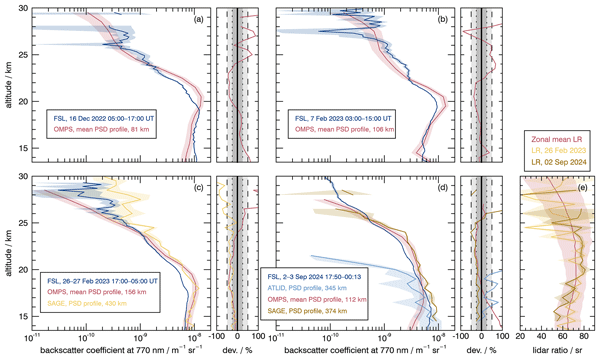
P12, Figure 3: Please add proper tick marks to x-axis and y-axis. What are the reasons for the peaks in the profiles? Hunga-Tonga sulfate aerosol layers? Please clarify! Why not showing the full day observations (from 8:10 UTC on 7 Feb to 8:10 UTC on 8 Feb)? Observations from 15:30 to 8:10 UTC are mostly nighttime observations! But the advantage of the 770 nm FSL are daytime observations! If there were clouds before 15:30 UTC on 7 Feb, one should select another day.
At the end the question remains: what is the goal of the manuscript? The FSL delivers aerosol backscatter and layering structures of stratospheric aerosol at 770 nm wavelength. No depolarization information is available. Depolarization information helps to distinguish stratospheric wildfire smoke and volcanic sulfate aerosol. The depolarization option is meanwhile a basic requirement for a state-of-the-art aerosol lidar. Such critical points should be discussed as well, maybe in the conclusion section.
Citation: https://doi.org/10.5194/egusphere-2026-675-RC2 - AC2: 'Reply on RC2', Ronald Eixmann, 09 Jul 2026
Peer review completion


Interactive discussion
Status: closed
-
RC1: 'Comment on egusphere-2026-675', Anonymous Referee #1, 13 Apr 2026
The manuscript describes a method to derive the backscatter coefficient of stratospheric aerosol from a novel frequency scanning lidar system. It is of great interest for the scientific community to resolve with high vertical and temporal resolution even low amounts of stratospheric aerosol. They compared their results to passive satellite observations and found a reasonable agreement considering the uncertainties of the spaceborne instruments. The manuscript is well written and structured and fits into the scope of AMT. I would recommend publication after minor revisions.
Main comments:
- You derive independently profiles of the Mie and Rayleigh signal similar to the HSRL method. The pure molecular signal would allow you to derive the extinction coefficient from your observations additionally to the backscatter coefficient. It would be a great achievement to deliver the extinction coefficient as well, because (1) you could better compare it to the extinction coefficient derived from the passive satellite observations without the assumption of a lidar ratio and (2) you could derive the lidar ratio of the stratospheric aerosol from FSL. Have you tried to derive the extinction coefficient? If possible, you could add it (as a “cherry on the cake”) to the paper, if not, you could discuss why it is not possible to get the extinction coefficient.
- It is good that you prove the consistency of your backscatter coefficients with independent observations by OMPS and SAGE-III. I would consider a comparison to ATLID as well. You state, that the wavelength conversion from 355 to 770 nm hampered the comparison. However, the comparison to OMPS and SAGE also required a number of additional steps and assumptions. If you once have to assume a particle size distribution (PSD), you could easily calculate the backscatter Angstrom exponent from 355 to 770 nm for sulfate aerosol and use ATLID for comparison. Wavelength dependent signal attenuation in the stratosphere is, e.g., discussed in Kar et al., AMT 2026. There is no direct overpass of EarthCARE for your 4 selected comparison cases, but for the September 2024 case, the orbits 1503D or 1510B might be considered.
Minor comments:
- In the introduction the usage of ground-based and spaceborne lidar systems for stratospheric aerosol observations is underrepresented. There are plenty of studies using these lidar systems for the study of stratospheric aerosol. There are studies focusing on volcanic eruptions or wildfire smoke injections as well as long-term monitoring of stratospheric aerosol conditions. The FSL method provides another great opportunity to study stratospheric aerosol additional to the already existing ones.
- You use the spectral scanning capability of your laser to derive the spectrum in the receiver. This technique is needed for retrieving the wind speed. There are other (simpler) approaches which use scanning capabilities in the receiver to separate the Rayleigh and Mie signal for the purpose of aerosol retrievals. Please include a short discussion in Sect. 2.1.
- Two short questions about your system: What is the height of full overlap? And is it operated continuously or manually?
- Could you indicate the time of sunset and sunrise in Fig. 3 to underline the good performance during daytime?
Technical corrections
- L102 The ATLID aerosol retrieval is described in Donovan et al., AMT 2024.
- Fig 2 caption “APD1 on 28 February”
- L228 ATLID is not a Doppler lidar, but a HSRL
- L423 “These …” please provide a noun from the previous sentence to which “these” corresponds to be unambiguous here.
Citation: https://doi.org/10.5194/egusphere-2026-675-RC1 - AC1: 'Reply on RC1', Ronald Eixmann, 09 Jul 2026
-
RC2: 'Comment on egusphere-2026-675', Anonymous Referee #2, 21 May 2026
The paper describes the use of a Frequency Scanning Lidar as an aerosol lidar for stratospheric aerosol observations. It is appropriate for AMT. To my opinion, the full FSL method needs to be better explained. A lot of details are missing.
Major revisions are needed.
Abstract: Please mention the measurement wavelength!
Introduction
P1, l15: stratospheric aerosol may play an important role, but not a central role.
P2, l38: I do not believe that space-borne spectrometers are the work horses for stratospheric aerosol observations. Please add to the list: spaceborne lidars, CALIPSO/CALIOP; EarthCARE/ATLID, Aeolus/Aladin together with relevant aerosol-related references. And even China has meanwhile a 532 nm HSRL lidar in space: ACDL/DQ-1, Dai et al., AMT 2024. And recently the launched the second 532 nm HSRL.
P47, l47: lidar measurements from ground?, from space?, airborne? What do you mean here?
P2, l58: Please mention the papers of Trickl et al. (several papers in ACP, long term observation over decades), Sakai et al. (JGR, 2025, long term observations over decades), and maybe Ohneiser et al. (ACP, 2022, Australian smoke), Baars et al. (ACP, 2019, Canadian smoke), Hu et al. (ACP, JGR, Lille lidar, France).
P2, l61-64: The motivation for the FSL lidar sounds not very convincing. One can use a simple 1064 nm backscatter lidar for stratospheric observations. The Rayleigh backscatter is even lower at that wavelength than at 770 nm. Most useful aerosol lidars are multiwavelength systems with laser wavelengths from 355 to 1064 nm.
One needs to better stress that this powerful lidar can be used day and night, most lidar cannot provide useful stratospheric information at daytime. And in this context it is necessary to provide arguments why daytime observations or better continuous observations throughout the day are necessary.
Otherwise the question remains, why do we need this FSL method?
Methodology
P3, l72: Better use Fernald 1984, not Klett 1985?
P3, l75: Rayleigh scattering as a function of temperature and pressure is considered in all lidar applications! There is no neglection of the temperature dependence!
P3, l78 to P4, l104: Please be short here, EARLINET uses Raman lidars since 25 years, HSRL lidars are used as aerosol lidars also for more than 20 years. There is no need to repeat all lidar basics in such detail. But the essential point is that the lidars have to have two signal channels for aerosol and for molecular signal detection, and then the goal is to provide not only backscatter coefficients, but also, extinction and lidar ratio profiles, and this preferably at several wavelengths. A ‘simple’ 770 nm FSL backscatter lidar is not just state-of-the-art from this point of view. So, it is necessary to sharpen the motivation for such an FSL. What is the main and unique advantage to run a 770 nm FSL, where is the gap in the global lidar landscape for such a system?
P4, l106: Why do we need an aerosol lidar that samples multiple frequencies within a short time period by changing the laser frequency from pulse to pulse? What is the motivation for such an approach? That should be made very clear here.
P4, l124: What about the receiver unit? Some information about the receiver telescope (primary mirrow diameter, etc.) is missing.
P5, l125-129: It remains unclear why we need laser wavelength tuning when we simply want to measure aerosol backscatter profiles at 770 nm?
P5, Figure 1: The sketch is confusing! Why do we see the aerosol peaks in the profiles (to the right…) when using the Rayleigh channel (APD 2)? There is a lot of cross talk?
P5, l135: We need more and precise information how you separate Mie and Rayleigh components when there is so much cross talk! And the question remains: why do we need a frequency scanning lidar to measure aerosol profiles? Maybe I missed the point and it is explained somewhere. But many readers may have the same problems!
P6, l147: Pleae provide a reference for Eq. (1)!
P6, l163: You need two APDs, not one? You have APD1 and APD2, not a single APD!
P6, l155-162: Is this method similar to Aeolus ALADIN and ATLID methods to separate Mie and Rayleigh signals? Could be mentioned!
P7, Figure 2: The figure is confusing! The full spectrum of the APD1 is stored and analyzed? This was not mentioned before, or did I miss that? There are three profile the total APD2 backscatter, the APD2 Rayleigh component, and even the APD1 Rayleigh component. How did you compute all this? These are essential points of the aerosol FSL approach and must described in the manuscript.
P7, l176: P2,total is scaled to P1,Ray at 15 km! What does that exactly mean?
P7, l179 and 181: Now two correction factors come into play! Were these essential parameters introduced and mentioned before, when explaining the sketch (Figure 1)? Did I miss this? If they were not introduced, all this has to be improved in such a technical paper. Providing references to other publications is not acceptable.
P9, l225: A comparison with CALIOP observations could be done in the case of the volcanic Raikoke aerosol in the summer and autumn of 2019.
P10, 268: The size distribution is unkown and thus the uncertainty in the lidar ratio is high. Why not use the FSL to derive extinction and lidar ratio information? What is the reason not to offer this option?
P11, 275-280: All this does not work after the Raikoe eruption in June 2019. The Raikoke plumes were visible in the stratosphere between 14-26 km for the next two years.
Results:
P12, Figure 3: Please add proper tick marks to x-axis and y-axis. What are the reasons for the peaks in the profiles? Hunga-Tonga sulfate aerosol layers? Please clarify! Why not showing the full day observations (from 8:10 UTC on 7 Feb to 8:10 UTC on 8 Feb)? Observations from 15:30 to 8:10 UTC are mostly nighttime observations! But the advantage of the 770 nm FSL are daytime observations! If there were clouds before 15:30 UTC on 7 Feb, one should select another day.
At the end the question remains: what is the goal of the manuscript? The FSL delivers aerosol backscatter and layering structures of stratospheric aerosol at 770 nm wavelength. No depolarization information is available. Depolarization information helps to distinguish stratospheric wildfire smoke and volcanic sulfate aerosol. The depolarization option is meanwhile a basic requirement for a state-of-the-art aerosol lidar. Such critical points should be discussed as well, maybe in the conclusion section.
Citation: https://doi.org/10.5194/egusphere-2026-675-RC2 - AC2: 'Reply on RC2', Ronald Eixmann, 09 Jul 2026
Peer review completion
Journal article(s) based on this preprint
Viewed
| HTML | XML | Total | BibTeX | EndNote | |
|---|---|---|---|---|---|
| 802 | 423 | 95 | 1,320 | 81 | 93 |
- HTML: 802
- PDF: 423
- XML: 95
- Total: 1,320
- BibTeX: 81
- EndNote: 93
Viewed (geographical distribution)
| Country | # | Views | % |
|---|
| Total: | 0 |
| HTML: | 0 |
| PDF: | 0 |
| XML: | 0 |
- 1
Ronald Eixmann

Thorben H. Lüke-Mense
Jan Froh
Michael Gerding
Josef Höffner
Christian Löns
Robin Wing
Christian von Savigny
Gerd Baumgarten
The requested preprint has a corresponding peer-reviewed final revised paper. You are encouraged to refer to the final revised version.
- Preprint
(1900 KB) - Metadata XML
The manuscript describes a method to derive the backscatter coefficient of stratospheric aerosol from a novel frequency scanning lidar system. It is of great interest for the scientific community to resolve with high vertical and temporal resolution even low amounts of stratospheric aerosol. They compared their results to passive satellite observations and found a reasonable agreement considering the uncertainties of the spaceborne instruments. The manuscript is well written and structured and fits into the scope of AMT. I would recommend publication after minor revisions.
Main comments:
Minor comments:
Technical corrections