
the Creative Commons Attribution 4.0 License.
the Creative Commons Attribution 4.0 License.
 | 15 Jan 2026
Aircraft‐derived particle fluxes distinguish entrainment zone and decoupled layer nucleation in marine boundary layers
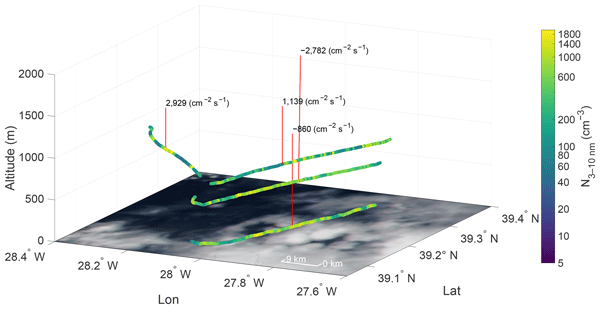
Abstract. New particle formation (NPF) in marine boundary layers plays a critical role in cloud condensation nuclei (CCN) budgets and aerosol–cloud interactions, yet the vertical distribution of NPF sources remains poorly constrained. We identified the vertical location of NPF events by deriving turbulent fluxes of 3–10 nm particles from aircraft measurements during the Aerosol and Cloud Experiments in the Eastern North Atlantic (ACE-ENA) campaign. To overcome stationarity limitations of traditional eddy covariance methods, we applied continuous wavelet transform analysis to data collected during June–July 2017 and January–February 2018 flights over the Azores. Our flux‐based analysis revealed two distinct NPF scenarios with fundamentally different vertical structures and spatial extents. The first scenario featured nucleation in the entrainment zone, where free tropospheric air entrains into the boundary layer. The second scenario showed nucleation in the decoupled layer, a stratified region between the well‐mixed surface layer and cloud-topped upper boundary layer. Both cases exhibited strong downward particle fluxes driven by similar mechanisms: air masses from different layers and mixing, which diluted aerosols to very low particle surface area, creating favorable nucleation conditions. NPF occurred in 15 % of flights, challenging prevailing theoretical expectations that NPF should rarely occur in marine boundary layers due to high condensation and coagulation sinks from sea spray aerosols. Aircraft‐derived aerosol fluxes provide essential observational constraints on the vertical distribution and source strength of new particle formation in marine environments, enabling improved representation of these processes in climate models.
Competing interests: At least one of the (co-)authors is a member of the editorial board of Atmospheric Chemistry and Physics. The peer-review process was guided by an independent editor, and the authors also have no other competing interests to declare.
Publisher's note: Copernicus Publications remains neutral with regard to jurisdictional claims made in the text, published maps, institutional affiliations, or any other geographical representation in this paper. While Copernicus Publications makes every effort to include appropriate place names, the final responsibility lies with the authors. Views expressed in the text are those of the authors and do not necessarily reflect the views of the publisher.-
Notice on discussion status
The requested preprint has a corresponding peer-reviewed final revised paper. You are encouraged to refer to the final revised version.
-
Preprint
(15547 KB)
-
Supplement
(5939 KB)
-
The requested preprint has a corresponding peer-reviewed final revised paper. You are encouraged to refer to the final revised version.
- Preprint
(15547 KB) - Metadata XML
-
Supplement
(5939 KB) - BibTeX
- EndNote
- Final revised paper


Journal article(s) based on this preprint
Interactive discussion
Status: closed
-
RC1: 'Comment on egusphere-2026-61', Anonymous Referee #1, 04 Mar 2026
-
AC1: 'Reply on RC1', Nicholas Meskhidze, 18 May 2026
The comment was uploaded in the form of a supplement: https://egusphere.copernicus.org/preprints/2026/egusphere-2026-61/egusphere-2026-61-AC1-supplement.pdf
-
AC1: 'Reply on RC1', Nicholas Meskhidze, 18 May 2026
-
RC2: 'Comment on egusphere-2026-61', Anonymous Referee #2, 20 Mar 2026
-
AC2: 'Reply on RC2', Nicholas Meskhidze, 18 May 2026
The comment was uploaded in the form of a supplement: https://egusphere.copernicus.org/preprints/2026/egusphere-2026-61/egusphere-2026-61-AC2-supplement.pdf
-
AC2: 'Reply on RC2', Nicholas Meskhidze, 18 May 2026
Peer review completion


Interactive discussion
Status: closed
-
RC1: 'Comment on egusphere-2026-61', Anonymous Referee #1, 04 Mar 2026
General Comments
Overall, the paper is well written and clear. The two areas where <10 nm particles were measured provide important evidence that new particles can form in these boundary layer regions where this phenomenon is relatively unexplored. I was glad to see that the authors made corrections for in-cloud sampling and time lags, which show they have experience with aircraft measurements and have taken extra care. However, there are a few additional measurements that should be further discussed to strengthen the overall conclusions, as detailed below.
Specific Comments
Was there no measure of coarse-mode concentrations that are expected to be small in the SPE regions? This should be discussed, given that one of the main points of the paper seems to be to dispute the idea that sea-spray surface area inhibits new particle formation. As a proxy, even windspeeds (which aren’t discussed except in the framework of flux measurements), might be helpful.
Also, it would be useful to show time series of aerosol surface area, at least in the sub-micron sizes, as that looks to be a potentially important change that occurs in the SPE regions. Fig 4 indicates almost no particles in the 10-1000 nm range in the second SPE period—is that correct, or is that just missing data? (Stot is shown and briefly discussed in the Fig 4 b-d vertical profiles, but these are not from the actual SPE periods.)
Lines 428-436: Were these cases when clouds were present above? If so, did you check to rule out drizzle, which would breakup in the inlet and cause artifacts? Below-cloud drizzle would be independent of LWC, which is derived from the CDP (smaller sizes). Also, since droplet number concentrations are never given, it’s unknown whether or not these were clean clouds, which are more likely to precipitate. The sometimes high (up to 1 g m-3) LWCs would suggest drizzle as a possibility. Call me skeptical, but I’ve enough experience with in-situ cloud measurements from aircraft to know that artifacts are common. This point, as well as some discussion of which of the four source regimes (lines 75-78) that the presented measurements represent would be useful.
Fig 3a and discussion on lines 412-413—are these occasional spikes in 3-10 nm particles above the cloud layer--e.g., 11:20-11:25--real? Should be discussed to assure that some of the signals noted below are not from entrainment of particles from above. Unlikely, since the concentrations below are sometimes higher, and these are short spikes, so perhaps they are artifacts of some sort?
Minor Issues
Lines 43-35: “This expectation is based on the relatively high surface area of sea spray aerosols, which act as condensation and coagulation sinks for nucleating vapors and newly formed particles”. There are plenty of accumulation-mode sulfate/organic particles in most MBLs that also may act as condensation and coagulation sinks. As do clouds themselves. This should be mentioned.
Perhaps move some of the lengthy data and analysis criteria in Section 2 to the supplement, where some of the associated graphs already are?
Lines 340-342: “We examine two flight days as case studies of SPEs observed at varying altitudes above the ocean. Additional supporting flights are presented in the Supplementary Information for each case.” After this you go immediately into Table 1 that shows six different flight days, which I found confusing. Perhaps discuss Table first and then go into the case studies.
Figure 4a caption: “The main panel shows size-resolved particle number concentrations (10-600 nm) from FIMS as a function of time and altitude, while N3-10 concentrations in the lower strip.” I think “are shown” is missing before “in the lower strip”.
I would suggest making 4a and 4b-d (and 7a and 7b-d) into separate plots, as these are really different from each other and this is too much information to easily assimilate in a single plot.
Fig 7 has a lot of missing data, so I’d suggest explicitly adding the sentence from Fig 4 caption to Fig 7 caption as well. This confused me until I figured it out. (“Gaps in the time series indicate the missing data.“)
Citation: https://doi.org/10.5194/egusphere-2026-61-RC1 -
AC1: 'Reply on RC1', Nicholas Meskhidze, 18 May 2026
The comment was uploaded in the form of a supplement: https://egusphere.copernicus.org/preprints/2026/egusphere-2026-61/egusphere-2026-61-AC1-supplement.pdf
-
AC1: 'Reply on RC1', Nicholas Meskhidze, 18 May 2026
-
RC2: 'Comment on egusphere-2026-61', Anonymous Referee #2, 20 Mar 2026
-
AC2: 'Reply on RC2', Nicholas Meskhidze, 18 May 2026
The comment was uploaded in the form of a supplement: https://egusphere.copernicus.org/preprints/2026/egusphere-2026-61/egusphere-2026-61-AC2-supplement.pdf
-
AC2: 'Reply on RC2', Nicholas Meskhidze, 18 May 2026
Peer review completion
Journal article(s) based on this preprint
Viewed
| HTML | XML | Total | Supplement | BibTeX | EndNote | |
|---|---|---|---|---|---|---|
| 1,525 | 1,182 | 148 | 2,855 | 375 | 122 | 136 |
- HTML: 1,525
- PDF: 1,182
- XML: 148
- Total: 2,855
- Supplement: 375
- BibTeX: 122
- EndNote: 136
Viewed (geographical distribution)
| Country | # | Views | % |
|---|
| Total: | 0 |
| HTML: | 0 |
| PDF: | 0 |
| XML: | 0 |
- 1
Cited


Ajmal Rasheeda Satheesh
Markus D. Petters

The requested preprint has a corresponding peer-reviewed final revised paper. You are encouraged to refer to the final revised version.
- Preprint
(15547 KB) - Metadata XML
-
Supplement
(5939 KB) - BibTeX
- EndNote
- Final revised paper
General Comments
Overall, the paper is well written and clear. The two areas where <10 nm particles were measured provide important evidence that new particles can form in these boundary layer regions where this phenomenon is relatively unexplored. I was glad to see that the authors made corrections for in-cloud sampling and time lags, which show they have experience with aircraft measurements and have taken extra care. However, there are a few additional measurements that should be further discussed to strengthen the overall conclusions, as detailed below.
Specific Comments
Was there no measure of coarse-mode concentrations that are expected to be small in the SPE regions? This should be discussed, given that one of the main points of the paper seems to be to dispute the idea that sea-spray surface area inhibits new particle formation. As a proxy, even windspeeds (which aren’t discussed except in the framework of flux measurements), might be helpful.
Also, it would be useful to show time series of aerosol surface area, at least in the sub-micron sizes, as that looks to be a potentially important change that occurs in the SPE regions. Fig 4 indicates almost no particles in the 10-1000 nm range in the second SPE period—is that correct, or is that just missing data? (Stot is shown and briefly discussed in the Fig 4 b-d vertical profiles, but these are not from the actual SPE periods.)
Lines 428-436: Were these cases when clouds were present above? If so, did you check to rule out drizzle, which would breakup in the inlet and cause artifacts? Below-cloud drizzle would be independent of LWC, which is derived from the CDP (smaller sizes). Also, since droplet number concentrations are never given, it’s unknown whether or not these were clean clouds, which are more likely to precipitate. The sometimes high (up to 1 g m-3) LWCs would suggest drizzle as a possibility. Call me skeptical, but I’ve enough experience with in-situ cloud measurements from aircraft to know that artifacts are common. This point, as well as some discussion of which of the four source regimes (lines 75-78) that the presented measurements represent would be useful.
Fig 3a and discussion on lines 412-413—are these occasional spikes in 3-10 nm particles above the cloud layer--e.g., 11:20-11:25--real? Should be discussed to assure that some of the signals noted below are not from entrainment of particles from above. Unlikely, since the concentrations below are sometimes higher, and these are short spikes, so perhaps they are artifacts of some sort?
Minor Issues
Lines 43-35: “This expectation is based on the relatively high surface area of sea spray aerosols, which act as condensation and coagulation sinks for nucleating vapors and newly formed particles”. There are plenty of accumulation-mode sulfate/organic particles in most MBLs that also may act as condensation and coagulation sinks. As do clouds themselves. This should be mentioned.
Perhaps move some of the lengthy data and analysis criteria in Section 2 to the supplement, where some of the associated graphs already are?
Lines 340-342: “We examine two flight days as case studies of SPEs observed at varying altitudes above the ocean. Additional supporting flights are presented in the Supplementary Information for each case.” After this you go immediately into Table 1 that shows six different flight days, which I found confusing. Perhaps discuss Table first and then go into the case studies.
Figure 4a caption: “The main panel shows size-resolved particle number concentrations (10-600 nm) from FIMS as a function of time and altitude, while N3-10 concentrations in the lower strip.” I think “are shown” is missing before “in the lower strip”.
I would suggest making 4a and 4b-d (and 7a and 7b-d) into separate plots, as these are really different from each other and this is too much information to easily assimilate in a single plot.
Fig 7 has a lot of missing data, so I’d suggest explicitly adding the sentence from Fig 4 caption to Fig 7 caption as well. This confused me until I figured it out. (“Gaps in the time series indicate the missing data.“)