
the Creative Commons Attribution 4.0 License.
the Creative Commons Attribution 4.0 License.
 | 16 Feb 2026
Measurement Report: Quantitative Analysis of Aerosol Acidity and Its Driving Factors in Guanzhong Area, Northwest China
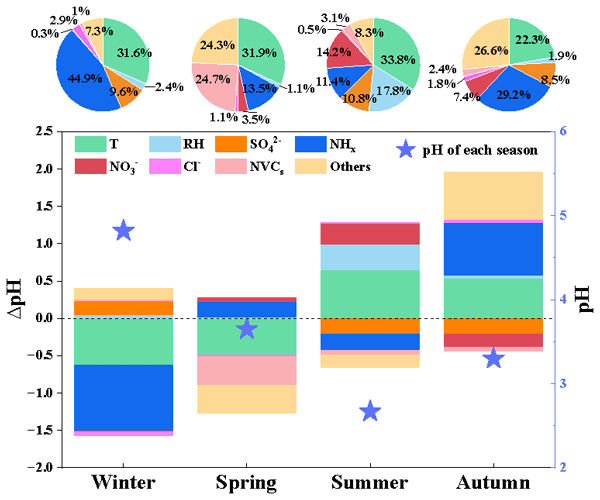
Abstract. Aerosol acidity significantly affects atmospheric chemistry and human health, yet its driving factors remain controversial. This study systematically examined a year-long characteristics of water-soluble inorganic ions in PM2.5 in the semi-arid Guanzhong Plain, Northwest China, and quantitatively analyzed its acidity and driving factors. The annual mean pH of PM2.5 was 3.8 ± 1.0 (winter > spring > summer > autumn). As pollution increased, aerosol pH shifted from the acidic range (2–5) on clean days to a near-neutral range (3–6) on polluted days. Sensitivity tests and driver analysis revealed that atmospheric temperature (22.3 %–33.8 %), NHx (gas NH3+NH4+, 11.4 %–44.9 %), and SO42- (8.5 %–10.8 %) were common key factors influencing pH across all seasons. Among these, temperature played a dominant role in seasonal variations, while NHx was the primary contributor during autumn and winter. Notably, Ca2+ emerged as a unique driver specific to spring, the relative standard deviation (RSD) was 8.8 %. Relative humidity (RH) exhibited a distinctive non-linear regulatory effect, i.e., aerosol pH initially decreases and subsequently increases with rising RH (inflection point occurred at 60 %–85 %). This phenomenon is primarily attributed to an abrupt change in liquid water content triggered by the deliquescence of hygroscopic components. Our results enhance the understanding of the contributions of various factors to aerosol pH and offers a new perspective for developing PM2.5 control strategies in the semi-arid and ammonia-rich region.
-
Notice on discussion status
The requested preprint has a corresponding peer-reviewed final revised paper. You are encouraged to refer to the final revised version.
-
Preprint
(2347 KB)
-
Supplement
(791 KB)
-
The requested preprint has a corresponding peer-reviewed final revised paper. You are encouraged to refer to the final revised version.
- Preprint
(2347 KB) - Metadata XML
-
Supplement
(791 KB) - BibTeX
- EndNote
- Final revised paper


Journal article(s) based on this preprint
Interactive discussion
Status: closed
- RC1: 'Comment on egusphere-2026-609', Anonymous Referee #1, 20 Mar 2026
-
RC2: 'Comment on egusphere-2026-609', Anonymous Referee #2, 19 Apr 2026
The comment was uploaded in the form of a supplement: https://egusphere.copernicus.org/preprints/2026/egusphere-2026-609/egusphere-2026-609-RC2-supplement.pdf
-
AC1: 'Comment on egusphere-2026-609', Jianjun Li, 30 May 2026
The comment was uploaded in the form of a supplement: https://egusphere.copernicus.org/preprints/2026/egusphere-2026-609/egusphere-2026-609-AC1-supplement.pdf
-
AC2: 'Comment on egusphere-2026-609', Jianjun Li, 30 May 2026
The comment was uploaded in the form of a supplement: https://egusphere.copernicus.org/preprints/2026/egusphere-2026-609/egusphere-2026-609-AC2-supplement.pdf
Peer review completion


Interactive discussion
Status: closed
-
RC1: 'Comment on egusphere-2026-609', Anonymous Referee #1, 20 Mar 2026
This study conducted a year-long characteristics of water-soluble inorganic ions in PM2.5 in the semi-arid Guanzhong region of China, and quantitatively analyzed its acidity and driving factors. The research is valuable for understanding regional aerosol chemistry, which offers a new perspective for developing PM2.5 control strategies in the semi-arid and ammonia-rich region. While the manuscript is fundamentally sound, certain aspects require further clarification and refinement.
- The quantitative attribution of pH drivers across seasons, particularly the identification of Ca²⁺ as a spring-specific driver and the non-linear RH effect, provides novel insights. However, the authors should more explicitly articulate how these findings advance beyond existing studies (e.g., Ding et al., 2019; Jia et al., 2020) in the introduction and conclusion sections.
- Further optimization of sentence structure are needed. For instance, Line 50-54, “High aerosol acidity levels have been linked to increased risks of respiratory illnesses and specific cancers. These acidity-driven atmospheric processes collectively contribute to the generation of intricate air pollution, the deposition of pollutants through dry and wet mechanisms, and their overall effects on human health and the climate system (Mao et al., 2009; Pye et al., 2020).” The connection between the top and bottom sentences is not smooth.
- Lines 96-99: This section states that understanding of pH drivers "remains insufficient." This phrasing is vague. The authors should more precisely articulate what is missing: (1) year-round quantitative attribution in semi-arid regions? (2) comparison of chemical vs. meteorological controls? (3) integration of dust effects? Sharpening this gap will strengthen the paper's motivation.
- Lines 124-130: The final paragraph of the Introduction reads as a summary of methods rather than a statement of scientific objectives. While it is useful to know what measurements and models were employed, the reader is left wondering what specific scientific questions this study aims to answer. Reformulate this paragraph to pose clear, testable research questions that emerge from the knowledge gaps identified earlier or clarify research purpose.
- Lines 101-118: This section describes the Guanzhong Plain's characteristics, but the connection to aerosol acidity could be stronger. The authors should explicitly hypothesize how each feature (e.g., semi-enclosed basin, ammonia emissions, dust transport, seasonal climate) might influence pH, setting up testable expectations for the results section.
- Lines 276-278: The authors state that SNAs dominate WSIIs, but the statement remains purely descriptive, not establish a link to pH analysis later. Please state what does it mean to be SNA dominant and what is the effect on acidity.
- Section 3.2 presents the MLR model development in detail. However, the actual NH₃ concentrations estimated from this model (shown in Table 1) are not discussed in the text. The authors should briefly comment on the seasonal NH₃ patterns and their consistency with expectations.
- Lines 380-383: The authors report mean ALWC concentrations with large standard deviations (e.g., winter: 80.4 ± 112.9 μg m⁻³; spring: 55.7 ± 132.2 μg m⁻³). The fact that the standard deviation exceeds the mean in multiple seasons. Please discuss the causes of the high standard deviation of ALWC and its potential impacts on aerosol pH.
- Figure 5 shows monthly means without variability indicators. Please add error bars to convey the spread within each month.
- Section 3.3: The manuscript currently presents valuable data on aerosol pH under clean versus polluted conditions, but the comparison is limited to statistical summaries. To more intuitively demonstrate how aerosol chemical composition and acidity evolve with increasing pollution, I recommend adding a new figure showing the percentage change in aerosol pH and major WSIIs across different PM5 concentration bins.
- Lines 397-399: The finding that pH shifts from 2-5 on clean days to 3-6 on polluted days is important. The authors could enhance the rigor of their analysis by employing statistical tests (e.g., t-tests) to compare the pH distributions between clean and polluted days across different seasons.
- Lines 499-503:The inflection point at 60-85% RH and the proposed mechanism involving deliquescence of NH₄NO₃ (DRH 62%) and (NH₄)₂SO₄ (DRH 80%) is compelling. However, the manuscript does not address an important follow-up question: Why does the inflection point vary by season? The discussion of this seasonal variation would strengthen the mechanistic interpretation.
- Lines 549-551: Although pointing out the importance of NVCs in spring, do not explain their mechanism of action. The authors could integrate the discussion from Section 3.4 on Ca²⁺ to briefly elaborate on this point.
- Lines 556-565: The comparison with coastal cities requires additional explanation regarding the reasons for this disparity.
- The unit format in the full text should be unified. For instance, in Figure 6, the unit of μg/m3 is unified as μg m-3
- Further refinement of language and optimization of sentence structure are needed:
- The manuscript uses multiple terms interchangeably: "driving factors," "drivers," "influencing factors," "key factors." Please choose one primary term and use consistently throughout.
- Lines 103-104: “Guanzhong Plain is a vital economic and agricultural center in northwestern China, the rapid industrial...”, write "where rapid" instead of "the rapid".
- Line 106: “The mechanisms of air pollution formation and its driving factors it in the region...”, delete “it”.
- Line 268: Write "decreased" instead of "decreasing
- Line 282: “This might be due to driven by...”, delete “due to”.
- Line 527: Write "enhance" instead of "enhancing".
- Line 210: The term "multiple linear regression" appears here for the first time in the manuscript, and the abbreviation (MLR) could be added.
- Line 368: Write "MLR" instead of "MRL".
Citation: https://doi.org/10.5194/egusphere-2026-609-RC1 -
RC2: 'Comment on egusphere-2026-609', Anonymous Referee #2, 19 Apr 2026
The comment was uploaded in the form of a supplement: https://egusphere.copernicus.org/preprints/2026/egusphere-2026-609/egusphere-2026-609-RC2-supplement.pdf
-
AC1: 'Comment on egusphere-2026-609', Jianjun Li, 30 May 2026
The comment was uploaded in the form of a supplement: https://egusphere.copernicus.org/preprints/2026/egusphere-2026-609/egusphere-2026-609-AC1-supplement.pdf
-
AC2: 'Comment on egusphere-2026-609', Jianjun Li, 30 May 2026
The comment was uploaded in the form of a supplement: https://egusphere.copernicus.org/preprints/2026/egusphere-2026-609/egusphere-2026-609-AC2-supplement.pdf
Peer review completion
Journal article(s) based on this preprint
Data sets
Measurement Report: Quantitative Analysis of Aerosol Acidity and Its Driving Factors in Guanzhong Area, Northwest China Q. Wang et al. https://zenodo.org/records/18455742
Viewed
| HTML | XML | Total | Supplement | BibTeX | EndNote | |
|---|---|---|---|---|---|---|
| 833 | 354 | 118 | 1,305 | 213 | 98 | 181 |
- HTML: 833
- PDF: 354
- XML: 118
- Total: 1,305
- Supplement: 213
- BibTeX: 98
- EndNote: 181
Viewed (geographical distribution)
| Country | # | Views | % |
|---|
| Total: | 0 |
| HTML: | 0 |
| PDF: | 0 |
| XML: | 0 |
- 1
Qian Wang
Xiao Guo
Minxia Shen
Yali Liu
Yifan Zhang
Lu Li
Weining Qi
Yue Cao
Shicong Li
Zhuoer Dong
Wenting Dai

The requested preprint has a corresponding peer-reviewed final revised paper. You are encouraged to refer to the final revised version.
- Preprint
(2347 KB) - Metadata XML
-
Supplement
(791 KB) - BibTeX
- EndNote
- Final revised paper
This study conducted a year-long characteristics of water-soluble inorganic ions in PM2.5 in the semi-arid Guanzhong region of China, and quantitatively analyzed its acidity and driving factors. The research is valuable for understanding regional aerosol chemistry, which offers a new perspective for developing PM2.5 control strategies in the semi-arid and ammonia-rich region. While the manuscript is fundamentally sound, certain aspects require further clarification and refinement.