
the Creative Commons Attribution 4.0 License.
the Creative Commons Attribution 4.0 License.
 | 27 Feb 2026
Toward robust fine-scale decadal precipitation forecasts through dynamically consistent subsampling
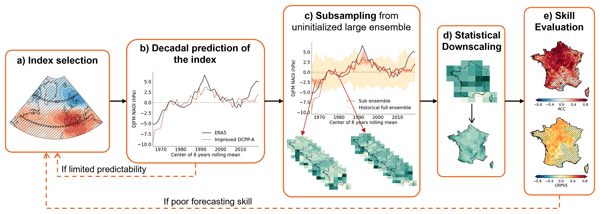
Abstract. Reliable decadal predictions of regional precipitation are critical for managing water-resources and developing climate services, yet they remain a major challenge. To address this gap, we present a 5-step framework that integrates recent advances in decadal predictions of large-scale sea-level pressure (SLP) modes to enhance prediction skill of precipitation at a fine scale resolution. We first identify key atmospheric indices controlling precipitation variability over France, including the winter and summer North Atlantic Oscillation (NAO), the winter West Atlantic Pressure Anomaly, and the summer Mediterranean-Scandinavia index. These indices are predicted through an improved post-processing method applied on the multi-model Decadal Climate Prediction ensemble. The resulting decadal forecasts of the indices are used to select dynamically consistent members from a large uninitialized climate model ensemble, thereby avoiding initial drift from decadal climate predictions. The selected forecasts are then statistically bias-corrected and downscaled to an 8-km grid, providing relevant predictions for local scale and impact studies. The last step of the framework is the skill evaluation: over France, winter precipitation forecast based on the NAO achieve significant Anomaly Correlation Coefficient across 70 % of grid cells. Summer skill, though weaker, improves notably when combining NAO with the North Atlantic Sea Surface Temperatures (significant over 53 % of grid cells). This approach offers a transferable pathway toward actionable, fine scale hydroclimate information at the decadal scale, potentially useful for climate services. The methodology is adaptable to other regions and variables, offering promising opportunities for improving decadal-scale hydroclimate predictions.
-
Notice on discussion status
The requested preprint has a corresponding peer-reviewed final revised paper. You are encouraged to refer to the final revised version.
-
Preprint
(2998 KB)
-
Supplement
(2914 KB)
-
The requested preprint has a corresponding peer-reviewed final revised paper. You are encouraged to refer to the final revised version.
- Preprint
(2998 KB) - Metadata XML
-
Supplement
(2914 KB) - BibTeX
- EndNote
- Final revised paper


Journal article(s) based on this preprint
Interactive discussion
Status: closed
-
RC1: 'Comment on egusphere-2026-573', Anonymous Referee #1, 01 Apr 2026
-
AC1: 'Reply on RC1', Joanne Couallier, 17 Jun 2026
The comment was uploaded in the form of a supplement: https://egusphere.copernicus.org/preprints/2026/egusphere-2026-573/egusphere-2026-573-AC1-supplement.pdf
-
AC2: 'Reply on RC1', Joanne Couallier, 17 Jun 2026
The comment was uploaded in the form of a supplement: https://egusphere.copernicus.org/preprints/2026/egusphere-2026-573/egusphere-2026-573-AC2-supplement.pdf
-
AC1: 'Reply on RC1', Joanne Couallier, 17 Jun 2026
-
RC2: 'Comment on egusphere-2026-573', Anonymous Referee #2, 27 Apr 2026
The manuscript by Couallier et al., presents an approach to sub-select ensemble members from an uninitialized large ensemble to predict precipitation over France with higher skill than using the full ensemble. The paper is generally well written though there are places where it can benefit from improving grammar. The manuscript falls withing the the scope of the journal and may be accepted for publication after clarifying major concerns.
Major points:
The study is missing important methodological details. By simply pointing towards an unpublished study (Alkama et al.) for methodological details is not appropriate in my opinion. Also, I am not sure how the drift in initialized predictions is treated and whether it affects their selection process. Missing these details are the major shortcoming of this study. Also, how are the model and observational data treated, for example, remapping, use of anomalies or mean values etc.
The study seems to have ignored several pioneering works related to climate predictions using ensemble selection approaches. It is important that the discussions include similar works done before. I have listed a few studies who use ensemble selections for seasonal to decadal climate predictions.
One of my major concern is that the authors use a rather small ensemble from which the selections are made and also only from single model. Why is the selection not performed using a multi-model ensemble from CMIP6 simulations? Using (sub-selecting) members from just one model can be a limitation when applying the same method to other regions as the author seems to claim. I do not agree that it would be easier to apply the methodology to other regions particularly when selection is performed using a single model ensemble. Also the ensemble size from which the selection is made is rather small.
The results shown in Fig. 6/7 does not support authors claims about reduced uncertainty when observation is almost always outside the spread of the selected ensemble. That would employ that the predictions from the sub-selected ensembles are not reliable, no? The reduction in ensemble spread is not really useful when it does not include observations inside.
It could be useful to compare the skill predictions from the sub-selected ensemble relative to the skill of actual prediction systems (DCPP-A). This could highlight the benefits of using the current approach in predicting the future climate.
Other points:
Line 44: I am not sure if the wording is clear: “Seasonal forecasts provide initialized climate information” what do you mean by “provide initialized climate information”?
Line 63: "thereby enhancing downstream precipitation forecasts",... It is not clear what does "enhancing forecasts" mean here?
Line 69: A recently study (https://iopscience.iop.org/article/10.1088/1748-9326/adde75), used NAO and temperature relationship to sub-select the ensemble members and make skill predictions over Eurasia. Maybe author could comment on this.
Line 91: "extracted"?
Line 97: "through homogenization technique"...did you mean “thorough”?
Line 99: AMV was already unfolded in the introduction.
Line 107: Double check the abbreviation “Decadal Climate Prediction Project Phase A”, is it phase A.
Line 108: please double check the start dates for DCPP-A, at least some of the predictions systems are initialized from 1960 and onward. Also, I am not sure about predictions from CESM1, does the initialization extend to 2014 for this model?
Line 235, it is not clear to me what exactly this means. In section 2.2b, there are several things being discussed. It would be better to describe here what had been done.
Eq. 2, please describe, what does alhpa and beta mean here and how they are derived?
Table S1, missing references for the prediction systems.
Line 470: “French climate”?
Lines: 500-506, there has been studies using sub-sampling and predicting climate on seasonal to decadal timescales, which surprisingly authors have completed ignored. A few those are listed below:
Line 513: That’s also my concern, why not use uninitialized simulations from different CMIP6 models?
Relevant references:
https://journals.ametsoc.org/view/journals/clim/31/14/jcli-d-17-0661.1.xml
https://agupubs.onlinelibrary.wiley.com/doi/10.1029/2021GL094915
https://agupubs.onlinelibrary.wiley.com/doi/10.1029/2020GL087900
https://iopscience.iop.org/article/10.1088/1748-9326/adde75
Citation: https://doi.org/10.5194/egusphere-2026-573-RC2 -
AC3: 'Reply on RC2', Joanne Couallier, 17 Jun 2026
The comment was uploaded in the form of a supplement: https://egusphere.copernicus.org/preprints/2026/egusphere-2026-573/egusphere-2026-573-AC3-supplement.pdf
-
AC3: 'Reply on RC2', Joanne Couallier, 17 Jun 2026
Peer review completion


Post-review adjustments


Interactive discussion
Status: closed
-
RC1: 'Comment on egusphere-2026-573', Anonymous Referee #1, 01 Apr 2026
In this study, a methodology to produce precipitation predictions over France, at high spatial resolution and at the decadal temporal horizon, is presented and evaluated. The method consists of five sequential steps (index selection, index prediction, subsampling, downscaling, and assessment). Key findings include significant skill enhancements over the extended winter season compared to uninitialised simulations, and weaker but significant improvements over the extended summer season.
This work focuses on a specific domain (France), but the authors highlight that their procedure could be adapted to other geographical regions, which I agree with: for this reason, I believe this study fits well within ESD’s aims and scope. The methodology is novel, and the results presented are substantial and potentially relevant to stakeholders.
The authors put effort into motivating their methodological choices (e.g. Section 3.4), but the organisation of the material could be streamlined and the level of information provided improved in places. In a couple of cases, further discussion would help the interpretation of the results. Finally, this work requires careful editing as it currently contains several grammatical errors. That being said, I did not find major issues with the manuscript and my overall assessment is positive.
Specific comments
- Eq.2 There are two free parameters appearing, alpha and beta, which are not discussed in the text and are set to 1. I’d like to understand what their role is, and how the authors decided on their values. Also, since the indices are not standardised (based on definitions and dimensionality) and have thus different variance, the loss function D(t) may penalise the index with greatest absolute error rather than that with greatest relative error. Is this a desired feature?
- Fig. 6b The full uninitialised IPSL ensemble shows remarkably high skill for the wNAO (r=0.6). This correlation is comparable with that found in Smith et al. (2020) and Nicolì et al. (2025) for (raw) initialised decadal predictions of the NAO, and much larger than that found in Nicolì et al. (2025) for uninitialised simulations. Clearly there are differences in data and definitions, but still I wonder if the authors could comment on the result further, possibly linking with previous studies if existing.
- L381-382 The claim that “All boosted decadal predictions ACCs outperform corresponding uninitialized IPSL ensembles substantially” is not, in my opinion, supported by the authors’ results for uAMV (see correlation values in Fig. 7 c). Furthermore, it would be meaningful to discuss the high ACC found for the uninitialised ensemble for uAMV, possibly linking with the role of the externally forced signal which the authors opted not to remove (L193-197).
- Fig. 8 It is surprising that the subsampling method based on wNAO yields better results than wWEPA, considering that the skill for the two indices is similar and wWEPA is associated with the leading mode of precipitation variability. The authors argue (L483-486) this is because the wNAO signal has larger fluctuations, but how exactly does this explain the difference? Is it because larger pressure variations impose a stricter constraint when sub-selecting ensemble members? Also, I am curious whether the authors have tried combining the wWEPA and wNAO indices for the subsampling procedure. To my eye, it would make sense to try combining the two indices associated with the leading PCs.
- Section 3.3 Spatial correlations in the target data can artificially inflate the number of significant grid-points (the multiplicity problem, see e.g. Wilks 2006), and specific statistical tests have been devised to assess the significance of fields. The authors refer to the number of significant grid-points both as a measure of relative goodness between different prediction strategies (e.g. L404-406), which may not warrant further analysis, and as an absolute measure of prediction skill (e.g. L17-19). If the authors wish to use the number of significant grid points in the latter sense, I think field significance should be assessed.
- Fig. 9e I do not fully understand how to interpret this result: since the 5 closest IPSL members and the full uninitialised ensemble members have virtually the same skill for uAMV (Fig. 7), and since the RCC measures the added value of initialisation, I would expect no skill improvements according to RCC for sNAO + uAMV compared to sNAO only (Fig. 9b). How can the skill enhancement be explained?
- L509 I find Fig. S3.1 important as it allows one to uncouple the extent to which final skill is limited by our ability to predict large-scale patterns of variability, or by the impact they have on surface climate. In my opinion this figure would deserve at least a mention in the Results section, but I leave this up to the authors.
Technical corrections
- The manuscript contains several grammatical and typographical errors. I recommend that a careful editing of the entire text be carried out. Issues include subject-verb agreement (e.g. L17), punctuation (e.g. L57), verb tenses (e.g. “is allowing” L246), typos (e.g. L450), articles (e.g. L130), and syntax (e.g. L117).
- L65 Perhaps add a very short explanation of the method of Alkama et al. here?
- L82 Here, I would consider mentioning that the 8 km spatial resolution considered in the study is meant to match that of the reference dataset. Also, I think the comments at L238-242 would fit better in the Introduction than in the Methods section.
- L110-113 I suggest to clarify that the IPSL-CM6A-LR ensemble consists of extended historical (uninitialised) simulations. Currently, this is only explained at L220.
- L113 The citation of Boucher et al. (2020) has no correspondence in the References. I guess the correct citation is Bonnet et al. (2021)?
- Fig. 1I find this figure very informative and easy to follow. The dashed lines with annotations “if poor forecasting skill” and “if limited predictability”, though, are never directly referenced in the main text. I can see that some of the choices presented earlier on by the authors (for example the fact that the wNAO index is computed over a different season than the precipitation anomalies, or that wNAO is used instead of EUNS) are explained later in section 3.4. Still, it may be worth mentioning in section 2.2 that try-and-error tests were carried out to reach a particular choice, and refer to 3.4 for full explanation.
- L166-169 The index of Jianping and Wang (2003) is based on the normalised difference of SLP values, whereas the difference is not normalised here. Please clarify this in the text.
- L199-203 To understand the exact procedure followed by the authors, it would be important to make sure readers can access Alkama et al. (currently submitted).
- Figs. 2 and 3 Reconciling these figures with the accompanying text requires switching signs a few times (Fig. 2a shows a pattern of negative precipitation anomaly, Fig. 3a shows a negative wWEPA pattern, and Fig. 3b shows an anti-correlation between wWEPA and PC1). I would suggest adding a few words of explanation to help the reader link Fig. 2 with Fig. 3.
- L321 Do the panels show “spatial correlation” or spatial maps of (time) correlations?
- Fig. 7 Shouldn’t the unit measure of uAMV be degree Celsius?
- Fig. 8 and 9 I recommend adding an explanation of what the dashed black box is in the caption.
References
Wilks, D., 2006. Statistical methods in the atmospheric sciences, second ed. Elsevier.
Citation: https://doi.org/10.5194/egusphere-2026-573-RC1 -
AC1: 'Reply on RC1', Joanne Couallier, 17 Jun 2026
The comment was uploaded in the form of a supplement: https://egusphere.copernicus.org/preprints/2026/egusphere-2026-573/egusphere-2026-573-AC1-supplement.pdf
-
AC2: 'Reply on RC1', Joanne Couallier, 17 Jun 2026
The comment was uploaded in the form of a supplement: https://egusphere.copernicus.org/preprints/2026/egusphere-2026-573/egusphere-2026-573-AC2-supplement.pdf
-
RC2: 'Comment on egusphere-2026-573', Anonymous Referee #2, 27 Apr 2026
The manuscript by Couallier et al., presents an approach to sub-select ensemble members from an uninitialized large ensemble to predict precipitation over France with higher skill than using the full ensemble. The paper is generally well written though there are places where it can benefit from improving grammar. The manuscript falls withing the the scope of the journal and may be accepted for publication after clarifying major concerns.
Major points:
The study is missing important methodological details. By simply pointing towards an unpublished study (Alkama et al.) for methodological details is not appropriate in my opinion. Also, I am not sure how the drift in initialized predictions is treated and whether it affects their selection process. Missing these details are the major shortcoming of this study. Also, how are the model and observational data treated, for example, remapping, use of anomalies or mean values etc.
The study seems to have ignored several pioneering works related to climate predictions using ensemble selection approaches. It is important that the discussions include similar works done before. I have listed a few studies who use ensemble selections for seasonal to decadal climate predictions.
One of my major concern is that the authors use a rather small ensemble from which the selections are made and also only from single model. Why is the selection not performed using a multi-model ensemble from CMIP6 simulations? Using (sub-selecting) members from just one model can be a limitation when applying the same method to other regions as the author seems to claim. I do not agree that it would be easier to apply the methodology to other regions particularly when selection is performed using a single model ensemble. Also the ensemble size from which the selection is made is rather small.
The results shown in Fig. 6/7 does not support authors claims about reduced uncertainty when observation is almost always outside the spread of the selected ensemble. That would employ that the predictions from the sub-selected ensembles are not reliable, no? The reduction in ensemble spread is not really useful when it does not include observations inside.
It could be useful to compare the skill predictions from the sub-selected ensemble relative to the skill of actual prediction systems (DCPP-A). This could highlight the benefits of using the current approach in predicting the future climate.
Other points:
Line 44: I am not sure if the wording is clear: “Seasonal forecasts provide initialized climate information” what do you mean by “provide initialized climate information”?
Line 63: "thereby enhancing downstream precipitation forecasts",... It is not clear what does "enhancing forecasts" mean here?
Line 69: A recently study (https://iopscience.iop.org/article/10.1088/1748-9326/adde75), used NAO and temperature relationship to sub-select the ensemble members and make skill predictions over Eurasia. Maybe author could comment on this.
Line 91: "extracted"?
Line 97: "through homogenization technique"...did you mean “thorough”?
Line 99: AMV was already unfolded in the introduction.
Line 107: Double check the abbreviation “Decadal Climate Prediction Project Phase A”, is it phase A.
Line 108: please double check the start dates for DCPP-A, at least some of the predictions systems are initialized from 1960 and onward. Also, I am not sure about predictions from CESM1, does the initialization extend to 2014 for this model?
Line 235, it is not clear to me what exactly this means. In section 2.2b, there are several things being discussed. It would be better to describe here what had been done.
Eq. 2, please describe, what does alhpa and beta mean here and how they are derived?
Table S1, missing references for the prediction systems.
Line 470: “French climate”?
Lines: 500-506, there has been studies using sub-sampling and predicting climate on seasonal to decadal timescales, which surprisingly authors have completed ignored. A few those are listed below:
Line 513: That’s also my concern, why not use uninitialized simulations from different CMIP6 models?
Relevant references:
https://journals.ametsoc.org/view/journals/clim/31/14/jcli-d-17-0661.1.xml
https://agupubs.onlinelibrary.wiley.com/doi/10.1029/2021GL094915
https://agupubs.onlinelibrary.wiley.com/doi/10.1029/2020GL087900
https://iopscience.iop.org/article/10.1088/1748-9326/adde75
Citation: https://doi.org/10.5194/egusphere-2026-573-RC2 -
AC3: 'Reply on RC2', Joanne Couallier, 17 Jun 2026
The comment was uploaded in the form of a supplement: https://egusphere.copernicus.org/preprints/2026/egusphere-2026-573/egusphere-2026-573-AC3-supplement.pdf
-
AC3: 'Reply on RC2', Joanne Couallier, 17 Jun 2026
Peer review completion
Post-review adjustments
Journal article(s) based on this preprint
Viewed
| HTML | XML | Total | Supplement | BibTeX | EndNote | |
|---|---|---|---|---|---|---|
| 887 | 520 | 82 | 1,489 | 236 | 107 | 99 |
- HTML: 887
- PDF: 520
- XML: 82
- Total: 1,489
- Supplement: 236
- BibTeX: 107
- EndNote: 99
Viewed (geographical distribution)
| Country | # | Views | % |
|---|
| Total: | 0 |
| HTML: | 0 |
| PDF: | 0 |
| XML: | 0 |
- 1
Joanne Couallier

Didier Swingedouw
Charlotte Sakarovitch
Ramdane Alkama
The requested preprint has a corresponding peer-reviewed final revised paper. You are encouraged to refer to the final revised version.
- Preprint
(2998 KB) - Metadata XML
-
Supplement
(2914 KB) - BibTeX
- EndNote
- Final revised paper
In this study, a methodology to produce precipitation predictions over France, at high spatial resolution and at the decadal temporal horizon, is presented and evaluated. The method consists of five sequential steps (index selection, index prediction, subsampling, downscaling, and assessment). Key findings include significant skill enhancements over the extended winter season compared to uninitialised simulations, and weaker but significant improvements over the extended summer season.
This work focuses on a specific domain (France), but the authors highlight that their procedure could be adapted to other geographical regions, which I agree with: for this reason, I believe this study fits well within ESD’s aims and scope. The methodology is novel, and the results presented are substantial and potentially relevant to stakeholders.
The authors put effort into motivating their methodological choices (e.g. Section 3.4), but the organisation of the material could be streamlined and the level of information provided improved in places. In a couple of cases, further discussion would help the interpretation of the results. Finally, this work requires careful editing as it currently contains several grammatical errors. That being said, I did not find major issues with the manuscript and my overall assessment is positive.
Specific comments
Technical corrections
References
Wilks, D., 2006. Statistical methods in the atmospheric sciences, second ed. Elsevier.