
the Creative Commons Attribution 4.0 License.
the Creative Commons Attribution 4.0 License.
 | 31 Mar 2026
Precipitation Nowcasting Based on Convolutional LSTM with Spatio-Temporal Information Transformation Using Multi-Meteorological Factors
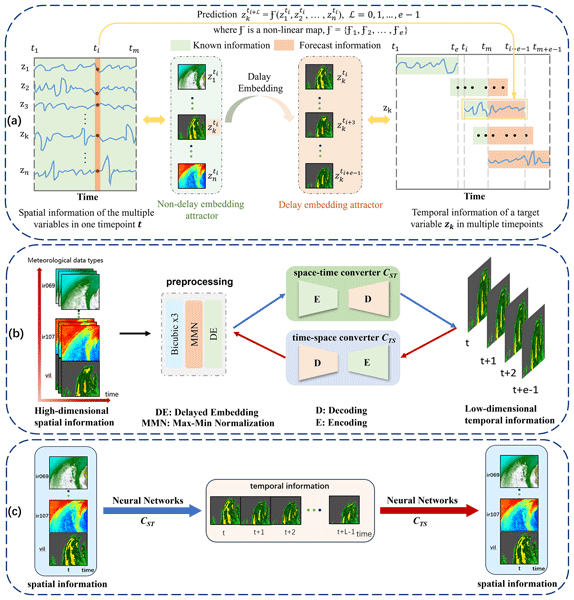
Abstract. Precipitation nowcasting is vital for protecting lives and economic activities, yet accurate forecasts based solely on past precipitation remain elusive. Conventional numerical weather prediction (NWP) models offer a solution but incur substantial computational costs. Moreover, due to the rapid pace of climate change, long-term time series data are often inadequate for accurately addressing precipitation forecasting for extreme weather events in a short period of time, as past meteorological time series data may not accurately reflect current atmospheric conditions. There is an urgent need to rely on short-term time series for prediction tasks. Existing studies have employed Spatio-Temporal Information Transformation(STI) equations with iterative solutions for short-term time series prediction. However, the solution process involves relatively simple nonlinear operations, which are prone to cumulative errors and can result in inaccurate forecasts. In response, the present work proposes a dual encoder-decoder training framework based on the STI equation and the idea of dual learning, which can map multidimensional spatial features to the temporal prediction of future precipitation variables. This architecture addresses the limitations of inaccurate predictions for short-term time series data. Additionally, an adaptive weighted gradient loss (ADGLoss) is proposed to mitigate the prediction ambiguity caused by the extension of prediction time and rectify systematic underestimation of high-intensity precipitation regions. Leveraging the U.S.-based SEVIR dataset, the proposed model integrates multiple meteorological variables to generate 1-hour precipitation forecasts. Experimental results demonstrate that the STI-driven framework achieves superior predictive accuracy and reduced error rates in multi-step forecasting compared to state-of-the-art deep learning benchmarks. The model effectively captures the spatio-temporal dependencies between heterogeneous meteorological variables and precipitation patterns, offering a novel pathway for advancing spatio-temporal prediction tasks in climate informatics.
Competing interests: At least one of the (co-)authors is a member of the editorial board of Geoscientific Model Development. The peer-review process was guided by an independent editor, and the authors also have no other competing interests to declare.
Publisher's note: Copernicus Publications remains neutral with regard to jurisdictional claims made in the text, published maps, institutional affiliations, or any other geographical representation in this paper. While Copernicus Publications makes every effort to include appropriate place names, the final responsibility lies with the authors. Views expressed in the text are those of the authors and do not necessarily reflect the views of the publisher.-
Notice on discussion status
The requested preprint has a corresponding peer-reviewed final revised paper. You are encouraged to refer to the final revised version.
-
Preprint
(14242 KB)
-
The requested preprint has a corresponding peer-reviewed final revised paper. You are encouraged to refer to the final revised version.
- Preprint
(14242 KB) - Metadata XML
- BibTeX
- EndNote
- Final revised paper


Journal article(s) based on this preprint
Interactive discussion
Status: closed
-
CEC1: 'Comment on egusphere-2026-46', Juan Antonio Añel, 01 Apr 2026
-
AC1: 'Reply on CEC1', Dufu Liu, 02 Apr 2026
Dear Dr. Juan A. Añel,
We sincerely thank the Executive Editor for this critical and professional correction. We have fully followed your official instruction, and accurately modified the manuscript type from the original "Model experiment description paper" to "Model description paper" in the revised manuscript submission system.
We confirm that this revision will be completed in strict accordance with your requirements. We will fully cooperate with all the subsequent procedures of the review process, and thank you again for your time and rigorous guidance on our manuscript.
Sincerely yours,
Dufu Liu
Citation: https://doi.org/10.5194/egusphere-2026-46-AC1
-
AC1: 'Reply on CEC1', Dufu Liu, 02 Apr 2026
-
RC1: 'Comment on egusphere-2026-46', Anonymous Referee #1, 25 Apr 2026
The comment was uploaded in the form of a supplement: https://egusphere.copernicus.org/preprints/2026/egusphere-2026-46/egusphere-2026-46-RC1-supplement.pdf
-
AC2: 'Reply on RC1', Dufu Liu, 24 May 2026
Dear Reviewer,
We would like to express our sincere gratitude to the Editor and the Reviewers for dedicating their time to evaluating our manuscript. We deeply appreciate the Reviewer's encouraging summary, acknowledging the relevance of our multimodal SEVIR setup and the value of our ablations. The constructive and meticulous feedback provided has been immensely helpful in improving the rigor, clarity, and overall quality of our paper.
We have carefully considered all the comments and revised the manuscript accordingly. Below, we provide a point-by-point response to each of the Reviewer’s concerns.
-
AC2: 'Reply on RC1', Dufu Liu, 24 May 2026
-
RC2: 'Comment on egusphere-2026-46', Anonymous Referee #2, 07 May 2026
This study proposes using spatial and temporal information from multiple meteorological variables to improve precipitation nowcasting. The authors develop a dual encoder–decoder ConvLSTM architecture based on the spatio-temporal information transformation framework, consisting of a spatio-temporal converter for precipitation prediction and a temporal-spatial converter that provides an inverse mapping to promote spatio-temporal consistency.
The paper is generally well organised. The model architecture and loss function are clearly described, and the experiments are well designed to evaluate the performance of the proposed model. The results are presented clearly, with effective illustrations and descriptions.
General comments
- Introduction and Related Work sections: These sections are somewhat descriptive and read more like a listing of previous studies. The manuscript would benefit from additional synthesis and transition and summary sentences. This would help guide readers more effectively and better motivate the proposed approach.
- Training with precipitation events only: At line 259, the authors mention that events with no rainfall are excluded from training. This choice requires further discussion. Although including many no-rain samples may lead to class imbalance, completely removing them may bias the training distribution and may require an additional strategy to handle rainfall occurrence and no-rain situations in operational applications.
- Training with interpolated data: Table 2 indicates that training with interpolated data slightly outperforms training with the original-resolution data. However, the stated motivation for interpolation is reduced training complexity, suggesting an efficiency-driven rather than accuracy-driven choice. Since the authors also conducted experiments at the original resolution, training without interpolation appears feasible. If efficiency is the main motivation, the authors could provide a direct comparison of computational cost, such as training time and memory usage, between the interpolated and original-resolution settings.
- Performance of the proposed model: The conclusion drawn in lines 324–325 could be too strong. The experimental results show that the proposed architecture performs better than other models under the specific experimental setting (e.g., the chosen dataset). Do authors think the proposed architecture is generally superior beyond the tested experimental conditions? For operational applications, a fair comparison between different models should allow each model to use its preferred input data, loss function, and training strategy. The forecast skill should then be evaluated against independent observational sources that are separate from the data used to train any of the models.
Specific comments:
- Line 29: The phrase “… recent observational data more effectively capture precipitation at the next time step…” reads a bit confusing.
- Line 51: As the acronym SOTA only appears once in the manuscript, the full name should be used instead.
- Line 63: The full name of LSTM should be given for the first time.
- Lines 137–138: The paper “Predicting future dynamics from short-term time series using an Anticipated Learning Machine” (https://doi.org/10.1093/nsr/nwaa025) seems relevant to the discussion of using spatio-temporal information.
- Lines 257-258: Should the contribution of lightning data to precipitation forecasting be case-dependent, for example depending on rainfall type, convective intensity, and the availability of other data types?
- Line 266: What is the spatial resolution after interpolation?
- Line 321: I wonder whether the same loss functions were used across all models.
- Line 330: The word “efficient” usually implies reduced computational cost. However, in this context, the authors seem to be referring mainly to the accuracy or effectiveness of the model in representing uncertainty.
- Figures 5 and 6: The proposed method appears to be clearly separated from the other methods in terms of forecast skill, while the remaining methods seem to form a relatively similar group. Could the authors discuss the main factors contributing to this separation?
- Figure 6: Could the authors explain the jumps in the PastNet results at small spatial scales, shown by the purple lines?
- Line 417: The phrase “Overall, STI-DEDN is more applicable in large-scale extreme precipitation events” could be confusing. Forecasting extreme precipitation more accurately at larger spatial scales is not the same as forecasting large-scale extreme precipitation events.
- Figures 5, 7 and 9: Rainymotion appears to preserve more small-scale texture than other models. Could the authors discuss the reason for this?
- Section 5.4.2: The meaning of “removing the STI framework” could be defined more explicitly. Does this refer specifically to removing the dual spatio-temporal and temporal-spatial converter structure?
Technical corrections
- There is missing space before “(” in several places, for example in lines 79, 85, 89 and 172.
- Please use lowercase “on” in titles.
- Please ensure consistent capitalization across all titles.
- Line 261: There appears to be a duplicated period at the end of the sentence.
Citation: https://doi.org/10.5194/egusphere-2026-46-RC2 -
AC3: 'Reply on RC2', Dufu Liu, 24 May 2026
Dear Reviewer,
We would like to express our deepest gratitude for your time and effort in reviewing our manuscript. We are highly encouraged by your positive assessment of our work, particularly your recognition of our model architecture, loss function, and overall experimental design. Your constructive feedback has been invaluable in helping us refine our narrative, clarify our experimental setups, and strengthen the overall rigor of the paper.
Below, we provide a detailed, point-by-point response to each of your comments, outlining the corresponding modifications made to the revised manuscript.
Peer review completion


Interactive discussion
Status: closed
-
CEC1: 'Comment on egusphere-2026-46', Juan Antonio Añel, 01 Apr 2026
Dear authors and Dr. Fita,
I would like to note that the type for this manuscript, currently labelled as "Model experiment description paper", does not correspond to the presented work, and therefore it should be modified and labelled as a "Model description paper". Please, do it accordingly during the next steps of the review process.
Juan A. Añel
Geosci. Model Dev. Executive Editor
Citation: https://doi.org/10.5194/egusphere-2026-46-CEC1 -
AC1: 'Reply on CEC1', Dufu Liu, 02 Apr 2026
Dear Dr. Juan A. Añel,
We sincerely thank the Executive Editor for this critical and professional correction. We have fully followed your official instruction, and accurately modified the manuscript type from the original "Model experiment description paper" to "Model description paper" in the revised manuscript submission system.
We confirm that this revision will be completed in strict accordance with your requirements. We will fully cooperate with all the subsequent procedures of the review process, and thank you again for your time and rigorous guidance on our manuscript.
Sincerely yours,
Dufu Liu
Citation: https://doi.org/10.5194/egusphere-2026-46-AC1
-
AC1: 'Reply on CEC1', Dufu Liu, 02 Apr 2026
-
RC1: 'Comment on egusphere-2026-46', Anonymous Referee #1, 25 Apr 2026
The comment was uploaded in the form of a supplement: https://egusphere.copernicus.org/preprints/2026/egusphere-2026-46/egusphere-2026-46-RC1-supplement.pdf
-
AC2: 'Reply on RC1', Dufu Liu, 24 May 2026
Dear Reviewer,
We would like to express our sincere gratitude to the Editor and the Reviewers for dedicating their time to evaluating our manuscript. We deeply appreciate the Reviewer's encouraging summary, acknowledging the relevance of our multimodal SEVIR setup and the value of our ablations. The constructive and meticulous feedback provided has been immensely helpful in improving the rigor, clarity, and overall quality of our paper.
We have carefully considered all the comments and revised the manuscript accordingly. Below, we provide a point-by-point response to each of the Reviewer’s concerns.
-
AC2: 'Reply on RC1', Dufu Liu, 24 May 2026
-
RC2: 'Comment on egusphere-2026-46', Anonymous Referee #2, 07 May 2026
This study proposes using spatial and temporal information from multiple meteorological variables to improve precipitation nowcasting. The authors develop a dual encoder–decoder ConvLSTM architecture based on the spatio-temporal information transformation framework, consisting of a spatio-temporal converter for precipitation prediction and a temporal-spatial converter that provides an inverse mapping to promote spatio-temporal consistency.
The paper is generally well organised. The model architecture and loss function are clearly described, and the experiments are well designed to evaluate the performance of the proposed model. The results are presented clearly, with effective illustrations and descriptions.
General comments
- Introduction and Related Work sections: These sections are somewhat descriptive and read more like a listing of previous studies. The manuscript would benefit from additional synthesis and transition and summary sentences. This would help guide readers more effectively and better motivate the proposed approach.
- Training with precipitation events only: At line 259, the authors mention that events with no rainfall are excluded from training. This choice requires further discussion. Although including many no-rain samples may lead to class imbalance, completely removing them may bias the training distribution and may require an additional strategy to handle rainfall occurrence and no-rain situations in operational applications.
- Training with interpolated data: Table 2 indicates that training with interpolated data slightly outperforms training with the original-resolution data. However, the stated motivation for interpolation is reduced training complexity, suggesting an efficiency-driven rather than accuracy-driven choice. Since the authors also conducted experiments at the original resolution, training without interpolation appears feasible. If efficiency is the main motivation, the authors could provide a direct comparison of computational cost, such as training time and memory usage, between the interpolated and original-resolution settings.
- Performance of the proposed model: The conclusion drawn in lines 324–325 could be too strong. The experimental results show that the proposed architecture performs better than other models under the specific experimental setting (e.g., the chosen dataset). Do authors think the proposed architecture is generally superior beyond the tested experimental conditions? For operational applications, a fair comparison between different models should allow each model to use its preferred input data, loss function, and training strategy. The forecast skill should then be evaluated against independent observational sources that are separate from the data used to train any of the models.
Specific comments:
- Line 29: The phrase “… recent observational data more effectively capture precipitation at the next time step…” reads a bit confusing.
- Line 51: As the acronym SOTA only appears once in the manuscript, the full name should be used instead.
- Line 63: The full name of LSTM should be given for the first time.
- Lines 137–138: The paper “Predicting future dynamics from short-term time series using an Anticipated Learning Machine” (https://doi.org/10.1093/nsr/nwaa025) seems relevant to the discussion of using spatio-temporal information.
- Lines 257-258: Should the contribution of lightning data to precipitation forecasting be case-dependent, for example depending on rainfall type, convective intensity, and the availability of other data types?
- Line 266: What is the spatial resolution after interpolation?
- Line 321: I wonder whether the same loss functions were used across all models.
- Line 330: The word “efficient” usually implies reduced computational cost. However, in this context, the authors seem to be referring mainly to the accuracy or effectiveness of the model in representing uncertainty.
- Figures 5 and 6: The proposed method appears to be clearly separated from the other methods in terms of forecast skill, while the remaining methods seem to form a relatively similar group. Could the authors discuss the main factors contributing to this separation?
- Figure 6: Could the authors explain the jumps in the PastNet results at small spatial scales, shown by the purple lines?
- Line 417: The phrase “Overall, STI-DEDN is more applicable in large-scale extreme precipitation events” could be confusing. Forecasting extreme precipitation more accurately at larger spatial scales is not the same as forecasting large-scale extreme precipitation events.
- Figures 5, 7 and 9: Rainymotion appears to preserve more small-scale texture than other models. Could the authors discuss the reason for this?
- Section 5.4.2: The meaning of “removing the STI framework” could be defined more explicitly. Does this refer specifically to removing the dual spatio-temporal and temporal-spatial converter structure?
Technical corrections
- There is missing space before “(” in several places, for example in lines 79, 85, 89 and 172.
- Please use lowercase “on” in titles.
- Please ensure consistent capitalization across all titles.
- Line 261: There appears to be a duplicated period at the end of the sentence.
Citation: https://doi.org/10.5194/egusphere-2026-46-RC2 -
AC3: 'Reply on RC2', Dufu Liu, 24 May 2026
Dear Reviewer,
We would like to express our deepest gratitude for your time and effort in reviewing our manuscript. We are highly encouraged by your positive assessment of our work, particularly your recognition of our model architecture, loss function, and overall experimental design. Your constructive feedback has been invaluable in helping us refine our narrative, clarify our experimental setups, and strengthen the overall rigor of the paper.
Below, we provide a detailed, point-by-point response to each of your comments, outlining the corresponding modifications made to the revised manuscript.
Peer review completion
Journal article(s) based on this preprint
Viewed
| HTML | XML | Total | BibTeX | EndNote | |
|---|---|---|---|---|---|
| 556 | 452 | 55 | 1,063 | 40 | 44 |
- HTML: 556
- PDF: 452
- XML: 55
- Total: 1,063
- BibTeX: 40
- EndNote: 44
Viewed (geographical distribution)
| Country | # | Views | % |
|---|
| Total: | 0 |
| HTML: | 0 |
| PDF: | 0 |
| XML: | 0 |
- 1
Dufu Liu
Feihu Huang
Peng Zheng
Xiaomeng Huang
Xi Wu
Xia Yuan
Jiafeng Zheng
Xiaojie Li
Jing Hu

The requested preprint has a corresponding peer-reviewed final revised paper. You are encouraged to refer to the final revised version.
- Preprint
(14242 KB) - Metadata XML
Dear authors and Dr. Fita,
I would like to note that the type for this manuscript, currently labelled as "Model experiment description paper", does not correspond to the presented work, and therefore it should be modified and labelled as a "Model description paper". Please, do it accordingly during the next steps of the review process.
Juan A. Añel
Geosci. Model Dev. Executive Editor