
the Creative Commons Attribution 4.0 License.
the Creative Commons Attribution 4.0 License.
 | 04 Feb 2026
A process-oriented analysis of the summertime diurnal cycle of precipitation and diabatic heating over China in three reanalyses
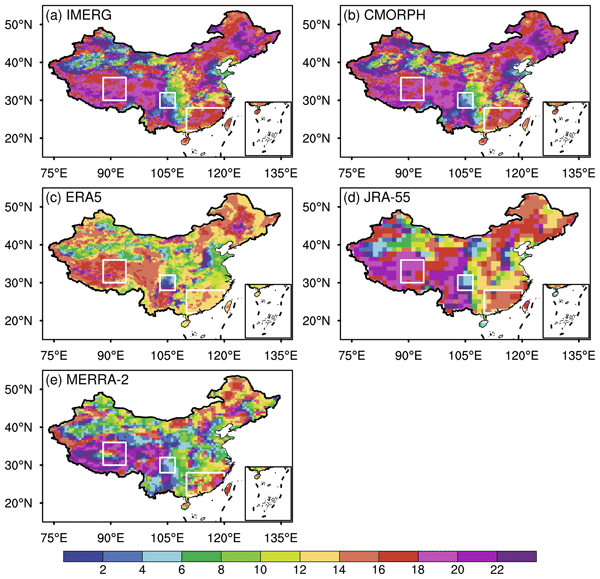
Abstract. We conduct a process‑oriented analysis of summertime diurnal cycle of precipitation (DCP) over China by comparing three widely used reanalyses (ERA5, JRA‑55, and MERRA‑2) with satellite observations. While all reanalyses capture the observed nocturnal precipitation peak related to elevated convection, they differ in simulating the daytime rainfall timing. JRA-55 and MERRA-2 better capture the observed timing, whereas ERA5 exhibits a 3-hour phase advance. The superior performance of JRA-55 is attributed to its gradual development of deep convection, supported by sustained heating and convective eddy transport. In contrast, ERA5 develops deep convection too rapidly, resulting in premature peaks in heating and precipitation. MERRA‑2 also produces early‑peaking convective rainfall, but with notably weaker intensity, suggesting that its better diurnal cycle is achieved largely through the suppression of convective precipitation. Diurnal cloud structures further corroborate these differences. Whereas JRA‑55 exhibits a slowly developing, upward‑tilting cloud structure from morning to afternoon, ERA5 and MERRA-2 peak earlier and have a shorter duration. The role of large‑scale forcing, quantified by CAPE and dynamic CAPE (dCAPE), is further tied to the performance of the convection schemes. Results show the peak timing of dCAPE lags that of CAPE and aligns more closely with the observed precipitation. While convective precipitation in ERA5 and MERRA‑2 tracks CAPE more closely, in JRA‑55 it aligns better with dCAPE, thereby yielding a more realistic DCP. This contrast highlights the critical influence of triggering choice on cumulus convection.
-
Notice on discussion status
The requested preprint has a corresponding peer-reviewed final revised paper. You are encouraged to refer to the final revised version.
-
Preprint
(2310 KB)
-
The requested preprint has a corresponding peer-reviewed final revised paper. You are encouraged to refer to the final revised version.
- Preprint
(2310 KB) - Metadata XML
- BibTeX
- EndNote
- Final revised paper


Journal article(s) based on this preprint
Interactive discussion
Status: closed
-
RC1: 'Comment on egusphere-2026-432', Anonymous Referee #1, 27 Feb 2026
-
AC1: 'Comment on egusphere-2026-432', Xiaocong Wang, 04 Apr 2026
The comment was uploaded in the form of a supplement: https://egusphere.copernicus.org/preprints/2026/egusphere-2026-432/egusphere-2026-432-AC1-supplement.pdf
-
AC1: 'Comment on egusphere-2026-432', Xiaocong Wang, 04 Apr 2026
-
RC2: 'Comment on egusphere-2026-432', Anonymous Referee #2, 06 Mar 2026
Summary:
The JJA diurnal precipitation cycle in China for reanalysis products – ERA5, JRA-55, MERRA-5 are evaluated using CMORPH and IMERG as observational baselines. With a process oriented approach across three representative regions—Tibetan Plateau, southeast China, and Sichuan Basin—differences in the diurnal cycles are diagnosed using variables relevant to convection. It is shown that some reanalysis products are able to reproduce the correct diurnal cycle for the wrong reasons—MERRA-2 and ERA5 do so by suppressing convective precipitation. Findings are thoroughly discussed and biases in reanalyses are explained clearly. The study provides valuable information towards the limitations of these reanalysis products for model diagnostics and development. The only outstanding issue I find in its current form is how the comparisons between the products are handled—tests for robustness including more quantitative lead-lag correlations would greatly strengthen the results.
Major comments:
3.2 Composite Analysis
- Do you change the precipitation threshold for the larger domain data? It seems you might be missing some days of precipitation if this is not taken into account. Or could you provide some plot that shows this isn’t the case?
- It also seems MERRA-2 has a low sampling bias for its selected days. I’d recommend some type of test for robustness—perhaps using the pdfs of precipitation/ probability of precipitation?
- Again, with the convective mass flux, is this domain size dependent?
- How are the differences in the time resolution dealt with?
- You can average/resample the data according to your lowest resolution and repeat the results, or show how averaging impacts your plots.
5.1 Vertical Velocity
- Figure 12 is very nice. I would like to see something more quantitative with it—lead-lag correlations with precip and dcape and cape? Alternatively, an intercomparison between models by scattering dcape vs precip should show the precipitation pickup and helps you compare region to region and model to model. See Ahmed et al. 2018 or Emmenegger et al. 2024.
Minor comments:
L81: Repeated citation
L117: I would change ‘Specially’ to ‘Specifically’
L118: ‘Such the’ to ‘Such as the’
Citation: https://doi.org/10.5194/egusphere-2026-432-RC2 -
AC1: 'Comment on egusphere-2026-432', Xiaocong Wang, 04 Apr 2026
The comment was uploaded in the form of a supplement: https://egusphere.copernicus.org/preprints/2026/egusphere-2026-432/egusphere-2026-432-AC1-supplement.pdf
-
AC1: 'Comment on egusphere-2026-432', Xiaocong Wang, 04 Apr 2026
The comment was uploaded in the form of a supplement: https://egusphere.copernicus.org/preprints/2026/egusphere-2026-432/egusphere-2026-432-AC1-supplement.pdf


Interactive discussion
Status: closed
-
RC1: 'Comment on egusphere-2026-432', Anonymous Referee #1, 27 Feb 2026
This manuscript evaluates how ERA5, JRA-55, and MERRA-2 represent the summertime diurnal cycle of precipitation (DCP) over China, using IMERG and CMORPH as observational references. The authors diagnose regional differences in precipitation phase and amplitude and relate them to diabatic heating (Q1/Q2), subgrid-scale transport proxies, cloud vertical structure, vertical velocity, and CAPE versus dCAPE over three representative regions (TP, SECN, SCB). The process-oriented framing is a strength and could be useful for understanding reanalysis behavior and guiding model development. However, key methodological details are missing for time handling, event selection, and the derivation of several diagnostics. Because several conclusions hinge on phase offsets of only a few hours, these gaps limit reproducibility and weaken the robustness of the physical interpretation.
Major comments:
1. Several highlighted phase differences are only a few hours, comparable to the sampling intervals of some products (for example, JRA-55 3-hourly precipitation and 6-hourly pressure-level fields). The manuscript provides temporal resolution information and a generic Fourier description, but it does not document the actual implementation used to produce the diagnostics. Please explicitly document:
- Whether precipitation time series are analyzed at native temporal sampling or interpolated to a common time grid prior to Fourier analysis?
- For composite diurnal variation figures, how the diurnal cycle is constructed in time (native timestamps versus interpolation for display)?
- For JRA-55 pressure-level fields (6-hourly), how diurnal variations of pressure-level diagnostics (Q1/Q2, vertical velocity, CAPE/dCAPE) are obtained from this sampling? If interpolation is used, specify method.
Required robustness check:
- Add a sampling sensitivity test by down-sampling ERA5 (and MERRA-2 where applicable) to JRA-55 sampling (3-hourly for precipitation, 6-hourly for pressure-level diagnostics) and show whether the inferred phase relationships and key conclusions (for example, ERA5 phase lead magnitude, CAPE versus dCAPE alignment) remain.
2. Table 1 reports substantially different numbers of selected events across datasets, implying that event days are selected independently for each dataset. If so, composites of heating/cloud/omega may reflect different synoptic populations rather than purely differences in modeled physics.
Please clarify whether the same dates are used across datasets. To strengthen attribution, add a sensitivity composite where event days are defined using IMERG (and/or CMORPH) and then applied to all reanalyses on the same dates.
3.The claim that convective precipitation in ERA5 and MERRA-2 follows CAPE more closely while JRA-55 aligns better with dCAPE is plausible but currently qualitative. Please add quantitative metrics (for each region and dataset), such as:
- phase offsets between precipitation and CAPE/dCAPE,
- lead-lag correlations, or
- a simple regression-based phase estimate for each series with uncertainty.
Also, briefly document (with citations) the relevant convective trigger/closure characteristics in the forecast models underlying each reanalysis, to support the triggering interpretation.
Minor comments:
Line 40-45: revise “continue still show” to “continue to show” or “still show”.
Line 115-120: Change “Specially,” to “Specifically,”.
Line 115-120: Change “such the Sichuan Basin” to “such as the Sichuan Basin”.
Data availability: “IMERGE” should be “IMERG”.
Citation: https://doi.org/10.5194/egusphere-2026-432-RC1 -
AC1: 'Comment on egusphere-2026-432', Xiaocong Wang, 04 Apr 2026
The comment was uploaded in the form of a supplement: https://egusphere.copernicus.org/preprints/2026/egusphere-2026-432/egusphere-2026-432-AC1-supplement.pdf
-
RC2: 'Comment on egusphere-2026-432', Anonymous Referee #2, 06 Mar 2026
Summary:
The JJA diurnal precipitation cycle in China for reanalysis products – ERA5, JRA-55, MERRA-5 are evaluated using CMORPH and IMERG as observational baselines. With a process oriented approach across three representative regions—Tibetan Plateau, southeast China, and Sichuan Basin—differences in the diurnal cycles are diagnosed using variables relevant to convection. It is shown that some reanalysis products are able to reproduce the correct diurnal cycle for the wrong reasons—MERRA-2 and ERA5 do so by suppressing convective precipitation. Findings are thoroughly discussed and biases in reanalyses are explained clearly. The study provides valuable information towards the limitations of these reanalysis products for model diagnostics and development. The only outstanding issue I find in its current form is how the comparisons between the products are handled—tests for robustness including more quantitative lead-lag correlations would greatly strengthen the results.
Major comments:
3.2 Composite Analysis
- Do you change the precipitation threshold for the larger domain data? It seems you might be missing some days of precipitation if this is not taken into account. Or could you provide some plot that shows this isn’t the case?
- It also seems MERRA-2 has a low sampling bias for its selected days. I’d recommend some type of test for robustness—perhaps using the pdfs of precipitation/ probability of precipitation?
- Again, with the convective mass flux, is this domain size dependent?
- How are the differences in the time resolution dealt with?
- You can average/resample the data according to your lowest resolution and repeat the results, or show how averaging impacts your plots.
5.1 Vertical Velocity
- Figure 12 is very nice. I would like to see something more quantitative with it—lead-lag correlations with precip and dcape and cape? Alternatively, an intercomparison between models by scattering dcape vs precip should show the precipitation pickup and helps you compare region to region and model to model. See Ahmed et al. 2018 or Emmenegger et al. 2024.
Minor comments:
L81: Repeated citation
L117: I would change ‘Specially’ to ‘Specifically’
L118: ‘Such the’ to ‘Such as the’
Citation: https://doi.org/10.5194/egusphere-2026-432-RC2 -
AC1: 'Comment on egusphere-2026-432', Xiaocong Wang, 04 Apr 2026
The comment was uploaded in the form of a supplement: https://egusphere.copernicus.org/preprints/2026/egusphere-2026-432/egusphere-2026-432-AC1-supplement.pdf
-
AC1: 'Comment on egusphere-2026-432', Xiaocong Wang, 04 Apr 2026
The comment was uploaded in the form of a supplement: https://egusphere.copernicus.org/preprints/2026/egusphere-2026-432/egusphere-2026-432-AC1-supplement.pdf
Peer review completion


Journal article(s) based on this preprint
Viewed
| HTML | XML | Total | BibTeX | EndNote | |
|---|---|---|---|---|---|
| 970 | 348 | 94 | 1,412 | 241 | 382 |
- HTML: 970
- PDF: 348
- XML: 94
- Total: 1,412
- BibTeX: 241
- EndNote: 382
Viewed (geographical distribution)
| Country | # | Views | % |
|---|
| Total: | 0 |
| HTML: | 0 |
| PDF: | 0 |
| XML: | 0 |
- 1
Yanjie Liu
Xiaocong Wang
Yimin Liu
Shuaiqi Tang
The requested preprint has a corresponding peer-reviewed final revised paper. You are encouraged to refer to the final revised version.
- Preprint
(2310 KB) - Metadata XML
This manuscript evaluates how ERA5, JRA-55, and MERRA-2 represent the summertime diurnal cycle of precipitation (DCP) over China, using IMERG and CMORPH as observational references. The authors diagnose regional differences in precipitation phase and amplitude and relate them to diabatic heating (Q1/Q2), subgrid-scale transport proxies, cloud vertical structure, vertical velocity, and CAPE versus dCAPE over three representative regions (TP, SECN, SCB). The process-oriented framing is a strength and could be useful for understanding reanalysis behavior and guiding model development. However, key methodological details are missing for time handling, event selection, and the derivation of several diagnostics. Because several conclusions hinge on phase offsets of only a few hours, these gaps limit reproducibility and weaken the robustness of the physical interpretation.
Major comments:
1. Several highlighted phase differences are only a few hours, comparable to the sampling intervals of some products (for example, JRA-55 3-hourly precipitation and 6-hourly pressure-level fields). The manuscript provides temporal resolution information and a generic Fourier description, but it does not document the actual implementation used to produce the diagnostics. Please explicitly document:
Required robustness check:
2. Table 1 reports substantially different numbers of selected events across datasets, implying that event days are selected independently for each dataset. If so, composites of heating/cloud/omega may reflect different synoptic populations rather than purely differences in modeled physics.
Please clarify whether the same dates are used across datasets. To strengthen attribution, add a sensitivity composite where event days are defined using IMERG (and/or CMORPH) and then applied to all reanalyses on the same dates.
3.The claim that convective precipitation in ERA5 and MERRA-2 follows CAPE more closely while JRA-55 aligns better with dCAPE is plausible but currently qualitative. Please add quantitative metrics (for each region and dataset), such as:
Also, briefly document (with citations) the relevant convective trigger/closure characteristics in the forecast models underlying each reanalysis, to support the triggering interpretation.
Minor comments:
Line 40-45: revise “continue still show” to “continue to show” or “still show”.
Line 115-120: Change “Specially,” to “Specifically,”.
Line 115-120: Change “such the Sichuan Basin” to “such as the Sichuan Basin”.
Data availability: “IMERGE” should be “IMERG”.