
the Creative Commons Attribution 4.0 License.
the Creative Commons Attribution 4.0 License.
 | 17 Feb 2026
Lift or impact: modeling bedrock incision coupled with sediment dynamics
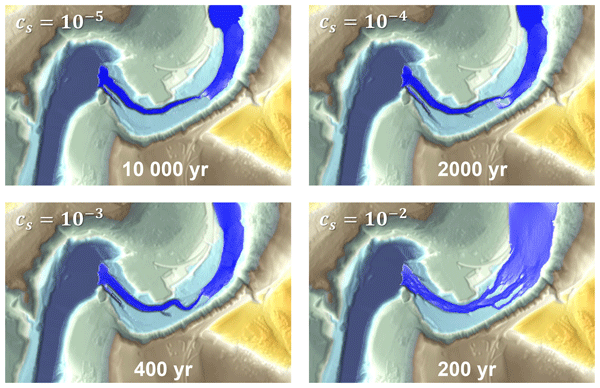
Abstract. We analyze how the process of bedrock incision by the impact of sediment grains can be described and coupled with sediment dynamics. We first point out that the key parameter is a bedrock dimensionless coefficient that describes the ratio between the volumes of impacting sediments and bedrock erosion. We then write the coupled equations by introducing a partitioning coefficient between sediment and bedrock erosions. It describes the time spent doing one or the other erosion process – or the proportion of depositing grains that impact bedrock. In a 1D along-stream system, the resulting equations lead to a similar description of the cover effect proposed by Sklar and Dietrich (2004), giving a rationale to their expression. In a second step, we extend the concept to lateral erosion or deposition fluxes. We develop analytical solutions for a river fed by uniform lateral sediment fluxes from hillslope and show why the sediment load can exceed the transport capacity. We then implement the equations in the numerical code River.lab/eros, where water depth and velocity, as well as erosion and deposition fluxes, are solved with the method of precipitons. As an example, we simulate the evolution of the Rheinfall at Schaffhausen, Switzerland, a prominent knickpoint along the Hochrhein. In contrast with sediment processes, where the knickpoint slope decreases by diffusion without upstream displacements, bedrock abrasion allows knickpoint to move upstream while retaining almost the same shape. This is consistent with detachment-limited behavior as emphasized in the theoretical part of the paper. The knickpoint shape (foot elevation and height) and retreat rates are highly dependent on the sediment load in river. Bedrock erosion first happens in a narrow canyon that propagates upstream, and then the river widens after the knickpoint passed by.
Competing interests: At least one of the (co-)authors is a member of the editorial board of Earth Surface Dynamics.
Publisher's note: Copernicus Publications remains neutral with regard to jurisdictional claims made in the text, published maps, institutional affiliations, or any other geographical representation in this paper. While Copernicus Publications makes every effort to include appropriate place names, the final responsibility lies with the authors. Views expressed in the text are those of the authors and do not necessarily reflect the views of the publisher.-
Notice on discussion status
The requested preprint has a corresponding peer-reviewed final revised paper. You are encouraged to refer to the final revised version.
-
Preprint
(2267 KB)
-
The requested preprint has a corresponding peer-reviewed final revised paper. You are encouraged to refer to the final revised version.
- Preprint
(2267 KB) - Metadata XML
- BibTeX
- EndNote
- Final revised paper


Journal article(s) based on this preprint
Interactive discussion
Status: closed
-
CC1: 'Comment on egusphere-2026-420', Takuya Inoue, 22 Mar 2026
-
AC2: 'Reply on CC1', Philippe Davy, 29 Apr 2026
I list below the issues addressed by RC1 (in italic) and my answers
General comments
The authors consider the role of sediment dynamics in the erosion of bedrock rivers by partitioning the time sediment spends impacting bedrock and the time it spends deposited. They then apply the framework to investigate how a river profile evolves as a function of sediment supply and rock properties. The manuscript offers and interesting approach to incorporating the complex role of sediment cover in landscape evolution. The paper would be strengthened by providing more context related to similar work attempting to couple sediment dynamics to bedrock incision, even though the particular approach may be new. The terms in many of the equations sometimes lack definition or the fully articulated assumptions behind them, which increases the difficulty of evaluating the model.
I agree with the comment, and the text has been improved accordingly (see the comments for reviewer 1)
Specific comments
As the authors note in line 49, there is an existing body of literature from which these ideas emerge in addition to previous studies with comparable applications (e.g., Beaumont et al., 1992; Nelson & Seminara, 2012; Turowski & Hodge, 2017). This body of literature is somewhat underrepresented, for example, alternative approaches to accounting for the partitioning between sediment participating in cover and sediment impacting bedrock. Making this broader context more explicit in the paper would aid the reader’s ability to both trace concepts used here and to better appreciate this new contribution.
We agree with the reviewer that we did not pay sufficient tribute to previous models. We have enriched the introduction with the necessary references and explanations (see the comments for Reviewer 1).
Careful explication of the concept of transport capacity as it is used here, in particular, would greatly support key claims in the paper. The authors define it in relation to an erosion rate and a length scale, but this leads to some seemingly unintuitive results, such as negative bedrock incision rates (see comment on line 423). I think it is likely that some of these apparent concerns would be assuaged by a more detailed set of definitions. Generally, there are many places where more careful definitions and statement of assumptions should be made.
Actually, bedrock erosion cannot be negative. I admit that this was not immediately obvious. I have significantly revised the text to explain why the results are perfectly rational, and to clarify the definitions and avoid any potential misinterpretation .
Relatedly, a more thorough description of the x_s partitioning coefficient would be helpful because it currently leads to some seemingly contradictory consequences, including only deposition with a fixed sediment cover. Since some of the novelty lies in this partitioning coefficient, resolving some of these issues by developing the rational behind it would be beneficial.
Done, see the comments for reviewer 1
Line comments
Line 20: It should be either “allows a knickpoint” or “allows knickpoints”.
Done
Line 24: Change to “has passed” in order to match tenses.
Done
Line 28: Here, and in the lines 33 and 60-61, the citations should be in-text instead of parenthetical.
Done
Line 41: Change to “…other complexities, such as … roughness, …”
Done
Line 51: More explicit engagement with the origin of these concepts would help contextualize the contribution.
Done
Eq. 2: There is more description in line 81, but it might make sense to define the parameter here where it first appears.
I added a short sentence explaining the transport length, with a citation to Beaumont et al. (1992), who were among the first to introduce it in relation to transport under- and overcapacity.
Eq. 5: It would be helpful to have a space between the comma and zero to make it clearer that it they are part of the two terms from which a maximum is selected rather than 1,0 as a single number.
Good point! Done.
Line 64: Is there a better name for \sqrt{RdD_s^3}. I know it is the standard normalization in the Einstein number, but I am not sure calling it a typical sediment flux itself is the best way to label it. Maybe characteristic sediment flux?
Ok. Done
Line 68: Capitalize Eq. for consistency.
Ok. Done
Line 68: Make “bedform” plural.
Done
Line 70: \alpha is used again in line 99. Additionally, state that w_s is the settling velocity rather than just saying the second \alpha depends on settling velocity.
The exponent is a, not α. Since the first reviewer also got confused, I could change the notation if necessary.
Eq. 7: There must be a notation error somewhere because the equation is currently dimensionally inconsistent.
Done (see comments for reviewer 1)
Line 76: Should “Eqs” be “Eqs.”?
Done
Eq. 8: I don’t think w_{si} is ever defined and \rho is not specified until line 140.
They are defined just after Eq. (8).
Line 84: Replace the less than sign with a period.
Done (see comments for reviewer 1)
Line 85: Here, and in many places, there is no space between the period and the opening parenthesis in the equation abbreviation, but in other places there is. I suggest having the space in all occurrences.
Done
Line 91: I suspect you mean completely eroded at a given location on the channel compared to completely eroded as in there is no sediment cover anywhere on the channel at a given instant. Can this be clarified?
We provide a simple definition of abrasion potential, noting that the sediment cover aspect will be addressed in the system equations. This approach is equivalent to that of Nelson and Seminara (2011). The text has been modified accordingly.
Line 96: I think what is meant in the last clause is either “which is the product of the first two terms in Eq. 8” or “which is equivalent to the first two terms in Eq. 8,” but the construction with a that clause does not seem right.
Good point. We modify the text by “we pose eb the potential bedrock erosion rate, which is the product of the first two terms in Eq. 8”
Eq. 10: The numbering is on the wrong side.
Done
Line 99: There might be a comma missing after is, depending on the intended meaning.
Done
Eq. 11: It is evident from each derivative, but can labels be added to more readily indicate the respective sediment reservoir?
Done
Eq. 12: I think this allows for the sediment cover to change with respect to the constituent grains but not with respect to its thickness. It is fair to model that, but the assumption should be stated very plainly.
Exact. I think this is now better explained. See also the comment for reviewer 1.
Line 115: Add reference to Eq. 4.
Done
Line 117: It may be worth noting the notational choice related to the prime to distinguish the integrating variable just to make it clearer, if that is what it is.
Ok. To avoid confusion, I have replaced x^{'*} by X^*
Line 185: The beginning bracket should be an absolute value sign.
Done
Line 207: Throughout, the period should probably be a dot (\cdot command in LaTeX). It could be omitted in the units, but in Line 466, for example, the number has the same problem, which changes the numerical value.
Done
Line 209: Which is meant: “directly supply the bedload” or “be supplied directly to the bedload”?
Done
Line 235: This is an interesting claim, but I did not really follow where it came from. Relatedly, Figure 3 states that the top plot is for q_s^* but the axis is Q_s^*. I suppose they are equivalent for a fixed channel width, but is that an appropriate assumption over the distance which it takes to reach q_s^\inf?
We have added an explicit definition of Q_s^\infty. We also reformulated the statement on the transport capacity (TC) because its definition can be ambiguous. If TC is defined as the sediment load at which erosion and deposition rates are in equilibrium, then it depends on the hillslope supply, as shown in Section 3.2. Therefore, it is not intrinsic value that depends solely on the river erosion and transport capacities. We have rewritten the text accordingly.
Line 266: Remove the definite article before “Figure 2”.
Done
Figure 4: The legends are illegible.
Done
Figure 5: The legends are illegible.
Done
Figure 9: I know it can be deduced from the other figures an is alluded to in the caption, but adding either a “Concentration =” next to the number or clarifying further in the caption would help the figure be independently readable, as done in the other figure captions.
Done
Figure 10 Caption: The colon is missing.
Done
Line 390: It should be “simulations with the same”
Done
Line 394: The multiplication sign between the 4 and power of ten is missing.
Done
Figure 12 Caption: “Evaluation” is not necessarily wrong, but was it meant to be “evolution”? The multiplication sign between the 5 and power of ten is also missing.
Changed
Line 423: The difference between the “classical transport capacity,” which you say can be exceeded and the “transport capacity,” which you say is physically justified is not very clear. Lines 435-437 imply that there may be no difference at all, but doesn’t that suggest negative bedrock incision via Eq. 8? How does a transport capacity that can be exceeded differ from a simply poorly defined transport capacity, or, I suppose more precisely according to equation 4, an incorrect choice of the hop length? If the negative value indicates deposition, then what does the criterion for deposition become if a river can transport more material than it is capable of transporting? If the river is only in a depositional state, that also seems to violate the fixed cover thickness that results from substituting Eq. 12 into Eq. 11. Based on Davy & Lague (2009), I think what is most likely meant is that transport capacity is not exclusively controlled by water discharge, but the use of the terms in this manuscript does not presently communicate that effectively and the questions about the term when “capacity” is exceeded remain.
Good point. I think that the term “classical transport capacity” might cause confusion, and the definition of the transport capacity can be ambiguous (see a reply to a previous comment by the same reviewer). We have rewritten the paragraph for clarity.
We also added a sentence after Eq. (12) to show that xs is also equal to the ratio qs/qs∞. Thus, bedrock abrasion is not possible if q exceeds the transport capacity, as this results in xs>1.
Line 426: A comma is not needed after the hyphen.
Done
Line 452: Use “has passed” instead.
Done
Line 452: Insert “a” between in and canyon.
Done
Line 456: Replace “of” with “to”.
Done
Line 460: I think “from” rather “in” the Alps would sound more natural.
Done
Line 461: Add “a” between as and reason.
Done
Line 465: Should parameter be plural? Also, do you mean just mean high values or are they higher than something in particular?
There are several values of this particular parameter.
Line 465: A more natural formulation may be “…which can lengthen the simulation time needed to obtain significant bedrock erosion.”
Done
Line 473: While there is nothing wrong, the ending does seem quite abrupt by finishing talking about not making conclusions and things being beyond the scope of the paper.
We have chosen to keep the last paragraph.
Citation: https://doi.org/10.5194/egusphere-2026-420-AC2 -
AC4: 'Reply on CC1', Philippe Davy, 29 Apr 2026
I list below the issues addressed by CC1 (in italic) and my answers
General comments
The authors consider the role of sediment dynamics in the erosion of bedrock rivers by partitioning the time sediment spends impacting bedrock and the time it spends deposited. They then apply the framework to investigate how a river profile evolves as a function of sediment supply and rock properties. The manuscript offers and interesting approach to incorporating the complex role of sediment cover in landscape evolution. The paper would be strengthened by providing more context related to similar work attempting to couple sediment dynamics to bedrock incision, even though the particular approach may be new. The terms in many of the equations sometimes lack definition or the fully articulated assumptions behind them, which increases the difficulty of evaluating the model.
I agree with the comment, and the text has been improved accordingly (see the comments for reviewer 1)
Specific comments
As the authors note in line 49, there is an existing body of literature from which these ideas emerge in addition to previous studies with comparable applications (e.g., Beaumont et al., 1992; Nelson & Seminara, 2012; Turowski & Hodge, 2017). This body of literature is somewhat underrepresented, for example, alternative approaches to accounting for the partitioning between sediment participating in cover and sediment impacting bedrock. Making this broader context more explicit in the paper would aid the reader’s ability to both trace concepts used here and to better appreciate this new contribution.
We agree with the reviewer that we did not pay sufficient tribute to previous models. We have enriched the introduction with the necessary references and explanations (see the comments for Reviewer 1).
Careful explication of the concept of transport capacity as it is used here, in particular, would greatly support key claims in the paper. The authors define it in relation to an erosion rate and a length scale, but this leads to some seemingly unintuitive results, such as negative bedrock incision rates (see comment on line 423). I think it is likely that some of these apparent concerns would be assuaged by a more detailed set of definitions. Generally, there are many places where more careful definitions and statement of assumptions should be made.
Actually, bedrock erosion cannot be negative. I admit that this was not immediately obvious. I have significantly revised the text to explain why the results are perfectly rational, and to clarify the definitions and avoid any potential misinterpretation .
Relatedly, a more thorough description of the x_s partitioning coefficient would be helpful because it currently leads to some seemingly contradictory consequences, including only deposition with a fixed sediment cover. Since some of the novelty lies in this partitioning coefficient, resolving some of these issues by developing the rational behind it would be beneficial.
Done, see the comments for reviewer 1
Line comments
Line 20: It should be either “allows a knickpoint” or “allows knickpoints”.
Done
Line 24: Change to “has passed” in order to match tenses.
Done
Line 28: Here, and in the lines 33 and 60-61, the citations should be in-text instead of parenthetical.
Done
Line 41: Change to “…other complexities, such as … roughness, …”
Done
Line 51: More explicit engagement with the origin of these concepts would help contextualize the contribution.
Done
Eq. 2: There is more description in line 81, but it might make sense to define the parameter here where it first appears.
I added a short sentence explaining the transport length, with a citation to Beaumont et al. (1992), who were among the first to introduce it in relation to transport under- and overcapacity.
Eq. 5: It would be helpful to have a space between the comma and zero to make it clearer that it they are part of the two terms from which a maximum is selected rather than 1,0 as a single number.
Good point! Done.
Line 64: Is there a better name for \sqrt{RdD_s^3}. I know it is the standard normalization in the Einstein number, but I am not sure calling it a typical sediment flux itself is the best way to label it. Maybe characteristic sediment flux?
Ok. Done
Line 68: Capitalize Eq. for consistency.
Ok. Done
Line 68: Make “bedform” plural.
Done
Line 70: \alpha is used again in line 99. Additionally, state that w_s is the settling velocity rather than just saying the second \alpha depends on settling velocity.
The exponent is a, not α. Since the first reviewer also got confused, I could change the notation if necessary.
Eq. 7: There must be a notation error somewhere because the equation is currently dimensionally inconsistent.
Done (see comments for reviewer 1)
Line 76: Should “Eqs” be “Eqs.”?
Done
Eq. 8: I don’t think w_{si} is ever defined and \rho is not specified until line 140.
They are defined just after Eq. (8).
Line 84: Replace the less than sign with a period.
Done (see comments for reviewer 1)
Line 85: Here, and in many places, there is no space between the period and the opening parenthesis in the equation abbreviation, but in other places there is. I suggest having the space in all occurrences.
Done
Line 91: I suspect you mean completely eroded at a given location on the channel compared to completely eroded as in there is no sediment cover anywhere on the channel at a given instant. Can this be clarified?
We provide a simple definition of abrasion potential, noting that the sediment cover aspect will be addressed in the system equations. This approach is equivalent to that of Nelson and Seminara (2011). The text has been modified accordingly.
Line 96: I think what is meant in the last clause is either “which is the product of the first two terms in Eq. 8” or “which is equivalent to the first two terms in Eq. 8,” but the construction with a that clause does not seem right.
Good point. We modify the text by “we pose eb the potential bedrock erosion rate, which is the product of the first two terms in Eq. 8”
Eq. 10: The numbering is on the wrong side.
Done
Line 99: There might be a comma missing after is, depending on the intended meaning.
Done
Eq. 11: It is evident from each derivative, but can labels be added to more readily indicate the respective sediment reservoir?
Done
Eq. 12: I think this allows for the sediment cover to change with respect to the constituent grains but not with respect to its thickness. It is fair to model that, but the assumption should be stated very plainly.
Exact. I think this is now better explained. See also the comment for reviewer 1.
Line 115: Add reference to Eq. 4.
Done
Line 117: It may be worth noting the notational choice related to the prime to distinguish the integrating variable just to make it clearer, if that is what it is.
Ok. To avoid confusion, I have replaced x^{'*} by X^*
Line 185: The beginning bracket should be an absolute value sign.
Done
Line 207: Throughout, the period should probably be a dot (\cdot command in LaTeX). It could be omitted in the units, but in Line 466, for example, the number has the same problem, which changes the numerical value.
Done
Line 209: Which is meant: “directly supply the bedload” or “be supplied directly to the bedload”?
Done
Line 235: This is an interesting claim, but I did not really follow where it came from. Relatedly, Figure 3 states that the top plot is for q_s^* but the axis is Q_s^*. I suppose they are equivalent for a fixed channel width, but is that an appropriate assumption over the distance which it takes to reach q_s^\inf?
We have added an explicit definition of Q_s^\infty. We also reformulated the statement on the transport capacity (TC) because its definition can be ambiguous. If TC is defined as the sediment load at which erosion and deposition rates are in equilibrium, then it depends on the hillslope supply, as shown in Section 3.2. Therefore, it is not intrinsic value that depends solely on the river erosion and transport capacities. We have rewritten the text accordingly.
Line 266: Remove the definite article before “Figure 2”.
Done
Figure 4: The legends are illegible.
Done
Figure 5: The legends are illegible.
Done
Figure 9: I know it can be deduced from the other figures an is alluded to in the caption, but adding either a “Concentration =” next to the number or clarifying further in the caption would help the figure be independently readable, as done in the other figure captions.
Done
Figure 10 Caption: The colon is missing.
Done
Line 390: It should be “simulations with the same”
Done
Line 394: The multiplication sign between the 4 and power of ten is missing.
Done
Figure 12 Caption: “Evaluation” is not necessarily wrong, but was it meant to be “evolution”? The multiplication sign between the 5 and power of ten is also missing.
Changed
Line 423: The difference between the “classical transport capacity,” which you say can be exceeded and the “transport capacity,” which you say is physically justified is not very clear. Lines 435-437 imply that there may be no difference at all, but doesn’t that suggest negative bedrock incision via Eq. 8? How does a transport capacity that can be exceeded differ from a simply poorly defined transport capacity, or, I suppose more precisely according to equation 4, an incorrect choice of the hop length? If the negative value indicates deposition, then what does the criterion for deposition become if a river can transport more material than it is capable of transporting? If the river is only in a depositional state, that also seems to violate the fixed cover thickness that results from substituting Eq. 12 into Eq. 11. Based on Davy & Lague (2009), I think what is most likely meant is that transport capacity is not exclusively controlled by water discharge, but the use of the terms in this manuscript does not presently communicate that effectively and the questions about the term when “capacity” is exceeded remain.
Good point. I think that the term “classical transport capacity” might cause confusion, and the definition of the transport capacity can be ambiguous (see a reply to a previous comment by the same reviewer). We have rewritten the paragraph for clarity.
We also added a sentence after Eq. (12) to show that xs is also equal to the ratio qs/qs∞. Thus, bedrock abrasion is not possible if q exceeds the transport capacity, as this results in xs>1.
Line 426: A comma is not needed after the hyphen.
Done
Line 452: Use “has passed” instead.
Done
Line 452: Insert “a” between in and canyon.
Done
Line 456: Replace “of” with “to”.
Done
Line 460: I think “from” rather “in” the Alps would sound more natural.
Done
Line 461: Add “a” between as and reason.
Done
Line 465: Should parameter be plural? Also, do you mean just mean high values or are they higher than something in particular?
There are several values of this particular parameter.
Line 465: A more natural formulation may be “…which can lengthen the simulation time needed to obtain significant bedrock erosion.”
Done
Line 473: While there is nothing wrong, the ending does seem quite abrupt by finishing talking about not making conclusions and things being beyond the scope of the paper.
We have chosen to keep the last paragraph.
Citation: https://doi.org/10.5194/egusphere-2026-420-AC4
-
AC2: 'Reply on CC1', Philippe Davy, 29 Apr 2026
-
RC1: 'Comment on egusphere-2026-420', Anonymous Referee #1, 09 Apr 2026
General Comments
The authors consider the role of sediment dynamics in the erosion of bedrock rivers by partitioning the time sediment spends impacting bedrock and the time it spends deposited. They then apply the framework to investigate how a river profile evolves as a function of sediment supply and rock properties. The manuscript offers and interesting approach to incorporating the complex role of sediment cover in landscape evolution. The paper would be strengthened by providing more context related to similar work attempting to couple sediment dynamics to bedrock incision, even though the particular approach may be new. The terms in many of the equations sometimes lack definition or the fully articulated assumptions behind them, which increases the difficulty of evaluating the model.
Specific Comments
As the authors note in line 49, there is an existing body of literature from which these ideas emerge in addition to previous studies with comparable applications (e.g., Beaumont et al., 1992; Nelson & Seminara, 2012; Turowski & Hodge, 2017). This body of literature is somewhat underrepresented, for example, alternative approaches to accounting for the partitioning between sediment participating in cover and sediment impacting bedrock. Making this broader context more explicit in the paper would aid the reader’s ability to both trace concepts used here and to better appreciate this new contribution.
Careful explication of the concept of transport capacity as it is used here, in particular, would greatly support key claims in the paper. The authors define it in relation to an erosion rate and a length scale, but this leads to some seemingly unintuitive results, such as negative bedrock incision rates (see comment on line 423). I think it is likely that some of these apparent concerns would be assuaged by a more detailed set of definitions. Generally, there are many places where more careful definitions and statement of assumptions should be made.
Relatedly, a more thorough description of the x_s partitioning coefficient would be helpful because it currently leads to some seemingly contradictory consequences, including only deposition with a fixed sediment cover. Since some of the novelty lies in this partitioning coefficient, resolving some of these issues by developing the rational behind it would be beneficial.
Line Comments
Line 20: It should be either “allows a knickpoint” or “allows knickpoints”.
Line 24: Change to “has passed” in order to match tenses.
Line 28: Here, and in the lines 33 and 60-61, the citations should be in-text instead of parenthetical.
Line 41: Change to “…other complexities, such as … roughness, …”
Line 51: More explicit engagement with the origin of these concepts would help contextualize the contribution.
Eq. 2: There is more description in line 81, but it might make sense to define the parameter here where it first appears.
Eq. 5: It would be helpful to have a space between the comma and zero to make it clearer that it they are part of the two terms from which a maximum is selected rather than 1,0 as a single number.
Line 64: Is there a better name for \sqrt{RdD_s^3}. I know it is the standard normalization in the Einstein number, but I am not sure calling it a typical sediment flux itself is the best way to label it. Maybe characteristic sediment flux?
Line 68: Capitalize Eq. for consistency.
Line 68: Make “bedform” plural.
Line 70: \alpha is used again in line 99. Additionally, state that w_s is the settling velocity rather than just saying the second \alpha depends on settling velocity.
Eq. 7: There must be a notation error somewhere because the equation is currently dimensionally inconsistent.
Line 76: Should “Eqs” be “Eqs.”?
Eq. 8: I don’t think w_{si} is ever defined and \rho is not specified until line 140.
Line 84: Replace the less than sign with a period.
Line 85: Here, and in many places, there is no space between the period and the opening parenthesis in the equation abbreviation, but in other places there is. I suggest having the space in all occurrences.
Line 91: I suspect you mean completely eroded at a given location on the channel compared to completely eroded as in there is no sediment cover anywhere on the channel at a given instant. Can this be clarified?
Line 96: I think what is meant in the last clause is either “which is the product of the first two terms in Eq. 8” or “which is equivalent to the first two terms in Eq. 8,” but the construction with a that clause does not seem right.
Eq. 10: The numbering is on the wrong side.
Line 99: There might be a comma missing after is, depending on the intended meaning.
Eq. 11: It is evident from each derivative, but can labels be added to more readily indicate the respective sediment reservoir?
Eq. 12: I think this allows for the sediment cover to change with respect to the constituent grains but not with respect to its thickness. It is fair to model that, but the assumption should be stated very plainly.
Line 115: Add reference to Eq. 4.
Line 117: It may be worth noting the notational choice related to the prime to distinguish the integrating variable just to make it clearer, if that is what it is.
Line 185: The beginning bracket should be an absolute value sign.
Line 207: Throughout, the period should probably be a dot (\cdot command in LaTeX). It could be omitted in the units, but in Line 466, for example, the number has the same problem, which changes the numerical value.
Line 209: Which is meant: “directly supply the bedload” or “be supplied directly to the bedload”?
Line 235: This is an interesting claim, but I did not really follow where it came from. Relatedly, Figure 3 states that the top plot is for q_s^* but the axis is Q_s^*. I suppose they are equivalent for a fixed channel width, but is that an appropriate assumption over the distance which it takes to reach q_s^\inf?
Line 266: Remove the definite article before “Figure 2”.
Figure 4: The legends are illegible.
Figure 5: The legends are illegible.
Figure 9: I know it can be deduced from the other figures an is alluded to in the caption, but adding either a “Concentration =” next to the number or clarifying further in the caption would help the figure be independently readable, as done in the other figure captions.
Figure 10 Caption: The colon is missing.
Line 390: It should be “simulations with the same”
Line 394: The multiplication sign between the 4 and power of ten is missing.
Figure 12 Caption: “Evaluation” is not necessarily wrong, but was it meant to be “evolution”? The multiplication sign between the 5 and power of ten is also missing.
Line 423: The difference between the “classical transport capacity,” which you say can be exceeded and the “transport capacity,” which you say is physically justified is not very clear. Lines 435-437 imply that there may be no difference at all, but doesn’t that suggest negative bedrock incision via Eq. 8? How does a transport capacity that can be exceeded differ from a simply poorly defined transport capacity, or, I suppose more precisely according to equation 4, an incorrect choice of the hop length? If the negative value indicates deposition, then what does the criterion for deposition become if a river can transport more material than it is capable of transporting? If the river is only in a depositional state, that also seems to violate the fixed cover thickness that results from substituting Eq. 12 into Eq. 11. Based on Davy & Lague (2009), I think what is most likely meant is that transport capacity is not exclusively controlled by water discharge, but the use of the terms in this manuscript does not presently communicate that effectively and the questions about the term when “capacity” is exceeded remain.
Line 426: A comma is not needed after the hyphen.
Line 452: Use “has passed” instead.
Line 452: Insert “a” between in and canyon.
Line 456: Replace “of” with “to”.
Line 460: I think “from” rather “in” the Alps would sound more natural.
Line 461: Add “a” between as and reason.
Line 465: Should parameter be plural? Also, do you mean just mean high values or are they higher than something in particular?
Line 465: A more natural formulation may be “…which can lengthen the simulation time needed to obtain significant bedrock erosion.”
Line 473: While there is nothing wrong, the ending does seem quite abrupt by finishing talking about not making conclusions and things being beyond the scope of the paper.
References
Beaumont, C., Fullsack, P., & Hamilton, J. (1992). Erosional control of active compressional orogens. In K. R. McClay (Ed.), Thrust Tectonics (pp. 1–18). Springer Netherlands. https://doi.org/10.1007/978-94-011-3066-0_1
Davy, P., & Lague, D. (2009). Fluvial erosion/transport equation of landscape evolution models revisited. Journal of Geophysical Research: Earth Surface, 114(F3). https://doi.org/10.1029/2008JF001146
Nelson, P. A., & Seminara, G. (2012). A theoretical framework for the morphodynamics of bedrock channels. Geophysical Research Letters, 39(6). https://doi.org/10.1029/2011GL050806
Turowski, J. M., & Hodge, R. (2017). A probabilistic framework for the cover effect in bedrock erosion. Earth Surface Dynamics, 5(2), 311–330. https://doi.org/10.5194/esurf-5-311-2017
Citation: https://doi.org/10.5194/egusphere-2026-420-RC1 -
AC1: 'Reply on RC1', Philippe Davy, 29 Apr 2026
I list below the issues addressed by RC1 (in italic) and my answers.
Major comments:
- A two-dimensional model considering bedrock erosion (including lateral erosion) and alluvial deposition (including bar formation) has been proposed by Inoue, Parker and Stark (2017, ESPL), Inoue et al. (2021, JGR), and Cho and Nelson (2025). The novelty needs to be further clarified. It is insufficient to simply state that the fundamental equations are new; the authors need to clearly define their novelty in terms of the phenomena they can address.
I agree that the article does not pay enough tribute to existing works. In the revised version of the manuscript, we add more references to previous works in the introduction, including field and laboratory evidences of bedrock erosion, and models.
We also agree that the model is close to the one developed by Inoue et al. (2014) but with some significant differences. We now explain better the conceptual differences between this model and others, and highlight the innovative nature of our formalism.
I summarize below the fundamentals:
- First, I make it clear that the aim is to develop long-term landscape evolution model with the requirement to keep the model simple, yet still relevant.
- The model is based on a partitioning of the erosive fluxes between eroding the sediment layer and impacting the bedrock. is the partitioning coefficient.
- An additional equation is necessary to solve for when bedrock erosion is active (). We opted for a model where varies linearly with the ratio of the deposition rate to the sediment erosion rate, which assumes that the alluvial sediment layer is very small when the bedrock is eroded. We also briefly discuss how other assumptions could be formulated (e.g., a cover trapped in riverbed roughness, as in {Inoue, 2014 #12844@@author-year}).
- If , i.e., when the sediment layer entirely covers the riverbed, the set of equations is the same as for a river overlying an alluvial cover.
- The sediment equation in the river is written as a Lagrangian derivative that requires only erosion and deposition fluxes. This introduces a 'transport' (or sedimentation) length, which makes it easier to link to the abrasion theory. Transport capacity is not an intrinsic property, but a state in which erosion compensates for deposition
- We argue that it is the transport length rather than the hop length, that determines the impact rates on the bedrock.
A figure is added in the text to illustrate the model.
- I find the explanations for transport length, saltation length, deposition rate and impact velocity problematic (Lines 85-87). Transport length is often defined as the distance a sediment travels from the moment it starts moving until it stops. This is different from the distance of a single jump (i.e., saltation length or hop length). Also, d (deposition rate) in Equation 2 is the volume of deposited particles divided by the transport length multiplied by the river width, which is clearly a different definition from the particle collision velocity. If you claim these are similar, you must clearly state the previous research that supports that relationship.
This is a misunderstanding, and we will make sure to clarify it in the text. The definition of transport length that we are using is the ratio of the sediment flux carried by the river per unit flow width to the deposition rate (see Davy and Lague (2009) amongst others, who generalised the concept originally defined by Beaumont et al., 1992). As the abrasion theory is based on the number of impacts per unit of time, the relevant parameter is the flow-related parameter (the transport length) rather than the grain lifetime-related parameter (the 'hop' length). This has now been clarified in the text.
Equation (2) does not involve any flow width – except if the equation is integrated over the river width as it is in the example 1 –; it is defined in the context of the shallow water equations (SWE), where the flow width should be an emerging property of the flow/erosion equations.
I don't understand the last comment. The deposition flux defines the collision flux, i.e. the number of potential impacts per unit of time, not the particle collision velocity.
- Please provide sufficient explanation regarding particle size, roughness, and the amount of sediment supplied from the upstream end in in the calculation conditions (Section 4.2). Regarding roughness in particular, you describe the importance of roughness on alluvial cover in Introduction, but there is no mention of how roughness is treated in your model or numerical calculations.
We have now provided details of all the parameters used in the numerical simulations. As explained above, bed roughness is not a parameter of the simulations, but depressions in the topography can trap sediment and prevent the erosion of bedrock.
- Providing longitudinal and transverse profiles of the alluvial layer thickness on the bedrock "hs" would help to more easily understand the cover effects.
Ideally, we should have created maps showing the values during the simulations. Unfortunately, that parameter was not recorded. If it’s really necessary, however, we can modify the code and run the simulations again.
1.2 Line-by-line comments
Eq. 2: Add an explanation for ξ to the text following the equation. L71 is too far away.
Done
Eq. 5: Add an explanation of α to the text following the equation.
Done
L67: D-->Ds
Done
L68: Include references that support the idea that A* is between 0.04 and 0.1. For MPM, qs = 8(τ*-τ*c)^1.5sqrt(RgDs^3), and the value of A* depends on τ*c and particle size.
In the text, the MPM equation is written with the transport stage, τ/τc-1, rather than τ*-τ*c. Thus, A* contains the critical Shields number (for example, A*=8*τ*cr^1.5 for MPM). I don’t think we need to provide any additional references to those given in the text.
Eq. 7: x*-->x. Otherwise, the dimensions of the left and right sides do not match.
Good point. This has been corrected.
L84: Please add explanations for ρs, wsi, and kv.
Done
L91: Does this mean that the alluvial cover ratio pc = 0? or pc <1?
It just means that, if the sediment layer covering the riverbed cannot be eroded, the system will eventually aggrade, and the sediment layer will fully cover the riverbed.
Eq.10: Since α is used in equation 5, please use a different symbol.
The exponent in equation 5 is a, not α.
Eq. 12: Substituting equation 12 into the second equation of equation 11, the right-hand side becomes 0. This is strange, as it means that the alluvial layer thickness does not change over time.
You are absolutely right, and I realise that my explanation was rather brief. I explain why we made this choice in the text and in response to the first major comment. This explanation is also provided in an additional figure, in which is plotted as a function of the deposition rate-to-erosion rate ratio.
While not definitive proof, this partitioning theory leads to the same description of the cover effect as that described by Sklar and Dietrich (2004) and, to some extent, Inoue et al. (2014).L125: Do not write a statement regarding conflicts of interest in Figure 1.
Sorry, it was an accidental copy-and-paste
Eq 20: If ξb is the transport length and ξ is the saltation length, then equation (2) should use ξb.
Sorry, it is a misunderstanding of what are ξ and ξb. I have already discussed the definition of ξ above. The text already provides a definition of ξb, which is an “apparent” transport distance derived from the erosion equations.
L176: Recently, Inoue et al. (2025, GRL) experimentally demonstrated that bedrock lateral erosion due to particle impacts increases with increasing lateral slope. Please refer to their work. Their experiments also showed that secondary flow suppresses lateral erosion. Please describe how the effects of secondary flow are considered in this model.
An interesting remark. My argument was purely geometrical. It's good to see that it's also supported by flume experiments. I have added the reference in line 190.
Section 4.1 on numerical implementation clearly states that inertia is neglected in the hydrodynamic model. To make it even clearer, I add a sentence stating that all inertial effects, including those associated with secondary flows, are not taken into account.
L262: In the appendix, please provide the basic equations for two-dimensional flow, the method for calculating shear stress, and the methods for calculating sediment transport in the x (streamwise) and y (lateral) directions. Also, indicate whether there is any double counting of the bed elevation change due to sediment transport in the y direction and the lateral erosion shown in Figure 2.
I agree that the description of the hydrodynamic and geomorphological model could be improved slightly. I have added more information on the model implementation in section 4.1 and refer to Davy et al. (2017) for a detailed description. We also indicate the way in which we calculate shear stress.
There is no double counting of lateral bed elevation. We verify that a precipiton never erodes twice a lateral grid point, but it is normal for a given point to be modified twice by two different precipitons. Physically, the precipiton method is very close to the way water volumes transport sediments and erode basal and lateral topographies.
L296: Provide information regarding the grain size of the bed material. Also, describe how the sediment inflow from the upstream end was determined.
Done.
Fig. 4: Add legends to the two top figures of the color map. One has one, but the text is too small to read. For the bottom figure, indicate the dimension on the vertical axis.
Done.
Fig. 5: The legend in the color map is too small to read.
The legend is the same as for Figure 4. We have made it clear.
Fig. 11: Add legend to the color maps.
The legend is the same as for Figure 6. We have made it clear.
Citation: https://doi.org/10.5194/egusphere-2026-420-AC1
-
AC1: 'Reply on RC1', Philippe Davy, 29 Apr 2026
-
CC2: 'Comment on egusphere-2026-420', Jens Turowski, 10 Apr 2026
I would like to contribute four main comments on this manuscript.
- I agree with Takuya Inoue’s comment that the novelty of the paper needs to be clarified. The work is currently not well motivated. It has already been pointed out in the other comments that there are similar approaches in the literature that need to be cited and put into context. A highly relevant paper developing a model based on the entrainment-deposition framework that has not been mentioned yet is by Shobe et al., GMD 2017. You may also want to look at recent work by Rebecca Hodge. She has done a lot of very relevant flume and field work on the topic.
New equations are warranted to either fix theoretical or empirical problems with existing approaches, or to close a gap in predictive capabilities. The authors could summarize the existing approaches accordingly and point out where their formulation is intended to improve. In addition, they could provide an overview of how and where their new model differs from existing ones. - There seems to be an issue with the mass balance to me. Consider a control volume in the stream. A hallmark of the entrainment-deposition model is that it considers the mobile volume of sediment per unit area Vm explicitly separate from the stationary mass Ms. The rate of change of mass change is the dVm/dt = e – d – dqs/dx, where t denotes time, e the entrainment rate, d the deposition rate, qs the along-stream sediment flux, and x the downstream distance. This can be compared to the mass balance equation used by the authors, eq. (1) in the manuscript, and the equations are the same when the time derivative is set to zero. For alluvial systems and landscape evolution time scales, for which the authors’ development is intended, this can be justified by arguing that the relevant adjustment time scale are short in comparison to the timescales considered in the model (i.e., the forcing terms would be slowly varying in comparison to the adjustment timescales). In this case, the temporal variation of Vm can be neglected and each part of the river can be considered to be in a transport steady state.
In contrast, in a bedrock system, we need to explicitly consider the mass balance of the stationary sediment Vs (which, btw, determines the cover). This gives a second mass balance equation dVs/dt = d – e. While the authors do not explicitly formulate this equation, it is implicit that its time derivative is not set to zero, i.e., d can differ from e. Mathematically, steady states can be possible where e-d = dqs/dx. However, physically, this does not make sense to me. The reason is that the adjustment timescale of Vs is necessarily the same as that of Vm and the assumption of this timescale being short enough to be able to neglect the temporal derivatives would need to apply to both equations simultaneously. This steady state assumption thus leads to e = d always. - When reading through the introduction, it seems to me that the authors are unaware of a large body of relevant literature. For many of the statements, I can think of multiple other papers (see some suggestions below). I suggest to widen the literature search, include some additional key references, and add ‘e.g.’ to many of the citation lists to acknowledge that they are incomplete.
- The discussion is currently superficial. It fails to critically evaluate the new formulation with respect to its physical assumptions, current debates, and the existing literature on fluvial bedrock erosion and bedrock channel morphodynamics. It is unclear in how far the model differs from existing models and whether there is evidence to support one or the other. The case study feels incomplete (actually admitted by the authors, line 467) and its point is unclear.
28 better cite Sklar and Dietrich 1998 or 2004 here, and move the citation of the 2001 paper to line 29.
29 Sklar and Dietrich 2001 is a key citation for the experiments. There are other examples or experimental papers, so best add ‘e.g.’. There are also quite a few papers providing field evidence.
32 earlier mechanistic formulations exist, for example due to Foley or Ishibashi.
33 further changes are for example by Auel et al. 2017, Demiral et al. 2026, and Turowski et al., 2023.
36 again multiple further articles exist, important would be Miller and Jerolmack 2021 and Turowski et al. 2023.
40 The linear cover model was actually proposed by Sklar & Dietrich 1998 (as far as I am aware, there are two earlier conference abstracts mentioning that model, one by Sklar and Dietrich in 2016 and one by Slingerland et al. in 2017).
42 there is more relevant literature, for example, Hodge and Hoey 2012 and Johnson 2014.
45 The statement here is especially scarce in citations. The only reference cited at the moment, Lamb et al. 2008, is not even concerned with the cover effect, and is not really relevant here.
48 The statement here begs for references.
In general, please define all the symbols when they are first used.
Eq. 8: here, the authors equate the saltation hop length from the original SD2004 model with the transport length from their model. This does not make sense to me, as the former one is defined for the process scale and the latter one for the landscape evolution scale. There is a statement on this in line 85, but the assumption should be justified before introducing the equation. Alternatively, introduce the equation with the saltation hop length first, then argue why this can be assumed to correspond to the transport length. I think a more honest way would be to make the two length scales scale with each other, rather than setting them equal. I would, however, expect that the scaling factor is not a constant.
Eq. 12: This seems to be quite a strong statement to me that seems odd from a mechanistic perspective. This is directly related to the construction of the model and should have a strong physical basis. Do I understand it correctly that this implies that the volume of eroded bedrock is set equal to the potential volume of sediment entrainment (corrected for porosity)? This seems implausible to me. The authors need to do some more work here to justify this.
It also does not make sense to me to add erosion products to the bedload (which can subsequently cause further erosion downstream). The erosion products produced by impact erosion typically are fine and would be part of the washload or at least suspended load.
415 The ad-hoc model is the linear model due to Sklar and Dietrich. Subsequent models have given physics-based (e.g., Aubert et al., 2016), reduced complexity (e.g., Hodge and Hoey, 2012) or stochastic frameworks (e.g., Turowski and Hodge, 2017).
435 The expression was not empirical, but an ad hoc formulation (essentially using the simplest function to connect the two endmembers of zero cover at zero sediment supply and full cover when supply matches transport capacity).
452 Increasing shear stress can also have the effect of increasing hop length, decreasing erosion rate. This has already been discussed in the Sklar and Dietrich 2004 paper. In addition, if the aspect ratio of the channel approach 1, shear stress is redistributed onto the walls, which can also reduce the bed erosion rate.
465 What is the point of including this into the paper if you do not do it properly?
469 Please cite the relevant literature.
References
Aubert, G., Langlois, V. J., and Allemand, P.: Bedrock incision by bedload: insights from direct numerical simulations, Earth Surf. Dynam., 4, 327–342, https://doi.org/10.5194/esurf-4-327-2016, 2016.
Auel, C., Albayrak, I., Sumi, T., Boes, R.M., 2017b. Sediment transport in high-speed flows over a fixed bed: 2. Particle impacts and abrasion prediction. Earth Surf. Proc. Land. 42 (9), 1384–1396. https://doi.org/10.1002/esp.4132.
Demiral, D., I. Albayrak, J.M. Turowski, R.M. Boes, 2026, Hydro-abrasion processes and modeling at hydraulic structures and steep bedrock rivers: 2. Hydro-abrasion model development and application, Journal of Hydro-environment Research, 64, 100690, https://doi.org/10.1016/j.jher.2025.100690
Hodge, R. A. and Hoey, T. B.: Upscaling from grain-scale processes to alluviation in bedrock channels using a cellular automaton model, J. Geophys. Res., 117, F01017, https://doi.org/10.1029/2011JF002145, 2012.
Johnson, J. P. L.: A surface roughness model for predicting alluvial cover and bed load transport rate in
bedrock channels, J. Geophys. Res., 119, 2147–2173, https://doi.org/10.1002/2013JF003000, 2014.
Miller, K. and Jerolmack, D.: Controls on the rates and products of particle attrition by bed-load collisions, Earth Surf. Dynam., 9, 755–770, https://doi.org/10.5194/esurf-9-755-2021, 2021.
Shobe, C. M., Tucker, G. E., and Barnhart, K. R.: The SPACE 1.0 model: a Landlab component for 2-D calculation of sediment transport, bedrock erosion, and landscape evolution, Geosci. Model Dev., 10, 4577–4604, https://doi.org/10.5194/gmd-10-4577-2017, 2017.
Sklar, L., and W. E. Dietrich (1998), River longitudinal profiles and bedrock incision models: Stream power and the influence of sediment supply, Rivers Over Rock: Fluvial Processes in Bedrock Channels, edited by K. J. Tinkler and E. E. Wohl, Geophys. Monogr. Ser., vol. 107, pp. 237– 260, AGU, Washington, D. C.
Turowski, J.M., R.A. Hodge, 2017, A probabilistic framework for the cover effect in bedrock erosion, Earth Surface Dynamics, 5, 311–330, doi: 10.5194/esurf-5-311-2017
Turowski, J.M., G. Pruß, A. Voigtländer, A. Ludwig, A. Landgraf, F. Kober, A. Bonnelye, 2023, Geotechnical controls on erodibility in fluvial impact erosion, Earth Surface Dynamics, 11, 979–994, https://doi.org/10.5194/esurf-11-979-2023
Citation: https://doi.org/10.5194/egusphere-2026-420-CC2 -
AC3: 'Reply on CC2', Philippe Davy, 29 Apr 2026
I agree with Takuya Inoue’s comment that the novelty of the paper needs to be clarified. The work is currently not well motivated. It has already been pointed out in the other comments that there are similar approaches in the literature that need to be cited and put into context. A highly relevant paper developing a model based on the entrainment-deposition framework that has not been mentioned yet is by Shobe et al., GMD 2017. You may also want to look at recent work by Rebecca Hodge. She has done a lot of very relevant flume and field work on the topic.
New equations are warranted to either fix theoretical or empirical problems with existing approaches, or to close a gap in predictive capabilities. The authors could summarize the existing approaches accordingly and point out where their formulation is intended to improve. In addition, they could provide an overview of how and where their new model differs from existing ones.
I agree with citing more references and acknowledging that the set of equations shares some features with other models (How could it be any other way?). But it seems to me that there are enough differences in the equations themselves, especially in 2D, and in the numerical implementation, as well as enough originality in the analysis, to make it worth publishing.
There seems to be an issue with the mass balance to me. Consider a control volume in the stream. A hallmark of the entrainment-deposition model is that it considers the mobile volume of sediment per unit area Vm explicitly separate from the stationary mass Ms. The rate of change of mass change is the dVm/dt = e – d – dqs/dx, where t denotes time, e the entrainment rate, d the deposition rate, qs the along-stream sediment flux, and x the downstream distance. This can be compared to the mass balance equation used by the authors, eq. (1) in the manuscript, and the equations are the same when the time derivative is set to zero. For alluvial systems and landscape evolution time scales, for which the authors’ development is intended, this can be justified by arguing that the relevant adjustment time scale are short in comparison to the timescales considered in the model (i.e., the forcing terms would be slowly varying in comparison to the adjustment timescales). In this case, the temporal variation of Vm can be neglected and each part of the river can be considered to be in a transport steady state.
I have rewritten the equations, which lacked clarity in hindsight. I specified when we assume stationarity and which derivative we use (Lagrangian or Eulerian). Stationarity is not a necessary assumption; it is just used in analytical examples to derive simple equations but not in the numerical model.
In contrast, in a bedrock system, we need to explicitly consider the mass balance of the stationary sediment Vs (which, btw, determines the cover). This gives a second mass balance equation dVs/dt = d – e. While the authors do not explicitly formulate this equation, it is implicit that its time derivative is not set to zero, i.e., d can differ from e. Mathematically, steady states can be possible where e-d = dqs/dx. However, physically, this does not make sense to me. The reason is that the adjustment timescale of Vs is necessarily the same as that of Vm and the assumption of this timescale being short enough to be able to neglect the temporal derivatives would need to apply to both equations simultaneously. This steady state assumption thus leads to e = d always.
The assumption has been clarified further (see comments for reviewers 1 and 2, as well as the revised text). As the second reviewer stated, this does not mean that the thickness of the alluvial cover does not vary; rather, it assumes that the variation remains small when bedrock abrasion is possible (i.e., ). This assumption is similar to that in Nelson and Seminara (2012) in their master equation.
When reading through the introduction, it seems to me that the authors are unaware of a large body of relevant literature. For many of the statements, I can think of multiple other papers (see some suggestions below). I suggest to widen the literature search, include some additional key references, and add ‘e.g.’ to many of the citation lists to acknowledge that they are incomplete.
The discussion is currently superficial. It fails to critically evaluate the new formulation with respect to its physical assumptions, current debates, and the existing literature on fluvial bedrock erosion and bedrock channel morphodynamics. It is unclear in how far the model differs from existing models and whether there is evidence to support one or the other. The case study feels incomplete (actually admitted by the authors, line 467) and its point is unclear.
While I acknowledge the absence of certain references, this paper is not intended as a comprehensive review of bedrock erosion, but rather as an analysis of the interplay between bedrock erosion and sediment dynamics. The scaling analysis and the two-dimensional implementation using an SWE model are both new.
I disagree that the conclusion is superficial (this could be said of all the papers cited by the reviewer, including his own). It is based on the model's findings.
28 better cite Sklar and Dietrich 1998 or 2004 here, and move the citation of the 2001 paper to line 29.
Good point; it was an error when copying and pasting the reference.
29 Sklar and Dietrich 2001 is a key citation for the experiments. There are other examples or experimental papers, so best add ‘e.g.’. There are also quite a few papers providing field evidence.
Done
32 earlier mechanistic formulations exist, for example due to Foley or Ishibashi.
33 further changes are for example by Auel et al. 2017, Demiral et al. 2026, and Turowski et al., 2023.
Ok
36 again multiple further articles exist, important would be Miller and Jerolmack 2021 and Turowski et al. 2023.
Ok
40 The linear cover model was actually proposed by Sklar & Dietrich 1998 (as far as I am aware, there are two earlier conference abstracts mentioning that model, one by Sklar and Dietrich in 2016 and one by Slingerland et al. in 2017).
An interesting point... for anyone interested in tracing the history of these concepts.
42 there is more relevant literature, for example, Hodge and Hoey 2012 and Johnson 2014.
Ok
45 The statement here is especially scarce in citations. The only reference cited at the moment, Lamb et al. 2008, is not even concerned with the cover effect, and is not really relevant here.
I don’t want to enter into the detail of the cover effect. Many authors (e.g., Beaumont et al., 1992; Tucker and Slingerland, 1994; Sklar and Dietrich, 1998; Howard, 1994) have noted that bedrock erosion can only occur if the sedimentary cover has been eroded, which is a fairly obvious point. However, my point was to highlight the issue of the exposed fraction, which I believe was first popularized by Sklar and Dietrich in 2004.
48 The statement here begs for references.
Ok
In general, please define all the symbols when they are first used.
Eq. 8: here, the authors equate the saltation hop length from the original SD2004 model with the transport length from their model. This does not make sense to me, as the former one is defined for the process scale and the latter one for the landscape evolution scale. There is a statement on this in line 85, but the assumption should be justified before introducing the equation. Alternatively, introduce the equation with the saltation hop length first, then argue why this can be assumed to correspond to the transport length. I think a more honest way would be to make the two length scales scale with each other, rather than setting them equal. I would, however, expect that the scaling factor is not a constant.
That's a good point, and I addressed it in my previous comments and in the text. I explained in the revised text why the definition in SD2004 should have referred to the transport length rather than the hop length since the model relies on impact flux (the number of impacts per unit of time and surface area) rather than particle trajectory. I also mentioned that I am using the same scaling and taking the same precautions regarding the validity of this assumption as the reviewer suggested.
Eq. 12: This seems to be quite a strong statement to me that seems odd from a mechanistic perspective. This is directly related to the construction of the model and should have a strong physical basis. Do I understand it correctly that this implies that the volume of eroded bedrock is set equal to the potential volume of sediment entrainment (corrected for porosity)? This seems implausible to me. The authors need to do some more work here to justify this.
Absolutely not! Eq. (12) states that the volume of sediment deposited on the bedrock surface to form the sediment cover is approximately equal to the volume of sediment reentrained in the flow. This equality only holds if the sediment cover is incomplete (xS<1)
It also does not make sense to me to add erosion products to the bedload (which can subsequently cause further erosion downstream). The erosion products produced by impact erosion typically are fine and would be part of the washload or at least suspended load.
You are right, but the text clearly states the assumptions of the model. You might ask, "Why develop models that don't reflect reality?" In my opinion, however, there is a lot to learn from models, even if they are overly simplistic or not parameterized with realistic parameters. The same criticisms could be leveled at most models, including those by Aubert et al. (2016), Hodge and Hoey (2012), and Turowski and Hodge (2017). Regarding the criticism itself, it is probably not as serious as it seems for several reasons:
- Our aim is to study bedrock processes triggered by sediment impacts. While abrasion produces very small particles, there are other processes that generate larger sediment grains from bedrock erosion, such as macro-abrasion.
- The amount of sediment supplied to river flow from bedrock erosion is small compared to the amount of sediment transported in the bedload. Whether or not we take them into account will not change the general dynamics.
415 The ad-hoc model is the linear model due to Sklar and Dietrich. Subsequent models have given physics-based (e.g., Aubert et al., 2016), reduced complexity (e.g., Hodge and Hoey, 2012) or stochastic frameworks (e.g., Turowski and Hodge, 2017).
I agree. I have added references in the text
435 The expression was not empirical, but an ad hoc formulation (essentially using the simplest function to connect the two endmembers of zero cover at zero sediment supply and full cover when supply matches transport capacity).
Ok
452 Increasing shear stress can also have the effect of increasing hop length, decreasing erosion rate. This has already been discussed in the Sklar and Dietrich 2004 paper. In addition, if the aspect ratio of the channel approach 1, shear stress is redistributed onto the walls, which can also reduce the bed erosion rate.
The decrease in the bedrock erosion rate when as shear stress (or transport stage) increases is due to the cover effect in SD2004. I don’t see any inconsistency with our findings. Regarding the aspect ratio, our geomorphic model considers lateral erosion by abrasion, whereas the hydraulic model is limited by the shallow water assumption, under which hydraulic friction is primarily basal.
465 What is the point of including this into the paper if you do not do it properly?
See my previous comment about "Why develop models that don't reflect exactly reality?"
469 Please cite the relevant literature.
Done (at least for one recent reference).
Citation: https://doi.org/10.5194/egusphere-2026-420-AC3
- I agree with Takuya Inoue’s comment that the novelty of the paper needs to be clarified. The work is currently not well motivated. It has already been pointed out in the other comments that there are similar approaches in the literature that need to be cited and put into context. A highly relevant paper developing a model based on the entrainment-deposition framework that has not been mentioned yet is by Shobe et al., GMD 2017. You may also want to look at recent work by Rebecca Hodge. She has done a lot of very relevant flume and field work on the topic.
-
EC1: 'Comment on egusphere-2026-420', Rebecca Hodge, 14 Apr 2026
Thanks to all reviewers for their constructive comments. This comment is to note that CC1 is from one of the invited reviewers, and so this preprint has recieved the requisite number of reviews for the discussion to be closed at the end of the discussion period.
Citation: https://doi.org/10.5194/egusphere-2026-420-EC1 -
AC4: 'Reply on CC1', Philippe Davy, 29 Apr 2026
I list below the issues addressed by CC1 (in italic) and my answers
General comments
The authors consider the role of sediment dynamics in the erosion of bedrock rivers by partitioning the time sediment spends impacting bedrock and the time it spends deposited. They then apply the framework to investigate how a river profile evolves as a function of sediment supply and rock properties. The manuscript offers and interesting approach to incorporating the complex role of sediment cover in landscape evolution. The paper would be strengthened by providing more context related to similar work attempting to couple sediment dynamics to bedrock incision, even though the particular approach may be new. The terms in many of the equations sometimes lack definition or the fully articulated assumptions behind them, which increases the difficulty of evaluating the model.
I agree with the comment, and the text has been improved accordingly (see the comments for reviewer 1)
Specific comments
As the authors note in line 49, there is an existing body of literature from which these ideas emerge in addition to previous studies with comparable applications (e.g., Beaumont et al., 1992; Nelson & Seminara, 2012; Turowski & Hodge, 2017). This body of literature is somewhat underrepresented, for example, alternative approaches to accounting for the partitioning between sediment participating in cover and sediment impacting bedrock. Making this broader context more explicit in the paper would aid the reader’s ability to both trace concepts used here and to better appreciate this new contribution.
We agree with the reviewer that we did not pay sufficient tribute to previous models. We have enriched the introduction with the necessary references and explanations (see the comments for Reviewer 1).
Careful explication of the concept of transport capacity as it is used here, in particular, would greatly support key claims in the paper. The authors define it in relation to an erosion rate and a length scale, but this leads to some seemingly unintuitive results, such as negative bedrock incision rates (see comment on line 423). I think it is likely that some of these apparent concerns would be assuaged by a more detailed set of definitions. Generally, there are many places where more careful definitions and statement of assumptions should be made.
Actually, bedrock erosion cannot be negative. I admit that this was not immediately obvious. I have significantly revised the text to explain why the results are perfectly rational, and to clarify the definitions and avoid any potential misinterpretation .
Relatedly, a more thorough description of the x_s partitioning coefficient would be helpful because it currently leads to some seemingly contradictory consequences, including only deposition with a fixed sediment cover. Since some of the novelty lies in this partitioning coefficient, resolving some of these issues by developing the rational behind it would be beneficial.
Done, see the comments for reviewer 1
Line comments
Line 20: It should be either “allows a knickpoint” or “allows knickpoints”.
Done
Line 24: Change to “has passed” in order to match tenses.
Done
Line 28: Here, and in the lines 33 and 60-61, the citations should be in-text instead of parenthetical.
Done
Line 41: Change to “…other complexities, such as … roughness, …”
Done
Line 51: More explicit engagement with the origin of these concepts would help contextualize the contribution.
Done
Eq. 2: There is more description in line 81, but it might make sense to define the parameter here where it first appears.
I added a short sentence explaining the transport length, with a citation to Beaumont et al. (1992), who were among the first to introduce it in relation to transport under- and overcapacity.
Eq. 5: It would be helpful to have a space between the comma and zero to make it clearer that it they are part of the two terms from which a maximum is selected rather than 1,0 as a single number.
Good point! Done.
Line 64: Is there a better name for \sqrt{RdD_s^3}. I know it is the standard normalization in the Einstein number, but I am not sure calling it a typical sediment flux itself is the best way to label it. Maybe characteristic sediment flux?
Ok. Done
Line 68: Capitalize Eq. for consistency.
Ok. Done
Line 68: Make “bedform” plural.
Done
Line 70: \alpha is used again in line 99. Additionally, state that w_s is the settling velocity rather than just saying the second \alpha depends on settling velocity.
The exponent is a, not α. Since the first reviewer also got confused, I could change the notation if necessary.
Eq. 7: There must be a notation error somewhere because the equation is currently dimensionally inconsistent.
Done (see comments for reviewer 1)
Line 76: Should “Eqs” be “Eqs.”?
Done
Eq. 8: I don’t think w_{si} is ever defined and \rho is not specified until line 140.
They are defined just after Eq. (8).
Line 84: Replace the less than sign with a period.
Done (see comments for reviewer 1)
Line 85: Here, and in many places, there is no space between the period and the opening parenthesis in the equation abbreviation, but in other places there is. I suggest having the space in all occurrences.
Done
Line 91: I suspect you mean completely eroded at a given location on the channel compared to completely eroded as in there is no sediment cover anywhere on the channel at a given instant. Can this be clarified?
We provide a simple definition of abrasion potential, noting that the sediment cover aspect will be addressed in the system equations. This approach is equivalent to that of Nelson and Seminara (2011). The text has been modified accordingly.
Line 96: I think what is meant in the last clause is either “which is the product of the first two terms in Eq. 8” or “which is equivalent to the first two terms in Eq. 8,” but the construction with a that clause does not seem right.
Good point. We modify the text by “we pose eb the potential bedrock erosion rate, which is the product of the first two terms in Eq. 8”
Eq. 10: The numbering is on the wrong side.
Done
Line 99: There might be a comma missing after is, depending on the intended meaning.
Done
Eq. 11: It is evident from each derivative, but can labels be added to more readily indicate the respective sediment reservoir?
Done
Eq. 12: I think this allows for the sediment cover to change with respect to the constituent grains but not with respect to its thickness. It is fair to model that, but the assumption should be stated very plainly.
Exact. I think this is now better explained. See also the comment for reviewer 1.
Line 115: Add reference to Eq. 4.
Done
Line 117: It may be worth noting the notational choice related to the prime to distinguish the integrating variable just to make it clearer, if that is what it is.
Ok. To avoid confusion, I have replaced x^{'*} by X^*
Line 185: The beginning bracket should be an absolute value sign.
Done
Line 207: Throughout, the period should probably be a dot (\cdot command in LaTeX). It could be omitted in the units, but in Line 466, for example, the number has the same problem, which changes the numerical value.
Done
Line 209: Which is meant: “directly supply the bedload” or “be supplied directly to the bedload”?
Done
Line 235: This is an interesting claim, but I did not really follow where it came from. Relatedly, Figure 3 states that the top plot is for q_s^* but the axis is Q_s^*. I suppose they are equivalent for a fixed channel width, but is that an appropriate assumption over the distance which it takes to reach q_s^\inf?
We have added an explicit definition of Q_s^\infty. We also reformulated the statement on the transport capacity (TC) because its definition can be ambiguous. If TC is defined as the sediment load at which erosion and deposition rates are in equilibrium, then it depends on the hillslope supply, as shown in Section 3.2. Therefore, it is not intrinsic value that depends solely on the river erosion and transport capacities. We have rewritten the text accordingly.
Line 266: Remove the definite article before “Figure 2”.
Done
Figure 4: The legends are illegible.
Done
Figure 5: The legends are illegible.
Done
Figure 9: I know it can be deduced from the other figures an is alluded to in the caption, but adding either a “Concentration =” next to the number or clarifying further in the caption would help the figure be independently readable, as done in the other figure captions.
Done
Figure 10 Caption: The colon is missing.
Done
Line 390: It should be “simulations with the same”
Done
Line 394: The multiplication sign between the 4 and power of ten is missing.
Done
Figure 12 Caption: “Evaluation” is not necessarily wrong, but was it meant to be “evolution”? The multiplication sign between the 5 and power of ten is also missing.
Changed
Line 423: The difference between the “classical transport capacity,” which you say can be exceeded and the “transport capacity,” which you say is physically justified is not very clear. Lines 435-437 imply that there may be no difference at all, but doesn’t that suggest negative bedrock incision via Eq. 8? How does a transport capacity that can be exceeded differ from a simply poorly defined transport capacity, or, I suppose more precisely according to equation 4, an incorrect choice of the hop length? If the negative value indicates deposition, then what does the criterion for deposition become if a river can transport more material than it is capable of transporting? If the river is only in a depositional state, that also seems to violate the fixed cover thickness that results from substituting Eq. 12 into Eq. 11. Based on Davy & Lague (2009), I think what is most likely meant is that transport capacity is not exclusively controlled by water discharge, but the use of the terms in this manuscript does not presently communicate that effectively and the questions about the term when “capacity” is exceeded remain.
Good point. I think that the term “classical transport capacity” might cause confusion, and the definition of the transport capacity can be ambiguous (see a reply to a previous comment by the same reviewer). We have rewritten the paragraph for clarity.
We also added a sentence after Eq. (12) to show that xs is also equal to the ratio qs/qs∞. Thus, bedrock abrasion is not possible if q exceeds the transport capacity, as this results in xs>1.
Line 426: A comma is not needed after the hyphen.
Done
Line 452: Use “has passed” instead.
Done
Line 452: Insert “a” between in and canyon.
Done
Line 456: Replace “of” with “to”.
Done
Line 460: I think “from” rather “in” the Alps would sound more natural.
Done
Line 461: Add “a” between as and reason.
Done
Line 465: Should parameter be plural? Also, do you mean just mean high values or are they higher than something in particular?
There are several values of this particular parameter.
Line 465: A more natural formulation may be “…which can lengthen the simulation time needed to obtain significant bedrock erosion.”
Done
Line 473: While there is nothing wrong, the ending does seem quite abrupt by finishing talking about not making conclusions and things being beyond the scope of the paper.
We have chosen to keep the last paragraph.
Citation: https://doi.org/10.5194/egusphere-2026-420-AC4
Peer review completion


Interactive discussion
Status: closed
-
CC1: 'Comment on egusphere-2026-420', Takuya Inoue, 22 Mar 2026
In this study, the authors propose a numerical analysis model for analyzing elevation changes in mixed bedrock-aluvial channels using a different formulation than previous studies. I feel that their formulation is challenging and novel. However, it is unclear what new capabilities have been achieved as a result. Furthermore, there are several unclear points in the modeling. Below I list a few major comments for the review along with some line-by-line comments.
Major comments:
1. A two-dimensional model considering bedrock erosion (including lateral erosion) and alluvial deposition (including bar formation) has been proposed by Inoue, Parker and Stark (2017, ESPL), Inoue et al. (2021, JGR), and Cho and Nelson (2025). The novelty needs to be further clarified. It is insufficient to simply state that the fundamental equations are new; the authors need to clearly define their novelty in terms of the phenomena they can address.
2. I find the explanations for transport length, saltation length, deposition rate and impact velocity problematic (Lines 85-87). Transport length is often defined as the distance a sediment travels from the moment it starts moving until it stops. This is different from the distance of a single jump (i.e., saltation length or hop length). Also, d (deposition rate) in Equation 2 is the volume of deposited particles divided by the transport length multiplied by the river width, which is clearly a different definition from the particle collision velocity. If you claim these are similar, you must clearly state the previous research that supports that relationship.
3. Please provide sufficient explanation regarding particle size, roughness, and the amount of sediment supplied from the upstream end in in the calculation conditions (Section 4.2). Regarding roughness in particular, you describes the importance of roughness on alluvial cover in Introduction, but there is no mention of how roughness is treated in your model or numerical calculations.
4. Providing longitudinal and transverse profiles of the alluvial layer thickness on the bedrock "hs" would help to more easily understand the cover effects.
Line-by-line comments
Eq. 2: Add an explanation for ξ to the text following the equation. L71 is too far away.
Eq. 5: Add an explanation of α to the text following the equation.
L67: D-->Ds
L68: Include references that support the idea that A* is between 0.04 and 0.1. For MPM, qs = 8(τ*-τ*c)^1.5sqrt(RgDs^3), and the value of A* depends on τ*c and particle size.
Eq. 7: x*-->x. Otherwise, the dimensions of the left and right sides do not match.
L84: Please add explanations for ρs, wsi, and kv.
L91: Does this mean that the alluvial cover ratio pc = 0? or pc <1?
Eq.10: Since α is used in equation 5, please use a different symbol.
Eq. 12: Substituting equation 12 into the second equation of equation 11, the right-hand side becomes 0. This is strange, as it means that the alluvial layer thickness does not change over time.
L125: Do not write a statement regarding conflicts of interest in Figure 1.
Eq 20: If ξb is the transport length and ξ is the saltation length, then equation (2) should use ξb.
L176: Recently, Inoue et al. (2025, GRL) experimentally demonstrated that bedrock lateral erosion due to particle impacts increases with increasing lateral slope. Please refer to their work. Their experiments also showed that secondary flow suppresses lateral erosion. Please describe how the effects of secondary flow are considered in this model.
L262: In the appendix, please provide the basic equations for two-dimensional flow, the method for calculating shear stress, and the methods for calculating sediment transport in the x (streamwise) and y (lateral) directions. Also, indicate whether there is any double counting of the bed elevation change due to sediment transport in the y direction and the lateral erosion shown in Figure 2.
L296: Provide information regarding the grain size of the bed material. Also, describe how the sediment inflow from the upstream end was determined.
Fig. 4: Add legends to the two top figures of the color map. One has one, but the text is too small to read. For the bottom figure, indicate the dimension on the vertical axis.
Fig. 5: The legend in the color map is too small to read.
Fig. 11: Add legend to the color maps.
Citation: https://doi.org/10.5194/egusphere-2026-420-CC1 -
AC2: 'Reply on CC1', Philippe Davy, 29 Apr 2026
I list below the issues addressed by RC1 (in italic) and my answers
General comments
The authors consider the role of sediment dynamics in the erosion of bedrock rivers by partitioning the time sediment spends impacting bedrock and the time it spends deposited. They then apply the framework to investigate how a river profile evolves as a function of sediment supply and rock properties. The manuscript offers and interesting approach to incorporating the complex role of sediment cover in landscape evolution. The paper would be strengthened by providing more context related to similar work attempting to couple sediment dynamics to bedrock incision, even though the particular approach may be new. The terms in many of the equations sometimes lack definition or the fully articulated assumptions behind them, which increases the difficulty of evaluating the model.
I agree with the comment, and the text has been improved accordingly (see the comments for reviewer 1)
Specific comments
As the authors note in line 49, there is an existing body of literature from which these ideas emerge in addition to previous studies with comparable applications (e.g., Beaumont et al., 1992; Nelson & Seminara, 2012; Turowski & Hodge, 2017). This body of literature is somewhat underrepresented, for example, alternative approaches to accounting for the partitioning between sediment participating in cover and sediment impacting bedrock. Making this broader context more explicit in the paper would aid the reader’s ability to both trace concepts used here and to better appreciate this new contribution.
We agree with the reviewer that we did not pay sufficient tribute to previous models. We have enriched the introduction with the necessary references and explanations (see the comments for Reviewer 1).
Careful explication of the concept of transport capacity as it is used here, in particular, would greatly support key claims in the paper. The authors define it in relation to an erosion rate and a length scale, but this leads to some seemingly unintuitive results, such as negative bedrock incision rates (see comment on line 423). I think it is likely that some of these apparent concerns would be assuaged by a more detailed set of definitions. Generally, there are many places where more careful definitions and statement of assumptions should be made.
Actually, bedrock erosion cannot be negative. I admit that this was not immediately obvious. I have significantly revised the text to explain why the results are perfectly rational, and to clarify the definitions and avoid any potential misinterpretation .
Relatedly, a more thorough description of the x_s partitioning coefficient would be helpful because it currently leads to some seemingly contradictory consequences, including only deposition with a fixed sediment cover. Since some of the novelty lies in this partitioning coefficient, resolving some of these issues by developing the rational behind it would be beneficial.
Done, see the comments for reviewer 1
Line comments
Line 20: It should be either “allows a knickpoint” or “allows knickpoints”.
Done
Line 24: Change to “has passed” in order to match tenses.
Done
Line 28: Here, and in the lines 33 and 60-61, the citations should be in-text instead of parenthetical.
Done
Line 41: Change to “…other complexities, such as … roughness, …”
Done
Line 51: More explicit engagement with the origin of these concepts would help contextualize the contribution.
Done
Eq. 2: There is more description in line 81, but it might make sense to define the parameter here where it first appears.
I added a short sentence explaining the transport length, with a citation to Beaumont et al. (1992), who were among the first to introduce it in relation to transport under- and overcapacity.
Eq. 5: It would be helpful to have a space between the comma and zero to make it clearer that it they are part of the two terms from which a maximum is selected rather than 1,0 as a single number.
Good point! Done.
Line 64: Is there a better name for \sqrt{RdD_s^3}. I know it is the standard normalization in the Einstein number, but I am not sure calling it a typical sediment flux itself is the best way to label it. Maybe characteristic sediment flux?
Ok. Done
Line 68: Capitalize Eq. for consistency.
Ok. Done
Line 68: Make “bedform” plural.
Done
Line 70: \alpha is used again in line 99. Additionally, state that w_s is the settling velocity rather than just saying the second \alpha depends on settling velocity.
The exponent is a, not α. Since the first reviewer also got confused, I could change the notation if necessary.
Eq. 7: There must be a notation error somewhere because the equation is currently dimensionally inconsistent.
Done (see comments for reviewer 1)
Line 76: Should “Eqs” be “Eqs.”?
Done
Eq. 8: I don’t think w_{si} is ever defined and \rho is not specified until line 140.
They are defined just after Eq. (8).
Line 84: Replace the less than sign with a period.
Done (see comments for reviewer 1)
Line 85: Here, and in many places, there is no space between the period and the opening parenthesis in the equation abbreviation, but in other places there is. I suggest having the space in all occurrences.
Done
Line 91: I suspect you mean completely eroded at a given location on the channel compared to completely eroded as in there is no sediment cover anywhere on the channel at a given instant. Can this be clarified?
We provide a simple definition of abrasion potential, noting that the sediment cover aspect will be addressed in the system equations. This approach is equivalent to that of Nelson and Seminara (2011). The text has been modified accordingly.
Line 96: I think what is meant in the last clause is either “which is the product of the first two terms in Eq. 8” or “which is equivalent to the first two terms in Eq. 8,” but the construction with a that clause does not seem right.
Good point. We modify the text by “we pose eb the potential bedrock erosion rate, which is the product of the first two terms in Eq. 8”
Eq. 10: The numbering is on the wrong side.
Done
Line 99: There might be a comma missing after is, depending on the intended meaning.
Done
Eq. 11: It is evident from each derivative, but can labels be added to more readily indicate the respective sediment reservoir?
Done
Eq. 12: I think this allows for the sediment cover to change with respect to the constituent grains but not with respect to its thickness. It is fair to model that, but the assumption should be stated very plainly.
Exact. I think this is now better explained. See also the comment for reviewer 1.
Line 115: Add reference to Eq. 4.
Done
Line 117: It may be worth noting the notational choice related to the prime to distinguish the integrating variable just to make it clearer, if that is what it is.
Ok. To avoid confusion, I have replaced x^{'*} by X^*
Line 185: The beginning bracket should be an absolute value sign.
Done
Line 207: Throughout, the period should probably be a dot (\cdot command in LaTeX). It could be omitted in the units, but in Line 466, for example, the number has the same problem, which changes the numerical value.
Done
Line 209: Which is meant: “directly supply the bedload” or “be supplied directly to the bedload”?
Done
Line 235: This is an interesting claim, but I did not really follow where it came from. Relatedly, Figure 3 states that the top plot is for q_s^* but the axis is Q_s^*. I suppose they are equivalent for a fixed channel width, but is that an appropriate assumption over the distance which it takes to reach q_s^\inf?
We have added an explicit definition of Q_s^\infty. We also reformulated the statement on the transport capacity (TC) because its definition can be ambiguous. If TC is defined as the sediment load at which erosion and deposition rates are in equilibrium, then it depends on the hillslope supply, as shown in Section 3.2. Therefore, it is not intrinsic value that depends solely on the river erosion and transport capacities. We have rewritten the text accordingly.
Line 266: Remove the definite article before “Figure 2”.
Done
Figure 4: The legends are illegible.
Done
Figure 5: The legends are illegible.
Done
Figure 9: I know it can be deduced from the other figures an is alluded to in the caption, but adding either a “Concentration =” next to the number or clarifying further in the caption would help the figure be independently readable, as done in the other figure captions.
Done
Figure 10 Caption: The colon is missing.
Done
Line 390: It should be “simulations with the same”
Done
Line 394: The multiplication sign between the 4 and power of ten is missing.
Done
Figure 12 Caption: “Evaluation” is not necessarily wrong, but was it meant to be “evolution”? The multiplication sign between the 5 and power of ten is also missing.
Changed
Line 423: The difference between the “classical transport capacity,” which you say can be exceeded and the “transport capacity,” which you say is physically justified is not very clear. Lines 435-437 imply that there may be no difference at all, but doesn’t that suggest negative bedrock incision via Eq. 8? How does a transport capacity that can be exceeded differ from a simply poorly defined transport capacity, or, I suppose more precisely according to equation 4, an incorrect choice of the hop length? If the negative value indicates deposition, then what does the criterion for deposition become if a river can transport more material than it is capable of transporting? If the river is only in a depositional state, that also seems to violate the fixed cover thickness that results from substituting Eq. 12 into Eq. 11. Based on Davy & Lague (2009), I think what is most likely meant is that transport capacity is not exclusively controlled by water discharge, but the use of the terms in this manuscript does not presently communicate that effectively and the questions about the term when “capacity” is exceeded remain.
Good point. I think that the term “classical transport capacity” might cause confusion, and the definition of the transport capacity can be ambiguous (see a reply to a previous comment by the same reviewer). We have rewritten the paragraph for clarity.
We also added a sentence after Eq. (12) to show that xs is also equal to the ratio qs/qs∞. Thus, bedrock abrasion is not possible if q exceeds the transport capacity, as this results in xs>1.
Line 426: A comma is not needed after the hyphen.
Done
Line 452: Use “has passed” instead.
Done
Line 452: Insert “a” between in and canyon.
Done
Line 456: Replace “of” with “to”.
Done
Line 460: I think “from” rather “in” the Alps would sound more natural.
Done
Line 461: Add “a” between as and reason.
Done
Line 465: Should parameter be plural? Also, do you mean just mean high values or are they higher than something in particular?
There are several values of this particular parameter.
Line 465: A more natural formulation may be “…which can lengthen the simulation time needed to obtain significant bedrock erosion.”
Done
Line 473: While there is nothing wrong, the ending does seem quite abrupt by finishing talking about not making conclusions and things being beyond the scope of the paper.
We have chosen to keep the last paragraph.
Citation: https://doi.org/10.5194/egusphere-2026-420-AC2 -
AC4: 'Reply on CC1', Philippe Davy, 29 Apr 2026
I list below the issues addressed by CC1 (in italic) and my answers
General comments
The authors consider the role of sediment dynamics in the erosion of bedrock rivers by partitioning the time sediment spends impacting bedrock and the time it spends deposited. They then apply the framework to investigate how a river profile evolves as a function of sediment supply and rock properties. The manuscript offers and interesting approach to incorporating the complex role of sediment cover in landscape evolution. The paper would be strengthened by providing more context related to similar work attempting to couple sediment dynamics to bedrock incision, even though the particular approach may be new. The terms in many of the equations sometimes lack definition or the fully articulated assumptions behind them, which increases the difficulty of evaluating the model.
I agree with the comment, and the text has been improved accordingly (see the comments for reviewer 1)
Specific comments
As the authors note in line 49, there is an existing body of literature from which these ideas emerge in addition to previous studies with comparable applications (e.g., Beaumont et al., 1992; Nelson & Seminara, 2012; Turowski & Hodge, 2017). This body of literature is somewhat underrepresented, for example, alternative approaches to accounting for the partitioning between sediment participating in cover and sediment impacting bedrock. Making this broader context more explicit in the paper would aid the reader’s ability to both trace concepts used here and to better appreciate this new contribution.
We agree with the reviewer that we did not pay sufficient tribute to previous models. We have enriched the introduction with the necessary references and explanations (see the comments for Reviewer 1).
Careful explication of the concept of transport capacity as it is used here, in particular, would greatly support key claims in the paper. The authors define it in relation to an erosion rate and a length scale, but this leads to some seemingly unintuitive results, such as negative bedrock incision rates (see comment on line 423). I think it is likely that some of these apparent concerns would be assuaged by a more detailed set of definitions. Generally, there are many places where more careful definitions and statement of assumptions should be made.
Actually, bedrock erosion cannot be negative. I admit that this was not immediately obvious. I have significantly revised the text to explain why the results are perfectly rational, and to clarify the definitions and avoid any potential misinterpretation .
Relatedly, a more thorough description of the x_s partitioning coefficient would be helpful because it currently leads to some seemingly contradictory consequences, including only deposition with a fixed sediment cover. Since some of the novelty lies in this partitioning coefficient, resolving some of these issues by developing the rational behind it would be beneficial.
Done, see the comments for reviewer 1
Line comments
Line 20: It should be either “allows a knickpoint” or “allows knickpoints”.
Done
Line 24: Change to “has passed” in order to match tenses.
Done
Line 28: Here, and in the lines 33 and 60-61, the citations should be in-text instead of parenthetical.
Done
Line 41: Change to “…other complexities, such as … roughness, …”
Done
Line 51: More explicit engagement with the origin of these concepts would help contextualize the contribution.
Done
Eq. 2: There is more description in line 81, but it might make sense to define the parameter here where it first appears.
I added a short sentence explaining the transport length, with a citation to Beaumont et al. (1992), who were among the first to introduce it in relation to transport under- and overcapacity.
Eq. 5: It would be helpful to have a space between the comma and zero to make it clearer that it they are part of the two terms from which a maximum is selected rather than 1,0 as a single number.
Good point! Done.
Line 64: Is there a better name for \sqrt{RdD_s^3}. I know it is the standard normalization in the Einstein number, but I am not sure calling it a typical sediment flux itself is the best way to label it. Maybe characteristic sediment flux?
Ok. Done
Line 68: Capitalize Eq. for consistency.
Ok. Done
Line 68: Make “bedform” plural.
Done
Line 70: \alpha is used again in line 99. Additionally, state that w_s is the settling velocity rather than just saying the second \alpha depends on settling velocity.
The exponent is a, not α. Since the first reviewer also got confused, I could change the notation if necessary.
Eq. 7: There must be a notation error somewhere because the equation is currently dimensionally inconsistent.
Done (see comments for reviewer 1)
Line 76: Should “Eqs” be “Eqs.”?
Done
Eq. 8: I don’t think w_{si} is ever defined and \rho is not specified until line 140.
They are defined just after Eq. (8).
Line 84: Replace the less than sign with a period.
Done (see comments for reviewer 1)
Line 85: Here, and in many places, there is no space between the period and the opening parenthesis in the equation abbreviation, but in other places there is. I suggest having the space in all occurrences.
Done
Line 91: I suspect you mean completely eroded at a given location on the channel compared to completely eroded as in there is no sediment cover anywhere on the channel at a given instant. Can this be clarified?
We provide a simple definition of abrasion potential, noting that the sediment cover aspect will be addressed in the system equations. This approach is equivalent to that of Nelson and Seminara (2011). The text has been modified accordingly.
Line 96: I think what is meant in the last clause is either “which is the product of the first two terms in Eq. 8” or “which is equivalent to the first two terms in Eq. 8,” but the construction with a that clause does not seem right.
Good point. We modify the text by “we pose eb the potential bedrock erosion rate, which is the product of the first two terms in Eq. 8”
Eq. 10: The numbering is on the wrong side.
Done
Line 99: There might be a comma missing after is, depending on the intended meaning.
Done
Eq. 11: It is evident from each derivative, but can labels be added to more readily indicate the respective sediment reservoir?
Done
Eq. 12: I think this allows for the sediment cover to change with respect to the constituent grains but not with respect to its thickness. It is fair to model that, but the assumption should be stated very plainly.
Exact. I think this is now better explained. See also the comment for reviewer 1.
Line 115: Add reference to Eq. 4.
Done
Line 117: It may be worth noting the notational choice related to the prime to distinguish the integrating variable just to make it clearer, if that is what it is.
Ok. To avoid confusion, I have replaced x^{'*} by X^*
Line 185: The beginning bracket should be an absolute value sign.
Done
Line 207: Throughout, the period should probably be a dot (\cdot command in LaTeX). It could be omitted in the units, but in Line 466, for example, the number has the same problem, which changes the numerical value.
Done
Line 209: Which is meant: “directly supply the bedload” or “be supplied directly to the bedload”?
Done
Line 235: This is an interesting claim, but I did not really follow where it came from. Relatedly, Figure 3 states that the top plot is for q_s^* but the axis is Q_s^*. I suppose they are equivalent for a fixed channel width, but is that an appropriate assumption over the distance which it takes to reach q_s^\inf?
We have added an explicit definition of Q_s^\infty. We also reformulated the statement on the transport capacity (TC) because its definition can be ambiguous. If TC is defined as the sediment load at which erosion and deposition rates are in equilibrium, then it depends on the hillslope supply, as shown in Section 3.2. Therefore, it is not intrinsic value that depends solely on the river erosion and transport capacities. We have rewritten the text accordingly.
Line 266: Remove the definite article before “Figure 2”.
Done
Figure 4: The legends are illegible.
Done
Figure 5: The legends are illegible.
Done
Figure 9: I know it can be deduced from the other figures an is alluded to in the caption, but adding either a “Concentration =” next to the number or clarifying further in the caption would help the figure be independently readable, as done in the other figure captions.
Done
Figure 10 Caption: The colon is missing.
Done
Line 390: It should be “simulations with the same”
Done
Line 394: The multiplication sign between the 4 and power of ten is missing.
Done
Figure 12 Caption: “Evaluation” is not necessarily wrong, but was it meant to be “evolution”? The multiplication sign between the 5 and power of ten is also missing.
Changed
Line 423: The difference between the “classical transport capacity,” which you say can be exceeded and the “transport capacity,” which you say is physically justified is not very clear. Lines 435-437 imply that there may be no difference at all, but doesn’t that suggest negative bedrock incision via Eq. 8? How does a transport capacity that can be exceeded differ from a simply poorly defined transport capacity, or, I suppose more precisely according to equation 4, an incorrect choice of the hop length? If the negative value indicates deposition, then what does the criterion for deposition become if a river can transport more material than it is capable of transporting? If the river is only in a depositional state, that also seems to violate the fixed cover thickness that results from substituting Eq. 12 into Eq. 11. Based on Davy & Lague (2009), I think what is most likely meant is that transport capacity is not exclusively controlled by water discharge, but the use of the terms in this manuscript does not presently communicate that effectively and the questions about the term when “capacity” is exceeded remain.
Good point. I think that the term “classical transport capacity” might cause confusion, and the definition of the transport capacity can be ambiguous (see a reply to a previous comment by the same reviewer). We have rewritten the paragraph for clarity.
We also added a sentence after Eq. (12) to show that xs is also equal to the ratio qs/qs∞. Thus, bedrock abrasion is not possible if q exceeds the transport capacity, as this results in xs>1.
Line 426: A comma is not needed after the hyphen.
Done
Line 452: Use “has passed” instead.
Done
Line 452: Insert “a” between in and canyon.
Done
Line 456: Replace “of” with “to”.
Done
Line 460: I think “from” rather “in” the Alps would sound more natural.
Done
Line 461: Add “a” between as and reason.
Done
Line 465: Should parameter be plural? Also, do you mean just mean high values or are they higher than something in particular?
There are several values of this particular parameter.
Line 465: A more natural formulation may be “…which can lengthen the simulation time needed to obtain significant bedrock erosion.”
Done
Line 473: While there is nothing wrong, the ending does seem quite abrupt by finishing talking about not making conclusions and things being beyond the scope of the paper.
We have chosen to keep the last paragraph.
Citation: https://doi.org/10.5194/egusphere-2026-420-AC4
-
AC2: 'Reply on CC1', Philippe Davy, 29 Apr 2026
-
RC1: 'Comment on egusphere-2026-420', Anonymous Referee #1, 09 Apr 2026
General Comments
The authors consider the role of sediment dynamics in the erosion of bedrock rivers by partitioning the time sediment spends impacting bedrock and the time it spends deposited. They then apply the framework to investigate how a river profile evolves as a function of sediment supply and rock properties. The manuscript offers and interesting approach to incorporating the complex role of sediment cover in landscape evolution. The paper would be strengthened by providing more context related to similar work attempting to couple sediment dynamics to bedrock incision, even though the particular approach may be new. The terms in many of the equations sometimes lack definition or the fully articulated assumptions behind them, which increases the difficulty of evaluating the model.
Specific Comments
As the authors note in line 49, there is an existing body of literature from which these ideas emerge in addition to previous studies with comparable applications (e.g., Beaumont et al., 1992; Nelson & Seminara, 2012; Turowski & Hodge, 2017). This body of literature is somewhat underrepresented, for example, alternative approaches to accounting for the partitioning between sediment participating in cover and sediment impacting bedrock. Making this broader context more explicit in the paper would aid the reader’s ability to both trace concepts used here and to better appreciate this new contribution.
Careful explication of the concept of transport capacity as it is used here, in particular, would greatly support key claims in the paper. The authors define it in relation to an erosion rate and a length scale, but this leads to some seemingly unintuitive results, such as negative bedrock incision rates (see comment on line 423). I think it is likely that some of these apparent concerns would be assuaged by a more detailed set of definitions. Generally, there are many places where more careful definitions and statement of assumptions should be made.
Relatedly, a more thorough description of the x_s partitioning coefficient would be helpful because it currently leads to some seemingly contradictory consequences, including only deposition with a fixed sediment cover. Since some of the novelty lies in this partitioning coefficient, resolving some of these issues by developing the rational behind it would be beneficial.
Line Comments
Line 20: It should be either “allows a knickpoint” or “allows knickpoints”.
Line 24: Change to “has passed” in order to match tenses.
Line 28: Here, and in the lines 33 and 60-61, the citations should be in-text instead of parenthetical.
Line 41: Change to “…other complexities, such as … roughness, …”
Line 51: More explicit engagement with the origin of these concepts would help contextualize the contribution.
Eq. 2: There is more description in line 81, but it might make sense to define the parameter here where it first appears.
Eq. 5: It would be helpful to have a space between the comma and zero to make it clearer that it they are part of the two terms from which a maximum is selected rather than 1,0 as a single number.
Line 64: Is there a better name for \sqrt{RdD_s^3}. I know it is the standard normalization in the Einstein number, but I am not sure calling it a typical sediment flux itself is the best way to label it. Maybe characteristic sediment flux?
Line 68: Capitalize Eq. for consistency.
Line 68: Make “bedform” plural.
Line 70: \alpha is used again in line 99. Additionally, state that w_s is the settling velocity rather than just saying the second \alpha depends on settling velocity.
Eq. 7: There must be a notation error somewhere because the equation is currently dimensionally inconsistent.
Line 76: Should “Eqs” be “Eqs.”?
Eq. 8: I don’t think w_{si} is ever defined and \rho is not specified until line 140.
Line 84: Replace the less than sign with a period.
Line 85: Here, and in many places, there is no space between the period and the opening parenthesis in the equation abbreviation, but in other places there is. I suggest having the space in all occurrences.
Line 91: I suspect you mean completely eroded at a given location on the channel compared to completely eroded as in there is no sediment cover anywhere on the channel at a given instant. Can this be clarified?
Line 96: I think what is meant in the last clause is either “which is the product of the first two terms in Eq. 8” or “which is equivalent to the first two terms in Eq. 8,” but the construction with a that clause does not seem right.
Eq. 10: The numbering is on the wrong side.
Line 99: There might be a comma missing after is, depending on the intended meaning.
Eq. 11: It is evident from each derivative, but can labels be added to more readily indicate the respective sediment reservoir?
Eq. 12: I think this allows for the sediment cover to change with respect to the constituent grains but not with respect to its thickness. It is fair to model that, but the assumption should be stated very plainly.
Line 115: Add reference to Eq. 4.
Line 117: It may be worth noting the notational choice related to the prime to distinguish the integrating variable just to make it clearer, if that is what it is.
Line 185: The beginning bracket should be an absolute value sign.
Line 207: Throughout, the period should probably be a dot (\cdot command in LaTeX). It could be omitted in the units, but in Line 466, for example, the number has the same problem, which changes the numerical value.
Line 209: Which is meant: “directly supply the bedload” or “be supplied directly to the bedload”?
Line 235: This is an interesting claim, but I did not really follow where it came from. Relatedly, Figure 3 states that the top plot is for q_s^* but the axis is Q_s^*. I suppose they are equivalent for a fixed channel width, but is that an appropriate assumption over the distance which it takes to reach q_s^\inf?
Line 266: Remove the definite article before “Figure 2”.
Figure 4: The legends are illegible.
Figure 5: The legends are illegible.
Figure 9: I know it can be deduced from the other figures an is alluded to in the caption, but adding either a “Concentration =” next to the number or clarifying further in the caption would help the figure be independently readable, as done in the other figure captions.
Figure 10 Caption: The colon is missing.
Line 390: It should be “simulations with the same”
Line 394: The multiplication sign between the 4 and power of ten is missing.
Figure 12 Caption: “Evaluation” is not necessarily wrong, but was it meant to be “evolution”? The multiplication sign between the 5 and power of ten is also missing.
Line 423: The difference between the “classical transport capacity,” which you say can be exceeded and the “transport capacity,” which you say is physically justified is not very clear. Lines 435-437 imply that there may be no difference at all, but doesn’t that suggest negative bedrock incision via Eq. 8? How does a transport capacity that can be exceeded differ from a simply poorly defined transport capacity, or, I suppose more precisely according to equation 4, an incorrect choice of the hop length? If the negative value indicates deposition, then what does the criterion for deposition become if a river can transport more material than it is capable of transporting? If the river is only in a depositional state, that also seems to violate the fixed cover thickness that results from substituting Eq. 12 into Eq. 11. Based on Davy & Lague (2009), I think what is most likely meant is that transport capacity is not exclusively controlled by water discharge, but the use of the terms in this manuscript does not presently communicate that effectively and the questions about the term when “capacity” is exceeded remain.
Line 426: A comma is not needed after the hyphen.
Line 452: Use “has passed” instead.
Line 452: Insert “a” between in and canyon.
Line 456: Replace “of” with “to”.
Line 460: I think “from” rather “in” the Alps would sound more natural.
Line 461: Add “a” between as and reason.
Line 465: Should parameter be plural? Also, do you mean just mean high values or are they higher than something in particular?
Line 465: A more natural formulation may be “…which can lengthen the simulation time needed to obtain significant bedrock erosion.”
Line 473: While there is nothing wrong, the ending does seem quite abrupt by finishing talking about not making conclusions and things being beyond the scope of the paper.
References
Beaumont, C., Fullsack, P., & Hamilton, J. (1992). Erosional control of active compressional orogens. In K. R. McClay (Ed.), Thrust Tectonics (pp. 1–18). Springer Netherlands. https://doi.org/10.1007/978-94-011-3066-0_1
Davy, P., & Lague, D. (2009). Fluvial erosion/transport equation of landscape evolution models revisited. Journal of Geophysical Research: Earth Surface, 114(F3). https://doi.org/10.1029/2008JF001146
Nelson, P. A., & Seminara, G. (2012). A theoretical framework for the morphodynamics of bedrock channels. Geophysical Research Letters, 39(6). https://doi.org/10.1029/2011GL050806
Turowski, J. M., & Hodge, R. (2017). A probabilistic framework for the cover effect in bedrock erosion. Earth Surface Dynamics, 5(2), 311–330. https://doi.org/10.5194/esurf-5-311-2017
Citation: https://doi.org/10.5194/egusphere-2026-420-RC1 -
AC1: 'Reply on RC1', Philippe Davy, 29 Apr 2026
I list below the issues addressed by RC1 (in italic) and my answers.
Major comments:
- A two-dimensional model considering bedrock erosion (including lateral erosion) and alluvial deposition (including bar formation) has been proposed by Inoue, Parker and Stark (2017, ESPL), Inoue et al. (2021, JGR), and Cho and Nelson (2025). The novelty needs to be further clarified. It is insufficient to simply state that the fundamental equations are new; the authors need to clearly define their novelty in terms of the phenomena they can address.
I agree that the article does not pay enough tribute to existing works. In the revised version of the manuscript, we add more references to previous works in the introduction, including field and laboratory evidences of bedrock erosion, and models.
We also agree that the model is close to the one developed by Inoue et al. (2014) but with some significant differences. We now explain better the conceptual differences between this model and others, and highlight the innovative nature of our formalism.
I summarize below the fundamentals:
- First, I make it clear that the aim is to develop long-term landscape evolution model with the requirement to keep the model simple, yet still relevant.
- The model is based on a partitioning of the erosive fluxes between eroding the sediment layer and impacting the bedrock. is the partitioning coefficient.
- An additional equation is necessary to solve for when bedrock erosion is active (). We opted for a model where varies linearly with the ratio of the deposition rate to the sediment erosion rate, which assumes that the alluvial sediment layer is very small when the bedrock is eroded. We also briefly discuss how other assumptions could be formulated (e.g., a cover trapped in riverbed roughness, as in {Inoue, 2014 #12844@@author-year}).
- If , i.e., when the sediment layer entirely covers the riverbed, the set of equations is the same as for a river overlying an alluvial cover.
- The sediment equation in the river is written as a Lagrangian derivative that requires only erosion and deposition fluxes. This introduces a 'transport' (or sedimentation) length, which makes it easier to link to the abrasion theory. Transport capacity is not an intrinsic property, but a state in which erosion compensates for deposition
- We argue that it is the transport length rather than the hop length, that determines the impact rates on the bedrock.
A figure is added in the text to illustrate the model.
- I find the explanations for transport length, saltation length, deposition rate and impact velocity problematic (Lines 85-87). Transport length is often defined as the distance a sediment travels from the moment it starts moving until it stops. This is different from the distance of a single jump (i.e., saltation length or hop length). Also, d (deposition rate) in Equation 2 is the volume of deposited particles divided by the transport length multiplied by the river width, which is clearly a different definition from the particle collision velocity. If you claim these are similar, you must clearly state the previous research that supports that relationship.
This is a misunderstanding, and we will make sure to clarify it in the text. The definition of transport length that we are using is the ratio of the sediment flux carried by the river per unit flow width to the deposition rate (see Davy and Lague (2009) amongst others, who generalised the concept originally defined by Beaumont et al., 1992). As the abrasion theory is based on the number of impacts per unit of time, the relevant parameter is the flow-related parameter (the transport length) rather than the grain lifetime-related parameter (the 'hop' length). This has now been clarified in the text.
Equation (2) does not involve any flow width – except if the equation is integrated over the river width as it is in the example 1 –; it is defined in the context of the shallow water equations (SWE), where the flow width should be an emerging property of the flow/erosion equations.
I don't understand the last comment. The deposition flux defines the collision flux, i.e. the number of potential impacts per unit of time, not the particle collision velocity.
- Please provide sufficient explanation regarding particle size, roughness, and the amount of sediment supplied from the upstream end in in the calculation conditions (Section 4.2). Regarding roughness in particular, you describe the importance of roughness on alluvial cover in Introduction, but there is no mention of how roughness is treated in your model or numerical calculations.
We have now provided details of all the parameters used in the numerical simulations. As explained above, bed roughness is not a parameter of the simulations, but depressions in the topography can trap sediment and prevent the erosion of bedrock.
- Providing longitudinal and transverse profiles of the alluvial layer thickness on the bedrock "hs" would help to more easily understand the cover effects.
Ideally, we should have created maps showing the values during the simulations. Unfortunately, that parameter was not recorded. If it’s really necessary, however, we can modify the code and run the simulations again.
1.2 Line-by-line comments
Eq. 2: Add an explanation for ξ to the text following the equation. L71 is too far away.
Done
Eq. 5: Add an explanation of α to the text following the equation.
Done
L67: D-->Ds
Done
L68: Include references that support the idea that A* is between 0.04 and 0.1. For MPM, qs = 8(τ*-τ*c)^1.5sqrt(RgDs^3), and the value of A* depends on τ*c and particle size.
In the text, the MPM equation is written with the transport stage, τ/τc-1, rather than τ*-τ*c. Thus, A* contains the critical Shields number (for example, A*=8*τ*cr^1.5 for MPM). I don’t think we need to provide any additional references to those given in the text.
Eq. 7: x*-->x. Otherwise, the dimensions of the left and right sides do not match.
Good point. This has been corrected.
L84: Please add explanations for ρs, wsi, and kv.
Done
L91: Does this mean that the alluvial cover ratio pc = 0? or pc <1?
It just means that, if the sediment layer covering the riverbed cannot be eroded, the system will eventually aggrade, and the sediment layer will fully cover the riverbed.
Eq.10: Since α is used in equation 5, please use a different symbol.
The exponent in equation 5 is a, not α.
Eq. 12: Substituting equation 12 into the second equation of equation 11, the right-hand side becomes 0. This is strange, as it means that the alluvial layer thickness does not change over time.
You are absolutely right, and I realise that my explanation was rather brief. I explain why we made this choice in the text and in response to the first major comment. This explanation is also provided in an additional figure, in which is plotted as a function of the deposition rate-to-erosion rate ratio.
While not definitive proof, this partitioning theory leads to the same description of the cover effect as that described by Sklar and Dietrich (2004) and, to some extent, Inoue et al. (2014).L125: Do not write a statement regarding conflicts of interest in Figure 1.
Sorry, it was an accidental copy-and-paste
Eq 20: If ξb is the transport length and ξ is the saltation length, then equation (2) should use ξb.
Sorry, it is a misunderstanding of what are ξ and ξb. I have already discussed the definition of ξ above. The text already provides a definition of ξb, which is an “apparent” transport distance derived from the erosion equations.
L176: Recently, Inoue et al. (2025, GRL) experimentally demonstrated that bedrock lateral erosion due to particle impacts increases with increasing lateral slope. Please refer to their work. Their experiments also showed that secondary flow suppresses lateral erosion. Please describe how the effects of secondary flow are considered in this model.
An interesting remark. My argument was purely geometrical. It's good to see that it's also supported by flume experiments. I have added the reference in line 190.
Section 4.1 on numerical implementation clearly states that inertia is neglected in the hydrodynamic model. To make it even clearer, I add a sentence stating that all inertial effects, including those associated with secondary flows, are not taken into account.
L262: In the appendix, please provide the basic equations for two-dimensional flow, the method for calculating shear stress, and the methods for calculating sediment transport in the x (streamwise) and y (lateral) directions. Also, indicate whether there is any double counting of the bed elevation change due to sediment transport in the y direction and the lateral erosion shown in Figure 2.
I agree that the description of the hydrodynamic and geomorphological model could be improved slightly. I have added more information on the model implementation in section 4.1 and refer to Davy et al. (2017) for a detailed description. We also indicate the way in which we calculate shear stress.
There is no double counting of lateral bed elevation. We verify that a precipiton never erodes twice a lateral grid point, but it is normal for a given point to be modified twice by two different precipitons. Physically, the precipiton method is very close to the way water volumes transport sediments and erode basal and lateral topographies.
L296: Provide information regarding the grain size of the bed material. Also, describe how the sediment inflow from the upstream end was determined.
Done.
Fig. 4: Add legends to the two top figures of the color map. One has one, but the text is too small to read. For the bottom figure, indicate the dimension on the vertical axis.
Done.
Fig. 5: The legend in the color map is too small to read.
The legend is the same as for Figure 4. We have made it clear.
Fig. 11: Add legend to the color maps.
The legend is the same as for Figure 6. We have made it clear.
Citation: https://doi.org/10.5194/egusphere-2026-420-AC1
-
AC1: 'Reply on RC1', Philippe Davy, 29 Apr 2026
-
CC2: 'Comment on egusphere-2026-420', Jens Turowski, 10 Apr 2026
I would like to contribute four main comments on this manuscript.
- I agree with Takuya Inoue’s comment that the novelty of the paper needs to be clarified. The work is currently not well motivated. It has already been pointed out in the other comments that there are similar approaches in the literature that need to be cited and put into context. A highly relevant paper developing a model based on the entrainment-deposition framework that has not been mentioned yet is by Shobe et al., GMD 2017. You may also want to look at recent work by Rebecca Hodge. She has done a lot of very relevant flume and field work on the topic.
New equations are warranted to either fix theoretical or empirical problems with existing approaches, or to close a gap in predictive capabilities. The authors could summarize the existing approaches accordingly and point out where their formulation is intended to improve. In addition, they could provide an overview of how and where their new model differs from existing ones. - There seems to be an issue with the mass balance to me. Consider a control volume in the stream. A hallmark of the entrainment-deposition model is that it considers the mobile volume of sediment per unit area Vm explicitly separate from the stationary mass Ms. The rate of change of mass change is the dVm/dt = e – d – dqs/dx, where t denotes time, e the entrainment rate, d the deposition rate, qs the along-stream sediment flux, and x the downstream distance. This can be compared to the mass balance equation used by the authors, eq. (1) in the manuscript, and the equations are the same when the time derivative is set to zero. For alluvial systems and landscape evolution time scales, for which the authors’ development is intended, this can be justified by arguing that the relevant adjustment time scale are short in comparison to the timescales considered in the model (i.e., the forcing terms would be slowly varying in comparison to the adjustment timescales). In this case, the temporal variation of Vm can be neglected and each part of the river can be considered to be in a transport steady state.
In contrast, in a bedrock system, we need to explicitly consider the mass balance of the stationary sediment Vs (which, btw, determines the cover). This gives a second mass balance equation dVs/dt = d – e. While the authors do not explicitly formulate this equation, it is implicit that its time derivative is not set to zero, i.e., d can differ from e. Mathematically, steady states can be possible where e-d = dqs/dx. However, physically, this does not make sense to me. The reason is that the adjustment timescale of Vs is necessarily the same as that of Vm and the assumption of this timescale being short enough to be able to neglect the temporal derivatives would need to apply to both equations simultaneously. This steady state assumption thus leads to e = d always. - When reading through the introduction, it seems to me that the authors are unaware of a large body of relevant literature. For many of the statements, I can think of multiple other papers (see some suggestions below). I suggest to widen the literature search, include some additional key references, and add ‘e.g.’ to many of the citation lists to acknowledge that they are incomplete.
- The discussion is currently superficial. It fails to critically evaluate the new formulation with respect to its physical assumptions, current debates, and the existing literature on fluvial bedrock erosion and bedrock channel morphodynamics. It is unclear in how far the model differs from existing models and whether there is evidence to support one or the other. The case study feels incomplete (actually admitted by the authors, line 467) and its point is unclear.
28 better cite Sklar and Dietrich 1998 or 2004 here, and move the citation of the 2001 paper to line 29.
29 Sklar and Dietrich 2001 is a key citation for the experiments. There are other examples or experimental papers, so best add ‘e.g.’. There are also quite a few papers providing field evidence.
32 earlier mechanistic formulations exist, for example due to Foley or Ishibashi.
33 further changes are for example by Auel et al. 2017, Demiral et al. 2026, and Turowski et al., 2023.
36 again multiple further articles exist, important would be Miller and Jerolmack 2021 and Turowski et al. 2023.
40 The linear cover model was actually proposed by Sklar & Dietrich 1998 (as far as I am aware, there are two earlier conference abstracts mentioning that model, one by Sklar and Dietrich in 2016 and one by Slingerland et al. in 2017).
42 there is more relevant literature, for example, Hodge and Hoey 2012 and Johnson 2014.
45 The statement here is especially scarce in citations. The only reference cited at the moment, Lamb et al. 2008, is not even concerned with the cover effect, and is not really relevant here.
48 The statement here begs for references.
In general, please define all the symbols when they are first used.
Eq. 8: here, the authors equate the saltation hop length from the original SD2004 model with the transport length from their model. This does not make sense to me, as the former one is defined for the process scale and the latter one for the landscape evolution scale. There is a statement on this in line 85, but the assumption should be justified before introducing the equation. Alternatively, introduce the equation with the saltation hop length first, then argue why this can be assumed to correspond to the transport length. I think a more honest way would be to make the two length scales scale with each other, rather than setting them equal. I would, however, expect that the scaling factor is not a constant.
Eq. 12: This seems to be quite a strong statement to me that seems odd from a mechanistic perspective. This is directly related to the construction of the model and should have a strong physical basis. Do I understand it correctly that this implies that the volume of eroded bedrock is set equal to the potential volume of sediment entrainment (corrected for porosity)? This seems implausible to me. The authors need to do some more work here to justify this.
It also does not make sense to me to add erosion products to the bedload (which can subsequently cause further erosion downstream). The erosion products produced by impact erosion typically are fine and would be part of the washload or at least suspended load.
415 The ad-hoc model is the linear model due to Sklar and Dietrich. Subsequent models have given physics-based (e.g., Aubert et al., 2016), reduced complexity (e.g., Hodge and Hoey, 2012) or stochastic frameworks (e.g., Turowski and Hodge, 2017).
435 The expression was not empirical, but an ad hoc formulation (essentially using the simplest function to connect the two endmembers of zero cover at zero sediment supply and full cover when supply matches transport capacity).
452 Increasing shear stress can also have the effect of increasing hop length, decreasing erosion rate. This has already been discussed in the Sklar and Dietrich 2004 paper. In addition, if the aspect ratio of the channel approach 1, shear stress is redistributed onto the walls, which can also reduce the bed erosion rate.
465 What is the point of including this into the paper if you do not do it properly?
469 Please cite the relevant literature.
References
Aubert, G., Langlois, V. J., and Allemand, P.: Bedrock incision by bedload: insights from direct numerical simulations, Earth Surf. Dynam., 4, 327–342, https://doi.org/10.5194/esurf-4-327-2016, 2016.
Auel, C., Albayrak, I., Sumi, T., Boes, R.M., 2017b. Sediment transport in high-speed flows over a fixed bed: 2. Particle impacts and abrasion prediction. Earth Surf. Proc. Land. 42 (9), 1384–1396. https://doi.org/10.1002/esp.4132.
Demiral, D., I. Albayrak, J.M. Turowski, R.M. Boes, 2026, Hydro-abrasion processes and modeling at hydraulic structures and steep bedrock rivers: 2. Hydro-abrasion model development and application, Journal of Hydro-environment Research, 64, 100690, https://doi.org/10.1016/j.jher.2025.100690
Hodge, R. A. and Hoey, T. B.: Upscaling from grain-scale processes to alluviation in bedrock channels using a cellular automaton model, J. Geophys. Res., 117, F01017, https://doi.org/10.1029/2011JF002145, 2012.
Johnson, J. P. L.: A surface roughness model for predicting alluvial cover and bed load transport rate in
bedrock channels, J. Geophys. Res., 119, 2147–2173, https://doi.org/10.1002/2013JF003000, 2014.
Miller, K. and Jerolmack, D.: Controls on the rates and products of particle attrition by bed-load collisions, Earth Surf. Dynam., 9, 755–770, https://doi.org/10.5194/esurf-9-755-2021, 2021.
Shobe, C. M., Tucker, G. E., and Barnhart, K. R.: The SPACE 1.0 model: a Landlab component for 2-D calculation of sediment transport, bedrock erosion, and landscape evolution, Geosci. Model Dev., 10, 4577–4604, https://doi.org/10.5194/gmd-10-4577-2017, 2017.
Sklar, L., and W. E. Dietrich (1998), River longitudinal profiles and bedrock incision models: Stream power and the influence of sediment supply, Rivers Over Rock: Fluvial Processes in Bedrock Channels, edited by K. J. Tinkler and E. E. Wohl, Geophys. Monogr. Ser., vol. 107, pp. 237– 260, AGU, Washington, D. C.
Turowski, J.M., R.A. Hodge, 2017, A probabilistic framework for the cover effect in bedrock erosion, Earth Surface Dynamics, 5, 311–330, doi: 10.5194/esurf-5-311-2017
Turowski, J.M., G. Pruß, A. Voigtländer, A. Ludwig, A. Landgraf, F. Kober, A. Bonnelye, 2023, Geotechnical controls on erodibility in fluvial impact erosion, Earth Surface Dynamics, 11, 979–994, https://doi.org/10.5194/esurf-11-979-2023
Citation: https://doi.org/10.5194/egusphere-2026-420-CC2 -
AC3: 'Reply on CC2', Philippe Davy, 29 Apr 2026
I agree with Takuya Inoue’s comment that the novelty of the paper needs to be clarified. The work is currently not well motivated. It has already been pointed out in the other comments that there are similar approaches in the literature that need to be cited and put into context. A highly relevant paper developing a model based on the entrainment-deposition framework that has not been mentioned yet is by Shobe et al., GMD 2017. You may also want to look at recent work by Rebecca Hodge. She has done a lot of very relevant flume and field work on the topic.
New equations are warranted to either fix theoretical or empirical problems with existing approaches, or to close a gap in predictive capabilities. The authors could summarize the existing approaches accordingly and point out where their formulation is intended to improve. In addition, they could provide an overview of how and where their new model differs from existing ones.
I agree with citing more references and acknowledging that the set of equations shares some features with other models (How could it be any other way?). But it seems to me that there are enough differences in the equations themselves, especially in 2D, and in the numerical implementation, as well as enough originality in the analysis, to make it worth publishing.
There seems to be an issue with the mass balance to me. Consider a control volume in the stream. A hallmark of the entrainment-deposition model is that it considers the mobile volume of sediment per unit area Vm explicitly separate from the stationary mass Ms. The rate of change of mass change is the dVm/dt = e – d – dqs/dx, where t denotes time, e the entrainment rate, d the deposition rate, qs the along-stream sediment flux, and x the downstream distance. This can be compared to the mass balance equation used by the authors, eq. (1) in the manuscript, and the equations are the same when the time derivative is set to zero. For alluvial systems and landscape evolution time scales, for which the authors’ development is intended, this can be justified by arguing that the relevant adjustment time scale are short in comparison to the timescales considered in the model (i.e., the forcing terms would be slowly varying in comparison to the adjustment timescales). In this case, the temporal variation of Vm can be neglected and each part of the river can be considered to be in a transport steady state.
I have rewritten the equations, which lacked clarity in hindsight. I specified when we assume stationarity and which derivative we use (Lagrangian or Eulerian). Stationarity is not a necessary assumption; it is just used in analytical examples to derive simple equations but not in the numerical model.
In contrast, in a bedrock system, we need to explicitly consider the mass balance of the stationary sediment Vs (which, btw, determines the cover). This gives a second mass balance equation dVs/dt = d – e. While the authors do not explicitly formulate this equation, it is implicit that its time derivative is not set to zero, i.e., d can differ from e. Mathematically, steady states can be possible where e-d = dqs/dx. However, physically, this does not make sense to me. The reason is that the adjustment timescale of Vs is necessarily the same as that of Vm and the assumption of this timescale being short enough to be able to neglect the temporal derivatives would need to apply to both equations simultaneously. This steady state assumption thus leads to e = d always.
The assumption has been clarified further (see comments for reviewers 1 and 2, as well as the revised text). As the second reviewer stated, this does not mean that the thickness of the alluvial cover does not vary; rather, it assumes that the variation remains small when bedrock abrasion is possible (i.e., ). This assumption is similar to that in Nelson and Seminara (2012) in their master equation.
When reading through the introduction, it seems to me that the authors are unaware of a large body of relevant literature. For many of the statements, I can think of multiple other papers (see some suggestions below). I suggest to widen the literature search, include some additional key references, and add ‘e.g.’ to many of the citation lists to acknowledge that they are incomplete.
The discussion is currently superficial. It fails to critically evaluate the new formulation with respect to its physical assumptions, current debates, and the existing literature on fluvial bedrock erosion and bedrock channel morphodynamics. It is unclear in how far the model differs from existing models and whether there is evidence to support one or the other. The case study feels incomplete (actually admitted by the authors, line 467) and its point is unclear.
While I acknowledge the absence of certain references, this paper is not intended as a comprehensive review of bedrock erosion, but rather as an analysis of the interplay between bedrock erosion and sediment dynamics. The scaling analysis and the two-dimensional implementation using an SWE model are both new.
I disagree that the conclusion is superficial (this could be said of all the papers cited by the reviewer, including his own). It is based on the model's findings.
28 better cite Sklar and Dietrich 1998 or 2004 here, and move the citation of the 2001 paper to line 29.
Good point; it was an error when copying and pasting the reference.
29 Sklar and Dietrich 2001 is a key citation for the experiments. There are other examples or experimental papers, so best add ‘e.g.’. There are also quite a few papers providing field evidence.
Done
32 earlier mechanistic formulations exist, for example due to Foley or Ishibashi.
33 further changes are for example by Auel et al. 2017, Demiral et al. 2026, and Turowski et al., 2023.
Ok
36 again multiple further articles exist, important would be Miller and Jerolmack 2021 and Turowski et al. 2023.
Ok
40 The linear cover model was actually proposed by Sklar & Dietrich 1998 (as far as I am aware, there are two earlier conference abstracts mentioning that model, one by Sklar and Dietrich in 2016 and one by Slingerland et al. in 2017).
An interesting point... for anyone interested in tracing the history of these concepts.
42 there is more relevant literature, for example, Hodge and Hoey 2012 and Johnson 2014.
Ok
45 The statement here is especially scarce in citations. The only reference cited at the moment, Lamb et al. 2008, is not even concerned with the cover effect, and is not really relevant here.
I don’t want to enter into the detail of the cover effect. Many authors (e.g., Beaumont et al., 1992; Tucker and Slingerland, 1994; Sklar and Dietrich, 1998; Howard, 1994) have noted that bedrock erosion can only occur if the sedimentary cover has been eroded, which is a fairly obvious point. However, my point was to highlight the issue of the exposed fraction, which I believe was first popularized by Sklar and Dietrich in 2004.
48 The statement here begs for references.
Ok
In general, please define all the symbols when they are first used.
Eq. 8: here, the authors equate the saltation hop length from the original SD2004 model with the transport length from their model. This does not make sense to me, as the former one is defined for the process scale and the latter one for the landscape evolution scale. There is a statement on this in line 85, but the assumption should be justified before introducing the equation. Alternatively, introduce the equation with the saltation hop length first, then argue why this can be assumed to correspond to the transport length. I think a more honest way would be to make the two length scales scale with each other, rather than setting them equal. I would, however, expect that the scaling factor is not a constant.
That's a good point, and I addressed it in my previous comments and in the text. I explained in the revised text why the definition in SD2004 should have referred to the transport length rather than the hop length since the model relies on impact flux (the number of impacts per unit of time and surface area) rather than particle trajectory. I also mentioned that I am using the same scaling and taking the same precautions regarding the validity of this assumption as the reviewer suggested.
Eq. 12: This seems to be quite a strong statement to me that seems odd from a mechanistic perspective. This is directly related to the construction of the model and should have a strong physical basis. Do I understand it correctly that this implies that the volume of eroded bedrock is set equal to the potential volume of sediment entrainment (corrected for porosity)? This seems implausible to me. The authors need to do some more work here to justify this.
Absolutely not! Eq. (12) states that the volume of sediment deposited on the bedrock surface to form the sediment cover is approximately equal to the volume of sediment reentrained in the flow. This equality only holds if the sediment cover is incomplete (xS<1)
It also does not make sense to me to add erosion products to the bedload (which can subsequently cause further erosion downstream). The erosion products produced by impact erosion typically are fine and would be part of the washload or at least suspended load.
You are right, but the text clearly states the assumptions of the model. You might ask, "Why develop models that don't reflect reality?" In my opinion, however, there is a lot to learn from models, even if they are overly simplistic or not parameterized with realistic parameters. The same criticisms could be leveled at most models, including those by Aubert et al. (2016), Hodge and Hoey (2012), and Turowski and Hodge (2017). Regarding the criticism itself, it is probably not as serious as it seems for several reasons:
- Our aim is to study bedrock processes triggered by sediment impacts. While abrasion produces very small particles, there are other processes that generate larger sediment grains from bedrock erosion, such as macro-abrasion.
- The amount of sediment supplied to river flow from bedrock erosion is small compared to the amount of sediment transported in the bedload. Whether or not we take them into account will not change the general dynamics.
415 The ad-hoc model is the linear model due to Sklar and Dietrich. Subsequent models have given physics-based (e.g., Aubert et al., 2016), reduced complexity (e.g., Hodge and Hoey, 2012) or stochastic frameworks (e.g., Turowski and Hodge, 2017).
I agree. I have added references in the text
435 The expression was not empirical, but an ad hoc formulation (essentially using the simplest function to connect the two endmembers of zero cover at zero sediment supply and full cover when supply matches transport capacity).
Ok
452 Increasing shear stress can also have the effect of increasing hop length, decreasing erosion rate. This has already been discussed in the Sklar and Dietrich 2004 paper. In addition, if the aspect ratio of the channel approach 1, shear stress is redistributed onto the walls, which can also reduce the bed erosion rate.
The decrease in the bedrock erosion rate when as shear stress (or transport stage) increases is due to the cover effect in SD2004. I don’t see any inconsistency with our findings. Regarding the aspect ratio, our geomorphic model considers lateral erosion by abrasion, whereas the hydraulic model is limited by the shallow water assumption, under which hydraulic friction is primarily basal.
465 What is the point of including this into the paper if you do not do it properly?
See my previous comment about "Why develop models that don't reflect exactly reality?"
469 Please cite the relevant literature.
Done (at least for one recent reference).
Citation: https://doi.org/10.5194/egusphere-2026-420-AC3
- I agree with Takuya Inoue’s comment that the novelty of the paper needs to be clarified. The work is currently not well motivated. It has already been pointed out in the other comments that there are similar approaches in the literature that need to be cited and put into context. A highly relevant paper developing a model based on the entrainment-deposition framework that has not been mentioned yet is by Shobe et al., GMD 2017. You may also want to look at recent work by Rebecca Hodge. She has done a lot of very relevant flume and field work on the topic.
-
EC1: 'Comment on egusphere-2026-420', Rebecca Hodge, 14 Apr 2026
Thanks to all reviewers for their constructive comments. This comment is to note that CC1 is from one of the invited reviewers, and so this preprint has recieved the requisite number of reviews for the discussion to be closed at the end of the discussion period.
Citation: https://doi.org/10.5194/egusphere-2026-420-EC1 -
AC4: 'Reply on CC1', Philippe Davy, 29 Apr 2026
I list below the issues addressed by CC1 (in italic) and my answers
General comments
The authors consider the role of sediment dynamics in the erosion of bedrock rivers by partitioning the time sediment spends impacting bedrock and the time it spends deposited. They then apply the framework to investigate how a river profile evolves as a function of sediment supply and rock properties. The manuscript offers and interesting approach to incorporating the complex role of sediment cover in landscape evolution. The paper would be strengthened by providing more context related to similar work attempting to couple sediment dynamics to bedrock incision, even though the particular approach may be new. The terms in many of the equations sometimes lack definition or the fully articulated assumptions behind them, which increases the difficulty of evaluating the model.
I agree with the comment, and the text has been improved accordingly (see the comments for reviewer 1)
Specific comments
As the authors note in line 49, there is an existing body of literature from which these ideas emerge in addition to previous studies with comparable applications (e.g., Beaumont et al., 1992; Nelson & Seminara, 2012; Turowski & Hodge, 2017). This body of literature is somewhat underrepresented, for example, alternative approaches to accounting for the partitioning between sediment participating in cover and sediment impacting bedrock. Making this broader context more explicit in the paper would aid the reader’s ability to both trace concepts used here and to better appreciate this new contribution.
We agree with the reviewer that we did not pay sufficient tribute to previous models. We have enriched the introduction with the necessary references and explanations (see the comments for Reviewer 1).
Careful explication of the concept of transport capacity as it is used here, in particular, would greatly support key claims in the paper. The authors define it in relation to an erosion rate and a length scale, but this leads to some seemingly unintuitive results, such as negative bedrock incision rates (see comment on line 423). I think it is likely that some of these apparent concerns would be assuaged by a more detailed set of definitions. Generally, there are many places where more careful definitions and statement of assumptions should be made.
Actually, bedrock erosion cannot be negative. I admit that this was not immediately obvious. I have significantly revised the text to explain why the results are perfectly rational, and to clarify the definitions and avoid any potential misinterpretation .
Relatedly, a more thorough description of the x_s partitioning coefficient would be helpful because it currently leads to some seemingly contradictory consequences, including only deposition with a fixed sediment cover. Since some of the novelty lies in this partitioning coefficient, resolving some of these issues by developing the rational behind it would be beneficial.
Done, see the comments for reviewer 1
Line comments
Line 20: It should be either “allows a knickpoint” or “allows knickpoints”.
Done
Line 24: Change to “has passed” in order to match tenses.
Done
Line 28: Here, and in the lines 33 and 60-61, the citations should be in-text instead of parenthetical.
Done
Line 41: Change to “…other complexities, such as … roughness, …”
Done
Line 51: More explicit engagement with the origin of these concepts would help contextualize the contribution.
Done
Eq. 2: There is more description in line 81, but it might make sense to define the parameter here where it first appears.
I added a short sentence explaining the transport length, with a citation to Beaumont et al. (1992), who were among the first to introduce it in relation to transport under- and overcapacity.
Eq. 5: It would be helpful to have a space between the comma and zero to make it clearer that it they are part of the two terms from which a maximum is selected rather than 1,0 as a single number.
Good point! Done.
Line 64: Is there a better name for \sqrt{RdD_s^3}. I know it is the standard normalization in the Einstein number, but I am not sure calling it a typical sediment flux itself is the best way to label it. Maybe characteristic sediment flux?
Ok. Done
Line 68: Capitalize Eq. for consistency.
Ok. Done
Line 68: Make “bedform” plural.
Done
Line 70: \alpha is used again in line 99. Additionally, state that w_s is the settling velocity rather than just saying the second \alpha depends on settling velocity.
The exponent is a, not α. Since the first reviewer also got confused, I could change the notation if necessary.
Eq. 7: There must be a notation error somewhere because the equation is currently dimensionally inconsistent.
Done (see comments for reviewer 1)
Line 76: Should “Eqs” be “Eqs.”?
Done
Eq. 8: I don’t think w_{si} is ever defined and \rho is not specified until line 140.
They are defined just after Eq. (8).
Line 84: Replace the less than sign with a period.
Done (see comments for reviewer 1)
Line 85: Here, and in many places, there is no space between the period and the opening parenthesis in the equation abbreviation, but in other places there is. I suggest having the space in all occurrences.
Done
Line 91: I suspect you mean completely eroded at a given location on the channel compared to completely eroded as in there is no sediment cover anywhere on the channel at a given instant. Can this be clarified?
We provide a simple definition of abrasion potential, noting that the sediment cover aspect will be addressed in the system equations. This approach is equivalent to that of Nelson and Seminara (2011). The text has been modified accordingly.
Line 96: I think what is meant in the last clause is either “which is the product of the first two terms in Eq. 8” or “which is equivalent to the first two terms in Eq. 8,” but the construction with a that clause does not seem right.
Good point. We modify the text by “we pose eb the potential bedrock erosion rate, which is the product of the first two terms in Eq. 8”
Eq. 10: The numbering is on the wrong side.
Done
Line 99: There might be a comma missing after is, depending on the intended meaning.
Done
Eq. 11: It is evident from each derivative, but can labels be added to more readily indicate the respective sediment reservoir?
Done
Eq. 12: I think this allows for the sediment cover to change with respect to the constituent grains but not with respect to its thickness. It is fair to model that, but the assumption should be stated very plainly.
Exact. I think this is now better explained. See also the comment for reviewer 1.
Line 115: Add reference to Eq. 4.
Done
Line 117: It may be worth noting the notational choice related to the prime to distinguish the integrating variable just to make it clearer, if that is what it is.
Ok. To avoid confusion, I have replaced x^{'*} by X^*
Line 185: The beginning bracket should be an absolute value sign.
Done
Line 207: Throughout, the period should probably be a dot (\cdot command in LaTeX). It could be omitted in the units, but in Line 466, for example, the number has the same problem, which changes the numerical value.
Done
Line 209: Which is meant: “directly supply the bedload” or “be supplied directly to the bedload”?
Done
Line 235: This is an interesting claim, but I did not really follow where it came from. Relatedly, Figure 3 states that the top plot is for q_s^* but the axis is Q_s^*. I suppose they are equivalent for a fixed channel width, but is that an appropriate assumption over the distance which it takes to reach q_s^\inf?
We have added an explicit definition of Q_s^\infty. We also reformulated the statement on the transport capacity (TC) because its definition can be ambiguous. If TC is defined as the sediment load at which erosion and deposition rates are in equilibrium, then it depends on the hillslope supply, as shown in Section 3.2. Therefore, it is not intrinsic value that depends solely on the river erosion and transport capacities. We have rewritten the text accordingly.
Line 266: Remove the definite article before “Figure 2”.
Done
Figure 4: The legends are illegible.
Done
Figure 5: The legends are illegible.
Done
Figure 9: I know it can be deduced from the other figures an is alluded to in the caption, but adding either a “Concentration =” next to the number or clarifying further in the caption would help the figure be independently readable, as done in the other figure captions.
Done
Figure 10 Caption: The colon is missing.
Done
Line 390: It should be “simulations with the same”
Done
Line 394: The multiplication sign between the 4 and power of ten is missing.
Done
Figure 12 Caption: “Evaluation” is not necessarily wrong, but was it meant to be “evolution”? The multiplication sign between the 5 and power of ten is also missing.
Changed
Line 423: The difference between the “classical transport capacity,” which you say can be exceeded and the “transport capacity,” which you say is physically justified is not very clear. Lines 435-437 imply that there may be no difference at all, but doesn’t that suggest negative bedrock incision via Eq. 8? How does a transport capacity that can be exceeded differ from a simply poorly defined transport capacity, or, I suppose more precisely according to equation 4, an incorrect choice of the hop length? If the negative value indicates deposition, then what does the criterion for deposition become if a river can transport more material than it is capable of transporting? If the river is only in a depositional state, that also seems to violate the fixed cover thickness that results from substituting Eq. 12 into Eq. 11. Based on Davy & Lague (2009), I think what is most likely meant is that transport capacity is not exclusively controlled by water discharge, but the use of the terms in this manuscript does not presently communicate that effectively and the questions about the term when “capacity” is exceeded remain.
Good point. I think that the term “classical transport capacity” might cause confusion, and the definition of the transport capacity can be ambiguous (see a reply to a previous comment by the same reviewer). We have rewritten the paragraph for clarity.
We also added a sentence after Eq. (12) to show that xs is also equal to the ratio qs/qs∞. Thus, bedrock abrasion is not possible if q exceeds the transport capacity, as this results in xs>1.
Line 426: A comma is not needed after the hyphen.
Done
Line 452: Use “has passed” instead.
Done
Line 452: Insert “a” between in and canyon.
Done
Line 456: Replace “of” with “to”.
Done
Line 460: I think “from” rather “in” the Alps would sound more natural.
Done
Line 461: Add “a” between as and reason.
Done
Line 465: Should parameter be plural? Also, do you mean just mean high values or are they higher than something in particular?
There are several values of this particular parameter.
Line 465: A more natural formulation may be “…which can lengthen the simulation time needed to obtain significant bedrock erosion.”
Done
Line 473: While there is nothing wrong, the ending does seem quite abrupt by finishing talking about not making conclusions and things being beyond the scope of the paper.
We have chosen to keep the last paragraph.
Citation: https://doi.org/10.5194/egusphere-2026-420-AC4
Peer review completion
Journal article(s) based on this preprint
Viewed
| HTML | XML | Total | BibTeX | EndNote | |
|---|---|---|---|---|---|
| 1,408 | 756 | 137 | 2,301 | 104 | 224 |
- HTML: 1,408
- PDF: 756
- XML: 137
- Total: 2,301
- BibTeX: 104
- EndNote: 224
Viewed (geographical distribution)
| Country | # | Views | % |
|---|
| Total: | 0 |
| HTML: | 0 |
| PDF: | 0 |
| XML: | 0 |
- 1
Philippe Davy

Wolfgang Schwanghart
Jürgen Mey
Caroline Darcel
Angela Landgraf
The requested preprint has a corresponding peer-reviewed final revised paper. You are encouraged to refer to the final revised version.
- Preprint
(2267 KB) - Metadata XML
In this study, the authors propose a numerical analysis model for analyzing elevation changes in mixed bedrock-aluvial channels using a different formulation than previous studies. I feel that their formulation is challenging and novel. However, it is unclear what new capabilities have been achieved as a result. Furthermore, there are several unclear points in the modeling. Below I list a few major comments for the review along with some line-by-line comments.
Major comments:
1. A two-dimensional model considering bedrock erosion (including lateral erosion) and alluvial deposition (including bar formation) has been proposed by Inoue, Parker and Stark (2017, ESPL), Inoue et al. (2021, JGR), and Cho and Nelson (2025). The novelty needs to be further clarified. It is insufficient to simply state that the fundamental equations are new; the authors need to clearly define their novelty in terms of the phenomena they can address.
2. I find the explanations for transport length, saltation length, deposition rate and impact velocity problematic (Lines 85-87). Transport length is often defined as the distance a sediment travels from the moment it starts moving until it stops. This is different from the distance of a single jump (i.e., saltation length or hop length). Also, d (deposition rate) in Equation 2 is the volume of deposited particles divided by the transport length multiplied by the river width, which is clearly a different definition from the particle collision velocity. If you claim these are similar, you must clearly state the previous research that supports that relationship.
3. Please provide sufficient explanation regarding particle size, roughness, and the amount of sediment supplied from the upstream end in in the calculation conditions (Section 4.2). Regarding roughness in particular, you describes the importance of roughness on alluvial cover in Introduction, but there is no mention of how roughness is treated in your model or numerical calculations.
4. Providing longitudinal and transverse profiles of the alluvial layer thickness on the bedrock "hs" would help to more easily understand the cover effects.
Line-by-line comments
Eq. 2: Add an explanation for ξ to the text following the equation. L71 is too far away.
Eq. 5: Add an explanation of α to the text following the equation.
L67: D-->Ds
L68: Include references that support the idea that A* is between 0.04 and 0.1. For MPM, qs = 8(τ*-τ*c)^1.5sqrt(RgDs^3), and the value of A* depends on τ*c and particle size.
Eq. 7: x*-->x. Otherwise, the dimensions of the left and right sides do not match.
L84: Please add explanations for ρs, wsi, and kv.
L91: Does this mean that the alluvial cover ratio pc = 0? or pc <1?
Eq.10: Since α is used in equation 5, please use a different symbol.
Eq. 12: Substituting equation 12 into the second equation of equation 11, the right-hand side becomes 0. This is strange, as it means that the alluvial layer thickness does not change over time.
L125: Do not write a statement regarding conflicts of interest in Figure 1.
Eq 20: If ξb is the transport length and ξ is the saltation length, then equation (2) should use ξb.
L176: Recently, Inoue et al. (2025, GRL) experimentally demonstrated that bedrock lateral erosion due to particle impacts increases with increasing lateral slope. Please refer to their work. Their experiments also showed that secondary flow suppresses lateral erosion. Please describe how the effects of secondary flow are considered in this model.
L262: In the appendix, please provide the basic equations for two-dimensional flow, the method for calculating shear stress, and the methods for calculating sediment transport in the x (streamwise) and y (lateral) directions. Also, indicate whether there is any double counting of the bed elevation change due to sediment transport in the y direction and the lateral erosion shown in Figure 2.
L296: Provide information regarding the grain size of the bed material. Also, describe how the sediment inflow from the upstream end was determined.
Fig. 4: Add legends to the two top figures of the color map. One has one, but the text is too small to read. For the bottom figure, indicate the dimension on the vertical axis.
Fig. 5: The legend in the color map is too small to read.
Fig. 11: Add legend to the color maps.