
the Creative Commons Attribution 4.0 License.
the Creative Commons Attribution 4.0 License.
 | 20 Feb 2026
Distinct dual-isotopic signatures of major methane sources in South Asia
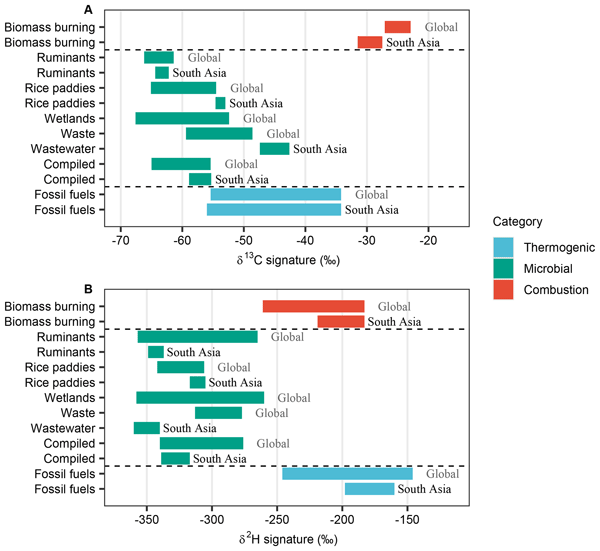
Abstract. Methane is a powerful greenhouse gas contributing significantly to global warming. South Asia is a major methane emission region, yet source-diagnostic isotopic signatures remain poorly constrained, limiting top-down source attribution. To address this gap, we conducted extensive sampling and isotopic analyses of major methane sources in South Asia. Our results reveal substantial deviations of South Asian methane source fingerprints from global means. Methane from C3 biomass burning is more depleted in δ13C (–30.9±2.2 ‰) but more enriched in δ2H (–201±18 ‰), while ruminant methane (C3) is strongly depleted in both δ13C (–68.7±0.5 ‰) and δ2H (–343±6 ‰). In contrast, rice paddy methane is more enriched in δ13C (–53.8±0.8 ‰) and δ2H (–311±6 ‰), with their ratios signaling pre-emission oxidation. Wastewater methane shows enriched δ13C (–45.0±2.4 ‰) and depleted δ2H (–350±10 ‰) relative to global means, with minimal oxidation or spatial variation. These pronounced regional differences highlight the importance of using regionally constrained source fingerprints in isotope-based source apportionment. A global synthesis further shows that δ13C signatures of biomass burning and ruminant methane are primarily controlled by C3/C4 feedstocks, whereas δ2H is relatively insensitive to substrate type. Methane from rice paddies and wetlands exhibits strong latitudinal gradients worldwide. Combining emission inventories with source-specific isotope fingerprints reveals a mismatch with atmospheric methane in South Asia, suggesting an overestimation of rice paddy emissions and/or an underestimation of other microbial sources. These findings demonstrate the utility of top-down dual-isotope constraints to refine regional methane budgets and mitigation strategies.
-
Notice on discussion status
The requested preprint has a corresponding peer-reviewed final revised paper. You are encouraged to refer to the final revised version.
-
Preprint
(2070 KB)
-
Supplement
(524 KB)
-
The requested preprint has a corresponding peer-reviewed final revised paper. You are encouraged to refer to the final revised version.
- Preprint
(2070 KB) - Metadata XML
-
Supplement
(524 KB) - BibTeX
- EndNote
- Final revised paper


Journal article(s) based on this preprint
Interactive discussion
Status: closed
-
RC1: 'Comment on egusphere-2026-411', Anonymous Referee #1, 16 Mar 2026
- AC1: 'Reply on RC1', Peng Yao, 19 Apr 2026
-
RC2: 'Comment on egusphere-2026-411', Anonymous Referee #2, 17 Mar 2026
Yao et a.: Distinct dual isotope signatures of major methane sources in South Asia.
GENERAL COMMENTS
This is a very welcome paper that provides important new isotopic source signature information which will greatly help those using isotopes to model the global methane budget. The paper should be published, but after some revision.
In global and regional budgets of atmospheric methane, source attribution is often a difficult task, as many areas have co-located emissions from different sources (e.g. coal mines, cattle herds, wetlands). To split the source inputs, isotopic discrimination is very powerful. But there are very few isotopic measurements from South Asia, even though this is a major methane-emitting region. Thus this paper is important – it presents a large number of new measurements in a region that is an important contributor to the global budget.
I have a number of queries. Many of these are small. Larger questions, however, do arise. They concern: 1. the use of Miller-Tans plots, and 2. the ricefield ‘signatures’: do they represent methane actually emitted into the air?
SPECIFIC POINTS
Line 31 “more depleted” and “more enriched” – compared to what? C4??
L52 maybe mention Ciais et al, 2026 Science 391: eadx8262, and Nisbet & Manning 2026. Science 391: 556-557
L57 – fastest-growing emitter? – can this be backed up with a reference? – African sources are also growing fast.
L59 biomass burning – perhaps cite a newer reference: note also that biomass burning includes crop fires and landfill fires as well as ‘quasi natural’ grass and forest fires/
L66 – combustion sources …ARE believed. Also maybe split natural microbial sources and agricultural microbial sources (see Nisbet et al. 2025. Phil Trans Royal Soc. 481(2309).
L70 maybe briefly mention ‘and geological sources’, though I suspect the Saunois et al budget over states them.
L84 – ‘nearly completely lacking. Indeed – the powerful reason this paper needs to be published. Incidentally for South East Asia see Woolley Maisch et al. Identification of Sources of Methane in Ho Chi Minh City, Vietnam. ACS ES&T Air (2025), and Brownlow et al Glob Biogeo Cycl 31 (2017): 1408-1419.
L97-111 – this methodology is impressive. See also parallel study by Woolley Maisch et al. Characterising methane emissions from dairy farm sources using mobile and dual-isotope measurements in Jersey, Channel Islands." Atmospheric Environment: X (2025): 100384.
L118. Ricefields. Here I have a major concern. The text describes careful and meticulous sampling of water in the paddy field. But the topic of the paper is the atmospheric source signature – in other words, the measurement target here is the isotopic ratio of the methane that is actually emitted into the air, NOT the methane that is present in the water body. Later on (line 375) the text explains that ~30-90% of methane is emitted by plant-mediated transport and thus may avoid the passage through oxygenated (i.e. methanotroph-rich) near surface water. In other words, methane that gets to the air via rice stalks is likely to be much lighter than the methane that escapes from the top of the water column, which is the residual methane after strong and isotopically selective oxidation.
L147 – equilibration – how long?
L149 – standards – specify the origin of the standards in Supp Info. Are they based on WMO X(ch4) from NOAA?
L194 – the Miller Tans approach needs background information. The choice of background for each specific plot needs to be carefully established. There are various approaches to the problem but the way background was established wasn’t obvious to me in the main text, nor in the supplemental information.
L209 and also L222 – a new paper, now in ACP discussions, may be of interest. Tapin, Emeline, et al. A global dataset of δ 13 C-CH 4 source signatures and associated uncertainties (1998–2022), with a sensitivity analysis to support isotopic inversions. Earth System Science Data Discussions 2026: 1-55
L237 – Miller Tans depends on background choice and that’s not discussed here. That’s an important judgement call and needs to be properly discussed in the text. Note – this is a major point and should be addressed properly before the paper is accepted.
L250 – in part the hydrogen comes from the biomass and in part from the water. As water varies strongly with meteorological source latitude, this needs to be dicussed. See for example: Liu, Jingfeng, et al. Variations in stable hydrogen and oxygen isotopes in atmospheric water vapor in the marine boundary layer across a wide latitude range. Journal of Environmental Sciences 26.11 (2014): 2266-2276.
Also: Zakharov, Vyacheslav I., et al. "Latitudinal distribution of the deuterium to hydrogen ratio in the atmospheric water vapor retrieved from IMG/ADEOS data." Geophysical Research Letters 31.12 (2004).
NOTE – Later comment – I have now seen L653-656. Maybe put some of that in the main text.
L257 – 90:10 ratio. I’m a bit surprised at this number – note L297 gives global 70:30. Is it seasonal? I don’t know India but I thought the autumn harvest Kharif season had C4 maize crop burning while the spring harvest Rabi was C3 wheat.
L279 – biomass burning – see comment above L257.
L300 note comment on L250 – d2H in water is latitude dependent.
L302-303 these two ‰ numbers are the same - easily in error of each other.
L312 – 32‰ number – that has a large uncertainty.
L315 – maybe cite the EDGAR7-based Figure 5 in Nisbet et al 2025 on agricultural emissions. Phil Trans Royal Soc. 481(2309).
L326 – mention also manure emissions. These are important when cattle are intensively farmed and the manure is held in anoxic conditions. Maybe that’s not a major factor in India where cattle roam extensively. Also mention wild ruminants, like small deer.
L342 – -45.3 ‰ value. Here is my other major point that needs to be cleared up before publication. For global budget studies the source signature that matters is the signature of the methane actually emitted into the air above the rice field, NOT the signature of the methane in the water. A lot of the methane that reaches the air comes from mud up the plant stems, and may escape the methanotrophy trap. The methane in the water is subject to methanotrophy, that selectively targets the 12C and hence the residual methane in water is enriched in 13C. Thus ambient water likely diffuses methane that is a bit heavier that the methane up the plant stems. Large bubbles quickly coming direct from the mud may contain lighter methane, but small bubbles are attacked my methanotrophs as they rise up. To get back to my main point, the methane source signature that matters for methane budget calculations is the methane that actually gets into the atmosphere above the rice paddy and is then carried away by the wind to join the regional and global burden. In other words, this needs to be sampled in the air, maybe at about 2m above the water and well above the plant stems.
L348 and 350, also L365, 368 - My impression (I may have misunderstood the supplementary database) is that the results here are from measurements in water, not air. Thus there needs to be a methanotrophy correction applied…..the bulk of what enters the air via plants is likely to be much lighter than -45%, which is ‰ value of the residual methane in the water. That’s much more enriched than I’d expect for the actual bulk ricefield input to ambient air.
I think this section needs a bit of rewriting…
The authors may wish to look at Table 2 in France et al. 2022. In particular, note the results from Yi O rice paddies in Hong Kong.
δ13C methane source signatures from tropical wetland and rice field emissions. Philosophical Transactions of the Royal Society A: Mathematical, Physical and Engineering Sciences 380, no. 2215.
See also Brownlow, R., et al. 2017. Isotopic ratios of tropical methane emissions by atmospheric measurement. Global Biogeochemical Cycles, 31(9), pp.1408-1419.
L416/421 – see discussion of waste and landfills in Nisbet, E. G., et al. Methane mitigation: methods to reduce emissions, on the path to the Paris agreement. Rev Geophys 58.1 (2020): e2019RG000675.
L435, L476, L 489 – remember the latitude impact on water for d2H.
L444, also 450-457. – Miller tans on rice – see earlier comments.
L461 – what does ‘per capita’ mean here? Averaged over the total human population of South Asia??? Or cattle heads? I’m lost! Explain the calculation.
L494 – “supposed”…”weaker” - did Nisbet et al 2023 really say this? I skimmed the text and didn’t find any such remark. But maybe I looked too quickly..
L528 note the isotopic fractionation is extremely locally specific. Over the Inter Tropical Convergence in the moist mid-troposphere at a few thousand metres in the air of the brightly lit tropics, methane’s lifetime is very short indeed and the fractionation huge. Over the North Pole in dark winter the lifetime is very long. So applying this bul global number of 6-7‰ is not valid for a snapshot data point over India. I think lines 522-534 need rewriting.
L542. ‘severalfold’ – what does this mean?? – there are big discepancies but in most categories not as big as many multiples.
L555 – ‘enriched’ – see earlier points: of course the methane in water is enriched relative to methane that actually reaches air – the methane in water is the left-behind.
L574 – cite Riddell-Young, Ben, et al. Microbial driver of 2006–2023 CH4 growth indicated by trends in atmospheric δD–CH4 and δ13C–CH4. Proceedings of the National Academy of Sciences 122.50 (2025): e2516543122.
L587 – caption needs more explanation, especially for Miller Tans.
CONCLUSION
This is a very valuable study, that should be published, but needs significant revision before publication.
Citation: https://doi.org/10.5194/egusphere-2026-411-RC2 - AC2: 'Reply on RC2', Peng Yao, 19 Apr 2026
Peer review completion


Interactive discussion
Status: closed
-
RC1: 'Comment on egusphere-2026-411', Anonymous Referee #1, 16 Mar 2026
This article provides very valuable data for understanding global methane emissions. The measurements concern both carbon 13 and deuterium isotopes in methane from several anthropogenic sources in South Asia. There were almost no data of this kind available in the literature before, therefore I recommend publishing this study. However, I think the methodology and interpretation needs to be severely revised first.
General comments:
-
You don’t mention background samples in the methods, though Miller-Tans was chosen over Keeling, without background-related justification. In the Keeling plots of the supplementary material, we see the lowest concentrated samples are always >2 ppm… even more in the case of ruminants; which means the hypothesis of the stability of background conditions, which is inherent to the Keeling plot approach1, isn’t fulfilled. Your data shows background samples taken at least for ruminants and biomass burning (labeled “blank”?), why aren’t they appearing on the Keeling plots?
-
I also notice the source signatures are derived from samples taken at different sites, with potentially specific environments. How different the isotopic signatures per source would be if there were average of individual signatures calculated per site?
-
not sure if this would help, but the link between δ2H of precipitations and into CH4 from biomass burning was studied before2. Your study only looks at the link with microbial CH4 .
Specific comments:
l. 57: "methane emitters" -> "methane emitting region"
l. 92: please rephrase to avoid too many pronouns.
l. 103-104 & 106: can you provide more details on the "clean air" you've used? What is the composition and/or manufacturer?
l. 123: Can you specify how deep the samples were taken (it is written “mid-depth”) ? I am concerned by how representative of CH4 emissions the dissolved CH4 is. Do you have any information on the isotopic effect (fractionation) of transport processes (through plant-mediated transport or oxidation in the water column)? If not, I would say the distance to the surface is an important parameter to take into account.
l. 167: "mesh size ##" ?
l. 190 to 196: The Miller-Tans and Keeling approaches are based on assumptions. I would appreciate a more detailed analysis of which assumptions are valid in your case, and resulting arguments for choosing one approach or another.
l. 236 to 240: Your assumptions here need to be supported by references, to provide more evidences and precisions. For example: "more sensitive" (to which parameter?); "wide range of conditions" (what type of conditions? explain with clear variables or parameters).
l. 240: "primarily" -> "only"
l. 246 and 250: the effect of C3/C4 types of vegetation on the CH4 isotopic composition is well known; please provide references to support what you observed.
l. 261: refer to Table 1, since the calculation to understand it are explained here.
l. 271: “In tropical regions, …” this sentence is true on the global scale, not specifically for tropical regions. Your C3 δ13C data is in agreement with global, within the uncertainties. It provides evidence of the type of plant being the main driver of CH4 isotopic composition variations, in the case of biomass burning.
l. 300-301: Variations in δ2H of CH4 is in a way influenced by diet, as it reflects the hydrogen isotopic signature in water. This sentence is strange because the causality isn’t very clear; what is it from the global mean value that suggests the δ2H of CH4 isn’t influenced by diet? By diet, if you only mean C3 or C4 plants, please clarify.
l. 302-311: You write the adjusted δ13C in methane (–63.3±1.1‰) compares well with the global value (–67.0±3.0‰), but C3-fed ruminant data for S Asia (-68.7±0.5‰) is written to be more depleted while being closer to the global value. It isn’t consistent.
l. 331: you state that ruminant δ2H in South Asia deviates from the global mean, but it doesn’t fall out of the range of uncertainty. Hydrogen isotopes can present large variations, with certainly more complex drivers linked to the H2O cycle. Your result are within these variation window.
l. 338: The linearity of the Keeling plot is recognized as being poor, but the causes aren’t discussed. Anyway, these plots can’t be interpreted because are not scientifically valid (see general comment on Keeling plots)
l. 350-351: This hypothesis explains more depleted values obtained with Miller-Tans, what are the reasons for other methods to give higher values from the same samples?
l. 384-387: Indeed, the sensitivity to this source is very high. Not only it is important to apply region-specific signatures, but also to reduce the uncertainties by doing more measurements ? (Which is what your study started to do!)
l. 395-396: Can you explain what you provide the values of the “concentration gradient”, and the reasons why it can be linked to minimal oxidation? Generally for the water sources, were all the samples taken at mid-depth, and what does this imply in term of oxidation?
l. 408: “dispersed and irregular patterns”, or wider range of values?
l. 422-429: there can be variation up to 10 ‰ in the waste methane δ13C, this is quite large. Also, we know wastewater CH4 is more enriched than from landfills, but you don’t have landfill data in your study. I think your wastewater results could be representative, as you claim on l. 224, but not for landfills. Please rephrase.
l. 451-453: Please explain in which way the “general oxidation level” is reflected here. These more enriched signatures show that some oxidation occurred, but if you write “level”, is it that you can quantify it?
l. 454: “these fractionation patterns”. Do you refer to oxidation or diffusion here? Perhaps using “process” rather than “pattern” is more suitable?
l. 471: “similar” to what?
l. 470-471: can you provide values or representation of this correlation? It isn’t very clear on the maps.
l. 472: “Hydrogen atoms in surface water likely served as a source for microbial methane, contributing to the observed spatial similarities in isotopic signatures.”. Please refer
l. 494: “resulting in fewer studies focusing on δ2H”. The lack of study on hydrogen isotopes isn’t because of one or “Some studies”, it’s mostly because of the technical challenges in the measurements. Also, other studies point at the additional constrains hydrogen gives.
l. 513: “Conversely, methane from rice paddies and wastewater displayed more enriched δ13C values than global means.”. For wastewater, please compare with the mean for wastewater as well.
l. 545: “and… and…”. Please rephrase.
l. 546: you mention seasonality. But does it affect all the sources, and why? Why not including this consideration in your analysis for the sources that are concerned?
l. 550: … if the underlying factors of variations are well-understood.
l. 570: remove “potential”
Figure 1: I think adding the countries boundary lines would improve the figure.
Figure 2:
-
"isotopic characteristics" isn't the right phrasing; rather use "isotopic source signatures" or "isotopic composition"
-
(D) and (E): I suggest to add a comparison with averages of this study.
Table 1: Please explain in the legend that you’ve used the global values for C4 to derive the mean for South Asia.
Figure 3, (D) and (E): I suggest to add a comparison with averages of this study.
Figure 6: can you indicate the region boundaries for the averages we see on the figure?
Figure S4: why 2 different color scales for the same variables? Also, the concentration units are in ppm on the x-axis, but should be L/nmol, considering the color scale and that there were water samples.
References:
1 Pataki, D. E., Ehleringer, J. R., Flanagan, L. B., Yakir, D., Bowling, D. R., Still, C. J., Buchmann, N., Kaplan, J. O., & Berry, J. A. (2003). The application and interpretation of Keeling plots in terrestrial carbon cycle research. Global Biogeochemical Cycles, 17(1), 1022. https://doi.org/10.1029/2001GB001850
2 Röckmann, T., Gómez Álvarez, C. X., Walter, S., van der Veen, C., Wollny, A. G., Gunthe, S. S., Helas, G., Pöschl, U., Keppler, F., Greule, M., & Brand, W. A. (2010). Isotopic composition of H2 from wood burning: Dependency on combustion efficiency, moisture content, and δD of local precipitation. Journal of Geophysical Research, 115(D17), D17308. https://doi.org/10.1029/2009JD013188
Citation: https://doi.org/10.5194/egusphere-2026-411-RC1 - AC1: 'Reply on RC1', Peng Yao, 19 Apr 2026
-
-
RC2: 'Comment on egusphere-2026-411', Anonymous Referee #2, 17 Mar 2026
Yao et a.: Distinct dual isotope signatures of major methane sources in South Asia.
GENERAL COMMENTS
This is a very welcome paper that provides important new isotopic source signature information which will greatly help those using isotopes to model the global methane budget. The paper should be published, but after some revision.
In global and regional budgets of atmospheric methane, source attribution is often a difficult task, as many areas have co-located emissions from different sources (e.g. coal mines, cattle herds, wetlands). To split the source inputs, isotopic discrimination is very powerful. But there are very few isotopic measurements from South Asia, even though this is a major methane-emitting region. Thus this paper is important – it presents a large number of new measurements in a region that is an important contributor to the global budget.
I have a number of queries. Many of these are small. Larger questions, however, do arise. They concern: 1. the use of Miller-Tans plots, and 2. the ricefield ‘signatures’: do they represent methane actually emitted into the air?
SPECIFIC POINTS
Line 31 “more depleted” and “more enriched” – compared to what? C4??
L52 maybe mention Ciais et al, 2026 Science 391: eadx8262, and Nisbet & Manning 2026. Science 391: 556-557
L57 – fastest-growing emitter? – can this be backed up with a reference? – African sources are also growing fast.
L59 biomass burning – perhaps cite a newer reference: note also that biomass burning includes crop fires and landfill fires as well as ‘quasi natural’ grass and forest fires/
L66 – combustion sources …ARE believed. Also maybe split natural microbial sources and agricultural microbial sources (see Nisbet et al. 2025. Phil Trans Royal Soc. 481(2309).
L70 maybe briefly mention ‘and geological sources’, though I suspect the Saunois et al budget over states them.
L84 – ‘nearly completely lacking. Indeed – the powerful reason this paper needs to be published. Incidentally for South East Asia see Woolley Maisch et al. Identification of Sources of Methane in Ho Chi Minh City, Vietnam. ACS ES&T Air (2025), and Brownlow et al Glob Biogeo Cycl 31 (2017): 1408-1419.
L97-111 – this methodology is impressive. See also parallel study by Woolley Maisch et al. Characterising methane emissions from dairy farm sources using mobile and dual-isotope measurements in Jersey, Channel Islands." Atmospheric Environment: X (2025): 100384.
L118. Ricefields. Here I have a major concern. The text describes careful and meticulous sampling of water in the paddy field. But the topic of the paper is the atmospheric source signature – in other words, the measurement target here is the isotopic ratio of the methane that is actually emitted into the air, NOT the methane that is present in the water body. Later on (line 375) the text explains that ~30-90% of methane is emitted by plant-mediated transport and thus may avoid the passage through oxygenated (i.e. methanotroph-rich) near surface water. In other words, methane that gets to the air via rice stalks is likely to be much lighter than the methane that escapes from the top of the water column, which is the residual methane after strong and isotopically selective oxidation.
L147 – equilibration – how long?
L149 – standards – specify the origin of the standards in Supp Info. Are they based on WMO X(ch4) from NOAA?
L194 – the Miller Tans approach needs background information. The choice of background for each specific plot needs to be carefully established. There are various approaches to the problem but the way background was established wasn’t obvious to me in the main text, nor in the supplemental information.
L209 and also L222 – a new paper, now in ACP discussions, may be of interest. Tapin, Emeline, et al. A global dataset of δ 13 C-CH 4 source signatures and associated uncertainties (1998–2022), with a sensitivity analysis to support isotopic inversions. Earth System Science Data Discussions 2026: 1-55
L237 – Miller Tans depends on background choice and that’s not discussed here. That’s an important judgement call and needs to be properly discussed in the text. Note – this is a major point and should be addressed properly before the paper is accepted.
L250 – in part the hydrogen comes from the biomass and in part from the water. As water varies strongly with meteorological source latitude, this needs to be dicussed. See for example: Liu, Jingfeng, et al. Variations in stable hydrogen and oxygen isotopes in atmospheric water vapor in the marine boundary layer across a wide latitude range. Journal of Environmental Sciences 26.11 (2014): 2266-2276.
Also: Zakharov, Vyacheslav I., et al. "Latitudinal distribution of the deuterium to hydrogen ratio in the atmospheric water vapor retrieved from IMG/ADEOS data." Geophysical Research Letters 31.12 (2004).
NOTE – Later comment – I have now seen L653-656. Maybe put some of that in the main text.
L257 – 90:10 ratio. I’m a bit surprised at this number – note L297 gives global 70:30. Is it seasonal? I don’t know India but I thought the autumn harvest Kharif season had C4 maize crop burning while the spring harvest Rabi was C3 wheat.
L279 – biomass burning – see comment above L257.
L300 note comment on L250 – d2H in water is latitude dependent.
L302-303 these two ‰ numbers are the same - easily in error of each other.
L312 – 32‰ number – that has a large uncertainty.
L315 – maybe cite the EDGAR7-based Figure 5 in Nisbet et al 2025 on agricultural emissions. Phil Trans Royal Soc. 481(2309).
L326 – mention also manure emissions. These are important when cattle are intensively farmed and the manure is held in anoxic conditions. Maybe that’s not a major factor in India where cattle roam extensively. Also mention wild ruminants, like small deer.
L342 – -45.3 ‰ value. Here is my other major point that needs to be cleared up before publication. For global budget studies the source signature that matters is the signature of the methane actually emitted into the air above the rice field, NOT the signature of the methane in the water. A lot of the methane that reaches the air comes from mud up the plant stems, and may escape the methanotrophy trap. The methane in the water is subject to methanotrophy, that selectively targets the 12C and hence the residual methane in water is enriched in 13C. Thus ambient water likely diffuses methane that is a bit heavier that the methane up the plant stems. Large bubbles quickly coming direct from the mud may contain lighter methane, but small bubbles are attacked my methanotrophs as they rise up. To get back to my main point, the methane source signature that matters for methane budget calculations is the methane that actually gets into the atmosphere above the rice paddy and is then carried away by the wind to join the regional and global burden. In other words, this needs to be sampled in the air, maybe at about 2m above the water and well above the plant stems.
L348 and 350, also L365, 368 - My impression (I may have misunderstood the supplementary database) is that the results here are from measurements in water, not air. Thus there needs to be a methanotrophy correction applied…..the bulk of what enters the air via plants is likely to be much lighter than -45%, which is ‰ value of the residual methane in the water. That’s much more enriched than I’d expect for the actual bulk ricefield input to ambient air.
I think this section needs a bit of rewriting…
The authors may wish to look at Table 2 in France et al. 2022. In particular, note the results from Yi O rice paddies in Hong Kong.
δ13C methane source signatures from tropical wetland and rice field emissions. Philosophical Transactions of the Royal Society A: Mathematical, Physical and Engineering Sciences 380, no. 2215.
See also Brownlow, R., et al. 2017. Isotopic ratios of tropical methane emissions by atmospheric measurement. Global Biogeochemical Cycles, 31(9), pp.1408-1419.
L416/421 – see discussion of waste and landfills in Nisbet, E. G., et al. Methane mitigation: methods to reduce emissions, on the path to the Paris agreement. Rev Geophys 58.1 (2020): e2019RG000675.
L435, L476, L 489 – remember the latitude impact on water for d2H.
L444, also 450-457. – Miller tans on rice – see earlier comments.
L461 – what does ‘per capita’ mean here? Averaged over the total human population of South Asia??? Or cattle heads? I’m lost! Explain the calculation.
L494 – “supposed”…”weaker” - did Nisbet et al 2023 really say this? I skimmed the text and didn’t find any such remark. But maybe I looked too quickly..
L528 note the isotopic fractionation is extremely locally specific. Over the Inter Tropical Convergence in the moist mid-troposphere at a few thousand metres in the air of the brightly lit tropics, methane’s lifetime is very short indeed and the fractionation huge. Over the North Pole in dark winter the lifetime is very long. So applying this bul global number of 6-7‰ is not valid for a snapshot data point over India. I think lines 522-534 need rewriting.
L542. ‘severalfold’ – what does this mean?? – there are big discepancies but in most categories not as big as many multiples.
L555 – ‘enriched’ – see earlier points: of course the methane in water is enriched relative to methane that actually reaches air – the methane in water is the left-behind.
L574 – cite Riddell-Young, Ben, et al. Microbial driver of 2006–2023 CH4 growth indicated by trends in atmospheric δD–CH4 and δ13C–CH4. Proceedings of the National Academy of Sciences 122.50 (2025): e2516543122.
L587 – caption needs more explanation, especially for Miller Tans.
CONCLUSION
This is a very valuable study, that should be published, but needs significant revision before publication.
Citation: https://doi.org/10.5194/egusphere-2026-411-RC2 - AC2: 'Reply on RC2', Peng Yao, 19 Apr 2026
Peer review completion
Journal article(s) based on this preprint
Viewed
| HTML | XML | Total | Supplement | BibTeX | EndNote | |
|---|---|---|---|---|---|---|
| 1,346 | 670 | 107 | 2,123 | 164 | 95 | 155 |
- HTML: 1,346
- PDF: 670
- XML: 107
- Total: 2,123
- Supplement: 164
- BibTeX: 95
- EndNote: 155
Viewed (geographical distribution)
| Country | # | Views | % |
|---|
| Total: | 0 |
| HTML: | 0 |
| PDF: | 0 |
| XML: | 0 |
- 1
Katja Belec
Henry Holmstrand
Josh Balacky
Abdus Salam
Krishnakant Budhavant
Mohanan Remani Manoj
Khaled Shaifullah Joy
Md. Alamin Hossain
Atinderpal Singh
Anil Patel
Neeraj Rastogi
Chinmay Mallik
Kirpa Ram
Gyanesh Kumar Singh
Örjan Gustafsson

The requested preprint has a corresponding peer-reviewed final revised paper. You are encouraged to refer to the final revised version.
- Preprint
(2070 KB) - Metadata XML
-
Supplement
(524 KB) - BibTeX
- EndNote
- Final revised paper
This article provides very valuable data for understanding global methane emissions. The measurements concern both carbon 13 and deuterium isotopes in methane from several anthropogenic sources in South Asia. There were almost no data of this kind available in the literature before, therefore I recommend publishing this study. However, I think the methodology and interpretation needs to be severely revised first.
General comments:
You don’t mention background samples in the methods, though Miller-Tans was chosen over Keeling, without background-related justification. In the Keeling plots of the supplementary material, we see the lowest concentrated samples are always >2 ppm… even more in the case of ruminants; which means the hypothesis of the stability of background conditions, which is inherent to the Keeling plot approach1, isn’t fulfilled. Your data shows background samples taken at least for ruminants and biomass burning (labeled “blank”?), why aren’t they appearing on the Keeling plots?
I also notice the source signatures are derived from samples taken at different sites, with potentially specific environments. How different the isotopic signatures per source would be if there were average of individual signatures calculated per site?
not sure if this would help, but the link between δ2H of precipitations and into CH4 from biomass burning was studied before2. Your study only looks at the link with microbial CH4 .
Specific comments:
l. 57: "methane emitters" -> "methane emitting region"
l. 92: please rephrase to avoid too many pronouns.
l. 103-104 & 106: can you provide more details on the "clean air" you've used? What is the composition and/or manufacturer?
l. 123: Can you specify how deep the samples were taken (it is written “mid-depth”) ? I am concerned by how representative of CH4 emissions the dissolved CH4 is. Do you have any information on the isotopic effect (fractionation) of transport processes (through plant-mediated transport or oxidation in the water column)? If not, I would say the distance to the surface is an important parameter to take into account.
l. 167: "mesh size ##" ?
l. 190 to 196: The Miller-Tans and Keeling approaches are based on assumptions. I would appreciate a more detailed analysis of which assumptions are valid in your case, and resulting arguments for choosing one approach or another.
l. 236 to 240: Your assumptions here need to be supported by references, to provide more evidences and precisions. For example: "more sensitive" (to which parameter?); "wide range of conditions" (what type of conditions? explain with clear variables or parameters).
l. 240: "primarily" -> "only"
l. 246 and 250: the effect of C3/C4 types of vegetation on the CH4 isotopic composition is well known; please provide references to support what you observed.
l. 261: refer to Table 1, since the calculation to understand it are explained here.
l. 271: “In tropical regions, …” this sentence is true on the global scale, not specifically for tropical regions. Your C3 δ13C data is in agreement with global, within the uncertainties. It provides evidence of the type of plant being the main driver of CH4 isotopic composition variations, in the case of biomass burning.
l. 300-301: Variations in δ2H of CH4 is in a way influenced by diet, as it reflects the hydrogen isotopic signature in water. This sentence is strange because the causality isn’t very clear; what is it from the global mean value that suggests the δ2H of CH4 isn’t influenced by diet? By diet, if you only mean C3 or C4 plants, please clarify.
l. 302-311: You write the adjusted δ13C in methane (–63.3±1.1‰) compares well with the global value (–67.0±3.0‰), but C3-fed ruminant data for S Asia (-68.7±0.5‰) is written to be more depleted while being closer to the global value. It isn’t consistent.
l. 331: you state that ruminant δ2H in South Asia deviates from the global mean, but it doesn’t fall out of the range of uncertainty. Hydrogen isotopes can present large variations, with certainly more complex drivers linked to the H2O cycle. Your result are within these variation window.
l. 338: The linearity of the Keeling plot is recognized as being poor, but the causes aren’t discussed. Anyway, these plots can’t be interpreted because are not scientifically valid (see general comment on Keeling plots)
l. 350-351: This hypothesis explains more depleted values obtained with Miller-Tans, what are the reasons for other methods to give higher values from the same samples?
l. 384-387: Indeed, the sensitivity to this source is very high. Not only it is important to apply region-specific signatures, but also to reduce the uncertainties by doing more measurements ? (Which is what your study started to do!)
l. 395-396: Can you explain what you provide the values of the “concentration gradient”, and the reasons why it can be linked to minimal oxidation? Generally for the water sources, were all the samples taken at mid-depth, and what does this imply in term of oxidation?
l. 408: “dispersed and irregular patterns”, or wider range of values?
l. 422-429: there can be variation up to 10 ‰ in the waste methane δ13C, this is quite large. Also, we know wastewater CH4 is more enriched than from landfills, but you don’t have landfill data in your study. I think your wastewater results could be representative, as you claim on l. 224, but not for landfills. Please rephrase.
l. 451-453: Please explain in which way the “general oxidation level” is reflected here. These more enriched signatures show that some oxidation occurred, but if you write “level”, is it that you can quantify it?
l. 454: “these fractionation patterns”. Do you refer to oxidation or diffusion here? Perhaps using “process” rather than “pattern” is more suitable?
l. 471: “similar” to what?
l. 470-471: can you provide values or representation of this correlation? It isn’t very clear on the maps.
l. 472: “Hydrogen atoms in surface water likely served as a source for microbial methane, contributing to the observed spatial similarities in isotopic signatures.”. Please refer
l. 494: “resulting in fewer studies focusing on δ2H”. The lack of study on hydrogen isotopes isn’t because of one or “Some studies”, it’s mostly because of the technical challenges in the measurements. Also, other studies point at the additional constrains hydrogen gives.
l. 513: “Conversely, methane from rice paddies and wastewater displayed more enriched δ13C values than global means.”. For wastewater, please compare with the mean for wastewater as well.
l. 545: “and… and…”. Please rephrase.
l. 546: you mention seasonality. But does it affect all the sources, and why? Why not including this consideration in your analysis for the sources that are concerned?
l. 550: … if the underlying factors of variations are well-understood.
l. 570: remove “potential”
Figure 1: I think adding the countries boundary lines would improve the figure.
Figure 2:
"isotopic characteristics" isn't the right phrasing; rather use "isotopic source signatures" or "isotopic composition"
(D) and (E): I suggest to add a comparison with averages of this study.
Table 1: Please explain in the legend that you’ve used the global values for C4 to derive the mean for South Asia.
Figure 3, (D) and (E): I suggest to add a comparison with averages of this study.
Figure 6: can you indicate the region boundaries for the averages we see on the figure?
Figure S4: why 2 different color scales for the same variables? Also, the concentration units are in ppm on the x-axis, but should be L/nmol, considering the color scale and that there were water samples.
References:
1 Pataki, D. E., Ehleringer, J. R., Flanagan, L. B., Yakir, D., Bowling, D. R., Still, C. J., Buchmann, N., Kaplan, J. O., & Berry, J. A. (2003). The application and interpretation of Keeling plots in terrestrial carbon cycle research. Global Biogeochemical Cycles, 17(1), 1022. https://doi.org/10.1029/2001GB001850
2 Röckmann, T., Gómez Álvarez, C. X., Walter, S., van der Veen, C., Wollny, A. G., Gunthe, S. S., Helas, G., Pöschl, U., Keppler, F., Greule, M., & Brand, W. A. (2010). Isotopic composition of H2 from wood burning: Dependency on combustion efficiency, moisture content, and δD of local precipitation. Journal of Geophysical Research, 115(D17), D17308. https://doi.org/10.1029/2009JD013188